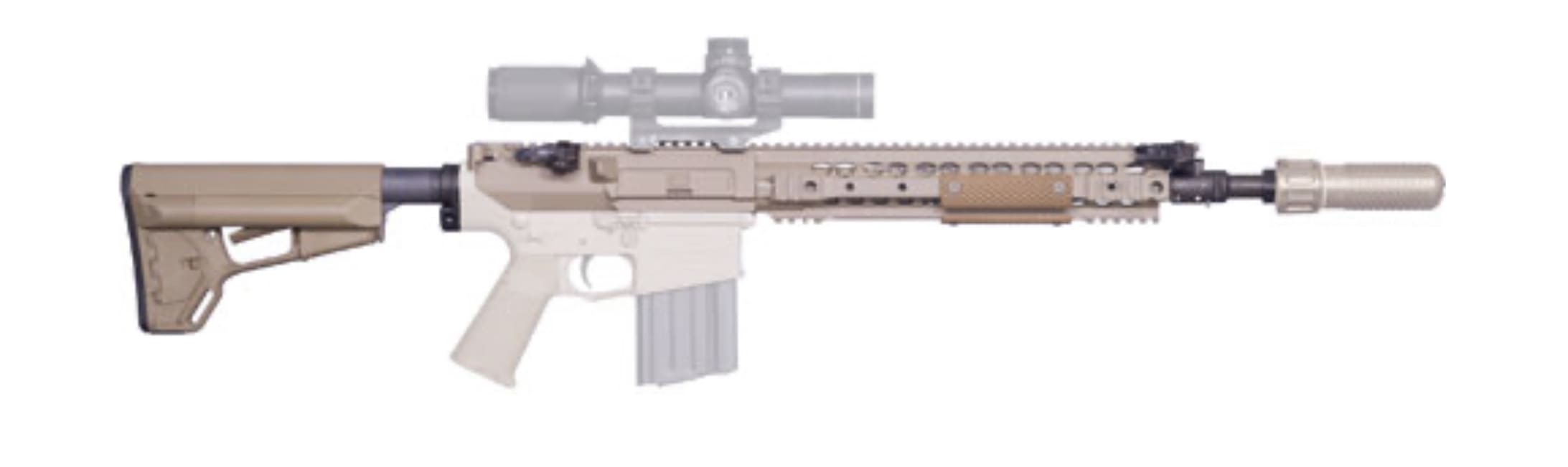
Although SOCOM started fielding the M4A1 Carbine In 1994, 3rd SFG(A) went to Haiti with the M16A2 and didn’t receive ours until we returned to Ft Bragg in the spring of 95.
WASHINGTON, D.C. — To earn any coveted badge in the U.S. Army, be it the Expert Infantryman’s Badge (EIB) or Expert Field Medic Badge (EFMB), is to be among America’s most proficient Soldiers.
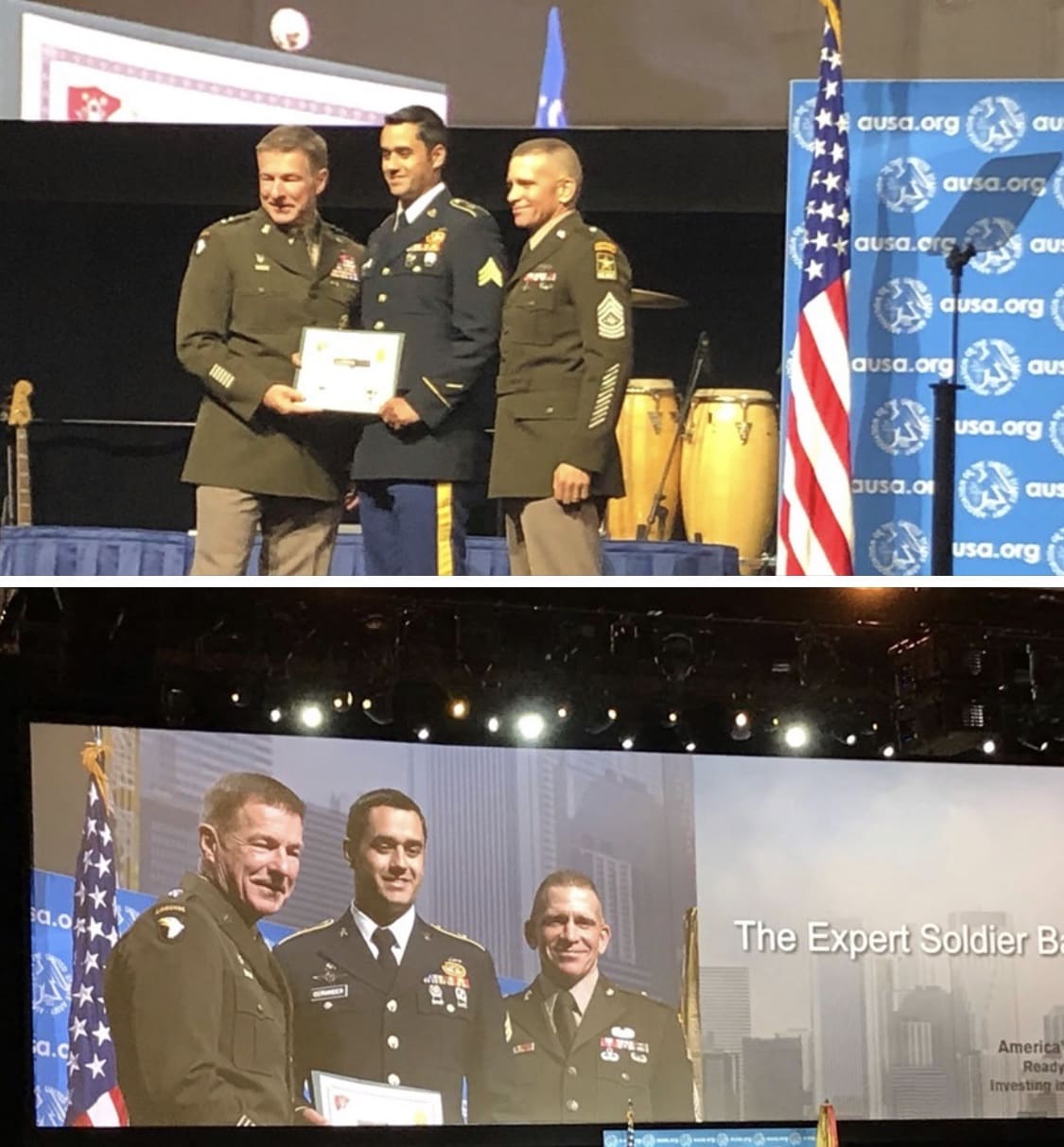
Sgt. Michael Ostrander, a small arms and towed artillery repairer assigned to 1st Special Forces Group, Joint Base Lewis-McChord, and native of Casnovia, Michigan, is one of the first Soldiers in the Army to earn the new Expert Soldier Badge (ESB).
“To hear that the ESB was actually going to be a thing, I was surprised,” Ostrander said. “Knowing I was one of the first Soldiers to earn it, I was excited to be a part of a great thing and honored to bring this great organization the credit it deserves,” he added.
Ostrander is one of the first 11 Soldiers to be awarded the ESB during the Association of the United States Army (AUSA) annual meeting, October 15, 2019, at the Walter E. Washington Convention Center in Washington, D.C.
The standards set to earn the Army’s new Expert Soldier Badge (ESB) are as challenging as the requirements to earn an EIB or EFMB.
Command Sgt. Maj. Edward W. Mitchell, senior enlisted leader at the Center for Initial Military Training, says like the EIB and EFMB, testing for the ESB consists of an Army Combat Fitness Test (ACFT), day and night land navigation, weapons, medical and more than 30 other individual tasks.
“We wanted every Soldier to make sure they understand that they are experts in their field,” Mitchell said. “Achieving the new badge … requires a much higher standard, just like its cousins, which are the EIB and the EFMB” Mitchell added.
Prior to the start of testing, participants underwent a week of intense training to prepare for the challenges they would face during the ESB qualification.
“There was a week of training before the week testing and it was pretty intense and there was also a big book of study material to go along with it,” Ostrander noted. “I learned a lot of medical stuff that I didn’t know before,” he added.
As with any competition, participants have one or more favorite parts.
“My favorite part of this was learning and solidifying the basic Soldier skills that I have forgotten or just never learned,” Ostrander said. “I learned that I’m a lot more capable than I thought.”
Since the ESB can be earned by any Soldier outside of the infantry, medical and special operations career fields, Ostrander suggests that Soldiers “brush up on things they’re rusty on” to be successful during testing.
-USASOC-
By SGT Larry Barnhill, USASOC Public Affairs


Although it has been reengineered many times over the past 60 years, the Army’s Special Forces Qualification Course, four components have remained constant. Some form of selection, whether pre-phase, SFOT or SFAS along with individual tactical skills, MOS specific training and collective team training culminating in an FTX, commonly referred to as “Robin Sage”. This is the current version of the Q Course.


Carbondale, PA, October 11, 2019. Gentex Corporation, a global leader in personal protection and situational awareness solutions for defense forces, emergency responders, and industrial personnel announced today that its new Ops-Core® FAST SF Carbon Composite Helmet System has been chosen by the U.S. Special Operations Command (USSOCOM) to fulfill their contract for Special Operations Forces Personal Equipment Advanced Requirements (SPEAR) Family of Tactical Headborne Systems (FTHS) — Coxswain Helmet System. The five-year Indefinite Delivery Indefinite Quantity (IDIQ) Firm Fixed Price (FFP) production contract carries a maximum value of $95M.
Gentex Corporation has been supplying products to USSOCOM since its activation in 1987 and is focused on designing and delivering solutions driven by end user input. Just recently, the company was awarded contracts for the USSOCOM SPEAR FTHS Ballistic and Non-Ballistic Helmets, as well as the USSOCOM Communication Accessory Suite Land (CASL) program for it’s Ops-Core Adaptive Mission Platform (AMP™) Communication Headset.
“We’re extremely pleased to have been chosen to provide the Coxswain Helmet System for USSOCOM,” said Tom Short, vice president of Ground Systems, Gentex Corporation. “The FTHS Coxswain contract validates our design process and helmet system innovations while bringing the FTHS Ballistic/Non-Ballistic and FTHS Coxswain Helmets together as one family of headborne systems with interchangeable accessories, common parts and simplified logistics.”
The FTHS Coxswain Helmet System consists of the Ops-Core FAST FTHS Carbon Composite Helmet with modular Ops-Core accessories: Step-In Visors with clear and tinted lenses, NVG Snap Shields, FAST Ballistic and Carbon Composite Mandibles, and FAST Low Profile Ballistic Appliques. Additionally, the helmets will come with a variety of Ops-Core VAS shroud options, helmet covers, ARCTM rails, pads, exterior Velcro and will be available in four sizes with various color/camouflage options. The Ops-Core FAST FTHS Carbon Composite Helmet is available today and commercial versions of the Coxswain Helmet System accessories will be available later this year.


Part of Gentex Corporation’s portfolio of helmet systems for defense, emergency response, and security forces, the focus and dedication of the company’s Ops-Core brand remains the same – protecting elite forces. The modular, scalable, open-architecture design of Ops-Core products allows for the seamless integration and true system level performance.
shop.gentexcorp.com/ops-core-fast-sf-carbon-composite-helmet
Below, a 7th Special Forces Group (Airborne) NCO rides horseback while leading a mule through Humboldt Toiyabe National Forest during the SOF Horsemanship Course at Marine Corps Mountain Warfare Training Center.

The purpose of the horsemanship course is to teach SOF personnel the necessary skills to enable them to ride horses, load pack animals, and maintain animals for military applications in remote and dangerous environments.

Photos by USMC LCpl William Chockey
The newest of United Special Operations Command’s components, Marine Corps Special Operations Command was founded in 2006, following an experiment with MCSOCOM Detachment-One.

Despite not having a long history in SOF, they also weren’t burdened with an organizational structure created during the Cold War. Instead, they leveraged capabilities found within the Corps and stood up a command with multiple disciplines including traditional Special Operators, Terminal Attack Controllers, Intelligence specialists, EOD and K9. Just like with standard Marine Corps units, medical support is provided by selected and trained Navy Corpsmen. Furthermore, MARSOC developed specialized training for all of their personnel l including logistics and communications. They have done a fantastic job at operationalize all of these capabilities.
If I were in one of the other components, I’d read this. They are coming for your missions.
MARSOC continues to evolve. This document shows us what they bring to the fight. Download it here.
Special Operations teams benefit from Indago 3 unmanned quadcopter on Wave Relay® MANET
NEW YORK, N.Y. – October 01, 2019 – Persistent Systems, LLC (“Persistent”) announced today that Lockheed Martin (NYSE: LMT) Procerus Technologies (LMPT) joined the Wave Relay® Ecosystem, an industry alliance of unmanned platform and sensor manufacturers using Persistent’s Wave Relay® mobile ad hoc network (MANET).


LMPT will now offer special operators a version of the Indago 3 unmanned aerial system (UAS) that runs on Persistent’s Wave Relay® MANET, including the MPU5 radio.
“This is a big win for users in the Special Operations community,” said Shane Flint, Vice President of Business Development for Persistent. “The users understand that, to truly network the battlefield, you need a robust, scalable solution that allows for unmanned systems and sensors to operate on a common network, empowering the whole team, and reducing weight on the operator. LMPT’s integration of Wave RelayÒ makes this possible.”
In a MANET, each radio — whether on the ground or in the air—acts as both a receiver and a relay station. So, in true peer-to-peer fashion, users can share voice, video, text, sensor and location data without having to depend upon fixed communications infrastructure or a vulnerable central hub.
“The Indago 3 not only provides full motion video to the SOF team, but also extends the MANET through its advantaged airborne position over the team,” Flint added.
Persistent’s MPU5 radio connects to the Indago 3 controller, while the lightweight Embedded Module is integrated inside the UAS. The system is available with either an S-Band or L-Band RF module depending on the needs of the user.
The quiet, all-weather Indago 3 UAS weighs less than five pounds and can be folded for compact transport and unfolded for rapid deployment, getting airborne in just two and a half minutes. It can also stay in the air for up to 40 minutes while carrying a 250-gram payload.
The equally tough Wireless Hand Controller comes loaded with a Virtual Cockpit™ user-friendly mapping interface and powerful mission-planning tools.
The Wave Relay® enabled Indago 3 is available now. For more information visit: www.persistentsystems.com/ecosystem-overview