Phantom Lights

Archive for the ‘SOF’ Category

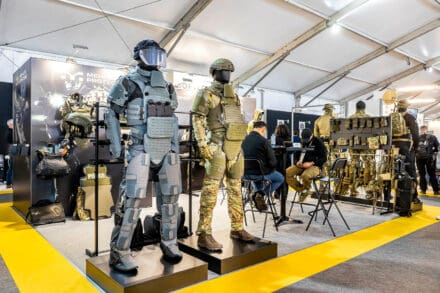
Mehler Systems Presents Full-Spectrum Tactical Solutions at SOFINS 2025

Wednesday, April 16th, 2025

FULDA, GERMANY (10.04.2025)

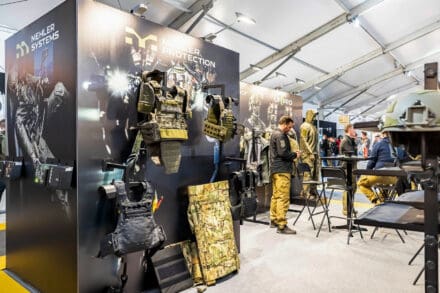
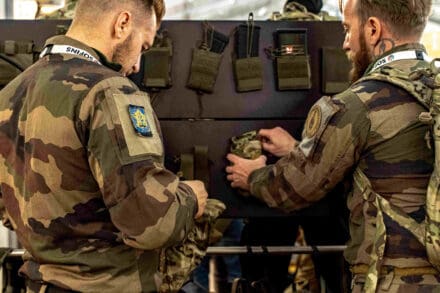
Mehler Systems, together with its brands MehlerProtection, UF PRO, and Lindnerhof, successfully participated in SOFINS 2025—the premier European exhibition for Special Operations Forces. Held from April 1 to 3 at the military base in Martignas-sur-Jalle, France, the event brought together elite tactical units, defense industry leaders, and cutting-edge solution providers to engage in dialogue and present the next generation of mission-ready equipment.

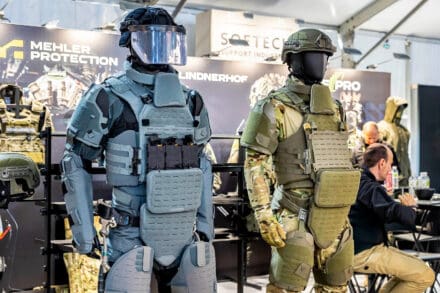
Throughout the exhibition, Mehler Systems showcased an integrated portfolio designed to meet the complex requirements of modern mission profiles. Mehler Protection presented a range of ballistic protection systems developed for high-threat environments. Among them was the ExoM Up-Armoured Exoskeleton, offering full-body protection up to VPAM 8 while maintaining operator mobility. The M.U.S.T. System demonstrated the flexibility of modular body armour platforms, and the Omega Helmet Line delivered lightweight head protection. The brand also displayed a comprehensive array of ballistic panels, vests, and plate carriers tailored for the specific needs of special operations forces.

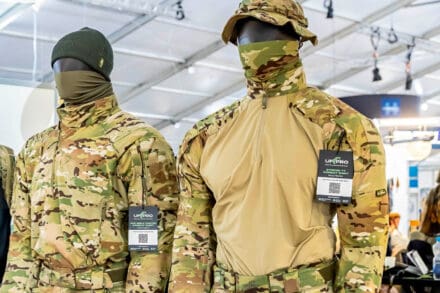
UF PRO introduced a selection of tactical garments engineered for performance across diverse climates and terrains. The Striker TT Combat Shirt and Pants offered breathable, durable solutions for hot and humid conditions, while the Monsoon XT Gen.2 Jacket and Pants provided dependable weather resistance in harsh, wet environments. For cold-weather operations, the AcEGen.2 Winter Combat Shirt delivered a balance of insulation and moisture regulation. The Striker X Gen.2 Combat Pants, designed for rugged terrain, completed the lineup with enhanced durability and mobility.

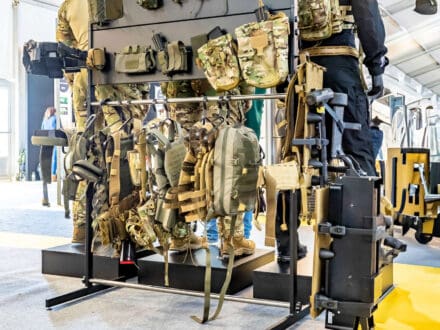
Lindnerhof featured its latest innovations in modular load-carrying systems and tactical gear. Visitors explored plate carriers, chest rigs, pouches, and belts—each developed for high adaptability, streamlined usability, and lightweight construction. A highlight of the exhibit was The Beast, Lindnerhof’s heavy load-carrying system built to manage extreme weight while maintaining comfort and stability during prolonged missions.

SOFINS 2025 once again proved to be a key engagement opportunity for Mehler Systems to connect directly with international defense professionals and reinforce its role as a trusted provider of integrated protective and tactical systems. The event underscored the group’s continued commitment to supporting those who serve with mission-focused solutions built on performance, protection, and operational reliability.

For more information about upcoming events, visit: mehler-systems.com/events

Did AFSOC Field A New Helmet? Well, Sort Of….

Saturday, April 12th, 2025

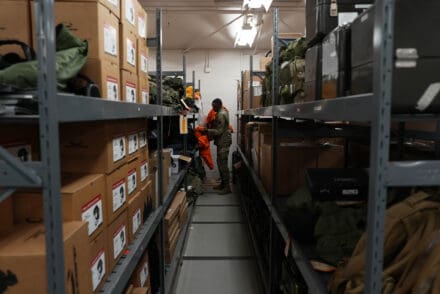
A buddy recently sent me this photo and asked me about this new helmet being worn by AFSOC, inquiring what it was.

I hadn’t seen it before and was intrigued. I put out some feelers and then I tracked the photo down to the Air Force Special Operations Command website, showcasing the Special Operations Forces Medical Skills Development program last October at Hurlburt Field, Florida. There was a whole photo story with these helmets peppered throughout.

It didn’t look like any helmet I had ever seen. Here I am thinking it might be some Air Force Research Lab project, but the truth, it would turn out, reminds me of that old Eddie Murphy comedy sketch, “We’ve got McDonald’s at home.*”

After further investigation, I found that this airsoft helmet (yes, I said airsoft) costs around $150 and goes by several names online, but seems to be manufactured by Avengers Airsoft. Avengers calls it the “Ark” Helmet w/ Integrated Cooling System & Headset. Granted, once you look at more of the photos you realize that they are training with paintball guns and that’s likely why they were purchased. They sort of look like issue helmets and are meant for airsoft. Even the website claims that the helmet is “Designed for Foam Blaster, Nerf, Gel Blaster, Battle Blaster, and low power Airsoft Gaming. ANSI rated full face mask recommended for close quarter / high power Airsoft Gaming.”

However, not only is this helmet not safety certified or approved for use as a ballistic, or even bump helmet, it’s also not Berry compliant. Sure, you can hide behind the micro-purchase exemption for Berry but I’d only use that defense if it were some uber cool European ballistic helmet like the NFM Hjelm, not some ABS bucket. What’s more, they aren’t using the face mask, despite using paintball guns, which kind of defeats the purpose of buying these helmets.

I’m not going to cast aspersions on the person who actually bought these things. I am sure they were well intended and bought what they were told to buy. They look sort of like an approved high cut helmet, but not much. Manufacturers Galvion, Gentex, and Team Wendy all make both ballistic and bump helmet models which are approved for wear and have been procured by the Air Force, and they can be used for sim training and have the appropriate mandibles.

Hopefully, AFSOC will procure some proper helmets for these Airmen soon which are actually certified for sim training. These toys should be crushed and put in the dumpster.

As for the rest of you, this is a cautionary tale. If you’re tasking a GPC holder to buy something for you, be very specific about what you want, even down to manufacturer and model preferences. Include specifications in order to further avoid confusion. If you don’t know, I suggest you have your GPC holder, or supply, get ahold of one of the Special Operations TLS vendors like Darley or Noble. There are several contract holders and they have in-house experts who can go over options. You can also do some research each here on SSD.

AFSOC Photos by Airman 1st Class Raul Mercado.

*Language warning, it’s Eddie after all…

USSOCOM: Changing Operational Demands Require Acquisition Changes

Friday, April 11th, 2025

Worldwide threats put the U.S. at risk and sometimes demand attention from U.S. Special Operations Command. To best meet those challenges, U.S. military acquisition needs to change, said Army Gen. Bryan P. Fenton, Socom commander.

“The character of war is changing faster than we’ve ever seen,” he said today before the House Armed Services Committee’s intelligence and special operations subcommittee.

“The innovation cycle now turns in days and weeks, not months and years. Our adversaries use $10,000 one-way drones that we shoot down with $2 million missiles — that cost-benefit curve is upside down,” he said.

Fenton noted that this is the most complex asymmetric and hybrid threat security environment he has seen during his 38 years of service. Contending with these challenges demands more from special operations forces.

“[It] requires tough choices, forcing trade-offs, as we strive to balance an increase in operations readiness and the need for modernization,” he said.

Fenton explained that over the past two years, for example, demand for SOCOM capabilities by combatant commands has increased by more than 35%, while at the same time, SOCOM has dealt with years of flat budgets.

To meet the demands of increased mission requirements and increasingly complex missions, he said SOCOM needs to improve its acquisition process.

“Our current acquisition procurement system … I would just offer, it’s outdated,” he said. “It’s glacial. I think it works in years and decades.”

He added that the lessons learned from the conflict in Ukraine made it clear how the U.S. military acquisition process can be changed for the better.

“What we’re seeing through the lens of Ukraine needs to be an acquisition … and procurement system that is hyper-speed, supersonic,” he said. “Because over there, we’re watching the changes in minutes, hours and days, and that is a very stark contrast” to what the U.S. does.

Fenton said changes to the requirements process, including simplifying it, as well as changes to authorities, could help SOCOM quickly get what it needs.

“If I could say it so bluntly, take more people out of that system, get less hands on the requirements process,” he told lawmakers. “Go from operator to commander and then acquisition.”

Fenton also suggested how changes in funding could benefit acquisition within Socom.

Funding for systems comes in the form of operations and maintenance funds; research, development, testing and engineering funds; and procurement funds. The Defense Department can’t easily move money between those budget lines, and that could be simplified, he said.

“I think there’s a way to take a lot of that off, compress the multiple lines to just a couple, and really modernize there,” Fenton said.

The general also asked for greater flexibility in how the department contracts new systems, particularly the option to increase the length of multiyear procurements.

“Give us an opportunity to think through multiyear processes,” he said. “Two years might seem multiyear, I think, to all of us. Multiyear probably needs to be five to 10 years so we can move at the speed and evolution of what we’re seeing out on the battlefield.”

By C. Todd Lopez, DOD News

98-year-old Pilot Sees Skyraider Legacy Live on in AFSOC’s OA-1K Skyraider II

Thursday, April 10th, 2025

HURLBURT FIELD, Fla. —  

At 98 years old, retired U.S. Air Force Lt. Col. Bill Buice never imagined he’d see another Skyraider take flight.

Looking ahead, he smiled as the hum of the aircraft’s turboprop engine deepened as it drew closer.

Joined by his family and members of Air Force Special Operations Command, Buice watched as the first missionized OA-1K Skyraider II arrived at Hurlburt Field, Florida, April 3, 2025.

As the OA-1K Skyraider II taxied, Buice said the moment brought back a wave of memories. To him, this was more than a new aircraft—it was a tribute to the original A-1 Skyraider, the plane he piloted during the Vietnam War until the day he was shot down nearly 60 years ago.

***

Rolling in for a pass to inspect the area below, Buice heard a sudden explosion.

It was July 9, 1968, and Buice, call sign “Firefly 16,” and his wingman, “Firefly 17,” were providing cover for a formation of American helicopters flying in northern Laos, near the Vietnam border.

Looking through the canopy of his A-1 Skyraider, he spotted a fire on the left wing of his aircraft.

Buice dumped the hydraulic system pressure to extinguish the flames. It worked, but the wing had a gaping hole, and the magnesium casting continued to burn.

He pulled the aircraft into a climbing turn, looking for a place to land. His teammates warned him over the radio.

“Not in the valley, whatever you do,” they urged, warning the enemy could be there.

Knowing he would soon lose complete control of the aircraft, he reversed his rudder controls, forcing the A-1 into a faster roll. Inverting the plane, he pulled the ejection handle as soon as he could see the sky through the canopy.

“The canopy disappeared with a bang,” Buice recalled. “Then nothing.”

He saw the jungle rushing up. His airspeed increased and altitude dropped. He pulled the handle again.

The rocket fired, pulling him from the cockpit. His parachute deployed, slowing his descent. He crashed through the jungle, hitting a tree and injuring his shoulder and quickly realized he couldn’t move his right arm.

Hearing noise nearby, he used his left hand to reach for his pistol and call for help with his radio.

Moments later, an Air America helicopter arrived. Owned and operated by the CIA, Air America was a cargo and passenger airline that provided air support for the U.S. and its allies during the Vietnam War.

A pilot came down to help Buice onto the lift, but as they ascended, the weight was too much.

“I insisted that he join me for the trip up, but it was too heavy,” Buice recalled. “So I gave him my radio and pistol, and he stayed behind, hoping another chopper would get to him before the bad guys did.”

Buice was airlifted to Udorn Royal Thai Air Force Base, Thailand for urgent medical treatment. Ultimately, his shoulder injury would end his 20-year Air Force career.

For decades, Buice often thought about the man who had rescued him, wondering if he made it out alive.

***

Sitting beside Buice at the OA-1K delivery ceremony was Phillip Jennings, a retired Air America helicopter pilot—the very man who had saved him that day. Over the years, the two had reunited only a handful of times, making this moment even more special, Jennings noted.

“I knew from the moment I watched him get shot down that we would have to go get him,” Jennings said. “I’m elated to be able to be here to see him be recognized and honored. He was the real hero that day, saving the Air America helicopters from landing in the deadly gunfire that shot his A-1 down.”

Though the crash ended his flying career, Buice said he has always felt a connection to the A-1 Skyraider.

As a pilot, Buice liked the A-1 for it’s ability to fly for an extended period while also being able to carry a large payload of ammunition.

The OA-1K Skyraider II now carries on that role, equipped with advanced weapons systems for light attack and reconnaissance missions for AFSOC.

Taking a moment to look at the new aircraft, Buice reflected on what it meant for the next generation of Skyraider pilots.

“I hope they embrace the challenges, the accomplishments—even the fear and the adrenaline,” he said. “There will be a day when they can no longer do this. Today is not that day.”

Today, Buice lives at the Hawthorne House, an assisted living neighborhood in the Air Force Enlisted Village in nearby Shalimar, Florida. The Air Force Enlisted Village is a community for retired enlisted military members and their surviving spouses.

By SSgt Natalie Fiorilli, Air Force Special Operations Command Public Affairs

USSOCOM Seeks Down Range Crosswind Sensing

Tuesday, April 8th, 2025

The USSOCOM Small Business Technology Transfer (STTR) program will soon be accepting submissions for Down Range Crosswind Sensing (DR-CWS), a special area of interest.

The objective is to develop applied research towards developing the capability to measure down range crosswind for long range precision small-arms engagements.

As a part of this feasibility study, the proposers shall address all viable overall system design options for a tactical, man-portable, monostatic device for optically sensing down-range crosswind to enable long range precision small-arms engagements. The device shall be able to measure crosswind conditions ranging from 0-25 mph out to a distance of 800m. In addition, the capability/complexity to manufacture & produce the optical wind sense devices shall be included as part of this feasibility study. The feasibility study should consider system accuracy, signature management, power usage, and system size/weight. The feasibility study should consider usage in tactical environments (timeliness and ability of calibration, rough handling, extreme temperatures, dust/haze, etc) across both day & night.

SOFWERX will host a virtual Q&A session for the areas of interest on 16 April at 1:00 PM ET.

Actual submissions open 23 April 2025 at 12:00 PM ET (Noon).

For more information and to RSVP for the Q&A session, visit events.sofwerx.org/sttr-25-d-release-7.

SOFWERX To Host Next Generation Maritime Optical Systems Collaboration Event for PEO-Maritime

Monday, April 7th, 2025

SOFWERX, in collaboration with USSOCOM Program Executive Office –  Maritime (PEO-M), will host a series of events to identify solutions for the Next Generation Maritime Optical Systems for the Naval Special Warfare Combatant Crafts. 

The Next Generation Maritime Optical Systems Collaboration Event seeks to bring together USSOCOM PEO-M Stakeholders with industry leaders and Subject Matter Experts (SMEs) to foster collaboration and gain valuable insights into the current state of the Maritime Optical System market, as well as identify emerging technologies and planned future advancements. This exchange will directly inform the requirements for the upcoming Next Generation Maritime Optical Systems for the Naval Special Warfare Combatant Crafts and ensure the requirements reflect the most cutting-edge and innovative solutions available. 

The collaboration will be crucial in delivering a state-of-the-art system that prioritizes both operator and craft safety and survivability, ultimately enhancing mission effectiveness in challenging maritime environments.   

The legacy Combatant Craft Forward Looking Infrared (CCFLIR) program equipped Special Operations Forces (SOF) with a critical multi-sensor, electro-optic system. This system significantly enhances SOF effectiveness by improving their ability to detect, recognize, identify, range, track, and highlight objects of interest in challenging maritime environments, regardless of visibility conditions. 

Building upon this foundation, the CCFLIR, Increment 2 (CCFLIR2), leveraged technological advancements for a new generation of capabilities. These included increased operational range, advanced image fusion, net-centric data sharing, enhanced information assurance, improved signature management, and seamless integration with craft and combat systems. These upgrades directly support the operational requirements of the Navy’s newer Special Warfare Combatant Craft, ensuring mission success in contested and complex maritime theaters. 

This event will unite USSOCOM SOF AT&L PEO-M, industry leaders, and subject matter experts to collaboratively shape the future of maritime superiority. Together, we will define the Next Generation Maritime Optical System for our Combatant Craft fleet, ensuring our advantage both today and for decades to come.

The goal is to leverage cutting-edge technology to significantly enhance the current Maritime Optical System capabilities (CCFLIR and CCFLIR2) in several key areas: 

Increased Operational Range:? Extending the Electro-Optical and Infrared (EO/IR) effective reach.

Advanced Image Fusion:  Combining data from different sensors for a clearer tactical picture.

Net-Centric Data Sharing: ?Seamlessly sharing real-time information across the network.

Enhanced Information Assurance:? Protecting sensitive data from unauthorized access and cyber threats.

Improved Signature Management: ?Minimizing multi-sensor detectability.

All-Weather Capability:  Unhindered by darkness, fog, smoke and adverse weather conditions.

Seamless Craft and Combat Systems Integration:  Ensuring the EO/IR system connects seamlessly with other onboard systems.

Increased Sea State Operation:  Ensuring the EO/IR system can survive operations during Sea State 5 conditions.

Ensuring Increased Maintainability:  Especially regarding fragile components like glass and cables, requires a multi-pronged approach focusing on design, material selection, and maintenance procedures.

Decreased Footprint:  System shall have a smaller footprint then the current Combatant Craft Forward Looking Infrared (CCFLIR 2) from a size, weight and power standpoint.

These upgrades are crucial for equipping the Navy’s Legacy and Future Combatant Crafts, ultimately enhancing both crew and craft survivability and effectiveness in challenging operational environments. 

The first event is scheduled for 10 June 2025.

Request to Attend NLT 23 April 2025 11:59 PM ET.

Learn more here.

Congressional Caucus Champions Special Ops Amid Rising Threats

Sunday, March 30th, 2025

U.S. Army Gen. Bryan P. Fenton, commander of U.S. Special Operations Command, joined congressional leaders March 26, 2025, to underscore the indispensable role of special operations forces and rally bipartisan support for their growing mission at the Congressional SOF Caucus event on Capitol Hill.

Fenton highlighted the unprecedented demand on SOF, driven by escalating threats from state and non-state actors alike, during his remarks to the caucus co-chaired by Representatives Richard Hudson, Kathy Castor and Scott Peters.

“The demand from your SOF is higher than it’s ever been,” Fenton said. “Crisis response missions are up 170% in three years, and deterrence taskings have risen 35% in two.”

Hudson, representing North Carolina’s 9th Congressional District, home to Fort Bragg, opened the event by detailing SOF’s vital footprint nationwide — from his state to Naval Base Coronado in California. He emphasized the strain on operators and their families amid the relentless operational tempo.

“We give you a broom handle and some bailing wire, and you go do it, and you’re excellent,” he said.

Hudson’s focus on resources echoed a recurring theme of the evening. Castor, a co-chair from Tampa, Florida — home to Socom headquarters — pointed to the disparity between SOF’s outsized contributions and its modest share of the Defense Department’s resources.

“You carry the load on the most sophisticated missions out there with just 2% of the defense budget,” she said.

Castor pressed for modernizing the command’s aging facilities at MacDill Air Force Base, contrasting those with U.S. Central Command’s state-of-the-art headquarters nearby.

“It’s time for that headquarters to live up to what we ask of the men and women who serve,” she urged, calling for bipartisan backing to ensure SOF’s infrastructure matches its mission.

The critical value of SOF emerged as a cornerstone of the discussion. Peters, representing San Diego’s Naval Special Warfare community, cited a recent bipartisan win — securing $310 million to address sewage flows impacting SEAL training waters — as proof of the caucus’ impact. He stressed SOF’s role in deterrence and crisis response amid threats from China, Russia, Iran and terrorist groups.

Fenton elaborated on SOF’s unique adaptability, describing the current era as “a SOF renaissance” tailor-made for converging challenges like unmanned systems and artificial intelligence. He cited recent successes, including eliminating hundreds of terrorists and rescuing Americans abroad.

“We’ve been called out 14 times in three years on short notice to be somewhere in the world,” he said.

He urged sustained investment in scalable capabilities to keep pace with adversaries exploiting new technologies.

Colby Jenkins, a former Geen Beret and combat veteran, who is currently performing the duties of assistant secretary of defense for special operations and low-intensity conflict, emphasized SOF’s relational edge. He praised the caucus for supporting families and empowering Socom as a service-like entity.

“That’s where we bring value — with relationships of trust that span decades,” Jenkins said.

Fenton also called for deeper ties between Socom and Congress to address installation needs and family support. He lauded the caucus’ role in bridging gaps for members without SOF bases in their districts, ensuring broad awareness of the community’s challenges.

“You watch over our families — we couldn’t do what we do without them,” he noted.

Fenton expressed confidence in SOF’s readiness, bolstered by the caucus’ commitment, highlighting the need for bipartisan resolve to equip operators for an uncertain future.

“SOF readiness is important now more than ever. “[Our] job [is] to … make sure that you’re getting the resources you need, the training you need and support you need,” Hudson said.

By Army MAJ Wes Shinego, DOD News

Melrose Air Force Range Achieves Milestone Joint National Training Capability Certification

Saturday, March 29th, 2025

CANNON AIR FORCE BASE, N.M. —  

Melrose Air Force Range has reached a new milestone – achieving Joint National Training Capability accreditation.

The JNTC program provides consistent, holistic, and relevant assessment of joint training programs across the armed services and U.S. Special Operations Command. The program documents capabilities and enables valid comparisons of joint training challenges, setting the standard for training capabilities.

“This certification enables the DOD’s ability to conduct training scenarios which translate to battlefield application here at MAFR, ultimately enabling the strategic advantage and lethality of Special Operations Forces to accomplish their mission,” said Col. Robert Johnston, 27th Special Operations Wing commander.

Due to its prime location west of Cannon Air Force Base, MAFR is the crown jewel of Air Force Special Operations Command, providing more than 4,500 training hours for Special Operation Forces every year.

These future upgrades will enhance MAFR’s existing capabilities and introduce new features, further solidifying its role as a premiere training location. This includes bolstering the range’s ability to provide critical Certification, Validation, and Verification (CV2) for its primary users: AFSOC Special Operations Task Groups and Special Operations Task Units.

Achieving CV2 for SOTU’s and SOTG’s here at MAFR helps AFSOC align with the Department of the Air Force AFORGEN cycles. Upgrades to the range also align with the Secretary of Defense’s priority of ensuring Cannon’s Air Commandos are a ready, modern, and lethal fighting force prepared to defeat and destroy our nations enemies.

The range is a training site for multiple iterations of Emerald Warrior exercises annually. This joint, combined exercise provides realistic and relevant, high-end training to prepare special operations forces, conventional forces, and international partners for the evolving strategic environment. Emerald Warrior shifts the focus to growing kinetic and non-kinetic effects in strategic competition.

EW training sites are assessed to provide seven core joint functions: Command and Control (C2), Intelligence, Fires, Movement and Maneuver, Protection, Sustainment, and Information.

“In an effort to improve our joint warfighters training experience on the range, we have identified limitations that are being targeted for improvement,” said Johnston. “The JNTC certification will provide additional financial support through Unfunded Requirements and Presidential Budget Requests to the Joint Staff.”

By TSgt Jacob Albers