Aquaterro

Archive for the ‘Space’ Category

38 RQS Trains to Support SpaceX, Boeing

Friday, September 3rd, 2021

PATRICK SPACE FORCE BASE, Fla. (AFNS) —

Pararescuemen, aircrew flight equipment Airmen and maritime operations specialists assigned to the 38th Rescue Squadron, Moody Air Force Base, Georgia, conducted rescue training in the Banana River and Atlantic Ocean near Patrick Space Force Base, Aug. 23-27.

The 38th RQS Blue Team performed free fall jumps and equipment drops into water to prepare for potential operations supporting the SpaceX human spaceflight program and Boeing’s spaceflight program as well as other immediate response-force operations.

“When astronauts are doing their launches, we cover down in the Pacific or Atlantic Ocean,” said Tech. Sgt. Michael Galindo, 38th RQS pararescueman and Blue Team section chief. “That way, if they have an emergency and they need a bailout, we’re the rescue team on-site who would recover them from their capsule.”

In the event of a malfunction during launch, the capsule will detach itself from the rocket and jettison away from potential explosions or other hazards. The goal is for the capsule to land in an ocean where pararescue jumpers can go in and extract anyone on board.

In order to execute this type of rescue operation, the team needs to be proficient in several areas. For starters, they need to know how to safely land in the ocean with their water gear. Additionally, there are two different boat packages they need to be familiar with: a Rigging Alternate Method Boat, or RAMB, which is a deflated Combat Rubber Raiding Craft that can be dropped by parachute into the water and then inflated upon landing; and a hard duck, which is an inflated CRRC fixed to a wooden base and dropped by parachute as well.

Using these packages, Galindo said their team can load the boats with medical supplies, paddles, boat engines and anything else they would need for their rescue operations. Then, the team can drop them from cargo aircraft and jump into the drop zone immediately after to conduct their rescue mission.

“In October, we’re actually doing two weeks of additional training at Cape Canaveral to learn how to access the SpaceX and Boeing capsules … and then make sure we can get access to the astronauts,” said Capt. Trent Vonich, 38th RQS Blue Team flight commander.

Conducting these training exercises on a routine basis ensures the teams are ready to go at a moment’s notice. This level of proficiency offers a layer of comfort for the astronauts conducting launches off the coast.

“It reassures them that if they do have an emergency, they know there’s a team who is highly trained in these types of rescues,” Galindo said. “It’s important for us to constantly keep current on this type of jump because there’s a lot that goes into it.”

While this training was specifically tailored to support the human spaceflight programs, it doubles as preparation for potential rescue operations in contingency locations.

“The top two locations in which that would occur would be the Arabian Gulf and the South China Sea,” Vonich said. “Adversaries have a number of capabilities that could potentially put one of our aircraft in the water, and we would have to go jump into the gulf or sea and do exactly what we did in today’s training.”

Whether rescuing downed pilots off foreign coasts or supporting rocket launches in the U.S., the 38th RQS could not execute their mission without trusted teamwork.

“It’s a lot of work being a pararescueman,” Galindo said. “I’m surrounded by a bunch of great people who are constantly challenging me. We have those who are always trying to improve themselves, whether mentally or physically, and it just drives me to be a better person and reach my potential.”

SpaceX plans to launch a crew of three Oct. 31, and the team will be prepared to respond if needed.

“Heaven forbid anything goes wrong, we’ll be ready if it does,” Vonich said.

Story and photos by SSgt Devin Boyer, 23rd Wing Public Affairs

Additional photos by SSgt Melanie A. Bulow-Gonterman

Army Gunsmoke Satellites Successfully Deploy from Mojave Desert, International Space Station

Friday, July 16th, 2021

REDSTONE ARSENAL, Ala. – The U.S. Army Space and Missile Defense Command delivers Army space assets on orbit by any means necessary to test new capabilities for the warfighter.

The command’s first and third Gunsmoke-J satellites, a joint capability technology demonstration by the USASMDC Technical Center and Assured Position Navigation and Timing/Space Cross Functional Team, were placed into orbit, June 30, by two very different paths.

The first CubeSat was deployed from the Cygnus cargo vessel S.S. Katherine Johnson as a secondary mission shortly after it undocked from the International Space Station.

“We were very lucky to have this unique opportunity to place our satellite into orbit, and we extend our gratitude to those involved for making this a reality,” said Rebecca Nagurney, Gunsmoke deputy program manager. “What this group and our Gunsmoke-J team has accomplished over the past few months is amazing and is a testament to what true teamwork can achieve.”

The third CubeSat was air-launched into orbit by a 747 carrier aircraft from Mojave Air and Space Port in Mojave, California. It was flown out to a launch site over the Pacific Ocean, about 50 miles south of the Channel Islands. After a smooth release from the aircraft, the LauncherOne rocket ignited and propelled itself toward space, ultimately deploying its payload into an orbit approximately 500 km above the Earth’s surface.

“This deployment and same day launch of two separate Gunsmoke-J satellites is a major step toward demonstrating what we believe will be enabling tactical warfighter capability,” said Wheeler “Chip” Hardy, division chief, USASMDC Technical Center Space Directorate’s Space Applications Division. “We are excited to be at this point after five years of development. This is the culmination of a lot of hard work by a lot of people to get to this point. We look forward to the verifying demonstrations and a possible future transition of the technology to the tactical forces.”

The Gunsmoke-J science and technology effort will provide new and advanced capabilities to tactical warfighters in a satellite about the size of a loaf of bread. Its experiments will show how its sensors can provide critical data and information key in multi-domain operations. The effort will also help inform future acquisition decisions.

“We are very excited because now we can begin our checkout and mission operations as our work is part of a science and technology demonstration effort,” Nagurney said. “If the Gunsmoke experiments are successful, then this work could lead to future systems, which would enhance long-range precision fires in support of the warfighter.”

Gunsmoke and potential follow-on small satellite systems are designed to provide information or sufficient data relative to tactical decision-making that is delivered in a timely manner.

“The team has worked extremely hard on this effort so it was thrilling to watch a successful launch,” Nagurney said. “It is very rewarding to work on a program like Gunsmoke where our work is going to impact future technology and Army acquisition decisions to help support the warfighter.”

By Jason Cutshaw (USASMDC)

US Army Test Facility Recreates Space on Earth

Thursday, July 15th, 2021

REDSTONE ARSENAL, Ala. — Just exactly how cold is it in space?

The unofficial answer: really cold. The official answer: typically -460 degrees Fahrenheit. So how exactly would you operate a space-based sensor, which needs to detect and track very faint infrared signatures when operating in the cold vacuum of space?

That is where the U.S. Army Combat Capabilities Development Command Aviation & Missile Center’s space-based sensor test facility comes into play. Its two independent space chambers, which operate under the center’s Software, Simulation, Systems Engineering and Integration Directorate, utilize cryogenic refrigeration systems to achieve the required low temperature and pressure environment. The sensor under test is installed within the space chamber, allowing it to observe a multi-spectral target generation source, with all other elements within the chamber conditioned to space-like temperatures and pressures.

“This is the closest you get to a flight test without actually being in space,” said Space Chamber team member David Riesland.

But how exactly would a sensor’s projection system survive and operate within the chamber’s lower temperature/pressure environment? A high-fidelity scene generation system provides radiometrically precise dynamic scenes to the projectors, depicting the threat engagement from the perspective of the sensor field of view. The system presents a TV-like image to the sensor under test, which changes based upon the sensor viewpoint within the simulated battlespace. This allows evaluation of the optical, photon collection, and image processing functions of the sensor under test.

Just because the facility is only two years old doesn’t mean the team gets to rest on its laurels. “We are constantly trying to keep up with the sensors,” said Space Chamber’s Daniel Saylor.

These types of chambers are very rare, which is why it is highly unusual that another space chamber exists down the road at Air Force facilities on Arnold Engineering Development Center in Tullahoma, Tennessee. But there are significant differences.

AvMC’s chambers were specifically designed for Missile Defense Agency testing, including features to extend the operational duration of test events with reduced operational costs. Their state-of-the-art technology allows AvMC’s chambers to heat and cool faster than previous capability increments. They are more limber and can operate for months at a time to allow extended duration testing for large-scale scenario studies.

Just how long of an extended duration?

“We haven’t found the limit yet,” Riesland said.

By Katie Davis Skelley, DEVCOM Aviation & Missile Center Public Affairs

SOCOM Heads to Space

Tuesday, May 18th, 2021

While there are a few SOF personnel who have joined NASA’s Astronaut Corps over the years, what SOCOM has in mind is placing sensors into Low Earth Orbit on Space Force cube satellites rather than operators.

During a briefing during yesterday’s virtual Special Operations Industry Conference presented by NDIA, Mr David Breede, the head of USSOCOM’s Program Executive Office – Special Reconnaissance (PEO-SR) discussed Program Manager Integrated Sensor Systems’ efforts to expand the Joint Threat Warning System, which is a SIGINT program of record, to the Space domain.

The plan is to test the capability during an Industry Demonstration Event at the Muscatatuck Urban Training Center in Indiana later this year.

USSOCOM Acquisition Executive Jim Smith commented that utilizing the space domain to collect information was a new thrust by PEO-SR stating, “how can we leverage space in a permissive environment?” He went on to explain that they also were working on improving how they fuse information gained from cyber, space, and small unmanned systems.

JTWS has fielded ground, air and maritime systems for decades and continues to adapt to the current operating environment.

JTWS is joined by another program of record called Processing, Exploitation and Dissemination which does exactly what the name describes to information gathered via JTWS.

AeroVironment Celebrates Historic First Powered Flight on another World by Mars Ingenuity Helicopter

Wednesday, April 21st, 2021


AeroVironment Mars Ingenuity Helicopter Program team members Sara Langberg, Peter Zwaan, Joey Beckman, Ben Pipenberg, Jeremy Tyler and Matt Keennon celebrate Ingenuity’s successful first flight. (Photo: AeroVironment, Inc.)

SIMI VALLEY, Calif., April 20, 2021 – AeroVironment, Inc. (NASDAQ: AVAV), a global leader in unmanned aircraft systems (UAS), celebrated with its colleagues at NASA/JPL when data confirming the Ingenuity Helicopter’s successful first flight on Mars arrived at approximately 3:50 a.m. PT on April 19.

“AeroVironment is proud to have played a key role in developing the Mars Ingenuity Helicopter and achieving today’s historic first powered flight on another planet,” said Wahid Nawabi, AeroVironment president and chief executive officer. “We congratulate JPL and NASA on today’s achievement and salute their leadership and vision for deploying unmanned technology to further our understanding of other worlds.”

Since 2013, the AeroVironment team has worked closely with NASA rotorcraft experts and with JPL electrical, mechanical, materials, vehicle flight controls, and systems engineers on the Mars Ingenuity Helicopter project. AeroVironment’s contributions to Ingenuity include the design and development of the helicopter’s airframe and major subsystems, including its rotor, rotor blades, hub and control mechanism hardware. AeroVironment also developed and built high-efficiency, lightweight propulsion motors, power electronics, landing gear, load-bearing structures, and the thermal enclosure for NASA/JPL’s avionics, sensors, and software systems.

“AeroVironment’s deep, rich and diverse history of designing reliable and effective unmanned solutions that deliver mission success in extreme environments, combined with our experience with near-space aircraft, make us uniquely suited to collaborate with NASA and JPL,” Nawabi said. “We also incorporated the ultra-lightweight and ultra-high-precision methods integral to Nano projects that have been developed in our MacCready Works Advance Solutions laboratory, where we’ve assembled a dedicated team of the industry’s brightest and most experienced engineers to solve some of today’s greatest technological challenges.

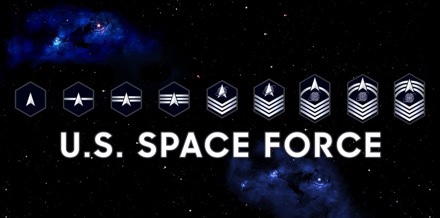
Space Force Insignia Survey

Friday, March 5th, 2021

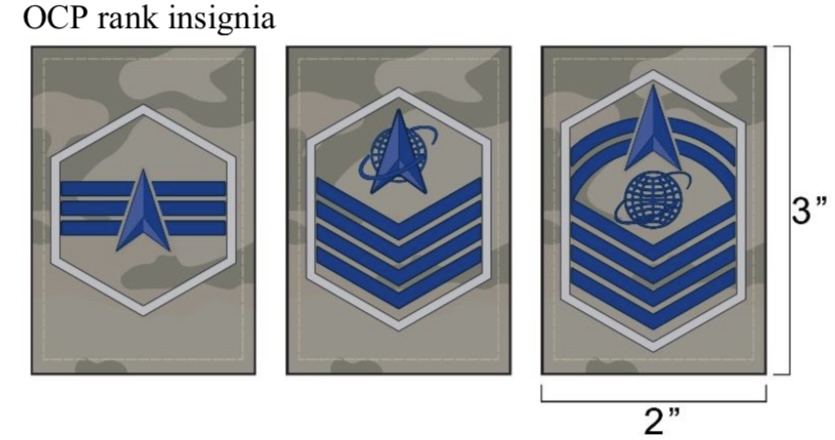
According to the popular Facebook group Air Force amn/nco/snco US Space Force is crowd sourcing rank insignia for their Enlisted Guardians via an online survey of its members.

As you may recall, the rank names were designated in late January. Now, it’s insignia.

Personally, I prefer the third choice with its throwback to 19th century rank but with the Space Force Delta.

First Multi-Domain Task Force Plans to be Centerpiece of Army Modernization

Wednesday, February 10th, 2021

WASHINGTON — The Army’s first Multi-Domain Task Force is charting an unknown path to help reshape how the total force fights and wins on future battlefields, its commander said Wednesday.

Initiated in March 2017, the MDTF pilot program focused on defeating an enemy’s anti-access/area denial, or A2/AD, capabilities in the Indo-Pacific region. Since then, through exercises and assessments, the program ensured the task force was able to deploy and operate in the region before it officially activated in the fall.

“There is little doctrine for [MDTFs],” said Brig. Gen. Jim Isenhower, the commander, adding his trailblazing unit will be a centerpiece of Army modernization.

As a centerpiece for the future Army, MDTFs are “new, networked, maneuver theater assets, focused on adversary A2/AD networks,” Isenhower said. Their capabilities also provide deterrence options for combatant commanders.

“The Army has empowered us, and asked us to figure out how we’re going to maneuver effectively in all domains, which will characterize how we fight in the future,” he added.

Down the road, the MDTF, which is based at Joint Base Lewis-McChord, Washington, won’t be alone. Later this year, a second MDTF is being planned to stand up in Europe. A third task force may also stand up and serve the Indo-Pacific next year.


The first MDTF originally had a field artillery brigade as its core that merged with an Intelligence, Information, Cyber, Electronic Warfare and Space, or I2CEWS, element.

“Through distributed operations and with access to requisite authorities, MDTFs are advanced headquarters that synchronize kinetic and non-kinetic capabilities in support of strategic objectives,” Isenhower said.

“We face increased physical and virtual standoff through layered and integrated networks, where adversaries leverage all instruments of national power to blur the lines between competition and conflict, altering international norms to the detriment of the international community,” he said.

Great power competition

For the MDTFs, the plan ahead is to evolve and outpace the speed of any persistent, great power competitors like China and Russia, said an officer assigned to the task force.

“Great power competition requires an Army that is capable of complete integration across the joint force to compete with our adversaries,” he said.

From a joint warfare perspective, this is where the MDTF comes in. “Our exercises are joint, our plans are joint, and we incorporate input from across the joint services at every turn,” he said.

That foundation enables the total force to use a broad range of multidisciplinary capabilities. It also gives joint forces the freedom of action to fit the needs of each service, he said.

Preparing Soldiers

Like with other Army organizations, it’s the individuals selected who make the task force exceptional, according to one of its senior enlisted members.

“Within our ranks are highly-trained Soldiers with specialized skill sets, [and are] technologically astute, creative thinkers, who are looking at new ways to address complex problem sets,” they said. “The diversity of our formation fosters an environment of critical thinking, and the Soldiers who comprise our task force are leaders at the front of their career fields.”

The MDTF Soldiers reflect the nation, he added, and are “the best at coming together to leverage technology and joint resources to meet the imperatives of our national defense strategy.”

After qualifying for the task force, they said, each member represents the best of each priority they specialize in. “That’s one of the most exciting parts of this — the Soldiers who comprise our organization,” he said.

Whether in exercise or garrison, the MDTF members do things others simply cannot, they said. Specifically, the experience of working in joint exercises, or becoming fluent in the synchronization and planning efforts typically linked to the joint environment.

“Every member on the MDTF values their opportunity to contribute to the Army’s — and the joint force’s — efforts to develop these new concepts, like [multi-domain operations] and all-domain warfare,” Isenhower said.

Joint problems need joint solutions

But the task force will only be as successful as the joint partnerships they maintain, they said. Those partnerships have come with their share of eye-openers.

“Our proximity to joint partners [has given us] a few lessons learned,” said a senior officer assigned to the task force. “We tend to get these large gains out of exercises that we’ve been on in the Pacific, but one of those lessons we were coming away with is that we need a more persistent training environment.”

On any given week, the MDTF may partner alongside a Carrier Strike Group from the U.S. Navy or fire planners from the U.S. Air Force.

These are prime examples of how the task force is a joint-enabler, and “without those joint partners, we’d become an Army solution [for] only Army problems,” the officer said. Instead, “we’re looking to work [with] joint partners toward joint solutions.”

“Many times, joint solutions are inhibited by closed architectures within respective forces, Isenhower said.

The task force “found opportunities to accelerate joint interoperability by just getting the right people in the room to talk to each other and figure out how to break down both literal and figurative firewalls that might inhibit rapid communication,” he said.

Although there is still work to do, the task force is on the right track, he said. MDTFs will simultaneously integrate joint partners and emerging technologies to inform the Army’s transformation into a faster, more dynamic force.

“This is a unique opportunity, and the MDTF — Soldiers and family members alike — feel privileged to be a part of it and don’t take for granted the responsibility and the privilege the Army’s given us to chart this path forward,” Isenhower said.

By Thomas Brading, Army News Service

US Space Force Selects Rank Structure, Still No Insignia

Sunday, January 31st, 2021

This will come in handy for those of you working in a joint environment. Late last week, US Space Force issued a memorandum outlining the rank structure for their Guardians with an effective date of 1 February 2021.

E1 Spc1 Specialist 1

E2 Spc2 Specialist 2

E3 Spc3 Specialist 3

E4 Spc4 Specialist 4

E5 Sgt Sergeant

E6 TSgt Technical Sergeant

E7 MSgt Master Sergeant

E8 SMSgt Senior Master Sergeant

E9 CMSgt Chief Master Sergeant

E9 CMSSF Chief Master Sergeant of the Space Force

You may address the junior enlisted specialist ranks as “Specialist.” Alternatively, you may use “Spec” or “Specialist” and the grade, as in “Spec4” like they used to do in the Army.

Sergeants are of course addressed as “Sergeant,” which can be used for TSgt and MSgt as well. TSgt may be also addressed as “Tech Sergeant” or “Technical Sergeant” although a MSgt may be only alternatively addressed as “Master Sergeant.” Interestingly, a SMSgt may be called “Senior” and a CMSgt “Chief.”

This convention is an interesting break in logic for Senior NCOs. Of course, in the late ’50s the Air Force was so enamored with the so-called “super grades” of E8 and E9 that they traded their Warrant Officers in for more of them. In fact, until 1995, Air Force enlisted rank insignia kept the MSgt and below visually distinct by only putting SMSgt and CMSgt stripes above the star. I guess in the mid-90s something finally made them give in and acknowledge MSgts as Senior NCOs. But I digress. I almost let you off by tiptoeing earlier around the fact that you can call a CMSgt just “Chief,” but you can’t call a MSgt just “Master.” Marinate in that one for awhile.

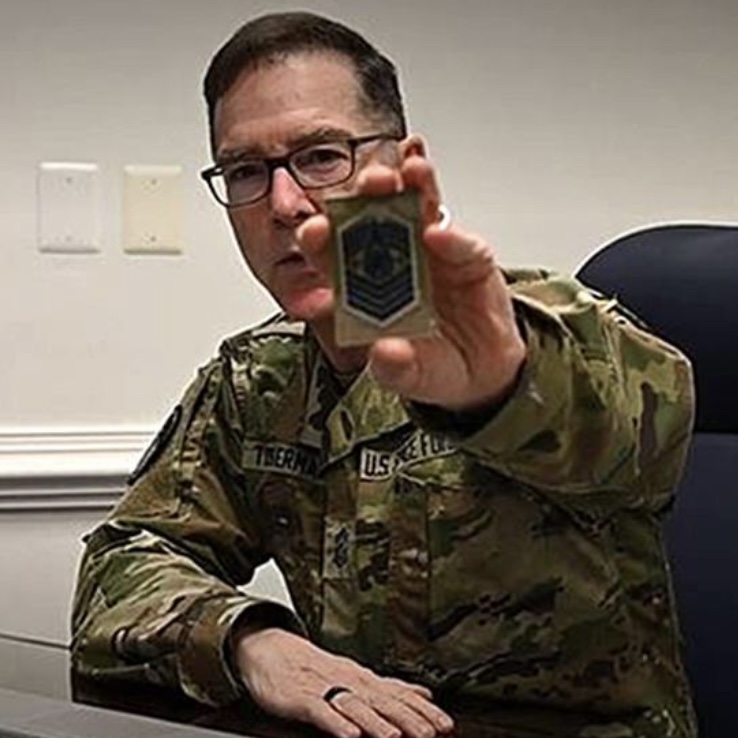
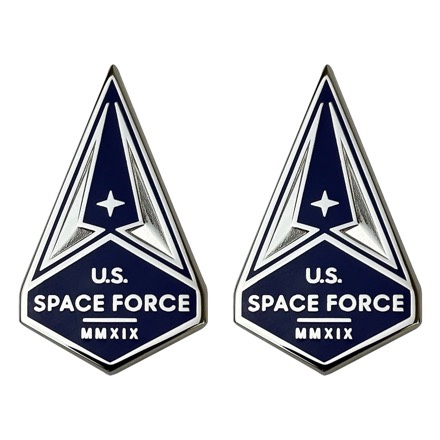
Having said all of that, there’s still no word on what USSF enlisted rank insignia will actually look like aside from this temporary CMSSF insignia.

Although Officer ranks were also mentioned in the memorandum, there is no difference from the Air Force, Army or Marines. Alas, USSF seems to have taken the Air Force’s lead and chosen to forego Warrants.