Atrius Development Group

Archive for the ‘Training’ Category

SureFire Field Notes – Travis Haley

Thursday, February 15th, 2018

Episode 20 of SureFire Field Notes is live! In this episode, Travis Haley of Haley Strategic Partners discusses the 22422 drill and low-light variations.


Travis Haley is a veteran Force Reconnaissance Marine with 15 years of dedicated real world experience including: combat tours in Middle East, Africa and Central Asia. After leaving the military, Mr Haley served as a special operations and security contractor before partnering with Magpul as founder and CEO of their training division, Magpul Dynamics. Mr Haley also served as CEO of the parent company, Magpul Industries, before breaking off to form the endeavor that would become Haley Strategic Partners.


www.SureFire.com

US Army Rapid Equipping Force Subterranean Training Exercise 

Sunday, February 11th, 2018

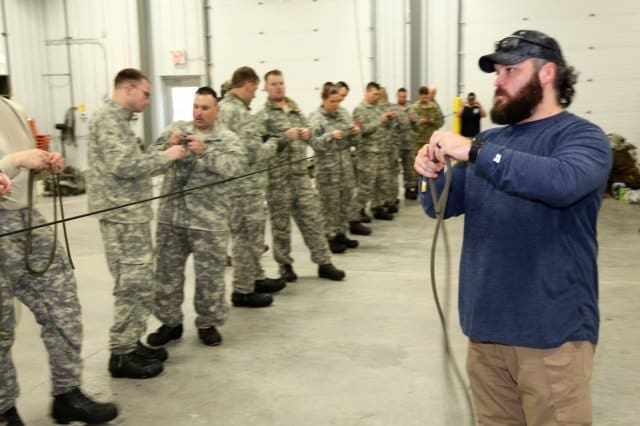
February 2017, the REF partnered with Asymmetric Warfare Group and 307th Brigade Engineer Battalion at the Muscatatuck Urban Training Complex, North Vernon, Ind., for a weeklong subterranean training event, which culminated with an exercise involving commercial and government off-the-shelf technologies. The results from the exercise will help inform the Total Force, solve the capability gaps of operating in a subterranean environment, and equip a future unit operating in dense and urban terrain.

North American Rescue Announces Acquisition Of JTM Training Group

Sunday, February 11th, 2018

Greer, SC (February 5, 2018) North American Rescue, LLC (NAR) is pleased to announce the acquisition of JTM Training Group (JTM) from Las Vegas, NV. JTM has over 20 years of experience providing tactical and medical training to military, law enforcement, EMS, and first responder personnel.

JTM Training Group has a strong history of offering premium evidence-based medicine education and training solutions for military and first responders. As a leader in their industry, they have been offering online EMT certification/re-certification courses since 2006 and are considered one of the most trusted online EMT providers in the world. Tactical Combat Casualty Care (TCCC) courses are also available, providing hands-on combat medical training that adheres to the TCCC Standardization Guidelines. Finally, their team of experienced and knowledgeable instructors enables them to provide customized opportunities for immersive, scenario-driven courses that are tailored to meet mission-specific requirements.

This broad range of training capabilities makes JTM an ideal addition to the NAR company goal of providing “products with a mission.” NAR has long recognized that successful life-saving treatment may begin with the right equipment, but the key elements of education to know when to use and training to know how to use that gear are requisites for desirable outcomes.

“North American Rescue has always been committed to equipping the warfighter and first responders with what they need to save lives,” said Robert Castellani, CEO of North American Rescue, LLC. “We are pleased to bring the JTM team onboard. For years we have been asked for training opportunities by customers of our premium products. We are confident that JTM’s solutions will enable us to exceed expectations for leading-edge education and training experiences and that the options of online, in-person, or even mobile training events will provide accessibility to premium training that meets and exceeds requirements.”

JTM Training Group will be changing their name to “North American Rescue Education and Training” (NAR Training), and will transition to new branding during the second quarter of 2018. Their website will remain fully functional, and courses will continue to be run and offered throughout the transition.

Greyhive Snapshot – Ian Strimbeck

Saturday, February 10th, 2018

It’s Called a GunFIGHT for a Reason

We all have that one friend, or have encountered that one individual, who lacks the intellectual capacity to understand that pressing the trigger is just one tiny aspect of owning a gun. When it comes to handguns, how often do most of us drive the gun out to extension every time we go to the range? How many of us think about how often we’re in close quarters with multiple individuals on a day to day basis? The length of extension of our pistol correlates directly to the proximity of the threat we’re dealing with. To solidify the idea in our head that we’ll always have enough distance between our pistol and the threat is not only foolish but reckless as well.

Criminals don’t care about how you train or your range safety protocols. All they care about is completing their mission, whether that be taking your wallet or your life for that matter. Most criminal assaults occur after an ambush and the victim ends up “locking up” in a standing entanglement with the assailant. But the victim can just go for his gun now right? Wrong. That would be a recipe for failure. But why? Can’t I just shove the guy with my off hand and pull my gun out like Wyatt Earp? This is what I commonly see being thought of as a quality method for retention based shooting. Usually it’s because of the misinformation out there from social media entertainers. A rubber dummy or cardboard target doesn’t fight back. It doesn’t give pressure back. It doesn’t have limbs that will attempt to strip your gun away. And it definitely doesn’t have a will to continue the fight after you’ve already given up on yourself.

At the end of the day, think realistically as to how to approach the way you train. Steer clear of attempting to copy uncontextualized methods of entangled handgun employment. Get to a quality class that utilizes pressure based training to truly test the skills. It will be anything but easy, but to truly grow your skillset you must constantly put yourself in places of conflict.

strimbeckIan Strimbeck is a United States Marine Corps veteran and founder of Runenation LLC. Runenation is a consulting and education company specializing in the constant growth of the multidisciplinary tactician. Too often in the “gun world,” you see individuals who are drawn to a singular tool in lieu of looking at the bigger picture. It isn’t solely about the gun, blade, grappling, striking, medical, fitness, or verbal acuity. It’s a constantly evolving skillset that you put a varying amount of effort into throughout your life. Like the rings on a tree trunk , it will grow as long as you put in the necessary effort.

greyhive.com/articles

Snapshot is a bi-weekly series from Greyhive featuring content written by our Experts. It is our goal to deliver information that prompts you to examine your preparedness from all angles, not just how quickly and accurately you shoot.

Guerilla Approach Changes Up Tactical Marksmanship Program

Thursday, February 8th, 2018

“Static shooting develops skill, but shooting and movement measures the depth of proficiency.”
Aaron Barruga of Guerrilla Approach explains why he changed his tactical marksmanship programming.

guerrillaapproach.com

SHOT Show 18 – Dynamis Alliance Combative Training Barrel

Tuesday, February 6th, 2018

This is the production version of the Dynamis Alliance Combative Training Barrel. It is designed to allow you to train with your carry pistol in either a combative environment or during safe, dry fire practice. This aluminum barrel is anodized high-vis red to make a clear distinction that this is a training tool and not a live barrel. This barrel is solid to make accidental loading impossible. This barrel will fit Gen 4 and below Glock 19 and 17 pistols.

dynamisalliance.com/product-details/combative-training-barrel

Max Velocity Tactical – The Warrior Mindset And Training Progression

Saturday, February 3rd, 2018

This is a follow up post to Max Velocity Tactical’s The Warrior Mindset and Firearms Culture, which can be viewed here. This blog post is published here with permission from the author.

SAS-Oman-1-1“Out of every one hundred men, ten shouldn’t even be there, eighty are just targets, nine are the real fighters, and we are lucky to have them, for they make the battle. Ah, but the one, one is a warrior, and he will bring the others back.” – Heraclitus

“Warrior Mindset is more than aggressiveness and determination, it is about over coming challenge and adversity. It’s about possessing, understanding, and being able to utilize a set of psychological and physical skills that allow someone to be effective, adaptive, and persistent. It also allows someone to use optimal decision-making, psychological techniques, physical and tactical skills learned in training and by experience.”

“The goal of a Warrior Mindset is to integrate the psychological with physical and tactical training to add a dimension that is often overlooked, but necessary to achieve maximal performance of a skill. If you only talk about mental toughness, but don’t actively train it, you haven’t developed into a complete warrior….regardless of what physical skills you have developed. You’ll find, with proper training, that you can possess the power to overcome any obstacle and change your outcomes if you train yourself mentally. This is the point in which you will truly bring out the Warrior Mindset within yourself.”

his post is a follow up to my previous post on Warrior Mindset and Firearms Culture. It would be worth reading that post, which you can do at the link below:

LINK: ‘The Warrior Mindset and Firearms Culture’

In case you didn’t bother with the link yet, a little review here:

Firstly, to focus on the positive. If you consider yourself a self-reliant and capable individual, then you need to action the warrior mindset. By your thoughts, actions, training and capabilities, you are working to become an embodiment of the warrior mindset. This is not something that you need to be concerned about only if you are in a martial profession, because in the great American tradition of individual self-reliance, we should all be capable self-reliant individuals. Thus, you are a protector of yourself, your family and your children. However, what is mostly missed is the fact that the utility of developing the warrior mindset and associated tactical skills, is not simply tactical capability. No, development of an effective warrior mindset is a positive character building process and will filter across and benefit all areas of your professional and personal life.

If we dedicate ourselves to the pursuit of tactical training in order to develop a warrior mindset, then we are directly concerned with developing:

  • Physical Fitness and Strength.
  • Hand to Hand Self-Defense Skills.
  • Skill at Arms.
  • Tactical Skills & Knowledge.
  • Physical & Moral Courage.
  • What is often missed, but is essential to a true warrior mindset, is talked about in the quotes at the top of the page:

  • Problem Solving & Decision Making Ability.
  • Performance Under Stress.
  • Psychological Resilience.
  • ‘Will to Win.’
  • Teamwork.
  • Leadership Qualities.
  • Situational Awareness.
  • Communication Skills.
  • These are the character building qualities that are essential to a warrior mindset and which will bleed across into your personal and professional life.

    In this post, I want to examine the training side in a little more detail, so on that note, some more from the previous post:

    The next issue is one of ‘tactical training’ and the current trends in American ‘tactical’ instruction. There are many instructors out there with real training and operational experience who should know better. But much of the current trend in rapid firearms manipulation and gaming, if left at that, will get you killed in a real tactical scenario. Does it have training worth? Yes. Does competition have training worth? Yes, in context. But if you wish to progress to a full warrior mindset you must see firearms manipulation and ‘gaming’ as simply a progression to more complex tactical range training. In essence, most of these students are stuck in a training zone that is going to be detrimental to them, and also does not allow them to develop the skills and qualities mentioned as part of the warrior mindset.

    But there is often an unwillingness to progress to true tactical training, due to misunderstanding / ignorance, and also a lack of willingness, skill or facility on the part of schools to teach it.

    The target of today’s post is therefore the ‘mainstream’ tactical training culture. This seems particularity apt with my just having returned from SHOT Show. Between the gun derp, fudds, and the cool guys I didn’t know which way to turn. Huge fun though!

    I just put out a post describing the current upgrades to the Velocity Training Center, and what we are doing to the class curriculum in 2018 (‘Hostile Environment Advanced Tactics (HEAT) classes: 2018’). What I am describing in that post is a state of the art facility at the VTC, combined with a curriculum that is designed to be a genuine tactical training progression. Thus, what we are doing is unique, with our mix of live fire, UTM force on force, and leadership training offerings, conducted in a designed and developed facility. This is why we attracted the attention of US SOF, who are now regularly training at the facility. Why? They can do more there, with greater freedom, than they can do elsewhere.

    Now, I will address one thing before I go on: I have called the class progression ‘advanced tactics.’ But are they or are they not ‘advanced?’ Here is the thing: all tactics come down to TTP’s (tactics, techniques and procedures) executed well. Thus, it is all about good solid basics. You do of course have to have the right TTPs in the first place, and of course we do, because we are professional soldiers with the right training and operational experience. All tactics come down to being basic in the end, or you will not be able to execute them under fire. At the end of the day: ‘brilliance in the basics.’ There are no ‘secret-squirrel super-secret drills’! However, just because drills are basic does not mean they are easy to execute, and certainly it is not easy to execute a drill as a tactic in the face of the enemy! ‘Shoot, move and communicate’ is easy on paper, but to actually execute that effectively in a combat environment is not so. So why ‘advanced tactics’? Because we are progressing students to legitimate small unit tactics, which I have chosen to call hostile environment tactics, which in the sense of any other ‘tactical training’ is genuinely advanced training.

    I see a lot out there about firearms training in various feeds: Instagram, Facebook, Blog Posts, etc. What gets me is when I see instructors swiping at the industry because of such and such reason why training needs to be better, or any number of other interpretations and nuances that make up these articles, yet I see them all lumped into the same box. And yet here I am doing exactly that same! Yet, my claim in my defense is that I am standing on another hilltop, looking over at the ‘mainstream’ and voicing my disapproval. What I am not doing, is trying to get to the top of the mainstream hill by climbing on the back of others, stomping them into the mud. I fully realize here at MVT that we will always be a boutique operation, simply because of the quality and nature of what we do, the challenge of it, and how we need students at the intersection of many different qualities that make them want to seek the warrior mindset. So much out there seems to be mutually exclusive, where you have ‘gun guys’ who never do PT, and cross-fitters who don’t like guns, and what we need are warriors who like to do PT and shoot guns and do tactical training, and invest in themselves! Thus, we focus on Heraclitus’s nine fighters and one warrior, and I do not see that changing anytime soon.

    The universal problem with the ‘mainstream’ tactical training market, as I see it, is this: there are forever instructors talking about how to be better, how to do better, many such examples. But uniformly, what they are all really talking about, is the minutiae of weapons manipulation. There is usually very little ‘tactical’ about the subject matter. It is just this drill versus that drill. Thus, they are focusing on the ‘shoot’ part of ‘shoot, move and communicate’ where doing so may actually, without proper tactical context, be of detriment to students. Yes, there may be movement, but it is usually a bit of running around, without tactical context. Maybe even carrying a sandbag or two. Yes, I get it.

    So perhaps it is a short-sighted method of training? For perspective, we must not forget that much of the weapon manipulation and cool-guy stuff we see on flat ranges has far more to do with selling stuff than with any real training. After all, it is an industry, of firearms, gear and related merchandise, and much of what you see is marketing. There is nothing wrong with that, cool-guy gear and firearms sell, and this is either direct marketing from the companies themselves, or via training companies or instructors who are perpetuating an image and doing product placement. Let us all just remember that, when we are making training decisions.

    The secret is, to get to a level of effective tactical competence with a rifle, does not take that much training. You will need to continue to train to prevent skill fade, but once you get to a good level, you can spend the rest of your life getting better by very small increments. Great as a hobby. What you need to do is put that shooting skill into context with a proper training progression – this will also prevent you learning training scars by constant cool-guy shooting drills that will perhaps get you killed in a real survival situation. There are many types of instructors out there, and some only know what they know, and they may be good at weapon manipulation minutiae, but you cannot expect them to teach tactics if they do not have a professional grounding (plus ability to teach). When on the other hand you get professional soldiers of whatever flavor, they should know better. They do know better. They know that training involves progression to tactical training ranges, and that without that progression, it is worthless as combat preparation, a fun hobby at best. They also know that the job of a SOF soldier is not simply to shoot. It is way more complicated than that, and involves development of the qualities that I have listed at the top of this post.

    It would be easy for an uninformed reader to take away from what I have written so far that MVT does not care about flat range drills. Not so. We are very good at teaching weapons manipulation and combat marksmanship, correctly and with the right context for combat application. This is because we understand fully how important the aspects of the training progression are. You need to be able to manipulate your weapon as second nature so that you can get your head out of it while in contact, assess the situation, scan, communicate, and execute a drill at team level in order to be able to stand a chance of survival or victory. On the flip side, much flat-range shenanigans focus on worthless drills that are hollow shadows of what they are supposed to be, and may in fact be dangerous. Have you ever seen students mag-dumping at the 7 yard line then ‘scanning’ a small sector with their eyes glued to the sights? Or the fake robot ‘scan’ that sees nothing?

    My beef is with the lack of tactical context to shooting training which purports to be ‘tactical’ when in fact it is not. At most, what I see in so many Instagram feeds is an over-focus on minutiae which lacks the bigger tactical picture. I can set up targets and sprint around pew-pewing them all day. Fun, but am I going to do that in a firefight? The minutiae that I refer to is the over-focus on aspects that do form part of the training progression, such as barricade drills, reactive / reflexive fire, all that, but which however become a be-all and end-all in themselves. If as a trainer or student you lack tactical context or knowledge, and you have no way to do real tactical training, then it stands to reason that you will spin down the rabbit hole of minutiae and the pursuit of ever faster or varied shooting drills.

    The above having been said, could be taken as an indictment of any competition or fun shooting drills. Again, not so. Competition is a great way to gain training, have fun, learn things and practice. If that is all you ever do or have done, then you are missing the big picture. If you have conducted some real tactical training with all the benefits to positive character development, it is no thing at all to have some fun at a competition while understanding the true context of it.

    I read a post from a company called Guerrilla Approach that popped into my feed. It was interesting. It made many of the claims that I have listed above, by which it focused on ‘better’ ways to do what in fact were just more drills on the flat range. The author, Aaron, seems like a good guy, and he is a former Green Beret, relatively young (former 18X I think). He made a comment in the post about how he was doing shoot house training as a young buck, and noticed how the ‘cadence fire’ of the instructors was lacking; how they shot sporadically, and only shot when they had a good center mass shot. In essence what he was unwittingly saying was that he had been a victim of flat range shooting drill training, which was not how the instructors with experience were conducting themselves. The cadence fire of so many drills that you see simply did not cut it in a dynamic shoot house situation. What do we also have to do in CQB? How about target discrimination / PID, along with problem solving, decision making and effective communication. Fast eyes, fast hands, slow feet.

    Another thing that he wrote was that we have learned a lot, by which I think he really meant about shooting, during the GWOT. That is absolutely true, and we are so much better at the shooting we teach, from the current manual of arms taught for the AR, weapon manipulation, to effective combat marksmanship, than we ever were before. But the flip side is that due to the nature of many operations in the GWOT, we have forgotten much of small unit tactics. This is a disadvantage of those young enough to have not spanned pre-9/11 and then the GWOT – their relative tactical training and experience is lacking, regardless of how many CAS missions they have seen. We see much creeping in now that is GWOT influenced and could be very dangerous, particularly if we are looking towards conflict with opposition forces such as North Korea. However, that topic is for another article. Suffice to say, at MVT we are keeping SUT alive as a school of excellence, we disregard nothing that has been learned more recently, but we also try not to forget past knowledge.

    But so what? Is there any relevance to my observations? What difference does it make whether people want to go pew-pew on the range as much as they like? Why is it any of my business? Well, at the end of the day it all comes down to your perspective, and what you are trying to achieve. If you are looking to invest in yourself, and develop the warrior mindset then you have to go beyond just shooting. You need to be challenged and grow. This is applicable whether or not you are in a martial profession, are a prepared citizen hoping not to have to utilize small unit tactics at some point, or simply growing yourself. Because the character building aspect of such martial pursuits will have benefits for you in the here and now, both in your professional and personal life. Going back to the list at the top of the page:

    If we dedicate ourselves to the pursuit of tactical training in order to develop a warrior mindset, then we are directly concerned with developing:

  • Physical Fitness and Strength.
  • Hand to Hand Self-Defense Skills.
  • Skill at Arms.
  • Tactical Skills & Knowledge.
  • Physical & Moral Courage.

    What is often missed, but is essential to a true warrior mindset, is talked about in the quotes at the top of the page:

  • Problem Solving & Decision Making Ability.
  • Performance Under Stress.
  • Psychological Resilience.
  • ‘Will to Win.’
  • Teamwork.
  • Leadership Qualities.
  • Situational Awareness.
  • Communication Skills.
  • These are the character building qualities that are essential to a warrior mindset and which will bleed across into your personal and professional life.

    How do we do that? We must put in place a training progression that includes fundamentals through weapon manipulation to combat marksmanship. We then progress to tactical live fire ranges with unknown reactive targets, working as a team, in a dynamic scenario-based environment. We must include constructive force on force training in an SUT / CQB environment. We should also include mission planning and leadership training. In fact, the progression is really a loop. We move along it but circle back to the flat range to keep progressing our skills. Of course, such tactical ranges need to be designed and run by professionals in order to maintain high standards of safety. This is all what we do at MVT, and why the VTC is designed as it is, along with the class curriculum.

    Now, posts such as this one often elicit a visceral reaction from some quarters. This is to be expected, when people do not hear what they want to hear, and when egos are dislocated. Let’s take a quick look at the why of that:

    In this and my previous ‘The Warrior Mindset and Firearms Culture’ post I essentially told everyone to get off their asses and do hard stuff. That is not unusual, although even the softest of these types of calls to action get push-back, because many are living in a fantasy land, legends in their own lunch break. What is new here is the call for ‘gun culture’ to move beyond square range work and into more realistic applications of using firearms for fighting. For many, square range classes are the hard things we are supposed to go do – to suggest this is not good enough, and that there is better, is heresy. Particularly for the industry which is happily making money off of cool guy merchandise and tactical fan-boys.

    Thus by denigrating the status quo in the current industry, I have committed the tacticool heresy of criticizing what a lot of people have come to see as the pinnacle of training. This therefore attacks not just the fudds, but also a lot of the tacticool types out there. Tying this to the warrior mindset also attacked a lot of folks of the type who have invested themselves in the huge ‘punisher’ logo and safe full of guns part of our culture. In reality lots of people talk a lot about warrior mindset, yet I don’t know many who actually seem to know what they are actually talking about – mainly because they have never been tested, and never been forced to improve: essentially, untested egos. I also said the magic word, warrior. I therefore riled up the wrath of the fudds who don’t think they need to be one, and the tacticool types who think they already are. That word, warrior, makes it about the the reader’s identity.

    https://maxvelocitytactical.com/2018/01/31/warrior-mindset-firearms-culture-2/

    Ravelin Group, LLC Offering 1-Day Cold Weather Carbine Course

    Saturday, February 3rd, 2018

    Ravelin Group, LLC is conducting a single day Cold Weather Carbine Course on Saturday, February 10th, 2018 at the Watertown, WI Conservation Club.

    img_5748.jpg

    ??Course cost is $250.00 plus a $25.00 range fee (cash only) for the Conservation Club.?Start time is 9:00 and will conclude about 5:00pm?

    Ross Botha from Lancer Systems will be our special guest and he will bring some Lancer System select-fire carbines for demonstration and test-firing.  (Bring extra non-steel cased factory loaded ammo, if you plan to test-fire the Lancer System AR’s)?

    Contact Steve@RavelinGroup.com for additional information or call (630) 834-4423 to sign-up.?

    www.RavelinGroup.com?