SIG SAUER - Never Settle

Archive for the ‘UAS’ Category

NDIA Future Forces Conference Poster #4 – Deadly UAS Homing Threats of the Future

Thursday, October 31st, 2024

With drones a major aspect of the war in Ukraine (and elsewhere) it’s best to become as familiarized with the infernal devices as possible. To wit, I present “Deadly UAS Homing Threats of the Future” presented at the recent Future Forces Conference in Virginia Beach.

For those interested, POC data is on the poster.

DroneShield Expands European Presence to Meet Surging Demand for Counterdrone Solutions

Wednesday, October 30th, 2024

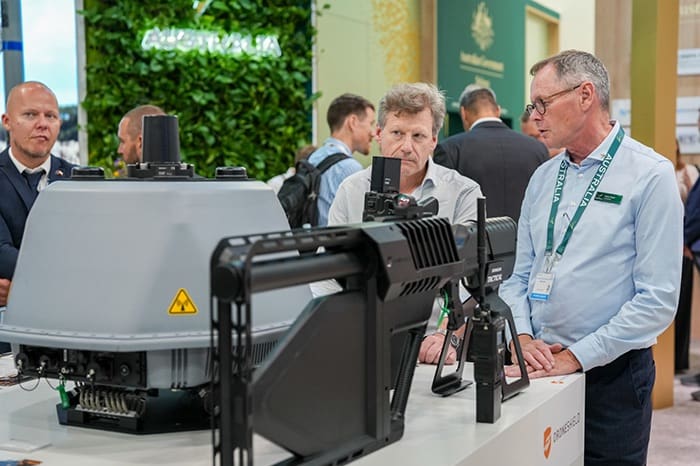
Sydney, Australia – DroneShield (ASX:DRO), a world-leading innovator in counter-unmanned aerial systems (C-UAS), is proud to announce the expansion of its European footprint. This is in response to the escalating need for advanced counterdrone technologies across Europe. To enhance its regional capabilities, DroneShield has strategically appointed a team of elite experts, establishing a strong presence in both Denmark and Germany, alongside its network of experienced in-country sales channel partners throughout Europe.

The seasoned senior European team includes Hans Høyer, Asger Hviid, Oleksiy Prymin, and Red McClintock, each with deep expertise in counter-UAS technologies. This multilingual team, proficient in English, German, Ukrainian, French, and Scandinavian languages, is poised to provide localised support, offering tailored solutions to defence, security, and commercial sectors across the continent.

The expansion comes at a pivotal time, as Europe faces increasing threats from rogue drone activities in military, critical infrastructure, and government sectors. DroneShield’s battle-proven solutions are globally deployed to combat these evolving threats, and the company’s European team will provide immediate, on-the-ground support for customers and partners in the region.

Hans Høyer, DroneShield’s newly appointed Sales Director, stated, “We understand the importance of proximity of support for our customers, and are committed to providing bespoke solutions that address their unique challenges. Whether it’s for special forces, fixed installations, or mobile solutions, we’re committed to providing unrivalled expertise and service.”


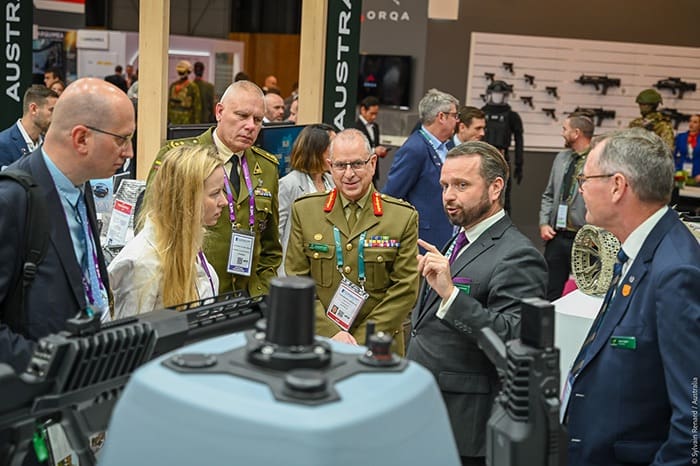
MSPO, Kielce in September 2024

Driving Innovation and Speed in European Defence

Throughout 2024, DroneShield’s European team has been actively engaging with the continent’s defence and security sectors, attending high-profile industry events to showcase rapidly deployable C-UAS detection and defeat solutions. DroneShield’s difference lies in the speed and precision of its deployments. With an unmatched track record for swiftly delivering solutions to the field, the team’s presence reinforces the company’s commitment to providing battle-proven, scalable technologies that meet the pressing challenges of modern drone threats.

“Our attendance at these key events isn’t just about showcasing products, it’s about highlighting the speed at which we can provide actionable, real-world solutions,” said Høyer. “We’re bringing a new level of readiness to the table, ensuring our customers can count on DroneShield for the rapid, effective deployment of tailored C-UAS solutions.”


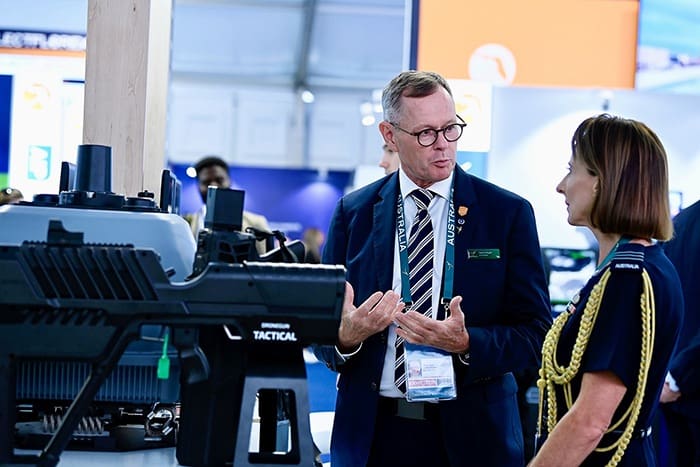
Eurosatory, Paris in June 2024

Strengthening European Defence with Local Expertise

The team’s launch makes a significant step in DroneShield’s rapid global expansion, reinforcing the company’s position as a leader in the defence technology space. By providing on-the-ground guidance, demonstrations, installations, and continued service support, the European team will ensure clients benefit from DroneShield’s market-leading innovations in counterdrone technology.

Backed by the innovation and resources of DroneShield’s global headquarters in Sydney, Australia, as well as DroneShield’s United States headquarters in Warrenton, Virginia, the European team’s local presence offers customers rapid response times and personalised service. From product demonstrations to installations and ongoing support, the team ensures customers receive comprehensive, real-time assistance to tackle drone threats with unparalleled effectiveness.

Farnborough International Airshow in July 2024
DroneShield’s CEO, Oleg?Vornik, commented, “With our expanded European presence, we are in a stronger position to meet the growing demands for counterdrone solutions in the region. Our team is not only bringing cutting-edge technology but also providing hands-on support to ensure each customer receives the best possible solution.”

AUSA 24 – DefendTex Vengeance FPV Drone

Thursday, October 24th, 2024

One of my personal missions at AUSA was to seek out truly attritable drones. One of the things I’ve taken away from the war in Ukraine is that with a consumption rate in excess of 10,000 per month, the attritable drone is the 155 shell of the future. These small, low-cost, disposable unmanned aerial systems are upending how we will conduct warfare. They are highly adaptable and are under constant revision as enemy TTPs adapt to their use. We’ve got to have something just as robust. In the hands of innovative American troops like SOCOM’s new robotics specialists, drones will be devastating.

Attritable, or consumable, apparently means a lot of things to a lot of people. For instance, when the Defense Innovation Unit’s Replicator initiative went to industry seeking out attritable drones they ended up buying AeroVironment Switchblade-600 loitering munition. A fine weapon to be sure, but our nation can hardly afford to expend them at the rate seen in Ukraine. If anything, our future adversaries are going to throw an order of magnitude more at us and we’ll need to be able to respond in kind.

One of the examples I ran across is from Australian small business DefendTex. They first impressed me years ago with their innovative Drone40.

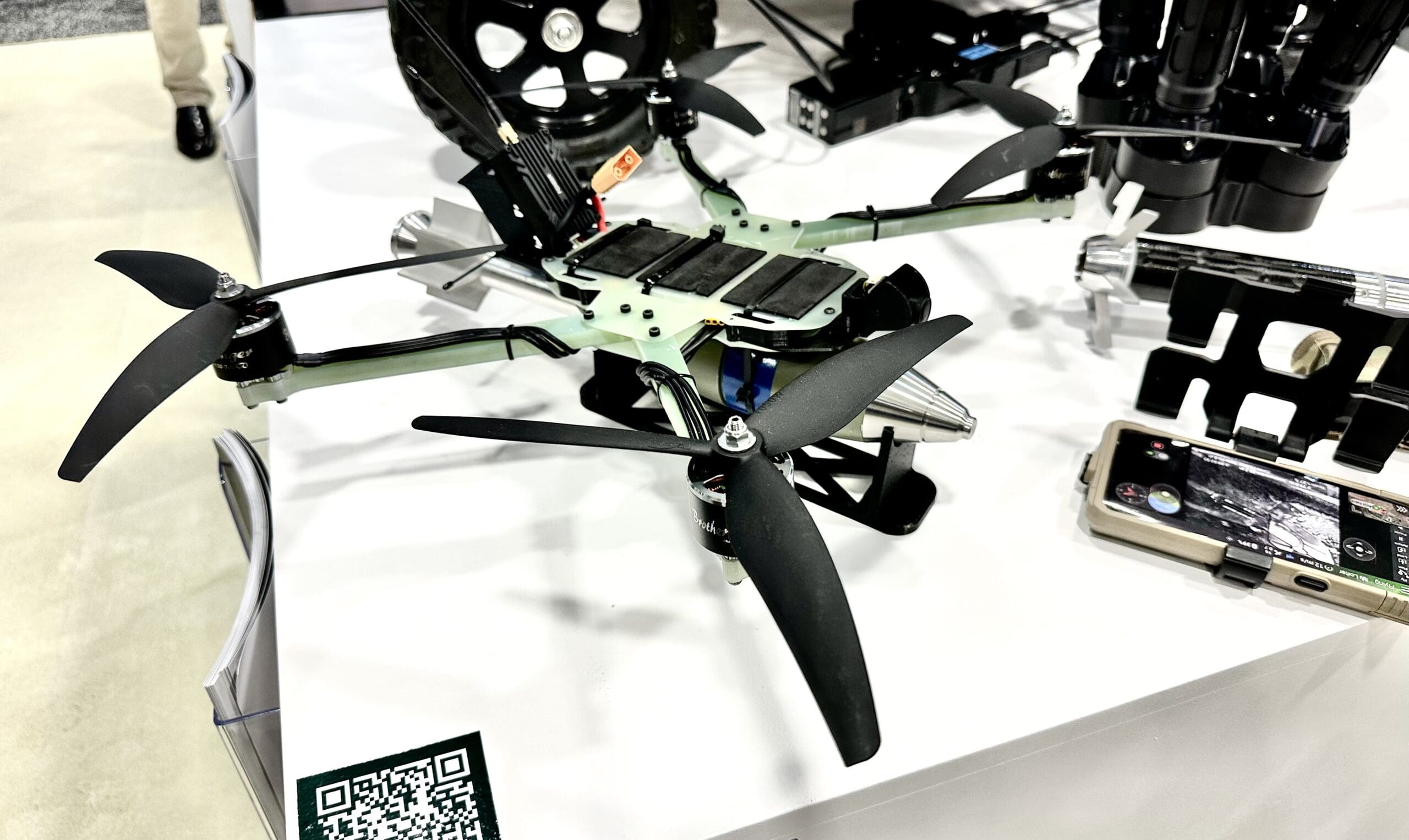
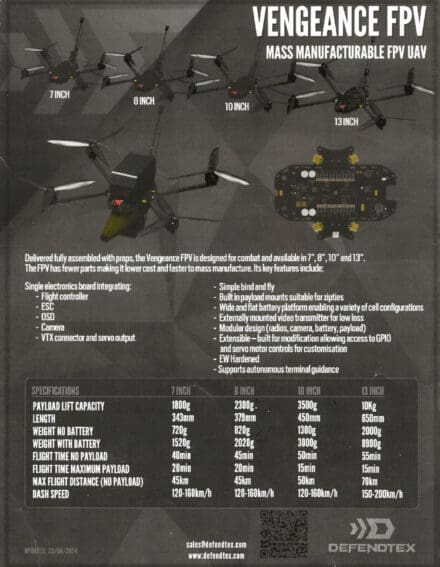
The Vengeance is a First Person View drone manufactured in Australia and has been submitted to the US for Blue certification.

Offered in 7″, 8″, 10″, and 13″ models, it can carry up to 10kg of explosive ordinance over a distance greater than 20kms.

It is built with a goal of around $1000 per copy in mass production and features simple construction using zip ties in some instances and a single circuit board integrating flight control, ESC, OSD, VTX connector and servo output.

Although it is an FPV drone, it can be configured for autonomous terminal guidance as well as swarm tactics.

AUSA 24 – Tomahawk Ground Control Stations

Monday, October 21st, 2024

Although all of AeroVironment’s uncrewed systems are open architecture and will accept control solutions from other vendors, AeroVironment purchased Tomahawk Robotics just over a year ago due to interest in their Ground Control Solutions.

The Tomahawk GCS is an AI-enhanced, open-architecture common control system providing multi-domain, multi-robotic command-and-control capabilities. Tomahawk’s Kinesis software and Kinesis SDKs enable rapid development, integration, and deployment of 3rd-party technology to the warfighter at the edge…

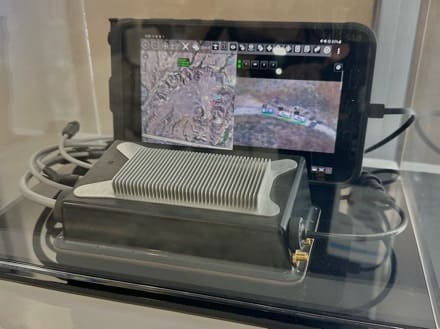
Seen above is the Grip S20, a rugged controller designed around the Samsung Galaxy S20 Tactical Edition smartphone. Grip S20 is military-hardened and provides an intuitive UI to simplify UxV control. It is run by their Kinesis software which offers unmanned systems control, TAK/ATAK integration to provide video rebroadcasting, COT messaging, and bi-directional syncing of POIs. Kinesis optimizes the vehicle pairing process, enables UxV formations and control, and a map engine that supports multiple sources via layers, DTED, and coordinates in both Lat Long and MGRS.

The controller can be paired with an edge processor like the MxC-Mini which is a Nett Warrior-compliant data link that seamlessly integrates with tactical UxVs. These edge processors ingest large amounts of data for high-speed, body-worn computation, reducing cognitive load, and fusing raw intelligence data for real-time decision-making.

www.avinc.com/uas/network-connectivity

GA-ASI Completes Full-Scale Fatigue Test on MQ-9B for Second Lifetime

Friday, October 18th, 2024

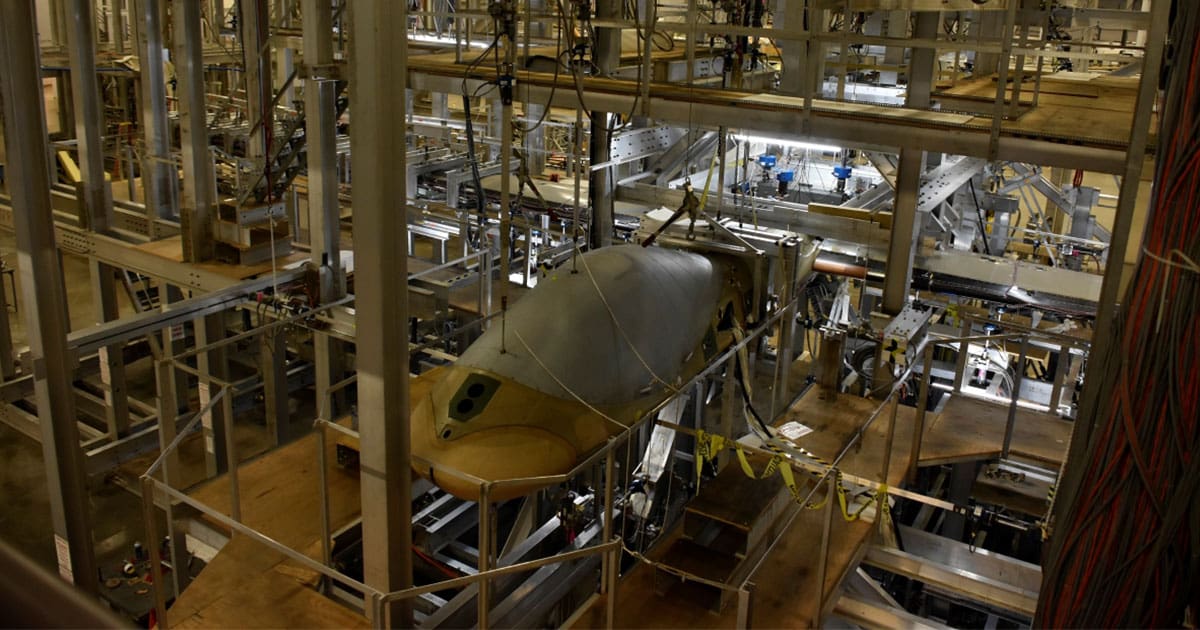
SAN DIEGO – 14 October 2024 – On Sept. 30, 2024, General Atomics Aeronautical Systems, Inc. (G  A-ASI) completed a major milestone with the full-scale fatigue testing of an MQ-9B Remotely Piloted Aircraft (RPA). The team completed the “second lifetime” of fatigue testing, which is equivalent to 80,000 operating hours and represents an important step in validating the design of the airframe system. The testing is part of the aircraft certification to NATO standard STANAG 4671, where the aircraft will ultimately be tested through three lifetimes, thereby proving the 40,000-hour lifetime of the airframe.

The full-scale fatigue test simulates the aircraft’s design service through the application of repeated structural loading on the assembled airframe. The testing identifies any potential structural deficiencies ahead of fleet usage and assists in developing inspection and maintenance schedules for the airframe. The results of the test will be used as part of the documentation for certification and will form the basis for in-service inspections of structural components.

MQ-9B is GA-ASI’s most advanced RPA and includes the SkyGuardian® and SeaGuardian® models as well as the new Protector RG Mk1 that is currently being delivered to the United Kingdom Royal Air Force (RAF).

“Full-scale fatigue testing is an integral part of validating the airframe design and a key input for the certification of the airframe prior to entering service,” said Chris Dusseault, vice president of MQ-9B in Europe. “The completion of the fatigue test builds confidence for our MQ-9B customers that the SkyGuardian/SeaGuardian meets the stringent design rigor and is mature at Entry into Service.”

The testing is the validation of years of design and analysis efforts. This is the second of three lifetimes of testing for the airframe. Two of the lifetimes simulate the operation of an aircraft under normal conditions, and the third has intentional damage inflicted on the airframe’s critical components to demonstrate its resistance to operational damage that may occur over the lifetime of the air vehicle.

Testing was conducted from Jan. 31, 2024, through Sept. 30, 2024, at Wichita State University’s National Institute for Aviation Research in Wichita, Kansas. The airframe tested is a production airframe purpose-built to support the test campaign.

In addition to the RAF, contracts have been signed for MQ-9B with Belgium, Canada, Japan, Taiwan and the U.S. Air Force in support of the Special Operations Command. The Japan Coast Guard is currently operating the SeaGuardian for maritime operations, and the Japan Maritime Self-Defense Force (JMSDF) selected SeaGuardian for its Medium-Altitude, Long-Endurance (MALE) RPA System Trial Operation Project.

At EDGE, Lockheed Martin Drives Advancements in AI, Crewed-Uncrewed Teaming and Networked Connectivity for U.S. Army

Friday, October 18th, 2024

The Big Picture

At several 2024 U.S. Army demonstrations such as Project Convergence and Army Futures Command’s Experimental Demonstration Gateway Event (EDGE), Lockheed Martin is demonstrating crewed-uncrewed teaming, uncrewed-uncrewed operations, Artificial Intelligence (AI)/Machine Learning (ML) and integrated systems in various missions relevant to 21st Century Security® in all domains including through the digital frontier.


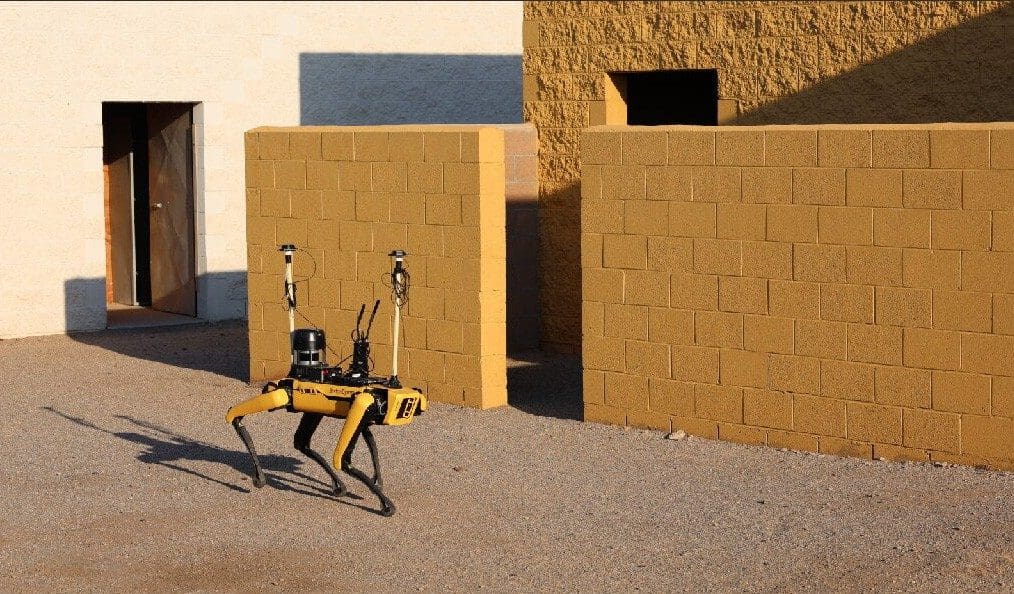
During EDGE, Lockheed Martin conducted highly realistic air/ground teaming scenarios with uncrewed aerial and ground vehicles. A launched effect provided overwatch guidance for a quadruped that navigated urban terrain with human and vehicle obstacles. This technology is designed to operate in environments with degraded or intermittent communications, and scale to many uncrewed systems. Image courtesy DVIDS.

The Details


During EDGE, Lockheed Martin conducted successful AI and launched effects demonstrations including rapid integration into Lockheed Martin’s mission systems thanks to the company’s open architecture systems. Image courtesy DVIDS.

During EDGE, Lockheed Martin conducted highly realistic air/ground teaming scenarios with uncrewed aerial systems (UAS), acting as launched effects surrogates, and uncrewed ground vehicles (UGV).

In one mission scenario, a launched effect provided autonomous overwatch guidance for a quadruped that navigated urban terrain with human and vehicle obstacles. This technology is designed to operate in environments with degraded or intermittent communications, and scale to many uncrewed systems.

The successful demonstrations included rapid integration into Lockheed Martin’s mission systems thanks to the company’s open architecture systems.

The scenario played out in the Air-Ground Littoral, an area where the majority of Army operations, both air and ground occur.

Lockheed Martin sees the Air-Ground Littoral as the space primarily occupied by ground forces, supporting helicopters and launched effects, between the ground and up to a few thousand feet of altitude.

Expert Perspectives

Dan Morrison, technical program manager, Lockheed Martin

“Our experimentation is refining autonomous, collaborative behaviors and proving out AI/ML systems in a realistic and challenging environment. Ultimately, this will further enable commanders to better integrate humans and machines in formation and offer increased standoff and reduced workload for Soldiers.”

Michael Harasimowicz, director, AI Innovations, Lockheed Martin

“AI enabling technologies are critical for the U.S. Army to harness decision advantage by extending and expanding sensor understanding at the edge of the battlespace. One day very soon you will see a mission where a Black Hawk helicopter sends information to launched effects that is out ahead of the fight and communicates with a UGV for first contact with the opposing force.”

Going Deeper: The Lockheed Martin AI Center

Lockheed Martin’s AI Center (LAIC), and the experience of our Applied AI researchers combined with the expertise of teammates who are U.S. Army veterans led to the successes at EDGE.

Fifteen members of the LAIC went to Yuma to support EDGE to support five separate AI-enabled capabilities.

“We are demonstrating our suite of AI capabilities for coordinated use and intuitive control across the Air and Ground domain featuring the Lockheed Martin Stalker uncrewed system and a Spot®, Boston Dynamics Quadruped Robot,” said Harasimowicz. “This synchronization of airborne and ground-based defenses demonstrates Lockheed Martin’s commitment to Force Protection Technologies, a key mission for the U.S. Army.”

Danish Counter-UAS Company MyDefence Chooses Oklahoma City for Second U.S. Location

Thursday, October 17th, 2024

The company will invest $1.2 million, creating nearly 50 new jobs

Oklahoma City – October 15, 2024 – The Oklahoma Department of Commerce (Commerce) is pleased to announce that Danish counter Unmanned Air Systems (c-UAS) company, MyDefence, has selected Oklahoma City for its second U.S. based offices. The company is planning an initial investment of more than $1.2 million. The expansion, which was facilitated by Commerce, will create 48 new jobs and provide military and defense companies with counter-drone technology to combat Improvised Explosive Devices (IEDs) and other threatening drone technology.  

“From an overall perspective, it is great news that MyDefence sets up its second US-based facility less than a year after its first,” said Defense Industry Attache, His Royal Highness brigadier general Prince Joachim. “Having chosen Oklahoma City to expand production, MyDefence will find itself at the heart of innovation and R&D in the field of counter-UAS. This move will undoubtedly inspire other Danish high-tech defence-industries.” 

MyDefence has identified the newly constructed Convergence development near downtown Oklahoma City for its offices and plans to be housed in the building by 2025. The Convergence multi-phase project is located within the newly established Oklahoma City Innovation District. When finished, Convergence will include 950 new offices, along with an amphitheater, retail space and Hilton-Curio affiliated hotel.  

“Oklahoma has some of the strongest aerospace and defense infrastructure in the nation— it only makes sense that we’re seeing more UAS companies invest here. It speaks to the strategic role we play in defending freedoms around the world,” said Governor Stitt. “I’m thankful to the team at the Department of Commerce for landing another great company, and look forward to welcoming MyDefence to Oklahoma.” 

Aerospace and Defense are Oklahoma’s second-largest industries, with an annual economic impact of nearly $44 billion. The state is home to over 1,100 aerospace entities, including manufacturing, MRO, UAS, research and development, and military, which employ over 120,000 workers. In the emerging unmanned industry, Oklahoma is ranked #1 in preparedness for drones, committing 845,000+ acres of sites for UAS and CUAS testing.  Oklahoma is a growing UAS hub for fire and rescue, precision agriculture, safety and security, transmission monitoring, weather, and aerial photography. It’s also home to the first UAS Design PhD program in the U.S. at Oklahoma State University.

“We’re thrilled to see MyDefence join Oklahoma’s thriving defense and aerospace sector,” said Evan Brown, Executive Director of EDGE at Commerce. “Oklahoma offers unparalleled opportunities for growth and a workforce that’s ready to lead, and it’s exciting MyDefence can be apart of it. We couldn’t be more excited to support a company like MyDefence and see how their cutting-edge technology brings new jobs and opportunities to Oklahomans.”  

“We are not only excited to welcome a cutting-edge company like MyDefence to the Oklahoma City business community, we are thrilled they are locating at the Convergence development in our Innovation District,” said Christy Gillenwater president and CEO of the Greater Oklahoma City Chamber. “This is more validation that our investment in creating an innovation culture in Oklahoma City is getting noticed worldwide. MyDefence joins an impressive peer group of companies in our community who are not only providing great jobs to Oklahomans but helping keep the world a safer place.” 

GA-ASI’s Gray Eagle Extended Range UAS Supports Army Vanguard Demos

Wednesday, October 16th, 2024

SAN DIEGO – 15 October 2024 – As part of the U.S. Army’s Vanguard demonstrations that took place in Fort Huachuca, Arizona, on Sept. 17–18, 2024, a Gray Eagle Extended Range (GE-ER) Unmanned Aircraft System (UAS) provided by the U.S. Army Intelligence and Security Command (INSCOM) showcased several new capabilities, including the integration of an Expeditionary Cyber Chassis (ECC) for Command, Control, Communications, Computers, Cyber, Intelligence, Surveillance and Reconnaissance (C5ISR) and Modular Open Suite of Standards (CMOSS) with Communications Intelligence (COMINT) and Mobile Ad Hoc Networking (MANET) radios from Silvus Technologies.

Sponsored by Col. Danielle Medaglia, Product Manager for Uncrewed Aircraft Systems, and operated by U.S. Army Soldiers, the GE-ER successfully demonstrated data relay and voice communication over significant distances, extending the range, quality, and speed of data exchanges for ground units. The demonstration also verified the capability of relaying video and chat messages between ground users equipped with Silvus 4200 MANET radios, highlighting the progress being made in enhancing tactical communications and situational awareness.

While utilizing the COMINT system, Gray Eagle was able to detect stationary and moving targets at significant ranges and provide data for analysis to expeditionary intelligence cells. This expansion of Gray Eagle capabilities is due to its open architecture, which exemplifies the Army’s Transformation in Contact (TIC) concept. The Army benefits by using an existing system to reduce risk and impacts while gaining new capabilities without the prolonged timelines of an acquisition new start.

“We’re excited to work with our Army customer to increase the relevance and capabilities of the GE-ER platform,” said Chris MacFarland, sector vice president of Strategic Development for Army Programs. “These efforts of Vanguard to demonstrate new capabilities hosted on CMOSS hardware will improve the Army’s premier UAS platform in supporting advanced UAS operations.”

Built by GA-ASI and operated by the U.S. Army, the GE-ER participating in the exercise represents the future capabilities of the Gray Eagle 25M’s open architecture design, allowing for rapid integration of vendor-agnostic sensors, radios, and payloads needed for Multi-Domain Operations. The ability to fully integrate internally mounted long-range sensors and launched effects, while controlling them with modernized laptop ground control systems, significantly enhances its survivability and lethality. Along with advanced data links, resilient GPS navigation systems, and an upgraded propulsion system, the GE 25M is resilient to electronic threats when deployed in expeditionary and austere locations.