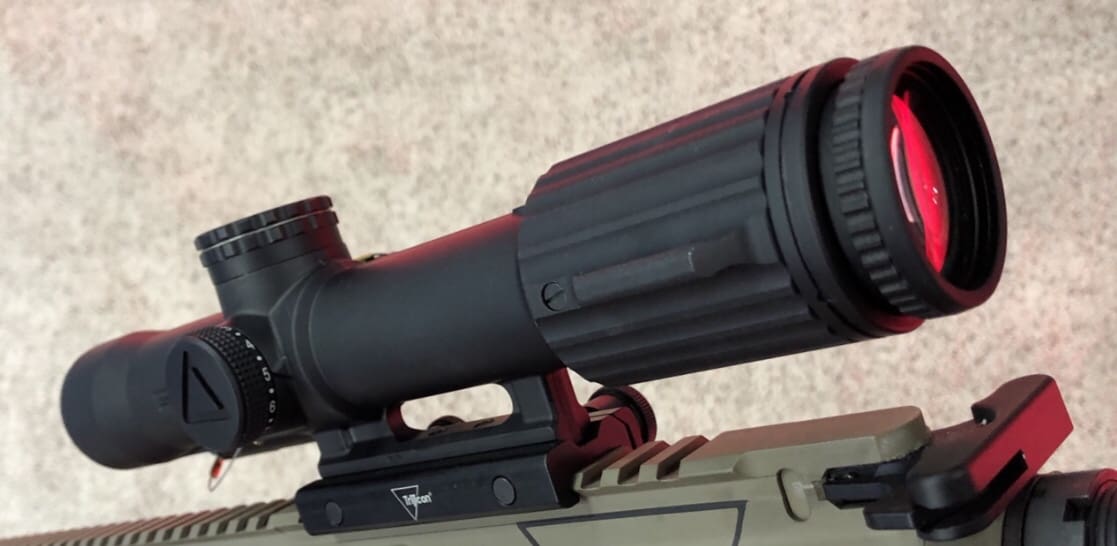
XC3 Weaponlight

Archive for the ‘USMC’ Category

Harvested HMMWV Parts Will Save Corps Millions, Increase Survivability of JLTV

Thursday, July 26th, 2018

MARINE CORPS BASE QUANTICO, Va. —

A harvesting effort by Program Executive Officer Land Systems and Marine Corps Systems Command could save the Corps millions and make one of its newest vehicles more survivable.

The Gunner’s Protection Kit, managed by Infantry Weapons within MCSC’s Portfolio Manager Ground Combat Equipment Systems, is currently installed on High Mobility Multipurpose Wheeled Vehicles. As a cost-savings measure, the kits will be removed from HMMWVs and installed on Joint Light Tactical Vehicles as they are fielded to the fleet next year. Using harvested parts instead of buying new potentially saves the Corps more than $100 million.

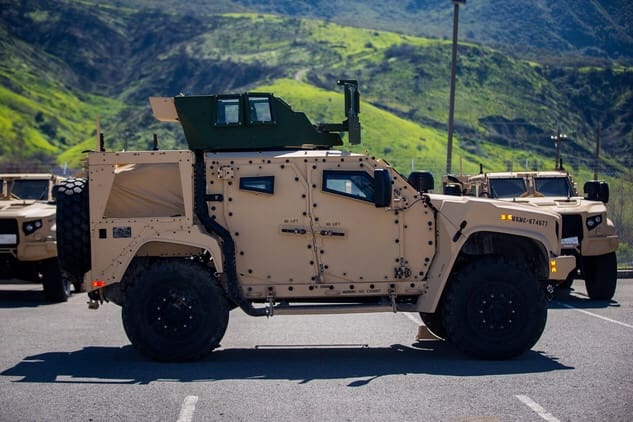
Logisticians and equipment specialists from Marine Corps Systems Command and Program Executive Officer Land Systems install a Marine Corps Transparent Armor Gun Shield on a Joint Light Tactical Vehicle May 1. The installation is part of a cost-savings plan to harvest Gunner’s Protection Kits and other equipment from older High Mobility Multipurpose Wheeled Vehicles and increase the JLTV’s survivability. (U.S. Marine Corps photo by Kristen Murphy)

“The harvesting strategy was developed by the JLTV Joint Program Office in 2012 as part of our efforts to meet affordability metrics for the program,” said Andy Rodgers, program manager for Light Tactical Vehicles in Program Executive Officer Land Systems. “Our collaboration with [Marine Corps Systems Command’s] Program Manager Infantry Weapons is key to that strategy.”

In the spring, logisticians and other program personnel from Infantry Weapons conducted a Proof of Principle, or PoP, going step by step through the process of removing a Marine Corps Transparent Armor Gun Shield—part of the GPK family of systems—from a HMMWV and placing it on a JLTV. The MCTAGS will be installed on the Heavy Guns Carrier JLTV variant.

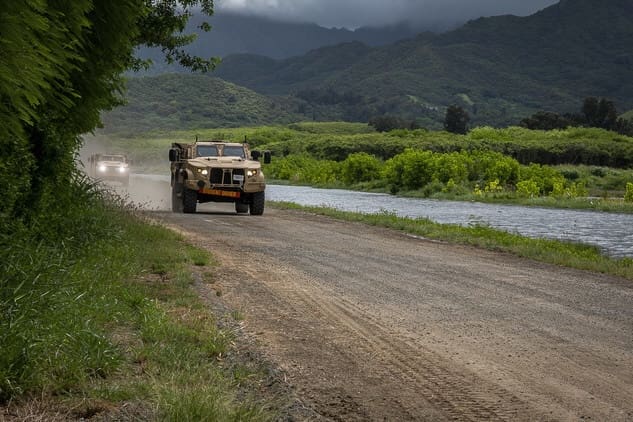
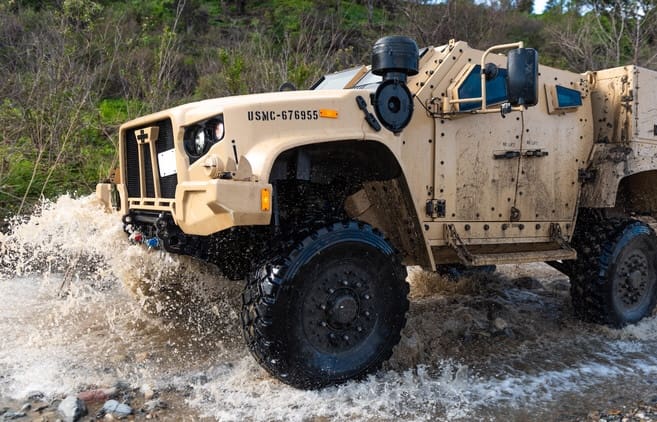
Marines from 1st Battalion, 7th Marines prepare to load Joint Light Tactical Vehicles onto Landing Craft Utility boats in preparation for a JLTV Multiservice Operational Test and Evaluation amphibious landing March 2, at Camp Pendleton, California. As part of a cost-savings plan, the Marine Corps will harvest Gunner’s Protection Kits and other equipment from older High Mobility Multipurpose Wheeled Vehicles and install them on JLTVs to increase the new vehicles’ survivability. (U.S. Marine Corps courtesy photo)

The PoP will help the program office develop, verify and publish a modification instruction to guide the Corps through the installation process, said Kevin Marion, a logistics management specialist in Infantry Weapons.

“The PoP was successful,” Marion said. “We started with existing [instruction] manuals for the MCTAGS, and then added steps for putting it on the new vehicle. In addition to documenting the steps, it also gave us a chance to identify any parts that can’t be reused because the degree of serviceability is questionable.”

The JLTV program office has completed similar PoP efforts with the Improved TOW GPK, or I-TGPK, which will be installed on the Close Combat Weapons Carrier variant of the JLTV. The CCWC can be armed with TOW—tube-launched, optically tracked, wire-guided—missiles.

The JLTV is an Army-led light tactical vehicle program. It will partially replace the Army and Marine Corps HMMWV fleet, providing a more survivable vehicle, and closing an existing gap in payload, performance and protection. The JLTV comes in four variants with payloads ranging from 3,500 to 5,100 pounds of cargo, and can go more than 70 miles per hour as well as traverse over arduous terrain.

Although only two variants will be equipped with the MCTAGS or I-TGPK, all JLTVs will contain harvested radios, antennas and other communications equipment from HMMWVs.

“It’s our responsibility as MCSC to be good stewards of taxpayer money, so if we have equipment that is in good condition, we should go ahead and use it,” Marion said.

An advantage to Marines is the tactics, techniques and procedures will remain largely unchanged for the harvested equipment, so they already know how to operate it, Rodgers said.

The HMMWVs will be demilitarized and traded through the Equipment Exchange Program. This program enables the organization to work with commercial vendors who can sell or use the vehicles as they see fit.

“The exchange program is no cost to the government, and no money changes hands,” Rodgers said. “In exchange, the vendor buys equipment we may need like MCTAG covers or ring mounts for the JLTV, and they ship it wherever we need it.”

Once vehicle fielding begins next year, Marine Corps field service representatives will execute the harvesting plan for the units that receive them, Rodgers said. This is part of the program’s “total package fielding” plan.

“As we field the JLTV, we’ll collect the HMMWV, harvest the parts, install them and then return the new vehicles [to the units],” Rodgers said.

Fielding for the JLTV will begin in spring 2019 to the Marine Corps School of Infantry-West at Camp Pendleton, California; School of Infantry-East at Camp Lejeune, North Carolina; The Basic School at Marine Corps Base Quantico, Virginia; and Motor Transport Maintenance Instructional Company at Camp Johnson, North Carolina. Fielding to the operating forces will begin in the summer of 2019. In all, the Army plans to purchase 49,000 JLTVs and the Marine Corps will purchase 9,091.

By Monique Randolph, MCSC Office of Public Affairs and Communication | Marine Corps Systems Command
USMC Small Arms Modernization Update

Thursday, May 10th, 2018

During NDIA’s Annual Armaments Meeting, Lt Col Christopher Woodburn (USMC, Ret), the Deputy, Maneuver Branch, Capabilities Development Directorate, discussed Marine Corps modernization efforts. He began by reiterating that Commandant of the Marine Corps, Gen Robert Neller’s priority remains the Infantry regarding small arms.

U.S. Marines with 3rd Battalion 8th Marine Regiment fire the M27 Infantry Automatic Rifle during a live-fire weapons exercise at range F-18 on Camp Lejeune, North Carolina in 2017. (Lance Cpl. Michaela R. Gregory/ Marine Corps)

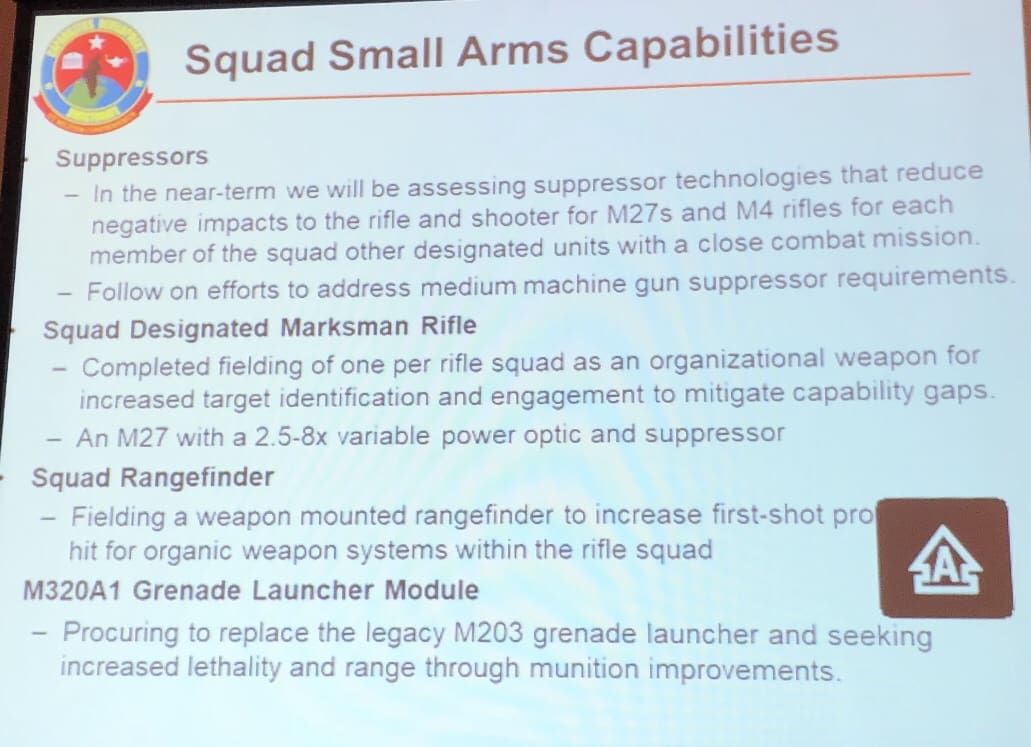
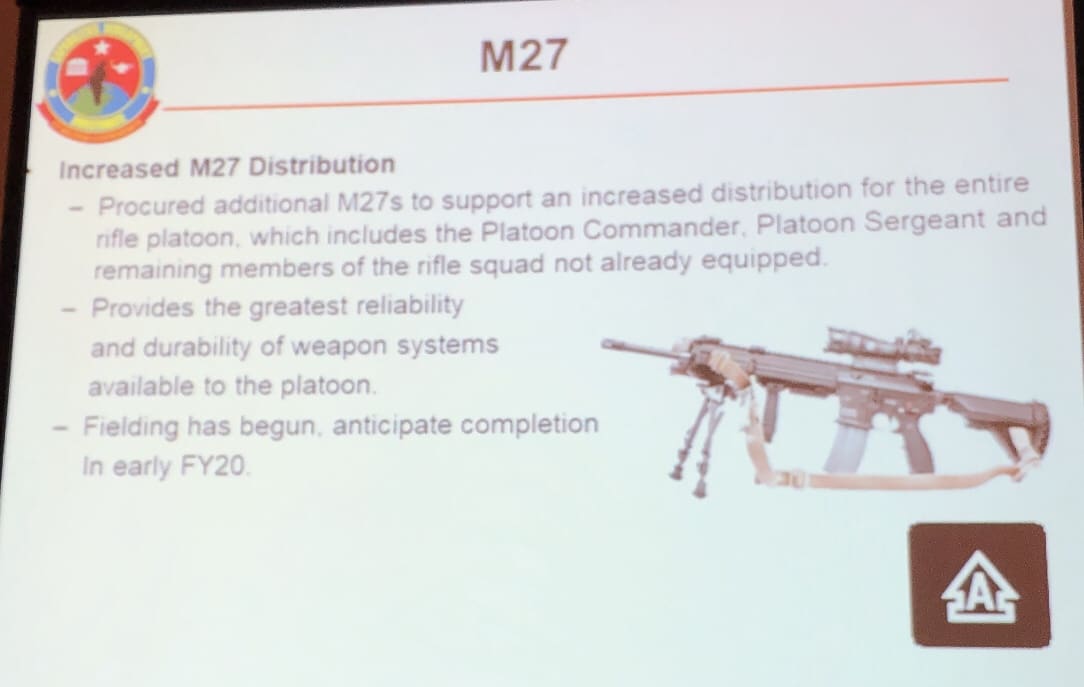
Next, he mentioned the recent M27 contract and clarified that the M27 Infantry Automatics Rifle would be fielded to the entire Rifle Platoon from the Platoon Commander on down. Fielding will begin in FY18 and continue through FY20.

The M4s displaced by the M27 fielding will be used to replace remaining M16A4s in the Ground Combat Element.

Additionally, he explained that the M38 Designated Marksman Rifle variant of the M27 was a Squad element weapon and that the Squad leader would assign it to his best marksman. Marines have also begun receiving the Squad Range Finder to improve target acquisition and engagement.

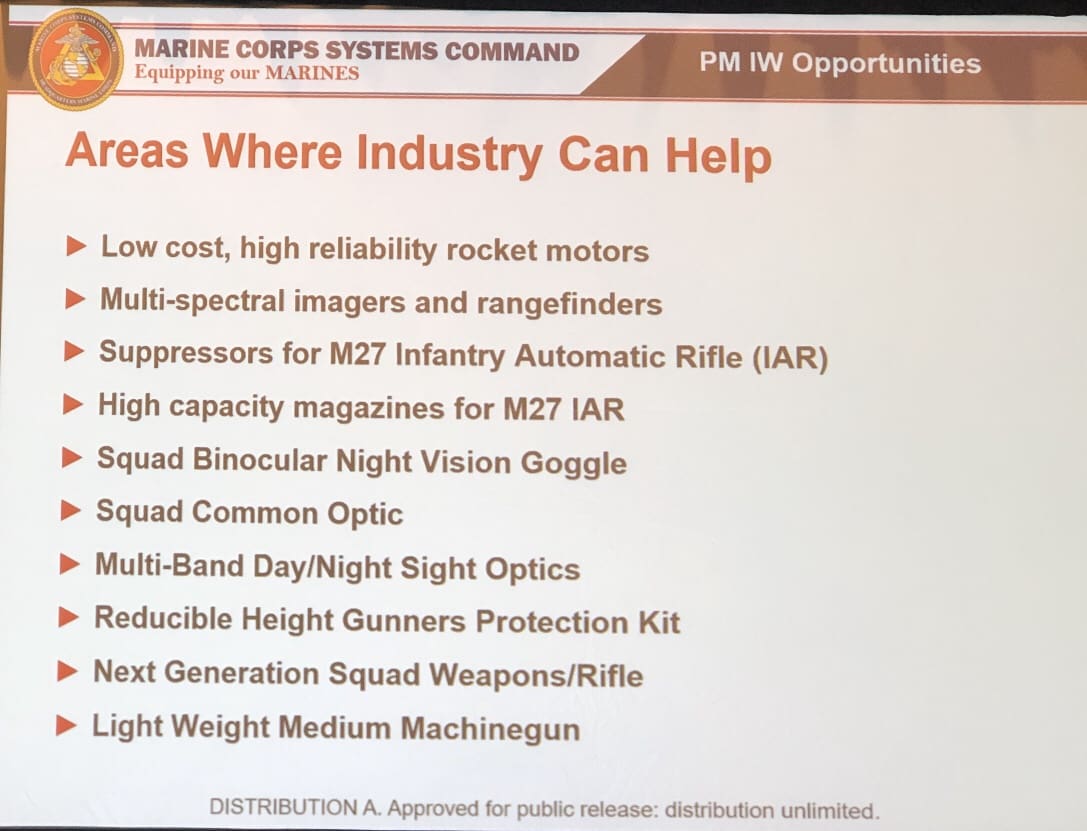
Woodburn stated that the Marines continue to evaluate suppressors for use with the M27 and M4 as well as Medium Machine Guns.

Next year, the Marine Corps will begin fielding the M320A1 40mm Grenade Launcher as a replacement for the M203. It will be used in standalone mode only, and not mounted to the IAR.

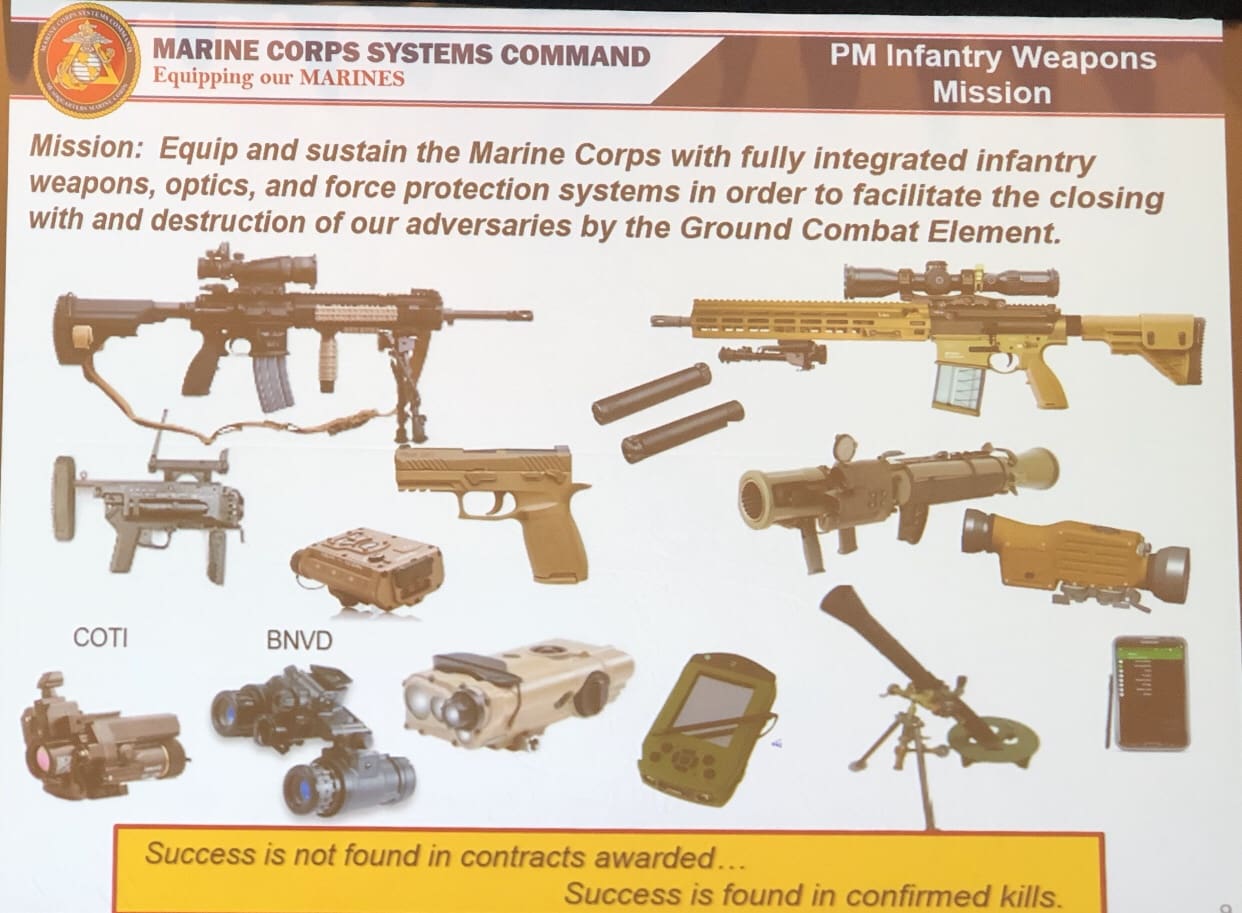
The Marine Corps has also adopted the Mk 13 Mod 7, sniper rifle which has been used for many years by USSOCOM. The Marines consider it an interim capability until they can field the Advanced Sniper Rifle in 7.62mm, 300 and 348 Norma Mag in the early 20s. They will also begin to see the 84mm M3E1 Carl Gustaf. The Marines will leverage the seven different rounds SOCOM has developed for the recoilless rifle.

97F58514-FB4A-4C2B-A3FF-E4AEAA425891

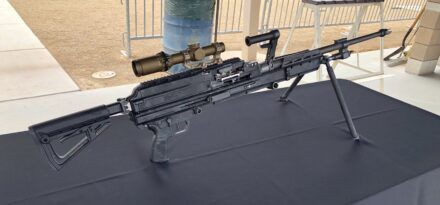
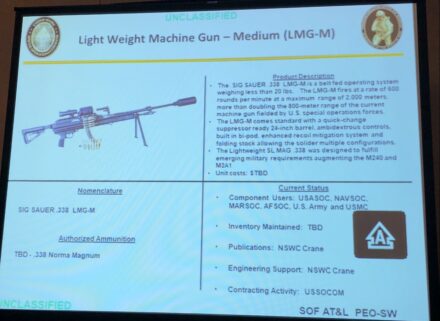
In other joint projects with SOCOM, the Marines continue their support of the 338 NM Lightweight Medium Machine Gun. They are also participating in the Army-led development of the Next Generation Squad Automatic Rifle.

Woodburn finished up by relating that the Marine Corps will begin fielding of the Modular Handgun System in FY19 to replace their legacy pistols.

M27 Accessories Evaluated

Saturday, April 21st, 2018

I’ve been sitting on this photo for awhile, but now that it has made it out into the wild, I figure it’s ok to share.

img_8883.jpg

I’m told it was taken at Quantico Marine Corps Base at Weapons Training Bn, and I’ve had a copy of the photo for several months.

The three weapons were under evaluation, pursuant to the impending M27 fielding. You’ll also note a few BE Meyers’ MAWLs and Geissele accessories such as the Upper Receiver Group – Improved and High Speed Selector Switch as well as B5 Systems stocks. That’s not to mention the optics. The URG-I was looked at as an alternative to fielding additional M27s, but quickly dropped as the Marine Corps has laid a solid path forward.

However, let me be very clear about this. A lot of things have been looked at, but the M27 fielding is under such close scrutiny that no changes will be made to the additional weapons, expected to be fielded later this year. Any changes will come down the road.

No, The Marines Haven’t Issued A Contract For Additional M27s

Thursday, February 22nd, 2018

I keep getting asked if the USMC has let a contract for additional M27 Infantry Automatic Rifles. Apparently, a few weeks ago a gun blog called Guns America reported that the Marine Corps had awarded Heckler & Koch a contract for additional M27s. The problem is, it’s untrue.

The author’s reasoning was that the “protest period” was over and consequently, a contract had been let. Once again, this isn’t true. For some reason, H&K representative Bill Dermody agreed with the interviewer during a video taken during SHOT Show by Guns America, giving further credence to the story.

Last Summer, Marine Corps Systems Command issued a pre-solicitation intent to solicit and negotiate with Heckler & Koch (H&K), for up to 50,814 M27 Infantry Automatice Rifles (IAR)Since then, they’ve publicly said and done nothing. There hasn’t been a “protest period” because there hasn’t been a contract award issued by the Marines.
Unfortunately, other websites who didn’t know what they were talking about, picked up the story and shared it.

Sure, the Marine Corps is interested in purchasing additional M27s to outfit their Infantry Forces and H&K would love the business, but the reality is that it hasn’t happened. At least, yet. The Commandant of the Marine Corps has publicly stated his desire to do so and I know the Marines are working toward that end, but they’ve still got some things to work out.

I promise you; as soon as I can tell you it has happened, I will.

USMC Fields M38 Squad Designated Marksman Rifle

Tuesday, December 26th, 2017

ABA5C741-76E0-43ED-96B6-5D88AC1785BF

Back in May we told you that the US Marine Corps planned to field M27 Infantry Automatic Rifles Equipped with 3-9x scopes as Squad Designated Marksman Rifles. Apparently, work began not long after and units are now equipped with the rifle, designated as the M38. The Marines adopted the 5.56mm M27 in 2011 to replace the M249 Squad Automatic Weapon in the infantry squad. The M27 is manufactured by Heckler & Koch and is based on the HK416.

B9A284C6-2D86-48DD-A26B-9174DA1024B1

The optic actually used has been identified as the Leupold TS-30A2 Mark 4 MR/T 2.5-8x36mm with a tuned Mk262 77gr turret. Interestingly, the Marines are supposed to transition to the M855A1 round this year.

E2F7AD30-0DB0-4147-98D8-0C7C68C144AE

In these photos, Marines with 3rd Battalion 8th Marine Regiment fire the M38 Squad Designated Marksmanship Rifle during a live-fire weapons exercise at range F-18 on Camp Lejeune, NC, Dec. 8, 2017. Photos by LCpl Michaela R. Gregory.

Marine Corps Fields “Game Changer” Biometric Data Collection System

Thursday, December 14th, 2017

MARINE CORPS BASE QUANTICO, Va. — In September, Marine Corps Systems Command completed fielding a new biometrics system to help deployed Marines identify and track the movement of individuals encountered on the battlefield, conduct entry control point operations, and determine who is a friend or foe.
Identity Dominance System-Marine Corps, or IDS-MC, is a simple and effective biometric data collection, matching, and transaction management system that is composed of a handheld device, known as the Secure Electronic Enrollment Kit, and a laptop computer with specialized biometric collection sensors and a badge printer.

IDS-MC replaces the Biometric Enrollment and Screening Device to assist with detainee management and questioning, base access, counterintelligence screening, border control and law enforcement operations. Unlike the BESD, IDS-MC’s transactional data management capability conveniently collects, shares, matches and stores identity information immediately, allowing the user to connect to the Tactical Data Network, manage and submit collected data and receive responses and feedback on submissions. This improves on the legacy system, which could take days to download data via a CD or DVD, and then Marines had to transmit that vital identity information from a separately connected computing system. This process was not only logistically cumbersome, but the latency in data submission and response receipt created force protection mission challenges for the Marine.

15064A65-57B8-4876-94CA-D8F15F20C17B
Marines conduct a field user evaluation for the Identity Dominance System-Marine Corps, or IDS-MC, in Dahlgren, Virginia. In September, Marine Corps Systems Command completed fielding of the IDS-MC, which is a new biometrics system to help deployed Marines identify and track the movement of individuals encountered on the battlefield, conduct entry control point operations, and determine who is a friend or foe.
“The IDS-MC is more convenient because it connects directly to the Marine Corps’ Tactical Data Network, allowing Marines to share data and submit biometrics and receive the responses effortlessly,” said Sarah Swift, Identity Operations Team lead for Biometrics and Forensics Systems at MCSC.

To develop the IDS-MC, the Identity Operations Team identified a need for a portable, easy-to-use system via feedback from Marines in the fleet. The system was created to directly address the specific needs of Marine Expeditionary Forces in a contested environment.

Using IDS-MC, Marines collect biometric data by capturing a person of interest’s fingerprints, iris and face images. That data can then be matched with pre-existing information onboard the system, either on a BEWL or other lists, such as an access control list used for base force protection. The IDS-MC also has the capability to capture location, biographical and any other reference data that may be useful to an intelligence analyst now or in the future.

The IDS-MC user submits biometric information to the Department of Defense’s Automated Biometric Identification System authoritative database via a web portal, allowing data to be shared across the Biometrics enterprise, and also aiding in the creation of the DoD extensive Biometric-Enabled Watch List, or BEWL. The BEWL contains an ongoing collection of biometric intelligence that helps users determine what actions to take immediately when they encounter a person of interest. Additionally, the Marine Corps Intelligence Agency Identity Intelligence Analytical Cell, or MCIA I2AC, reviews the IDS-MC user’s biometrics submissions and other collected biographical and reference data, and provides direct support to the submitting Marines, providing them analysis reports and intelligence products for potential Persons of Interest.

“The BEWL helps Marines match nefarious people they might encounter anywhere in the world to the ones listed in the database,” said Swift. “We support Marines by providing them the most up to date BEWL, and then they can collect a person’s biometrics. If it shows up in the system as a match, they’ll be notified with a pop-up on the device.”

“All of this provides the Marine Air-Ground Task Force with the ability to rapidly and efficiently identify people encountered in the battle space in support of targeting, military intelligence, law enforcement operations and force protection,” said Maj. Keystella Mitchell, project officer for IDS-MC.

In addition to identifying known threats, the system also collects information on potential future threats and stores it for future reference. If an individual is a match in the system, Marines are able to immediately receive that information and use it to inform on-the-spot decisions.

“It can be difficult to determine who the enemy is because they truly blend in with their surroundings,” said Mitchell. “The IDS-MC is a game changer and force multiplier as a connected system for the commander on the ground because they can identify the threat and take action much quicker than before.”

In addition to the planned fielding of the IDS-MC system, an urgent system quantity shortfall was identified by the Special Purpose Marine Air-Ground Task Force and Marine Corps Forces Central Command customers. This required an unplanned increase in the number of production assets which required a fielding re-prioritization strategy, additional rapid procurement and integration. The Identity Operations Team adapted its strategy, and within two months of validating the requirement, it fielded the additional systems.

The fielding of the IDS-MC system has led to a 154 percent increase in the biometric collections submitted to MCIA I2AC and resulted in 11 watch list hits in just the first month of fielding.

The IDS-MC is managed by the Identity Operations Team which falls under Command Element Systems at MCSC.

By Kaitlin Kelly, MCSC Office of Public Affairs and Communication

Happy Birthday Marines!

Friday, November 10th, 2017

1266B063-F08E-45A1-B4C0-5E779F521248

The story goes that by 1918, the US Marines were fully employed putting foot to Central Power ass, but when the Germans saw how hard the Devil Dogs partied on their birthday, they promptly surrendered the next morning. That’s right, the service that was founded in a Tavern is why we celebrate Armistice Day on 11 November.

Thanks for keeping the world safe Marines!

The Corps’ Secret Agents Get Their Own 007

Wednesday, November 8th, 2017

MARINE CORPS BASE QUANTICO, Va. — The Marine Corps is equipping Marines with a new weapon, providing enhanced concealed carry capabilities at an accelerated rate and lower cost to the Corps.

IMG_5324
Individual Weapons project officer Gunnery Sgt. Brian Nelson prepares to draw the M007 concealed carry weapon. The M007 offers enhanced concealed carry capabilities, which includes a smaller frame, ambidextrous slide stop lever and flared magazine well. Marine Corps Systems Command recently fielded the M007 to Marine and civilian CID agents and members of Helicopter Squadron One. (U.S. Marine Corps photo by Jennifer Napier)
The Glock 19M–called the M007 by the Corps–replaces the M9 service pistol for personnel requiring a weapon that can be easily concealed.

The Marine Corps requires that all accredited Marine Corps Criminal Investigators, both civilian and military, be armed with a concealable pistol when on duty in civilian attire. This concealed weapon capability ensures those performing official duties–such as law enforcement or security personnel–are not readily identified as being armed.

“The M007 has a smaller frame and is easier to conceal, making it a natural selection to meet the Marine Corps’ conceal carry weapon requirement,” said Gunnery Sgt. Brian Nelson, Individual Weapons project officer at Marine Corps Systems Command.

In coordination with the Federal Bureau of Investigation, which adopted the weapon in 2016, the Corps fielded the M007 earlier this year to Marines and civilians in the Marine Corps Criminal Investigation Division, as well as members of Helicopter Squadron One–also known as Marine One.

IMG_5325
Marine Corps Systems Command is equipping Marine and civilian CID agents and members of Helicopter Squadron One with the M007. The M007 offers enhanced concealed carry capabilities, which includes a smaller frame, ambidextrous slide stop lever and flared magazine well. The weapon’s smaller frame makes it easier to conceal, as demonstrated in the photo. (U.S. Marine Corps graphic)





Aside from concealability, the M007 has several physical improvements over its predecessor. The grip lacks finger grooves but has a textured frame, improving the ergonomics of the weapon and providing a consistently comfortable grip with traction for a wider range of users. The ambidextrous slide stop allows for both right- and left-handed use. The magazine release of the M007 can also be changed and the magazine well is flared, making the system easier to reload, said Nelson.


Collaboration between the product team at MCSC and the FBI played a key role in the Corps’ ability to hasten the otherwise lengthy acquisition process.

“The fielding of the M007 is an example of how we can streamline the acquisition process by reviewing another service or agency’s test data to see if it fits the Marine Corps’ need,” said Lt. Col. Paul Gillikin, Infantry Weapons team lead at MCSC. “We received the initial request for a new concealed carry weapon system in April 2016. By collaborating with the FBI, we were able to procure, establish sustainability plans and start fielding the weapon to Marines by May 2017.”

Typically, the acquisition process of a new weapons system–from the time the requirement is received by MCSC to the time the system is fielded to the fleet–takes months, if not years, to complete. By leveraging thorough test data performed by the FBI, MCSC’s team reduced their own testing time. The team also carefully planned to ensure the M007 is fully supported, sustainable, and meets all logistics and safety requirements, enabling MCSC to meet and deliver the concealed carry weapons systems Marines need in a relatively quick turnaround time, said Gillikin.

Program Manager Infantry Weapons, which falls under MCSC’s Ground Combat Element Systems portfolio, manages the concealed carry weapons program for the Marine Corps.

By Ashley Calingo, MCSC Office of Public Affairs and Communication