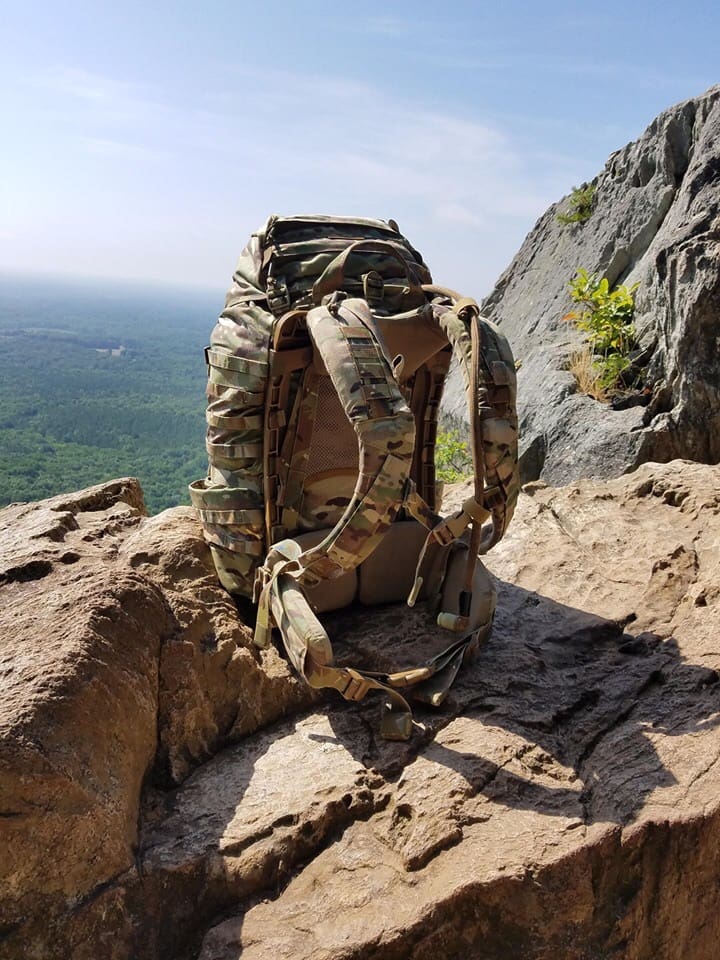
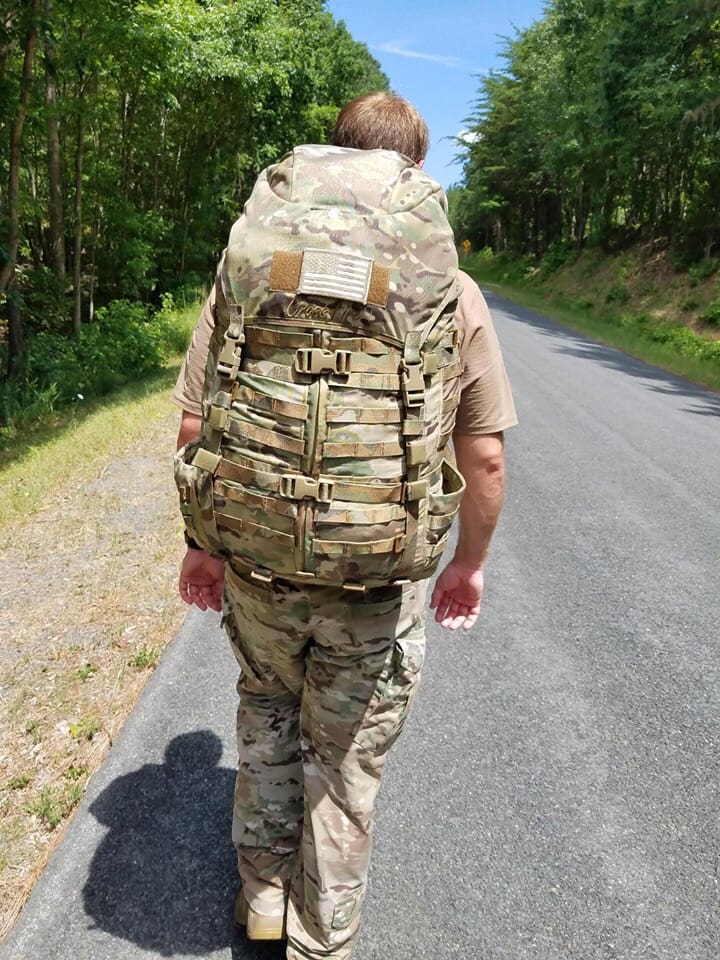
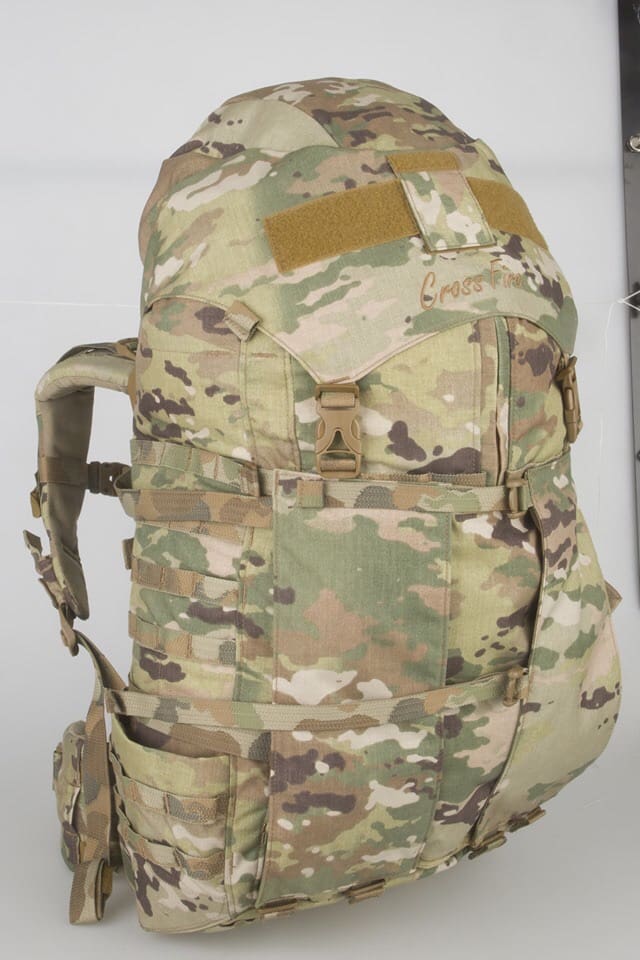
FORT BENNING, Georgia — Army Rangers here are evaluating three Mystery Ranch backpack variations by jumping out of U.S. Air Force C–130 Hercules aircraft.

The three commercial off the shelf variants tested by Soldiers with the 75th Ranger Regiment’s 3rd Battalion included an Assault Pack, Patrol Pack, and Recce Pack.
Forty-seven Soldiers from the 75th Regimental Special Troops Battalion conducted 45 static line infiltration training jumps on Benning’s Fryar Drop Zone, using the backpacks as part of their combat equipment load.
The new backpacks range from 3,200 cubic inches for the Assault pack to 6,200 cubic inches for the Recce pack, according to Lt. Col. Dave Dykema, with the U.S. Army Operational Test Command’s (OTC) Airborne and Special Operations Test Directorate (ABNSOTD) based at Fort Bragg, North Carolina.
He said the new backpack variations provide modularity to support various mission requirements not supported by the Army’s legacy All-purpose Lightweight Individual Carrying Equipment (ALICE) backpack.
“The ABNSOTD was professional and user friendly,” said Capt. Joshia Auerbach, the 75th’s Regimental Air Officer.
“They responded to our need rapidly, and tested the equipment in a manner that was quick and efficient for the Ranger Regiment, expertly incorporating testing into our training schedule.”
“These rucksacks provide a modern load carrying solution that can now be certified for static line airborne operations,” said Staff Sgt. Jake Leveille, 75th Regimental Air NCO.
Spec. Thomas Lewis, Squad Rifleman, said he understood the importance of operational testing the new backpacks.
“Participating in this test provided me with insight on how the Army ensures our equipment is safe and suitable, before fielding it to the force,” he said.
“Soldiers enjoy getting involved in training hard during operational testing,” said Dykema.
“They have the opportunity to operate and offer up their own suggestions on pieces of equipment that can impact development of systems that future Soldiers will use in support of combat missions,” he added.
Highly-instrumented test drops help test overall survivability of equipment used during airborne operations, according to Dykema.
By SFC Ian Seymour, Airborne and Special Operations Test Directorate, U.S. Army Operational Test Command
Editor’s Note: The test packs are the SPEAR program packs, selected for issue by USSOCOM which were being certified for static line jumps.
This is the thirtieth installment of ‘Max Talk Monday’ which shares select episodes from a series of instructional videos. Max Velocity Tactical (MVT) has established a reputation on the leading edge of tactical live fire and force on force training. MVT is dedicated to developing and training tactical excellence at the individual and team level.
It is vital to understand how to react to effective enemy fire, but to do so in a way where you do not endanger your buddies or bystanders. It’s not good enough to be able to shoot fast, you have to be able to target discriminate and implement safety angles between you and members of your team. This video is an explanation of the problems of fratricide, safety angles, and a suggested drill to help you train. Do not confuse tactical cool-guy shooting with real tactical context. Train to win the fight!
Max is a tactical trainer and author, a lifelong professional soldier with extensive military experience. He served with British Special Operations Forces, both enlisted and as a commissioned officer; a graduate of the Royal Military Academy Sandhurst. Max served on numerous operational deployments, and also served as a recruit instructor. Max spent five years serving as a paramilitary contractor in both Iraq and Afghanistan; the latter two years working for the British Government in Helmand Province, Afghanistan.
Saturday’s launch of the “Expedition 60” space mission from Baikonur Cosmodrome in Kazakhstan honored the 50th Anniversary of the Apollo 11 moon landings. It also marked a significant milestone of international cooperation as a crew consisting of a US astronaut, a Russian cosmonaut and an Italian astronaut embarked for a mission aboard the International Space Station. If you didn’t get a chance to view the live stream of the launch, you can watch NASA’s recording of it here.
The launch broadcast was also significant for another reason. In a pre-recorded interview COL Morgan was seen wearing the “Class B” version of the new Army Green Service Uniform. In the screen grab image below you can see some of the notable features of the AGSU shirt and tie combination. Note the khaki-tan color of the shirt and the dark olive drab color of the Officer’s Style side-cap, the slip-on shoulder rank insignia, and the tie. Also noteworthy is the scalloped shirt pocket flaps that reflect the traditional style of the WWII era Army dress uniform.
The Army Green Service Uniform is scheduled to be available for purchase at Army Exchange Service stores in April 2020, and to be issued to Soldiers upon completion of Advanced Individual Training in July 2020. At the present time the uniform is going through a wear-test phase and some details, such as the final shirt fabric, are still being worked out.
We wish COL Morgan and his colleagues aboard the ISS a successful mission and a safe return to earth. In the meantime, we also look forward to continuing to bring you further information about the Army Service Green Uniform. Follow Flying Cross on Instagram and Facebook to keep up to date, and also visit our dedicated web site for further info: www.GoAGSU.com
(Photo credits: NASA)
Note: This article was modified to exclude details about short fabric as a final material decision has not yet been made by the US Army.
Coming to TRIGGRCON, one holster to rule them all!
The ARX LUX from Tenicor is an outside the waistband holster, compatible with a variety of compact weapon lights (the Streamlight TLR7, Surefire XC1-B, XC2, and the Inforce APLc). Retention is not dependent on the light, so the holster still works, even without a light.
Available for the Glock 19 with more models to follow.
The Citadel slide by ZEV Technologies is the latest addition to its popular line of Glock aftermarket slides. Machined from 17-4 stainless steel billet, the Citadel is offered in Black DLC or Titanium Gray and comes pre-cut for a Trijicon RMR. Available in Gen 3, 4 and 5 for the Glock 17 and 19 models.
Unique features include angled serrations located at the front and rear of the slide to provide a positive grip by naturally moving your hand downward, whether gripping from the front or the back while manipulating the slide, performing press checks or during malfunction clearing drills.
The top of the slide is finished with micro-channels to reduce glare while aiming down the sights. The Citadel is windowless, making it perfect for duty or conceal carry.
ZEV Citadel Slide features:
• Machined from 17-4 Stainless steel billet
• Lowered ejection port to aid in ejection of brass
• Match grade, precision milled tolerances that are tighter than factory
• Improved accuracy and grouping performance upon installation
• DLC or PVD coatings offered have a Rockwell hardness rating above that of factory coatings
• RMR adapter plate included
ZEV PRO Barrel
ZEV Technologies PRO Barrels offer a smooth exterior and a streamlined hood design that incorporates the ZEV logo slashes and caliber marking. Offered in Black DLC or Burnt Bronze, threaded and non-threaded for Glock 17 (Gen 1-4) and Glock 19 (Gen 1-5) models. The PRO barrel line features extremely tight tolerances and are manufactured with pre-hardened chromium stainless steel (416R) that was originally designed for use in Match Grade rifle barrels. This material provides high tensile strength and toughness to withstand typical chamber pressures while still being highly corrosion resistant.
ZEV PRO barrel bores are some of the most precise in the industry. Every barrel is double honed (rough and finish) until a minimum surface finish of 16 RA is reached. During this process the barrels are held to a final dimension of +/- 0.003″ for consistency and accuracy.
The barrels are cut rifled and 100% inspected for groove dimensions and broach finish. Available standard and threaded with ½ x 28 suppressor threading.
ZEV PRO Barrel specs:
• 416R Rifle Barrel Quality Stainless Steel
• Match grade drop in barrel
• Final dimension of +/- 0.003? for consistency and accuracy
This interesting one came from a reader. He calls it his “Retro Postmodern Franken “ARRR” Pistol,” further describing it as “Incorporating modern functionality with kitschy classic accoutrements selectively supercharged.”
Build details:
Spikes Tactical Lower Registered as Pistol
Noveske Short Throw Trigger
KNS Anti-Rotation Pins
Geissele SSA Trigger
Norgon Ambi-Mag Catch
MAGPUL K2 Grip
MAGPUL Enhanced Trigger Guard
MAGPUL ASAP End Plate
SB Tactical SBA3 PIstol Brace
USGI Standard Capacity Magazine with MAGPUL Anti-Tilt Follower & Ranger Floor Plate.
FORT SILL, Okla. — With the growing threat of cyberattacks, the U.S. Army Field Artillery School has placed a renewed emphasis on learning manual methods of fire direction and gunnery.
“Bringing back the charts is a big deal,” said Staff Sgt. Chad Payne, an instructor for the 13J fire control specialist course. “If you don’t understand the chart, you won’t actually understand what the automated system is doing for you.”
About a decade ago, the school began reducing its emphasis on teaching manual methods, said Col. Samuel Saine, assistant commandant. That’s because improvements to the Advanced Field Artillery Tactical Data System enabled AFATADS to be used effectively in all situations, he said, and it dramatically sped up the firing process.
Then electronic warfare in Crimea and Ukraine shut systems down there, and at the same time, cyberattacks began disabling automation systems at civilian firms. These attacks “woke some people up,” Saine said.
Over the past year, the Field Artillery School commandant has made it a priority to reinsert manual or degraded operations back into the program of instruction for all courses, Saine said.
BASIC TO BRIGADE COMMAND
The renewed emphasis is not only in advanced individual training for new Soldiers, he said, but also in all of the officer courses from basic up to the pre-command course for colonels.
Now students begin AIT using maps to plot and they learn the math behind firing solutions.
“They’ll do manual operations until we know they fully understand the basics,” Payne said, explaining only then do students move on to the automated system.
This method provides students with a better appreciation of the concepts, he said, enabling them to “hit the ground running” at their first units.
They are also better prepared when electronic warfare takes the AFATADS system offline, he said, and degraded operations are now part of the scenario during AIT field exercises.
When systems go down, Soldiers are now trained on how to transition between the automated and manual methods, confirmed Pvt. Cynthia Antaya, a 13J student at the school.
EW can affect communications, automated systems and access to GPS. So 13J Soldiers break out their charts, pencils, plotting pins and protractors for degraded operations.
“It’s going to be important to know your charts and darts and how to go manual and still be able to continue on with your job, even when everything’s down,” Antaya said.
CANNON CREWS
It’s essential that artillery sections “never sway from our No. 1 task,” Saine emphasized, “and that No. 1 task is to provide uninterrupted fires to the maneuver elements of our Army — the infantry and armor.”
Manual or degraded operations for firing howitzers are actually a 20-level task for the gunner and primarily only 10-level tasks are taught at AIT, said Staff Sgt. Rodrick Stone, an instructor for the 13B cannon crewmember course.
Some instructors, however, still demonstrate manual sighting for the students, Stone said.
“I believe it’s very important that they learn both ways, because in the event that the digital goes down, you have to have a failsafe — a backup plan,” he said.
The Field Artillery School has helped work degraded operations into the program of instruction for the Advanced Leadership Course, Saine said. Since howitzer gunners are by doctrine sergeants, learning how to manually sight howitzers is emphasized in ALC, he said.
With degraded operations, the gunner switches to a panoramic telescopic sight, Stone said. Aiming poles and firing stakes are used. “We already have an additional primary aiming reference that’s set up; he instantly sights in off of that,” Stone said.
Then the traverse hand wheel is spun manually to raise or lower elevation of the howitzer tube, he explained.
“When I was coming in, degraded operations was the only thing that was going on,” Stone said. “There was no digital systems at the time.”
Now the threat of cyber warfare once again makes degraded operations of paramount importance, he said.
“We have more capacity and capability than they do,” Saine said of the enemy, “so they’re going to try to find creative ways to degrade and deny some of our systems.”
BEYOND THE CLASSROOM
The emphasis on degraded operations is not only happening in the schoolhouse, it’s in the field as well, Saine said. Doctrine has been updated and so have performance standards.
Training Circular 3-09.8 for fire support was recently updated with increased performance standards for manual gunnery and degraded operations.
The chief of field artillery emphasizes degraded operations at fires conferences and at quarterly meetings with division artillery commanders, Saine said.
“It’s not just a Fort Sill thing,” Saine said. “He believes very strongly it needs to be informed by the operational force.”
Preparing for EW is not only practical, he said, but it also creates a more well-rounded force.
“What we found along the way is that we actually were increasing the proficiency of our Soldiers and our leaders,” Saine said, “because it helped them understand to a higher degree how everything worked together.”
As this week marks the 50th anniversary of the first man on the moon. I thought it would be a good idea to talk about how the UDT/SEALS teams have contributed to this effort. The Navy, as a whole, had a large part in the space race. From using Navy aviators as astronauts. The first American in space, Alan Shepard, was a Navy officer. The USS Lake Champlain was the ship that plucked him out of the water and brought him home. Neil Armstrong, the first man on the moon, was a naval aviator during the Korean War. When NASA Langley invented things to test how far they could push the new astronauts, they would test them out on team guys. From pilots to Frogmen to researchers and engineers, the Navy was heavily involved in the space program.
There have also been SEALS that have gone on to the space program. Capt. William Shepherd, Capt. Christopher Cassidy and LT Jonny Kim. LT Kim entered the Navy as an enlisted guy right out of high school, went to BUD/S then SEALS team 3 later became an “O” then NASA. I want to mention one other person that was at his last command before he was going to astronaut training. CDR Pete Oswald was the C.O. of Unit 4 in Puerto Rico. He died in a training accident in EL Salvador in 2002. There is no dough in my mind that he would have been a great astronaut.
Here are a couple of articles about the SEALS in the space program.