Colt

Gunfighter Moment – Mike Pannone

March 29th, 2014

First and second focal plane and misdeeds in the punchbowl!

I hope you already got a cup because I might be pissing in your punchbowl.

Front focal plane/first focal plane (from now on referred to as FFP) refers to the reticle being in front of the magnification on a variable power optic. This means as the power of magnification is increased, the reticle size increases proportionately. This is extremely advantageous on higher variable power optics with maximum magnification 10X or greater. The benefit is that the reticle retains its true calibration regardless of magnification. This allows the shooter to use the optimal magnification setting for range estimation and holds given the circumstance and have a true MOA/mRad scale.

Rear focal plane/second focal plane (from now on referred to as RFP) refers to the reticle being behind the magnification on a variable power optic and that means as the power of magnification is increased the reticle size remains constant. The reticle is only truly calibrated at the maximum magnification. This is advantageous specifically on low power optics (those starting between 1-1.5X variable to 4-8X) because the reticle is much more clearly visible at the minimum magnification and ranging is overwhelmingly (in my case always) done at the max magnification.

At 1X with an FFP optic, the reticle is very small and in low light very difficult to see so you NEED an illuminated reticle or dot. If the illumination fails for some reason you are bound to mount the rifle and really need to see some aiming reference (think short range engagement) and barely be able to see anything in the tube. Even in broad daylight an FFP reticle at 1x is hard to use rapidly due to the size of the reticle at the lowest magnification setting and the calibration is really meaningless in the midrange powers (1-4) as the hash marks are hard to see at those powers. Let’s use for instance a 1-8X variable power FFP scope. It is designed for the reticle size to be optimized at 8X. That means at 1X it is 1/8th the optimal size.

For the reasons stated above, I am not a fan right now of FFP on low power optics (last few sentences will explain so read on please!). Low power optics, again those starting between 1-1.5X and variable to 4-8X are better suited in RFP so the reticle is consistent and optimally sized at the lowest to highest magnification setting in case the dot/battery fails. I take that position from experience with both military and sport application in day and low-light/night use. Also, you are not going to range someone/something at anything under 200m with any setting but full power when you only have 4-8X considering the guns (5.56 and.308) shoot as flat as they do. With a 50, 100 or 200m zero your max point blank range, the distance where the bullet does not go above or below your height over bore for most AR based military carbine and sport carbine applications, you can hold center on an 8” target (plate or cranium) and get an effective hit out to 250 in 5.56 with standard sight height and 50 or 200m zero and out to 200m with a 100m zero (with non-SBR barrel lengths and based on a 16” gun with 55 grain M193). You can estimate close enough at fewer than 200m for a minor hold as not to need an FFP in my professional and operational experience. It is also more expensive and less functional for a combat or sport optic and is outperformed by the larger and optimized SFP reticle size with or without illumination. It is a capability without a requirement for low power optics. I see the benefit as negligible and the down-side distinct based on the profile of application of a low power variable magnification optic for combative and sport use.

Caveat- If you want an FFP low power optic then it needs illumination with extreme battery life/durability like an Aimpoint … and if Aimpoint can do it than the others can as well. I’d sign on to that but until then I’ll remain an advocate of rear focal plane variable power combat/sport optics in the 1-1.5X to 4-8X range of magnification. They dramatically increase the reach of any rifle yet still afford the close range speed and reliability of a reticle that is scale optimized and usable even without magnification.

– Mike Pannone
GFmomentpic

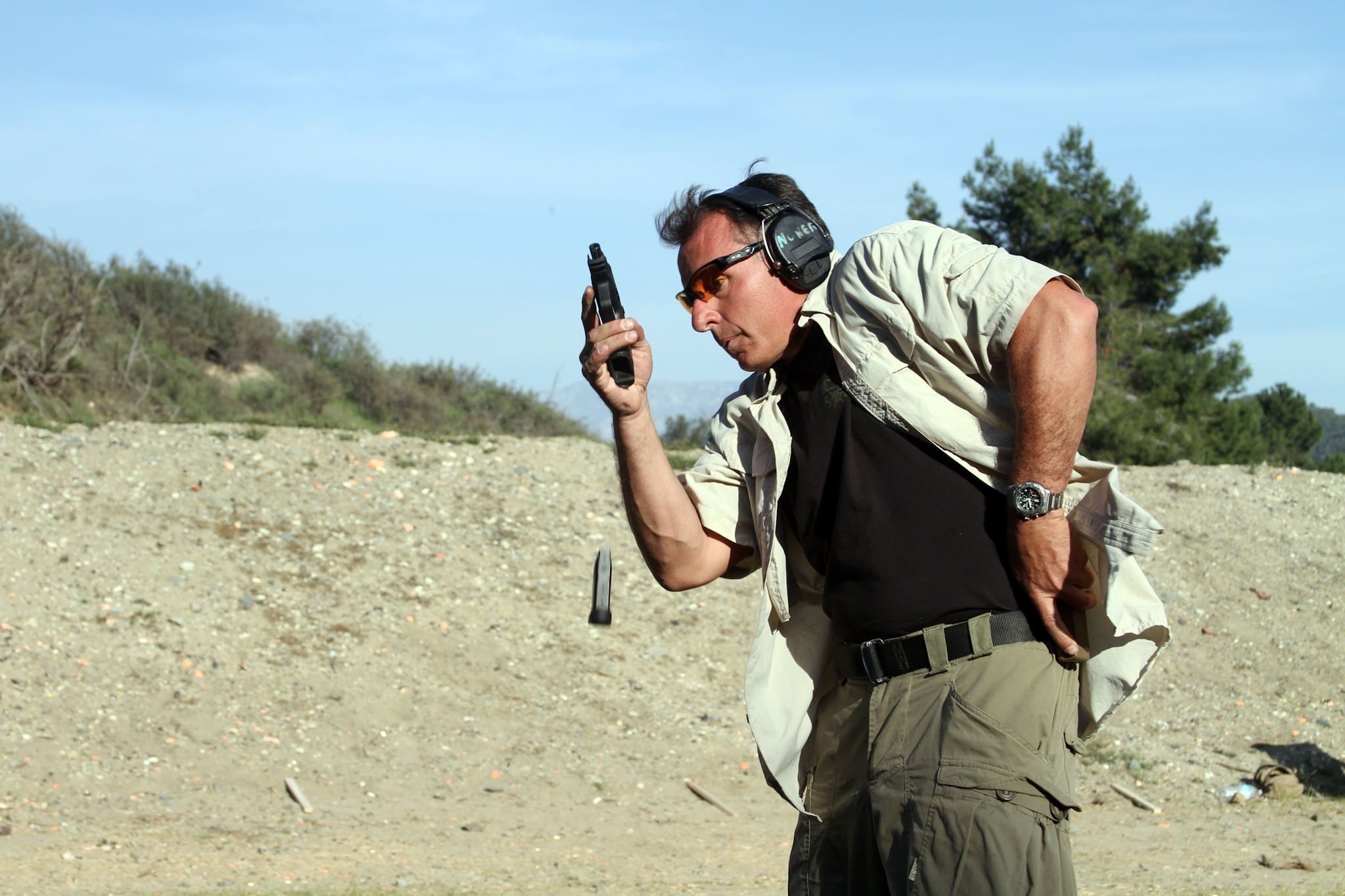
Mike Pannone retired from the Army’s premier assault force (1st SFOD-D) after an explosive breaching injury. A year after his retirement America was attacked on 9/11 and he returned to help serve his country as the head marksmanship instructor at the Federal Air Marshals training course and then moved to help stand up the FAMS Seattle field office. In 2003 he left the FAMS to serve as a PSD detail member and then a detail leader for the State Department during 2003 and 2004 in Baghdad and Tikrit.

In 2005 he served as a ground combat advisor of the Joint Counter IED Task Force and participated on combat operations with various units in Al Anbar province. Upon returning he gave IED awareness briefings to departing units and helped stand up a pre-Iraq surge rifle course with the Asymmetric Warfare Group as a lead instructor. With that experience as well as a career of special operations service in Marine Reconnaissance, Army Special Forces and JSOC to draw from he moved to the private sector teaching planning, leadership, marksmanship and tactics as well as authoring and co-authoring several books such as The M4 Handbook, AK Handbook and Tactical Pistol shooting. Mike also consults for several major rifle and accessory manufacturers to help them field the best possible equipment to the warfighter, law enforcement officer and upstanding civilian end user. He is considered a subject matter expert on the AR based Stoner platform in all its derivatives.

www.ctt-solutions.com

Gunfighter Moment is a weekly feature brought to you by Alias Training & Security Services. Each week Alias brings us a different Trainer and in turn they offer some words of wisdom.

TNVC Re-Introduces The Famed PVS-4 NV Scope

March 29th, 2014

This is an announcement from TNVC regarding the availability of their version of the PVS-4 Night Vision scope.

In our continuing effort to bring economical HIGH quality AND US built NV to the market…

The legendary PVS-4 Night Vision Weapon Sight is one of the most prolific night vision scopes ever made. Originally designed by Optic Electronic Corporation of Dallas in 1975, it was adopted by the U.S. Military in 1978 and served through 2008. That is an incredibly long time for a night vision device! The reason is that it is hard to beat, even by today’s standards. The PVS-4 utilizes a catadipotic lens system that gathers a tremendous amount of light. This provides incredibly clean and clear images, even in a Gen2 configuration.

The TNV/PVS-4 is our version of this classic weapon sight. We start off with a completely refurbished and refinished original PVS-4 housing/optical system. There are no more PVS-4?s being built, so anything available today is going to be “used.” However, these units are meticulously refurbished and upgraded. Parts are replaced and the entire system is just like new. The original systems were manufactured by Varo (Litton). We use new/unissued L3 MX-9644/UV Gen3 image intensifier tubes for the best possible resolution in their class. The reticle is fully adjustable for windage and elevation and features the standard M-16 pattern. This reticle features a range-estimator and a three-point cross hair that provides an aiming point for close range, 200m, and 400m.


The mounting interface on the TNV/PVS-4 has been upgraded from the original design. M1913 Picatinny Rail was not around in 1975, so the original PVS-4 was attached to weapons using proprietary brackets and mounts. Today’s modular weapon platforms feature much easier attachment methods. The TNV/PVS-4 has an excellent LaRue Tactical OEM LT100 quick detach mount. This incredibly solid mount allows users to add or remove the scope from standard M1913 rail without losing their zero.

Our TNV/PVS-4 also features an upgraded power supply. It runs off the ubiquitous CR123A 3-Volt Battery. This helps with commonality of batteries in the field since the majority of electronic devices use this power supply. It will also run off the old military button battery.

tnvc.com/shop/tnvpvs-4-gen2-weapon-sight

tnvc.com/shop/tnvpvs-4-gen3-weapon-sight

Magpul Now Shipping Updated MOE-K Grip

March 28th, 2014

NL_productimage_Left_MOE-K_v02

The MOE-K is now shipping in a updated configuration, featuring an aggressive new TSP texture and a slight increase in the grip diameter.

The MOE-K is designed as a drop-in upgrade for the standard AR-15/M16 pistol grip, offering a low-profile, compact design and steeper grip angle compared to traditional styles. Optimized for use with PDWs, the MOE-K improves comfort and control on rifles that bring the primary hand in closer to the shooter’s body or body armor.

Available in Black, FDE, OD Green, and Foliage.

store.magpul.com/product/MAG438

Vertx announces sponsorship Of WSOF Welterweight Champion Steve Carl

March 28th, 2014

March 26, 2014 – Vertx® is pleased to announce the sponsorship and addition of current World Series of Fighting Welterweight champion, Steve Carl, to their distinctive Pro Staff.

Carl has established himself as one of the world’s best Welterweights by posting an impressive 21-3 professional MMA record. Coming off 7 straight submission victories, Steve Carl is set to defend his title against Rouismar Palhares on March 29th at WSOF 9. The fight will be televised live on NBCSN.

Carl, known for his prowess inside the cage, is a former Army Sergeant who served two tours during his time in the military. He often credits his military background for the mental fortitude and strength necessary to become champion. His veteran status in addition to successes inside and outside MMA is what led him to be a natural fit for Vertx.

Vertx Director of Marketing, Ginger Rohlfs, feels Carl is a great addition stating, “Steve Carl is in many ways the proverbial good guy and he is a reflection of the Vertx brand. He’s been the underdog only to rise to the occasion and let his actions deliver results. We’re fortunate to have him on our team.”

The Cedar Rapids, Iowa native had this to say about the partnership — “I’m honored to be supported by a company that I can really get behind like Vertx. They are known for having some of the best tactical gear around, and being a nature lover, I can’t wait to proudly wear Vertx in the cage and out in the field. I’m excited to be a part of such a great company.”

www.wearvertx.com

Tactical Tailor – RHINO RUCK

March 28th, 2014

IMG_4131

Tactical Tailor’s RHINO RUCK was developed at the request of a SOCOM client that required an updated ALICE pack tailored to the communicator who is required to deploy across all spectrums of airborne operations.

The RHINO is a static line and MFF jumpable ruck. It is purpose built around the STRRLS, H-Harness, Harness Single Point Release, and the Parachutist Drop Bag. The RHINO features a pass through RTO zipper with optional removable PRC 117G go bag that can be worn as an assault pack or mounted directly to a plate carrier. Rigging channels are cut and sewn directly into the ruck. Additional features include external compression straps, double rain fly, and reinforced hydration and commo channels. The RHINO may be custom modified to meet end user and unit requirements.

For more information, contact Nate Smith – Tactical Tailor’s SOCOM Sales Manager at nate@tacticaltailor.com

www.tacticaltailor.com

Slumberjack – Thermal Cloak First Impressions

March 28th, 2014

Slumberjack revealed their SJK Tactical Hunting Gear line during SHOT 2014. The line includes packs, insulated tree stand bags, and tents, all made from durable, lightweight materials in Kryptek camouflage.

Thermal 1

We recently got a hold of a product in the upcoming line, the SJK Tactical Thermal Cloak. The Thermal Cloak is designed to offer protection from the elements as well as act as a personal blind. Tactical hood styling allows the wearer to maintain peripheral vision and hearing. The fabrics used are waterproof and seam taped to repel wind, rain, and snow, while 160g of synthetic insulation keeps the wearer warm. The bottom of the cloak is open to allow the wearer to feel the edges of their tree stand to ensure proper footing. The cloak can also be cinched up around the wearer’s knees for increased mobility. The arm ports are self-sealing (via magnets) that allow for the wearer to move into a firing position. The front zipper and hand warmer pocket help regulate temperature.

SONY DSC

The 160g of insulation cloak keeps the wearer warm, and the fleece around the collar area is a nice touch that adds a bit more comfort to the cloak.

The arm ports are spacious, and secure using magnets. This is a nice feature for when trying to stay quiet, although the position of the magnets does leave a bit of open spacing for cold to get in. There are also front-side handwarming pockets to help regulate temperature.

The hood features a rear elastic retention band for adjustment. This is a nice feature as it allows the user to tailor the hood to the size they require, so as to maintain peripheral vision and for comfort.

The bottom of the cloak features split sides that secure with magnets like the arm ports. They quickly and quietly separate when mobile, and snap back together when stationary. There are also cinches with loops to raise the bottom of the cloak to knee level if additional mobility is required.

Thermal 6

The Thermal Cloak utilizes a front side zipper. This is also supported by magnets like the arm ports, so that the user can quietly secure the front opening without manipulating the zipper, and/or maintain ventilation when wearing the cloak.

Thermal 12

The Thermal Cloak also comes with its own stuff sack.

Functionality wise, the Thermal Cloak fulfills its purpose well. It keeps its wearer warm, and is designed to operate as quietly as possible, as expected from a product meant for use when hunting.

Expect to see the SJK Tactical Hunting Gear line available later this year.

www.slumberjack.com

Skallywag Tactical – “Spin Drift” Steve Reichert Signature Blade

March 28th, 2014

Skallywag 7

The “Spin Drift” is a knife co-developed by Steve Reichert and Skallywag Tactical. CNC machined from D2 tool steel, the blade is heat treated to 1880F then cooled to -300F. Steve Reichert’s signature is then laser etched into the blade, after which it is coated in Black Ion Bond, leaving a rugged non-reflective flat grey/black coating.

Skallywag 2

The scales are Black linen Mircarta, CNC milled with a cross hatch texture for improved grip.

The “Spin Drift” comes with a Kydex sheath from Survival Sheath Systems. It features attached loops for on-the-belt carry.

skallywagtactical.com

Phantom Bogey; Hyperstealth’s Deceptive Decoy Technology

March 28th, 2014

(March 22, 2014, Vancouver, B.C.) – Hyperstealth Biotechnology Corp. President/CEO, Guy Cramer, announces another breakthrough the company refers to as “Phantom Bogey” where a military can deceive the opposing force with full scale decoys where the simulated decoy moves as if it was real, will show up as a target to battlefield optical sensors and will reflect a laser target designator allowing the real personal and equipment to remain hidden or at least mixed in with the decoys diverting fire and focus away to provide higher survivability for the real counterparts.

In the dictionary a Phantom is described as an appearance or illusion without material substance, as a dream image, mirage, or optical illusion (1). Whereas a Bogey is an unidentified aircraft or missile, especially one detected as a blip on a radar screen (2). Combining the two we achieve the perfect decoy, Hyperstealth’s Phantom Bogey comes across as both a target and with substance but it is in-fact neither.

Hyperstealth is a successful Canadian camouflage design company with over three million military issued uniforms and over 3000 vehicles and fighter jets using their patterns around the world.

The First Lightbender

In 2011 Hyperstealth’s Cramer announced Quantum Stealth (Light Bending Material)(3) a story which went viral around the world after a 2012 CNN T.V. story on that technology (4). Many remain skeptical that Cramer has accomplished this, however, members of the Hyperstealth advisory board who have seen and handled the Quantum Stealth material have come forward to confirm his claims: William Jarvis, 19 year Navy SEAL (Retired) who has accompanied Cramer to a number of these demonstrations in the U.S. and Britain. Colin Worth a 20+ year RCMP (Royal Canadian Mounted Police) officer (Retired) who accompanied Cramer to the first set of Canadian Government Demonstrations. Master Corporal Matt Pitre, Sargent Scott McLeod both Retired Canadian Special Forces and Brigadier-General Larry Lashkevich, (Canadian Forces Retired) who accompanied Cramer on his second and third demonstrations to the Canadian Military.

The U.S. military (which has budgeted for Quantum Stealth R&D for fiscal year 2015) refuses to disclose the Quantum Stealth to protect the technology and it also prevents adversaries to develop counter technologies.

What’s the reverse of Invisibility? Seeing something that actually isn’t there!

Decoys have been successfully used in military campaigns for thousands of years. The German’s were often tricked by the American “Ghost Army” of World War II, a specialized team of artists, professional theater crews, engineers and actors were put together to come up deceptive methods to turn the German attention away from the actual military objectives.

So what’s the difference with the Hyperstealth “Phantom Bogey” system? Once Cramer understood how to bend light, he was then able to determine how to manipulate light to create a false target instead of bending light around the target as Quantum Stealth does. It does so at minimal cost, power and weight. These are not stationary decoys like a manikin, nor do they take up the space or weight that a typical decoy would use, these are decoys which would look and move just as real as the item, vehicle or person they were simulating.

The Best Offense is a Good Defense

Imagine a tactical compound which does not have enough soldiers to defend it and is about to come under attack; Using the Phantom Bogey technology the defenders are able to simulate 100 extra heavily armed soldiers who now appear to be defending the position. Ten simulated Main Battle Tanks are added to the compound and move into defensive positions, simulated helicopter gunships, takeoff and move over the compound, if the attack comes, the small team defending the position are no longer the primary targets. The defenders could also drop Phantom Bogey’s behind the enemy and pretend to flank them or surround them. Unless the bad guys were within a couple of feet they would not be able to tell the difference between the real targets and the Phantom Bogey’s. A flanking or surrounding move will often force the opposition to move from their cover allowing the smaller group of defenders to acquire a larger portion of the target much easier. A more likely outcome is that the attackers are likely to be overwhelmed with the show of force and retreat.

Scenario 2: A Special Forces Team not knowing how many bad guys are in a room they want to enter and send in the Phantom Bogey simulating their entry to the bad guys with cameras and sensors on the Phantom Bogey’s detecting the exact location of the enemy and any weapons fire location before they actually enter.

Scenario 3: Using the Phantom Bogey technology a Special Forces team is able to infiltrate behind enemy lines using decoy equipment and decoy people which appear to the enemy as their own equipment and soldiers.

Scenario 4: Opponents watch convoys of troop transports full of troops moving to a specific location, it’s actually just drivers with simulated troops in the back. The enemy watching the logistics from a distance assumes a whole Army group is moved to a location as the truck returns with no troops in the back and the location is now just full of decoys of the Army group.

Scenario 5: With limited resources Police are more often alone without a partner in their vehicles and do not have immediate access to backup. With Phantom Bogey a Police partner may be added to provide a perception of more officers and/or you could add simulated K-9 (dogs). In talking to Police, they can have 5 patrol cars show up to a gathering that they need to disperse but the crowd will taunt them until a Police K-9 vehicle shows up, and the crowd will quickly disperse.

Due to operational security currently surrounding these techniques, the methodology of Phantom Bogey will not be disclosed.

Given shrinking defense budgets with expected and substantial downsizing of military personal and equipment, the addition of Phantom Bogey may help to fill in these cracks where perception is viewed as reality.

The military term for the field of camouflage is known as CCD (Camouflage Concealment and Deception). If Quantum Stealth is the optimal Camouflage and Concealment, then Phantom Bogey would be the optimal method of visual Deception.