In this video, Chip discuss the Wilcox RAPTAR ES and RAPTAR ES Lite, and demos some of its features.


In this video, Chip discuss the Wilcox RAPTAR ES and RAPTAR ES Lite, and demos some of its features.
This week, we are looking at Belt Systems. Specifically, FirstSpear offers a line of Belt Systems with components that can be used in conjunction with one another. In some cases they canb also be used as stand alones or to augment gear already in your kit bag. The items include the Assaulters Gun Belt (AGB), Padded AGB Sleeve, Tactical Suspenders, as well as the Line One Belt and 6/9 BeltLink.


This video gives you a great overview and shows you how to configure your gear.
While we can’t always expect a deal, FirstSpear has been generous enough to offer something special this week. Buy one AGB and get a set of free 6/9 belt links. When you add the AGB to the cart a set of TWO 6/9 belt links will add automatically to cart.
Tactical-Life.com and Panteao Productions got some excellent video coverage during SHOT Show and we thought it would be great to share it with our readers here at SSD. This video introduces the Lewis Machine & Tool (LMT) DMR Stock and SLK8 Receiver.
The new LMT DMR AR buttstock released during SHOT Show is designed for use with a mil-spec carbine extension tube, offering three separate position adjustments. In addition, the cheek weld height and the length of pull can both be adjusted to 45 different positions. Intended for 3-gun competitions, the slick side SLK8 receiver (think LM8 with no rails) offers a stainless steel 5R cut-rifled barrel (available in 16″ and 20″) with a 1-in-7.5-inch twist rate, an ambidextrous magazine release, a two-stage match trigger and Ergo grip.
For the full story, visit Tactical-Life.com/magazines/guns-and-weapons/lmt-new-2014.
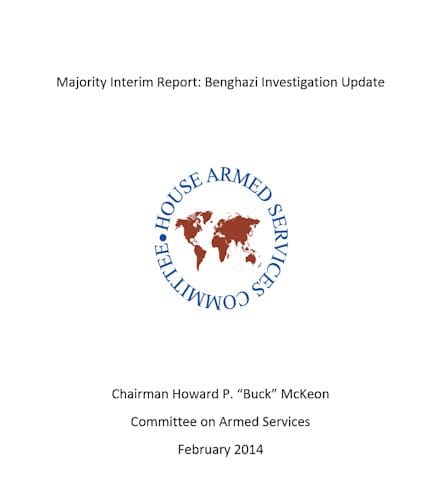
I’ve essentially remained quiet on the events that transpired on Banghazi, Libya on September 11th, 2012. This is based on two issues. First, very soon after the event, I was privy to information that has just recently come to light. Second, I didn’t have all of the information regarding this tragedy and I still don’t. On one hand, I didn’t want to disclose who may or may not have been on the battlespace that night and on the other, there’s nothing that will make you look more like a fool than making declarative statements about situations you don’t have the facts on. However, I now have the House Armed Services Committee report entitled, “Majority Interim Report: Benghazi Investigation Update.” I’d say that’s a good point to start talking, armed with, you know, “facts”. Having said that, two caveats with this report. From the summary, “This report should be considered one component of continuing comprehensive Benghazi-related oversight underway in the U.S. House of Representatives. In keeping with the committee’s jurisdiction, however, this document addresses only the activities and actions of personnel in DOD.” By no means is the info the final word, but it does begin to allow us to peer deeper into what happened from DoD’s perspective.
It was a sad day for America and we lost some great folks. Many want to lay blame, but blame isn’t going to bring those men back. Generally, it isn’t one thing that goes wrong, but a whole chain of events with several issues coalescing into disaster. As far as I can tell, I’m the only guy who wants to take a serious look at what happened, for the sake of making sure it doesn’t happen again. It seems that everyone else talking about this has some agenda.
Since that day, the event has been politicized and I have watched countless armchair generals talk about things they don’t understand; Internet experts fueled by propaganda and spin doctors. I hate to lay it on most of you, but your sister-in-law’s nephew’s best friend who is a Spec-4 truck driver stationed at Fort Polk is not an authoritative source on US force projection. I could spend hours and hours talking about the subject but sufficed to say, when attempting to project force to the location of Benghazi, Libya, the United States is a victim of the tyranny of distance. You’ll see this issue come up over and over in this report. What’s more, while it does happen on a case-by-case basis, QRFs do not sit on strip alert just waiting for a crisis, despite what you might see in the movies. Even if they had, they would have been quite some distance from Benghazi (see ‘tyranny of distance’), as you will see in the report. You’ll read about three different groups dispatched to the region in the wake of the attacks and some of the challenges they faced to get there. Additionally, we don’t commit forces to ‘suicide’ missions and rarely, if ever attempt forced entry without a clear operational picture of the situation. As you will find in the report, this was not the case. DoD did not enjoy a clear operational picture. This hindered the military’s ability to respond.
Despite this, they did take action. Several, in fact.
The first step DOD took upon learning of the attack involved a U.S. drone that was overflying Darnah, a city in northeastern Libya. AFRICOM’s operations officer immediately redirected the unarmed Predator to Benghazi, which was about an hour’s flight time away. Separately, following the meeting in the White House, Secretary Panetta (in consultation with General Ham, General Dempsey, and others) verbally authorized three specific actions. First, two Marine FAST platoons in Rota, Spain were ordered to prepare to deploy; one bound for Benghazi and one destined for Tripoli. Second, a special operations unit assigned to the European Command, known as a Commander’s In-Extremis Force (CIF), which was training in Croatia was ordered to move to a U.S. Naval Air Station in Sigonella, Italy and await further instructions. Third, a special operations unit in the United States was also dispatched to the region. These orders were issued approximately two to four hours after the initial attack on the Special Mission Compound.
Of particular interest to me is that there is no indication of a cabal within DoD set to destroy America from within or a decision by senior leaders to ‘let Americans die’. Rather, we see the same problems we constantly face; the fog of war and interagency stovepipes. We may have gone a long way to mitigate those issues within the CENTCOM AOR but in the other theaters they remain.
The findings are the most significant issue at hand. While not exhaustive, and omitting certain operational factors such as the units of assignment for those personnel actually on the ground, it is clear about DoD issues at hand that day and during the immediate aftermath. It also indicates which issues are the responsibility of both State and the White House. In fact, it discusses State’s request to reduce the Tripoli-based DoD Security Support Team from 16 to 4. However, please remember that Tripoli is over 600 miles by land from Benghazi (see tyranny of distance). It remains unclear if a larger force would have changed the outcome of the attack.
Findings I. In assessing military posture in anticipation of the September 11 anniversary, White House officials failed to comprehend or ignored the dramatically deteriorating security situation in Libya and the growing threat to U.S. interests in the region. Official public statements seem to have exaggerated the extent and rigor of the security assessment conducted at the time.
II. U.S. personnel in Benghazi were woefully vulnerable in September 2012 because
a.) the administration did not direct a change in military force posture,
b.) there was no intelligence of a specific “imminent” threat in Libya, and
c.) the Department of State, which has primary responsibility for diplomatic security, favored a reduction of Department of Defense security personnel in Libya before the attack.III. Defense Department officials believed nearly from the outset of violence in Benghazi that it was a terrorist attack rather than a protest gone awry, and the President subsequently permitted the military to respond with minimal direction.
IV. The U.S. military’s response to the Benghazi attack was severely degraded because of the location and readiness posture of U.S. forces, and because of lack of clarity about how the terrorist action was unfolding. However, given the uncertainty about the prospective length and scope of the attack, military commanders did not take all possible steps to prepare for a more extended operation.
V. There was no “stand down” order issued to U.S. military personnel in Tripoli who sought to join the fight in Benghazi. However, because official reviews after the attack were not sufficiently comprehensive, there was confusion about the roles and responsibilities of these individuals.
VI. The Department of Defense is working to correct many weaknesses revealed by the Benghazi attack, but the global security situation is still deteriorating and military resources continue to decline.
I know, I know, this is Soldier Systems Daily and I rarely comment on operational issues but this has been something I have been following for some time. As the old adage goes, “Amateurs talk about tactics, but professionals study logistics.” It is my assertion that the events in Beghazi are just as much a function of logistics as they are bad, pre-crisis decision making. While Nathan Bedford Forrest (Lt Gen, CSA) was misquoted with “Git thar fustest with the most mostest,” the sentiment is apropos. That is certainly what transpired in this case. The bad guys got there first and were gone before we could project any serious combat power to the area.
Feel free to read the whole thing and then comment. All I ask is this, keep it on point. There are loads of websites out there where inappropriate and off topic comments are the norm. If you feel the need to express yourself that way, please go there.
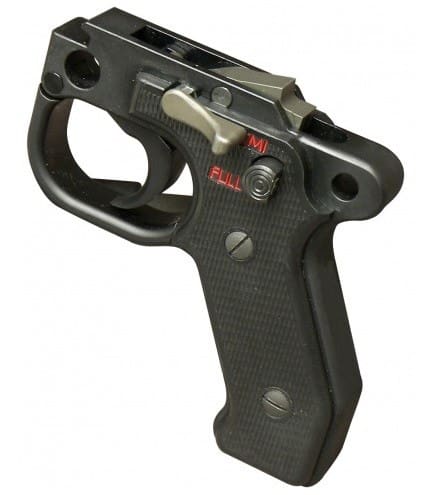
In addition to the HCAR, Ohio Ordnance Works also had their M240 Semi-Auto trigger Pack available at the Osprey Range Day. The M240 Select Fire is a direct replacement trigger pack for all MAG and M240 variants which allows the machinegunner to switch between semi and full-auto fire. This increases the versatility of the M240, by allowing the machinegunner to place more precise shots while not wearing down on the sear. Additionally, it becomes much easier to zero in the weapon when set to semi-automatic.
www.ohioordnanceworks.com/parts/m240-select-fire-1/m240-select-fire
Jeff Martone of Tactical Athlete, and combative instructor for Osprey Global Solutions was present at the Osprey Range Day, where he gave a demonstration on kettlebell training and technique. This video is a bit long, however it’s very informative and functions as a good primer for utilizing kettlebells in a fitness routine.
The LOSOK Custom Arms Mk 36 rifle debuted at SHOT Show 2014 with Osprey Global Solutions. The Mk 36 consists of a rotating bolt, M1 Garand-style action upper mated to an AR-style lower. It is important to note that the Mk 36 is currently in a prototype phase.
The upper receiver of the Mk 36 was manufactured using Direct Metal Laser Sintering (DMLS) by Solid Concepts Inc., the company that manufactured the world’s first 3D printed metal gun. The Mk 36 receiver is quite possibly the first ever 3D printed rifle receiver in the USA, if not the world.
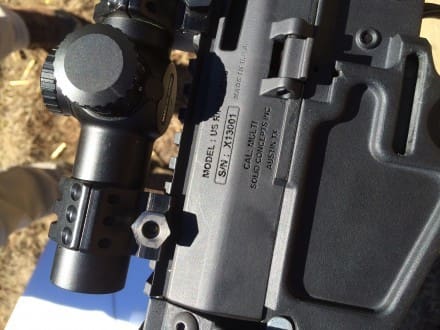
The lower receiver and foreend are both carbon fiber reinforced polymer. Due to the AR-style lower, the Mk 36 is compatible with standard AR fire control parts and furniture. The rifle is only 8 1/2 lbs unloaded.
The model featured in the video is chambered for .30-06 and is capable of a 1500 yard range with proper ammunition. It is loaded using 20-round box magazines.
Another prototype chambered for 5.56 was also available for viewing at the event. It utilized a modified Mini-14 receiver and was completed in only 10 days, just in time for the Osprey Range Day.
The Mk 36 will be marketed and produced by Osprey Armament.
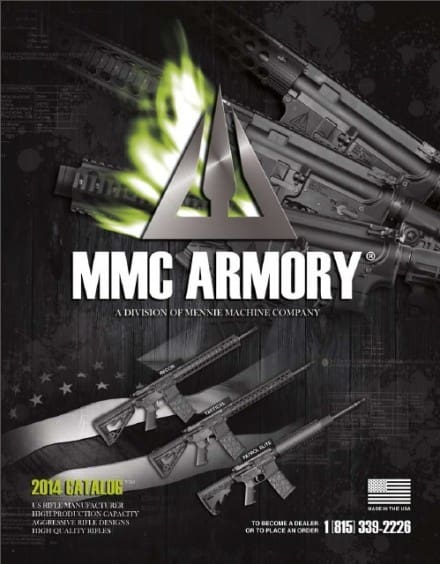
MMC Armory is a division of Mennie Machine Company, located in Mark, Illinois. They have decades of experience manufacturing parts for the auto industry and have put their expertise towards manufacturing rifles and accessories.
The MMC Armory PDW 7 is designed for CQB operations. The upper receiver is machined 7075 T6 aluminum alloy and hard coat anodized, with indexing marks and M4 feed ramps. The lower receiver is also machined 7075 T6 aluminum alloy and hard coat anodized, with a flared magazine well. The barrel is 4150 CrMv nitride treated steel and features a 1:7 twist, with a pistol length gas system and M4 extension. Chambering is available for both .223/5.56 and .300 BLK.
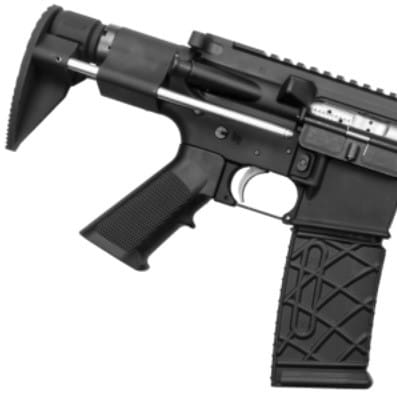
The trigger is an enhanced nitride treated Mil-Spec single stage, creep adjusted with polished engagement surfaces and a crisp 5 lb. break. The bolt carrier group is full auto rated with a staked gas key. The PDW 7 is capable of 700-800rpm when fired full-auto.
All moving parts from the bolt carrier group to the collapsible wire stock on the PDW 7 are coated in Nickel Boron for lubeless operation.
It is currently available through Osprey Armament.