Atrius Development Group

Archive for 2019

RDECOM Transitions to Army Futures Command

Monday, February 4th, 2019

ABERDEEN PROVING GROUND, Md. — The Army Materiel Command (AMC) and Army Futures Command (AFC) held a ceremony on January 31, transitioning the U.S. Army Research, Development and Engineering Command (RDECOM) from AMC to AFC. The official date of the transfer is Feb. 3 during which RDECOM will be renamed Combat Capabilities Development Command.

“The United States Army has been focused on the near-term for the last 18 years, and rightfully so. But as we wind down and come out of the conflicts in Iraq and Afghanistan the message is very, very clear, we need to re-focus on large-scale, ground combat and we need to re-focus on the future,” said Gen. John M. Murray, commanding general AFC.
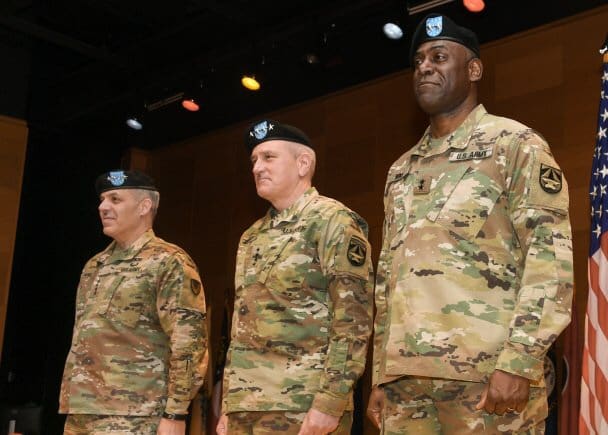
(Left to right) Commanding General Army Materiel Command Gen. Gustave F. Perna, Commanding General Army Futures Command Gen. John M. Murray and Commanding General Combat Capabilities Development Command Maj. Gen. Cedric T. Wins during a Transition of Authority ceremony Jan. 31 at Aberdeen Proving Ground, Md. (Photo Credit: Conrad Johnson)

As the Army’s newest command and the largest of AFC’s three major elements, the Combat Capabilities Development Command (CCDC) comprises eight major and three international centers and laboratories including: Data & Analysis Center; Armaments Center; Army Research Laboratory; Aviation and Missile Center; Chemical Biological Center; Command, Control, Computers, Communications, Cyber, Intelligence, Surveillance and Reconnaissance Center; Ground Vehicle Systems Center; and Soldier Center. The international elements are the regionally aligned Americas, Atlantic and Pacific Centers.

Army Materiel Systems Analysis Activity officially became part of AFC during the ceremony and was renamed Data & Analysis Center. It was realigned with existing CCDC analysis organizations to create an integrated analysis center.
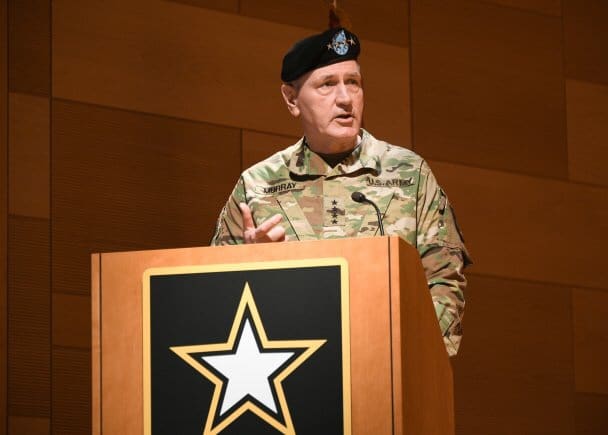
At a Transition of Authority ceremony Jan. 31, Gen. John M. Murray, commanding general Army Futures Command, addresses the Army’s effort to focus on technologies to support Multi-Domain Operations. The ceremony, held at Aberdeen Proving Ground, Md. signified the transfer of the U.S. Army Research, Development and Engineering Command from Army Materiel Command to AFC. (Photo Credit: Conrad Johnson)

The three major elements of the AFC include: Futures and Concepts, Combat Development and Combat Systems.

As part of the Combat Development element, CCDC will focus on fundamental scientific research, technology development, engineering and analysis to support the Army’s six modernization priorities: Long-Range Precision Fires, Next-Generation Combat Vehicle, Future Vertical Lift, the Network, Air & Missile Defense and Soldier Lethality. Key tenants of the CCDC’s mission are speed of delivery and integrating technology into existing weapon systems.

CCDC joining AFC is the next step in the Army’s effort to transform its approach to modernize critical core capabilities that will give Soldiers and allies a decisive edge in battle. As the modernization strategy focuses on delivering capabilities to support Multi-Domain Operations by 2028, CCDC will maintain a balance between scientific research to support MDO and technology that may not be developed until 2050 or beyond.
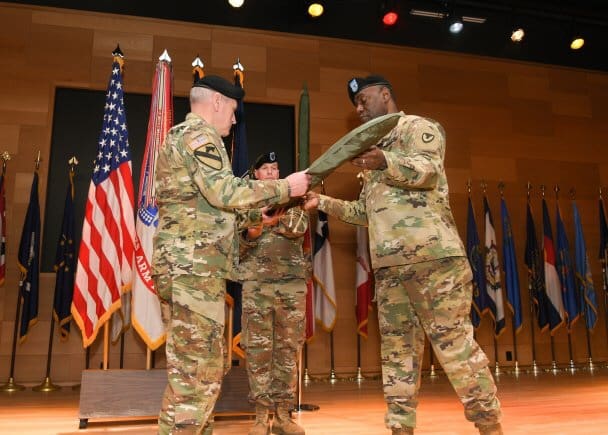
Gen. John M. Murray, commanding general Army Futures Command, and Maj. Gen. Cedric T. Wins, commanding general Combat Capabilities Development Command, uncase the official flag, signifying the transition of the U.S. Army Research, Development and Engineering Command from Army Materiel Command to AFC. (Photo Credit: Conrad Johnson)

“As the last commander of RDECOM and the first commander of CCDC — as a Soldier of more than 30 years — I see no bitterness in what we do here today. I see a new challenge and more reason to hope as we become part of a bigger team taking bolder action to forge the future,” said Maj. Gen. Cedric T. Wins, commanding general CCDC.

To prepare for the move to AFC, CCDC S&T advisors engaged with the Modernization Task Force, which became the AFC Headquarters, and the Cross Functional Teams to help drive the modernization process. The CFTs are composed of subject matter experts from the requirements, acquisition, science and technology, test and evaluation, resourcing, contracting, cost and sustainment communities.

The command also launched an across-the-board campaign plan to gain greater visibility of operations and become more effective and efficient. The campaign plan included reorganizing the command’s portfolio and management structures to mirror the Army’s modernization priorities and naming a lead center for each modernization priority.

CCDC collaborates with hundreds of international and domestic academic and industry partners to maintain a steady stream of world-class technology. Becoming part of AFC will enable CCDC to partner in new ways and provide greater clarity and focus for all of the Army’s major commands.

“The world-class scientists and engineers, technicians and support staff of this organization are some of the most talented and respected professionals in their fields. So on behalf of the countless Soldiers you have supported while you’ve been a member of the AMC family for the last 4,450 days, I personally say ‘thank you’,” said Gen. Gustave F. Perna, commanding general AMC.

The U.S. Army Research, Development and Engineering Command has the mission to provide innovative research, development and engineering to produce capabilities for decisive overmatch to the Army against the complexities of the current and future operating environments in support of the Joint Warfighter and the Nation. RDECOM is a major subordinate command of the U.S. Army Materiel Command.

By Argie Sarantinos-Perrin, CCDC HQ Public Affairs
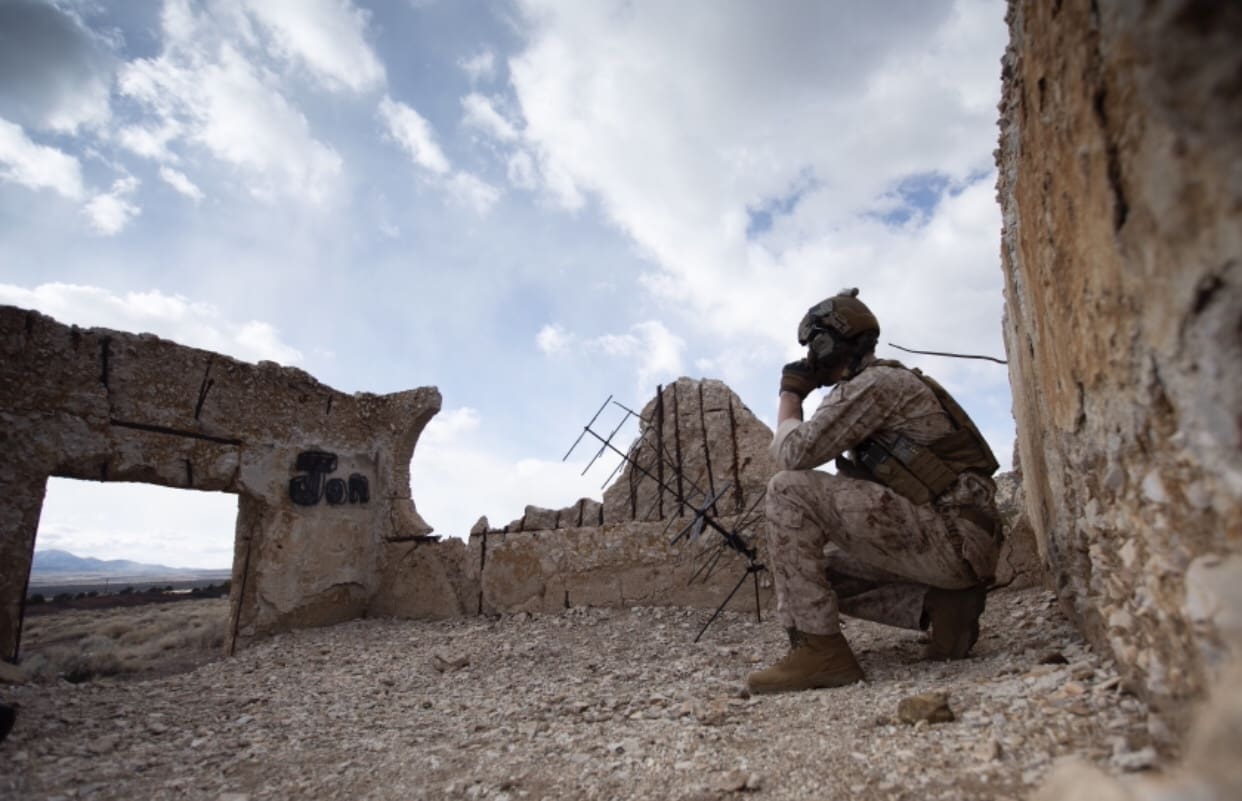
Trade Act Compliant Salomon Forces Guardian Boots Available Soon

Monday, February 4th, 2019

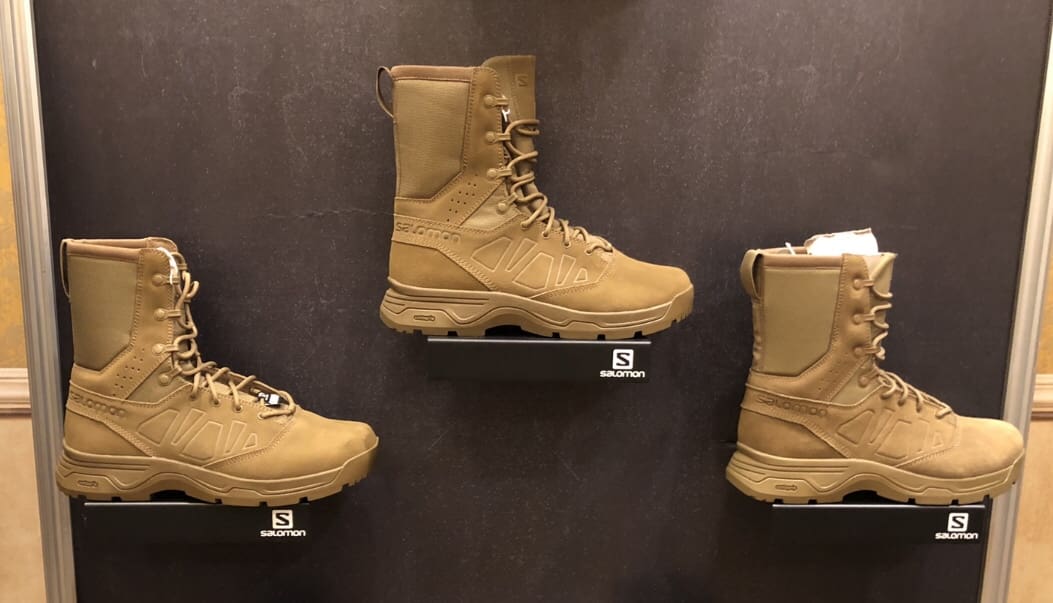
Salomon is introducing Trade Agreements Act compliance to it’s three versions of the Guardian boot. That means they’ll be easier to procure.

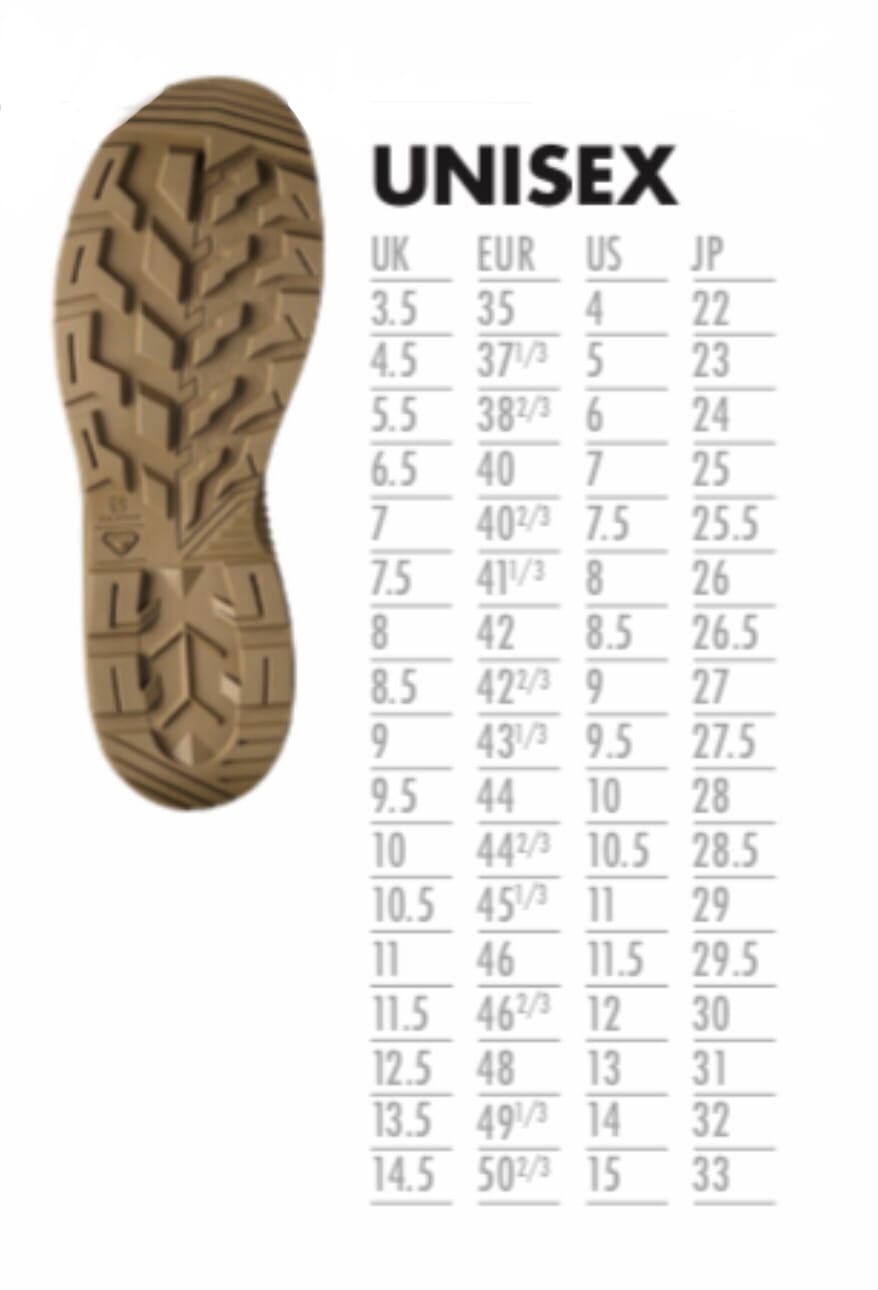
Other than the country of origin, there are no changes to the Guardian. But it’s being joined by the Guardian-Wide with its wider fit. Additionally, there is now also the Guardian CWSP (ClimaSalomon WaterProof) which incorporates a waterproof/breathable lining.

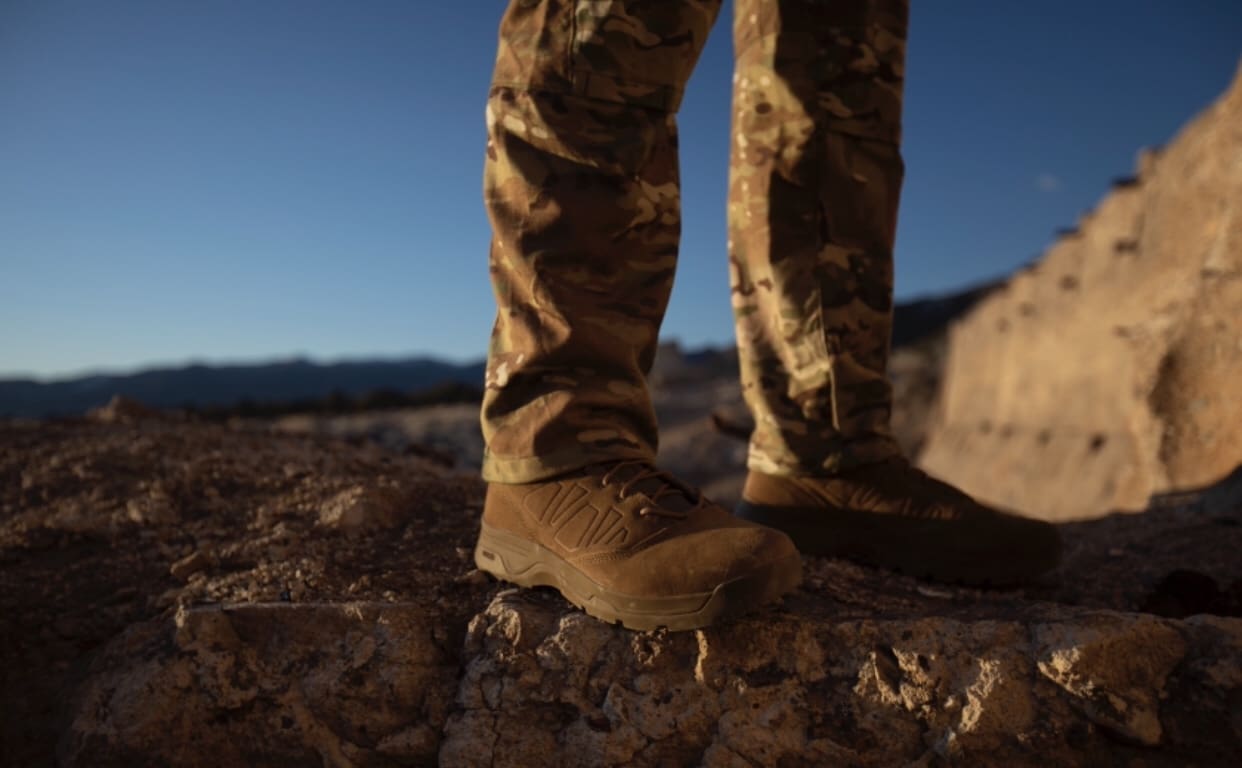
Coyote in color and 8″ tall, the Guardian series conforms to footwear requirements of AR 670-1. They feature the Contragrip outsole and Energy Cell EVA molded midsole.

All three versions of the trade compliant Guardian will be in stock ready to ship mid-February 2019.

Salomon Forces are available from www.salomon.com or your favorite outfitter.

Soldier Center Partners with Industry Experts to Advance Exoskeleton Technologies


Monday, February 4th, 2019

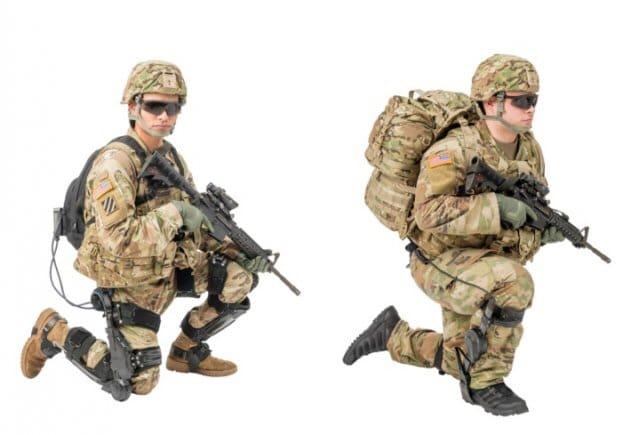
NATICK, Mass. — David Audet, chief of the Mission Equipment and Systems Branch in the Soldier Performance Optimization Directorate, at the Research, Development and Engineering Command’s Soldier Center, is gearing up his team for the next User Touch Point activities to explore exoskeleton options later this month.

“As we explore the more mature exoskeleton options available to us and engage users, the more we learn about where the possible value of these systems is to Army operations,” said Audet.

“Before the Army can consider investing in any development above what industry has done on their own, we need to make sure that users are on board with human augmentation concepts and that the systems are worth investing in. The Army is not ready yet to commit. NSRDEC [RDECOM Soldier Center] has a lead role in working with PEO-Soldier and the Maneuver Center of Excellence, Fort Benning, to determine whether or not a longer-term investment in fielding new technologies is justifiable. But this is what we do best. We find the options and create the partnerships to help us figure it out.”


Recent media has brought a lot of attention to the Lockheed Martin Missiles and Fire Controls, or LMMFC, ONYX, a Popular Science award recipient for 2018.

As innovative as it is, and with all the attention on the Soldier Center’s $6.9 million Other Transaction Agreement (OTA) award, it’s easy to get caught up in the moment and lose perspective of the overall work the Soldier Center is actually doing.

Out of the 48-month phased effort, roughly $680K has been put on the LMMFC OTA — currently focused on having enough systems to take to the field for operational evaluation. Although performing, the technology has yet to prove itself in a full operational exercise before moving forward. And while LMMFC is highly confident in their product and continues to invest their funding on further developing the system for commercial use, the Soldier Center is also looking at other technologies.

Located in Maynard, Massachusetts, Dephy, Inc.’s ExoBoot is another entrant in the program. The Dephy ExoBoot is an autonomous foot ankle exoskeleton that was inspired by research done at the Massachusetts Institute of Technology under collaboration with the Army. It is currently under consideration for evaluation during the third and fourth quarter of 2019. Brigadier General David M. Hodne has worn the ExoBoot during Soldier Center program updates and is quite intrigued by the capability. User feedback will determine if both systems move forward and under which considerations.

“Under ideal conditions, we would favor a full development effort,” said Audet. “However, given the push for rapid transition and innovation, we can save the Army a lot of time and money by identifying and vetting mature technologies, consistent with the vision of the Army Futures Command, or AFC.

“In order to achieve the goal of vetting and providing recommendations, NSRDEC [the Soldier Center] and PEO-Soldier are strong partners, teamed up to work with third party independent engineering firms such as Boston Engineering out of Waltham, Massachusetts. The engineering analysis of systems will provide an unbiased system-level analysis of any of the technologies under consideration, following rigorous analysis of the capabilities as they exist, the operational parameters provided by users and assessment of how humans will use and interact with the systems.”

“We are confident products will succeed or – at a minimum – fill a gap we have not been able to address by any other materiel or training means,” said Audet.

“We will be prepared to transition, but we know there is a road ahead before we get there. We aren’t committing to anything more than to bring the systems to a demonstration and educate the community at large on what these preliminary technologies can offer. In the meantime, we add a layer of third party independent analysis as a reassurance policy that we are mitigating bias and staying laser focused on user needs and meeting the demands of the future warfighting landscape.”

TacJobs – Constellis Is Always Hiring

Sunday, February 3rd, 2019

www.constellis.com/careers

Survival Kit Contents Check

Sunday, February 3rd, 2019

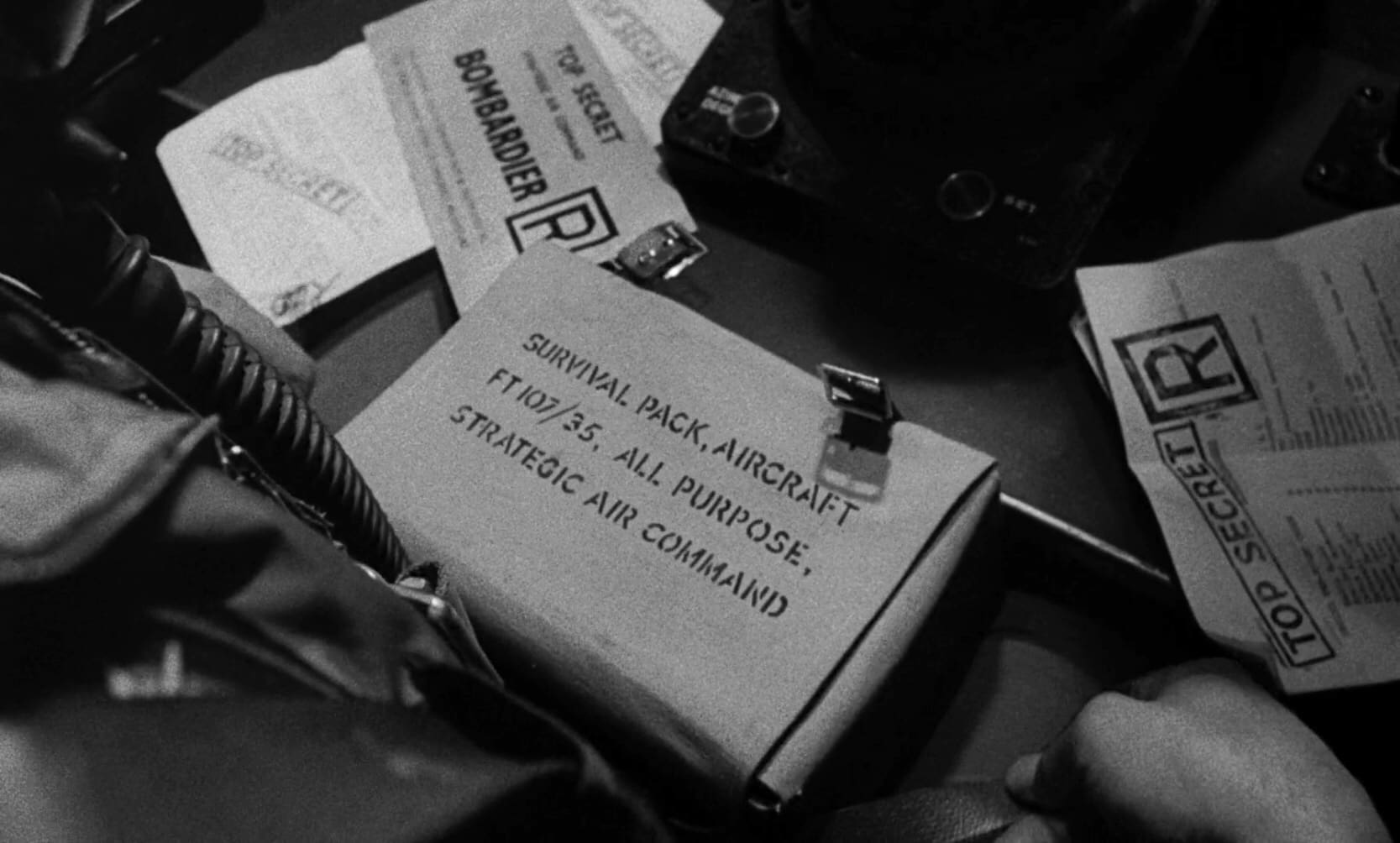
“Survival kit contents check. In them you’ll find:

– One forty-five caliber automatic

– Two boxes of ammunition

– Four days’ concentrated emergency rations

– One drug issue containing antibiotics, morphine,

  vitamin pills, pep pills, sleeping pills, tranquilizer pills

– One miniature combination Russian phrase book and Bible

– One hundred dollars in rubles

– One hundred dollars in gold

– Nine packs of chewing gum

– One issue of prophylactics

– Three lipsticks

– Three pair of nylon stockings.

Shoot, a fella’ could have a pretty good weekend in Vegas with all that stuff.”

Major T. J. “King” Kong

1981 Army Clothing History

Sunday, February 3rd, 2019

From the official US Army History Of 1981.

Clothing and Personal Equipment

The Army took several initiatives in fiscal year 1981 involving uniforms. Black shoulder marks were approved for wear by enlisted personnel in grade of corporal and higher; a maroon beret was authorized for wear by soldiers in airborne units; black braid was added to female officers’ green slacks; a black pullover wool sweater, approved last year, was fielded; a maternity uniform shirt was approved; and washable Army-green trousers with washable braid were approved.

The Army terminated the policy of granting exceptions to appearance standards based on religious beliefs for wearing beards, unshorn hair, turbans, or religious jewelry. This change followed a review of the effect of these exceptions on the soldier’s mission, health, and safety. Soldiers already in the Army may continue to enjoy the previously granted exceptions as long as they are otherwise eligible for service.

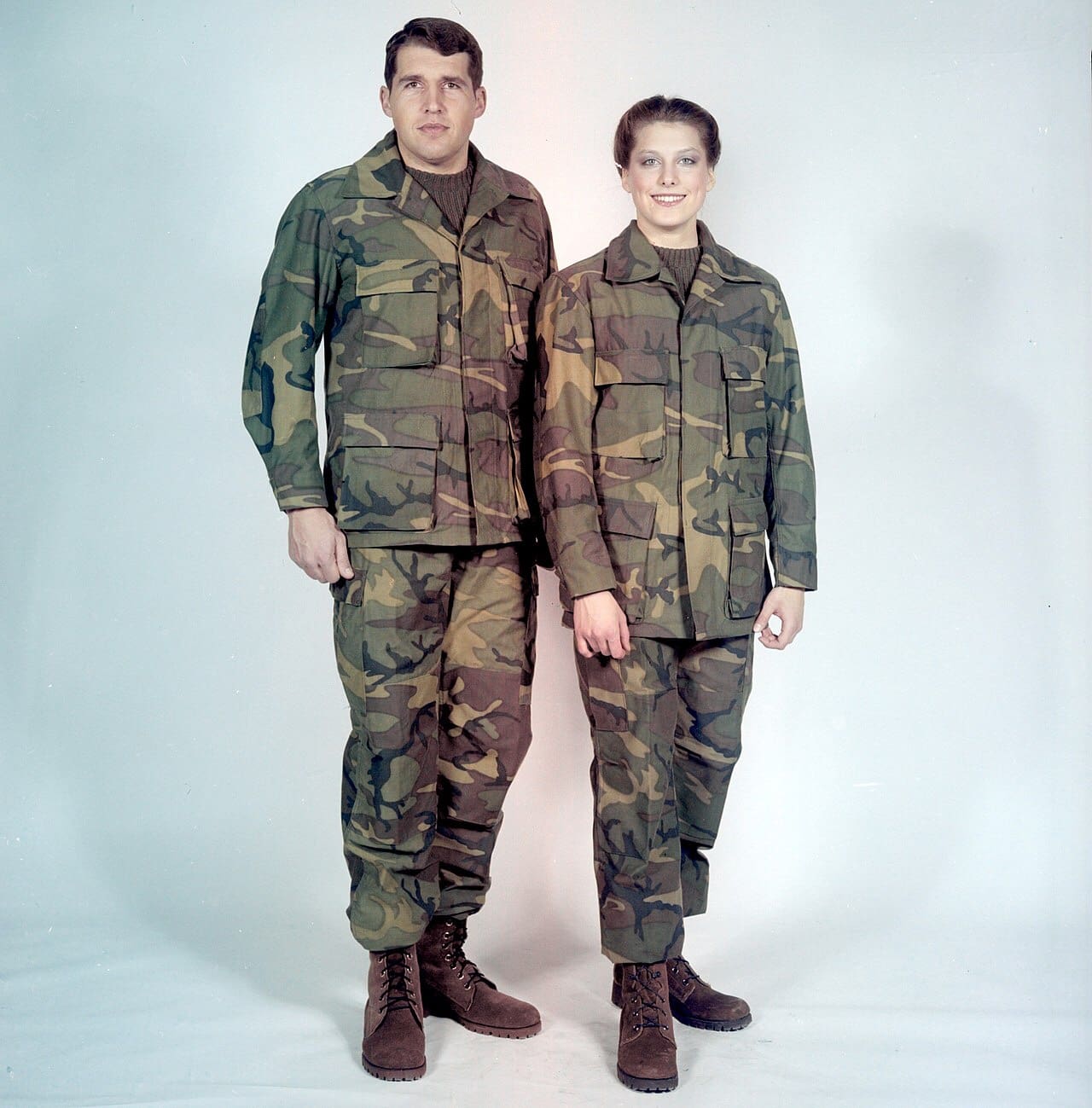
The temperate camouflage battle dress uniform (BDU) will be introduced as the Army’s field-garrison uniform on 1 October 1981. The BDU has a wood (forest like) color pattern, is infrared reflective, has reinforced elbows, knees, and seat, and is made with fabric that is 50-percent cotton and 50-percent nylon. The BDU includes a coat, hat, and trousers and represents the second phase of a multistage transition to all-camouflaged individual clothing and equipment. The first stage was the introduction of the desert camouflage BDU as an organizational item. It will be used mainly by the Rapid Deployment Force (RDF) in a desert environment. During fiscal year 1981 the RDF was completely outfitted in both day and night editions of the desert BDU.

Both the temperate and desert BDUs are part of the Army’s Battle Dress System (BDS). This system includes three camouflage uniforms which will allow the Army to operate in temperate, desert, and arctic environments. Conversion to this system will require the modification of many existing items of individual clothing and equipment as well as the introduction of new items.

C.A.C.I. Inc.-Federal received a contract in September 1981 to examine existing Army personal-organizational clothing and individual equipment management procedures and to recommend a more cost-effective way of doing business. The study should be completed by mid-1982. A study advisory group has been established to monitor the contractor’s progress, clarify requirements, and supply guidance.

Heraldic Activities

The Institute of Heraldry continued to provide heraldic services for the armed forces and other government agencies during fiscal year 1981. The emphasis of this year’s work, however, was on Army items. These included the design and development of the Army Achievement Medal, Noncommissioned Officers Professional Development Ribbon, Army Service Ribbon, and Overseas Service Ribbon. To meet the needs of Army units, 158 distinctive unit insignia and 28 shoulder-sleeve insignia were designed and developed during this period. In the area of research, the institute is continuing its program of evaluating various materials and methods of manufacturing flags in order to provide alternative, less costly items and to broaden the procurement base. The following statistics reflect, in part, the accomplishments of the institute: design of 510 items; completion of 1830 paintings and drawings and 174 sculptured items (molds, models, and casts); development of 130 items-some new and some modified which were placed in the procurement system; and inspection of 134,508 items under the optional-purchase quality-control system during visits to fifty-five posts and base exchanges. In addition the institute performed 1,750 research and engineering support actions to assist the Defense Personnel Support Center.

The V-42

Sunday, February 3rd, 2019

Corps Strength – Walk it off

Saturday, February 2nd, 2019

Since my book Corps Strength came out, I couldn’t count how many people have related their experiences with fitness, diet and weight loss to me. They tell me about their latest efforts, ask for advice, bounce off ideas and share their success/non-success. I have always really liked to hear these stories, as I learned a long time ago to get my gouge (on any subject) from actual people, with real life experience. About 90% of what I wrote in my book was based on either my own personal experience, or from the first hand accounts of others. The other 10% is from what I’ve read. The point is I don’t buy into any hyped program stats, airbrushed advertising pictures or those amazing diet ads. I could fill another book with all that crap. One common thing I’ve heard from literally hundreds of people is that they just want to get in better shape and lose some weight. The vast majority don’t care about doing a SEAL workout, running a marathon, climbing mountains, having six pack abs, etc. Most people just want to look their best, be active, healthy and injury free. That may sound like a low bar for many people, myself included. But, sadly most of the people in this country aren’t clearing that low bar. Many millions in fact are obese, sick and from all that, have serve limits on their lifestyle.

Putting eating habits aside, many people nowadays, (especially age 40+) have health problems that prevent them from participating in a vigorous exercise program, or even an active lifestyle. When they do attempt a workout program, it almost never lasts. They just burnout and/or get injured and quit. I’ve seen this movie way too many times. Sad really, as I know that most go into these things with the best of hopes and intentions. So when I’m asked for advice from people in these circumstances, I always recommend just one simple thing in the area of exercise: Walking. Walking is by far the best low impact exercise out there, especially for people that are overweight. Many people say swimming is the best, but I don’t buy it. Yes, swimming burns calories and is no doubt low impact, but it’s logistically hard to do and most people don’t know how to swim well enough to get the benefit. Just splashing around is a waste of time. For the average person walking is a much better choice and you need no special skills, or training. Besides that walking can be done almost anywhere, anytime of year and in even in less than perfect weather.

walking

Walking is also a no-brainer, that you can do while listening to music, news, sports, audio books, or just have some quality time inside your own head to think through stuff. Taking a friend or family is even better. I consider walking my dog with my wife as time very well spent. I think that this very simple habit has good benefits for everyone and not just those in poor condition, but even those who have a good PT program underway. Undefeated heavyweight boxing champion Rocky Marciano always took long walks as part of his training, not in place of running or gym work, but in addition too. I myself have always been a big walker, even as a kid I would walk everywhere. To my mothers dismay (and my sore butt after), neighbors and relatives would inform my mother of seeing me as a little kid many miles from home with my dog, going on some adventure, or another. Plus, for many people this may be the only time they can get outdoors during the work week as too many jobs are inside office work.

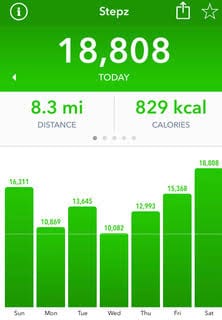
Walking burns calories, especially if you put a little ass into it. How much? Well, the standard for most walking programs is 10,000 steps a day. How far that is depends on your stride length, height etc. In any case, nowadays this is very easy to keep track of through an App on your smart phone. I use the Stepz app. On this one you can easily set up the step count for your height and weight. For me 10K steps is about 4.5 miles, which burns approx 450 calories. Now, that isn’t exact but close enough for government work. If 10K is too much to start, shoot for 5K, or just 2K. The point is to start somewhere and stick to it. Burning just an extra 200-400 calories a day by walking can make a big difference in losing and keeping excess weight off. It also provides a base of fitness that you can (if you want too) slowly start adding some jogging to: Like jog a 100 yards, walk a hundred, etc. From there you can go where ever you like, Then maybe add some weight lifting, biking and hiking and you now have a complete PT program. The point is you start at place that allows you to work up from without injury, or burnout and get some benefit along the way. At my work, a few of us have a little weekly walking competition. Every week we post our weekly total, to motivate each other to hit our step numbers. Many times that thought is enough to get me and the others out walking, when we would rather hit the couch.

raw

Attached is a picture of my total steps from last week. Of course mine includes my running, hiking and stair climbing, so some days are pretty high. On days that I only hit the gym, or I’m traveling I don’t get to 10K without some additional walking, which I almost always do after I eat supper. Which BTW is the best way to settle your dinner before you spool it down for the night. It’s a great way to clear your mind of the days battles also. In my book I call this “active rest” and it’s always been an important part of my routine and always will be. Get a step app and add some walking to your daily routine. My hunch is that you will enjoy some real benefits whether you need the exercise or not. Till next month:

“Be Safe Always, Be Good When You Can”.

Semper Fi
MGunz