An eerie fog swirls around your boots as you lead your infantry platoon through the increasingly dark forest. A twig snaps, and the bushes rustle ominously 50 meters to the west. Suddenly, from the shadows emerges either one angry horse-sized duck or 300 angry duck-sized horses.
Given a choice, which would you rather fight? I wager you would much rather focus all of your attention on the one goliath duck than have to deal with a deluge of tiny horses. This may be just a silly thought exercise, but the concept has merit. Although the weight of one horse is equal to around 300 ducks, the effect on the battlefield is much different.1 Even with superior intellect and technology, it is much more difficult to focus energy on numerous small, less lethal targets than it is to direct your efforts on the one larger but perhaps deadlier target. Yet this is the scenario the Army has boxed itself into with the continued focused development of large, heavy, and highly technical machines of war as the solution to combat.
To use a popular science fiction franchise as another example, a long time ago in a galaxy far away, the Galactic Empire concluded that the best way to win its long-running war was to build a super weapon so technologically advanced and massively devastating that Rebel forces would be forced into a final submission.2 As franchise installments revealed, the massive time and resources required to build and operate the behemoth known as the “Death Star” was wasted not once but twice as the inferior Rebel forces exploited key vulnerabilities to destroy the weapon system with a swarm of relatively cheap fighters. The American way of war is on a similar path, but on the wrong side. We love technology. Our combat systems are built to defeat any attack, conquer any terrain, and destroy any enemy. But as history has demonstrated, even the most powerful of forces can be defeated, or at least perpetually disrupted, when attacked unconventionally.
Armies worldwide are only getting more lethal, more accurate, and able to strike from increasingly further distances. The battlefield has changed. Years of training, billions of dollars, and months of deployment activities can be lost as a barrage of hypersonic missiles crest the horizon, each zeroing in on armored vehicles individually tagged and targeted by space and drone observation.3 One entire combined arms battalion could be gone in a blink. While the Army has committed to increasing our ability to conduct counterfires and missile defense, and improve the lethality and distance of our weapon systems, that may be only half the solution. The plan of simply “out-executing” an opponent with like equipment is not actually simple at all. Army tactics must change to counter the advantages currently held by our adversaries at the same time we raise our ability to match and exceed them.
Losses are an unfortunate byproduct of war. It is not acceptable (in the U.S. military, at least) to simply throw people and equipment into the meat grinder in a battle of attrition, but it is equally dangerous to be of the mindset that losses can be fully negated with sufficiently hardened vehicles. Enemy long-range fires are at such a volume, range, and mobility that they can afford to attack targets early and often, and for better or worse, the U.S. Army fights through its vaunted main battle tanks. Most battle planning orbits around the use and maneuver of heavy armor, supported by air and artillery, to take and hold ground. We’re watching the stalemate live in Ukraine, where neither side can take and hold ground despite significant ground and air barrages. The Army should consider going lighter, cheaper, and more numerous to defeat opponent advantages before committing heavy armor. The goal would be to finish the fight with the tanks rather than start it.
If the U.S. military is planning on fighting a peer threat, we need to consider what gives a peer threat the most trouble. Namely, what gives us the most trouble. Too often, we reference Operation Desert Storm as a great victory against a similarly equipped military, but it is the Yom Kippur War in 1973 that may give us the most insight. The Israeli Army, which is similarly equipped to U.S. forces, was initially defeated in part because of the overwhelming number of individual anti-tank weapons leveled against their western forces. Coupled with surprise and other compounding factors, the better-equipped and trained Israeli forces were rocked on their heels. More recently, the U.S. military conducted the exercise Millennial Challenge 2002, where it faced an unnamed virtual Middle Eastern enemy force led by retired Marine Gen Paul Van Riper.4 The results were unnerving at best:
“Van Riper decided that as soon as a U.S. Navy carrier battle group steamed into the Gulf, he would “preempt the preemptors” and strike first. Once U.S. forces were within range, Van Riper’s forces unleashed a barrage of missiles from ground-based launchers, commercial ships, and planes flying low and without radio communications to reduce their radar signature. Simultaneously, swarms of speedboats loaded with explosives launched kamikaze attacks. The carrier battle group’s Aegis radar system — which tracks and attempts to intercept incoming missiles — was quickly overwhelmed, and 19 U.S. ships were sunk, including the carrier, several cruisers, and five amphibious ships. “The whole thing was over in five, maybe ten minutes,” Van Riper said.”5
Gen Van Riper wreaked havoc on the technologically superior U.S. forces in short order, and at a much-reduced cost, than if he had attacked with like forces (i.e., Navy vs. Navy). The lessons we learned were the wrong ones. We doubled down on protection and lethality instead of adapting the swarm tactics as a viable winning strategy.
Swarming skirmishers are not a new trend and have been a feasible tactic since formal militaries were created… and likely earlier. Throughout history, inferiorly equipped enemies have adapted by giving advanced forces both more and less to engage. They deploy small, agile, and inexpensive combat forces in greater numbers with seemingly chaotic movements, as opposed to large high value targets with structured objectives. Napoleon struggled against guerrilla tactics in Spain and also employed his own skirmishers to disrupt coalition formations before committing his own formations. Soviet tanks and helicopters struggled to defeat scattered locals equipped with anti-air and anti-tank weapons in Afghanistan and are continually harassed by small drone warfare in Ukraine.6 The U.S. has personally experienced fighting these tactics in Korea, Vietnam, Iraq, and Afghanistan, not to mention the struggles with fighting Native Americans early in our own country. Yet despite the continual examples presented by history, the U.S. Army persists in the thought that our “Death Stars” will dominate future conflicts. We move further and further away from skirmishers as a viable addition to our fighting formations. With the advent of brigade combat teams, the lethality, mobility, and deep-strike capability of the Vietnam-era long-range reconnaissance detachments (LRSDs) is slowly being converted to armored reconnaissance units, designed to engage and defeat adversary reconnaissance armor with like vehicles. The ability to actively harass and disrupt without being decisively engaged has dissipated at a time when it is needed the most.
Field Manual 3-0, Operations, implores commanders to give the enemy “multiple dilemmas” in an effort to affect their observe, orient, decide, act (OODA) loop. Small teams — ghosting from tree to shadow in the wood line, attacking and disappearing continuously — cause trepidation and disrupt movement like almost no other force. The Imperial Tie Fighters swarmed like killer bees, never presenting a singular target and utilizing a “death by a thousand cuts” strategy. Vietcong forces mastered this fear during the Vietnam War as well as our sniper teams do today. Modern skirmishers would utilize certain traits to be the most effective:
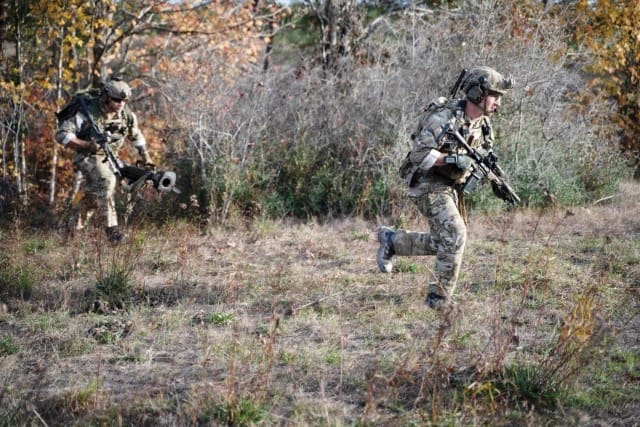
1. Small Teams: A group of two to four Soldiers is more effective for “hit and run” attacks than the traditional cavalry and infantry formations. Operating semi-independently, and in large numbers (of teams), these groups would swarm enemy forces from multiple angles, striking and withdrawing as another team attacks from a new direction. Their goal is to create chaos and confusion, with the bonus possibility of destroying key enemy equipment and personnel.
2. High Lethality and Mobility: Smaller, lighter, faster. For the cost of one Bradley Fighting Vehicle, the Army could have around 25 Polaris MRZR all-terrain vehicles. That trade-off gives a commander 25 chaos teams, which, when equipped with individual sniper rifles, grenade launchers, and anti-air and anti-tank weapons, can attack targets of opportunity at will before quickly fading into the shadows. Given individual dirt bikes or quad bikes, especially if electric and quiet, the individual skirmishing soldier, and team overall, is even more mobile and frustrating.
3. Stigmergy: Essentially, swarming attacks are executed without continual direction and coordination during the attack.7 In an ambush, Team A engages suddenly and violently, then withdraws just as quickly. Team B engages from a different direction just as the enemy responds to the initial attack, then quickly withdraws. As enemy attention shifts, Team A, or even a third or fourth team engage again, continually interrupting the OODA loop with new problems, all without having defined planning between teams.
“Stigmergy-based rules allow units to deduce when to attack, retreat, and how much distance to maintain with other detachments based on the surrounding environment. Relatively simple sets of rules, properly vetted and trained, can allow junior leaders to rapidly self-organize with little to no electronic communication signature to complete a mission.”8
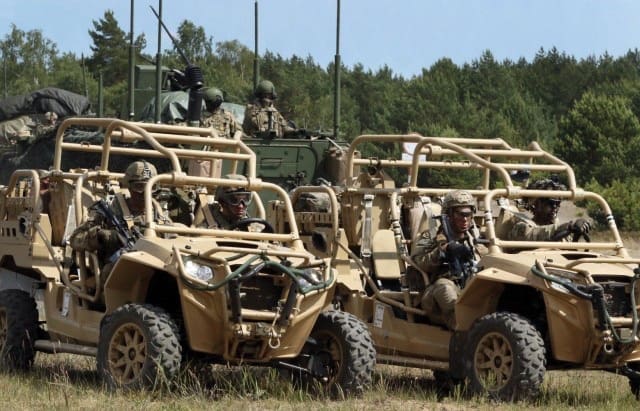
It can be argued that Stryker brigade combat team (SBCT) reconnaissance squadrons, as well as Ranger battalions and even infantry companies, all retain a skirmisher mentality. This is certainly true, and the intent would be to enhance these capabilities with equipment and training rather than allow them to be slowly transformed to heavily armored, high-signature formations. The two most likely candidates for the development of chaos teams are the cavalry squadrons and infantry companies. Their missions and training sets are already closely associated with the objectives of the skirmisher, but with the added ability to bridge the gap between a reconnaissance (information) focus and the infantry (kill and hold) focus.
The arguments against such formations are largely based on risk. There is obvious concern for the survivability of the teams, which is in direct conflict with the current trend of increasing the armor of reconnaissance elements. Their key to survival, however, is the same as what makes them lethal. Chaos teams are small and fast, with a minimal vehicle signature and battlefield footprint. Much like hearing the buzz of a mosquito, it is difficult to pin down where it’s coming from, and even harder to actually swat it. This becomes exponentially more difficult as the number of mosquitoes increases. As mentioned, the teams utilize opportunistic hit-and-run attacks to avoid direct and extended engagements with enemy forces. Violent action is followed by rapid disengagement during the initial confusion, leaving the enemy dealing with the sudden chaos. There is the threat of being discovered and destroyed, which is a constant concern for all reconnaissance elements (as well as a necessary evil). Once again, the small footprint of the teams is conducive to quickly and easily going to ground as needed. Training focus on survival skills and camouflage will further enhance their ability to fade into the forest. The enemy gets a vote; however, and it is likely to find a few teams through luck or detection. The large number of teams and fluidity of their mission minimize the impacts to combat effectiveness of the skirmisher element. In contrast, the loss of armored vehicles in traditional reconnaissance formations can open gaps that are not easily closed. Whereas swatting that one mosquito is satisfying, it does little to stop the onslaught of the rest of the swarm. By nature, the chaos teams are certainly high risk, but the effects they provide could prove to be a much higher reward.
The Army currently lacks the ability to actively disrupt enemy operations on a persistent basis. We lament adversary capabilities for anti-tank and anti-air at the lowest level, forcing excessive caution before our adversary has even used it against us, but have not addressed our tactics to counter them. U.S. Army reconnaissance and infantry elements have clearly defined missions and doctrine but lack the flexibility to flow in and through the enemy with open objectives. Much like the swarms of Tie Fighters surging against approaching Rebel fighters, the benefits of the chaos teams are clear. They have minimal logistics support requirements, the ability to cause massive disruption, and can absorb the loss of teams without becoming combat ineffective.
Before the message boards fill with die-hard fans, I fully acknowledge that tanks are probably more Imperial Star Destroyer than Death Star. The point remains that the historical Army concept of relying on this heavy armor is susceptible to catastrophic failure with a few well-placed shots (and perhaps a bit of the Force). To defeat an adversary with the depth and breadth of artillery and anti-access/area denial that our adversaries have demonstrated, the Army needs to employ less Death Stars and invest in quite a few more Tie Fighters.
By LTC Travis Michelena
Notes
1 The average duck is roughly 4 pounds, while the average horse is roughly 1,200 pounds.
2 George Lucas, Star Wars, Lucasfilm, 1977, www.imdb.com/title/tt0080684.
3 Amanda Macias, “Russia’s New Hypersonic Missile, which can be Launched from Warplanes, Will Likely Be Ready for Combat by 2020,” CNBC, 13 July 2018, www.cnbc.com/2018/07/13/russia-new-hypersonic-missile-likely-ready-for-war-by-2020.
4 Micah Zenko, “Millennium Challenge: The Real Story of a Corrupted Military Exercise and its Legacy,” War on the Rocks, 5 November 2015, warontherocks.com/2015/11/millennium-challenge-the-real-story-of-a-corrupted-military-exercise-and-its-legacy.
5 Ibid.
6 “The Soviet Invasion of Afghanistan and the U.S. Response, 1978–1980,” U.S. Department of State, n.d., history.state.gov/milestones/1977-1980/soviet-invasion-afghanistan.
7 A form of self-organization without formal planning, direct control, or communication; examples: ants, bees, flocks of birds, and schools of fish.
8 Justin Lynch and Lauren Fish, “Soldier Swarm: New Ground Combat Tactics for the Era of Multi-Domain Battle,” Modern War Institute, 5 April 2018, mwi.westpoint.edu/soldier-swarm-new-ground-combat-tactics-era-multi-domain-battle.
LTC Travis Michelena currently serves in the 79th Theater Sustainment Command Forward Element in Vincenza, Italy, with a focus on sustainment operations throughout Africa. He has more than 17 years of experience as an Army logistician with deployments to Iraq, Afghanistan, and Haiti. LTC Michelena’s previous assignments include serving as commander of the Forward Support Company, 4th Squadron, 10th Cavalry Regiment, 3rd Brigade Combat Team, 4th Infantry Division; an observer-coach-trainer and Headquarters and Headquarters Company commander with the First Army’s 181st Infantry Brigade; and S-3 and executive officer with the Surface Deployment and Distribution Command in Europe.
This article appeared in the Spring 2025 issue of Infantry. Read more articles from the professional bulletin of the U.S. Army Infantry at www.benning.army.mil/Infantry/Magazine or www.lineofdeparture.army.mil/Journals/Infantry