Phantom Lights

Archive for the ‘Air Force’ Category

1st Air Commando Force Directive on Beards – March 1944

Sunday, March 3rd, 2019

Love the phraseology by the legendary Col Cochran. The 1st ACG was so busy during Operation Thursday, the men didn’t have time to shave.

Above, you can see the “fuzz” on Col Allison (l) and Col Cochran (r). The fellow in the center wearing the pith helmet is Gen Orde Wingate, British commander of the Chindits fighting force. He wore a full beard.

Well Played Aviano, Well Played

Thursday, February 28th, 2019

Air Force Leaders Implement New Warfighting Planning Process

Tuesday, February 19th, 2019

WASHINGTON (AFNS) — Air Force leaders directed the implementation of a new approach to planning to better meet future threats. The team focused on this effort will be led by Maj. Gen. Clinton Crosier.

“The Air Force needs to plan across stove pipes to prepare for warfare of the future,” Secretary of the Air Force Heather Wilson said. “This will change the way we develop Air Force programs and budgets to face threats from high-end adversaries.”

In today’s technologically competitive, multi-polar world, the Air Force must be able to innovate and operate faster and more effectively than its potential adversaries. However, under the current force design model, planning and development are sub-divided into 12 core functions, such as rapid global mobility and air superiority, managed across seven major commands.

In October, Wilson and Air Force Chief of Staff Gen. David L. Goldfein initiated an interim effort to move forward an Air Force Warfighting Integration Capability.

Wilson and Goldfein charged Crosier with leading a 70-person team to develop the AFWIC way forward. The team is made up of Airmen from across the Air Force.

“Warfighting in the 21st century is all about multi-domain integration, agility in decision-making, and speed of action. We must consistently innovate, integrate and field capabilities more effectively than our adversaries,” Goldfein said. “AFWIC will help us evolve and transform our processes and organizations to meet the challenges of future warfighting.”

AFWIC will explore and wargame innovative solutions, develop an integrated family of concepts, and direct capability development efforts across the Air Force.

This organization will also develop a single, multi-domain strategy that will identify, guide, and prioritize future force development. That will improve Air Force agility, readiness, and lethality in the joint fight, Goldfein said.

By Tech. Sgt. Robert Barnett, Secretary of the Air Force Public Affairs

Airmen Test Resolve During Air Assault Assessment

Saturday, February 16th, 2019

MOODY AIR FORCE BASE, Ga. —

Cadres from the 820th Base Defense Group (BDG) evaluated approximately 37 Airmen during an Army Air Assault Assessment (AAA), January 28-31, here.

The assessment measured each Airmen’s readiness to determine who would be selected to attend the 10-day Army Air Assault School (AAS), at Fort Campbell, Ky. The BDG is one of the few units within the Air Force that sends their Airmen to AAS to enhance their personal readiness and also reinforce their unit’s lethal capabilities.

“Everything we learn at AAS is a part of our mission scope within the BDG,” said Staff Sgt. Nicholas Groomes, 822d Base Defense Squadron (BDS) training instructor and cadre team member “It’s rare to find an Army school that’s curriculum falls under our umbrella, so the more experience we can get for our Airmen the better off the BDG can be downrange.”

The AAA provided Airmen with an opportunity to challenge themselves personally and to self-assess their physical and mental readiness to perform in high-stress situations.

“The reason I wanted to go to AAS was to test myself and to prove that I could get through something so difficult,” said Senior Airman Jeffrey Lewis, 822d BDS fireteam leader. “You always hear of how superior the Army Air Assault School is and how physical it is. I saw this as a milestone to achieve and an opportunity to improve.”

In order to be eligible to attend the school, Airmen have to complete a wide array of tests consisting of: rappel tower operations, ruck layout and sling load inspections, the Army physical fitness test, an obstacle course and finally a 12-mile ruck march.

“There are very few opportunities for Airmen to go to AAS and the BDG is one of the only units that gives their Airmen the chance to attend, so I wanted to take advantage of that,” said Groomes. “It’s a great opportunity for Airmen to [assess] themselves and learn what things they need to improve, not only physically, but mentally to push through.”

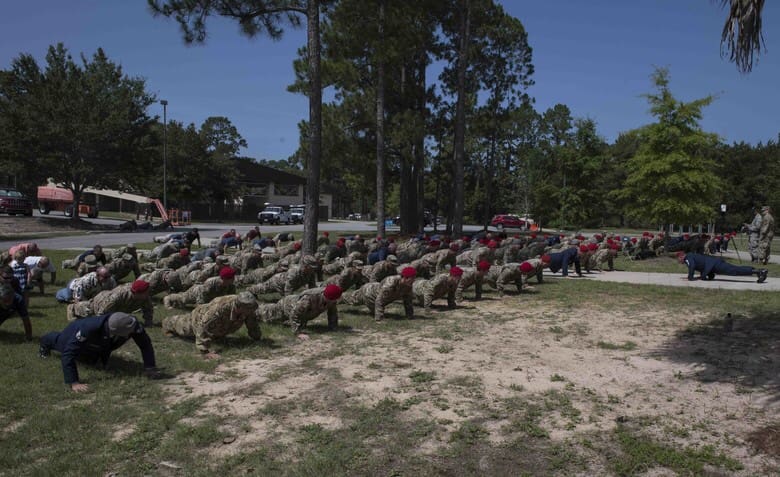
While still having to pass all proficiency tests, Airmen were required to perform constant remedial physical training throughout the duration of the assessment to test their physical and mental resiliency.   

“The biggest thing I needed, to get through (the assessment), was a strong drive and motivation,” said Lewis. “Being self-aware and keeping my mental composure through very intense situations was key.”

Cadres already know the physical and mental demands it takes to complete AAS, so during AAA they implemented strenuous measures to help simulate what an Airman should expect at Fort Campbell.

“We intentionally try to make the assessment more rigorous than the school to better prepare our Airmen for success when they arrive there,” said Staff Sgt. Ulysses Ortiz, 820th Combat Operations Squadron unit trainer and lead cadre team member. “We have very few slots at the schoolhouse, so we only want our most deserving Airmen to go.”

Of the 37 Airmen that started the assessment, approximately 10 were deemed qualified for AAS.

Upon completing the assessment, Tech. Sgt. Christopher Zavala, 822d BDS squad leader, explained what it took to finish the assessment and how attending Army Air Assault School will benefit not only himself but other Airmen’s careers in the future.

“The biggest thing it took for me to push through the AAA was just channeling that inner drive that motivated me to train so hard for it in the first place,” said Zavala. “I wanted to lead by example and Air Assault will add more tools to my toolbox, which gives me the ability to explain and elaborate those things to my Airmen coming in from [technical] school to help them succeed.”

By A1C Eugene Oliver, 23d Wing Public Affairs

USAF Security Forces Holster for Modular Handgun System M18

Monday, February 11th, 2019

US Air Force Security Forces soon begin fielding the M18 variant of the Modular Handgun System, a variant of the SIG SAUER P320.

For many years, Security Forces have been using a Safariland holster with the M9 Beretta pistol. It appears that they will continue to do so once they transition to the M18.

Download PDF here.

The Safariland kit detailed in this image will be available in Coyote as well as Black to support the full Security Forces Mission. It includes mounting options as well as magazine pouches.

Space Operators Provide TACPs Tactical Space Training

Sunday, February 10th, 2019

PETERSON AIR FORCE BASE, Colo. —

Deployed Tactical Air Control Party Airmen expect space effects to work; otherwise pilots get shot down, bombs miss targets, and soldiers die. TACPs may not know how space works, but if it doesn’t work well for America and its allies then its results devastating.

U.S. Air Force Tactical Air Control Party Airmen with the New Jersey Air National Guard’s 227th Air Support Operations Squadron coordinate close air support with U.S. Marine Corps aircraft during joint training on Joint Base McGuire-Dix-Lakehurst, N.J., Dec. 6, 2018. (U.S. Air National Guard photo by Master Sgt. Matt Hecht)

Space operators from the 16th and 4th Space Control Squadrons at Peterson Air Force Base are working to change the TACP community’s knowledge of space by developing the first Space Operations Course, Jan. 7-11. The course was an Airman initiative designed to give the TACPs a working knowledge of what space effects from three Air Force Space Command wings do to specifically impact their ground operations.   

The week-long course, organized by Airmen of the 21st Space Wing and the 13th Air Support Operations Squadron, allowed TACP Airmen a look into tactical-level space operations with regard to mission planning.

“There are two big reasons why we came together to create this course,” said Capt. Ray Reeves, 13th ASOS flight commander and course planner. “The first reason is that the TACP community is focusing on integrating operations across multiple domains at the tactical level, based on the Air Force Chief of Staff’s priorities. The second was based off experiences from my last deployment. On the way out of theater I went by the Combined Air and Space Operations Center and received a brief from the space team in theater. I was surprised to learn there were a lot of capabilities and information that their assets were providing and major effects they could have on the battlefield. At the tactical level within my area of operations, neither myself nor the ground team I was with know those capabilities existed, which could have impacted our operations on the ground in a positive manner.”

Tactical air control Airmen assigned to the 19th Air Support Operations Squadron, Fort Campbell, Kentucky and the 818 Operational Support Squadron, Pope Field, North Carolina perform exercise Talon Fury Dec. 12, 2019 at Whiteman Air Force Base, Missouri. During the exercise TACP Airmen’s job were in charge of calling in the B-2 Spirit Stealth Bomber to help provide air support to those who are on the ground. (U.S. Air Force photo by Senior Airman Thomas Barley)

Upon return from that deployment, Reeves began working with the 21st SW to determine what space brings to the fight and how they can work together to improve battlefield operations.

TACP Space Integration Course 19-01 provided 18 Airmen from 11 units operational knowledge of the 21st SW, 50th SW, 460th SW and the National Reconnaissance Office.

“Space is really at the forefront of deployed operations,” said Capt. Chelsea Moss, 16th SPCS weapons and tactics flight commander and course planner. “TACPs are the subject matter experts for air power for the Army. There wasn’t any formal instruction on space, so we wanted to be able to provide this course to show the importance of space in mission planning and support.”

Topics covered during the course included GPS, communicating in jammed environments, space support in monitoring Remotely Piloted Aircraft, space threats, Intelligence, Surveillance and Reconnaissance threats, and battlespace situational awareness.

“Particularly from the perspective of the 21st SW, we wanted to show how we monitor RPA links and how we can provide support,” said Moss. “We wanted to show what we do on a basic level and how TACPs can request space support from the Air Operations Center.”

“Working with our Airmen on the ground and showing them how space capabilities can improve their operations is crucial to maintaining our warfighting superiority,” said Col. Devin Pepper, 21st Operations Group commander. “The creation of this course is such an important step for both Air Force Space Command and Air Combat Command.”

Equipped with a better understanding of the symbiotic relationship between space and ground operations, TACPs can better integrate space into their training and operations.  

“I can’t put into words how important this is to the TACP community,” said Reeves. “When we start talking about the future fights and what we’re training toward – and we’re talking about major contested operations with a peer enemy – the ability to operate from multiple domains is going to be key to any success on the ground. By us learning what space can provide and being able to integrate it at the ground level, we are going to impact far more than just the TACP community. TACPs are aligned from the lowest tactical echelon in the Army to three-star headquarters, so if we can help integrate space across those echelons I believe we can have a Department of Defense wide impact.”

TACPs are embedded with Army units and are responsible for planning, integrating and executing Air Force operations worldwide. When properly trained and positioned they ensure the space-based effects are used and integrated to support ground maneuvers.

By Staff Sgt. Emily Kenney, 21st Space Wing Public Affairs

Commander of Special Tactics Enterprise Promoted to Brigadier General

Saturday, February 9th, 2019

HURLBURT FIELD, Fla. —

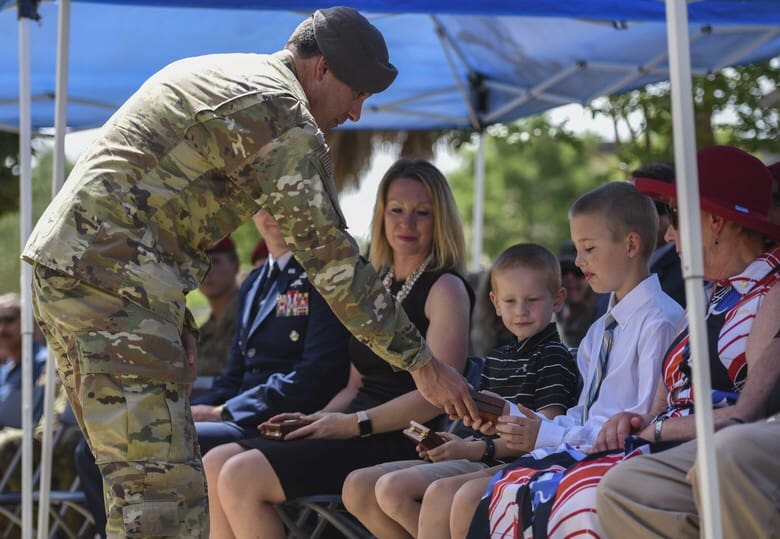
Hundreds of family, friends and teammates gathered as U.S. Air Force Col. Claude K. Tudor, Jr., commander of the 24th Special Operations Wing, was promoted to the rank of brigadier general during a ceremony Feb. 8, here.

U.S. Air Force Lt. Gen. Brad Webb, commander of Air Force Special Operations Command, was the presiding official during the ceremony.

“There’s a few things we want in a general officer,” Webb said. “We want officers of character; those that are competent; those that are professional; those that have integrity; that are team players; that have compassion for their troops, our charges after all; those that are intellectually curious; those that have strategic vision…tying complex ideas to the other; being prudently audacious, never quitting; and of course, wrapped up in our motto, understanding there is a way and we will find it.”

Webb concluded with stating Tudor is all of this and more.

Tudor earned an Air Force commission through the Troy State University Reserve Officer Training Corps program in 1992 and immediately entered the pipeline to become a Special Tactics officer.  

As a Special Tactics Officer, Tudor is specially trained in the planning and employment of Special Tactics Teams at all levels of command to provide: global access for force projection; precision strike, i.e. close air support, combined arms, and strategic attack; personnel recovery/combat search and rescue, and battlefield trauma surgery.

Tudor has spent the preponderance of his career in special operations ground combat assignments and deployed extensively in support of joint and coalition special operations leading combat, humanitarian assistance and peacekeeping operations globally.

Tudor took command of Air Force Special Operations Command’s 24th SOW Mar. 8, 2018, and is responsible for preparing Air Force Special Tactics Teams to conduct global air, space, and cyber-enabled special operations across the spectrum of conflict to prepare for, fight, and win our nation’s wars. These Airmen are disciplined and hand-selected Airmen to lead joint operations and deliver solutions to the nation’s most complex military challenges. The 24th SOW is the only wing in the Air Force dedicated to training, equipping and providing Special Tactics Airmen for immediate deployment into combat operations.

Tudor gave remarks during the ceremony, driving home his motivation to continue serving Airmen, his passion, and he attributed his success to many in the audience.

“It’s not just about the individual DNA, but also the family, the neighbors, school teachers, and friends who are like family and forged me to who I am today; so thank you for coming and sharing in this event with us,” Tudor said.

Tudor is a qualified military free fall jumper, a static line jumpmaster with more than 400 jumps, combat diver, Federal Aviation Administration certified Air Traffic Controller, and Joint Terminal Attack Controller.

His awards and decorations include the Defense Superior Service Medal, Legion of Merit, Bronze Star Medal with oak leaf cluster, Defense Meritorious Service Medal with oak leaf cluster, Joint Meritorious Unit Award, Gallant Unit Citation, Air Force Outstanding Unit Award with Valor and eight devices and Air Force Recognition Ribbon.

By Senior Airman Joseph Pick, 24th Special Operations Wing Public Affairs
SHOT Show 19 – Quantico Tactical Exhibits Laser Early Warning Detection System

Thursday, January 24th, 2019

The Laser Early Warning Detection System is one of those technologies that is going to save lives. In fact, it was developed by Attollo Engineering from their OMNir technology at the direction of Air Force Research Labs because of a friendly fire incident in Afghanistan where a US aircraft mistakenly bombed US troops.

LEWDS is lightweight and mounts to the top of the helmet or other equipment. It uses a common CR123A battery.

It offers a haptic alert (user programmable) if it is lased with 1064 & 1550nm energy which is generated by:


– Low Eye-safe military laser rangefinders (LRFs) used for precision target locating

– Low frequency gimbal-mounted LRFs

– High frequency handheld LRFs

– PRF-coded Laser Target Markers (LTMs) used for handoff to laser designator systems

– PRF-coded Laser Target Designators
(LTDs) used for guiding laser guided bombs

In addition to direct targeting LEWDS also detects “Danger Close” illumination and is designed to reject false alarms.

LEWDS does not need to be fielded to all. Because it detects Laser energy generated from above, Terminal Attack Controllers and small unit leaders are the best use of the device as they are most likely to have contact with Close Air Support aircraft to alert them they are placing friendly troops in danger.

LEWDS is available from www.quanticotactical.com.