Tropo Performance

Archive for the ‘Air Force’ Category

Aircrew Gets New Anti-Smoke Goggles

Thursday, July 11th, 2019

KEESLER AIR FORCE BASE, Miss. (AFNS) —

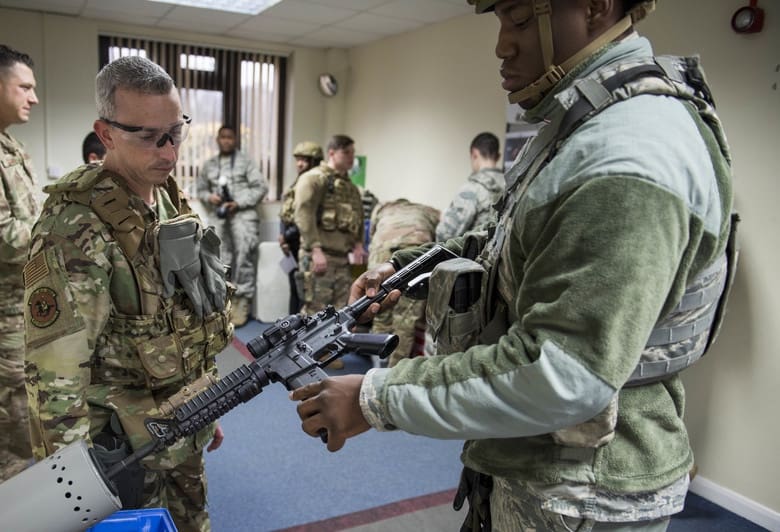
If smoke starts filling up a C-130J Super Hercules aircraft, the aircrew reach for their anti-smoke goggles. For more than 20 years the ASGs have been a basic four part system, until now.

With innovation, the new ASGs are now a three-part system. The suspension frame itself is still made the same with the nape pad attached, while the goggles and oxygen mask portion have been upgraded.

“The ones that we are replacing have the same basic frame, but the goggles and the oxygen mask are two separate pieces,” said Tech. Sgt. Ronald Patton, 403rd Operation Support Squadron aircrew flight equipment craftsman. “Before, you would need to put the oxygen mask over your mouth and nose, then pull the frame up and place the nape pad at the back of your head. Once that was in place you would put the goggles on and pull the straps on both sides to tighten them.”

The way the new ASGs work is still the same concept, except now the goggles and oxygen mask are one piece, so when you place the oxygen mask over your nose and mouth, the goggles are put on at the exact same time, saving time and making them quicker to put on and operate.

“The new masks are made similar to ones that firefighters use,” said Master Sgt. Ray Reynolds, 403rd OSS aircrew flight equipment supervisor. “The older goggles had a narrower field of view, while the new ones allow the aircrew to be able to use their peripheral vision.”

As a part of the AFE duties, they are required to make sure the equipment operates the way it is supposed to, be able to fix the equipment and replace any parts as needed.

Patton said that when the new ASGs came in, the manufacturer sent a ‘fix’ in with the mask to ensure they operated as designed. This ‘fix’ was a single screw that needed to be replaced on the front of the mask.

“Every part on the ASG system is replaceable, which helps to make sure they last,” Reynolds said. “Looking at the order of parts that could be damaged from easiest to hardest. The first thing is the hose, the second thing being the communication cord and the third is the microphone and then onto the remaining parts.”

AFE technicians are also required to test the pull disconnect on the air hoses to ensure that they will not come unattached from the oxygen hose on the aircraft too easily. This pull test requires a minimum of 12 pounds to a maximum of 20 pounds of pull before the hose on the mask would release, ensuring that there is some resistance before it disconnects.

If the disconnect is not between the 12 to 20 pounds of pull, then they have to fix the connector to correct the amount of pressure to meet the requirement, Patton said.

“We are also required to conduct pre-flight, post-flight, periodic maintenance, 30-day and 120-day inspections on the ASGs,” Patton said.

The 30-day inspections consists of basic checks. A visual examination is conducted and they look for cuts, tears, abrasions, discolorations, rust, anything other than normal, looking for anything that is obviously defective. A cleaning is done and the components are tested to ensure they work.

The 120-day inspection is the same inspection, but with a full break down of all of the components and a deep clean, checking the integrity of the components that you cannot see, Reynolds said.

“It is not that the old ASGs were replaced because they were faulty, they worked exactly as they were designed to. It seems like they just needed to improve on the integrity of the system itself,” Patton said. “Will it operate better under stressful situations, will it be easier to repair if it does break, does it have as many subcomponents that can break, does the aircrew member find it easier to don, and can the aircrew operate better in the environment, were questions that they asked when designing the new system.”

To improve the ASG system, they took a mask similar to a firefighter’s mask and the quick don suspension frame and made it one system, then they added the communications portion, Reynolds said.

“So they are doing something right, because if they hadn’t created this one, the ones that we have still work. I have been in this career field for more than 30 years and this is only the third version that I have seen,” Reynolds said.

“While the older ASG masks still work and some are still located on our C-130J aircraft, we are working to replace them on all of the aircraft” Patton said. “We currently have six sets in service and have replaced more than half of the 815th Airlift Squadron’s ASGs with a new quick don system and we expect to have them all of our aircraft by the middle of August, after the current inspection cycles are complete.”

By Jessica L. Kendziorek, 403rd Wing Public Affairs

Shorts Coming To Nellis AFB Flightline

Tuesday, July 9th, 2019

According to information received by the Facebook group Air Force AMN/NCO/SNCO, maintenance crews at Nellis AFB near Las Vegas will soon be donning shorts.

2744954D-0EE9-4813-8357-82F05192390D

For once, this makes sense. It’s extremely hot at Nellis in the summer and our allies, and contract maintenance, have been doing it for decades. Additionally, Services has been wearing something similar, along with polo shirts, for decades as a special duty uniform.

50F430C5-D24A-45F6-9E6C-7EB0B91A8382

The email says that the shorts are the 5.11 Stryke model (below), but the attached photo is of the classic 5.11 Tactical Short (above). Ostensibly, they will be in Dark Navy.

F51BA4A7-2A51-4B7E-AB2A-5ADDCE51EE51

Hopefully, this will catch on and we’ll see a more suitable work uniform for maintenance personnel, across the Air Force.

New USAF Special Warfare Symbol

Wednesday, July 3rd, 2019

This is the symbol for the new Air Force Special Warfare careerfield (Enlisted is 1Z and Officer is 19). It’s surrounded by the latest versions of the enlisted beret badges, including the new Special Reconnaissance AFSC, which replaces Special Operations Weather Team*.

The SR AFSC has already transitioned to 1Z with Pararescue and Combat Control to follow suit later this year. Along with a new AFSC, they are said to get new job titles as well. TACP and Air Liaison Officers will remain as is, at least for now. Special Tactics Officers and Combat Rescue Officers are supposed to become Special Warfare Officers.

The three new 1Z shredouts as well as STOs and CROs currently wear different colored berets. The plan is transition all to a completely new shade of Grey; Gunmetal. Once again, TACP/ALO will remain in Black berets. That is supposed to change this Fall concurrent with the amalgamation of active duty Pararescue Squadrons into Air Force Special Operations Command. Along with the current Special Tactics Squadrons they are supposed to transition into Special Warfare Squadrons. However, the beret transition is at the direction of the current AF Chief of Staff, General Goldfien. Many at the unit level feel that their heritage is being stripped away and don’t want to make the change, hoping the next CSAF won’t enact the change once he’s in place late this Summer.

As for this new symbol, don’t expect it to be used officially for anything. Guardian Angel used the globe wings for years as a morale symbol. Even so, do notice anything odd about it?

*Never fear, rumor has it Army SOF will soon once again have actual weather support as required by the Key West agreement thanks to Air Combat Command, which is standing up a Flight of Weather Parachutists, just like the old days. Rumor was bad. ACC has no intention of supporting Army SOF. Any support will come from AFSOC weather, remotely.

AFSOC U-28A Aircraft Named “Draco”

Tuesday, July 2nd, 2019

HURLBURT FIELD, Fla. —

After more than 13 years in service, the U-28A intelligence, surveillance and reconnaissance aircraft officially received approval in May for the naming convention of “Draco”.  

Draco is the Latin term for dragon. Most aircraft commonly have a name after their numerical designation, such as CV-22 Osprey. 

Col. Robert Masaitis, 492nd Special Operations Training Group commander, Draco pilot and former commander of the 34th Special Operations Squadron at Hurlburt Field, commented on the process of naming the aircraft.

“From my time in the community (2010-2012), we were split between a couple of schools of thought on the official naming of the U-28,” said Masaitis. “Lt. Gen. Eric Fiel, the AFSOC commander at the time, had told us we ought to name the aircraft. Between the two, then later three squadron commanders, we could agree that ‘Draco’ was probably the obvious choice. I’m glad to see we’re bringing this initiative to fruition after all this time, as the U-28 has become so much more than the single-engine, non-descript ‘utility’ aircraft we brought into the service over a decade ago.”

The mission of the Draco is to provide manned fixed-wing tactical airborne ISR support to humanitarian operations, search and rescue, conventional and special operations missions.

 “This is fantastic recognition of an aircraft and community,” said Brig. Gen. William Holt, AFSOC special assistant to the commander. “Draco has changed the very fabric of our AFSOC DNA and will continue to be our premier ISR platform for years to come.”

The Draco reached a historic milestone on June 22, 2018, when the AFSOC aircraft reached the 500,000 flying hours mark.

Lt. Col. Chad Anthony, 319th Special Operations Squadron commander, commented on the capabilities of the aircraft.

“Over the battlefields of the global war on terror, Draco has come to mean unparalleled special operations intelligence, surveillance and reconnaissance support, especially to the men and women on the ground in the line of fire,” said Anthony. “Aircrew and special operators who have flown and worked with the Pilatus U-28A have known it as Draco since its first combat deployment in June 2006.”

Maj. Caitlin Reilly, a U-28A Draco pilot and AFSOC director of operations executive officer, commented on the importance of the name approval and the Draco community.

“All of us in the U-28 community today are humbled by the vision and expertise of the U-28A plankholders (the original founders of the program),” said Reilly. “They created something that had never been done before, and it has evolved into an asset that is now one of the ‘minimum force requirements’ of our nation’s elite SOF teams on their ‘no-fail’ missions.”

The Draco is an integral part of AFSOC’s light tactical fixed wing fleet.

Col. Andrew Jett, 492nd Special Operations Wing commander, former 34th SOS commander and Draco pilot, commented on the significance of the name. 

“Our partners may not have known the personal names of the crewmembers, but they always know Draco,” said Jett. “There is a tremendous amount of recognition and respect when a crewmember identifies him or herself as being a member of Draco. I’m thrilled about the exceptional reputation Draco has built over the 13 plus years of the program and it’s now codified as the permanent aircraft name, and is something every member of Draco, past and present, can take pride in.”

Reilly further commented on the pride she and fellow Draco aviators take in the name.

The best thing about the U-28 community, and AFSOC as a whole, is that it is a competency-based organization, she said.

All of the U-28 aircrew are equally proud of the Draco name approval.

Every Air Commando in the U-28A community dedicates themselves to the demanding task of upholding the level of expertise and respect that the name Draco commands, said Reilly. It’s extremely challenging, and we’re all immensely proud of what this name represents.

By SSgt Lynette Rolen, Air Force Special Operations Command Public Affairs

U-28 Photo by photo by A1C Joel Miller

Constellation graphic by Jeff Pendleton

Col Matt Allen Assumes Command of 24th SOW – The Air Force’s Sole Special Tactics Wing

Wednesday, June 26th, 2019

HURLBURT FIELD, Fla. – U.S. Air Force Col Matt S. Allen, a Special Tactics Officer, assumed command of the 24th Special Operations Wing during a ceremony at 10 a.m., June 24 at Hurlburt Field, Florida.

U.S. Air Force Lt. Gen. Brad Webb, commander of Air Force Special Operations Command, presided over the ceremony.

The 24th SOW is the only Special Tactics wing in the U.S. Air Force. The primary mission of the wing is to provide Special Tactics forces for rapid global employment to conduct global air, space, and cyber-enabled special operations across the spectrum of conflict to prepare for, fight, and win our nation’s wars. The 24th SOW is U.S. Special Operations Command’s tactical air/ground integration force and the Air Force’s special operations ground force that leads global access, precision strike, personnel recovery and battlefield surgery operations.

Since April 2018, when the 24th SOW had their last change of command, Special Tactics operators have conducted 264 combat missions, controlled over 500 aircraft and removed more than 730 enemies from the battlefield. Webb commended their efforts.

“To the 24 SOW, particularly, this is the message – you guys continually impress. You lead this command, AFSOC, in many ways,” Webb said. “This [major command] is drafting off the intellectual energy of this wing, and I am not ashamed to say that. Actually, you’re making us that much better.”

As the commander of the 24th SOW and roughly 2,500 Airmen, Allen is responsible for preparing Special Tactics forces to conduct global air, space, and cyber-enabled special operations across the spectrum of conflict to prepare for, fight, and win our nation’s wars.

“This is about putting the right person at the right place in the right time, and that person is Col. Matt Allen,” Webb said. “Matt, of course you are going to command during interesting times. You will lead your charges while you balance the demands of the present, counter [violent extremist organizations], with what is frankly, right on our door step or what will be in the future, and is expressed in the National Defense Strategy – great powers competition.”

Prior to assuming command of the 24th SOW, Allen was the commander of the 720th Special Tactics Group, here.

Over a 20-year career, Allen has served in three Special Tactics Squadrons as Team Leader, Director of Operations, and Commander. Colonel Allen has led and participated in joint special operations in Operations ENDURING FREEDOM, IRAQI FREEDOM, and ENDURING FREEDOM-Trans Sahara.

“I am proud and humbled to be here,” Allen said. “Immensely proud of this organization and our professional standards and incredibly humbled at the enormity of the task that lies ahead of us.”

Air Force Special Tactics is the most highly decorated community in the Air Force since the end of the Vietnam War and has received one Medal of Honor, nine Air Force Crosses, 46 Silver Stars, nearly 650 Bronze Stars medals (more than 250 with valor), and hundreds of Purple Hearts.

“Our men and women provide access, strike, recovery, and battlefield surgery across the spectrum of conflict, and foundational to this, is mission command,” Allen said. “The joint team depends on us to get it right the first time, every time, and we will continue to deliver.”

24th Special Operations Wing Public Affairs, Senior Airman Joseph Pick and Senior Airman Rachel Yates

Special Tactics Training Squadron Dedicates Building To Selfless Hero

Sunday, June 23rd, 2019

HURLBURT FIELD, Fla. – Those who have walked the grounds of Hurlburt Field know that the entire base is engulfed with Air Force history. The street names, buildings, airpark, and training complexes all tell a story and keep memories alive of perhaps a father, husband, son, daughter, or in many cases – a hero.

Today, U.S. Air Force Lt. Col William “Bill” Schroeder’s name was bound forever to Special Tactics and Hurlburt Field history when the Special Tactics Training Squadron annex building, which formerly housed the 10th Combat Weather Squadron, was dedicated in his namesake.

A crowd of family and friends amidst a sea of berets gathered as key leadership within the 24th Special Operations Wing, alongside members of Schroeder’s family, unveiled the new name of the STTS annex building which now reflects “Schroeder Special Tactics Training Facility.”

“The STTS forges and refines the next generation of America’s Special Operations Warriors,” said U.S. Air Force Col. Matt Allen, presiding officer of the ceremony and incoming commander of the 24th SOW. “The men and women who walk these halls are preparing to take their place in the front lines of the most powerful Air Force and Special Operations Command in our nation’s history.”

Schroeder’s name, now prominently displayed on the front-side of the building, next to the doors of the entryway, will stand as a reminder to future generations of Special Tactics Airmen of Schroeder’s gallant devotion to country and duty.

As a career Special Operations Weather Officer, Schroeder commanded the 10th CWS from June 2013 to May 2014, when it was inactivated.

Susan Schroeder, mother of Bill, described Bill as being dedicated to the Air Force since he was only 12 years old, but Bill’s family has fond memories of his time served as the commander of Thor’s Legion, taking care of Airmen.

“And in this building, in particular, when he took us through it when we first came to visit, he was so proud of everything that was in there,” said Susan.

When the squadron inactivated, special operations weathermen integrated into the 720th Special Tactics Group, adding special reconnaissance capabilities to Special Tactics teams.

Following the 10th CWS, Schroeder commanded the 342nd Training Squadron, Lackland Air Force Base, Texas, until April 2016 when he was fatally wounded.

Schroeder, with complete disregard for his own safety, placed himself in direct danger to defend his first sergeant against an armed assailant. Schroeder’s gallant actions allowed the first sergeant to escape and to notify security forces, preventing additional loss of life.

Schroeder was posthumously awarded the Airman’s Medal, which is given to those who distinguish themselves by heroic acts outside of combat.


“Bill gave his life defending his teammates in San Antonio on 8 April 2016, but he lived every day of his life reminding us of the importance of service to others, love of country, and love of his fellow man,” said Allen. “And it’s in this legacy that the ST community proudly dedicates this building to Bill.”


Alongside the building dedication, Schroeder is also memorialized through a recent career change within Special Tactics.

On April 1, the Special Operations Weather Team career field transitioned into Special Reconnaissance, or SR, shifting their primary focus to reconnaissance capabilities brought to a Special Tactics team. “SR” is the operator-initials of Schroeder, an intentional renaming to memorialize a former leader.


Special Reconnaissance Airmen have been an integral piece of Special Tactics with unique training to conduct multi-domain reconnaissance and surveillance across the spectrum of conflict and crisis. As SR, they will continue to maintain their application of lethal and non-lethal air-to-ground integration of airpower.


Susan spoke about what the building dedication means to their family.


“We want you all to know how much gratitude we feel towards all of you who are recognizing our son, our husband, our father, at this very time, with this very, very unique dedication,” said Susan.


24th Special Operations Wing Public Affairs

Cubic Awarded Contract to Develop Small Form Factor Radio for US Air Force

Tuesday, June 11th, 2019

Cubic Mission Solutions to deliver and demonstrate low-risk solution for Data Link Enterprise small form factor radio capability 

SAN DIEGO – June 10, 2019 – Cubic Corporation (NYSE: CUB) today announced its Cubic Mission Solutions (CMS) business division was awarded a delivery order from the U.S. Air Force (USAF) for the development and demonstration of a Small Form Factor (SFF) Radio prototype for the Data Link Enterprise (DLE). The system is composed of one ground and one air component for improved communications capability, providing ground-to-air and air-to-ground real-time communications.

Cubic’s state-of-the-art solution is a lightweight, airborne and ground radio system delivering SFF capability in the most compact tactical radio prototype. In addition to a number of standard waveforms, Cubic’s system will demonstrate an internally developed, protected waveform known as “Boomslang.”

“We are very pleased to have been competitively selected by the USAF to develop and demonstrate our cutting-edge small form factor radio solution for the DLE,” said Mike Twyman, president, Cubic Mission Solutions. “Our system design is based on proven and mature technologies which we have implemented for a number of successful Department of Defense programs. We look forward to leveraging our expertise to provide the lowest risk and most capable solution for the DLE.”

Cubic’s SFF technical approach focuses on an architecture maximizing functionality and performance while minimizing the system’s size, weight, power and cost (SWaP-C) for both the ground and airborne systems. Cubic’s offering is modular, scalable and affordable with plug and play, open standard interfaces meeting Modular Open Systems Approach (MOSA) requirements.

“With decades of experience in developing systems for airborne and ground platforms, we are able to deliver a cost-effective solution, leveraging enhanced off-the-shelf technologies to build a prototype that will be ready for fielding in future follow on efforts,” said James Parys, program director, Cubic Mission Solutions.

Vendors Deliver Air Force Flight Helmet Prototypes in Just 9 Months Thanks To AFWERX Vegas


Tuesday, June 11th, 2019

LAS VEGAS—U.S. Air Force fixed-wing aircrews at Nellis Air Force Base, Nev. are flight-testing new prototype helmets this summer, thanks in part to an accelerated acquisitions process enabled by the AFWERX Vegas Innovation Hub. In just nine months, more than 100 crowd-sourced user-suggestions and concepts resulted in product presentations selected from 38 companies. From these, three teams of partnered vendors were tasked with the production of prototypes.


At an informal celebration at the AFWERX Vegas Innovation Hub earlier this month, U.S. Air Force personnel took delivery of four helmet designs that may each represent the next generation of fixed-wing aircrew equipment. In just nine months, the AFWERX innovations process generated tangible products for further Air Force testing and development. PHOTO: AFWERX Vegas

Four robust prototypes have now been delivered to the Air Force, ahead of schedule and ready-for-testing.

The fixed-wing aircrew helmet currently issued to the Air Force was last updated in the 1980s. Previous attempts at determining user specifications, and soliciting new designs from industry, had failed to gain much altitude. “Previously, it had taken the Air Force years to fully articulate a requirement and launch an RFP [Request-for-Proposal],” says Mark Rowland, an Innovation Actualizer at AFWERX Vegas. “It took us just a few weeks.”


After approximately two months of problem-definition workshops with stakeholders and experts, as well as an on-line design challenge soliciting ideas from the public, the AFWERX Vegas Innovation Hub hosted 35 non-traditional potential vendors of components and full-helmet solutions in a November 2018 showcase. From these, a total of 10 vendors were configured into three teams. Each was tasked to develop prototypes. PHOTO: US Air Force A1C Bryan T. Guthrie

The prototype helmets were developed with an eye toward decreased weight, improved thermal management and stability, customizable fit, and integration with night-vision and other systems.

“The current helmets worn by aircrews in most fixed-wing aircraft were […] not made to withstand and balance [all the modern technology] that we are putting on them,” explains 1st Lt. Naomi Harper, a program manager with the Air Force Life Cycle Management Center’s Human Systems Division. “If the weight on the helmets is off, the center of gravity is completely off, which can cause neck issues and pain for our aircrews.”

One of AFWERX’s innovation-acceleration secrets? Focus on finding “dual-use” or “Commercial Off-the-Shelf” (“COTS”) solutions that are already in production. Another secret? Involve non-traditional vendors—especially small businesses and start-ups—who may require comparatively little developmental funding to achieve next-level successes.

For vendors who may otherwise lack familiarity with the Air Force, AFWERX can serve as both a matchmaker and a catalyst. The military is a great potential partner, says AFWERX Vegas hub Deputy Director Colby Edwards, because it can often provide critical funding with little contractual commitment and without sharing Intellectual Property (IP) rights in development phases. The opportunity to serve the American warfighter is important, too.

“In the helmet-design challenge, we think AFWERX has helped save the Air Force millions of dollars and years of development, brought-in more competition, and generated more-innovative products,” says Edwards. “Even better—the impact to the warfighter will ultimately be improved effectiveness, safety, and comfort.”

“Now, the AFWERX Vegas team looks forward to seeing the project’s continued successes, as U.S. Air Force program offices and testers begin to work directly with these potential vendors,” he says.

To learn more about the AFWERX Challenge, visit: www.AFWERXchallenge.com

The AFWERX Vegas Innovation Hub was started in 2017 and is funded by the U.S. Air Force to support outreach to the business and academic communities. The location is one of three AFWERX Innovation Hubs—the others are in Austin, Texas and the District of Columbia. Each serves as a nexus for activities focused on delivering design solutions to Air Force problems faster, more effectively, and more efficiently than in the past.

The AFWERX Vegas team reconfigures its process to meet requirements for each Air Force design project. Often, in early stages, the team hosts ideation workshops and online challenges. Through such efforts, AFWERX optimizes participation of subject-matter experts from industry, business, investment, academia, and the military. Later stages can incorporate mini-tradeshows, “Shark-Tank”-like pitch meetings, side-by-side competitive “fly-off” events, and more.

As envisioned by U.S. Secretary of the Air Force Heather Wilson in 2017, AFWERX is intended to solve some of the toughest challenges that the Air Force faces in an “outside the fence” environment, through innovation and collaboration amongst our nation’s top subject-matter experts. The world is changing quickly—new technologies, new threats, and new opportunities.

To learn more about AFWERX, visit: www.afwerx.af.mil