Celebrate 20 years of the TLR-1

Archive for the ‘Army’ Category

Close Combat Lethality Task Force Hosts Artificial Intelligence for Small Unit Maneuver Working Group

Saturday, August 13th, 2022

FORT BENNING, Ga. — The Department of Defense Close Combat Lethality Task Force hosted the Artificial Intelligence for Small-Unit Maneuver working group July 27 – 28 at Fort Benning.

The purpose of the working group was to establish a joint artificial intelligence community of interest to identify capability gaps, review existing AI initiatives and synchronize AI focus areas to improve lethality across DOD, and specifically, U.S. Army, U.S. Marine Corps and special operations close combat small-unit formations.

Participants included academic experts, representatives from the Office of the Under Secretary of Defense for Research and Engineering, Chief Digital and Artificial Intelligence Office and operational end-users from the U.S. Army, U.S. Marine Corps and U.S. Special Operations Command communities, each possessing a unique skill set on how to leverage AI for their specific missions.

“We are transforming the joint force by integrating next-generation technologies and war-fighting concepts,” said U.S. Army Col. Shannon Nielsen, director of the Close Combat Lethality Task Force. “[This] enhances our ability to compete globally, deter adversaries, and win on all-domain battlefields at the small-unit level.”

During the working group, participants discussed current and future AI initiatives and opportunities to synchronize Artificial Intelligence for Small-Unit Maneuver efforts to gain technological and resourcing efficiencies.

The Artificial Intelligence for Small-Unit Maneuver working group will continue to meet monthly with members of the joint AI community of interest to identify, prioritize, and advocate AI programs and DOD investment strategies to improve close-combat lethality.

By Alexander Gago

82nd Airborne Troops Test Army’s Next-Generation Combat Goggle

Friday, August 12th, 2022

FORT BRAGG, North Carolina — 82nd Airborne Division Paratroopers helping the Army make decisions on its newest program to provide Infantry Soldiers with a mixed reality headset.

Working toward a future when cloud services, squad radios, and necessary combat information can be combined and visualized on a set of futuristic goggles, Soldiers with the 2nd Battalion, 501st Parachute Infantry Regiment (PIR), 1st Infantry Brigade Combat Team are rehearsing combat missions under sweltering 100 degree-plus heat, high humidity, and even a few thunderstorms.

According to Program Executive Office Soldier, the Integrated Visual Augmentation System (IVAS) may one day integrate next generation 24/7 situational awareness tools and high-resolution digital sensors to deliver a single platform that improves Soldier sensing, decision making, target acquisition, and target engagement.

Army Secretary Christine Wormuth said during first looks at IVAS, “Remember early satellite phones from the 1980s that wealthy people had in their cars? They were big and clunky and now we have iPhones. It took us some time to get there.”

Capt. Roberto Huie, commander of Bravo Company, 2nd Battalion, 501st Parachute Infantry Regiment (PIR), 1st Infantry Brigade Combat Team (IBCT), 82nd Airborne Division, said seeing the location of all his Soldiers wearing the system is a huge benefit.

“Such a system will significantly improve reaction time for unit leaders who make decisions under the stress of battle,” he said.

The Opposing Force Commander, Capt. Phillip Johnston of Alpha Company, 2nd Battalion, 501st Parachute Infantry Regiment (PIR), 1st Infantry Brigade Combat Team (IBCT), 82nd Airborne Division, said the test gave him an opportunity to train his company, with nine separate missions to plan, rehearse and execute.

“We trained at a level of we have not seen previously in the Army,” he said. “It was invaluable to have an outside look into the Company from the Operational Test Command without having the pressure of graded evaluations that normally come with training events.”

~~

Story by LTC Jerry L. Jones Jr., Test Officer, Maneuver Test Directorate, U.S. Operational Test Command

Photos by Mr. Nicholas Robertson, Visual Information Specialist, U.S. Army Operational Test Command

Army’s New Next Generation Squad Weapon Program to Launch ARC’s Weapons Intelligence Platform

Wednesday, August 10th, 2022

ARC’s embedded IoT sensors to provide unprecedented mission-critical data to ground leadership

?

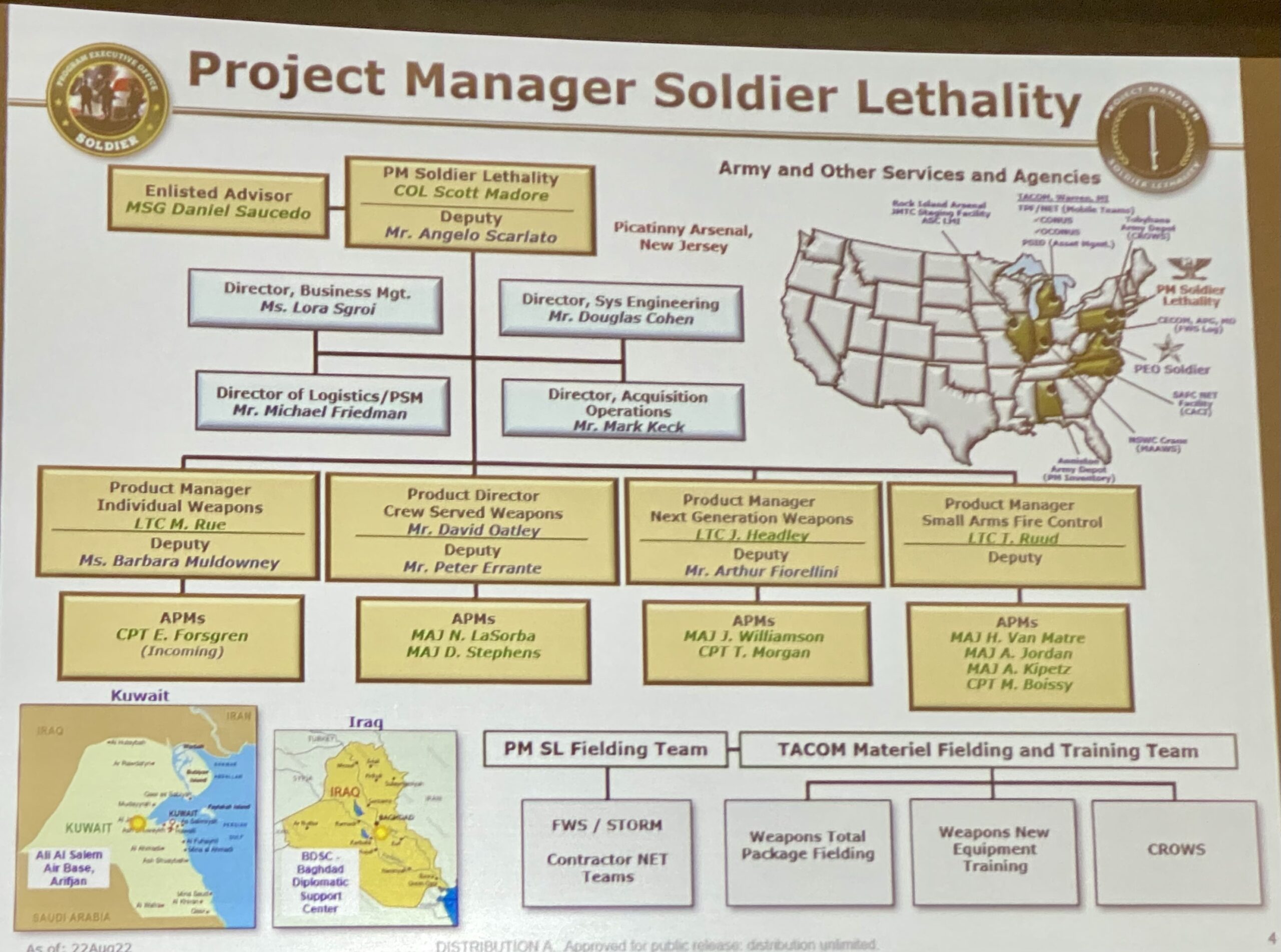
WASHINGTON–Armaments Research Company, Inc. (ARC), a technology and data company serving national security and public safety customers, announced today their Internet-of-Things (IoT) full-stack technology will be introduced in the Next Generation Squad Weapon (NGSW) program of record, in partnership with Sig Sauer. For the first time in 65 years, the U.S. Army’s initiative will replace its individual rifles, squad machine guns, fire control system, and ammunition, helping to modernize and better equip the warfighters of tomorrow.

ARC’s technology platform will provide data on individual weapons at scale. The resulting insights will enable units to regularly assess weapons’ health, reduce failure rates, extend the lifetime of a weapon and optimize maintenance plans, enhancing performance and reducing costs. The data can also improve a unit’s understanding of its readiness, which measures the unit’s fundamental ability to deploy quickly.

“Our team is thrilled to partner with Sig Sauer to deliver this groundbreaking platform and refresh the Army’s weapons for the first time in several decades,” said ARC CEO Michael Canty. “The Army NGSW program office is pushing the boundaries in seeking a modern, data-driven approach to weapons readiness and we are honored to contribute. With tens of thousands of new weapons as data sources in the field, we can optimize equipment safety and reliability, ultimately harnessing this data to save lives.”

The first production delivery of NGSW weapons will include ARC’s round count and inventory management system, gathering weapons usage data on the units over the next several years. The NGSW program’s intention to revolutionize the Army’s tactical weapons comes in response to findings that current weapons systems threaten conflict overmatch. More than 1,000 soldiers provided hands-on feedback during weapon testing and selection.

ARC’s weapons intelligence platform works with tactical tools and frontline AI to ensure mission readiness and improve small-unit performance. The platform enables the U.S. Army to capture mission-critical data from individual- and tactical-level weapons at scale, helping leaders at all levels make informed decisions during and after training to improve readiness, performance and operational efficiency.

ARC technical solutions and case studies are available for individual demonstration. Interested parties are invited to visit armaments.us and contact info@armaments.us for more information.

Fort Leonard Wood Prepares for Arrival of Electric Vehicles

Wednesday, August 10th, 2022

FORT LEONARD WOOD, Mo. — Anyone driving around Fort Leonard Wood these days can spot one pretty quickly and easily, and it seems like there are more and more every day. Electric vehicles, or EVs, are not the future — they are here — and not just the privately-owned ones.

Government-owned vehicles are going electric as well — Fort Leonard Wood received two EVs last month, and more are on the way.

The electric vans in the Logistic Readiness Center inventory are part of the Army’s latest directive of electrifying its non-tactical vehicle fleet. Executive Order 14057 — Catalyzing Clean Energy Industries and Jobs Through Federal Sustainability — requires the Department of Defense to transition its non-tactical vehicles to a 100% zero-emission vehicle fleet, including 100% of light-duty acquisitions by 2027, and 100% of medium- and heavy-duty acquisitions by 2035, said Installation Energy Manager Allen Simpson with the Directorate of Public Works.

Fort Leonard Wood maintains approximately 540 vehicles that meet the definition of non-tactical, and the Directorate of Public Works — or DPW — is working out ways to keep those vehicles charged up and ready for use every day.

“DPW’s responsibility is to assure charging stations are installed ahead of the arrival of the electrical vehicles,” he said. “We must be ahead of the demand for them.”

Because of the lower mileage government-owned vehicles are typically driven — making it less likely they will need to be charged every day — Simpson said the plan will most-likely involve having one charging station for every four to six vehicles, and he expects to see the first seven charging stations up and running within a month or two.

To meet the goal of installing that many stations here, Simpson said DPW has employed a unique solution. They are privatizing the ownership of the charging stations under the already-existing electrical distribution contract — doing this has several advantages.

“First of all, we save on manpower of managing the purchases, operation and maintenance, and we don’t have to worry about life-cycle replacements,” he said. “We will simply pay a monthly fee, just as we do for maintaining our other utility distribution systems.”

The installation’s preparations for an electrified fleet of government-owned vehicles — and the infrastructure to charge them all — is just one piece of a larger energy plan primarily focused on resiliency and the provision of a cleaner, more sustainable environment, Simpson said.

One way DPW is doing that is by working with the U.S. Army Corps of Engineers to install two combined heat and power plants here, Simpson said.

The implementation of combined heat and power, also commonly known as cogeneration, increases energy efficiency by allowing heat that would normally be lost in power generation to be recovered to provide heating and/or cooling, which cuts costs, Simpson said.

“The efficiency comes because we are capturing the heat that’s produced in that process and putting that heat into a boiler plant,” he said. “So, we’re not having to buy that natural gas to heat the boilers. The natural gas offsets itself while we are able to produce our own electricity.”

When they are completed, Simpson said the plants will give Fort Leonard Wood the ability to produce about seven percent of its peak-power demand.

Another newer initiative is a collaboration between DPW and the USACE Prime Power School, which moved to Fort Leonard Wood from Fort Belvoir, Virginia, in 2010. The school has the mission of training service members to install, operate and maintain certain types of electrical power plants.

Leaders from these agencies, along with other stakeholders, are working together to address energy resiliency by looking into the possibility of utilizing the expertise and power-generation capabilities of the Prime Power School should the installation ever experience an electrical energy crisis, Simpson said.

Chief Warrant Officer 5 Willie Gadsden, Prime Power School commander and deputy commandant, said the Army prime power production specialists who graduate from the school are uniquely qualified to assist.

“We have a depth of knowledge that could quickly and efficiently get after that particular problem set,” he said. “It is absolutely a great partnership.”

Simpson said these projects — and others — ultimately aid in Army readiness.

“The goal is to develop and maintain programs and projects that provide each installation the means to stave off or survive a utility emergency,” he said. “The expectation I have for Fort Leonard Wood is to prepare ourselves, so that we can adapt and recover without loss to any mission or support function.”

By Brian Hill, Fort Leonard Wood Public Affairs Office

US Paratroopers Kick-Off Exercise Super Garuda Shield with Trilateral Airborne Operations

Tuesday, August 9th, 2022

BATURAJA, Indonesia — Paratroopers from 11th Infantry Division (Airborne), Tentara Nasional Indonesia and Japan Ground Self-Defense Force conducted trilateral airborne operations with the 36th Airlift Squadron during exercise Super Garuda Airborne 2022 in Baturaja, Indonesia on Aug. 3, 2022.

The operation is the kick-off event for Super Garuda Shield 2022. Part of Operation Pathways, Garuda Shield is a longstanding annual, bilateral military exercise conducted between the U.S. military and Indonesia National Armed Forces. The exercise reinforces the U.S. commitments to allies and regional partners, ensures joint readiness and bolsters interoperability to fight and win together.

The 2022 Garuda Shield exercise is significantly larger in scope and scale than previous exercises. Service members from Indonesia and the United States will be joined this year by those from Australia, Japan and Singapore. In addition to the active participants, Canada, France, India, Malaysia, the Republic of Korea, Papua New Guinea, Timor Leste and the United Kingdom are expected to join Super Garuda Shield as observer nations.

“We were really focusing on partnership,” said Lt. Col. Ben Wisnioski, assistant Army attaché, U.S. Defense Attaché Office Jakarta, Indonesia. “We focused on training, working with each other, and building significant rapport.”

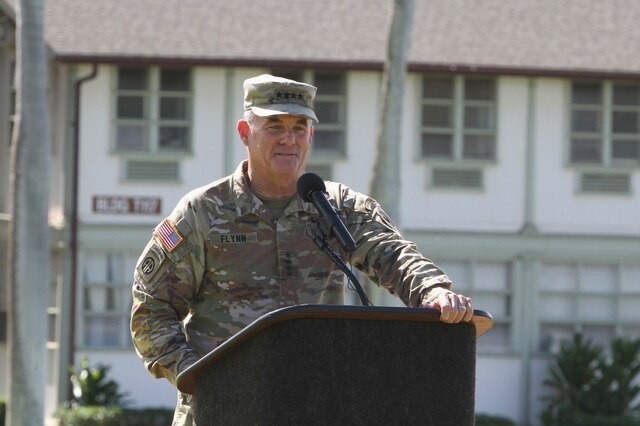
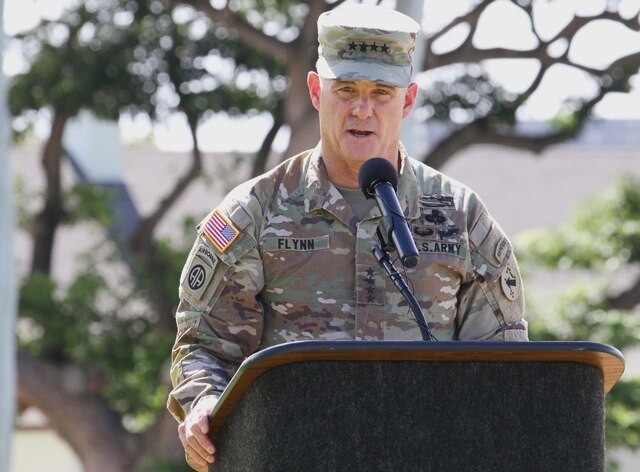
Hundreds of distinguished visitors including Gen. Charles Flynn, commanding general of U.S. Army Pacific, watched as over 200 paratroopers jumped into the fields and dense tropical forests of Baturaja.

“It was the softest landing I’ve ever had,” said Wisnioski with a smile, as he pointed at his uniform, doused in thick mud.

The paratroopers then completed an airborne seizure, navigating through narrow bridges, marshes, and dense foliage to reach their objectives.

Following the parachute portion of the operation, representatives from the three armies participated in a wing exchange ceremony. Gen. Andika Perkasa, commander, Tentara Nasional Indonesia, and Lt. Gen. Kuzuki Ushijima, command chief of staff, Japan Ground Self-Defense Force, pinned wings onto six U.S. Army paratroopers.

“We’re here for a free and open Indo-Pacific,” said Sgt. 1st Class Eric Green, 2nd Platoon, Apache Company, 1st Battalion, 501st Infantry Regiment, 11th Infantry Division (Airborne). “We’re just here to let our partners know we’re here to help. I wouldn’t want to be anywhere else.”

In addition to the ceremony Soldiers from the United States, Tentara Nasional Indonesia and Australian Army, showcased weapon systems to the senior leaders and distinguished visitors.

Sgt. Alexander Clarke, mortarman with 2nd Battalion, 35th Infantry Division, explained the functions and capabilities of the M224, 60mm Lightweight Company Mortar System.

“It’s just breaking down our capabilities and what makes them the best that we’ve got,” said Clarke. “I think we’re super grateful to be able to train alongside the [Tentara Nasional Indonesia] and get to know them better. It builds that cohesion.”

Super Garuda Shield provides opportunities for Department of Defense experimentation and joint collaboration. The exercise increases readiness of both for all participating nations. With focus on specific tasks, tactics and procedures to conduct combined arms maneuver, air assault, aviation and mission command.

By SGT Nicholle Salvatierra

Soldiers Share Their Experiences About WAREX 782202

Saturday, August 6th, 2022

Blue skies dotted with fluffy clouds. Fields of green surrounded by groves of trees. Gentle breezes and the swaying of branches from time to time. A typical tranquil setting, suddenly interrupted by the cracks of unexpected gunfire in the distance.

Soldiers spring to action to defend the perimeters of their bases. They mount machine guns, aim their M4 carbines equipped with blank firing adapters toward the sound of danger, and shoot, move, and communicate intently during Warrior Exercise (WAREX) 782202 on Fort McCoy, Wisconsin.

WAREX serves as an annual training opportunity for many U.S. Army Reserve Soldiers. The training exercise works on practicing Army Warrior Tasks and drills, reinforcing skills that keep a Soldier ready to fight.

“Our Soldiers have learned a lot in regards to base defense,” said Spc. Melina Lambert, a transportation management coordinator with the 940th Movement Control Team. “We’ve been really focusing on improving our strategies for base defense. A lot of them are newer, so they don’t really know much about [annual training] in general, so they’re getting a sneak peek of what the Army and the Reserve is really like.”

“And now with WAREX, we’ve been able to do a lot more AWTs [Army Warrior Tasks] which has helped … with our normal Soldier tasks that we should be working on, every time we come out,” she continued. “And I feel as though it’s been a lot nicer than being in the office.”

But being in the field presents its own challenges. Beads of sweat form on foreheads, and wearing a full long-sleeved uniform with load-bearing vests and protective helmets along with a combat load introduces fatigue just from carrying a Soldier’s weapon and gear.

“The training has been a little difficult at first… especially with the heat and climate conditions,” said Army Sgt. Juan Stamps, Jr., a transportation movement coordinator with the 940th Movement Control Team. “We’ve had a lot of heat casualties, unfortunately. But we learned to adapt and keep our Soldiers hydrated and out of the sun so that we can continue our training.”

The exercise also presents opportunities to identify and strengthen weaknesses with individuals, and thus, units, as a whole.

“I feel with our Soldiers, our communication could be better, and that has been a work in progress,” Lambert reflected. “Otherwise, we’ve been doing a really good job learning a lot of information.”

“It’s all about getting new perspectives on the same thing we all do, which is train and be better. Without failure, success would never come. But I feel that this AT has definitely helped with creating a team now. And we feel a lot closer.”

“We’ve learned a lot not just as a unit but as individual Soldiers as well,” Stamps said. “We’ll come back, we’ll all talk about the things that we learned. The funny things, the bad things. We learn about each other and we help each other out when we don’t know as much as we should.”

“It’s been a fun bonding experience for the unit.”

Overall, Soldiers are coming out of WAREX with newfound experiences, thoughts, and wisdom. Through trial and error, thick and thin, even just a few weeks of working in austere environments and training as one would fight enhances the capabilities of the Soldiers of the U.S. Army. And Soldiers welcome the challenge.

“Embrace the suck,” Lambert said. “[Annual training] can be difficult and have difficult moments. But within those difficult moments you can find peace and making sure to focus on that peace is very important.”

Story by SFC Raymond Boyington, 361st Theater Public Affairs Support Element

Custom Munitions Printing Increases Safety

Thursday, August 4th, 2022

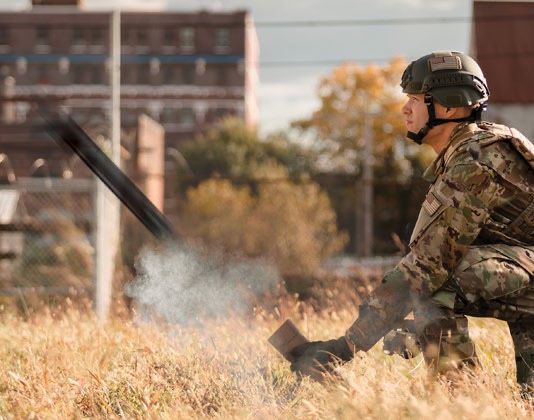
CRANE, Ind. — Crane Army Ammunition Activity, in a joint effort with the U.S. Air Force, is integrating a customized printing system into its countermeasures decoy flare program. The new technology allows printing to be done on live energetics which increases safety and ensures that Crane Army Ammunition Activity — or CAAA — remains a key supplier for the U.S. military in its efforts to support the warfighter.

The Keyence MK-G 1000 is the world’s first self-troubleshooting continuous inkjet printer that does not require operator involvement, enabling CAAA to safely apply warning labels directly onto energetic grains, and better meet new requirements from the Air Force. This new technology allows for improved safety not only in the flare production process but also achieves the Air Force’s priority of safety in the rare event an ejected flare is found on the ground.

CAAA’s Countermeasures Commodity Manager Trish Staggs said, “Safety is crucial. If an unexploded munition is found, people will see the warning and know not to touch it.”

CAAA is the first installation within the U.S. Army’s organic industrial base to implement the new technology on a pyrotechnic flare line. The capability to print at a high rate of speed from any direction or orientation using a four head printing system is just one of the many qualities of equipment. Damage and blurring on the bare energetic material are eliminated by spraying closely controlled dye-based, fast-drying ink particles onto targets.

The printer’s features allows operators are able to focus on other areas of the mission. The MK-G 1000 has self-diagnostic technology that can automatically perform maintenance and troubleshooting. If any issue arises, the printer attempts to repair itself which eliminates the need for a trained technician. It features a hands-free self-cleaning function which not only cleans the ink path, but also the components to help maintain the print quality. Both the printing and the cleaning processes have been adapted to meet explosives use standards.

Another highlight of the system is the ease in which it functions. By eliminating specialized training, any operator can handle the job. The printer also doesn’t require operator contact, making the process safer and more efficient.

“It is so easy to use and is very operator friendly,” said Tina Burden, a CAAA explosives operator. “We don’t even have to touch it; it does the work for us and eliminates the need for us to handle the grain as much during production.”

The printing system was integrated into the production line safely after CAAA technicians and an Indiana based industry expert conducted approximately 70 hours of research. The buildings production schedule was never impacted throughout the set-up process.

“There was no learning curve,” CAAA Production Controller Devon Roach said. “Set-up, testing, and the go ahead to use live energetics were done effortlessly and they have never looked back.”

“I can’t emphasize enough how willing to help the Keyence company and the customer service representative have been,” Dave Bowman, a CAAA explosives operator supervisor, said. “Any problem or question has been taken care of in a quick and uncomplicated manner.”

The U.S. Army is currently bringing its organic industrial base into the 21st century by modernizing its facilities and processes. Integrating the printer into munitions production is an example of how CAAA is infusing the industry’s best practices while maximizing the skills and capabilities of its civilian workforce.

Crane Army Ammunition Activity produces and provides conventional munitions in support of U.S. Army and Joint Force readiness. It is part of the Joint Munitions Command and the U.S. Army Materiel Command, which include arsenals, depots, activities and ammunition plants. Established Oct. 1977, it is located at Naval Support Activity Crane.

By Christy Carroll

ERDC, Transatlantic Division Team Recognized with USACE Innovation Award

Tuesday, August 2nd, 2022

VICKSBURG, Miss. – A team from the U.S. Army Engineer Research and Development Center’s (ERDC) Geotechnical and Structures Laboratory (GSL), the U.S. Army Corps of Engineers (USACE), Transatlantic Division and the USACE Protective Design Center was recently recognized with the 2022 USACE Innovation of the Year Award.

The team developed simple and effective bunker enclosure door designs for the U.S. Central Command (CENTCOM) to help reduce risk for traumatic brain injury (TBI) to bunker occupants. The new designs sought to reduce the peak pressures experienced by an individual seeking shelter in a bunker by more than 90 percent.

CENTCOM’s area of responsibility encompasses more than 4 million square miles and stretches from Kazakhstan to Yemen.

“The ERDC team, in coordination with the Transatlantic Division, developed modifications to existing bunker designs to reduce TBI vulnerability and provide design recommendations to the Army to address force protection challenges concerning current personnel bunkers,” said Bart Durst, ERDC-GSL director.

Throughout the research and design process, team members leveraged the Department of Defense’s High Performance Computing systems at ERDC to conduct more than 120 high-fidelity simulations of door designs and configurations.

The innovative solution was developed within a very short timeline using the survivability knowledge maintained through ERDC’s Expedient Passive Protection program and their computational capabilities. The team was able to deliver the project in six months.

“I am extremely proud of ERDC-GSL’s contribution to this team and this project,” Durst said. “These innovations will tremendously benefit warfighters across the globe in the execution of their mission. These retrofits provided rapid solutions to address an urgent need for expeditionary force protection to reduce TBI vulnerabilities.”

ERDC Public Affairs