Aquaterro

Archive for the ‘Army’ Category

Army Modernizes Pacific Expeditionary Signal Battalion

Sunday, June 5th, 2022

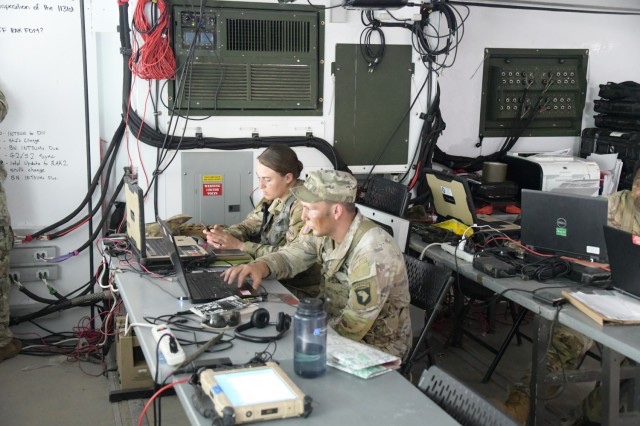
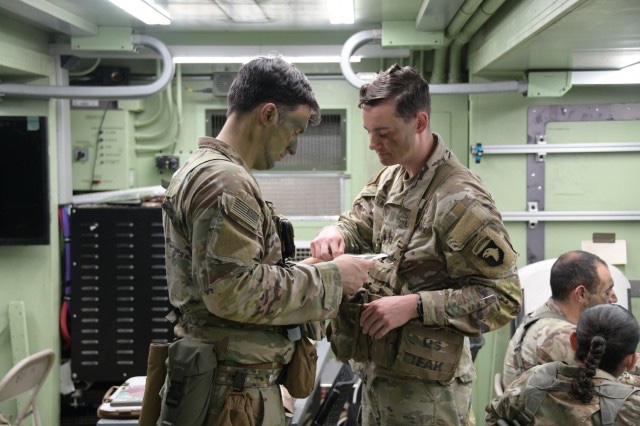
HELEMANO MILITARY RESERVATION, Hawaii — As the 307th Expeditionary Signal Battalion, or ESB, celebrated its 80th birthday on May 27, the Army is converting the unit to an ESB-Enhanced formation. With this conversion comes a smaller, lighter and faster network communications equipment tool suite that will better serve the unit’s unique and varied mission sets.

With companies in both Hawaii and Alaska, the battalion provides global network connectivity on short notice to U.S. Army Pacific and U.S. Army North units, often in harsh locations, from secluded island jungles thousands of miles across the ocean to ice-covered mountains in the Arctic Circle.

“We talk about the tyranny of distance, about the challenges created by the vast number of locations and extreme environments throughout the Pacific; this new expeditionary equipment set will help us to support those missions,” said Col. Lee Adams, commander of the 516th Theater Signal Brigade, to which 307th ESB-E is assigned. “We are always trying to improve and to provide foundational capabilities for the theater Army. This transition to an ESB-E does that for us; it gives us a better capability to enable the theater Army to fight successfully.”

The reduced size and system complexity of the equipment set enables ESB-E units to significantly increase their network support to other units with more nodes and less manpower, while reducing transportation requirements by over 60 percent. The tool suite includes various-sized expeditionary satellite dishes and baseband equipment, high-throughput backhaul radios, and wireless command post technologies. It replaces the unit’s much larger Tactical Network Transport At-The-Halt equipment, formally known as Warfighter Information Network-Tactical, which is often transported across the Pacific via cargo ships. The new equipment set can be transported via commercial airline if needed, in hours versus days or weeks.

Prior to his current position, Adams commanded the first unit to be converted to an ESB-E, the 50th ESB-E, during the planning and initial fielding of the unit’s pilot equipment. The 307th ESB-E conversion marks the sixth unit that the Army has fielded with the new equipment package. The Army’s Project Manager Tactical Network, assigned to the Program Executive Office for Command, Control, Communications-Tactical, began fielding the unit with the Scalable Network Node to the companies in both Hawaii and Alaska in March. Fielding the remainder of the initial baseline systems is expected to be complete by the end of the fiscal year.

The Army’s agile ESB-E acquisition and fielding approach aligns with its two-year incremental Capability Set fielding process, which enables the service to enhance the ESB-E baseline capability in future capability sets if Soldier feedback warrants it, or when evolving commercial technologies become mature enough to be procured. On the current plan, the Army is fielding several ESB-Es per fiscal year until all of the ESBs have been upgraded to the new baseline capability.

“As I talk to the other ESB-E commanders, the [project manager], and its fielding team that is here now, and we get feedback from our Soldiers as they going through the training, I can see firsthand the accumulation of lessons learned and how the equipment set continues to improve,” said Lt. Col. Drew Chaffee, commander of the 307th ESB-E, who also once served as a company commander for the unit.

The ESB-E tool suite is a critical element of Capability Set 21, which delivers smaller, lighter and faster communications systems that are easier to operate and provide increased network communication Primary, Alternate, Contingency and Emergency, or PACE, plan options. The tool suite provides signal path diversity in congested and contested environments, leveraging numerous high-throughput line-of-sight and beyond-line-of-sight capabilities.

“It’s critical to have a good PACE plan, to be able to incorporate different transport that may be more survivable in a particular terrain. Every commander wants more options,” Adams said. “When we are fighting in a battle environment that is degraded, intermittent or just has delayed latency, I have to have different technologies, different pieces of kit that make me more survivable, make us a harder target to hit, yet allows us to stand still to support multi-domain operations at an assured level. And that is what having these different network transport capabilities provide us.”

To enable additional transport paths for improved network resiliency, the Army is working to deliver high-throughput and low latency satellite communications leveraging emerging commercial technologies and services in non-traditional orbits, such as Low Earth Orbit and Medium Earth Orbit. In April, the 307th ESB conducted a demonstration of commercial high-throughput and low latency satellite communications, at the Helemano Military Reservation on Oahu. The unit plans to further experiment with the capability during upcoming U.S. Army Pacific training exercises.

“The name of the game is operational flexibility,” Chaffee said. “This new kit is scalable and tailorable to the mission. We have the operational flexibility to tailor our teams, our equipment set, and our footprint to the requirements based on the mission and the environment that we find ourselves in. This smaller lighter ESB-E kit is going to get us there much more effectively and it highlights the United States’ ability to support and adapt in some of the most austere and remotely located environments in the world.”

By Amy Walker, Project Manager Tactical Network, PEO C3T, public affairs

Software Factory Helps Transform Army from Industrial to Information Age

Thursday, June 2nd, 2022

REDSTONE ARSENAL, Ala. — Anyone can submit a problem to the Army Software Factory.

To be clear, that is not just anyone at the factory, or in the formation, or anyone of a certain rank or office. Anyone in the U.S. Army can submit a problem to the Army Software Factory. It is an innovative concept but one that fulfills the promise of Army Futures Command.

When AFC was stood up in 2018, it was understood that it would not be business as usual. And when AFC opened the Army Software Factory in 2021, it was making good on that promise. The first-of-its-kind factory brings in rotating groups of Soldiers and Army civilians through a highly competitive application process and trains them in modern agile software development. Joshua Farrington of the U.S. Army Combat Capabilities Development Command Aviation & Missile Center, or AvMC, is one of those civilians chosen for a prestigious factory rotation. Farrington is currently in a three-year assignment at the factory located in Austin, Texas.

“Employees that accept a rotation with the Army Software Factory bring their unique perspectives and capabilities from their home organizations and share those ideas into our ecosystem which further widens our vision of what is possible,” said Maj. Christopher Bennett, product manager at the Army Software Factory. “In addition to building their collaboration skills, rotations of employees that come through the Software Factory will encourage innovation through context-sharing on problems and products. When more people see a greater variety of problems and pains solved by software across the Army, it helps build a repository of ideas more easily shared across teams to reference.”

The program starts with a 16-week boot camp. There are four different tracks — platform engineer, software developer, product manager and designer. Farrington is on the software development track.

When a problem is submitted, the factory has a team to vet it. They do interviews, an initial scoping, and then decide whether to accept the problem. Once a problem is accepted, the assigned team works with partners to build a web application to address the problem — providing the collaboration that Army Futures Command is striving to foster Army-wide. Currently, Farrington is working on an application that will assist the 101st Airborne Division in their air assault mission planning process.

Another innovative aspect of the factory is that it is “rank agnostic” with Soldiers solving problems for Soldiers — an experience that Farrington said has been personally beneficial.

“It has been impactful for me — working directly with a lot of Soldiers,” Farrington shared. “At AvMC, we were doing things for the Warfighter but I was not around the Warfighter. Now, here, I am on a team with three other Soldiers who have directly dealt with the problem we are trying to solve. My impact for the Warfighter feels a lot more tangible.

“I was a civilian at AvMC writing Army-related software and I just wouldn’t have the context on what the app was actually doing because I had never flown a helicopter. So a Soldier who actually understands the context of how an app is actually going to be used – it just makes it so much easier to make decisions. I think having more Soldiers writing software will be a huge asset to the Army.”

In the Army’s continuing mission to transform itself from the industrial age to the information age, the Army Software Factory is a key player in the future fight — one that will be as much in the virtual cloud as it is in the physical ones.

“One of the big purposes of the Software Factory is to increase the software that is in the Army’s technical capabilities,” Farrington said. “The talent is already there, the Software Factory is finding a way to make the most of it.”

By Katie Davis Skelley, DEVCOM Aviation & Missile Center Public Affairs

DEVCOM, Army Special Forces Collaborate with International Partner to Test Additive Manufacturing Technology

Monday, May 30th, 2022

ABERDEEN PROVING GROUND, Md. — On a battlefield in the future, Soldiers deployed to remote areas around the world will use sophisticated additive manufacturing printers to ‘print’ virtually everything they need, from food to shelter to weapons. The Army has made additive manufacturing a priority and Combat Capabilities Development Command, or DEVCOM, is supporting the effort with Project Prime, a collaboration with U.S. Army Special Forces and an international industry partner.

The Project Prime team consists of the U.S. Army 7th Special Forces Group (Airborne), or 7th SFG (A); DEVCOM’s International Technology Center — United Kingdom, or ITC-UK; DEVCOM’s Command, Control, Communications, Computers, Combat systems, Intelligence, Surveillance and Reconnaissance Center, or C5ISR; and Defend3D, a company based in the United Kingdom that enables secure transmission of remote 3D printing.

Special Forces Soldiers tested the technology by repeatedly adding and printing additive manufacturing files using Defend3D’s Virtual Inventory Communication Interface, or VICI. VICI provides a server application that manages the virtual inventory, assigns rights to remote manufacturers and provides the product in a ‘one-click-print’ format with minimal training for the end-user to securely stream.

“Despite a network connection categorized commercially as having low to no connection, VICI facilitated speedy, secure and accurate printing. Based on expectations set at the beginning of the project, VICI did everything we needed it to do, and 7th SFG (A) was satisfied with the system performance and endorsed the capability for further development and implementation,” said Dr. Patrick Fowler, DEVCOM Global Technology advisor at ITC-UK.

Each DEVCOM ITC has a Global Technology advisor who scouts technology in their area of operation. Project Prime began when a DEVCOM global technology advisor was scouting additive manufacturing technology in the Atlantic region, which includes London, United Kingdom; Paris, France; Frankfurt, Germany; and Tel Aviv, Israel. The ITCs, which are part of DEVCOM’s global enterprise, serve as the forward-deployed ‘eyes and ears’ of the Army Science and Technology Enterprise. Other DEVCOM ITCs include: North America; South America; Northern Europe; Southern Europe; Northeast Asia; Southeast Asia and the Southern Hemisphere.

VICI ensures end-to-end encryption by enabling organizations to store their designs locally and use the virtual inventory to manufacture parts in remote locations. For example, a deployed Soldier communicates a need, such as a spare part or a modification to an existing part, to the computer-aided design, or CAD, element at 7th SFG (A). The CAD element either designs the part from scratch or selects from a database of commonly used parts. This is then streamed to the Soldier in the field, who prints the part. Because the file is never sent, VICI prevents adversaries from accessing the information and identifying vulnerabilities in equipment and capabilities.

“We made it a priority to pursue avenues that will allow us to operate in environments that are not conducive to regular resupply efforts. For detachments to stay in the fight in these environments, we explored systems that operate outside the conventional supply chains. Project Prime’s deployable 3D printer and VICI software enables secure transmission and an easy-to-use interface,” said Chief Warrant Officer 2 Jesse Peters, Innovation Cell, 7th SFG (A).

Other benefits of the technology include:

The 3D printer operator does not need to be an expert in 3D printing to print the required files.

The interface prevents overloading the network since forward-deployed Soldiers only see objects they have requested for their mission.

It securely stores files in a sharable repository, including files created by the Department of Defense and coalition networks.

“Imagine this scenario — a clever Green Beret on a remote base develops a novel attachment for an existing Unmanned Aircraft System, which is stored in VICI. Then, a clever Airman across the world at a remote airfield sees it and adds his/her twist. Next, a British Soldier prints it and starts using it in his/her own operations,” Fowler said.

During the training event, feedback was gathered in real-time as the deployed Soldiers communicated with the 7th SFG (A) Innovation Cell. Other information was collected after the training, including the pros and cons of the system, software interface, training requirements and long-term durability.

7th SFG (A) plans to train more of their Soldiers on the technology to support a U.S. Army Southern Command deployment. Once the deployment is completed, ITC-UK will document all of the activities and achievements of Project Prime and make it available to the broader Department of Defense community. The information will benefit other DEVCOM centers and research laboratory, particularly the C5ISR Center, which focuses on securing communications to the tactical edge. The technology may also fill gaps with other Army units.

“We’re looking for funding to further develop VICI to make it operable on a cell phone or a small device, including a Raspberry Pi, which is a very small computer that plugs into a computer monitor, TV, or similar small end-user devices. This will make the solution, which is currently used on a laptop, even more deployable,” Fowler said.

By Argie Sarantinos, DEVCOM HQ Public Affairs

FM 6-0, Commander and Staff Organization and Operations (May 2022)

Thursday, May 26th, 2022

The Army recently released a new version of FM 6-0, Commander and Staff Organization and Operations (May 2022) which provides commanders and their staffs with tactics and procedures for organizing and operating their command and control (C2) system.

Check it out at:

armypubs.army.mil/epubs/DR_pubs/DR_a/ARN35404-FM_6-0-000-WEB-1

DEVCOM Soldier Center Designs Protective Jumpsuit for Elite Firefighters

Thursday, May 26th, 2022

NATICK, Mass. — Some heroes wear capes, and some wear jumpsuits designed by the U.S. Army Combat Capabilities Development Command Soldier Center, or DEVCOM SC.

America’s smokejumpers literally dive into danger. They are an elite group of firefighters who parachute into remote areas to put out wildfires. They need and deserve the very best equipment to do their jobs effectively and safely. DEVCOM SC’s Design, Pattern & Prototype Team in the Soldier Protection Directorate took on the task of updating the jumpsuits that smokejumpers wear when they take the leap to put out wildfires.

“The rough terrain jumpsuit is worn by smokejumpers working for the United States Department of Agriculture’s Forest Service and the Department of Interior’s Bureau of Land Management,” said Patti Bigrig, a clothing designer on the Design, Pattern & Prototype Team, or DPPT. “There are about 400 to 500 smokejumpers within the United States. Their mission is to parachute into remote areas, where vehicles have no access, to extinguish forest fires.”

Zach Glover, one of the smokejumpers who aided DEVCOM SC in a fit and integration check for the new and improved rough terrain jumpsuit, explained that the jumpsuit is used to protect smokejumpers from any kind of impalement from tree limbs and has a built-in letdown system if they get caught in a tree. The jumpsuit adds some fire protection as well.

Glover values the opportunity for smokejumpers to provide input into the new prototype. “The new suit will improve mobility, be lighter weight, and allow for better protection, range of motion, and freedom of movement,” said Glover.

The effort is a perfect fit for DEVCOM SC’s expertise. “DEVCOM SC’s long-term expertise in developing clothing to meet Warfighter needs benefits this project in all aspects,” said Annette LaFleur, DPPT’s team leader.

“We not only look at the musculoskeletal structure and movement of the human body within the framework of a clothing item but how the necessary equipment works cohesively with the garment to enhance performance and mission success,” said Bigrig. “We listen to the user to find out what isn’t working and devise a solution.”

DPPT is adept at designing for function and specific occupational specialties — whether it be a protective ensemble for a fuel handler or bomb suit for an explosive ordnance disposal operator or a new rough terrain jumpsuit for smokejumpers. On a daily basis, the team works to meet the needs of Warfighters and other users by translating user requirements into tangible prototypes. The prototypes incorporate materials and features to meet the specific needs of the user. For the rough terrain jumpsuit, the prototype includes padding with the proper impact protection, as well as flame-retardant base materials.

“The team starts by sketching design options, discussing ideas with the user before drafting patterns and sewing the first prototype,” said LaFleur. “We design, test and validate, ensuring the item is user tested and approved. We don’t want the user to have to think about or be burdened by their clothing or gear. If they are solely focused on their mission, then we know we have done our job well.”

The rough terrain jumpsuit prototype includes improvements to features and materials.

“Due to the natural rough terrain in which these parachutists are entering, the current jumpsuit has a short field life,” said Bigrig. “The current jumpsuit is made from Kevlar, which has great puncture resistance but very low abrasion resistance. It quite frequently requires repair or replacement. Kevlar is sensitive to, and weakened by, exposure to sunlight, and this factor also plays into a shorter use expectancy. The goal of this new jumpsuit is to increase the durability, protection and extend the life of its use.”

Melynda Perry, a textile chemist on DEVCOM SC’s Textile Material Evaluation Team, ran tests on the current jumpsuit material and suggested some materials to be integrated into the new suit. The new suit includes two layers — a base layer and a higher abrasion resistant layer. The goal is to identify lighter weight materials with improved abrasion resistance that have lower amounts of aramid fibers to offer higher protection against UV exposure, extending the life of the jumpsuit.

The new jumpsuit prototype also features an improved collar and integrated impact resistant foam. It also includes an adjustable side pocket at the bottom of the jumpsuit trousers. The pocket is used to hold rope and other gear.

Bigrig conceived the idea for the adjustable pocket, and Chong Whitfield, a DPPT production designer, refined the idea. Being able to adjust pockets helps improve safety.

“It’s the Goldilocks pocket,” said Bigrig. “You can adjust it so that it is just right.”

User input, which plays a key role in all of DEVCOM SC’s product development, is driving the design of the new jumpsuit.

“We had a lot of conversations with the smokejumpers and gleaned great information on how we could make this jumpsuit into something that would greatly improve on what they currently had,” said Bigrig. “It is a wonderful relationship because we adapted the design to the feedback we received.”

Prior to working with the DPPT, the smokejumpers already had a good working relationship with DEVCOM SC’s Air Drop Team, part of the Soldier Sustainment Directorate. This relationship led to the smokejumpers seeking out DPPT.

“We viewed videos of their donning and doffing process, deployment from the plane along with the five-point landing procedure,” said Bigrig. “We had a lot of conversations with the smokejumpers and gleaned great information on how we could make this jumpsuit into something that would greatly improve on what they currently had.”

Other DEVCOM SC teams were also involved in the effort. Bigrig explained that the DPPT has been leveraging the expertise of DEVCOM SC’s Ballistic and Blast Team’s Chuck Hewitt to test impact resistant materials to integrate into the suit. Perry has also been instrumental in testing and providing recommendations for best materials for the new jumpsuit.

“There are people here who are experts in their fields,” said Glover. “They are experts in design, textiles, blunt impact ballistics and parachutes. We are firefighters and smokejumpers first and working with these experts is really beneficial for us.”

Bigrig is proud to work with the smokejumpers on the new Rough Terrain Jumpsuit.

“The users are firefighters with a high degree of ingenuity, and we are honored to help them take the jumpsuit to the next level,” said Bigrig.

By Jane Benson, DEVCOM Soldier Center Public Affairs

Soldiers Give Feedback on Emerging Defense Capabilities

Monday, May 23rd, 2022

FORT LEONARD WOOD, Mo. — Leaders from U.S. Army Futures Command and the Maneuver Support Center of Excellence wrapped up the two-week Maneuver Support, Sustainment and Protection Integration Experiments — or MSSPIX — this week, giving Army leaders and capability developers a chance to gain insights into the viability of emerging technologies through credible and validated operational assessments.

According to Kyle Henry — the chief of the center’s maneuver support battle lab experimentation branch and one of the key organizers of the event — the annual MSSPIX is an important venue for conceptual and materiel development because of the feedback provided by the very Soldiers who may one day use the technology to assist in accomplishing missions.

“Without the Soldiers, this would be a glorified tech demo,” he added. “That’s not what we’re trying to do. We want a non-biased look at these technologies, these capabilities.”

Henry said the overarching focus of this year’s MSSPIX was to enable protection and sustainment solutions in support of what’s called multi-domain operations — the Army’s attempt to address competition and potential conflict between the United States and countries with relatively similar warfighting capabilities across air, land, sea, space and cyberspace. This includes the mitigation of hazards, the preservation of assets and the protection of Soldiers.

“The technologies being assessed are designed to minimize a Soldier’s presence on the battlefield, or otherwise aid in protecting lives, while also improving the ability to defeat enemy forces, disrupt enemy capabilities and physically control spaces,” Henry said.

During a demonstration day event on May 17, Sgt. Daniel Alexander, with Fort Leonard Wood’s 595th Sapper Company, and Spc. Wyanet Nakai, from the 212th Military Police Company at Fort Bliss, Texas, operated what’s being called the Mobile-Acquisition, Cue and Effector, or M-ACE — one of 14 capabilities assessed this year by a group of more than 20 Soldiers from installations across the country.

Integrating radar technologies with a remote cue system, M-ACE can lock onto and disable a moving target, such as a drone.

Having a system like this in a combat environment is ideal for military police, Nakai said, as they are typically considered what’s called “mounted,” meaning they stay inside their tactical vehicles.

“What we’re doing is controlling the weapon from inside,” she said. “This set up is really nice, and it’s safer.”

For a combat engineer, like Alexander, whose missions require both mounted and unmounted capabilities, it’s nice to know the Army is trying to minimize Soldier risk on the battlefield.

“It’s nice to know we’re going another route for combat [military occupational specialties],” he said. “We go outside the wire, put our lives on the line, and with technology like this, it takes the Soldier out of many of those situations — it minimizes the dangers.”

This was the first time either Alexander or Nakai have participated in MSSPIX. Alexander, originally from Bolingbrook, Illinois, said he was happy for the opportunity to provide inputs that may one day help improve the Army’s ability to more effectively and safely meet its mission requirements.

“I hope other Soldiers in my unit get this opportunity,” he said.

Nakai, from the Navajo Nation in Utah, said it’s fascinating to be part of a project decades in the making.

“I didn’t know what MSSPIX was,” she said. “I’m amazed by how much time goes into these technologies — someone said 18 years for this one. It blows my mind how much thought and effort goes into building a system like this, and they want to keep improving it.”

By Fort Leonard Wood Public Affairs Office

New Army Tech Successfully Demonstrated During Arctic Exercise

Sunday, May 22nd, 2022

JOINT BASE ELEMENDORF-RICHARDSON, Alaska — During a multi-service exercise, the U.S. Army Engineer Research and Development Center Cold Regions Research and Engineering Laboratory, or ERDC CRREL, successfully demonstrated a groundbreaking technology to detect airborne targets.

The project, called TripLine, was developed by ERDC and uses emitted sounds to passively detect targets. The technology was showcased during Arctic Edge 22, a bi-annual event hosted by the Alaskan Command at Joint Base Elemendorf-Richardson, Alaska, committed to the defense of North America with roots going back more than five decades.

The TripLine project started in 2017 and utilizes technology to detect airborne targets through soundwaves that interact with the ground and transfer a portion of the acoustic energy into the ground. The transferred soundwave energy subsequently interacts with buried sensing fiberoptic cable and induces a small, but highly perceptible, change in the cable that can be measured, analyzed and recorded by the TripLine system. This atmosphere-to-terrain energy transfer enables the presence of aircraft near the TripLine system to be automatically detected.

Dr. Sergey Vecherin, a research physicist at CRREL who leads the team developing a suite of algorithms for Tripline, said the system aims to be low-maintenance and suitable for operations in arctic conditions.

“TripLine is a system for automatic detection of acoustic sources with some unique operation capabilities,” said Vecherin. “Other systems cannot do what Tripline can, either due to scientific or operational limitations.”

When the first TripLine experiments were conducted in 2017, the goal was to prove sensor success for the desired sources in principle. In 2019, TripLine was used in another field experiment for different sources and different locations.

“In August 2020, we had a very successful demonstration in New Mexico,” said Vecherin. “According to the Air Force after the test evaluation, our system was named one of only two, out of more than two dozen tested, that successfully passed the test. This is a huge success considering the caliber of our competitors.”

The TripLine system has been tested and proven to have a high detection probability and a low false alarm rate in several different environments that had a nearly ideal soil structure for the sensing system. These soils are relatively loose, sandy soils with low contrast in air-ground acoustic impedance, and under these conditions, the acoustic detection system has performed nearly flawlessly.

One remaining demonstration of the system needed to be performed, a test of the technology under highly challenging soil conditions. It was determined that the cold, austere environments of the Arctic would present one of the greatest challenges to the sensor system due to the high acoustic impedance from frozen soils, as well as the noise damping from snow and ice coverage.

In the Arctic Edge 2022 exercise, TripLine has been tested under extremely challenging environmental conditions. Vecherin said, “So far, TripLine has successfully passed all the tests, indicating the high value of the technology.”

The highly complex terrain conditions around JBER were found to be ideal for the demonstration project as the ground was completely frozen, most likely well below the buried sensing cable.

In March of 2021, the U.S. Army released its Arctic Strategy, “Regaining Arctic Dominance,” which outlines how the Army will generate, train, organize and equip our forces to partner with Arctic allies and secure national interests and maintain regional stability. Operating in the Arctic allows the Army to powerfully project forces to enhance their ability to respond in competition, crisis or conflict. TripLine will be able to assist in achieving that goal.

The goal of the demonstration effort was to show that the TripLine sensing system is capable of detecting airborne objects within proximity of JBER, despite the frozen soil and thick coverage of snow and ice. Between February 25 and March 16, 2022, numerous commercial and military aircraft had flight paths near Joint Base Elmendorf-Richardson, and the TripLine event utilized those flights to demonstrate that it could detect and monitor movement across the region in real time with a high degree of accuracy.

“As demonstrated, TripLine capability is proven to function in austere environments,” said Dr. Steven Peckham, a Research Scientist at CRREL and a program lead for the TripLine project. “That opens the opportunity to utilize the technology throughout the Arctic.”

This successful live demonstration proves that the acoustic sensing system reliably functions in such locales, despite being buried in frozen soil and under several feet of snow and ice. In addition, this successful demonstration opens the opportunity for the Department of Defense to deploy this new technology in locations around the globe where airborne threats have traditionally been a challenge to detect and monitor in real-time.

One of the next steps for the TripLine project will be to gain more funding for additional testing, research and development, until the system can be approved and released for use by the Department of Defense.

“Going forward we have a presentation to the North American Aerospace Defense Command and U.S. Army Northern Command, as well as our international partners,” said Peckham. “From here, the TripLine project has satisfied all of the requested demonstration testing and can advance, given supporting resources, to deploying the capability in the field for an extended period.”

By SGT David Marquis

Army’s Synthetic Training Environment Harnesses Evolving Mapping Technology

Thursday, May 19th, 2022

AUSTIN, Texas — Geospatial intelligence professionals gathered at the United States Geospatial Intelligence Foundation’s GEOINT 2022 Symposium in Aurora, Colorado, last month to discuss new efforts and achievements in the rapidly growing field.

Topics highlighted at the event included how technological advances have influenced the creation and use of maps, including within military and intelligence communities.

During an April 26 “What is a Map?” panel, guest speakers from the U.S. government and private industry explored how maps have evolved in recent years, what new types of information maps can communicate and why maps continue to be indispensable tools in everything from personal navigation to foreign policy development to warfighting.


“Maps and terrain and that data set is foundational to everything we do,” said Brig. Gen. William Glaser, director of the Army Futures Command Synthetic Training Environment, or STE, Cross-Functional Team.

Glaser and fellow panelists detailed how today’s dynamic, high-performance maps — which frequently utilize 3D imagery and are often informed by an amalgamation of artificial intelligence, fluid data inputs and precision sensors — can improve visibility and thereby increase a user’s understanding of a situation, along with options for action.


“Our relationship with a map now is not just passive,” said panelist Ed Parsons, geospatial technologist at Google. “We’re interacting with the map. The map is changing its contents depending upon what we’re doing, but we’re also sharing what we’re doing with the developers of that map.”

As a result, many of today’s maps are “elastic,” meaning that they can morph and adapt as conditions and user input fluctuate, Parsons explained.

It is this near real-time visibility that can provide Army map users with distinct tactical advantages.

“The ability to visualize the terrain in 3D is absolutely critical for commanders and Soldiers to understand the operational environment,” Glaser said.

He noted that one of the Army’s core STE efforts, One World Terrain, provides a singular synthetic format for use in multiple scenarios. Viewable in “everything from goggles to laptops to PCs,” the 3D terrain data set is helping to more closely link operational and training activities, thereby enhancing overall readiness.

The Army is also developing the STE Information System, a virtual training suite, and equipment such as the Squad Immersive Virtual Trainer, a mixed-reality tool that utilizes a heads-up display.

The ongoing development of a synthetic training platform enabled by advanced mapping technology is groundbreaking because it means the Army “can fight a thousand bloodless battles before we ever put a Soldier into harm’s way,” Glaser said.

The multi-faceted nature of digital maps extends across sectors, of course, and often translates to many users having access to — but also influence on — collective maps.

“Maps are probably more widely used now than at any point in our history,” Parsons said.

This expanded use of maps has also increased demand for functionality and format.

“Cartography is an art, not just a science,” said Dr. Lee Schwartz, director of the Office of the Geographer and Global Issues at the State Department’s Bureau of Intelligence and Research. “Maps need to be visually compelling as well as providing a lot of information.”

Ensuring map development is participatory, such as by involving the contributions of individuals who live in areas being mapped, is also an important consideration in modern map development.

“You have to include the human element always,” Schwartz said.

Moreover, the way maps are used to make decisions means the information they contain needs to be secure and valid. While this is an area for further growth, in many cases, accuracy is attained simply through critical mass.

“The maps are now sort of self-healing; by using the maps, you’re contributing to the content,” Parsons said.

Dr. Daniela Moody, vice president of artificial intelligence at Arturo, also highlighted the storytelling nature of maps, which are increasingly moving beyond instructing the user how to get somewhere to informing the user why to go somewhere.

“This is no longer a static environment,” Moody said. “Maps are becoming the way to tell a story, the way to make that quick decision.”

Glaser emphasized that while digital maps are ushering in transformational capabilities, traditional paper maps are still necessary, particularly for maneuvering in degraded environments. As such, the Army will continue to promote analog map reading skills and compass navigation fluency even as it implements more interactive mapping systems.

“Every Army officer who’s worth his weight in salt loves maps,” Glaser said.

“It’s that one thing that’s going to lead his Soldiers to victory safely.”

You can watch a video of the presentation here.

By Maureena Thompson, Army Futures Command