Phantom Lights

Archive for the ‘Army’ Category

DEVCOM Soldier Center’s Director of Research and Technology Integration Inducted into Senior Executive Service

Tuesday, April 19th, 2022

NATICK, Mass. – Craig L. Rettie, director of Research and Technology Integration for the U.S. Army Combat Capabilities Development Command Soldier Center, or DEVCOM SC, has been inducted into the Senior Executive Service, or SES.

In his position at DEVCOM SC, Rettie is responsible for the planning, programming, coordination and external integration of DEVCOM SC’s science and technology program to ensure America’s warfighters are optimized, protected, and lethal.

During the March 31 SES induction ceremony, Douglas Tamilio – director of DEVCOM SC and an SES Level II – hosted the ceremony and administered the oath of office to Rettie. The ceremony took place in Hunter Auditorium at the Natick Soldiers Systems Center, or NSSC.

By becoming an SES, Rettie joins an elite group of men and women chosen for their leadership qualifications and tasked with leading the ongoing transformation of the government.

Tamilio said that Rettie has the right skill set, as well as a wide depth of experience coupled with demonstrated leadership.

“He epitomizes the Army Values of loyalty, duty, respect, selfless service, honor, integrity, and personal courage,” said Tamilio.

Rettie credited the many people who have led, mentored, and supported him over the years.

“Being selected for the Senior Executive Service is an honor that words are incapable of truly describing,” said Rettie. “I certainly never set out almost 40 years ago with the intention of winding up here, in this position. I have been blessed over those years to have the strongest leaders, insightful mentors, and strong supporters. Any credit for my successes belongs to them and the great people I have worked with on this journey. I look forward to continuing to serve the Army and Soldiers, with this great workforce, for years to come.”

By Jane Benson, DEVCOM SC Public Affairs

U.S. Army Aviation and Missile Command’s Advance Planning Briefings to Industry Offers Corporate Partners ‘Predictability, Situational Understanding’

Monday, April 18th, 2022

REDSTONE ARSENAL, Ala. — The U.S. Army Aviation and Missile Command hosted the Redstone Arsenal Center of Excellence — Advance Planning Briefings to Industry March 22-24 at Redstone Arsenal, Alabama.

The annual event offered transparency in acquisition strategies by providing long-range technology and capability development objectives to members of industry. It also showcased potential business opportunities available with various Team Redstone organizations.

Due to COVID-19 conditions, the event was held virtually again. Although the auditorium was nearly empty, approximately 1,000 participants tuned into the three-day forum, which was packed with presentations from senior leaders throughout the federal government, as well as civic leaders, such as Alabama Senator Tommy Tuberville, Huntsville Mayor Tommy Battle, Madison Mayor Paul Finley and Madison County Commissioner Dale Strong.

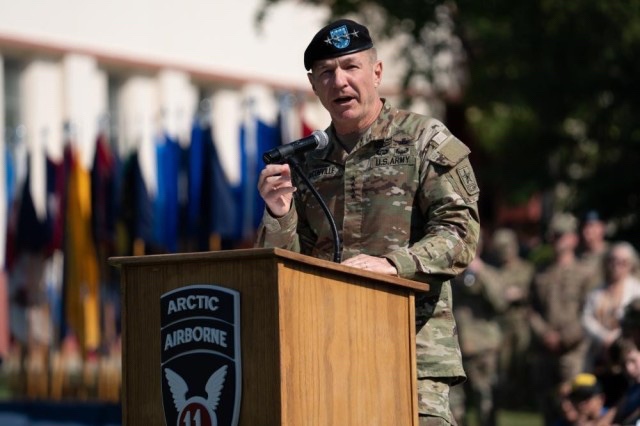
Army Materiel Command Commanding General Gen. Edward Daly was the keynote speaker and described the APBI as critical and beneficial, as it provides predictability and situational understanding to the corporate sector.

Daly outlined the four Redstone Arsenal core competencies of logistics services; space operations and missile defense; research, development, test and evaluation; and intelligence and homeland defense.

“Those are what we are focused on during APBI,” he said. “Making sure the industry partners have predictability and situational understanding on where we are going depending on what they do in support of those areas.”

He said the theme of this year’s event, “government-industry partnership to support large-scale combat operations,” is more important than ever due to the real-world events occurring in Europe.

Daly said his priorities are aligned to those of the Secretary and Chief of Staff of the Army and noted that industry partners could assist in those areas, such as modernization and identifying vulnerabilities in the supply chain — not just shortfalls and gaps, but also quality and cyber threats. His final message to the virtual audience was a reminder that when it comes to industry, the size of the company does not matter.

“This is not just about large industry partners; this is also about small businesses,” Daly said. “We have balanced this approach very carefully so that so we can simultaneously take care of small business efforts, as well as our corporate partners. We have a common bottom line, and that’s the support of the warfighter — that’s our single, common bond — our ability in those partnerships to take the right actions to support the warfighter.”

More than half of the 73 tenants that call Redstone Arsenal home spoke at the 2022 APBI, and event organizer, AMCOM Ombudsman Eric Lampkin said the event has steadily grown each year. With that growth, he said the virtual option, while necessitated for the last two events due to the COVID-19 pandemic, will remain as an option, even when APBI returns to in-person attendees.

“Next year we anticipate doing a hybrid of both virtual and in-person,” Lampkin said. “The virtual option allows attendees to dial-in when it is relevant to their needs and as their time allows. However, nothing beats the ability to shake hands, meet face-to-face and network in-person, especially when it comes to the industry matchmaking event.”

The second day of APBI traditionally features a matchmaking forum, which allows small businesses to meet with large corporations, federal contractors and government organizations. Lampkin said hosting the matchmaking event virtually was challenging because you do not get those personal connections, so he looks forward to the crowds returning to the Bob Jones Auditorium next year.

Rodney Pennywell, who assisted Lampkin by coordinating the civic leadership involvement, attended the event as a small business owner. He said when he started attending APBI six years ago, the structure and focus were different; they did not address the needs of small businesses or provide opportunities for how industry could assist Redstone organizations.

He said, “Over the years, the presenters have dramatically tailored their message to the industrial base, particularly to small businesses, ensuring that they better understand RSA missions and related business opportunities. These presentations now truly address industry needs by giving advance notice of where the federal government requires industry assistance with developing innovative technologies and solutions to achieve long-term goals and objectives.”

Former AMCOM commander Jim Rogers works for a large defense industry partner and while he was not able to attend APBI this year, as the vice president of Army programs for his company, he encouraged employees from all over the U.S. to register and tune into the virtual event.

Rogers concurs with Pennywell. He said APBI is much more robust than it was when he served at Redstone 2010 through 2012.

“Our business areas are from the west coast to the east coast, and it’s not only the people who have interest in doing business with Redstone, but also our supplier diversity, which is the folks who are looking for small businesses who want to do business with us. So you have the whole gamut of people on the line listening about what is going on at Redstone Arsenal.”

The next APBI will be held in spring 2023 and Lampkin said the planning will begin about eight months prior to the kickoff. He said he hopes to be in person next year, with a virtual option for attendees, but regardless of the forum, the intent of the event will not change, which is securing partnerships between the Department of Defense and the private sector.

“It’s important that we communicate with industry so they know where to direct their energy and resources,” Lampkin said. “It’s value added to them and it’s also value added to us on the government side, because we can communicate the technology we are looking for, what we are trying to do, where we see ourselves in five years and where we need industry to help us get these things done.”

Lampkin added, “We have to have industry continuously engaged in the organic industrial base, continuously engaged in the defense department and continuously delivering technology so we can remain ahead of our near-peer competitors.”

By Michelle Gordon

Army Units Train for Nuclear Forensics Mission During Exercise Prominent Hunt

Saturday, April 16th, 2022

BETHANY BEACH, Del. — Highly specialized American Army units from the U.S. Department of Defense’s premier all hazards command trained for interagency nuclear forensics missions during Exercise Prominent Hunt at Bethany Beach, Delaware, April 4-7.

The 20th Chemical, Biological, Radiological, Nuclear, Explosives Command’s Nuclear Disablement Team 2 and 3rd CBRNE Response Team qualified to serve as a part of the National Technical Nuclear Forensics Ground Collection Task Force at the conclusion of Prominent Hunt.

NTNF members who have recently served on prepare-to-deploy orders for the task force — including members of NDT 3, 2nd CRT from the 46th Chemical Company, Army Public Health Center and AFTAC — served as observers and controllers during the exercise.

Soldiers from the Joint Base Lewis-McChord, Washington-based 3rd CBRNE Response Team, 9th Chemical Company, trained for their NTNF mission of collecting ground samples through crawl, walk and run phases.

“Prominent Hunt promotes tactical and operational readiness to react in a nuclear emergency to meet the Army’s current demands,” said 1st Lt. Samantha K. Roberson, the team leader for CRT 3. “This mission specifically gives our Soldiers a further understanding on the radiation and nuclear portion of our mission-essential tasks. These lessons they can internalize and apply to future missions and carry on to their future Soldiers.”


According to Roberson, CRTs have to stay ready for all four weapons of mass destruction threats: chemical, biological, radiological and nuclear.

“This task force gives us a rare opportunity to exercise our radiological and nuclear capabilities. In this particular mission, we stress our ground sampling and escort tasks alongside the FBI and Department of Energy to create a joint task force,” said Roberson.

A former enlisted Soldier from Baton Rouge, Louisiana, Roberson was commissioned into the U.S. Army Chemical Corps in August 2019 after earning a bachelor’s degree in Environmental Science and Toxicity from the University of Louisiana at Lafayette, Louisiana.

“I felt drawn to the Chemical Corps as it naturally pairs with my degree,” said Roberson. “The Chemical Corps has provided me with the opportunity to learn more of what I’m passionate about, while protecting my fellow Soldiers from any CBRN threats.”

NDTs directly contribute to the nation’s strategic deterrence by staying ready to exploit and disable nuclear and radiological WMD infrastructure and components to deny near-term capability to adversaries. They also facilitate follow-on WMD elimination operations.

As the U.S. Department of Defense’s nuclear subject matter experts, Nuclear Disablement Teams serve as an informed interface between the CBRNE Response Team and the Department of Energy technical experts. The U.S. Army’s three Nuclear Disablement Teams — NDT 1 “Manhattan,” NDT 2 “Iron Maiden” and NDT 3 “Vandals” — are all stationed on Aberdeen Proving Ground, Maryland.


Maj. Stacey M. Yarborough, the deputy team leader for the Nuclear Disablement 3, served as an observer during the exercise.

“The NDTs are the DoD component lead,” said Yarborough. “We exercise mission command over elements from a CBRNE Reconnaissance Team, the Air Force Technical Applications Center and augmentations from the 20th CBRNE Headquarters.”

Yarborough said NDTs plan and battle track ground collection missions through a variety of Department of Defense communication systems.

“Our Medical Science Officer and Health Physics Technician noncommissioned officers monitor all members of the ground collection team for radiation exposure forward of the DoE hotline,” said Yarborough, a Nuclear and Countering Weapons of Mass Destruction officer from Felton, Delaware.

Lt. Col. Ronald C. Lenker, the team leader for NDT 2, served as the task force leader during exercise, a role usually reserved for an FBI Special Agent.

“The Ground Collection Task Force is led by the FBI as the task force leader and the Department of Energy also provides a deputy task force leader,” said Lenker. “In this particular scenario, no FBI agent was available, so I’m the acting task force leader for this exercise.”

An 18-year Army veteran from Wiconisco, Pennsylvania, who has deployed to Kuwait and Iraq, Lenker has participated in Exercise Prominent Hunt six times, including three exercises as a player and three as an observer and controller.

“Prominent Hunt is extremely important to the NTNF GCTF,” said Lenker. “This exercise demonstrates several agencies from the federal government can come together, swiftly form a cohesive task force and accomplish the mission In this case, attribution for the detonation of a terrorist initiated improvised nuclear device.”

Lenker said the task force came together to navigate around obstacles during the exercise. When one system went down, the operations team used a joint mapping tool in Humvee to track the plume of a simulated detonation.

“The highlight for me is seeing my Soldier and Airman teammates overcoming challenges as they arise,” said Lenker. “It’s this type of problem solving skills that set our military personnel apart from any other military in the world in my opinion.”

Story by Walter Ham

Photos by Marshall R Mason

??????????

As a part of an interagency task force lead by the FBI, the National Technical Nuclear Forensics Ground Collection Task Force gathers and packages samples of radioactive fallout that enable partner agencies to determine the source.

Headquartered on Aberdeen Proving Ground, Maryland, the 20th CBRNE Command is home to 75 percent of the U.S. Army’s active-duty explosive ordnance disposal technicians and chemical, biological, radiological, nuclear specialists, as well as the 1st Area Medical Laboratory, CBRNE Analytical and Remediation Activity, five Weapons of Mass Destruction Coordination Teams and three Nuclear Disablement Teams.

From 19 bases in 16 states, Soldiers and civilians from the 20th CBRNE Command deploy to confront and defeat the world’s most dangerous hazards during joint, interagency and allied operations around the world.

Infantry Week Highlights Soldiers’ Combat-Readiness

Saturday, April 16th, 2022

FORT BENNING, Ga. — U.S. service members throughout the Department of Defense, along with partner nations, converged at Fort Benning, Georgia, April 4-11 to compete during U.S. Army Infantry Week.

Infantry Week supports service members’ readiness by providing a controlled, high-pressure environment to validate tactics, techniques and procedures, test the latest doctrine, highlight Infantry initiatives and build esprit de corps through competition and camaraderie.

An annual event hosted by the U.S. Army Infantry School, Infantry Week is the venue for some of the most physically and mentally demanding challenges any Soldier can face in a U.S. Army competition.

Infantry Week is comprised of three events: the International Sniper Competition, the All-Army Lacerda Cup Combatives Competition and the Best Ranger Competition.

The week kicked off with the International Sniper Competition where teams competed in a three-day test of precision, technique and teamwork.

Instructors from the U.S. Army Infantry School designed a gauntlet that challenged each three-person team’s ability to work together within a range of sniper skills. Events included long-range marksmanship, observation, reconnaissance, communications and the ability to move with stealth.

The sniper team from U.S. Army 2nd Special Warfare Training Group (Airborne), based at Fort Bragg, North Carolina, earned the title of the world’s best sniper team.

The All-Army Lacerda Cup Combatives Competition features teams of eight individuals from across the Army who competed in a three-day event, hand-to-hand, for the tournament titles. Soldiers went in head-to-head matches against opponents in their respective weight classes.

The competition enhances unit combat readiness by building Soldiers’ personal courage, confidence and resiliency as well as situational responsiveness to close quarters’ threats in the operational environment.

U.S. Army Staff Sgt. Sharon Jacobson, from Colorado Springs, Colorado, became the first female noncommissioned officer to win the Lacerda Cup Combatives Competition.

“It’s an honor. It’s amazing. I’m the first NCO enlisted female Soldier to do it. It feels really good. I’m really proud of myself,” said Jacobson. “These competitions push Soldiers and NCOs to their limits both mentally and physically.”

This year, U.S. Army Ranger-qualified two-person teams competed in the David E. Grange Jr. Best Ranger Competition. The grueling 60-hour event tested each team’s physical, mental, technical and tactical skills. Back-to-back events featured weapons firing, extended foot marches, land-navigation courses and Ranger-specific tasks.

The winners of the 2022 David E. Grange Jr. Best Ranger Competition representing the 75th Ranger Regiment were Capts. Joshua Corson and Tymothy Boyle.

Corson highlighted a lesson he can bring back to his unit. “Competing … brings back the drive to want to compete, the drive to want to win, the drive to do better every day and not give up,” said Corson.

Boyle spoke on why winning the Best Ranger Competition matters to him. ‘We have to go as hard as we can, we have to try to win because that is what our job is because we owe it to everybody we represent,” said Boyle.

The fierce competition coupled with camaraderie displayed throughout the seven-day event made this Infantry Week an incredibly successful event.

Story by Alexander Gago

Photos by Patrick A. Albright, Alexander Gago, and Markeith Horace.

Veteran, Linguist Reflects on Vietnam Service

Wednesday, April 13th, 2022

ELLICOTT CITY, Md. — Originally from the San Francisco Bay Area in California, Dr. Tom Glenn originally enlisted in the Army so he could attend the Army Language School — later called the Defense Language Institute, or DLI. With a passion and knack for linguistics, Glenn taught himself French and Italian as a child, studied Latin during high school and German during college.

With a craving for more, Glenn enrolled in DLI with the hopes of learning Chinese.

“I wanted to go to the best language school in the U.S., maybe in the world,” he said. “But when I got [there], they told me they weren’t going to teach me Chinese, they were going to teach me a language I had never heard of: Vietnamese.”

Glenn was a Soldier and had to follow orders, so he spent all of 1959 learning Vietnamese. He spent six hours a day in class with two hours of private study each night for a full year.

“I graduated first in my class of ten,” he said. “I asked the Army to send me to Vietnam but [they said] they had nothing going on there.” Instead, Glenn was assigned to the National Security Agency, or NSA, at Fort Meade, Maryland.

Still hoping to study Chinese, Glenn enrolled in George Washington University in Washington, D.C. as a part time graduate student. Glenn went on to earn a master’s degree in government and a doctorate in public administration.

By the time Glenn finished his enlistment in 1961, he said he was “comfortably speaking” Vietnamese, Chinese and French; the three main languages spoken in Vietnam.

The NSA immediately offered Glenn a job at “five steps above the normal level” and sent him to Vietnam for the first time in 1962 as a civilian.

“Between 1962 and 1975, I spent more time in Vietnam than in the U.S.,” he said.

Despite being a civilian, Glenn lived with the military as if he were still a Soldier.


Tom Glenn poses for a photo in his fatigue uniform in Dak To, Vietnam in 1967. One morning while assisting U.S. 4th infantry division and 173rd airborne brigade, Glenn woke up to find his uniforms missing. Some of the Soldiers at his camp had “snitched” his fatigues and taken them to a local tailor whom they paid to sew tags above the breast pockets that read ‘Glenn’ and ‘Civilian.’ (Photo Credit: Courtesy photo)

“I was one of them — sleeping on the ground next to them, eating [field rations while] sitting in the dirt by their side, using their latrines and going into combat with them,” he said. “I was the only civilian I knew who was willing to put his life on the line by working with the military in combat on the battlefield.”


Tom Glenn in Saigon, Vietnam in 1962 (Photo Credit: Courtesy photo)

Glenn’s job was in intelligence; using signals intelligence, intercepting and exploiting the enemy’s radio communications, informing friendly forces on what enemy force intentions were and where they were.

He says that the strongest human bond he’s ever seen was that between two men fighting side by side.

Glenn spent his thirteen years in Vietnam all over the country, “wherever combat was going on.” He worked most often in central Vietnam, just south of the demilitarized zone that separated North and South Vietnam. The day-to-day was just like any other Soldier in combat.

“[The days were] defined by the boredom of waiting and the terror of close combat,” he said.

Glenn wants Americans to know the “grisly horror” of war. He wants citizens to respect and admire service members who “put their lives on the line for our good.”

After the Vietnam War, Glenn’s readjustment to civilian life would have been more difficult had he been sent straight home. Instead, he was sent abroad to serve on the battlefield all over the world after Saigon fell in 1975.

Glenn retired from NSA in 1992.


Tom Glenn in Saigon, Vietnam in 1974 (Photo Credit: Courtesy photo)


A Civilian Meritorious Medal that Glenn earned for saving lives during the fall of Saigon, Vietnam under fire in 1975 (Photo Credit: Courtesy photo)

“Welcome home, brother”

When Glenn meets other Vietnam veterans, he puts his hands on their shoulders and looks them in the eye. They share an experience unknown to other Americans.

For years following the war, many Americans saw Vietnam as “the war we never should have been involved in.” During those years, Glenn never mentioned his service overseas.

“Then, several years ago, I was invited to a welcome-home party for Vietnam veterans,” he said. “After some hesitation, I went. A bunch of young people, who hadn’t even been born before the end of [the war], shook my hand, hugged me and thanked me for my service.”

Glenn urges other Americans to approach those who served and thank them. Only then will that service member know that their service is “worthy of gratitude.”

Award-winning author

“The real adjustment [came] thirty years ago when I retired as early as I could [to] write full time,” Glenn said. “I was so intent on writing that the transition was a relief rather than an adjustment.”

Glenn’s first book is titled “Friendly Casualties” and consists of a collection of short stories to highlight the horrors of war. He chose to write about Vietnam because of his post-traumatic stress injuries, or PTSI. “[It] wounded my soul,” he said.

He learned that the only way to survive his injuries was to face the memories “head-on.” The best way to force himself to face those memories was to write it all down, which has resulted in six books and 17 short stories as of March 2022.

Glenn’s books are categorized as “fact-based fiction” which he said is the only way he could “delve into the emotions [he] lived through in real life.” He said he’s lived through experiences “far more compelling” than anything completely made up.

“I want people to know what [it was like],” he said. “I needed to vent, to stand face-to-face with my memories and learn to live with them.”

By Megan Clark

Georgia National Guard Tests New Live-Fire Range System

Sunday, April 10th, 2022

FORT STEWART, Ga. – The Georgia Army National Guard’s 122nd Tactical Support Detachment traveled to Fort Stewart for the April 1-3 drill weekend to train and qualify Soldiers on the M4 carbine rifle and M17 pistol.

The training, conducted annually to ensure unit readiness, was unique due to the software that Soldiers from the 122nd TSD operated from the range tower to control targets, score shooters and provide statistical feedback. TRACR II had been an untested Army system; the 122nd TSD was the first unit to use the new technology.

Targetry Range Automated Control and Recording (TRACR II) provided these Georgia Guardsmen with firsthand experience on a fresh interface that addressed many of the after-action reviews and suggestions made by previous operators of the legacy system.

“No Soldier has ever operated TRACR II yet,” Alex Stinefast, Program Executive Office Simulation, Training and Instrumentation (PEO STRI) program manager for TRACR II, said before the 122nd used the system on the range. “The intent is to leave it in Fort Stewart for 120 days and gather Soldiers’ feedback so that we can make improvements prior to going into full-rate production and send it out to all of the Army.”

The legacy TRACR software has been in use since its development and implementation in 2005-08 and has been updated approximately six times, according to David Howard, TRACR II program engineer.

“We’ve gone from the old Java-based type of application to more of a web-based application, which you see now on your phones,” said Howard.

Soldiers of the 122nd TSD said the software had a familiar app-like feel and was easy to learn and use when supporting range operations.

“I think it’s very beginner-friendly,” said Sgt. Desmond Albright, from the 122nd TSD.

Within 30 minutes, he learned the program and navigated the controls. The new colorful display on the system allowed him and other users from the detachment to select multiple targets, create scenarios, and assign motions to the silhouettes on the range. The leaders overseeing the training and qualification could provide individual scorecards to all the shooters to let them know which targets they had engaged or missed.

“It was a great experience,” said Albright. “As far as being newly introduced to [TRACR II] for the first time, it was pretty easy to use.”

Supported by the new TRACR II software, all participating Soldiers successfully engaged the required amount of targets with their assigned weapons and recorded qualifying scores.

The TRACR II team hopes the new software provides a platform for better training in Fort Stewart and throughout the Army.

“We are expecting the new equipment training to be significantly shorter,” said Stinefast. “We are hoping that the range operators can come in and figure out how to operate it and then start running the range.”

By MAJ Charles Emmons, Georgia National Guard

The Royal Dutch Marines: A Way of Life

Thursday, April 7th, 2022

GRAFENWOEHR TRAINING AREA, Germany – It is a commitment not to be taken lightly. The choice to become a Royal Dutch Marine is more than committing oneself to a new job – it’s committing to a new way of life.

“It was a lot harder than I thought it was going to be,” admitted Marine 2nd class Collins. Collins, born to a Dutch mother and an American father, followed in the footsteps of his father who served in the United States Army. “I was looking for the biggest challenge I could find, and I was looking for an exciting job, and I found both.”

Collins said that waking up early, not always getting enough food or sleep, combined with the rigors of physical training, initially made adjustment to military life a challenge.

“The Dutch Marines are known for their arduous training programs, which are primarily focused around hardship,” said 1LTC van Haaren. Enlisted Marines must complete two phases to become a Royal Dutch Marine. Part of the second phase takes place at Grafenwoehr, Germany, because according to van Haaren, the Netherlands lacks live-fire ranges. This phase is initial tactical training, and consists of 15 weeks of rigorous training, which is demanding both physically and mentally.

At the completion first phase, only half of the enlisted hopefuls will pass.

The speed march is an example of one of the more challenging physical and mental events for prospective Royal Dutch Marines. The Marines ran carrying rucksacks weighing approximately 40 pounds, in addition to weapons (the Colt C7 and switching off the general-purpose machine gun FM MAG 7.62). The speed march was five miles long and completed in under just 50 minutes.

The reason for the demanding nature of training is simple – to fashion the Marines into their most strong and capable selves, and to ensure only the most resolute of them make it to the Royal Dutch Marine Corps.

“Once you’re in, it’s usually for life,” said van Haaren, who himself plans to make a career of the Royal Dutch Marines.

According to van Haaren, the Royal Dutch Marine Corps specializes in carrying out special maritime operations, amphibious landings, and expeditionary land operations with light infantry units. They can be deployed for long periods of time, under all climatological and geographical circumstances. As sea soldiers, they deploy from Royal Netherlands Navy ships to carry out amphibious landings. On the ground, the Royal Dutch Marines must be capable of sustaining their own survival for up to 72 hours with zero support.

For that reason, both phases of training must be intense.

On the ranges of Grafenwoehr Training Area, equipped with Colt C7s, the Marines practice fire and movement drills which consist of individual and platoon movements. The Marines also work in pairs to train on their general-purpose machine gun, the 7.62 FN MAG, with one Marine reloading and signaling to the firer when to shoot. The ability to do this requires a great deal of teamwork, discipline, and situational awareness.

The practice of live fire could be potentially unnerving for some, but for the right few, the process can be invigorating.

“I really enjoyed the shooting drills,” said Collins, with a grin. “Probably one of my favorite things to do.” Collins had never shot prior to enlisting.

After their time in Grafenwoehr, the Marines will return to the Netherlands and continue their second phase of training. It takes place at the Mariniers Opleidings Centrum at the Van Ghentkazerne in Rotterdam. During this time, the Marines execute multiple land and amphibious validation operations. Fresh challenges will await them, with more demands on their bodies and minds.

For Collins, these demands are worth it. He motivates himself by thinking of his father, who he wants to make proud, and by avowing to himself to finish what he started.

“Being a Marine, to me, means to keep going where others might quit,” said Collins. “To always help the guy to the left and right of you, and to help the less fortunate around the world.”

Once both phases of training are successfully completed, van Haaren said the Marines will receive their “dark blue beret”. From there, they will be assigned at last to the operational units of the Royal Dutch Marine Corps. Their training will be complete, but their real journey and the rest of their lives, will have just begun.

Learn more about the Grafenwoehr Training Area at: www.7atc.army.mil

By SPC Elizabeth MacPherson

U.S. Army Special Operations Command Troops Test RA-1 Ram Air Parachute Automatic Activation Device

Wednesday, April 6th, 2022

FORT BRAGG, North Carolina – Airborne equipment testers here are busy with Special Operations Soldiers testing the Army’s newest Enhanced Electronic Automatic Activation Device (EEAAD).

The Airborne and Special Operations Test Directorate (ABNSOTD) is gathering data from the operational user to support an Army-wide fielding decision to replace the aging reserve automatic activation device currently fielded to military free-fall (MFF) units.

“The EEAAD provides the capability of the rigger shop to download the data instantly, which is not provided by the currently fielded automated activation device,” said a Parachute Rigger with the U.S. Army Special Operations Command.

The ABNSOTD first completed risk reduction efforts for the EEAAD using only ABNSOTD test jumpers to ensure that the intended test item did not impose additional and unforeseen risks or hazards to the jumper before operational test jumps.

Operational testing started in the vertical wind tunnel.

“This allowed the test team to observe the approach load system under simulated free-fall conditions being employed by a MFF qualified test jumper,” said James Cochran (JC), a seasoned Military Test Plans Analyst with the ABNSOTD.

“The ABNSOTD employed a host of risk reduction measures to ensure the potential test item was safe and effective from the intended user’s standpoint,” he said.

Operational Soldiers from USASOC finished testing with the RA-1 main parachute and reserve with the EEAAD installed by conducting MFF test jumps into the Laurinburg, North Carolina drop zone.

“The EEAAD will not only provide MFF operators with a next-generation reserve parachute activation device but will also facilitate after action reviews,” said Lt. Col Derek Johnson, Chief of ABNSOTD’s test division.

“The EEAAD will also support jump incident investigations by providing the ability to download and analyze flight data at the unit level,” he added.

The operational testing consisted of new user training and military free fall jumps followed by data collection of jump data, downloaded from the EEAAD.

“The simplicity of the menus and setting provides more confidence to the jumper that the device will work as expected,” said one USASOC Operator.

By Mr. Richard Hedgecock, Military Test Plans Analyst, Airborne and Special Operations Test Directorate, U.S. Army Operational Test Command