Lowa Zephyr Mk 2 GTX

Archive for the ‘Army’ Category

Army, Academia Collaborate on Exoskeleton to Reduce Soldier Injuries

Thursday, September 1st, 2022

ABERDEEN PROVING GROUND, Md. — An unpowered exosuit designed to reduce the physical demands placed on Soldiers is one step closer to adoption after prototypes earned passing grades from more than 100 Soldiers at three Army posts.

According to the U.S. Army Public Health Center, low back injuries result in more than one million lost or limited duty days for Soldiers each year.

The Army’s Pathfinder program — led by a collaborative team of Soldiers from the 101st Airborne Division at Fort Campbell, Kentucky, and engineers at Vanderbilt University — brought about the design and testing of unique, exoskeleton prototypes to augment lifting capabilities and reduce back strain for sustainment and logistics operations.

The research and development of the soft, lightweight, unpowered exoskeleton, called the Soldier Assistive Bionic Exosuit for Resupply, or SABER, has moved from the Pathfinder team to the U.S. Army Combat Capabilities Development Command Soldier Center, or DEVCOM SC. The DEVCOM SC team is preparing the suit for manufacturing and robust field trial use by the Army.

The Pathfinder program is a congressional initiative to advance the Army Futures Command’s modernization goals and support the innovation of Soldier-inspired, research-based technologies like SABER. DEVCOM officials said they leverage the program to connect Soldiers with its global science and technology network, which ranges from fundamental research to advanced technology upgrades to already fielded equipment.

“By engaging Soldiers earlier in the research and development process, we are able to make them aware of emerging research and technologies that academia can provide to help meet their needs,” said Dr. Arwen DeCostanza, Pathfinder program manager. “Collaborative projects like this one, yield discoveries and future outcomes by capitalizing on the creativity of Soldiers, faculty, students, industry partners and the Army science and technology community.”

Working with Soldiers in the 101st Airborne Division, researchers at Vanderbilt designed SABER as a wearable device that is soft, lightweight and form fitting. This unmotorized device can be selectively engaged by the Soldier to assist lifting capabilities.

The exosuit design addresses needs identified by the Soldiers, such as aiding strenuous lifting tasks like ammunition resupply and reducing injury and fatigue, critical to readiness over sustained periods.

“We spent the first few months focused on interviewing, observing and spending time with Soldiers,” said Dr. Karl Zelik, associate professor of mechanical engineering, Vanderbilt University. “We didn’t try to create Iron Man — a complex, full-body, rigid, unrealistic suit. Instead, we started by deeply understanding Soldier needs to develop a lightweight, low-profile, non-powered wearable tool that helps provide much-needed assistance without slowing Soldiers down or interfering with other operational tasks.”

To develop the idea for this project, Vanderbilt engineers engaged Soldiers in frequent interviews, design sprints and field tests to identify critical problems hindering their daily duties in the field. Physical overexertion stood out as a problem in need of a rapid solution.

To address strength and endurance limitations associated with material handling and field artillery, Vanderbilt researchers, engineers, technology translation experts and other military partners — working alongside Soldiers — took an exoskeleton technology Vanderbilt had previously designed for commercial use and spent a year of iterative development and testing to transform it into the SABER system.

In designing the system, the team focused on extended use of the suit during critical tasks to address Soldier load and movement issues.

More than 100 Soldiers participated in testing of the exosuit at three different bases, reporting less back strain and greater endurance while wearing SABER prototypes.

“Over the course of the day, lifting 60-pound rounds you get worn out, especially after hours. It takes a toll on your body,” said Pfc. Dale Paulson, 101st Airborne Division. “Wearing the suit really helped a lot, especially with getting the rounds out of the back of the truck. It felt like it gave me an extra boost. I didn’t have to work as hard. I feel like it helped me move quicker.”

Biomechanical evaluations revealed that the three-pound suit reduced stress on Soldiers’ backs by more than 100 pounds while lifting. Additionally, most Soldiers increased their endurance by over 60 percent while wearing SABER.

An overwhelming 90 percent of Soldiers surveyed after operational field testing in May 2022 believed the exosuit increased their ability to perform job tasks, and all of them reported that they would be likely to wear it for their job if it were developed into a product and made available to them.

DEVCOM Army Research Laboratory, in cooperation with DEVCOM SC, is providing funding to HeroWear, a Nashville-based industrial exosuit manufacturer and to Vanderbilt University to iteratively design and fabricate dozens of pre-production units in late 2022, with the goal to ramp up to hundreds of units in 2023.

DEVCOM SC will also conduct field demonstrations for critical stakeholders, getting the technology in the hands of the 101st Soldiers and other units, while simultaneously working a broader transition path.

“We were extremely proud to be recognized by our fellow DEVCOM and AFC leads as partners of choice in understanding the technology, and how to introduce this game-changing capability to Soldiers,” said Dave Audet, chief, systems division, DEVCOM SC. “Our on-going DEVCOM Soldier Center exoskeleton program and collaboration with Vanderbilt made it possible to accelerate technology modification and a successful transition from [the Army Research Laboratory] to Soldier Center.”

The DEVCOM Army Research Laboratory manages the Pathfinder program in close partnership with the DEVCOM Armaments Center. Civil-Military Innovation Institute executes the Pathfinder program on site at each military location and facilitates the interactions between military and universities.

Universities in North Carolina, Tennessee, West Virginia and Montana are working with the 82nd and 101st Airborne Divisions — both under XVIII Airborne Corps — several Special Operations Groups and West Virginia and Montana National Guard units, to identify and rapidly solve Soldier challenges and accelerate the transition of those solutions into the Army.

By DEVCOM Public Affairs Office

USAR P3O and Allegiant Air Sign Partnership Proclamation

Wednesday, August 31st, 2022

LAS VEGAS – The U.S. Army Reserve Command’s Private Public Partnership Office (P3O) and the Allegiant Travel Parent Company, the parent company of Allegiant Air, signed a partnership proclamation here on Thursday, August 25.

P3O director Ms. Alecia Grady and Allegiant Travel Company CEO John Redmond signed the proclamation. The proclamation declares that P3O recognizes Allegiant Air as a proud supporter of the U.S. Army Reserve and will assist soldiers and families in overcoming barriers to obtain meaningful employment or education opportunities to support mission readiness goals, enhance their financial stability and create connections with the community.

Army Reserve Ambassador Chris Schroeder, Civilian Aide to the Secretary of the Army Daryl A. Keithley, and representatives from 11th Battalion of the Army Reserve Careers Group attended the event. Those in attendance received a tour of the Allegiant Air operations center immediately following the proclamation signing.

Allegiant Air is committed to hiring veterans, service members, and their families. According to Redmond, over ten percent of Allegiant Air’s employees have served or are still serving. With the signing of the proclamation, partnering with P3 will help facilitate more hiring of Army Reserve Soldiers to Allegiant Air.

Allegiant was founded in 1997 and is certified by the U.S. Department of Transportation (DOT) as a “Scheduled Air Carrier” with authority to fly scheduled and charter airline operations throughout the U.S. The Company also has authority for charter service to Canada and Mexico.

Readers can find more information about the U.S. Army Reserve’s Private Public Partnership at www.usar.army.mil/P3 and Allegiant Air at https://www.allegiantair.com/about-allegiant.

P3O ensures Army Reserve soldiers are succeeding in their civilian careers which directly benefits the Army and the nation by bringing substantial value and depth to the force. More than 87% of the force integrates military service with civilian careers, providing the Army with professional skills, education and expertise acquired in the private sector.  Through collaboration with organizations offering job opportunities, and a nationwide network of corporate, profit/non-profit and academic partners, the Army Reserve’s Private Public Partnership Office is increasing its efforts to connect soldiers with internship, employment, and education opportunities.  P3O is leveraging technology, management tools, social networking platforms and hiring events to connect soldiers and families with employment opportunities.    

-Private Public Partnership Public Affairs

Production Model Infantry Squad Vehicles Airdrop Tested for Long-term Ruggedization

Friday, August 26th, 2022

FORT BRAGG, North Carolina — Airborne equipment testers here are working with aerospace engineers on modifying airdrop rigging techniques because of structural and mechanical changes made by the manufacture of the Infantry Squad Vehicle (ISV).

“Testing centered around determining if production representative mode (PRM) ISVs could tolerate the forces experienced during low velocity airdrop operations (LVAD),” said Lt. Col. Derek Johnson, Chief of Test Division at the Airborne and Special Operations Test Directorate (ABNSOTD).

The ISV is a new concept to allow Army Infantry Brigade Combat Team Soldiers to cover large areas of challenging terrain more quickly and less fatigued by reducing the area usually covered on foot.

Infantrymen would also be able to carry enough personal and squad provisions to self-sustain for several days, and the ISV is also transported easily by air assets during air assault and airborne assault missions.

The U.S. Army Combat Capabilities Development Command Soldier Center in Natick, Massachusetts assisted ABNSOTD in modifying the ISV rigging procedures and paperboard honeycomb kit to accommodate changes to the production representative model of the ISV by General Motors Defense.

“This capability is required across the range of military operations facing Infantry Brigade Combat Teams conducting crisis response, initial entry, and selected decisive action missions,” said James Cochran (JC), a seasoned Military Test Plans Analyst within ABNSOTD.

Johnson said the changes were deemed necessary after a previous version of the ISV encountered material problems during developmental testing when it was discovered some vehicle components were insufficiently ruggedized for long term vehicle service.

Testing started with a rigging exercise of two PRM ISVs on one standard Type V low velocity airdrop operations (LVAD) platform and one Dual Row Airdrop System platform.

Once rigging solutions and paperboard honeycomb modifications were incorporated into the rigging procedures, both vehicles underwent Simulated Airdrop Impact Testing (SAIT).

The two PRM ISVs rigged on airdrop platforms were raised by crane and free dropped to simulate the impact velocity experienced during LVAD operations.

“During the execution of the SAITs, high-speed video, photography, and instrumentation (accelerometers and impact data recorders) were employed to assess the PRM ISV’s reaction to the forces experienced during LVAD operations,” said Michael Estremera, Electronics Engineer at ABNSOTD.

After SAIT, both vehicles were thoroughly inspected by ABNSOTD, General Motors Defense, and the ISV Program Office to see if either ISV had any damage from forces experienced during the simulated drop.

The testing culminated with a 50-kilometer road test, with ABNSOTD personnel operating the PRM ISVs on improved, semi-improved, and un-improved roads as well as off-road routes at various speeds.

Following road testing, ABNSOTD, General Motors Defense and ISV Program Office personnel thoroughly inspected both vehicles to assess any damage the vehicles may have sustained.

This follow-on testing generated data on the ability of a PRM ISV to withstand the forces experienced during LVAD operations and remain fully mission capable.

“Operating the ISV is a great experience from the driver’s point of view,” said Staff Sergeant Clinton Martinez, an ABNSOTD Parachute Rigger. “It rides smoothly over all types of terrain and visibility is outstanding.”

“The speed and maneuverability of the ISV, along with its capability to easily negotiate all types of terrain should impart confidence in the Infantrymen that will be utilizing this vehicle in real world and training operations,” said Sgt. 1st Class Marcus Love, an Infantryman assigned to ABNSOTD.”

The ISV is deployable worldwide by sea, air, and land to support strategic deployment and operational maneuver in accordance with Army and Joint doctrine.

Story by Mr. Blake Bagby, Military Test Plans Analyst, Airborne and Special Operations Test Directorate, U.S. Army Operational Test Command

Photos by Mr. Michael Zigmond, Photographer, Airborne and Special Operations Test Directorate

APNT/Space CFT Concludes High Altitude Experimentation

Thursday, August 25th, 2022

HUNTSVILLE, Ala. – The Assured Positioning, Navigation and Timing/Space (APNT/Space) Cross-Functional Team (CFT) has concluded a 64-day stratospheric flight demonstration utilizing Airbus’s Zephyr 8 ultra-long endurance solar-powered unmanned air system (UAS).

Launched from Yuma Proving Ground (YPG) on June 15, the Zephyr 8 UAS ascended to over 60,000 feet into the stratosphere before executing its flight plan over the southern portion of the United States, into the Gulf of Mexico, and over South America. Once returning to airspace over YPG, the team conducted multiple assessments.

On August 18 around 2100 hours PDT, the prototype aircraft’s flight campaign ended when the Zephyr 8 UAS encountered events that led to its unexpected termination over YPG. These events are under investigation. No injuries or risk to personnel or other aircraft resulted from this incident. Further information will be released following the investigation.

“Our team is working hard to gather and analyze important data following the unexpected termination of this flight,” said Michael Monteleone, Director of the APNT/Space CFT. “Despite this event, the Army and its partners have gleaned invaluable data and increased knowledge on the endurance, efficiency, and station keeping abilities of high-altitude UAS platforms. That knowledge will allow us to continue to advance requirements for reliable, modernized stratospheric capabilities to our Soldiers.”

This flight marked a number of firsts for Zephyr 8, including its departure from U.S. airspace, flight over water, flight in international airspace, data collection and direct downlink while outside of U.S. airspace, the longest continuous duration (7 days) utilizing satellite communications, and the demonstration of resilient satellite command and control from three different locations – Huntsville, AL; Yuma, AZ; and Farnborough, UK.

During this flight, Zephyr 8 more than doubled the previous UAS endurance record, just under 26 days, and flew in excess of 30,000 nautical miles – more than one lap around the Earth. The 1,500 flight hours beat all known unmanned aircraft endurance records, marking significant capability and informing future mission requirements.

This experimentation successfully demonstrated Zephyr’s energy storage capacity, flight endurance, station-keeping and agile positioning abilities.  Given the amount of data that was generated during the 64-day flight and the time required to analyze it, as well as the need to investigate the events that led to the termination, further flight demonstrations have been postponed until 2023.

This 64-day test flight was performed in conjunction with government and industry partners who support experimentation that continues to inform Army requirements.

-Army Futures Command

Mack Defense Receives Order for 144 Additional Trucks for the U.S. Army M917A3 Heavy Dump Truck Program

Tuesday, August 23rd, 2022

ALLENTOWN, PA – Mack Defense announced today that the U.S. Army and the U.S. Army Reserve have ordered an additional 144 Mack Defense M917A3 Heavy Dump Trucks (HDTs).

The additional vehicles, based on the commercially available Mack® Granite® model, are part of the previously announced firm-fixed price $296 million contract to be fulfilled over seven years that the Army awarded Mack Defense in 2018. The HDTs are a key component in construction and maintenance missions for infrastructure assets, such as airfields, roadways, landing strips, supply facilities and motor pools.

“We are proud to maintain our production operation which was created for the U.S. Army M917A3 HDT program, and we are extremely proud that our Mack Defense HDT vehicles, which have been fielded, are meeting and exceeding expectations,” said David Hartzell, president of Mack Defense. “Mack Defense remains committed to producing vehicles for the U.S. armed forces based on modified versions of our industry-leading Mack vehicles providing the latest technologies and best value while meeting the military’s demanding requirements.”

The Army previously had ordered 155 HDTs, which are spec’d with heavier-duty rear axles, all-wheel drive, increased suspension ride height and other ruggedized features to meet the unique requirements of the Army. Those HDT vehicles have all been built, and final deliveries will continue through August 2022.

The Mack Granite HDT model is a modern truck equipped with modern technology, such as ABS and other active safety systems. The Granite model is user-friendly, comfortable and safer to operate compared with other past models used by the Army, which is key to the Army’s investment in the new HDTs, Hartzell said. The Granite HDTs and the production line at the Mack Experience Center in Allentown, Pennsylvania, were both inspected by the government quality auditors to ensure both met expectations.

Production of the HDTs at the MEC began in Q1 2021, following an investment of $6.5 million to create a dedicated HDT production line at the facility. The production line helps fulfill the M917A3 contract, while allowing Mack Defense to produce other vehicle variants.

The production line in the MEC is in Mack’s former Customer Adaptation Center, where vehicle modifications occurred. The Customer Adaptation Center has since moved to Mack’s Lehigh Valley Operations (LVO) in Macungie, Pennsylvania, where all Mack Class 8 vehicles for North America and export are assembled. Previously, non-armored HDT vehicles began production at LVO and were then transported to the MEC, where final assembly, including adding the dump body, occurred.

www.mackdefense.com

BAE Systems wins U.S. Army’s Cold Weather All-Terrain Vehicle (CATV) Competition, Receives $278 Million Contract

Tuesday, August 23rd, 2022

FALLS CHURCH, Va. – August 22, 2022 – BAE Systems’ Beowulf has won the U.S. Army’s competition for its Cold Weather All-Terrain Vehicle (CATV) program and the company has received a $278 million contract for production units, spare parts and contractor logistics support. The win further confirms BAE Systems as the industry leader in the design and production of military all-terrain vehicles for operations in harsh terrains and in the toughest weather conditions.

Beowulf is an unarmored, tracked, and highly versatile vehicle for carrying personnel and a variety of payloads in either of its two compartments. Beowulf can traverse snow, ice, rock, sand, mud, and swamp conditions, and can operate in steep mountain environments. Its amphibious feature also allows it to swim in flooded areas or coastal waters. This marks the first sale of Beowulf, which is based on its sister BvS10 armored variant in service with several European nations.

As the focus on Arctic Mobility operations grows, we see increasing opportunities in other markets for the BvS10 and Beowulf with an emerging demand to replace legacy BV206s.

“Beowulf is a highly capable solution to meet the US Army’s requirement for Arctic operations. We look forward to providing our soldiers operating in challenging terrain and environments with this highly capable vehicle,” said Mark Signorelli, vice president of business development at BAE Systems Platforms & Services. “We have been maturing and modernizing cold weather all-terrain capabilities for decades, bringing advanced capabilities to the United States and numerous other countries. This contract means we will continue to do so for many years to come.”

Beowulf’s articulated mobility system is key to its effectiveness, providing optimal maneuverability across varying surfaces. Its modular design can be reconfigured for multiple missions, such as logistical support, disaster and humanitarian relief, search and rescue, and other missions as required.

Its large windows and spacious cabin make Beowulf suitable to the tasks for the CATV program, including search and rescue, defense support to civilian authorities, and homeland defense. Its modern, commercial design ensures soldiers’ operational effectiveness in executing a wide variety of difficult missions.

Beowulf successfully completed the prototype evaluation phase of the CATV program earlier this year in Alaska. It performed in multiple tasks while remaining fully mission capable. The testing included amphibious operations, navigating terrain with varying levels of complexity, starting and operating in extreme cold weather, and most critically, user assessment by soldiers.

Beowulf is built by BAE Systems Hägglunds in northern Sweden, adding firsthand experience in operating in an arctic environment. The platform includes several key components from U.S. suppliers, such as its engine, transmission, and hydraulic system. The CATV program will replace the legacy fleet of Small Unit Support Vehicles (SUSVs), also built by BAE Systems Hägglunds, and known internationally as the BV206. The BV206 has been in service globally, including with the U.S. Armed Forces, since the early 1980s.

Cavalry Troopers Explore Future of Robotics at Fort Hood

Tuesday, August 23rd, 2022

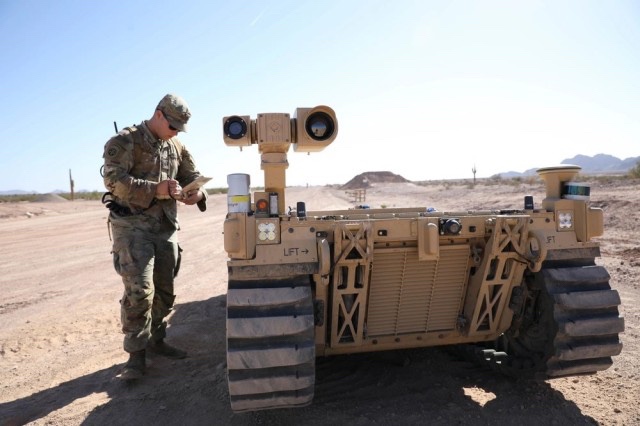
FORT HOOD, Texas – Robotic Combat Vehicles, or RCVs, will become the future for combat operations.

This is another reason why troopers with the 1st Battalion, 7th Cavalry Regiment “Garryowen,”, 1st Armored Brigade Combat Team, 1st Cavalry Division, are working with the Next Generation Combat Vehicle Cross Functional Team members to test different versions of the RCV platforms here until late summer 2022.

The testing started in late July with Soldiers training on the vehicles, followed by tactical scenarios and situational training exercises. Army engineers and technicians collected the Soldiers’ feedback, and will use that to further develop the robotic vehicle’s capabilities with the end-user in mind.

“Soldier feedback is the foundation for every single requirement we’re writing,” said Maj. Cory Wallace, RCV lead for the Next Generation Combat Vehicles Cross-Functional Team, during a training session, July 25. “If you have people (engineers) who are not connected with the Soldiers, every step of the process, we build stuff that is not useful, doesn’t work or seems way too expensive and it never leaves the motor pool.”

Garryowen troopers will have a chance to employ a tethered Unmanned Aerial System, a counter-UAS jammer, modular smoke obscuration module, a Commonly Remote Operated Weapon System (equipped with both crew-served weapons, up to 50-caliber, and a Javelin), as well as an autonomous drive function.

The RCV platforms have non-standard battery-powered systems. Soldiers are testing the limits of the vehicles in the Fort Hood training areas terrain, driving them on various terrain conditions commonly encountered on the battlefield. The Soldiers are also testing the vehicles’ ability to identify and avoid obstacles and their capacity to fire weapons while on the move.

“If you think about it, you know, in any … combat formation, 90 percent of it is a movement moving on unimproved surfaces from point A to point B. We can then off-load that onto a robot and have that robot do that, so the crews can perform more important tasks.” Wallace said.

Soldiers in the field have further validated the combat benefits of adding robots to a manned-unmanned teamed formation. On-site technicians have collected technical data, and the Soldiers have identified new capabilities desired for the operational experiment with the RCVs.

The Soldiers believe that the robots will be beneficial in several ways. First, they will provide increased situational awareness, more efficient use of resources, and greater flexibility in planning and execution. In addition, Wallace added, the Soldiers believe that the robots will reduce the risk to Soldiers’ lives by providing a safe way to gather information and conduct operations in dangerous environments. The on-site technicians will continue to collect data, and the Soldiers will continue to validate the benefits of adding robots to the formation.

“We are essentially planning and writing for the future. What we want to do is make sure we’re well prepared, and we have trained individuals so we can win the nation wars,” said Staff Sgt. Miguel Albertson, 1-7 Cav.

The Army is preparing to make future decisions on the potential acquisition and use of unmanned systems in combat by conducting additional Soldier training and evaluation sessions with RCV platforms over the next 36 months.

Soldiers will have the opportunity to provide input on how they believe unmanned systems could be employed in combat operations, as well as identify any challenges or limitations that should be considered. This feedback will inform future decision-making on the Army’s acquisition of the systems.

By Eric Franklin, Fort Hood Public Affairs

U.S. Army Selects AeroVironment JUMP 20 Medium Unmanned Aircraft System for Future Tactical Unmanned Aircraft System (FTUAS) Increment 1

Monday, August 22nd, 2022

• FTUAS to replace RQ-7B Shadow UAS currently fielded in selected Brigade Combat Teams

• Increment 1 entails testing and fielding JUMP 20 medium unmanned aircraft on an accelerated schedule as it competes to become the U.S. Army’s FTUAS of choice  

• The JUMP 20 vertical takeoff and landing (VTOL), runway independent medium unmanned aircraft system provides intelligence, surveillance and reconnaissance (ISR) services with increased maneuverability, and improved command and control


Specialist. Christopher McCoy assigned to 1st Engineer Battalion, 1st Infantry Division, conducts an engine start on the JUMP 20 prior to a launch during the FTUAS capabilities assessment at Fort Riley, Kansas. (Photo: Courtesy asset of the U.S. Department of Defense [DoD]) Disclaimer: The appearance of U.S. DoD visual information does not imply or constitute DoD endorsement.

ARLINGTON, Va., Aug. 19, 2022 –AeroVironment, Inc. (NASDAQ: AVAV), a global leader in intelligent, multi-domain robotic systems, today announced it received an Other Transaction Agreement award by the United States Army on Aug. 18, 2022 for Increment 1 of the Future Tactical Unmanned Aircraft System (FTUAS) program. The contract encompasses the purchase, testing and delivery of one JUMP® 20 medium unmanned aircraft system (MUAS) to a selected Army Brigade Combat Team (BCT) and associated services, training and support.

“With Increment 1 of the FTUAS program, the Army will be testing and fielding the JUMP 20 on an accelerated schedule as they seek a replacement for the RQ-7B Shadow UAS currently fielded in Brigade Combat Teams,” said Gorik Hossepian, AeroVironment vice president and product line general manager for MUAS. “The combat-proven JUMP 20 is a rapidly deployable, runway independent, vertical takeoff and landing solution for the Army. Its ability to be deployed, operated and sustained from anywhere is a game-changer in theater and in situations where the enemy has invaded or destroyed infrastructure.”

The AeroVironment JUMP 20 is the first fixed-wing unmanned aircraft system capable of vertical takeoff and landing (VTOL) to be deployed extensively in support of U.S. military forces. Ideal for multi-mission operations, JUMP 20 delivers 14+ hours of endurance, a standard operational range of 115 miles (185 kilometers) and is runway independent. The system can be set up and operational in less than 60 minutes without the need for launch or recovery equipment and has a useable payload capacity of up to 30 pounds (13.6 kilograms). The JUMP 20 also features a common autopilot and ground control system architecture providing a highly customizable, modular platform that can be custom configured to meet operational or customer requirements.