SIG SAUER - Never Settle

Archive for the ‘Army’ Category

Spartan Brigade showcases Armored Formation On-The-Move Network Pilot

Friday, February 25th, 2022

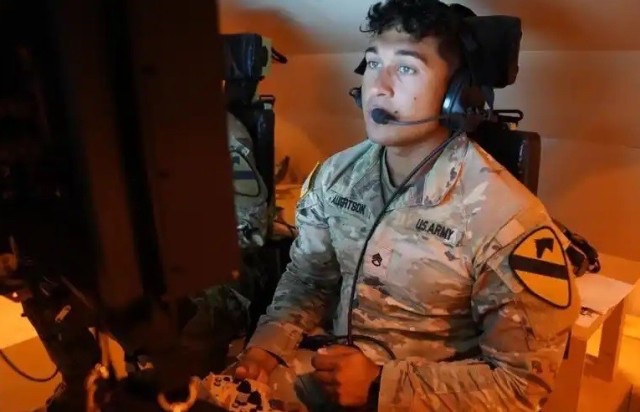
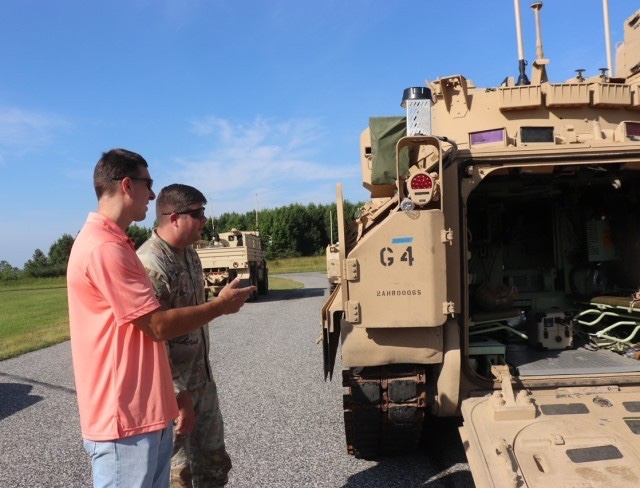
FORT STEWART, Ga. – The “Spartan Brigade,” 2nd Armored Brigade Combat Team, 3rd Infantry Division, showcased the U.S. Army’s Armored Formation On-The-Move Network Pilot on Feb. 8-9 at Fort Stewart. The pilot was in its third and final week when the unit and Army stakeholders conducted a corresponding media day and distinguished visitors day, where they exhibited three equipment sets that leveraged satellite and line-of-sight commercial network prototypes from over 20 industry partners.

Each equipment set enabled different combinations of network communications, both on the move and at the quick halt, to enhance command and control for distributed and dispersed operations and survivability and lethality.

“We know on the future battlefield you have to fight dispersed and distributed,” emphasized Maj. Gen. Charles D. Costanza, Commanding General, 3rd Infantry Division and Fort Stewart. “Even the brigade tactical operations center set up out here [for this pilot], which is scaled way down, is still too big, and so this capability would enable us to fight more distributed and dispersed. And then with the future modernization efforts we are doing with vehicles, for example AMPV [Armored Multi-Purpose Vehicle], you put those two capabilities together, I think this is really going to improve our ability to fight and survive on the future battlefield.”

Each week of the pilot a different Spartan Brigade battalion stressed and assessed one of the equipment sets in realistic brigade-designed mission threads, during and after which the Army garnered Soldier feedback and assessment data.

“One of our primary modernization focus areas is really about the network and how we enable the future fight through speed, range and convergence,” said Maj. Gen. Robert M. Collins, Program Executive Officer for Command, Control, Communications-Tactical.

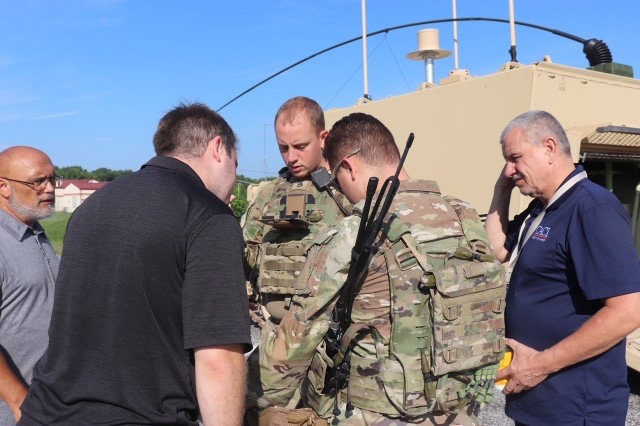
During the media day, a handful of Washington reporters from defense and technology news outlets and a regional news station visited on Tuesday, Feb. 8 to ask questions and talk to Soldiers and Army network acquisition and fielding leaders about the different equipment sets. The following day, modernization stakeholders from various U.S. Army program executive offices, cross-functional teams, training and doctrine commands, science and technology organizations, and additional Army senior leaders had a similar opportunity to talk to Soldiers as well as exchange ideas on the network modernization of armored formations.

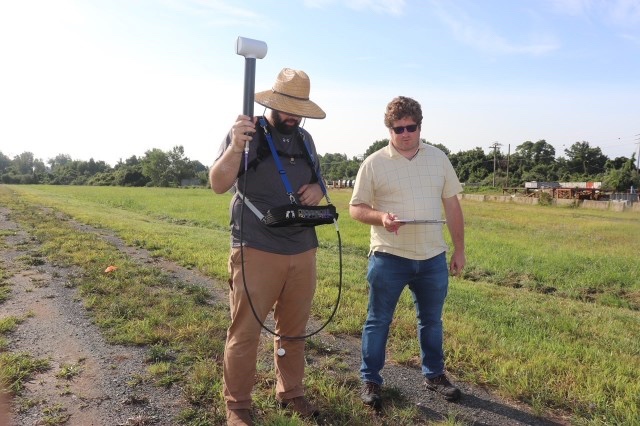
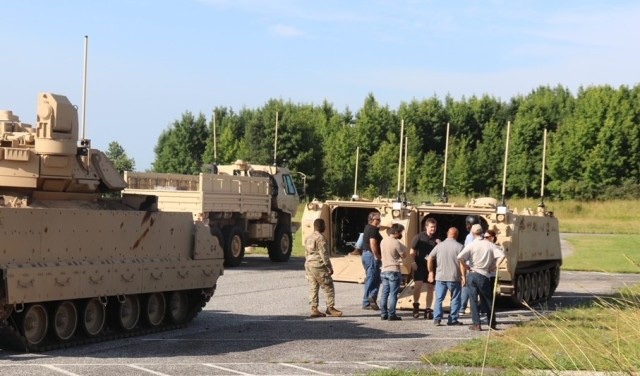
The media and distinguished visitors first spoke to Soldiers at a static display that highlighted two of the equipment sets and then rode out to the training area to talk to Soldiers employing the third equipment set.

“They [the Soldiers] truly got to assess each of the equipment sets,” said Col. Terry R. Tillis, commander of the “Spartan Brigade,” 2nd ABCT, 3rd ID. “At the end of the day, if we can’t integrate with current capabilities, and it’s not simple enough for our end user, it is something we don’t want. But the general feedback we have received [is that] it’s easy to use, it is expeditionary, and allows us to keep a much smaller command post signature, which will help us increase our survivability.”

The Soldier feedback combined with qualitative and quantitative assessment data will inform the Army’s Capability Set 25 armored formation network design and concept from the division to the battalion level. The final armored formation OTM network solution set will enable more effective and less predictable offensive and defensive operations and will increase the lethality of the Army’s armored units.

By CPT Sean Minton

The Time Is Now For Next Generation Squad Weapons

Wednesday, February 23rd, 2022

Over four years ago, then Army Chief of Staff GEN Mark Milley told Congress that the US Army needed a new family of squad weapons which would provide overmatch for their small arms. The resulting program, Next Generation Squad Weapons is ready to deliver on that requirement. Base on events earlier this week in Ukraine, this program must move forward, with all speed.

Any day now, the US Army may announce the winner to provide replacements for up to 120,000 of the M4 carbines and M249 Squad automatic weapons currently wielded by close combat forces. The Marine Corps is monitoring the program to consider making similar changes. This program doesn’t just concern weapons, but also the ammunition a Soldier fires. The Army specified a performance spec based around a government provided 6.8mm projectile which is similar to 270 WSM.

The contest is now down to two very different candidates. One is a low risk option; SIG SAUER’s weapons consist of a rifle and belt-fed machine gun which fire a hybrid-cased cartridge. Alternatively, True Velocity’s option* is a bullpup design with box-fed rifle and automatic rifle firing a composite-cased cartridge.

Both SIG and TV are ready to move forward, having announced commercial variants of both their ammunition and weapons. At this point, we are approaching COTS.

It’s time to stop the delays and announce the winner. The Army has already selected a Fire Control solution from Vortex Optics as well as let a contract to Winchester which operates the Lake City Army Ammunition Plant and will produce whichever type of 6.8mm cartridge is selected. The pieces are falling into place.

Procured using an Other Transaction Agreement, there is a lot of flexibility on how this moves forward, but it must. At this point, the ball is truly in the Army’s court. Even after the award, there’s still a lot work to be done but the sooner it begins the better. Not only does moving forward with this program get us on the way to achieving small arms overmatch, but it sends a serious message to Russia that US forces are equipping themselves with weapons to defeat their ground forces in combat, regardless of their personal armor. This may give Russia pause in their stated goal to restore the former republics of the USSR to Russian control. It will assuredly weigh on the psyche of their troops. Either is a psychological win.

*The US Army novated General Dynmanics’ NGSW OTA to Lone Star Future Weapons which is owned by True Velocity in June.

10th SFG(A) Invites Warriors Heart to Discuss Matters Held Close to an Operator’s Chest

Wednesday, February 23rd, 2022

COLORADO SPRINGS, Colo. – 10th Special Forces Group (Airborne) invited speakers from Warriors Heart to speak candidly about the effects of post-traumatic stress disorder and traumatic brain injury (TBI) at the Norris Penrose Event Center Dec. 9, 2021.

Warriors Heart is a treatment center in Bandera, Texas, which provides inpatient care to active-duty service members, veterans and first responders for chemical dependency, alcohol abuse and psychological disorders related to PTSD or mild TBI.

The event was put on by Trojan Legacy—a 10th SFG(A) program that promotes resiliency, recovery and respect within the unit—to help shed light on what undiagnosed PTSD and TBI can look like and lead afflicted Soldiers to medical treatment.

“I almost killed myself,” said Tom Spooner, Warriors Heart co-founder and retired Delta Force Operator. “‘How do I get this noise to stop?’ I was getting lost all the time; I wouldn’t know where I was when I was driving down the road. I just kept going…I had damage to the decision-making part of my brain that I didn’t know of.”

In 2006, Spooner experienced his third mass-casualty event and suffered a traumatic brain injury from an exploded mortar round while deployed which ultimately resulted in an incident where he used the military decision making process (MDMP) to plan his suicide.

“What’s going to stop this noise?,” he continued. “I started going through MDMP on utilizing my Glock and putting a bullet in my brain to stop the noise as a valid course of action. I was doing constraints, limitations, other courses of action, second and third order effects.”

Throughout Spooner’s 21 years of service, he volunteered for Airborne duty, Special Forces and Delta Force.

“Volunteers can’t complain,” he said. “The [Special Forces] selection process guarantees a lot of things. Up front, selection guarantees I will never quit…and I have never asked for help. The selection process guarantees I will not ask for help, and I only do it when I’m off the road.”

Nevertheless, Spooner had a buddy whom he confided in about what was going on in his mind as he veered off course.

“He was my everything guy,” Spooner said. “I would always tell him the truth. He stayed on me, stayed on me and stayed on me. He told me to get help. I had undiagnosed TBI, unprocessed trauma, PTSD and grief going on.”

Spooner finally sought treatment and received cognitive, psychological and vestibular therapy in conjunction with medication. Through medical testing, Spooner found that he was operating at a processing speed of 50 percent and had verbal memory of 50 percent.

“How could I honor the guys who sacrificed their lives,” he said. “Me wrecking my family and my military career is dishonoring them.”
Along with a keen sense of honor, Spooner has a keen sense of regret which, in fact, prompted him to volunteer for Delta Force assessment and selection after serving with 7th Special Forces Group (Airborne) for six years.

“There are things in life worse than death, and that’s regret,” he said. “Not having those hard conversations with people I care about. I could’ve said something but I didn’t because I thought it’d jam up my relationship. I don’t know if it would’ve changed the circumstances…but it’s one of my greatest regrets in life.”

Spooner’s own experiences acted as a looking glass as to how TBI and PTSD can manifest.

“If you have a buddy and you’re seeing these same things going on, you can talk to them and refer them to treatment,” said Sgt. Maj. Doug Lane, 10th SFG(A) Trojan Legacy senior enlisted adviser. “We want to create that peer-to-peer network and have candid conversations with our friends to ensure that if there are these issues, we steer them to the right resources.”

Story by SSGAnthony Bryant, 10th Special Forces Group (Airborne)

Army Partners with Small Businesses to Develop Innovations for Aviation Systems

Monday, February 21st, 2022

WASHINGTON – The U.S. Army just announced over $5M in new funding contracts with three small businesses to transition their innovative solutions in wind measurement systems, which have the potential to change the future of Army aviation weapon systems.

The companies will each receive up to $1.7M for an 18-month period through the Army Applied Small Business Innovation Research Program, which releases contract opportunities on an ad-hoc, rolling basis for U.S.-based small companies to tackle some of the Army’s most critical priorities.

“We are excited to see small businesses advancing target engagement capabilities in the complex, dynamic environment of tactical Army aviation,” said Charles San Filippo, test and evaluation advisor for the Army’s Future Vertical Lift Cross Functional Team. “As part of an effective, mature, and affordable fire control solution for Future Attack Reconnaissance Aircraft, or FARA, and Future Long-Range Assault Aircraft, or FLRAA, this holistic wind measurement capability will enhance Soldier survivability and lethality against near-peer threats.”

Congratulations to the following companies on their Direct to Phase II awards:

Vadum (Raleigh, North Carolina) for the Wind Measurement and Correction for Aviation Targeting

XeroWind LLC (Falls Church, Virginia) for the Twi Dimensional Path-Integrated Laser Wind Measurement System

Arete Associates (Northridge, California) for the Aviation Targeting Wind Sensor

“If a company is already established with direct customers and commercial sales, and they have a product that’s useful for the U.S. Soldier, they can skip Phase I and submit a Direct to Phase II proposal,” said Dr. Matt Willis, Director, Army Prize Competitions and Army Applied SBIR Program, Office of the Deputy Assistant Secretary of the Army for Research and Technology (DASA (R&T)). “This puts them even closer toward turning over a new technology to the Army that has the potential to be game-changing.”

The Army Applied SBIR Program aims to help small businesses overcome the inherent challenges they face when engaging in government research and development compared to their larger counterparts. The awards offer a unique opportunity for small businesses to interact with the Army and technical subject matter experts, as well as receive feedback on their technology maturation.

“This effort will show that small business innovation, combined with the efforts of proven industry partners, can provide the concentration of resources needed for state-of-the-art development to meet the Army’s mission and make innovative advances for multi-domain operations,” San Filippo said.

The Army Applied SBIR Program recently announced three new contract opportunities in artificial intelligence and machine learning and autonomy. Qualified small businesses can submit proposals through March 3 at noon EST. Full proposal packages must be submitted through the DSIP Portal. Additional information, including eligibility information and how to apply, can be found on the Army SBIR|STTR website.

By Stephanie Price

Sergeant Major of the Army Announces Inaugural Best Squad Competition

Saturday, February 19th, 2022

The Army’s Best Warrior Competition is getting an upgrade.

FORT BENNING, Ga. — During his remarks Tuesday to the Maneuver Warfighter Conference at Fort Benning, Georgia, Sgt. Maj. of the Army Michael Grinston announced that groups of Soldiers will compete together in the inaugural U.S. Army Best Squad Competition.

“For over two years I’ve talked about the importance of building a cohesive team that is highly trained, disciplined, and fit,” Grinston said. “Now it’s time to measure ourselves against that standard.”

For purposes of the competition, a “squad” will consist of five Soldiers:

One Squad Leader – Sergeant First Class or Staff Sergeant

One Team Leader – Sergeant or Corporal

Three Squad Members – Specialist and below

The inclusion of a sergeant first class was authorized to account for staff sections not typically led by a staff sergeant.

Specific details on how the squads will be assembled have not been finalized; the Army execution order is expected to be published before the end of the month. Grinston said his intent is for the teams to come from the lowest echelons of command possible.

“We don’t want divisions assembling super-squads,” he said. “But we have to figure out how that looks because each competing command is operated a little differently.”

For example, he said he would be open to allowing Soldiers from across a garrison headquarters and headquarters battalion to compete together even if those Soldiers aren’t in an organic squad.

“I want units to really think about what makes up a squad,” Grinston explained. “’This is My Squad’ isn’t just about the traditional infantry squad. It’s about those small groups of Soldiers who really know and care about each other and hold each other to a high standard of proficiency, discipline, and fitness.”

As the Army continues to modernize and train for large-scale combat operations in a multi-domain environment, Chief of Staff of the Army Gen. James C. McConville said that begins with the squad.

“The foundation of readiness is the individual Soldier and the small unit – from the team and squad levels,” he said. “The best units in the world ensure their individuals and small units are masters of their craft. If you don’t have a solid foundation of readiness, you won’t have agility. You’ll never be able to execute graduate-level operations.”

Grinston said his goal is to assess squads not just on their technical and tactical proficiency, but also on their cohesiveness and ability to work together as a team.

“By the time the squads get to the Army level, we know they’re tactically sound,” Grinston said. “So we’re going to challenge them in ways maybe they haven’t been challenged before, see how they respond when they’re stressed in other ways.”

The Army-level competition doesn’t begin until the end of September, but units will begin assembling and assessing squads now to earn the right to represent their assigned competing commands. In all, 12 teams, including one each from the Army National Guard and Army Reserve, will compete.

Sgt. Maj. of the Army Grinston also plans to select the NCO and Soldier of the Year from among the 60 competitors, but said they won’t necessarily come from the winning squad.

They, along with the best squad, will be announced at the AUSA Annual Convention in October.

By SFC Will Reinier

Simplified Human/Machine Interfaces Top List of Critical DOD Technologies

Thursday, February 17th, 2022

WASHINGTON — A modern-day cell phone packs quite a wallop when it comes to computing technology and capability. But most cell phones barely come with a “quick start guide,” let alone an instruction manual that spells out how to use all the features.

Cell phone companies have mastered the interface between humans and technology, making their use entirely intuitive and rendering thick instruction manuals a thing of the past.

The same thing should be happening for weapons systems used by servicemembers, Heidi Shyu, who serves as the undersecretary of defense for research and engineering, said. During a virtual discussion today with the Potomac Officers Club near Washington, D.C., she said intuitive, easy-to-use human/machine interfaces is something that’s a priority for her and the Defense Department.

“When I [served as an executive for the] Army before, one of the experiences I learned is with a lot of our weapons system, you really have to have a manual and go through weeks of training, if not months and years to be proficient, which is ridiculous,” she said. “[Weapons systems] ought to be designed with the appropriate ease-of-use human/machine interface, so it will become much more intuitive.”

As the Defense Department’s chief technology officer, Shyu said she’s interested in developing better ways to simplify the way service members use the technology they are given in order to reduce the training burden and learning curve.

“I really would like to see how we can change our weapons systems’ human/machine interface to be a lot more intuitive, to ease the amount of training that’s required,” she said.

For most service members, combat means use of a weapon such as a rifle, an aircraft that can drop a bomb or launch a missile, or a ship or tank that fires a large gun that requires a round to be loaded. All of these kinetic weapons systems fire solid projectiles which need to be carried along with warfighters, and which may eventually run out. But a new generation of weapons systems, which uses directed energy rather than expendable ammunition or ordnance, is on the horizon, Shyu said.

“In the area of directed energy, we’re … finally at the cusp of developing laser technology,” she said. “After 30 years, we’re finally getting to the point of fielding the prototypes. So I’m thrilled. Army and Navy are [both] fielding laser systems. I’m really happy to see that. We’re also developing high-power microwave systems as well.”

The Optical Dazzling Interdictor, Navy program, or ODIN for short, is a nonlethal weapons system used to confuse and perhaps render harmless an enemy drone — rather than shooting it down.

The ODIN system is already installed on multiple Arleigh Burke-class guided-missile destroyers within the Navy’s fleet, and there are plans to install additional systems as well.

The Army is also developing several directed energy systems. One of those is the Directed Energy Maneuver-Short Range Air Defense, or DE M-SHORAD system, which involves a 50kW-class laser to protect divisions and brigade combat teams from unmanned aerial systems, rotary-wing aircraft, and threats from rockets, artillery and mortars.

The department is also interested in the development of advanced materials, Shyu said.

“I’m certainly interested in materials that can handle higher heat, higher temperature, next-generation hypersonic materials,” she said. “I’m interested in material that’s stronger, but lighter weight. It certainly can help us reduce the logistics burden; and also materials that can have higher efficiency — materials that can potentially change properties. [There are] a lot of different areas within advanced materials we need to continue to push the research in.”

The department is also doing its part to bring the manufacture of microelectronics back to the U.S. to improve supply chain reliability, Shyu said.

“You guys have all heard about the situation that we’re in with the supply chain, where 70% of our chips are coming from Asia,” she said. “That poses a supply chain risk. You can see there’s a lot of interest on the Hill in terms of helping out the microelectronics foundries to try to onshore some of the capabilities.”

Shyu said the Defense Department is working closely with the Department of Commerce and with foundry companies to make that happen.

“We also work very closely with intelligence communities to make sure we understand all the needs and figure out how we can leverage commercial processes which can evolve at a much faster rate than just the defense-unique foundry,” she said.

Finally, Shyu said, the department is interested in having the U.S. take the lead on the development of 5G technologies — and the advancement of the next-generation of radio communications as well.

“I call it the ‘next G’,” she said. “Namely, beyond 5G. What I don’t want to happen is for us to take our eyes off the ball and play catch-up. I’m interested in making sure we’re developing technologies on 6G and 7G, so we, the U.S., can shape the standards, as opposed to some other country shaping the standard and us playing catch-up.”

By C. Todd Lopez

Department of Defense Awards Silvus Technologies Purchase Order for Streamcaster Radios

Wednesday, February 16th, 2022

Los Angeles, California (February, 2022) – Silvus Technologies, Inc. (“Silvus”) today announced the company has been awarded a second purchase order under an unnamed Department of Defense program. Initially contracted to deliver 1,000 radios in May 2020, Silvus’ success in supporting rigorous integration and testing resulted in the additional order. The second radio contract received by Silvus will result in a substantial increase of StreamCaster radios in the hands of our troops.

During trials in support of the program, Silvus’ proven performance was demonstrated  as their radios were subjected to electronic warfare jamming environments where Silvus’ Interference Avoidance capabilities allowed the network to support the traffic in contested spectrum environments. Of particular importance was the StreamCaster’s ability to perform at scale and range without having to trade off anti-jam capabilities like other radio systems. StreamCasters exceeded all threshold requirements and met or exceeded many objective requirements for the Single Channel Data Radio program.

“At Silvus, we take great pride in our ability to rapidly produce cutting edge technology to meet the needs of the warfighter,” said Colonel (Ret.) Mike Kell, Silvus Director of Army Strategic Programs. “This second purchase order represents not only a significant milestone in supporting the Department of Defense with state-of-the-art data radios, but also a major step forward in realizing the military objective of providing greater capabilities towards a more lethal soldier connected into a unified network.”

The StreamCaster Radios were selected due to their optimization for low size/weight/power (“SWaP”), high scalability, high throughput, and resilient connectivity in harsh environments, providing the soldier with real time data transmission for situational awareness in dynamic, unpredictable circumstances. Silvus’ radio is also the only low SWaP radio capable of supporting a 140-node, company-scale network at 1.25 MHz bandwidth at a range greater than 1 KM.

Troop Support Takes Over Fielding of Army Green Service Uniform for New Recruits, Soldiers

Wednesday, February 16th, 2022

PHILADELPHIA  –  

After years of planning, the Defense Logistics Agency Troop Support is now providing Army green service uniform items to recruits, and soon soldiers shopping at Army & Air Force Exchange Service stores.

While the Army initially fielded the Army green service uniforms in 2020, the Troop Support Clothing and Textiles supply chain’s planning efforts with the Army dates to 2017, said Cheryl Reynolds, C&T chief of the Plans & Integrations’ Recruit Clothing Division.

“Planning, both materiel and demand, plays an integral part in each and every new item introduction,” Reynolds said. “For the AGSU program, our discussions with the Army started over four years ago and they have been conducted regularly ever since.”

Within the last two years, C&T has been working to transition AGSU support from Army contracts to DLA-provided contract support. This included converting existing DLA Army service uniform contracts or creating new acquisitions for fabrics and end-items, Reynolds said. The team then closely monitored vendor production, shipments, and stock levels ahead of customer roll-out timelines.

The AGSU ensemble is tailored by gender and includes 17 end-items, two fabrics and 270 insignia, Reynolds said. Uniform items include short- and long-sleeve shirts or blouses, trousers or slacks, coats, gloves, dress shoes, socks, belts, and neckties.

Troop Support provided nearly 8,000 AGSU sets in total to recruit training centers at Forts Benning, Leonard Wood, Sill and Jackson this month. In April, Troop Support will begin fielding to AAFES stores worldwide.

C&T collaborated with internal finance, contracting, planning, technical and customer support teams, and personnel from the Army Program Executive Office Soldier and Tank-automotive and Armaments Command to successfully field the uniforms.

“Our team’s successful roll-out of the AGSU at the four Army RTCs reflects a significant achievement between multiple agencies within the DLA enterprise and the Army,” said C&T Director Air Force Col. Matthew Harnly.

Reynolds described the process as a ‘massive undertaking’ due to the extensive network of coordination required, number of items and various sizes.

“With close to 1,000 sizes overall, it was crucial that we were buying the quantities per size,” Reynolds said. “Time-phased inventory plans were developed for each of the items to ensure that adequate safety levels would be received when DLA took over support of the program which is necessary for a successful roll-out.”

Army recruit training center team Supervisor Timothy Schmidt noted a nuanced challenge in planning quantities by size, based on physique differences between new recruits and seasoned soldiers.

“The challenge is going to be determining what the size tariff needs to be going forward under the DLA contract versus what the Army is buying because we incorporate AAFES support, which is a different targeted demographic than the RTC audience,” Schmidt said.

“Recruits at the RTCs are, generally speaking, an 18–24-year-old demographic,” he continued. “So, [physically], they tend to be different than for instance matured soldiers who are going to AAFES and buying their uniforms at their installations.”

C&T also overcame industry challenges and found opportunity in using new vendors to produce end-items, said Ashley Liddle, chief of the dress uniform integrated support team.

“We have a limited industrial base and adding a new uniform, the normal contractors that we work with were at capacity, so we were able to find new contractors that have never done business with us,” Liddle said. “So, the majority of contractors making the items are new to us.”

Learn more about the C&T supply chain, including customer and vendor support here.

By Mikia Muhammad, DLA Troop Support Public Affairs