XC3 Weaponlight

Archive for the ‘Army’ Category

New Infantry Squad Vehicle Tested at US Army Yuma Proving Ground

Friday, March 19th, 2021

There’s a new vehicle turning heads on the range at U.S. Army Yuma Proving Ground (YPG), and it will likely begin arriving in Army brigades in a matter of months.

It’s the Infantry Squad Vehicle (ISV), and it promises to give Soldiers an opportunity to arrive to a fight faster, rested, and ready.

Powered by a 2.8 liter turbo diesel engine with a six speed automatic transmission, the four-wheel drive vehicle carries up to a nine Soldier infantry unit and their heavy gear. If it looks familiar, it is because the platform is based on a commercially-available vehicle.

“About 70% is common with the Chevy Colorado ZR2, and the rest is a mixture of commercial parts that you can modify and put onto the Chevy Colorado,” said Steve Herrick, product lead for Ground Mobility Vehicles. “About 90% of this can be bought on the commercial market.”

The ISV is meant to reduce the burden on infantry Soldiers weighed down by heavy gear and faced with rugged terrain. The fast and lean ISV can be air transported into locales within theater rapidly and efficiently.

“It provides an operationally relevant vehicle for a small tactical unit to be transported to a drop off point as quickly as possible in a mission-ready state,” said Sean Lamorena, test officer. “It’s intended to be transported by means of the infantry’s rotary or fixed wing aircraft platforms.”

“This vehicle is going to help Soldiers in the Infantry Brigade Combat Teams that currently walk everywhere,” added Herrick. “It’s made to be ‘a better boot,’ a capability that allows you to effectively change how you operate.”

Right now it’s being put through its paces across the more than 200 miles of rugged road courses at YPG to ensure it functions as it should wherever in the world it could be called on to serve.

“We’re performing reliability and maintainability (RAM) testing to support the evaluation in a desert environment,” said Lamorena. “We’re also doing two performance tests at the conclusion of RAM testing.”

Over the next few months, the ISV will traverse 5,000 miles across Yuma Test Center’s rugged ranges, including sand slope mobility tests that will see it tackle a sandy 30% grade—for perspective, the steepest grade on an interstate highway in the contiguous United States is 6%. Through much of the testing, the vehicle and its driver will be joined by plastic dummies weighted with sand in the vehicle’s remaining seats.

“We up-weight the vehicle to its operational weight expectation,” said Isaac Rodriguez, team leader in the Combat Automotive Systems Division. “We also install a data acquisition system that monitors GPS and the vital signs of the vehicle.”

During testing, simulated missions take the vehicle across road courses featuring various terrain conditions, from paved to gravel, to punishing desert washboard that would severely rattle a vehicle without four wheel drive. As they traverse these roads, test vehicle operators continually verify performance of all the platform’s performance.


“Yuma provides the capability of extreme weather differences, as well as a desert terrain,” said Herrick. “We can’t get those things that Yuma provides at other testing locations. The distances travelled on the courses and the weather conditions really help here.”

The rising temperatures as spring approaches will also help the testing.

“We’ll take advantage of the hot temperatures to execute cooling performance of the vehicle,” said Rodriguez. “We’ll load the vehicle up and verify that it is able to maintain its proper operating temperatures.”

Though the vehicle is manufactured by General Motors and the company’s desert proving ground is co-located at YPG, there are currently no plans to utilize their road courses in tests of the ISV.

“We have the capability to do so, but based on the scope of testing for this vehicle it isn’t necessary,” said Rodriguez. “If the customer added a requirement that would need to be done at that facility, we would certainly entertain that idea.”

Eventually, the Army intends to field 59 ISVs to each brigade, beginning with brigades within the 82nd Airborne Division in May. The testing completed at YPG is an important element of the success of this rapid adoption and deployment of the vehicle.

By Mark Schauer

Soldiers and Marines Airdrop Medical Supplies, Food to Forward Personnel

Thursday, March 18th, 2021

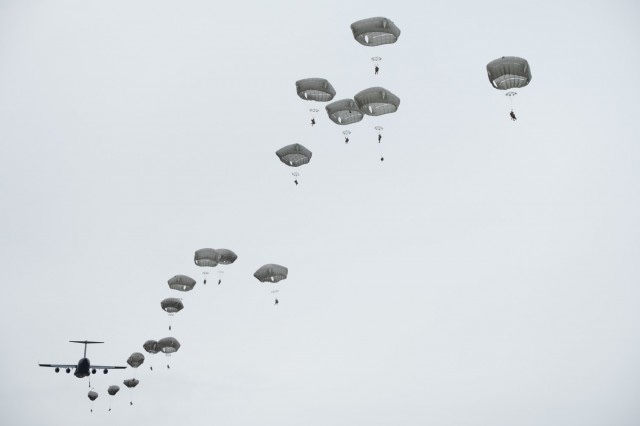
CAMP ARIFJAN, Kuwait — Soldiers with the 1st Theater Sustainment Command’s operational command post, or 1st TSC-OCP, headquartered here, successfully executed joint airdrop missions with a Marine C-130J Hercules aircrew and Army riggers in the U.S. Central Command’s area of operations.

Pallets loaded with key medical supplies, food and other materiel were delivered in three drops to different locations, said Army Warrant Officer Michael Romeo, who works in the air section of the 1st TSC-OCP Support Operations, or the SPO shop.

The aircrew belongs to the Marine Aerial Refueler Transport Squadron-352, Detachment A, and are known as the “Raiders” Romeo said.

“These missions are definitely a high priority,” said Romeo, who is a warrant officer in the 165th Quartermaster Company, Georgia National Guard, but now serving with the Army Reserve’s 310th Sustainment Command (Expeditionary), based in Indianapolis, Indiana. The 310th ESC acts as the staff for the 1st TSC-OCP.

Romeo, who was on the mission as an observer for the 1st TSC-OCP, said the airdrops are a regular part of 1st TSC-OCP’s support for personnel forward deployed, especially for perishable medical and food supplies.

“They will send in an airdrop request for review, and then it comes to me,” he said. “The biggest thing we do as logisticians and sustainers is making sure we are getting the right equipment and supplies to the people who need it,” he said. “Using aerial delivery is a quick and easy way to do that.”

The 101st Sustainment Brigade, based at Fort Campbell, Kentucky, and the 151st Quartermaster Detachment from Fort Bragg, North Carolina, also supported the air drop operations, he said.

Marine Gunnery Sgt. David Hoyt, the loadmaster for the flight, said he was impressed by the Army riggers.

“They are quick and focused and do a good job,” he said. “They understand we have time constraints and got the job done.”

Army Spc. Christian Ramos, 151st Quartermaster Detachment, said he is a team leader for airdrop system, equipment and repair.

The Guam native said once the pallets were loaded onto the aircraft, he and the other riggers use strings and rubber bands to attach the parachutes to the static lines on both the left and right sides of the plane.

“The static line is connected to the G-14 clevis, upon deployment, it will pull the parachute off,” Ramos said. “The strings I was attaching with the rubber or retainer band, are called anti-oscillation ties, so they prevent the static line from moving around in flight and getting tangled.”

The G-14 is a U-shaped piece of metal that slides on the static line, like a curtain ring on a curtain rod. When the pallet reaches the plane’s back door, the rubber band snaps from the weight of the pallet and the parachute deploys.

Ramos said this air drop mission was his first time as a joint airdrop inspector. “It means that I am inspecting the loads and ensuring that these loads are free of deficiencies, which reduces the likelihood of a malfunction, so the guys on the ground can get the supplies that they need.”

Spc. Hope Mastroberti, a parachute rigger, 151st Quartermaster Detachment, said during this deployment, she was able to attend the Joint Air Load Inspector course.

Mastroberti, a native of Crystal River, Florida, said she loves being a rigger, a job she has had for two years. “I love the opportunities I’m provided. I pack personal parachutes and I pack heavy rigging parachutes.”

By SSG Neil W. McCabe

Breakthrough Lays Groundwork for Future Quantum Networks

Wednesday, March 17th, 2021

RESEARCH TRIANGLE PARK, N.C. — New Army-funded research could help lay the groundwork for future quantum communication networks and large-scale quantum computers.

Researchers sent entangled qubit states through a communication cable linking one quantum network node to a second node.

Scientists at the Pritzker School of Molecular Engineering at the University of Chicago, funded and managed by the U.S. Army Combat Capability Development, known as DEVCOM, Army Research Laboratory’s Center for Distributed Quantum Information, also amplified an entangled state via the same cable first by using the cable to entangle two qubits in each of two nodes, then entangling these qubits further with other qubits in the nodes. The peer-reviewed journal, Nature, published the research in its Feb. 24, 2021, issue.

“The entanglement distribution results the team achieved brought together years of their research related to approaches for transferring quantum states and related to advanced fabrication procedures to realize the experiments,” said Dr. Sara Gamble, program manager at the Army Research Office, an element of the Army’s corporate research laboratory, and co-manager of the CDQI, which funded the work. “This is an exciting achievement and one that paves the way for increasingly complex experiments with additional quantum nodes that we’ll need for the large-scale quantum networks and computers of ultimate interest to the Army.”

Qubits, or quantum bits, are the basic units of quantum information. By exploiting their quantum properties, like superposition, and their ability to be entangled together, scientists and engineers are creating next-generation quantum computers that will be able solve previously unsolvable problems.

The research team uses superconducting qubits, tiny cryogenic circuits that can be manipulated electrically.

“Developing methods that allow us to transfer entangled states will be essential to scaling quantum computing,” said Prof. Andrew Cleland, the John A. MacLean senior professor of Molecular Engineering Innovation and Enterprise at University of Chicago, who led the research.

Entanglement is a correlation that can be created between quantum entities such as qubits. When two qubits are entangled and a measurement is made on one, it will affect the outcome of a measurement made on the other, even if that second qubit is physically far away.

To send the entangled states through the communication cable—a one-meter-long superconducting cable—the researchers created an experimental set-up with three superconducting qubits in each of two nodes. They connected one qubit in each node to the cable and then sent quantum states, in the form of microwave photons, through the cable with minimal loss of information. The fragile nature of quantum states makes this process quite challenging.

The researchers developed a system in which the whole transfer process—node to cable to node—takes only a few tens of nanoseconds (a nanosecond is one billionth of a second). That allowed them to send entangled quantum states with very little information loss.

The system also allowed them to amplify the entanglement of qubits. The researchers used one qubit in each node and entangled them together by essentially sending a half-photon through the cable. They then extended this entanglement to the other qubits in each node. When they were finished, all six qubits in two nodes were entangled in a single globally entangled state.

“We want to show that superconducting qubits have a viable role going forward,” Cleland said.

A quantum communication network could potentially take advantage of this advance. The group plans to extend their system to three nodes to build three-way entanglement.

“The team was able to identify a primary limiting factor in this current experiment related to loss in some of the components,” said Dr. Fredrik Fatemi, branch chief for quantum sciences, DEVCOM ARL, and co-manager of CDQI. “They have a clear path forward for increasingly complex experiments which will enable us to explore new regimes in distributed entanglement.”

By U.S. Army DEVCOM Army Research Laboratory Public Affairs

Army Expeditionary Warrior Experiments (AEWE) 2022 Calls for White Papers

Tuesday, March 9th, 2021

The Army Expeditionary Warrior Experiment (AEWE) 2022 will assess concepts and capabilities of merit for individual Soldier and small unit modernization within the context of Multi Domain Operations (MDO) and Cross Domain Maneuver (CDM).  

The AEWE 2022 learning demands will be examined in terms of SEE, TALK, SENSE, DECIDE, and ACT. The end state is that small units overmatch peer threats in lethality, maintain momentum to pursue threats over extended distances for more than 72 hours of continuous operations. Capabilities of interest enable the small unit to:

SEE: Understand the terrain in three dimensions, the electromagnetic spectrum, the threat, non-combatants and friendly forces through technologies like enhanced small unit mission command systems enabled by artificial intelligence, applications on ATAK and Nett Warrior, and heads up displays.

AEWE 2022 is open for Submissions. White Papers and Quad Charts due NLT COB 01 APRIL 2021. See our website to download and complete all AEWE 2022 documents:

www.benning.army.mil/MCoE/MCDID/MBL/Live-Experimentation

Please send all submissions to:

usarmy.benning.tradoc.mbx.mbl-expeditionary-warrior-experiments@mail.mil

and

Janet Sokolowski

janet.sokolowski.ctr@mail.mil

(706) 544-8107

Integrated Technology Takes Night Vision to a New Level

Tuesday, March 9th, 2021

ABERDEEN PROVING GROUND, Md. – We still own the night.

The PVS 14 night vision monocular and PAS 13 thermal rifle optics are technologies of the past as the Enhanced Night Vision Goggle – Binocular (ENVG-B), Nett Warrior, and Family Weapon Sights – Individual (FWS-I) deliver leap-ahead capabilities to ensure overmatch against near-peer threats in all domains.

Soldiers from the 101st Airborne Division spent three weeks at Aberdeen Proving Ground learning and testing the new equipment set as a part of the program’s guiding Soldier Centered Design philosophy that ensures end user feedback at every step of the technology’s development.

“The ENVG-B is leaps and bounds beyond what we have now, it’s really impressive technology,” said SPC Timmoy Ellis, 2-506, 101st Airborne Division. “My first time in a unit when I tried out the old NODs [night observation device] last year, I got lost and was all the way on the other side of where I was supposed to be. So this will especially help the new guys that haven’t walked in the field at night, they’ll be able to see exactly where they’re going. I wouldn’t have gotten lost if I had these ENVG-B’s, that’s for sure.”

The ENVG-B’s dual tubes feature high-definition white phosphor and overlaid fused thermal technology. ENVG-B Program of Record prototypes are making marked advancements from legacy PVS-14s and previously fielded Enhanced Night Vision devices.

“The white phosphor fused with the thermal overlay helps a lot as well,” said SGT William Williams, 3BCT, 2-506, 101st Airborne. “The good thing about it is the mode that may work best for me, may not work for one of my Soldiers. It has lots of settings to where they can adjust whether they want more white phosphor or more thermals, so in situations where you’re not getting a lot of ambient light you can crank the thermal up and really see anything that picks up heat or puts off a heat signal.”

This ENVG-B capability set features more mode options with the added ability to interface with Nett Warrior’s AR tools in multiple goggle modes.

“When you integrate those technologies you’re going to increase situational awareness and also lethality at night,” said MAJ Bryan Kelso, PEO Soldier Assistant Product Manager for ENVG-B. “You get added capabilities such as rapid target acquisition, the ability to passively bring the weapon optic into the goggle, and also augmented reality when you bring in any of the icons displayed on the Soldier’s Nett Warrior end user device [EUD]. Those all feed straight into the ENVG-B goggles so the Soldiers don’t have to open up their EUD and they can keep moving and seeing those graphical icons.”

Increased SA capabilities

When the high-resolution ENVG-Bs are paired with a Nett Warrior device, the Android Tactical Assault Kit (ATAK) uses AR applications to overlay map graphics and blue force tracking capabilities for increased situational awareness, communication, and mission planning across day and night operations. Soldiers can also enter enemy icons on the EUD and share with others across their network.

“The Nett Warrior technology gives us a better understanding of what we’re getting ready to go do, and helps us battle plan and track each other,” said Williams. “As a squad leader it’s nice to have the Nett Warrior, even if it is not being pumped into the NODs itself I can take that quick tactical pause, flip my phone down on my kit to check it out and see where all my guys are at and see exactly what’s happening on the battlefield.”

“With Nett Warrior you don’t have to be confused,” added Ellis. “You know there’s a river right here so plot to go around it, you know this team is over here, this squad is over there, you know exactly where everyone’s at so you don’t have to stop the formation to look for guys or see if they got stuck at an obstacle, so we can plan accordingly. It’s pretty cool”.

Nett Warrior not only enables increased situational awareness to the dismounted leader, but to higher command and control (C2) as well. The NW system is equipped with a dual channel multi-band radio that enables communication and data sharing on a much larger scale.

“These systems help make communication to leadership easier because sometimes things get hectic out there and I might stumble up, but now even if I can’t talk at the moment I can hit a button and push everything that I have on my Nett Warrior out to my chain of command so they know exactly what I’ve got going on,” added Williams.

Not only does Nett Warrior deliver increased situational awareness and C2 communication, but it enables more efficient mission planning and execution as well.

“Usually it takes hours or days to plan a mission once it comes down,” said Ellis. “Then we sit down and build a sand table and they say ‘Hey, this is what we’re doing,’ so you don’t really get to see that 3D aspect of it. Now once we know we have to hit this village, we can get it planned out pretty quickly, push the mission package out to the other guys, and knock that mission out.”

Mission planning with Nett Warrior is more efficient, but it is also more comprehensive.

“When you mission plan with the Nett Warrior system you can show that we’re hitting this building here and then you can plan out since we’re hitting this building we can put up support by fire here, the weapons go here, and build from the same operating picture that everyone sees. It’s a really nice concept because everyone can see exactly the lay of the land and exactly what you’re doing in advance before even going in,” said Ellis.

Added range, even from cover and concealment

The FWS-I optic feeds the view of the weapon sight into the ENVG-B goggle display, allowing Soldiers to accurately identify and engage targets at increased ranges without physically being face to face and without the need for a laser.

“The FWS-I is mounted in front of the Soldier’s day optic on their M4, which allows you to passively engage targets in a multitude of ranges out to the max effective range of the weapon,” said Kelso. “You can actually detect targets beyond 600 meters, so past where you could effectively engage with an M4.”

The increased range of the optic will allow targets to be identified at farther distances than ever before, and RTA provides the Soldier a passive solution to engage enemies. Picture in Picture and Full Weapon Sight modes allow the Soldier to accurately engage from behind cover and concealment.

“It’s pretty cool to be able to put my head down and engage targets without actually compromising cover,” said Williams. “I could stay completely behind cover, my eyes and head not even looking in the direction of the target, and utilize my FWS-I pumped into the ENVG-B and effectively engage my targets that way.”

Williams adds, “Another good thing about the FWS-I is that it eliminates us having to use a laser, which is a big thing because if we’re engaging with a near-peer because they will be able to tell where we’re at immediately if we’re using lasers.”

Big picture

The ENVG-B, Nett Warrior, and FWS-I all individually deliver capabilities beyond what is standard in today’s battlespace. The ENVG-B delivers dual tube improved Image Intensification (I2) resolution, fused thermal image, and wireless connection with FWS-I and Nett Warrior. The FWS-I provides enhanced target recognition and passive engagement capabilities, even behind cover and concealment. Nett Warrior provides blue force tracking, improved communication, and mission planning tools.

“It reduces the potential of fratricide issues and can help units link up with each other, especially if you want to remain in radio silence,” said Kelso. “There is also consistent visibility of where those blue forces are on the battlefield and with its dynamic refresh rate feature it refreshes more often based on the Soldier’s movement. When identifying either potential or known enemies that information can also get fed through the unit and immediately populate the common operating picture to inform decision makers at a higher level.”

Together the integrated kit delivers the increased situational awareness, communication, and lethality to save lives and ensure undeniable near peer overmatch.

“It has definitely grown on me,” said Williams. “At first I didn’t like it at all. I was like, just give me the NODS and let’s go on, but it has grown on me and in certain situations I think it can help save lives and win the fight.”

Nearly 5,000 ENVG-Bs have been fielded thus far per an Army Directed Requirement. In parallel, the ENVG-B Program of Record has entered Low Rate Production and continues to prepare for its next major test event involving Soldiers in May at Fort Polk, LA. Nett Warrior will be tested with 2nd Cavalry Regiment in April followed by its fielding to 3rd Infantry Brigade Combat Team 25th Infantry Division in July 2021.

By Courtney Bacon

FN Demonstrates Cutting-Edge Technology at 2021 Army Expeditionary Warrior Experiment

Monday, March 8th, 2021

(McLean, VA – March 8, 2021) FN America, LLC, maker of the world’s most battle-proven firearms®, is pleased to announce that the company has been selected to participate in the U.S. Army’s Expeditionary Warrior Experiment (AEWE), taking place March 9, 2021, at Fort Benning, Georgia.

Following a highly successful AEWE demonstration of the company’s emerging technology last December, FN will further exhibit their e-Novation suite of revolutionary weapon enablers that provide innovative and disruptive technology that resonate and align with the U.S. Army’s modernization efforts.

“For the past 130 years, FN has delivered small arms solutions to militaries worldwide. At the heart of our business is the goal of improving and enhancing solider capabilities,” said Mark Cherpes, President and CEO for FN America, LLC. “This demonstration for AEWE allows us to further showcase our newest technology that facilitates training solutions and enables new possibilities in battlefield situational awareness. We are looking forward to demonstrating these emerging technologies for the U.S. Army.”

“We are extremely proud to have been invited to demonstrate our e-Novation solutions,” said Todd Smith, Vice President for FN’s military operations. “FN leads the way in integrating enablers onto the weapon platforms and the technologies we are demonstrating at AEWE directly meet the U.S. military’s requirements and approach to Soldier as a System.” 

The Army Expeditionary Warrior Experiment (AEWE) assesses Cross Domain Maneuver (CDM) concepts and capabilities at the lower tactical echelon in support of Multi Domain Operations (MDO). The Experimentation Force (EXFOR) will employ mutually supporting lethal and nonlethal capabilities across multiple domains (air, land, space, and cyberspace), the electromagnetic spectrum, and the information environment to create a synergistic effect that increases relative combat power and provides overmatch. It is the Army’s primary venue for Small Unit modernization, providing capability developers, Cross Functional Teams (CFTs), PEO’s, Army Science and Technology (S&T) community, and industry a repeatable, credible, rigorous operational experiment supporting both concept and materiel development.

FN’s e-Novation product line encompasses solutions addressing marksmanship training, aiming devices and small arms management. To learn more on these products or FN’s full military portfolio, please visit fnamerica.com.

US Army, Argonne Scientists Explore Nanoparticles for Future Weapon Systems

Thursday, March 4th, 2021

ABERDEEN PROVING GROUND, Md. – Material scientists from the U.S. Army and Department of Energy conducted a study of plasma-treated aluminum nanoparticles with the goal of improving future propellants and explosives.

Researchers from the U.S. Army Combat Capabilities Development Command, known as DEVCOM, Army Research Laboratory, and the Center for Nanoscale Materials at the Argonne National Laboratory, investigated a new class of surface-engineered aluminum nanoparticles. They published their findings in the peer-reviewed Journal of Applied Physics for a special issue, Fundamentals and Applications of Atmospheric Pressure Plasmas. The journal featured the article on the cover of its Feb. 14, 2021, issue.

“The ultimate goal of the effort is to extend the range and disruptive power of Army weapon systems,” said Dr. Chi-Chin Wu, a materials scientist at the laboratory. Wu leads this effort and is the first author of the article. “The paper presents results that support of ongoing investigations of aluminum nanoparticles for use as novel energetic ingredients in propellant and explosive formulation.”

The study exploits plasma-based surface treatment and chemical synthesis techniques, she said.

“Images and data obtained from two state-of-the-art transmission electron microscopes at the Center for Nanoscale Materials at the Argonne National Laboratory revealed valuable information on oxide shell phase transformation and the dispersive nature of the deposited carbonaceous materials,” Wu said. “This provides tremendous insight for further optimization.”

The new plasma approach enhances the reactivity of commercial 40-60 nanometer particles. For comparison, a human hair is typically 60,000 nanometers in width. According to Wu, the method involves first treating with a helium plasma to etch away a significant portion of their inert oxide shell and then treating with a helium/carbon monoxide plasma to deposit a reactive surface coating.

“Plasma science is a fascinating emerging technology for many applications but has yet to be sufficiently explored in the energetics community,” she said. “All this is done in a custom dielectric barrier discharge plasma reactor. The resultant particles were then characterized by high resolution transmission electron microscopy revealing important nanoscale surface and chemical composition features. We are constantly seeking new energetic materials with higher energy densities and faster energy release rates.”

Plasma treatment and synthesis, coupled with comprehensive material characterization, is critically important for optimizing methodologies and materials for scale-up and transition, she said.

Dr. Rose Pesce-Rodriguez, also from the laboratory and a co-author of the study, said the plasma approach developed by Wu has opened new possibilities for the U.S. Army to effectively surface-engineer metallic nanoparticles for energetics applications.

“Aluminum is just the first example,” Pesce-Rodriguez said. “Since 2018, several parallel efforts involving in-house, DOD, DOE and academic collaborations have blossomed. Making headway on this problem is difficult because samples are so small and require specialized technology to image and analyze.”

According to Pesce-Rodriguez, the microscopy tools available at DEVCOM-ARL and Argonne enabled Wu and collaborators to do a “remarkable job” of characterizing the new plasma-treated particles.

“We’re looking forward to more exciting discoveries,” Pesce-Rodriguez said. “It seems we’re learning something new almost every day.”

Wu said her ultimate goal is for DEVCOM-ARL to develop and transition energetic materials through a unique combination of innovative plasma technologies and advanced materials characterization techniques.

Collaborative partners in this study are Drs. Jianguo Wen and Ilke Arslan at the Center for Nanoscale Materials, Argonne National Laboratory.

“It’s been great to collaborate with Dr. Chi-Chin Wu and her team on advanced disruptive energetics,” Wen said. “This gives Argonne the opportunity to bring our expertise and unique capabilities to challenging Army problems.”

Dr. Mark Tschopp, the regional lead of ARL Central in the Chicago area, said this is a great example of collaboration between the Army and the Department of Energy.

“It combines the expertise of scientists at both laboratories along with unique facilities at the Department of Energy User Facility Center for Nanoscale Materials,” he said. “Expanding the Army team to include other partners is vital to tackling some of the fascinating and challenging science that the Army Research Laboratory is pursuing in areas such as at the intersection of energetics and plasma science.”

According to Wu, the work is an example of how the laboratory is working to operationalize science to provide energetics for transformational advances.

“It brings material science expertise into energetics for advancing future weapon systems,” she said.

The U.S. Department of Energy, Office of Science, Office of Basic Energy Science supported use of the Center for Nanoscale Materials, an Office of Science user facility, under an existing contract.

By U.S. Army DEVCOM Army Research Laboratory

Spartan Paratroopers Harness Biometric Technology

Wednesday, March 3rd, 2021

JOINT BASE ELMENDORF-RICHARDSON, Alaska – Paratroopers of the 4th Infantry Brigade Combat Team (Airborne), 25th Infantry Division, “Spartan Brigade,” began a six month-long study on Joint Base Elmendorf-Richardson, Alaska, using wearable technology to study the resiliency of soldiers operating in an Arctic environment, Jan. 11, 2020.

The Spartan Brigade contracted with wearable technology company WHOOP and scientists from the University of Queensland to conduct a 6-month study of nearly 1,000 paratroopers. Paratroopers use the real-time data provided by the WHOOP straps and accompanying mobile phone application to measure their daily strain and recovery rates while training in extreme Arctic winter conditions.

“The rigors of Arctic airborne operations take a toll on the human body,” said Col. Chris Landers, the Spartan Brigade commander. “How do we maximize a paratrooper’s effectiveness on the battlefield while dealing with extreme cold and lack of sunlight?”

As the only airborne infantry brigade combat team in the Arctic theater, the Spartan Brigade paratroopers conduct airborne operations in sub-freezing temperatures, during high winds, and with minimal hours of sunlight.

“We’re called on by our nation to respond with little notice to contingencies around the globe,” said Landers. “We don’t choose the time or the place, but we can choose how well we perform when we get there.”

Using adjustable wrist straps, the study captures biometric data on each volunteer participant throughout the workday and while they’re sleeping, providing an analysis of their exertion, heart rate behavior, and sleep quality, all of which is used to determine overall strain and recovery.

Unlike blind studies, the paratroopers participating in this study will each have immediate access to their own data through the accompanying mobile application, and can make decisions using this feedback to improve their personal performance.

“We are empowering our paratroopers to better understand themselves,” said Command Sgt. Maj. Alex Kupratty, the Spartan Brigade command sergeant major. “This study is all about putting the power of technology and data directly into their hands, so they can truly harness their own potential.”

Paratroopers will also be provided educational blocks to teach them techniques to maximize their recovery. Partway through the study, a section of participants will be asked to concentrate on three habits: creating a cold, dark space for sleeping; not eating after 7pm, and sticking to a rigid sleep time schedule.

“The goal of the study is twofold,” said Chief Warrant Officer 4 Phillip Ranck, study project leader for the Spartan Brigade. “First, that soldiers gain a better understanding of themselves. Second, that soldiers understand that their leaders are taking an aggressive approach to understanding the impacts of training and the Arctic environment’s impact on their mental and physical health.”

Participants can also sign up for social groups, adding a competitive incentive within their peer groups as they compare their strain and recovery numbers every day.

“The goal is to give our paratroopers the data and education to shape the conversations among their peers about their daily fitness and health,” said Kupratty. “Not only do they better understand their own bodies, but they’re building lifelong, healthy habits along the way.”

All leaders from the squad level and up will have access to their paratroopers’ data, so they can adjust training and operational plans to maximize the health and potential of their teams.

“Imagine as a squad leader that you have a paratrooper that has had an abnormally low recovery for several days,” said Kupratty. “Maybe your platoon has been in the field for weeks, or the paratrooper just returned from an Army school. Now you have the data to better help them recover, or to adjust your training to match the team’s needs.”

According to some researchers, fluctuations in someone’s recovery rate may indicate a buildup of social or personal stressors that can lead to decreased motivation or resiliency, or the development of an illness like influenza or COVID-19.

“This is all about better understanding what a soldier needs to be the best version of themselves as fast as possible,” said Kupratty.

The study is organized by the brigade’s digital technology innovation cell, SPARwerx. The SPARwerx initiative crowdsources innovators from across the brigade to develop internal technologies, systems, and concepts to maximize the welfare, safety and efficiency of Spartan paratroopers.

By MAJ Jason Welch