FirstSpear

Archive for the ‘Army’ Category

Airborne 22: US, Japan Test Interoperability

Wednesday, February 2nd, 2022

YOKOTA AIR BASE, Japan (AFNS) —

The 374th Airlift Wing supported Japan Ground Self-Defense Force soldiers assigned to the 1st Airborne Brigade in operation Airborne 22, Jan. 25–26.

Airborne 22 is the largest annual static-line personnel jump and cargo drop exercise between the U.S. Air Force and JGSDF.

The exercise integrated 11 C-130Js from the 36th Airlift Squadron, Yokota Air Base, and two from Dyess Air Force Base, Texas, carrying approximately 500 JGSDF soldiers for an airdrop training at the Combined Arms Training Center Camp Fuji, Japan, drop zone.

An additional 100 Container Delivery System bundles, carrying simulated cargo, were also dropped from U.S. Air Force C-130Js at six different points of impact at Fuji DZ. The simulated cargo, which consisted of fuel, water, food, and different types of ammunition, directly supported JGSDF operations on the ground.

This interoperability mission provides an excellent opportunity for the JGSDF to get all the airborne exercise they need, said Capt. Jordan Baab, 36th Airlift Squadron instructor pilot and Airborne 22 mission commander. It also offers the 36th AS the chance to practice its forward-deployed attack capabilities.

Airborne 22 demonstrates the U.S. Air Force and JGSDF’s capability to execute a large force insertion on a drop zone. It showcases the combined capacity between USAF and JGSDF’s ability to rapidly deploy joint forces while emphasizing the strong allied commitment to a free and open Indo-Pacific region.

“This is a proof of concept that the tactics, techniques and procedures that we practice and train every day play into effect and work pretty well,” said Capt. Audrey Crismon, 39th Airlift Squadron C-130J pilot and Airborne 22 mission commander. “No matter where we are, who we are working with.”

By Senior Airman Brieana E. Bolfing, 374th Airlift Wing Public Affairs

Army Applications Laboratory Names Four Companies to Soldier Power Cohort

Tuesday, February 1st, 2022

Cohort Aims to Help the US Army Power Soldiers on the Move
AUSTIN, TX – Four companies have been selected for the Soldier Power Cohort with the Army Applications Laboratory (AAL) through a program managed by Huntington Ingalls Industries (HII). Sourced from across the country, the selected companies are developing innovative power generation and power conversion, high-density energy storage, and intelligent management and distribution technologies that can support self-sufficiency, reduce burdens, and lessen dependence on resupply.

“Technology is a force multiplier for the Army, but with more technology comes more weight and the need for more power. We need to find a smart way to lighten that load for Soldiers who work in expeditionary environments for days at a time,” said Col. Jay Wisham, director of AAL. “While the commercial market for these technologies is relatively niche, both the Army and industry are facing similar challenges in how to maintain power for devices when away from the grid. This Cohort offers a way to join forces and move the field forward while keeping our Soldiers safe and effective in the harshest environments.”

Dramatic improvements in energy and power density for low-power commercial applications have increased the amount of output achievable while reducing size and weight. Intelligent power management and distribution solutions have also been instrumental in enhancing overall efficiency (as well as convenience) for consumers. As part of the Soldier Power Cohort, companies will earn $100,000 to develop conceptual designs that translate these existing solutions to address the Army’s specific problem. Cohort participants will learn about the Soldier Power problem set directly from key stakeholders, including Army Futures Command’s Soldier Lethality Cross-Functional Team; the Network Cross-Functional Team; and Combat Capability and Development Center Command, Control, Communications, Computers, Cyber, Intelligence, Surveillance, and Reconnaissance Center.

The 8-week Soldier Power Cohort began on January 24, 2022, with concept design presentations planned for March 17, 2022.

The following companies will participate in the cohort:

Epirus, Inc.

Hawthorne, CA

Epirus is a high-growth technology company that develops directed energy systems and power management solutions for broad applications across industries. The nucleus of Epirus’ innovation is the company’s machine intelligent SmartPower technology platform, a multi-layered management solution that delivers precision control, unprecedented power density, and high-power efficiency to various devices.

Resonant Link, Inc.

Shelburne, VT

Resonant Link powers fleets and devices while they work by wirelessly charging medical devices, consumer electronics, and electric vehicles. Through a breakthrough wireless charging technology called the Multi-layer Self-Resonant Structure (MSRS), Resonant Link provides wireless power for multiple Fortune 500 companies and government agencies.

Spark Thermionics, Inc.

Emeryville, CA

Spark Thermionics is an early-stage energy startup developing a “powerplant on a chip” — lightweight and fuel-flexible electricity generation based on a thermionic energy conversion. Spark is led by world leaders in thermionic technology and has received recognition in Physics Today, Fortune, the Official White House blog, and elsewhere.

Xerion Advanced Battery Corp.

Kettering, OH

Founded in 2010, Xerion Advanced Battery Corporation is a fast-growing battery company located in Dayton, OH, that works with Fortune 500 companies in a variety of industries. Through its patented battery technologies, the company aims to revolutionize the energy industry by introducing a step change in innovation in Li-ion batteries for portable electronics, power tools, and unmanned aerial systems (UASs).

Army Fielding Enhanced Common Operational Picture Suite, Looks Towards Cloud-Enabled Mission Command

Monday, January 31st, 2022

ABERDEEN PROVING GROUND, Md. — The latest iteration of the Army’s converged suite of common operational picture capabilities is now fielding to Soldiers after reaching a critical milestone with the approval of Command Post Computing Environment, Increment 1 for a full deployment decision.

This milestone, reached December 15, marks the culmination of an integrated test strategy consisting of cyber security assessments; interoperability and developmental tests; Soldier touch points; and operational assessments throughout the last 15 months. The FDD also verifies training packages, affordability and sustainment for the CPCE, Inc 1 capability, and ultimately signals the start of fielding key enhancements to operational units.

“This [decision] is significant because Increment 1 provides several improvements over Increment 0 that the Soldiers have been asking for,” said Col. Matt Paul, project manager Mission Command, assigned to the Program Executive Office for Command, Control, Communications-Tactical.

CPCE is the primary computing environment under Army Futures Command’s Common Operating Environment modernization effort, supporting command posts and combat operations. Inc 1 marks the first significant convergence of warfighting functions into CPCE and incorporates improvements across a wide range of applications, including new mission planning and whiteboard tools, geospatial capabilities to converge some Intel functions, and security and general performance enhancements.

“Convergence into a simple, intuitive, single common operating picture is critical,” said Col. Evert Hawk II, Mission Command lead for the Army Futures Command Network Cross-Functional Team. “For commanders to make rapid, informed decisions, they need to access and evaluate data from numerous sources across warfighting functions. The team has leveraged Soldier feedback to make sure we are bringing all that information together and presenting it in an integrated way.”

An operational test conducted last year assessed the effectiveness, suitability and survivability of the enhanced Inc 1 capabilities, proving the ability for commanders and staff to share battlefield information and collaborate through a customizable COP from the battalion to the combatant command level.

To produce the COP, CPCE Increment 1 receives and processes data feeds from more than 25 other digital systems inside of the command post, including those from Joint and Coalition partners. The software’s ability to produce a COP was successfully demonstrated as part of the OA during last year’s Joint Warfighting Assessment 2021 (JWA21) with the 4th Infantry Division. JWA21 included Joint and Five Eyes partners all contributing to CPCE’s COP using common data standards and interfaces.

CPCE Inc 1 served a similar role in Project Convergence 2021, connecting to a myriad of experimental systems to provide the joint COP for the Army’s signature modernization exercise.

“CPCE Increment 1 provided a foundational capability at PC21 to allow the Army to conduct experiments with promising new systems still in development,” said Paul. PC21 observations indicated a need for established Joint interface standards to better prioritize data convergence and to integrate a data fabric onto the CPCE environment.

Two weeks ago, the 41st Field Artillery Brigade in Grafenwoehr, Germany became the first unit equipped with the new CPCE baseline when it received Inc 1 software. The unit — which is the only European-based fires brigade — provides strategic, operational, and tactical-level fires and support throughout the U.S. Army European Command.

Other units receiving Inc 1 software this month include the 2nd Infantry Brigade Combat Team and 4th Brigade Combat Team (Airborne), 25th Infantry Division, at Schofield Barracks, Hawaii.

The software’s extensibility allows it to serve as a platform to integrate new or legacy 3rd party applications from industry and government sources. CPCE Increment 2 will build on Inc 1 and will converge additional warfighting functions, including sustainment and aviation applications.

Inc 2 will also add an initial data fabric capability to allow commanders and staffs to search and discover data they need more quickly and easily. Integrated data fabrics will stitch together different data formats to make relevant data visible and available throughout the ecosystem, facilitating sensor-to-shooter tasks, information advantage and decision dominance. Critically, CPCE Inc 2 will align the Army’s data fabric implementation to the Department of Defense’s Joint All-Domain Command and Control, known as JADC2, construct and will contribute to the department’s new Joint Warfighting Concept.

Inc 2 also plans to leap into the cloud, supporting Army imperatives to migrate applications into a Cloud environment. PM Mission Command plans to leverage the cloud to provide a unit with redundant capability to maintain its COP and its critical mission data during large-scale combat operations. Specifically, the Army intends to optimize CPCE cloud deployment for units ‘first in the fight’, referred to as Joint Forcible Entry units.

PM Mission Command has also executed a number of unit driven pilot efforts concurrent to Inc 1 development and fielding to demonstrate CPCE in a cloud environment. These efforts include the XVIII Airborne Corps “DragonCloud” and similar initiatives that have provided the ability for units to use CPCE from cloud service providers where sufficient bandwidth is available. These proofs of concept are addressing cloud hosting and cyber accreditation challenges, and ongoing experimentation is generating valuable feedback to inform future cloud deployment.

By Justin Eimers

British Army Experiments with Automated Vehicles to Deliver Vital ‘Last Mile’ Capability

Thursday, January 27th, 2022

The British Army has embarked on a six-month experiment, working with industry, that will focus on the feasibility of automating supplies to soldiers.

This innovative experiment, known as Project Theseus, will determine which tasks in the crucial ‘last mile’ of the battlefield can be automated. This technology will be used to transform the Army of the future. 

Under Project Theseus, it is hoped the use of self-driving air or ground platforms to deliver combat supplies, including ammunition, materials, food and fuel, will reduce the need for personnel to risk their life by entering into what are typically hostile environments. 

Contracts worth £3million each have been awarded to Horiba Mira, Rafael, and Marlborough Communications Limited (MCL) to provide full ground and air automated resupply systems for the tactical battlefield. 

Robotic and Autonomous System capabilities will play an increasing role in delivering deployed sustainment in the near-future. Doing so will increase combat power through increasing mass and tempo of resupply, as well as reducing risk-to-life for our people, leading to an increased probability of mission success.

-MAJOR MATT MCGARVEY-MILES, SO2C ROBOTIC AND AUTONOMOUS SYSTEMS, FUTURE FORCE DEVELOPMENT

On 9 December 2021, Nuneaton-based Horiba Mira demonstrated its autonomous ground and air vehicle platforms. This included an uncrewed aerial vehicle (drone) taking off, loaded with ammo boxes and dropping them to soldiers some distance away, and a ground platform loaded by soldiers with a dummy casualty evacuation, which was then sent back to the command station. 

The project is part of the Army’s wider Robotics and Autonomous Systems experimentation within the Expeditionary Robotics Centre of Expertise. It has built upon the foundation of autonomous systems development from projects such as Robotic Platoon Vehicle (RPV), which predominantly focused on platform autonomy. 

Major Matt McGarvey-Miles, SO2C Robotic and Autonomous Systems, Future Force Development said,

“Robotic and Autonomous System capabilities will play an increasing role in delivering deployed sustainment in the near-future. Doing so will increase combat power through increasing mass and tempo of resupply, as well as reducing risk-to-life for our people, leading to an increased probability of mission success.”

Theseus also exploits the innovation, findings and technology demonstrator investigations delivered by Dstl’s Autonomous Last Mile Re-Supply (ALMRS) project.  

Theseus is looking at the entire resupply process, as a system, rather than individual platforms. It will seek to identify the most effective tasks to automate, including the use of AI tools.

Experimentation with the Field Army will take place in the UK, culminating with a large-scale experiment in March 2022.

The project will not only focus on the use of self-driving air and ground vehicles but also the autonomous processing, ordering and delivery of ammunition, fuel and other items to troops over the last mile of the battlefield. The aim is to give soldiers the ease of an Amazon-style delivery service when and where they need it most.  

The project will deliver six months of funded research and development and a series of capability experiments. The autonomous systems being put through their paces are designed to augment the existing military capability, not replace it, and will enable soldiers to be redeployed to the tasks that only humans can do.

– Courtesy of British Army

Rangers and National Guard Support IVAS Tropics Test

Wednesday, January 26th, 2022

CAMP SANTIAGO, Puerto Rico — From minus 30 degrees Fahrenheit to over 90, the Integrated Visual Augmentation System was tested in back-to-back extreme weather test events led by Program Executive Office Soldier’s Project Manager IVAS this spring. After its time at the Cold Region Test Center in Alaska, the system was tested by 3rd Battalion, 75th Ranger Regiment at Camp Santiago’s Joint Readiness Training Center in Puerto Rico.

This was the first time that a platoon from a Ranger regiment had put IVAS military form factor through its paces and tested how the goggle increases situational awareness during land navigation, rapid target acquisition and full mission exercises.

“In my opinion, no one in the Army trains harder than we do,” said Brian Hayman, platoon sergeant for the 3rd Battalion, 75th Ranger Regiment. “If a unit is going to fully put this system to test, whether it’s good or bad, it’s going to be the guys out here.”

Hayman explained why his Soldiers were selected for this task. “The Ranger Regiment has a unique mission mindset where our guys, from skill level one all the way up to our senior enlisted, have been trained by the best of the best,” he said. “Our squad leaders have countless deployments overseas and they were trained by guys who have countless deployments overseas, and all that wealth of knowledge trickles down.”

LAND NAVIGATION

The Rangers tested land navigation, rapid target acquisition and after action review capabilities in progressive exercises that culminated in a movement-to-contact event and a platoon raid. The land navigation feature stood out as a favorite capability among the group.

“Traditionally, you have five points and you’re taking the time to hand-plot them on a map,” said Hayman. “A lot of guys make mistakes plotting on a map. With IVAS, the mistakes are taken away by just inputting the 10-digit grid into the system and then the programmed route populates in front of you. You never have to stop to do a map check or anything like that because, with just the push of a button, you have an arrow that’s in the bottom of your screen and you walk the arrow to your point, so there’s no accidentally drifting left or right. You never use a compass, and even if you need one, you look up and it’s in the top of the band. That’s what helped me a lot, overall.”

With intuitive access to navigation tools preventing the need to stop and fumble with a compass to discreetly reevaluate their location in the dark, the Rangers executed the land navigation course significantly faster than the Army requirement for a traditional five point course.

“The Army standard is to find four out of five points in five hours,” said Hayman. “I believe last night almost 90 percent of the guys had five points within an hour, hour and 15 minutes max.”

“The land navigation last night was too easy,” said squad leader Staff Sgt. Jake Croxdale. “It was super intuitive to navigate with the guide arrow, because I would just click where I wanted to go, the arrow popped up and I moved out. Being able to access a map by hitting just one button instead of having to look down at a phone or paper allowed me to not stop as much as I normally would, and ultimately execute faster.”

The IVAS heads-up display provides map, compass and navigation tools at the click of a button, not only for individual Soldiers, but it also enables the interconnected communication necessary to plan, build, share and execute routes across team, squad and platoon level elements.

“Land navigation was easy, but so was making the route and sharing it with my guys,” said Croxdale. “I created a route and blasted it out and it worked super quickly. We’ve had problems with other products where the connectivity was not as good, but as soon as I sent it to them they had it and we were able to move out.”

While executing the shared route, each Soldier could also see where the others were within their selected element. The ability to see the location of other Soldiers during the land navigation was a benefit praised by every level of leadership on the ground executing test operations, from the platoon leader to the platoon sergeant to squad leaders.

“I have command and control aspects in my job as platoon leader, so the icons on the map of where everyone’s located on the battlefield at any given point in time is super beneficial for me,” said 1st Lt. Luke Huen. “Instead of having to relay to a person to get their exact location, which might change in a matter of seconds, I can just hit a button and I know exactly where they are. It takes away all the guesswork. I think that’s by far the best feature.”

Huen recognized the information visibility as an advantage at his operational level, and the platoon sergeant and squad leaders echoed his sentiment as well.

“The good thing about being able to see where everybody is located is that you know where your front line trace is,” said Hayman. “If I’m running a support by fire berm and maneuvering two assault squads, especially in thick vegetation like we were last night, I can look on my map and see and then give more accurate commands off of that. I always know where all my guys are.”

Croxdale added that the situational awareness provided by IVAS allowed him to track accurately all eight members of his squad in real time so he knew exactly where each member of his formation was, with just the scroll of a cursor. He explained that their current tools are not carried by everyone in the squad, so the increased visibility allowed him to make more informed tactical decisions as a leader.

AFTER ACTION REVIEW

The Rangers were also briefly shown the after action review feature of the IVAS suite of capabilities. It gives a detailed virtual “play back” of the executed scenario to use as a review tool during both training drills and missions.

“It’s just like watching tape, growing up playing football,” said Croxdale. “You can see where the mistakes were made. I can replay it, see what everyone was doing and be like, ‘Hey, your dispersion wasn’t very good at this point in this situation,’ and if they come back and question it, I have the tapes to back it up.”

“It could be useful, especially if you get into something where there was literal fire and maneuver,” added Croxdale. “Not even just looking at walking and dispersion, but to [review] a fire and maneuver, that is definitely value added.”

TEAM & NATIONAL GUARD SUPPORT

The 75th Rangers provided thorough and honest feedback on the fourth IVAS capability set, but the test could not have been executed without support from the Army test community and Army National Guard.

“IVAS is an important system for the Army,” said Col. Ben Patrick McFall, commander of Yuma Proving Ground, Arizona. “But what I think is really important is the relationships between the PEOs, [program managers] and [Army Test and Evaluation Command] test community.”

“What is really important is the partnership that we have that allows us all to work together with the sole interest of supporting the warfighter, so we find any failure points before they do downrange,” McFall added. “We are also incredibly thankful to the Puerto Rico National Guard for support to this effort.”

The 191st Regional Support Group of the Puerto Rico Army National Guard stepped up to provide logistical and installation support to the IVAS test event at Joint Readiness Training Center. The Guard team, led by Capt. Noelia Roldan of the 292nd Combat Sustainment Support Battalion, remained flexible and accommodated changes, proving the team and the installation to be an ideally located asset to the Army test community.

Sgt. 1st Class Joshua Braly, who currently serves on the Soldier Lethality Cross-Functional Team, said he helped to facilitate ARNG support because he has personal ties to the Guard.

“I am also a Georgia Guardsman,” said Braly. “IVAS is being designed for the close combat force and the Army National Guard is a large part of that, which is why I am involved.”

Because of his connection to the Guard, Braly knew that they could deliver flexible and invaluable support that other locations could not.

“Given challenges we faced with COVID restrictions of movement, our usual avenues of approach for assessing this type of equipment in Panama, Suriname, Hawaii, Guam and other tropics region test centers were more challenging,” said Braly. “We reached out to the Puerto Rico National Guard and they eagerly accepted. Not only that, but they put Soldiers on orders to provide dedicated training area, range and logistical support to our effort.”

In fact, IVAS has leveraged National Guard installation and personnel support throughout many of its previous test events as well. Besides the tropics testing event in Puerto Rico, the Guard supported multiple large IVAS Soldier touchpoint events at Fort Pickett, Virginia, over the past two years; the aviation platform integration held at Redstone Testing Center in Huntsville, Alabama, using National Guard aircraft; and Vehicle User Study 3 held at Camp Roberts, California, in September 2021. Each of these events assess key areas necessary to further the development of IVAS for future testing, integration and fielding.

“The National Guard has been instrumental in support of the assessment and testing phase for this Army signature effort,” said Braly. “The flexibility of ARNG facilities and support of personnel and equipment will continue to enable timely and constructive testing necessary to further the development of IVAS, as well as other Army modernization efforts.”

The IVAS tropics weather test was executed by 3rd Battalion, 75th Ranger Regiment and supported by the Puerto Rico National Guard. Without the involvement of either IVAS team partner, the test would not have been as impactful.

“The IVAS test team has been beyond impressed with the professionalism and quality of feedback provided [by] the Rangers,” said Susan Fung, deputy technology director for Project Manager IVAS. She assured them, “Your feedback has been invaluable. We’ve been providing daily updates to the team back at the office and are definitely taking the details of your feedback and are working to incorporate them.”

The Rangers provided honest and realistic feedback based on their years of operational experience and deployments and can see the overall potential for the IVAS technology.

“The potential for this is unbounded, the ceiling is super high for it,” said Huen. “All these guys know that like in the next five, 10, 15 years we can see that this could be extremely useful, especially in what we do.”

“The thought process behind the IVAS system is incredible,” said Hayman. “It blows my mind that we’re in a day and age where the system even exists.”

By Courtney Bacon

3rd ID Collaborates with Cadets at Inaugural Marne Innovation Workshop

Monday, January 24th, 2022

ATLANTA — Soldiers from the 3rd Infantry Division participated in the first Marne Innovation Workshop at the Georgia Institute of Technology in Atlanta, Jan. 6-9, 2022. The workshop is a collaborative event that included participants from the Army ROTC program at Georgia Tech, the United States Military Academy and the 75th Innovation Command.

“The Marne Innovation Workshop is the first opportunity for 3rd ID to partner with the Georgia Institute of Technology, and its intent is to solve today’s problems with today’s technology,” said Capt. Ben McFarlin, deputy innovations officer for 3rd ID.

Recently, 3rd ID Soldiers generated a list of challenges which were curated from feedback and survey results received from across the Division. Georgia Tech students and USMA cadets then selected a set of challenges from this list.

Groups of cadets and students worked with Soldiers during the four-day workshop to begin developing ideas and prototypes to solve the challenges brought forward by 3rd ID. The teams will continue to work together over the next six months to further hone their ideas.

The 3rd ID is currently on a modernization path that includes new equipment, weapons and vehicles across the division. The Marne Innovation Workshop complements this modernization push by focusing on enhancing and broadening its Soldiers intellectually through new industry and academic partnerships, and in new directions for problems.

“The investments that we make in people will pay off in the long run,” said Brig. Gen. Jasper Jeffers, the deputy commanding general of maneuver for 3rd ID. “I hope our Soldiers realize that they don’t have to accept barriers to their good ideas; if they have a good idea, there is a way and a path to put together a team and work on it.”

Innovation fosters a culture of development for Soldiers by giving them technical skills learned through education. It also makes their units more efficient and lethal by giving time back to warfighters to devote to readiness. Those benefits contribute to any mission the Marne Division receives, whether it’s deploying, conducting garrison operations, or modernizing the force.

Although the cadets, students and Soldiers who met during the Marne Innovation Workshop are geographically dispersed, they will remain in contact over as they collaborate to develop solutions to problems faced by 3rd ID Soldiers.

By SPC Daniel Thompson

MOSA Expedites Army Modernization Efforts at Aviation, Missile Center

Saturday, January 15th, 2022

REDSTONE ARSENAL, Ala. — It’s more than just a buzzword — it’s the way of the future for Army aviation.

MOSA — modular open systems architecture (or approach) — has become a popular term in recent years in the defense community, but it’s something the U.S. Army Combat Capabilities Development Command Aviation & Missile Center’s Joint Technology Center/System Integration Laboratory has worked on for years. That expertise and baseline is helping the DEVCOM Aviation & Missile Center adapt technologies quickly, efficiently and at a lower cost to support Army modernization efforts.

“While it’s a new term today, for us it’s business as usual,” said Joe Reis, Multiple Unified Simulation Environment lead for the JSIL. “We’ve been striving for the last 10 years to try to break our software down into components so it can be reused. Wherever possible, we started adopting all these different standard protocols with the vision of being able to reuse those components and being able to integrate with more than just ourselves. With that we’re able to stretch into areas we never have before.”

At DEVCOM AvMC, the MOSA success story starts with MUSE — the Multiple Unified Simulation Environment — a command and staff trainer. Originally created to provide Intelligence, Surveillance and Reconnaissance simulation capabilities, today the government-developed and sustained MUSE software baseline is being used in a variety of systems, including advanced teaming, part of AvMC’s support to the Future Vertical Lift Cross-Functional Team. The JSIL works primarily with unmanned aircraft systems, to include Shadow, Gray Eagle, Reaper and Global Hawk.

“The MUSE baseline was the foundational software that we began with for the Advanced Teaming effort,” said JSIL Software Lead James Bowman III. “We’ve been modifying and enhancing the MUSE baseline for over 20 years, by incorporating customer capability requests, keeping pace with industry standards and maintaining an accreditation (Authority to Operate — ATO). It would not have been possible for the Army to constitute the capabilities inherent in MUSE in time to meet the needs of Army Futures Command.”

“We’ve leaped into this research and development field instead of just being a trainer, because of being able to break these components down,” Reis added.

For the AvMC team, that is the whole point of MOSA — delivering solutions expeditiously to the Army and the Warfighter.

“MOSA is taking a modular approach, and for us, that’s just not theoretical,” Bowman said. “Software modularity allows the teams to share components across our enterprise, thereby negating duplicative efforts. It is paramount that the government continue to address intelligent software design, since it is our responsibility to provide quality solutions to and for the Warfighter that are concurrently cost-optimal for the government.

“We work to ensure that there is an intentionality to identifying common capabilities, already resident in MUSE, in order to exploit for utilization in our UAS Trainer solutions. Obviously, if not properly implemented, there can be challenges with code synchronization. JSIL addresses this by adhering to industry standard software processes and by utilizing Azure DevOps to ensure solution integrity. Consequently, stove-pipe solutions are a thing of the past. Once a bug is fixed in a component, all software that utilizes that component inherits the benefits of the fix.”

Another MOSA success story is the JSIL’s support to the Synthetic Training Environment Cross-Functional Team. The Reconfigurable Virtual Collective Trainer-Air uses the MUSE baseline foundationally, merged with work the JSIL did for the Air Force, to create a UAS software baseline for the RVCT-A.

“We would not have been able to support the high op-tempo of the RVCT-A effort had we not leveraged and utilized this MOSA construct,” Bowman said. “We continue to be energized about the possibilities of utilizing the MUSE and collective decades of UAS modeling and simulation domain knowledge to address current and emerging requirements.”

What’s next for MOSA at AvMC? The JSIL team will support swarming unmanned aircraft systems, part of the work being done with Advanced Teaming and Air Launched Effects. That effort includes incorporating an Army Game Studio Image Generator, which will reduce the money spent for commercial off the shelf rendering engine licenses and maintenance fees, a price tag that runs over $1 million alone for one UAS variant.

“If we can take that million-dollar expenditure and invest it in an existing GOTS image generator, that cost just goes away,” Bowman said. “MOSA is not just some buzzword, in our view, the implementation thereof provides tangible evidence of how we save the Army money, and how we get solutions to the soldier expeditiously, because we’re constantly building on a pre-existing, well-vetted, foundation.”

AvMC supports a variety of partners with MOSA, to include Program Executive Office Aviation; PEO Simulation, Training and Instrumentation; the Air Force Agency for Modeling and Simulation; PEO Intelligence Electronic Warfare & Sensors; and the FVL and Synthetic Training Environment CFTs.

“All of this work that we have done and are very proud of also has a global impact,” Bowman said. “We work with coalition partners, and because we adhere to these standards, when we show up to an exercise, not only are we operating our simulation, our coalition partners ask us at times to help them and we do that proudly. We’re U.S. citizens working with our coalition partners that are going to go to battle with us in the event that hostilities break out. We’re very proud to work with these standards to support not just the U.S., but its partners.”

By Amy Tolson, DEVCOM Aviation & Missile Center Public Affairs

US Army’s New IVAS Allows Maximum Mission Awareness In-Transit

Wednesday, January 12th, 2022

CAMP ROBERTS, Calif. — Mounted armored vehicles such as the Bradley have long been used as heavy weapons platforms with long range sensors to hunt targets and provide armored transportation to dismounted Soldiers. However, once onboard the vehicle, Soldiers lose visibility of what is happening around them, leaving them ill-prepared to anticipate the changing battlespace upon dismount.




In effort to provide situational awareness while Soldiers are in transport, a cross-enterprise Army team is working to incorporate Integrated Visual Augmentation System (IVAS) technology and sensors into vehicle platforms for optimal battlefield visibility at every stage of the mission. The goggle-based IVAS display integrates digital low-light, thermal night vision and high-resolution waveguide technology to create a mixed reality interface for the dismounted Soldier. Therefore, optimizing the system for Soldiers at every stage of a mission — including transport — is critical to ensuring success in future multi-domain operations.

To maximize the integration of IVAS to the Bradley platform specifically, the Army Platform Integration team, comprised of Program Executive Office (PEO) Soldier, PEO Ground Combat Systems and Combat Capabilities Development Command (DEVCOM), executed a third Vehicle Excursion (VE3) test event at Camp Roberts, California in September 2021.

“The goal of platform integration, like the one demonstrated here on the Bradley Infantry Fighting Vehicle, is to not only ensure that Soldiers equipped with IVAS don’t lose their enhanced situational awareness while mounted, but to also take advantage of the on-board platform sensors that enable them to see what the combat vehicle sees,” said Maj. Shawn Jones, Platform Integration lead under PEO Soldier Project Manager IVAS.

Soldiers from 1st Armored Brigade Combat Team, 2-7 Infantry Battalion, 3rd Infantry Division out of Fort Stewart, Georgia, came to test the capability and noticed that feeds from the current sensors were more accessible to each Soldier on the platform as they executed Improvised Explosive Device (IED) searches, reconnaissance and complex attack missions.

“The IVAS augmented reality system integrates communications, thermals and night vision to enhance our situational awareness and lethality from within the Bradley,” Pfc. Benjamin Franke said. “It allows everyone to see what the driver, commander and gunner are seeing outside, which gets more eyes-on and increases situational awareness immediately for when we dismount.”

While Soldiers can receive mission updates such as emerging intelligence, terrain and target locations while in transport, they also hope to use the physical advantages of the vehicle platform to maximize their effectiveness upon dismount.

“An individual Solider on ground sometimes has limited visibly of the enemy due to an obstructed line of sight,” said Sgt. 1st Class Darrell Borgic. “But the Bradley is taller and has better optic capability, so dismounts are able to leverage that to see targets while on the ground and make an informed tactical decision.”

“The system lets us get more eyes on our objective so we don’t miss anything, which keeps us all safer,” added Franke. “Some of the exercises required us to scan for IEDs, so having our dismounts onboard also be able to look for those has actually shown to make a difference in our mission success.”

The development of the integrated technology required teammates to reach across lanes of expertise and facilitate the integration of the new modern IVAS with the Bradley. Don Aldea, PM Mounted Armored Vehicles Mechanical and Systems Engineer and Lead Engineer for IVAS Integration, ensured Bradley and IVAS requirements were communicated and developed across the diverse teams.

“It all started when leadership came and asked, ‘When an IVAS-equipped Soldier hops onto a vehicle platform or a Bradley for transport, how do we maintain the connectivity and situational awareness they had on the ground so that combat advantage doesn’t stop just because they are now mounted and moving?’” Aldea said.

It was a complex problem set with requirements and kit that was not easily compatible, he said, but the team’s VE3 user study event was proof of concept that the capability is feasible and operationally delivers increased lethality and survivability. Aldea highlighted some of the main technical features of the system.

“When a Soldier walks into a Bradley wearing IVAS, they can do three main things: SEE, World View and power up,” he said. “We put in interfaces to power and charge their batteries, for SEE we cloned the feeds from the three existing sensors – front DVE [Drivers Vision Enhancer], driver’s CIV [Commander’s Independent Viewer] and gunner’s IBAS [Improved Bradley Acquisition Subsystem] – so the Soldiers can passively view what the Bradley sees through their IVAS HUD [heads up display]. We also integrated radios so we can use all the features of IVAS for a connected mission execution.”

Though Aldea is a systems engineer, he is passionate about the operational capability gap that IVAS mounted on a Bradley will address.

“When Soldiers come up to a position where they are getting ready to deploy outside of the vehicle — as of today they are going in mostly dark and blind,” Aldea explained. “With this integrated technology, they can get map, mission and intel updates enroute. They can see what is around them to strategically position the Bradley and then drop the ramp where they are not in direct fire and execute immediately.

“In World View, they can also know where their brother and sister platforms are, so they can work together, cover more ground and make informed decisions and ad hoc changes on the move all while buttoned up in the Bradley,” Aldea added.

1 / 3

SHOW CAPTION +

3rd Infantry Division Soldiers participate in Bradley Vehicle Excursion 3 test event with the Integrated Visual Augmentation System (IVAS) prototype Capability Set 4 at Camp Roberts, Calif. in September 2021. (Photo Credit: Courtney Bacon)

VIEW ORIGINAL

2 / 3

SHOW CAPTION +

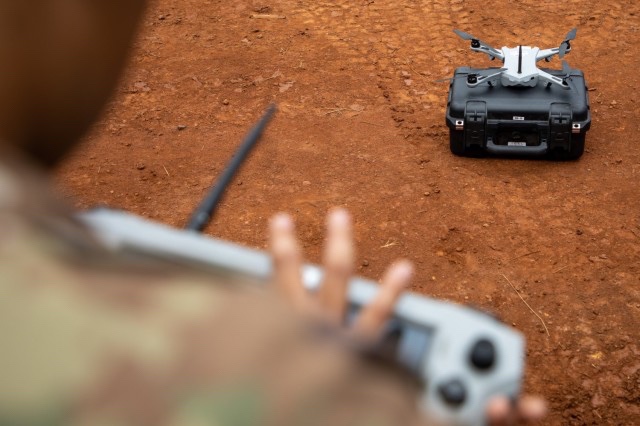
3rd Infantry Division Soldiers use the Blackhornet Soldier Borne Sensor (SBS) during the Bradley Vehicle Excursion 3 test event with the Integrated Visual Augmentation System (IVAS) prototype Capability Set 4 at Camp Roberts, Calif. in September 2021. (Photo Credit: Courtney Bacon)

VIEW ORIGINAL

3 / 3

SHOW CAPTION +

3rd Infantry Division Soldiers participate in Bradley Vehicle Excursion 3 test event with the Integrated Visual Augmentation System (IVAS) prototype Capability Set 4 at Camp Roberts, Calif. in September 2021. (Photo Credit: Courtney Bacon)

VIEW ORIGINAL

The DEVCOM night vision lab was also a critical part of the integrated team’s work. Dr. Navin Mathur, IVAS Platform Integration Lead Engineer, explained how the increase in networked and visual accessibility delivers an enhanced solution to the problem set.

“Having a networked End-User Device (EUD), like IVAS on a Soldier in the back of a platform like a Bradley or Stryker becomes invaluable, but it is only part of the solution,” said Mathur. “Not only does the SEE feature allow entire crews to clear a large area within the safety of the vehicle instead of dismounting and being physically exposed, but the physical limitations of the Soldier and platform are significantly minimized through the additional integration of the Army Black Hornet UAS [unmanned aerial system]. The drone feeds into the IVAS HUD which allows visibility on areas that the platform and the dismount can’t physically cover.”

Another notable aspect is the delivery and integration of Soldier power into the vehicle platforms.

“The UBC [universal battery charger] integrated on the platform will reduce the need for Soldiers to carry extra CWBs [conformal wearable batteries] while dismounted on the objective and allow for easy resupply of fresh batteries while mounted,” Mathur said. “Even if the mission is extended, our Soldiers are still powered to execute.”

IVAS is being developed to efficiently deliver relevant mission information and operationally relevant tools to Soldiers at every stage of mission execution. The integration of the technology with platforms and drones extends the combat advantage of a single dismount beyond physical limitations.

“Together it gives the entire force better situational awareness and allows Soldiers to make more informed decisions before dismounting,” said Mathur. “There are no longer gaps in information between mounting, transit and dismounting, which will increase the survivability and lethality for both the platform and the Soldiers.”

The cross-enterprise Platform Integration team plans to conduct a user study with further IVAS integration to Stryker platforms in August 2022.

“This product has the potential to be a force multiplier,” said Franke. “It’ll help bring more vehicles, crews and dismounts home alive and I hope to be able to use it as it continues to develop in the future.”

By Courtney Bacon