Celebrate 20 years of the TLR-1

Archive for the ‘Army’ Category

Really Right Stuff – Sniper Tripod Advanced Kit Issued NSNs

Tuesday, August 1st, 2023

While this isn’t exactly a new item, it’s going to be new to many readers. Last May, the US Army issued NSNs for a new tripod kit from Really Right Stuff to update the old sniper kits.

The Sniper Tripod Advanced Kit (NSN: 1005-01-702-7501) consists of tripod, high-performance ball head, versatile clamps, and adaptable mounts as well as a carrying bag.

The core of this Made in the USA Kit is the RRS tripod which features carbon fiber legs which are both light and strong. The tripod can instantly transition from ground level to standing using their pull tabs. It features four leg sections meaning it can be made quite compact for travel, and will sustain a load of up to 80 pounds.

The component NSN list is:

SubA-TFCT-34L Tripod Only (No Anvil-30) 1005-01-702-7382

Anvil-30 ARC Ball Head (only): 1005-01-702-7401

STAK Carrying Bag: 1005-01-702-7517

USR 240mm: 1005-01-702-7494

M-LOK Hardware: 1005-01-702-7494

Harris Bipod Adapter (HBA): 1005-01-702-7507

SC-ARC Bipod Clamp: 1005-01-702-7507

VR-76: 1005-01-702-7489

MPR-73: 1005-01-702-7485

QD Leg Collar: 1005-01-702-7510

Apex QD Mount: 1005-01-702-7510

Foot Spikes: 1005-01-702-7415

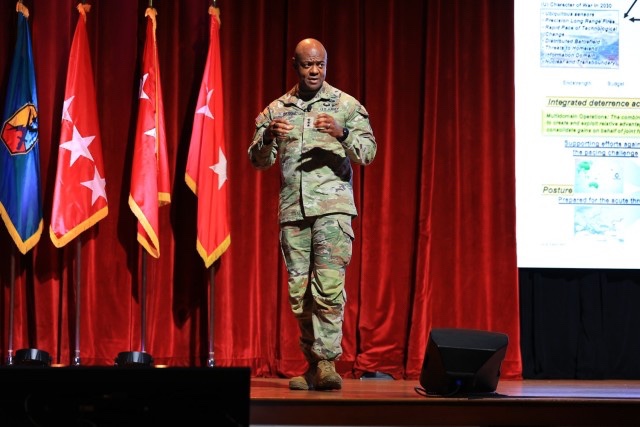
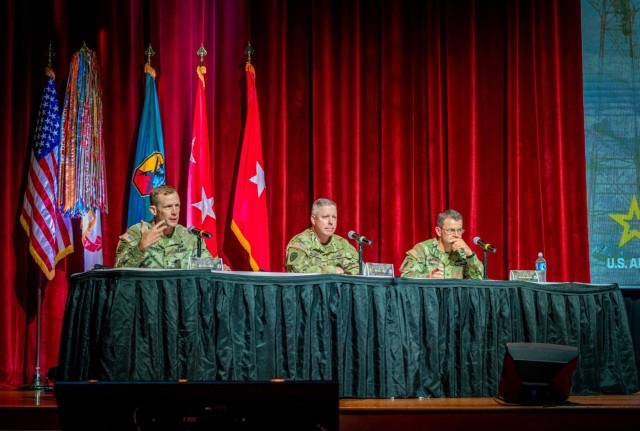
US Army Training and Doctrine Command and US Army Forces Command celebrate 50 years

Monday, July 31st, 2023

WASHINGTON — This year marks 50 years since the founding of U.S. Army Training and Doctrine Command and U.S. Army Forces Command.

“TRADOC today is not exactly like the TRADOC established in 1973, but throughout that time, the command has persevered as an organization and fulfilled its numerous missions — especially training” said Britt McCarley, TRADOC chief historian, who has been with the organization since 1988.

TRADOC and FORSCOM were founded during World War II as one organization known as the Army Ground Forces. When formed in 1942, the Army Ground Forces was the largest training organization ever established in the U.S. with 780,000 troops, which peaked at 12.2 million Soldiers by July 1, 1943.

After several reorganizations, Army Ground Forces finally settled into the two organizations they are today: TRADOC and FORSCOM. TRADOC and FORSCOM’s split 50 years ago came from a need to support two separate missions.

“TRADOC recruits and trains the next generation of Soldiers — develops adaptive leaders, helps modernize the force and shapes the culture of the Army. TRADOC was born out of innovation and that is still our mission today,” said Gen. Gary M. Brito, commanding general, TRADOC. Brito added that TRADOC provides institutional training throughout a Soldier’s career.

“TRADOC is improving our Army’s ability to fight and win large scale combat operations through the conduct of multi-domain operations.”

In addition to recruiting, training and education, TRADOC also establishes standards and drives improvement in the Army wherever it can. Whereas FORSCOM’s mission is to train and prepare the force to be globally responsive to build and sustain readiness for commander requirements.

“For me, the most rewarding part [of working for TRADOC] is the chance to be part of an organization that contributes to the common good of the United States,” McCarley said. “Defense of the nation is fundamental to the life of any country, and the opportunity to contribute to the larger American defense mission is the most rewarding part of my civilian service.”

On average, TRADOC trains more than 750,000 Soldiers and service members every year in its 32 Army training centers.

“I could not be more honored to serve with the dedicated team of civilian and military members, who support our Army mission every day,” Brito said. “But this 50-year anniversary isn’t TRADOC’s alone — it carries added significance to the Army as it is also the anniversary of U.S. Army Forces Command and the all-volunteer force. I look forward to our next 50 years and what the future has in store for our great Army.”

By SFC Michael Reinsch

In Memoriam – MG Anthony Potts

Sunday, July 30th, 2023

We are saddened to report that MG Anthony “Tony” Potts, was the only fatality of a single engine plane crash last week in Havre de Grace, Maryland. Commissioning in the Aviation branch in 1986, general Potts was a Master Army Aviator having flown the AH64 Apache helicopter. During his service in the Acquisition Corps he held several posts including four years as Program Executive Officer Soldier where he oversaw multiple initiatives including the Next Generation Squad Weapons program.

Most recently, MG Potts served as Program Executive Office Command, Control & Communications-Tactical and was planning to retire soon.

General Potts will be greatly missed by his colleagues, friends and family.

May He Rest In Peace.

‘Wearables Pilot Program’ Technology Tested at Exercise Talisman Sabre 2023

Sunday, July 30th, 2023

BRISBANE, Australia — Technology by definition is the application of scientific knowledge for practical purposes, especially in industry.

With a force of more than 1.4 million service members, not including Reserve and National Guard component service members, Dr. Nathan Fisher says the U.S. Department of Defense is always looking years ahead for the advantage in the continually evolving, multi-trillion-dollar industry.

While significant amounts of U.S. military spending is allocated towards weapons platforms, a relatively small portion goes into the wellbeing of its most critical assets — U.S. Soldiers, Airmen, Sailors, Marines, Coast Guardsmen and Guardians, according to Fisher, a senior scientist with the Joint Program Executive Office for Chemical, Biological, Radiological and Nuclear Defense.

Currently, Fisher said that funding is being used to test new technology that could help DoD prevent heat-injuries among its service members, among other things. He said more than 12,000 U.S. service members experience heat injuries annually.


Fisher said various research and development organizations within the DOD are participating in a one year Wearables Pilot Program to gain insight on how to implement wearable bio-physiological monitoring devices into the military from a practical and architectural vantage point.

The wearables come in various forms, which in some cases are familiar as a smartwatch.

One of its latest devices made the thousands of miles journey from the U.S. to Australia to be tested on service members training as a part of Exercise Talisman Sabre 2023.

“What we have here is the Health Readiness and Performance System, which is one of the devices that we’re evaluating as part of the wearables experiment (at) Talisman Sabre,” Fisher said.


The piece of technology connects to a data strip on the skin over the heart, which is nearly the size of a standard bandage you’d have in a medicine cabinet.

Although it takes up a small amount of space on a service member who otherwise carries upwards of 60 pounds of gear, its capacity to save lives is enormous.

“This particular device can do a number of things, but one of many is to identify early signs of heat stress and heat illness,” said Fisher, the native of Arlington, Virginia, who is also the rank of major in the U.S. Army Reserve.

The device connects to a cell phone through a receiver via secure communications technology.

“It measures heart rate, heart rate variation, respiratory rate, pulse oxygen level activity, and a few other physiological metrics that all come together in order to enable a predictive algorithm to analyze the data from that service member and then alarm that individual, or squad leader, or medic to take a look at that person,” Fisher continued.

A squad leader in the immediate area, or a medic receiving the information via a server, can receive the data to make an informed potential life-saving decision.

According to Fisher, the device ideally takes two days to establish a baseline reading of an individual’s data.

He said information derived from a collection of individuals’ data can also lead to preventive medicine measures amongst a formation including the spread of communicable diseases and viruses.

Wearables have commanded the attention of senior leaders supporting Talisman Sabre.

“I don’t get too excited about technology but this device is lifesaving,” said U.S. Army Col. Kevin Bass, the deputy commanding officer of 18th Medical Command, which is part of the Australian Defence Force and U.S. Combined Joint Theater Medical Component in supporting Talisman Sabre.

Dr. Nathan Fisher, a senior scientist, sits with U.S. Army Sgt. 1st Class Timothy Hughes, the public affairs chief for U.S. Army Pacific’s 18th Medical Command, and the Australian Defence Force and U.S. Combined Joint Theater Medical Component to discuss “Wearable Pilot Program” technology being tested in the field during Exercise Talisman Sabre 2023. The Combined Joint Theater Medical Component coordinates and synchronizes health service and support across the Australian continent, which is nearly the size of the mainland of the U.S. Talisman Sabre is the largest bilateral military exercise between Australia and the United States advancing a free and open Indo-Pacific by strengthening relationships and interoperability among key allies and enhancing our collective capabilities to respond to a wide array of potential security concerns. (U.S. Army video by Sgt. 1st Class Timothy Hughes/Released)

While reflecting on his service with the “Screaming Eagles” of the 101st Airborne Division (Air Assault), he noted how a small percentage of paratroopers were expected to receive varying degrees of injuries on a given jump.

“Imagine if the medical guy sitting at the lead edge of the drop zone had an app,” Bass said. “You can sit there and scroll through it, and maybe in a future version of this, you can automatically race to the ones with an alert status.”

Currently, more than 500 service members across the Australian continent are testing the wearable technology.

The Combined Joint Theater Medical Component coordinates and synchronizes health service and support across the Australian continent, which is nearly the size of the mainland of the U.S.

Talisman Sabre is the largest bilateral military exercise between Australia and the United States advancing a free and open Indo-Pacific by strengthening relationships and interoperability among key allies and enhancing our collective capabilities to respond to a wide array of potential security concerns.

By SFC Timothy Hughes

USARCENT Tests Phone App That Detects Unmanned Aerial Systems

Friday, July 28th, 2023

SHAW AIR FORCE BASE, S.C. — U.S. Army Central’s Task Force 39, the team dedicated to developing innovative ideas throughout USARCENT, facilitated a test of CARPE Dronvm at McEntire Joint National Guard Base and Poinsett Range on July 18, 2023.

CARPE Dronvm is a DoD funded application developed by MITRE Corporation that uses crowd-sourced information to detect unmanned aerial systems, or UAS. This test used a version of the application on cell phones to detect a UAS. Maj. Travis Valley, the Task Force 39 operations officer, said the potential for crowd-sourced UAS detection increases force protection capabilities.

“The CARPE Dronvm experiment, or proof of principle, was a huge success for ARCENT.” said Valley. “This was the largest experiment ARCENT has conducted to date. We expanded the experiment footprint, covering 50 kilometers, with multiple individuals in the area using the CARPE Dronvm app. This was all to prove the CARPE Dronvm app works. It did, in fact it exceeded my expectations on the simplicity of use and the program’s drone detection ability. This has the potential as a force protection multiplier, adding another tool to help protect Soldiers in a deployed environment.”

During the test, Soldiers used government provided cellular devices to test the functionality and capability of the application by capturing images of a UAS. The UAS used in the test flew from McEntire JNGB to Poinsett Range to provide the maximum amount of testing space available.

CARPE Dronvm is the result of a U.S. Air Forces Central initiative to develop systems to detect UAS. U.S. Army Central is testing the ability to operate this application at the Soldier level.

“Countering the drone threat in the U.S. Central Command area of responsibility is essential to keeping our personnel, aircraft and equipment safe,” said U.S. Air Force Lt. Col. Steven Norris, AFCENT counter-UAS cell chief. “Our MITRE partners have been helping make CARPE Dronvm a reality since 2019. Every single warfighter can help sense and warn, creating a comprehensive layered defense that will tie into our existing command and control architecture and increase awareness of threats in the region.”

In recent years, the threat posed by UAS increased as malign regional actors continue to use and experiment with this relatively cheap weapons system. Due to its low cost to entry, it is becoming the weapon of choice for potential adversaries resulting in rapid technology proliferation and increased employment. Lt. Gen. Patrick Frank, the USARCENT commanding general said his command is focused on developing technologies to counter this threat.

“The UAS threat is a shared security challenge for the U.S. and our regional partners,” said Frank. “To combat this threat, CENTCOM and USARCENT will test and field counter-UAS systems. The advanced measures we intend to pursue regarding innovation and experimentation will provide critical, real-time data to inform Army and defense decisions on counter-UAS technologies.”

United States Army Central is the U.S. Army service component command for United States Central Command and is responsible to the Secretary of the Army for the support and administration of more than 12,000 Soldiers, including those assigned to joint task forces and embassies, across the 21 countries in the CENTCOM area of responsibility.

Story by CPT Richard Moore

Photos by SFC Michael Behlin, SSG Leo Jenkins, and SGT Amber Cobena

Nijmegen March Offers Challenge, Inspiration to Participants

Friday, July 21st, 2023

BRUNSSUM, Netherlands — Teams across U.S. Army Garrison Benelux and its mission partner organizations have prepared their minds and bodies for the Four Days March July 18 to 21, 2023, in Nijmegen.

Otherwise known as “De Vierdaagse” in Dutch, participants walk between 30 to 50 kilometers — or 18.6 to 31 miles — each day through villages and the countryside while an estimated 2 million spectators cheer them on. The ultimate goal for the marchers is to achieve the Four Days March Cross, an official decoration of the Kingdom of the Netherlands, which can be worn on many nations’ military uniforms.

Lt. Col. Shaun Reynolds, a civil affairs officer with the Allied Joint Force Command Brunssum J9 (Civil-Military Cooperation), is registered to participate with the installation’s Allied International Marching Team. Reynolds finished the march for the first time last year, receiving his cross. This year he is marching for the second award, which adds a crown to the medallion.

“It’s a motivator, getting the cross,” Reynolds said, “but [now] doing it a second year … I’m going for the crown.”

This year celebrates the 105th edition of the Nijmegen Four Days March. As the world’s largest multiple day marching event, it invites up to 47,000 participants from over 70 nationalities. Participants can register as an individual or in a group and choose to compete in either the civilian or the military category. Ages range from as young as 11 years old to over 90 years old.

“There’s people that travel from all over the world [to participate in the march],” said Staff Sgt. Alexander Bertsch, a 424th Air Base Squadron air traffic controller at Chièvres Air Base, Belgium, and team captain of the installation’s marching team. This is his second time participating.

The team, made up of service members from the U.S. Air Force and Army, started training for the march a few months ago.

“It’s not just a show-up-and-do-it kind of thing,” said Bertsch.

Master Sgt. Stephen Spaeder, 424 ABS emergency operations superintendent, agreed.

“I went in thinking it was just a walk. It was a lot more challenging than I expected [and] definitely a humbling experience,” he said. “I had just run a marathon the month beforehand, so I thought I was ready.”

Spaeder sustained a serious knee injury from the lengthy marching last year, landing him in physical therapy for three months after the event was over.

He learned valuable lessons from the previous year and began training earlier for the 2023 event. Additionally, this year Spaeder knows exactly what he will carry in his rucksack. While all military participants must carry 10 kilograms — 22 lbs. — of weight on their backs, it takes experience to know what items are best to bring along.

Spaeder also determined that taking more breaks throughout each marching day to take off his boots and socks in order to cool his feet and ward off blisters is an essential ingredient to success.

“You learn a lot about yourself and your feet,” Reynolds said. From his practice marches and experience last year at the Nijmegen event, he discovered that he needed to purchase boots a whole size larger than usual for a march this length.

He also emphasized how important it is to wear broken-in boots and learn how to properly care for your feet before even attempting the march.

While blisters top the list for injuries during the march, Bertsch struggled with different issues starting on the third day. The excessive marching caused his calves and ankles to tighten up, and he had to push hard through the final day to the finish line.

“I struggled to take each step,” he said. “You have to rely on the people around you. Without my team, I don’t think I would have made it.”

Even so, Bertsch will never forget the atmosphere of all four days of the march.

“It’s really inspiring to see all these people going through a rough time and being happy about it,” he said. “You can do a lot more walking than you think you can do, and keep good spirits despite the challenge.”

Members of both teams recounted how special it was to see the community and spectator involvement at the event. They explained that throughout the four days children were passing out snacks and candy, giving high-fives and asking for military patches off their uniforms. Crowds were clapping at 4 a.m. as the marchers began their day’s journey. Spectators cheered them on nearly the entire course as they marched up to 12 hours each day. DJs and bands played live music at many locations. One of the rest stops even offered drinks and bratwursts.

Maj. Juan Fuentes, future operations officer at USAG Benelux-Brunssum, will be participating in the march for the first time this year as part of the Chièvres Air Base team.

“I just really want to experience being … part of something,” he said. “There’s always a little bit of nerves and excitement. It’s an event I need to be part of.”

The Allied International March Team and Chièvres Air Base team join nearly 5,000 other military participants in the march. Their course will begin and end each day at the military camp Heumensoord, just south of Nijmegen. This camp is built every year for the Four Days March and supplies a dining facility, showers and sleeping accommodations for registered military detachments.

Nearly 90% of those who start the march cross the finish line four days later. Typically, around 70% of those people have participated in the march on more than one occasion.

“The atmosphere is what brings people back,” said German Armed Forces Maj. Heiko Lingelbach, a member of the German Communications Directorate at JFC Brunssum.

Lingelbach, who is also the chairperson of the Allied International March Team and leads a multi-national group of 41 participants this year, has seen people sign up for the march again and again.

“It grows on you, and you say ‘ok, I can do this again,’” said Lingelbach.

Reynolds emphasized the tremendous crowd support towards the end of the march.

“The last day you’re really on air even if you’re hurting,” he said.

During the last 5 kilometers (3.1 miles), all marchers are given gladiola flowers as they join a procession down the Nijmegen city center called Via Gladiola.

More than 250,000 spectators gather for this finale and offer high-fives, hugs, and cheers. Senior officials and dignitaries salute the military as they finish their last steps.

“I recommend that anyone who has the chance to do it, should do it,” said Spaeder, “I had a blast!”

By Sandra Wilson, USAG Benelux Public Affairs

Editor’s Note: The following story is the thirteenth in the series Bits of the Benelux. This series takes a deep dive into the stories, cultures and traditions found throughout Belgium, the Netherlands and Germany.

National Guard’s State Partnership Program Marks 30 Years

Thursday, July 20th, 2023

WASHINGTON — This weekend, the National Guard’s State Partnership Program marks 30 years of contacts, exercises and aid to nations around the world.

The SPP is a unique program that began in 1993. It paired state National Guard units with the newly independent nations of the former Soviet Union and nations emerging from the Warsaw Pact.

“The program that began in 1993 with just 13 countries and has now grown to 100 countries,” said Army Maj. Gen. William L. Zana, the Guard’s director of strategy, plans and international affairs. The general spoke about the program at the Pentagon today.

The importance of allies and partners is a cornerstone of U.S. strategy. “It is a theme that runs deeply through our national security strategy, national defense strategy, and national military strategy,” Zana said. “And I’d argue [it] is deeply encultured within what we do as the U.S. military, how we operate and our values.”

The SPP is based on working side-by-side with willing partners around the world. The National Guard Bureau administers the program in close consultation with Defense Department officials and the State Department. The aim is to build trust, confidence and capabilities with partner nations.

In the program’s early days, the emphasis was on helping nations throw off 47 years of Soviet domination. Many nations in that first class of partners are now proud members of the North Atlantic Treaty Organization.

The program soon punched above its weight and spread to U.S. Southern Command, U.S. Central Command, U.S. Africa Command, and U.S. Indo-Pacific Command. “The Guard is currently partnered with more than half of the world’s nations, and we expect to see continued growth in the coming years,” Zana said.

Combatant commanders universally praise the program. “[The SPP] is 1 percent of the nation’s security cooperation budget and results in 20 to 30 percent of the touch points or engagements that combatant commands have,” the general said. “So, they inherently see that value and the multipliers that go with that.”

These contacts are not limited to senior military and civilian officials, rather they stretch from privates and airmen up to generals. Guardsmen — unlike active-duty personnel – tend to stay in place, and many of the Guard’s noncommissioned officers and officers have “grown up” with their partners.

Zana, who has worked two of the last four years in Africa, said exercises are good training but often of short duration. “It’s not the same as having a relationship that has endured over many, many years where … families know one another, you’ve broken bread on both sides of an ocean,” he said. “You can’t build that trust overnight. I think it’s something that we, as the United States military, are particularly good — and our partners are really good — at.”

The partners have done more than simply exercise together. When U.S. National Guard units began deploying in harm’s way, the partners came with them. “The richness of those connections it can’t be… be overstated,” the general said. “It’s one of those things that made the program popular and built the enduring enthusiasm for it.”

National Guardsmen are Citizen-Soldiers who bring experiences and education from their civilian occupations to the process. “Often, some of the most creative activities and the things that happened with the program are an expansion beyond mil-to-mil or the creativity that goes with our Soldiers, Airmen and their counterparts from other countries,” he said. “That said, there are limitations with the funding of the program.”

The program calls for around $50 million, with additions coming from Congress. Zana would like to see all the money “on budget” to create a better planning horizon. “This year, we’ve got hundreds of events that we’ve either had to cancel or postpone,” he said. “And these are all events that are very much aligned with our national defense strategy and very much aligned with our partners and our combatant commands’ theater strategies.”

Ukraine was an early member of the program, partnering with the California National Guard in 1993. California Guardsmen helped train Ukrainian service members in NATO standards. They also trained them in using weapons like the Javelin and Stingers, which were so crucial in the early days of the Russian invasion of the country.

The California connection thrust the SPP into the news, and Americans got an idea of the depth and breadth of the military-to-military relationship. “In advance of Russia’s invasion of Ukraine, we were doing close partnerships, not just with the, with California and Ukraine,” Zana said. “One of the things we often refer to is ‘You marry one state, but you get the whole family with the Guard.’ So, when there’s a capability that doesn’t exist within the Army Guard or Air Guard within a state, we reach across the 54 states, territories and the District of Columbia to be able to get additional resources or capability.”

One aspect that hasn’t gotten the attention it deserves is the way Ukraine has adopted the U.S. emphasis on unit and tactical-level leadership, driven by noncommissioned officers. “If you look at the small unit, tactics and success within Ukraine, I think part of that is attributed back to much of the work that was done between Ukraine, California and other partners in the region,” he said.

The 30th anniversary will be marked at National Harbor in Maryland on July 17-18. Partner officials will join National Guardsmen, DOD officials, State Department officials and ambassadors to mark the event. Army Gen. Mark A. Milley, the chairman of the Joint Chiefs of Staff, will be the keynote speaker on July 17.

By Jim Garamone, DOD News

Additional Info:

State Partnership Program Celebrates 30 Years

State Partnership Program 30th Anniversary media roundtable 

Major General William Zana Briefing on 30th SPP Anniversary

30th Anniversary of the State Partnership Program

State Partnership Program turns 30

A Five-Part Series By Master Sgt. Jim Greenhill and Sgt. 1st Class Zach Sheely, National Guard Bureau

‘Why Don’t we do a Little Partnership Thing?’ The Department of Defense National Guard State Partnership Program is Born

‘Our Real Superpower as a Nation is our Allies and Partners’ The Department of Defense National Guard State Partnership Program Today

‘A Mosaic of Opportunities’ The Department of Defense National Guard State Partnership Program Looks to the Future

‘It truly is a Team Sport’ How the Department of Defense National Guard State Partnership Program Works

‘The Most Important People in the Army are the Sergeants’ The Department of Defense National Guard State Partnership Program: A Crucial Arrow in Ukraine’s Quiver

ASIs for Arctic Soldiers

Tuesday, July 18th, 2023

Calling all Arctic Angels and Soldiers who have had the opportunity to serve in Alaska.

The Arctic can be a harsh, ever-changing environment.

The skills to live, work and thrive there are invaluable, and now there’s an identifier to prove it.

Actually, there are four to distinguish those who have completed cold weather training.

Arctic Skills Specialist – J1

Arctic Soldier – J6

Arctic Leader – E9

Arctic Aviator/Operator – E2

For details, contact Division G1 Readiness or visit:

11thairbornedivision.army.mil/Portals/108/Arctic%20Additional%20Skill%20Identifier