SIG SAUER - Never Settle

Archive for the ‘Army’ Category

US Army Selects Blue Force Gear Sling as Authorized M4A1 Component

Monday, May 22nd, 2023

Pooler, GA – Blue Force Gear, the industry leader in modern combat slings, is pleased to announce that the US Army has chosen the patented Blue Force Gear Push Button Sling in both Black and Tan as an authorized attachment to the M4A1.

This modification can be done at the soldier level and both slings can be ordered through the Army’s Global Combat Support System (GCSS-A) using the following information: Vickers Push Button quick-adjustable sling from Blue Force Gear (Tan: NSN 1005-01-707-1744, Black: NSN 1005-01-625-4470).

After years of supporting the United States Marine Corps with their standard issue rifle sling, Blue Force Gear stands ready to fully support the US Army with the Push Button Sling and New Equipment Training and Education.

“The modern combat sling is probably the most overlooked and underutilized tool that—when properly sized, mounted, and employed—is the cheapest and most effective component for immediately enhancing a soldier’s lethality and safety,” said Chris Sizelove, Blue Force Gear Director of Education and Training. “I am proud of the Army for providing authorized options for the M4 besides the issued parade sling.”

Along with the sling options, the Army has also authorized additional modern buttstock options, most notably the B5 Systems Bravo (Black: NSN 1005-01-706-2373, Tan: NSN 1005-01-706-2510), which, when used in conjunction with the modern combat sling adds many additional capabilities to the combat rifle system.

“By authorizing our proven sling, the Army has made it easier than ever for Soldiers to improve marksmanship and weapon handling,” said Ashley Burnsed, CEO at Blue Force Gear. “This is a huge win for the US Army.”

Arctic Angels Put Freeze-Dried Plasma to the Test

Friday, May 19th, 2023

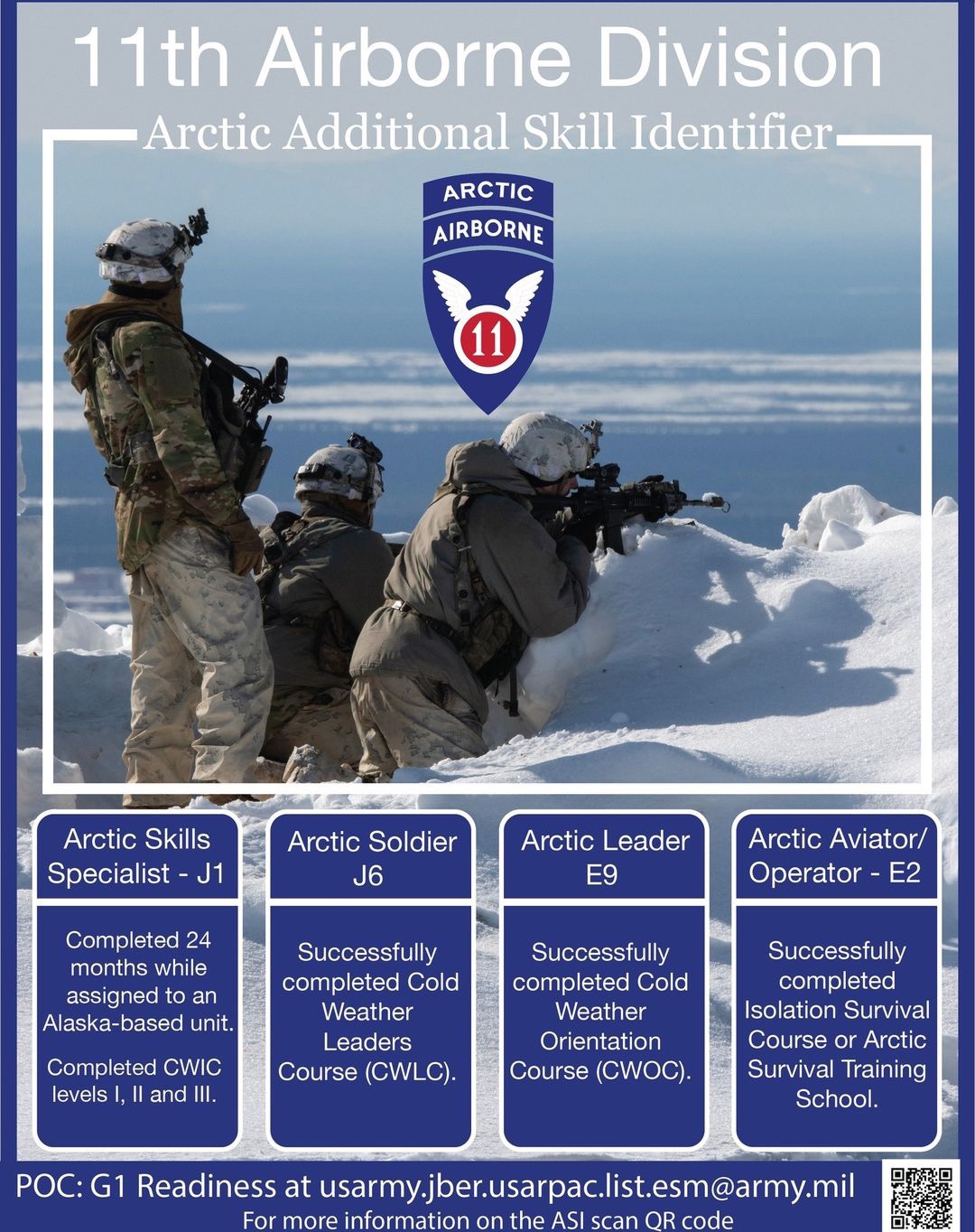
FORT WAINWRIGHT, Alaska — Team members with U.S. Army Medical Materiel Development Activity participated in an arctic conditions assessment of its freeze-dried plasma, or FDP, program recently, partnering with the 11th Airborne Division at Fort Wainwright, Alaska to assess performance of its plasma kits as part of the Joint Pacific Multinational Readiness Center exercise last month.

During the assessment in Alaska, 11th Airborne Division medical providers, conducted scenario-based training for casualty treatment in real-world conditions. These scenarios included mass-casualty training, frontline field treatments and airborne operations to test the FDP kits in conditions paratroopers may face during combat operations.

Assessments of treatments, products and devices, including FDP, are critical to the development process of the lifesaving technologies designed for the rigors of U.S. combat operations. Exposure to extreme elements, like the blistering cold found at Fort Wainwright, help serve as proof-of-concept for products like FDP, according to Andy Atkinson, FDP product manager with USAMMDA’s Warfighter Protection and Acute Care Project Management Office, known as WPAC PMO.

“We really value the input from individual Soldiers on FDP’s performance during an airborne operation in the Arctic,” said Atkinson. “Freezing temperatures create unique challenges for medical products which can degrade with repeated freeze-thaw cycles. The Soldiers didn’t see that with FDP and the overall resounding feedback from the field was positive, with Soldiers eager to get their hands on this product. That’s really valuable feedback for the program office.”

USAMMDA’s WPAC PMO has been developing both human and canine FDP since 2010 as part of its modernization efforts in support of medical providers in the U.S. military joint forces — plasma and other blood products are a key focus of the U.S. Army and the Department of Defense’s medical development efforts to help prepare warfighters for tomorrow’s wars.

A distinct advantage of FDP over similar blood products designed in previous years is its durability and suitability for use as close to the point-of-injury as possible — placing expeditionary FDP in the hands of medics, corpsmen and medical officers to begin blood replacement in the critical minutes and hours after injury, according to Lindsey Garver, Ph.D., deputy project manager with WPAC.

“FDP provides a shelf-life and storage conditions that allow it to be used as far forward as Role 1,” said Garver, referring to medical care provided by first responders at the unit level. “It could be stockpiled offering a significant logistical advantage over whole blood for hemorrhage control. It is one of several blood components USAMMDA has in development to supplement the blood supply on the battlefield.”

The WPAC team is leading the development efforts for both human and canine FDP, partnering with stakeholders across the Department of Defense and non-DOD medical development partners. A critical component of the FDP development process is the feedback gained through touchpoints to assess both the current needs of the frontline medical providers and the utility of FDP in its current state of development. Responses from potential end-users like the medical providers with 11th Airborne Division help the WPAC team refine their approach during all phases of development, according to Garver.

“FDP is one component of blood that can be used for transfusion; it can also be used to maintain a service member at or near the point-of-injury as a bridge to transfusion,” said Garver. “In the case of the 11th Airborne Division partnership, it allowed us to understand how FDP would be used in an Arctic environment, how the product and packaging held up during airborne operations with combat medics, ease of use and if it performed to standard at both the point-of-injury and battalion aid station level of care. There is significant interest in ensuring a safe and substantial blood supply is available to our warfighters in environments with contested logistics and evolving battlefield scenarios. FDP is a critical part of that.”

Blood plasma, the liquid part of blood, “contains important proteins and other substances crucial to one’s overall health,” according to the American Red Cross. U.S. military medical providers have used plasma since at least WWII due to its lifesaving properties when no or limited supply of whole transfusable blood is available.

Given the wide range of possible future battlefields, it is important to develop, test and field blood products, including FDP, that are approved by the Food and Drug Administration; user-friendly; and expeditionary, according to Kendra Lawrence, Ph.D., the WPAC program manager with USAMMDA. Near real-time feedback from intended end users, including the evaluation of FDP in partnership with 11th Airborne Division during JPMRC, gives the WPAC development team insight into current progress of FDP and to cater the product with the end-user in mind.

“The JPMRC exercise and collaboration with 11th Airborne Division was a unique opportunity for the program office to gain real-world user feedback on the performance of a life-saving blood product in an artic environment,” said Lawrence, herself an Army and Iraq War Veteran. “Importantly, they showed that freeze-dried plasma is resilient, transportable, and easy to use under austere freezing conditions.”

By T. T. Parish

Exercise in Philippines Assesses Progress of 1st Multi-Domain Task Force

Thursday, May 18th, 2023

CAMP MAGSAYSAY, Philippines — As one of Army Futures Command’s first forays into in-theater persistent experimentation, a team of observers/assessors were in the Philippines looking at the 1st Multi-Domain Task Force’s capabilities in the Pacific.

This Joint Warfighting Assessment, or JWA, team observed the 1st MDTF’s concepts and capabilities during Balikatan 23, a Marine-led exercise. The JWA23 team is led by the U.S. Army Joint Modernization Command and includes experts from various capability development integration divisions. The assessment is meant to build on the lessons learned during past Joint Warfighting Assessments and Project Convergence capstone events. With persistent experimentation, regular assessments like this throughout each year will allow Army modernization and transformation efforts to maintain momentum and speed.

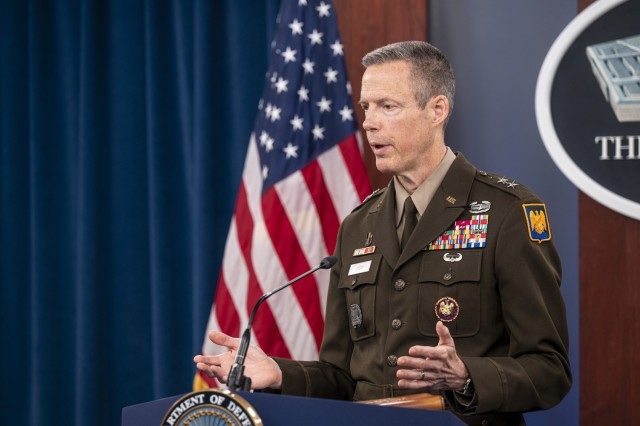
Brig. Gen. Bernard Harrington, commander of the 1st MDTF, underscored the significance of initiatives like JWA23 in shaping the future of the Army in the Indo-Pacific.

“JWA23 is an opportunity to get multiple teams together to figure out how we get the Joint force into position in the Indo-Pacific” Harrington said. “Over the last two years, [U.S. Army Pacific] has steadily increased investments in the first island chain, placing combat-credible forces on key terrain to build interoperability with key partners. JWA23 is one feedback mechanism to evaluate how we prevent conflict and prevail in competition.”

The MDTF is the newest formation in the Army and is at the forefront of Army experimentation. Many of the new capabilities the Army is looking to in the future would come from the MDTF. During JWA 23, the JMC-led team assessed the 1st MDTF’s ability to integrate with joint partners and allies, joint sensor-to-shooter efforts, joint networking and joint force protection. As part of preparing for future conflict, the MDTF is being asked to do things the Army has never done before.

Balikatan is the largest annual bilateral exercise conducted between the Philippines and the United States. This year’s exercise, which took place in late April, was the largest to date, with more than 17,600 participants. Balikatan advances combined military modernization and capability development efforts by providing realistic rehearsals of concept, as well as numerous subject matter expertise exchanges.

From the beginning, the build of the MDTF was designed to be a joint force enabler. Looking specifically at the Pacific, adversaries have spent the past 20 years designing a network to keep out the Army’s joint force partners, focusing on high-flying aircraft and large maritime vessels, said Lt. Col. Ben Blane of the 1st MDTF.

“When we talk about the Balikatan exercise, we do have this relationship with the partners here in the Philippines,” Blane said. “But we’re also bringing in our partners from the U.S. Air Force and the U.S. Marines. We’re connected with our partners afloat in the Pacific and also in our main operations center at Joint Base Lewis-McChord who are helping us with some of these concepts. It’s that partnership, and then together, really building those capabilities forward in the Pacific. So, if we do rise to the point of conflict, we have some survivable positions here that can support the joint force.”

The Joint Modernization Command and its Joint Warfighting Assessments have been important to the MDTF’s experimentation and development from the start, Blane said. And as part of AFC’s persistent experimentation efforts, JWAs continue to be an integral part of developing the right capabilities with the right people for the future of competition and warfare.

“To take you all the way back to JWA19, the assessors saw the value in filling some of these gaps that we were talking about,” he said. “There was a quote in the final document that said the Army needs to immediately prioritize this formation and get into both PACOM and EUCOM as fast as possible. You saw the activation of the MDTF soon after.

“Bringing in this team here during JWA23, we refine these ideas, talk about these concepts, talk about the things we’re learning, and then get it through that other lens where we’re bringing in experts with the JMC team and all of the Army Modernization Enterprise,” Blane said. “We’re really honing in on what we’re doing here, why it’s important and then taking that refined message and then being able to push that back out to the rest of the force. That’s huge. And I’ll tell you what, the Soldiers are super excited about what they’re doing.”

MDTF experimentation is critical to getting the formations and capabilities of future warfare correct. Joint and Combined multidomain operations are key to the future, and the MDTF is at the cutting edge of that concept.

By Jonathan Koester

French-led NATO Exercise ORION is First of its Kind in Over 30 Years

Saturday, May 13th, 2023

CAMP DE MAILLY, France — U.S. Army and NATO allies work side by side in a French-led interoperability coalition training for the first time in over thirty years.

The French 3rd Division’s exercise, Large-scale Operations for a Resilient, Integrating, high-intensity Oriented and New Army, nicknamed ORION, was a culminating national exercise that took place across several French regions, from April 17-May 4, 2023.

“It’s their national exercise, so it’s their ability to show that they can lead this force in a large-scale combat operation,” said Maj. Robert Moore, an operations officer assigned to 1st Battalion, 77th Field Artillery Regiment. “It’s also an opportunity to show that we can have seamless unity and be able to provide large-scale combat operations against any foe that we may encounter.”

The exercise combines field tactic maneuvers, artillery maneuvers as well as air-space surveillance technology with joint air-ground integration centers composed of command teams from multiple nations.

“ORION encompasses a command post exercise,” said Capt. Shawn Botin, a brigade planner assigned to the 1st Armored Brigade, 34th Infantry Division. “It builds multinational interoperability and allows us to train with our partner nations in NATO.”

The exercise jointly trained over thirteen countries and foreign military forces in multiple facets.

“Our main interoperability goal is to learn the similarities between our nation and the other nations,” said Botin. “This refines our processes because if the United States were to be called upon to serve with a partnering nation, we can assist with providing a seamless transition into their work processes.”

ORION focused on large-scale combat operations; foreign forces have rallied together under French 3rd Division command to exhibit multinational interoperability.

“We are not just here to train our Soldiers but also to assist with the training of the French 3rd Division as they are conducting the live portion of this exercise,” said Botin. “This exercise fortifies the relationships the U.S. Army has with its partners and lays the foundation to build new ones.”

During the exercise, U.S. Army troops with different specializations had the opportunity to work with their immediate counterparts from countries like Belgium, United Kingdom, Germany, Spain and more.

“I think the biggest take-away for the Soldiers is understanding that there are military members outside of the United States military,” said Botin. “Learning how to operate with them and seeing a specialist in the U.S. Army isn’t that much different from a specialist in the French or British forces.”

Moore went on to express that more than just on a tactical level, this campaign has benefited Soldiers on a personal level as well.

“The Soldiers love to work with other countries and to build camaraderie, not just within their own unit but also our partners’,” said Moore. “You realize that we have a lot more in common than we have different.”

By PFC Alejandro Carrasquel

M4 Weapon Accessories Added to Additional Authorized List

Thursday, May 11th, 2023

We’ve got some great news thanks to the CA Military Department Combat Shooting Team:

NEW service rifle quick-adjust slings, butt stocks and QD mounts have NSNs and are added to the Additional Authorized List, per TACOM. ALL of the following are -10 (End User!) level accessories:

Slings:

> Vickers Push Button quick-adjustable sling from Blue Force Gear (NSNs: Tan, NSN 1005-01-707-1744; Black, 1005-01-625-4470)

> Magpul MS4 Dual QD quick-adjustable sling (NSN: Black, 1005-01-693-8723; Tan, 1005-01-692-2559)

Butt Stocks:

> Magpul CTR (NSNs: Black, 1005-01-614-7778; Tan, 1005-01-616-4923)

> B5 Systems Bravo (NSNs: Black, NSN 1005-01-706-2373; Tan, 1005-01-706-2510)

> Hogue (NSN: Black, 1005-01-706-2547)

QD Rail Hardware:

> Side mount: NSN 1005-01-706-2552

> Top mount: NSN 1005-01-706-2366

Additional NSNs from PS Magazine.

DEVCOM Soldier Center’s Tube Foods Fuel High-Altitude Pilots

Thursday, May 11th, 2023

NATICK, Mass. — Proper nourishment is key to achieving great heights. This is especially true for the elite group of pilots who rely on the expertise of the Combat Feeding Division, part of the Soldier Sustainment Directorate, at the U.S. Army Combat Capabilities Development Command Soldier Center, or DEVCOM SC.

The Combat Feeding Division’s food technologists, equipment specialists, engineers, microbiologists and packaging specialists have been perfecting tube foods for almost 60 years. DEVCOM SC is the only place that designs and produces the foods that meet the specific needs of the Air Force’s U-2 reconnaissance aircraft pilots and the National Aeronautics and Space Administration’s, or NASA’s, ER-2 research aircraft pilots.

Elite pilots wear pressurized suits and helmets to perform their missions. The foods, which have a pudding-like consistency, come out of a container about the size of a large tube of toothpaste.

The tube foods are attached to feeding probes that are inserted into an opening in the helmets.

The tube foods help pilots power through missions that can last up to 12 hours. The foods come in 19 different offerings, including entrees, fruits and desserts. Choices range from chicken with tortilla soup, to hash browns with bacon, to key lime pie, to chocolate pudding with caffeine — to name just a few. Given the difficulty and length of pilot missions, caffeine is included in some of the selections. The offerings keep evolving. CFD plans to add pasta with marinara sauce next year as well as a new vegan option.

DEVCOM SC’s longtime and unique innovation and expertise in food science and technology and food packaging play a substantial role in tube food development.

“The Combat Feeding Division has a long history of developing nutritionally optimized, good-tasting ration products to meet warfighters’ unique needs and preferences,” said Erin Stomberg, PhD, RD, division chief of Combat Feeding. “The tube foods produced by the division food technologists are one important example of this. Air Force pilots on long flight missions need nutrition for sustainment and performance of their mission, and we are honored to provide this service to them. We accomplish this by using our knowledge of food product development and food processing technologies available in our pilot plant and listening to customer feedback in order to formulate custom varieties based on pilot preferences.”

Daniel Nattress, a food technologist who has served as the project officer for the Tube Food Program for 24 years, pointed out that “decades of knowledge and expertise go into every tube.”

“We have the expertise to make healthy, wholesome foods that taste good, meet nutritional requirements and meet required shelf-life requirements (three years at 80 degress Fahrenheit and six months at 100 degrees Fahrenheit),” said Nattress. “We also need to know how to manufacture foods which meet the nutritional requirements and still fit through the narrow straw-like probe.”

Nattress explained that colleagues in the Tube Food Program also have the “knowledge and expertise to operate the specialized equipment, as well as pack the tube food for safe storage and transportation.”

Equipment upgrades have improved the process. A new state-of-the art tube filler and sealer is easier to clean and maintain than the previous version and a new steam retort, which preserves the tube foods, is more efficient and extremely reliable.

Direct interaction with pilots is key to making the best product. Nattress and his colleagues have visited the home base of the U-2 pilots several times, and the pilots have visited Combat Feeding as well.

“Face-to-face contact is essential to understand what products the pilots want and for them to understand our capabilities,” said Nattress. “We conduct surveys with the pilots every three or four years to verify what they currently like, what they’d like to have and any changes they’d like to have. When we were at Beale Air Force Base, the training base, we got to try on the U-2 suits. This gave us an understanding of what they go through on their missions.”

DEVCOM SC’s efforts to understand pilot needs and to provide them with a quality product are reflected in comments from the U-2 pilots themselves:

“Caff apple pie (Caffeinated Apple Pie) is a must after 8 to 10 hours and preparing to recover the hardest jet in the world to land!”

“Nothing better than hash browns and bacon (Hash Browns with Bacon) after you kick on the autopilot during climbout to an early morning sortie.”

“Not only does it give us some energy, but it’s something we look forward to — especially truffle mac (Truffle Macaroni and Cheese). Delish.”

Comprehensive review sessions also provide Combat Feeding with additional insights.

“We also participate in the twice-yearly U-2 Program Management Reviews, a meeting of all government agencies and contractors,” said Nattress. “These meetings give us an overview of the entire U-2 program from Tube Foods to U-2 suits to the airframe. This gives us the overall picture and shows us where we fit in.”

Robert Bernazzani, team leader of the Joint Foodservice and Engineering Team, praised the comradery of the experts who produce the food tubes, their eclectic set of skills, and their creation of a quality finished product.

“It is very gratifying to be part of such an important and vital program for the military,” said Bernazzani. “Most of the work that is done in Combat Feeding is research and development. This program is unique because we actually not only do the R&D but produce the tubes that are consumed by the warfighter.”

“Everyone who works on the Tube Food Program, that includes several others from packaging specialists to microbiologists, are very proud to provide U-2 pilots the sustenance they need to perform these vital reconnaissance missions,” said Nattress. “When we have had the opportunity to visit Beale, or to host pilots, they are very appreciative of the products we are able to manufacture.”

By Jane Benson, DEVCOM Soldier Center Public Affairs

Stepping Back in Time, U.S. Soldiers Invited to WWII Reenactment in Bulgaria

Sunday, May 7th, 2023

NOVO SELO TRAINING AREA, BULGARIA (April 23, 2023) – On 23 April, U.S. Army Soldiers from the Army Support Activity-Black Sea (ASA-Black Sea) stationed at Novo Selo Training Area (NSTA), along with the 1st Battalion 18th Infantry Regiment, and the 418th Civil Affairs Battalion attended a World War II reenactment in Yambol, Bulgaria.

The Military Historical Reenactment of “Hungarian Spring 1945” depicted the battle between the Bulgarians and Germans near Lake Balaton in Hungary at the end of World War II.

The event featured weapons, explosives, howitzers, military trucks, several motorbikes, and a stationary tank.

Twenty students from the National Military University “Vasil Levski” in Veliko Tarnovo and 45 volunteers from the Reenactment Club participated in the reenactment.

“U.S. Army soldiers were in the audience and watched the historical reenactment,” said Georgi Vardarov, Director of the Museum of Battle Glory. “By the time the Bulgarians were fighting the German-Nazi soldiers, the American Army was also fighting the German Army, but on the Western front,” said Vardarov as he emphasized the significance of bringing together Bulgarian and American military personnel during the reenactment.

The reenactment lasted an entire 20 minutes, and spectators had the opportunity to relive the historic battle through their own eyes.

“It is an honor to be here and learn so much about Bulgarian history and its role in World War II. I got the chance to see many historical vehicles and weapons that were key to the Bulgarians’ success in the battles they fought,” said Cpt. Avery Smith, a team leader assigned to the 7th Mobile Public Affairs Detachment. “The re-enactment was phenomenal, and I could tell that a lot of details and training went into perfecting this performance for the guests. Their ability to preserve their history so well makes me proud to say we are military partners. Bulgaria is a beautiful country, and the community here in Yambol felt friendly and welcoming.”

Besides the reenactment, the museum also set up static displays of tanks and other military equipment from WWII for visitors to see up close.

“This event with the Yambol Military Museum was a wonderful way to educate not only myself but the rest of the U.S. Personnel who were present,” said James Adamski, deputy garrison Manager at NSTA, as he shared his appreciation for the opportunity to learn about Bulgarian history. “Very few people know of the Bulgarian History that was so very critical at the end of WWII.”

ASA-Black Sea continues to build strong relationships with the local communities as it emphasizes the importance of strengthening its ties with the people of Bulgaria.

By Joshua Rojas

Army’s Air Assault Division Ushers in Network Paradigm for Tomorrow’s Battlefield

Saturday, May 6th, 2023

FORT CAMPBELL, Ky. — The Screaming Eagles are experimenting with the latest iteration of modernized Army communications capabilities, both at home and abroad, to help guide development of technologies, doctrine, and policy.

Supporting the Army’s process of using Soldier feedback and lessons-learned to enhance the network, the 3rd Brigade Combat Team, 101st Airborne Division (Air Assault), or 3-101, recently completed an Integrated Tactical Network validation exercise at their home station, while elements of the Division are using additional capabilities while deployed to Romania.

Since its introduction to Soldiers in 2019, the Integrated Tactical Network, or ITN, has been providing secure but unclassified and encrypted mobile network communications that increase communications mobility, flexibility and resiliency. As part of division-centric network design efforts, the Army will simplify the network at brigade and below levels to support the Army’s Division as Unit of Action plan, which will elevate network-related complexity to the division echelon, freeing up maneuver units to focus on the fight.

“We are asking ourselves, what does that division commander need in order to command his division and all his forces, so we are designing the next capabilities to be centered around the division as unit of action,” said Col. Shermoan Daiyaan, Project Manager for Tactical Radios, under Program Executive Office for Command, Control, Communications-Tactical.

The key to refining ITN capabilities at all echelons is through continued fielding, Soldier feedback and iterative improvements, providing more units across the globe with hands-on, real-world experiences using the capability. The Army will use this feedback to inform Army of 2030 network designs, centered on large-scale combat operations.

So far, the ITN has been fielded to multiple infantry brigade combat teams across the 82nd Airborne Division, 25th Infantry Division, 11th Airborne Division and one Stryker unit, the 2nd Cavalry Regiment, with additional BCT and division enabler fieldings underway or planned for the remainder of FY23 and FY24.

The 82nd Airborne Division, as an early ITN adopter, will be the first full division equipped with ITN, followed by the 101st and 1st Cavalry Division.

“The ITN is going to give our commander better situational awareness of what’s going on across the battlefield,” said Chief Warrant Officer 2 Craig Alhouse, brigade network operations officer with the 3-101. “Whether we’re doing a forcible entry or an airfield seizure, what’s different is what’s displayed and how the commander reaches out to the subordinate and tells them what he needs them to accomplish.”

That also would give the commander more informed decision abilities in the long run, he said.

The thrust of the validation exercise featured individual Soldiers using the full ITN suite, including leader radios connected to their end-user devices to send text messages up to the brigade level, which then compiled operational graphics to send up to the nationalized higher headquarters over the Secret network.



With options for assured voice, text and graphics communications over several channels, the ITN provides multiple paths for communications, even in network-degraded environments.

“I think one of the things we noticed with ITN is that it removes the ability to say you didn’t get that message,” said Capt. John Dacier, 3-101 Brigade Assistant S3. “You have a plethora of ways to communicate all the way down to the granular level.”

The pathway providing seamless two-way communications is the Secure But Unclassified-Encrypted, or SBU-E, enclave. Since the ITN’s initial fielding, SBU-E has been used at the battalion and below level, with division headquarters and enablers communication at the mostly Secret level. Because communications are encrypted, SBU-E provides appropriate levels of security for safe mission partner collaboration without the complexity of setting up a secret environment.

As part of assessments that will inform division-centric design, the 82nd Airborne Division is nearly exclusively employing SBU-E at its Joint Readiness Training Command rotation this spring. The 25th Infantry Division is also incorporating SBU-E during this spring and summer’s multi-national Pacific Pathways exercises across Hawaii, the Philippines, Indonesia and Australia, providing the Army with even more critical feedback.

“Island hopping experimentation using SBU-E in the Pacific, and in the European theater, is critical for the Army to prepare for future conflicts because we will never fight alone,” said Daiyaan. “That’s real combat power at the tactical edge.”

Technology enhancements aside, Army leaders may consider policy changes to implement the proliferation of SBU-E network communications at battalion and below, which is a consideration for the next round of capabilities in 2025.

“We are looking at different courses of action to reduce that complexity at brigade and below levels, so if policy allows mission partner environment data exchange in SBU-E we could certainly reduce complexity because there’s fewer domains and enclaves,” said Matt Maier, Project Manager for Interoperability, Integration and Services, under Program Executive Office for Command, Control, Communications-Tactical.

In addition to exchanging operational graphics and position location information with Romanians inside of the mission partner environment, the 101st Airborne Division (Air Assault) is employing a simplified data plan focused on data security and credential management identification while deployed in Europe.

“Once you secure data, then you don’t necessarily have to secure the network all the time, [which adds] a layer of complexity,” said Lt. Col. (P) Randy Linnemann, 101st Airborne Division G6. “While we’ve been here, we made progress replicating a lot of our Army mission command information systems into a cloud environment.”

The 101st Airborne, along with the 4th Infantry Division and on a larger scale I Corps, has piloted data and cloud capabilities as part of the Army’s overarching data-centric networked environment experimentation.

“ITN brings [the ability] to pull that data from the edge up to the headquarters, process it at the headquarters and then deliver refined data back down to the edge,” Linneman said. “So we’ve become much more effective, pushing our data exchanges down to the lowest level so that we get the best data going through the chain of command, enabling more rapid and better decision making at every echelon.”

Leveraging the cloud to leave behind cumbersome network equipment, which can be vulnerable to damage due to the elements, also been a game changer, according to Linneman.

“Not having to run that equipment there with us has led us to actually have a higher reliability rate then we would have had running it on premise,” Linnemann said. “Having our data available to us everywhere we go in the world [in the cloud] is really kind of what we’re looking at.”

Army network developers are taking this feedback and incorporating it into cloud-native command post options for Army of 2030 network designs.

Over the next several months, the Army is working plans to simplify and adapt the network foundation for 2030, while enabling design and requirements to support Army of 2040.

As the Army moves forward with its preliminary design process for FY25 network design, it will also take lessons learned from previous, current and future laboratory and operational exercises to meet Division as Unit of Action requirements.

“Working with the 101st is our first opportunity to identify how we can move the complexity up to Division to meet Army 2030 imperatives,” Maier said. “Lessons learned and iterative improvements are the only way we get good at this, which is why we talk to units and pull them into the conversation early and often.”

By Kathryn Bailey, PEO C3T