Phantom Lights

Archive for the ‘Army’ Category

Work Begins on Fort Bragg VOLAR-Style Barracks

Thursday, November 10th, 2022

FORT BRAGG, N.C. — The Department of Defense awarded two contracts totaling over $36 million for renovations, repairs and revitalizations to barracks on Fort Bragg Sept. 28, with a future contract for demolitions still pending.

These contracts are part of the accelerated approved funding and will focus on the VOLAR-style barracks, built in the 1970s, that were identified as unsustainable back in early August.

At that time, leadership made the decision to do an early removal of Soldiers from the Smoke Bomb Hill Barracks that were slated for future demolition and renovations. This decision started a multi-week endeavor to relocate the over 1,100 Soldiers.

“When we started the process, it was kind of like doing a jigsaw puzzle with none of the pieces having a picture,” explained Brian Adkins, the Fort Bragg Directorate of Plans, Training, Mobilization and Security director. “We had over a 1,000 of pieces and no idea what the picture was supposed to look like. We had to come together with a plan to move the over 1,000 Soldiers from the affected barracks.”

The team, consisting of housing, engineering, legal, finance, maintenance, transportation, and multiple military units, met twice a day to provide updates to the process and present any issues they may have run into.

“It was a very coordinated process in which housing was intimately involved,” said Adkins. “Just for clarity, our teams are not experts for this sort of movement, but what we are good at is coordinating, synchronizing, and integrating everyone’s efforts. We continue to refine every day on where we are at, making sure to understand the full scope of it, and then trying to balance it. I mean, it really entailed not only Smoke Bomb Hill Soldiers, but every other unit on the post.”

Adkins said Fort Bragg had to consolidate service members to make space for those affected by the degradation of the volar-style barracks.

“We didn’t want to put one Soldier here, one Soldier there,” explained Adkins. “We wanted to maintain some degree of unit integrity, at least at the squad level or above.”

Adding to the challenge of keeping unit integrity, service members also have a day job – missions to accomplish and training to complete.

“In many cases, they still had deployments and we were wedging this in in the middle of that,” added Adkins. “So, it was just an enormous number of moving pieces that we normally didn’t have.”

As the power projection platform, Fort Bragg is ready to deploy at a moment’s notice and has multiple procedures already in place for rapid Soldier movement. These movements are basic muscle memory for the units and the supporting Department of Army civilians; however, this large-scale movement was a first for the installation.

But the Smoke Bomb Hill Barracks situation is more of a challenge because it is not muscle memory and involves several units include U.S. Army Special Operations Command, XVIII Airborne Corps, 20th Engineers, and Medical Command. In all actuality, all major commands on the installation were impacted as service members consolidated to make room for the service members on Smoke Bomb Hill.

Through teamwork, the units and organizations involved created a deliberate plan and a coordinated approach to tackle the barracks issue. The garrison continues to work with Soldiers in helping with the relocation from transportation, the movement of household goods to additional financial support.

In addition to the movement piece, the transportation office added stops to the free Fort Bragg Shuttle Service ensuring affected service members are able to get around post and to their areas of operations.

Adding to Adkin’s analogy of the jigsaw puzzle, the outline of the puzzle is set and now Fort Bragg is able to support the required transportation and financial assistance to fill in the big picture.

“It is our utmost responsibility to ensure [living areas for our service members] are clean, safe and functional,” said Command Sgt. Maj. Thomas Holland, XVIII Airborne Corps commanding sergeant major. “The means of how Soldiers were able to report issues are just as old, if not older, than the barracks themselves. They really didn’t have the space or ways to communicate issues to anyone other than their local chain of command on what they’re seeing in their barracks as frequently or intensively as they needed to.”

Holland added that many service members may feel nervous or fearful of talking with senior leaders but understands that each voice matters and can lead to better solutions. If there is an issue with their living or working facilities, work orders need to be submitted through the Army Maintenance website and the Fort Bragg Directorate of Public Works housing phone line, 910-396-0321.

“The culture of the XVIII Airborne Corps is the spirit of innovation — we know there is an idea trapped somewhere in that squad,” said Holland. “In this case there is an experience, a perspective, trapped in every squad within the Fort Bragg community and we want to untap that perspective as fast as possible so that we can get the appropriate resources to that Soldier — that is our ultimate goal.”

Those resources begin with the approved $105 million for fiscal year 2022 to renovate five Smoke Bomb Hill Barracks and $18 million to demolish 11 barracks from the same area, along with around 100 other facilities on Fort Bragg. Another $29 million has been set aside for other barracks around the installation.

“The Savannah District is leveraging the expertise of the entire USACE enterprise, to include Huntsville and Omaha Districts, to support Fort Bragg’s urgent effort to address the concerns at the Smoke Bomb Hill barracks complex,” said Col. Joseph Geary, U.S. Army Corps of Engineers, Savannah District, commander. “In coordination with the installation, we provide the technical expertise and rapid contracting capability to build the quality facilities that our Soldiers expect and deserve.”

The Army has since published an Execution Order in the beginning of October directing Army senior leaders to conduct comprehensive assessments of all facilities worldwide, with an emphasis on Soldier barracks as key to the overall infrastructure. Army units will physically inspect all barracks rooms, focusing on mold and assessing any other health, safety or functionality issues that require immediate correction.

This effort is directed in preparation for the upcoming Facility Investment Plan wargame and will incorporate facility walk-throughs to validate senior leader requirements with eyes-on knowledge and understanding of needs.

The Army will then develop a comprehensive strategy for planning, programming, and addressing long-term concerns. The FIP is the Army’s planning method for identifying, analyzing, and prioritizing Army facilities investment requirements across a 10-year horizon.

The Army and its leaders will holistically address everywhere service members, civilians, and their Families work, live and train. The Army will ensure a healthy living environment for all service members eliminating any issues that are adversely affecting readiness, resilience, and quality of life.

US Army’s DEVCOM Chemistry lab Focuses on Energetics Innovation

Tuesday, November 8th, 2022

REDSTONE ARSENAL, Ala. — Thinking about a chemistry lab usually evokes visions of beakers bubbling with solutions, Bunsen burners, perhaps a giant periodic table taped to the wall. But this is not that type of chemistry lab.

The U.S. Army Combat Capabilities Development Command Aviation & Missile Center Propulsion Engineering Analytical Chemistry laboratory works on the Center’s stockpile reliability programs where they conduct prognostic aging and safe life assessment through disassembly of weapon systems detailed chemical analysis.

“The ammunition and explosives mission is one which spans the entire weapons system life cycle — from early research and development, to production, to sustainment and eventually demilitarization,” said Dr. Robert Little, chief for the Propulsion Engineering Division. “In each phase, there are hazards and risks to be managed. The Analytical Chemistry laboratory, and the core competencies of the trained personnel, are key elements to ensure that explosive stability and safety are maintained for fielded weapons systems in their intended tactical environments.”

Simply put, it is not enough to make sure the energetic materials — propellants, pyrotechnics and explosives utilized in weapon systems — work, they must continue to work, across many years and a full spectrum of military tactical environments.

 “A rocket motor in Afghanistan, for example, is in a hot, arid climate so propellant stabilizer depletion is faster at elevated temperatures,” said Chris Marshall, supervisory chemist for the lab. “In a cooler environment it is much slower. Propellant in a TOW missile in Afghanistan may become unsafe for use and storage after as little as 10 years, if subject to solar radiation heating. In Alaska, based on a much lower temperature it may be 30 years.”

The lab team does not just work on fielded weapons systems, it also helps develop the next generation of propellants for use in solid fuel ramjet, an airbreathing jet propulsion engine that employs a continuous combustion process.

“We try to find new methods to analyze new propellant formulations — including novel energetic formulations and new energetics molecules. Research chemists will bring them to us and say, ‘How do I get the composition and ballistic properties of this new formulation?’” Marshall said.

Additionally, the lab works on missile failures.

“We may have a missile in theater malfunction, and we get samples back and we’ll analyze all failure modes to figure out what happened,” Marshall said. “Why we had a misfire, hang-fire, detonation or deflagration event. We work on failure reviews for production as well. We work with our contracting partners that make the missiles and when they have issues, this lab will partner with them, their chemists and their labs, trying to multitask issues. Since this lab has diagnostic capabilities in explosives compositions and their properties, we can do things that vendors may not be equipped to do.”

This is not the type of subject matter expertise that can be learned in undergraduate school — there is no “Energetics 101.”

“You have to grow an energetic chemist, mentor and train,” Marshall said. “There’s a lot of hands-on training — hands-on work — you can’t really teach it because you are not going to handle this stuff in school. We try to always team a younger engineer or scientist with an older, more seasoned professional to help mentor that person.”



For the Analytical Chemistry Lab team, their work gives them the opportunity to work in scientific innovation while also support not just the Army but also the Navy, Air Force and international allies.

“We know what we’re doing every day protects our service members — protects our sons, daughters, and grandchildren. We want to protect those lives.”

By Katie Davis Skelley, DEVCOM Aviation & Missile Center Public Affairs

Tactical and Tech Day Expo Returns to Vicenza

Saturday, November 5th, 2022

Vicenza, Italy – U.S. Army Southern European Task Force Africa (SETAF) partnered with National Conference Services Inc. (NCSI) to host the Tactical and Tech Day Expo at the Golden Lion Conference Center on Caserma Ederle, Vicenza, Italy, October 26, 2022.

NCSI worked with SETAF prior to the event to develop a list of vendors that would provide technological solutions to bring to our partners in Africa. Having just completed a recent event in Morocco, NCSI was able to identify technology gaps and source vendors who could deploy solutions both in Italy and in Africa.

“Working with specific vendors can help bridge the technology services gap in places like Morocco to provide better, and more mobile security and data protection,” said Katia Sears, NCSI events manager.

The expo allows companies to showcase their products by providing demonstrations using the latest technological options and services that can fulfill mission requirements through collaborative efforts with members of the Vicenza Military Community who may utilize their services.

Companies showcased products that could aid units with communications, language translation, radar, big data analytics, workflow software, signal monitoring, and advanced structures on the African continent.

Sgt. 1st Class Simone Loncke, the operations NCO for the Operation Protection Directorate, feels a certain responsibility and vested interest in intel for the continent. She says, “Technology is a way of the future and we have to embrace it. I am impressed by all we can invest in to protect the continent, and how fast it can be deployed.”

While the event aims to cultivate a network of mission-oriented partnerships, it also provides opportunities for individual members to develop professional relationships.

“Technology changes so fast and it is important for the Army procurement process to get in on this stuff early,” said the G6 Sgt. Maj. Thomas Richard.

Due to Covid restrictions, the Tactical and Tech Day Expo has not been held in Vicenza since 2019. An annual event, it is scheduled tentatively for the Spring of 2023.

Story by SPC Alisha Grezlik, U.S. Army Southern European Task Force, Africa

Sikorsky and DARPA’s Autonomous Black Hawk Flies Logistics and Rescue Missions Without Pilots on Board

Thursday, November 3rd, 2022

Uninhabited Black Hawk® helicopter lifts external cargo and
completes casualty evacuation and medical resupply missions


Sikorsky demonstrates to the U.S. Army for the first time how an optionally piloted
Black Hawk helicopter flying in autonomous mode could resupply forward forces. These uninhabited Black Hawk flights occurred in October at Yuma Proving Ground in Arizona. Photo courtesy Sikorsky, a Lockheed Martin company.

YUMA PROVING GROUND, Ariz., Nov. 2, 2022 – Sikorsky, a Lockheed Martin company (NYSE: LMT) and the Defense Advanced Research Projects Agency (DARPA) have successfully demonstrated to the U.S. Army for the first time how an uninhabited Black Hawk helicopter flying autonomously can safely and reliably perform internal and external cargo resupply missions, and a rescue operation.

Performed Oct. 12, 14 and 18 as part of the U.S. Army’s Project Convergence 2022 (PC22) experiment, the flights show how existing and future piloted utility helicopters could one day fly complex missions in reduced crew or autonomous mode. This would give Army commanders and aviators greater flexibility in how and when aircraft and pilots are used, especially in limited visibility or contested environments.

Why It Matters

Sikorsky is partnered with DARPA to develop autonomy technology that will exponentially improve the flight safety and efficiency of rotary and fixed-wing aircraft. Sikorsky’s autonomy system, known as MATRIX™ technology, forms the core of DARPA’s ALIAS (Aircrew Labor In-cockpit Automation System) project.

“We believe MATRIX technology is ready now for transition to the Army as they look to modernize the enduring helicopter fleet, and acquire Future Vertical Lift aircraft,” said Igor Cherepinsky, director of Sikorsky Innovations. “In addition to increasing flight safety and reliability, MATRIX technology enables survivability in high tempo, high threat 21st Century Security environments where Black Hawk helicopters operate today, and DEFIANT X® and RAIDER X® helicopters could operate in the future. Uncrewed or reduced crewed helicopters could safely perform critical and lifesaving missions day or night in complex terrain and in contested battlespace.”

The Yuma Details

During PC22 Technology Gateway, the Sikorsky and DARPA team showed how the optionally piloted Black Hawk helicopter with no humans on board can deliver a large quantity of blood product unharmed by flying low and fast above ground level using the terrain to mask its signature; resupply troops with an external load; and re-route mid-flight to evacuate a casualty.

To begin the flight demonstrations, pilots flew and landed the Black Hawk aircraft, then activated the MATRIX system to give full control to the flight computer. When the pilots exited, the helicopter autonomously completed the following mission demonstrations: 

• Long-endurance Medical Resupply: The Black Hawk aircraft flew 83 miles while loaded with 400 units of real and simulated blood – totaling 500 pounds. On reaching 40 miles from its initial take-off point, the helicopter descended into a valley as low as 200 feet above ground level at 100 knots.

• Cargo Delivery and Casualty Evacuation (combined mission): The helicopter lifted off with a 2,600-pound external load attached to a 40-foot sling, and flew at 100 knots for 30 minutes toward a designated landing zone. While in flight, the helicopter was redirected, simulating a scenario in which a threat needed to be neutralized near the primary landing site. Sikorsky demonstrated how a ground operator with a secure radio and tablet can take control of the uncrewed helicopter, command it to release its sling load, and then land to evacuate a casualty from a nearby location. Once the manikin on a litter was secured inside the cabin, the ground operator launched the aircraft. During the return flight, a BATDOK health monitoring device integrated with the helicopter’s communications system relayed the patient’s vitals in real-time to a ground-based medical team.

What’s Next

The PC22 demonstrations were the second set of uninhabited Black Hawk flights this year. Sikorsky and DARPA will continue to work toward the transition of this technology for military operations, such as aircrew support and operations, logistics and medical resupply, casualty evacuation, and commercial applications such as firefighting, cargo and urban air mobility.

Cold War Veterans Promote Knowledge Sharing at Future Force Experiment

Monday, October 31st, 2022

CAMP PENDLETON, Calif. — Bill Veitch, Jim Bailey and Russell Lange are expert military analysts who intimately understand the challenges the Army and its sister services are likely to face in the next 10-20 years. As Cold War Veterans and former air defense artillery Soldiers, the trio have firsthand experience preparing for the potential of major operations against formidable adversaries.

“We can drill down on the growing pains that the Army is having as it modernizes, coming out of counter-insurgency and going into large-scale combat operations,” said Veitch, an operations research/systems analyst with 49 years of experience working for the Army, including 28 years of experience serving as a Soldier.

Given their enduring commitment to the Army, the careers of Veitch, Bailey and Lange collectively represent roughly 130 years’ worth of military insights — insights they are now leveraging, along with a keen awareness of the changing nature of warfare, to help prepare future generations of warfighters.

“Most of the Soldiers today, their basis of experience is brigade-centric, because the brigade was the unit of action throughout the wars in the Middle East. But in the Cold War, the division and the corps were the central building blocks of combat power,” Lange explained.

Veitch, Bailey and Lange, who work for the U.S. Army Joint Modernization Command, have played an integral role in ensuring that Project Convergence 22, an all-service and multinational innovation experiment currently taking place at U.S. military installations across the Western United States, is actively utilizing, disseminating and preserving valuable warfighting knowledge.

New to the experiment’s data collection and analysis efforts this year is the Table of Knowledge, or ToK, an on-site group of military professionals with specialized technical skills who can directly inform and troubleshoot experimentation.

“During PC21, we identified a big gap within the way that we collected data and the way that we conveyed the message back to the leadership,” said Bailey, lead analyst for Scenario Alpha of PC22. “We weren’t really presenting the facts in the correct languages.”

To remedy the issue ahead of PC22, Bailey brainstormed solutions with Lange and Veitch, eventually coming up with the Table of Knowledge concept, which promotes sharing and integration of field experience and technological expertise. Representatives from Army Futures Command’s Capabilities Development Integration Directorates, or CDIDs, populate the table, providing a centralized and easily accessible resource for robust information on capabilities ranging from fires, air defense artillery, cyber and intelligence to maneuver and sustainment.

“They serve as subject matter experts, so that when an issue or problem occurs in the [exercise control center], we have the right people in this ToK to start troubleshooting and pursuing a response or an answer to the issue,” Lange said, referring to the many activities being monitored simultaneously by the experiment’s exercise control center.

“It’s like a think tank,” Bailey said of the effort. “We do a lot of cross-domain talk.”

Whether addressing an issue through the perspective of multiple areas of expertise or via one specific lens, the ToK was built to offer highly customizable information.

“It’s a Swiss Army knife,” Veitch said.

The presence of CDID points of contact at PC22 also means CDID commanders located around the country can quickly obtain information on how experimentation is progressing. At the same time, experiment participants can draw on CDID expertise to resolve any gaps in understanding.

Individuals occupying seats at the ToK are not only well-versed in their subject matter, but also eager to ensure others comprehend and are able to apply useful information.

“These are the up-and-coming captains and majors who are going to lead the Army of 2030,” Veitch said. “They’re seeing firsthand where modernization is going, how it is going to impact them and what they can do to influence it.”

Capt. Jessica Burris of the Intelligence CDID is one of the ToK experts assisting PC22 participants with inquiries related to new technologies undergoing assessment. Since the start of the experiment, she has been busy providing guidance on aspects of sophisticated sensor-to-shooter systems and other prototypes that rely on intelligence collection, processing, exploitation, and dissemination to operate.

“It’s incredibly beneficial,” Burris said of the ToK, adding that the availability of subject matter experts “provides a lot more context to issues or situations with pre-prototypes.”

Burris added that CDIDs are especially well-suited to offer guidance because they are the organizations within the Army tasked with developing new capability requirements, and have a thorough understanding of how in-development technologies and solutions should be operating.

Omar Gutierrez, an operations research/systems analyst with The Research and Analysis Center, has been working alongside the ToK and has observed just how influential the new resource can be.

“Every conversation I listen in on is rich,” he said of the interactions observed, noting that experts are consistently purposeful about “talking through an integration lens.”

Gutierrez has also seen how conversations that take place at the table encourage a more holistic appreciation of what the event’s various experiments collectively aim to accomplish.

“The operational ‘so what’ — that matters a lot,” Gutierrez said.

By Maureena Thompson, Army Futures Command

Nimble, Lightweight Command Posts Guide Tactical Operations at Project Convergence 22

Saturday, October 29th, 2022

CAMP PENDLETON, Calif. — At Project Convergence 2022, a large-scale, all-service experiment focused on evaluating innovative warfighting capabilities, lightweight command posts are illustrating how the U.S. military will enable nimble tactical operations on future battlefields.

Staffed by Airmen and Soldiers, the command post prototypes, referred to in the exercise as Tactical Operations Centers — Light, are significantly smaller and more agile than previously fielded versions.

The U.S. Air Force provided the equipment that forms the centers — high-powered, ultra-secure servers and commercially compatible computing systems — following three years of iterative research and development with industry partners.

The effort originated from a desire to transform legacy Control and Reporting Centers (CRCs), which have for years served as the Air Force’s mobile command and control (C2) and communications radar centers in theater, while advancing distributed tactical C2 objectives.

While reliable and effective, CRCs are also heavy and large, making rapid relocation difficult.

“We’re just too big and clunky,” said Douglas Lomheim, deputy chief of Ground Battle Management Systems at the U.S. Air Force Air Combat Command.

The Air Force’s exploration of viable miniaturized alternatives has yielded multiple potential options for command centers with smaller footprints.

One option undergoing evaluation at Project Convergence 22 is the Modular Detachment Kit, which utilizes scalable, decentralized C2 and sensor nodes and remote voice and data communications to deliver a common operating picture.

The modular nature of the kit means warfighters can select and deploy only the capabilities they need for a specific operational environment, minimizing costs and optimizing transport efficiency.

A smaller, less detectable C2 center is also inherently a more survivable one, Lomheim explained, with the ability to establish a more dispersed setup, further improving operator safety.

The Modular Detachment Kit also leverages new technologies and open architecture framework to support increased data storage and an expanded range of data and communications assets, allowing for easier connection and integration with sister services and multinational partners.

“Anything that’s developed for [joint all-domain command and control] can easily be loaded on here,” Lomheim said, referring to the U.S. Department of Defense’s development of Joint All-Domain Command and Control.

The system’s diverse set of modules, which address various needs for C2, datalink, radio, radar and multi-mission operations capabilities, and ability to track air, land, maritime, space and cyber resources, make it well-equipped for deployment to a challenging, multi-domain environment – the precise type of environment that Project Convergence 22 is replicating.

As part of the experiment, the Tactical Operations Centers — Light are tracking simulated threats as well as real aircraft movements, conducting activities ranging from coordinating with Tactical Air Control Party members in the field to monitoring possible defense maneuvers by the Army’s Patriot Missile System and the Navy’s Aegis Weapon System.

“It’s a brand-new perspective,” said Air National Guardsman Master Sgt. David Joseph, Weapons Director with the 255th Air Control Squadron based in Gulfport, Mississippi.

“We’re kind of in that crawl, walk phase of it, mostly trying to just get a sense of how we’re all going to connect and how we’re actually going to integrate into the systems that we’re all using,” Joseph said, noting that the shift from having roughly 100 personnel manning a CRC to only a handful operating the new command post model has been interesting to see.

The dynamism of the system is also intriguing. “We’re essentially safeguarding both Air Force and Naval assets and airspace management,” said Staff Sgt. Caleb Kennedy of the Air Force’s 20th Air Support Operations Squadron at Fort Drum, New York.

Through the ongoing Project Convergence 2022 experiment, Joseph, Kennedy and fellow Airmen have worked alongside Army Air Defense Artillery Fire Control Officers and other specialists to amplify situational understanding and practice pairing sensors with the most appropriate shooters, harnessing the system’s potential to deliver improved battlespace awareness, decision advantage and information dominance.

“We’re learning a lot of additional roles, we’re seeing those roles and responsibilities meld together, and actually it’s really enhancing our team efficiency,” Kennedy said, adding that the experience is helping to build participants’ subject matter expertise on air power and execution.

“We’re showing that we’re able to connect in with any system that is provided from our other, sister services,” Kennedy said of the Air Force’s participation in Project Convergence 2022. “Having us here is giving just one more way to expedite battlefield effects and ultimately safe airspace management.”

“The further we go into the future, we’re going to be fighting a war a whole different way than we’re fighting it today,” Joseph said.

“I feel like this exercise here is going to be the baseline for how we go about fighting that war.”

By Maureena Thompson, Army Futures Command

Washington Guard Snipers Train with Overseas Counterparts

Friday, October 28th, 2022

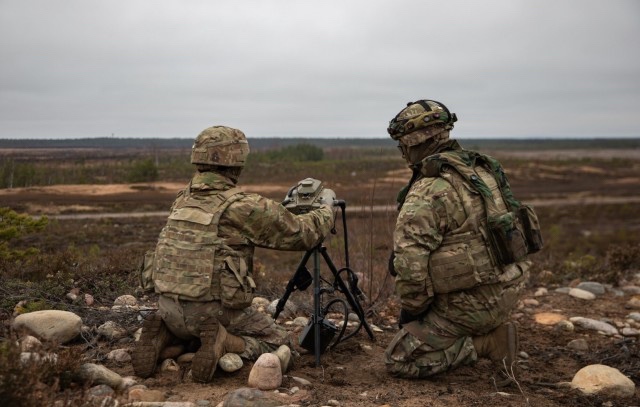
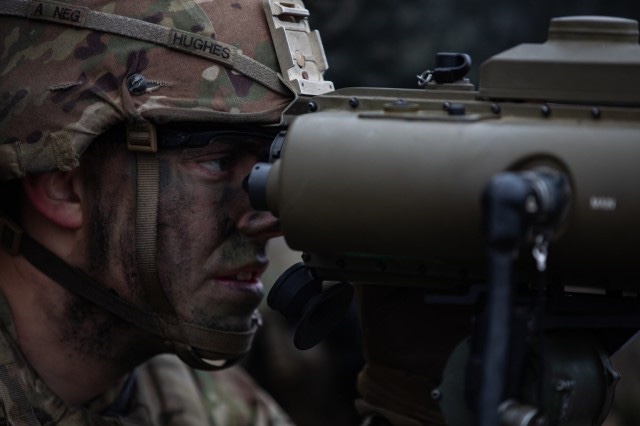
CAMP MURRAY, Wash. — As the 3rd Battalion, 161st Infantry Regiment arrived in Poland in April 2020 for the start of its NATO Enhanced Forward Presence rotation, Staff Sgt. Chris Smith sought training opportunities for his snipers. Almost a year after returning, those with whom Smith developed a working relationship continue to reach out for training and guidance.

“We were waiting for our vehicles to arrive, so one day I just walked over to the snipers with the British 20th Armoured Brigade Combat Team and said, ‘Hey we speak the same [sniper] language. Let’s get together and start training,’” said Smith. “We hit the ground running and forged some strong relationships.”

As part of the NATO Enhanced Forward Presence, 3rd Battalion, 161st Infantry Regiment Soldiers worked in a multinational, combat-ready force, demonstrating the strength of the transatlantic bond and making clear that an attack on one ally would be considered an attack on the whole alliance.

In early October, Smith received an email from his British counterpart asking for help with a sniper class. The email included an invitation to share knowledge and expertise in the field and participate in shooting concentrations during the multinational course.

“We have been asked to help with developing the circuits and being guest speakers,” said Smith.

National Guard snipers are often some of the best National Guard Soldiers who excel in physical fitness, mental fortitude and intelligence.

Guard snipers train at the National Guard Marksmanship Training Center at Camp Robinson, Arkansas, taught by instructors from the 233rd Regiment Training Institution. Guard members who complete the course receive their sniper identifier and are qualified U.S. Army snipers. They are also eligible to compete in the Winston P. Wilson and Armed Forces Skill at Arms Meeting National Guard Sniper Championship.

Smith, a law enforcement officer in Spokane, joined the Guard after leaving active duty. He left active duty as a captain but decided to pursue the sniper career field in the Guard.

“Not an average experience in the military,” said Smith. “This is more unique, more chances to do cross-training.”

While deployed to Poland, Smith said the highlights of the year included working with snipers from NATO nations and building that team comradery.

“It was truly the highlight of the trip. On deployments, you make of it what you can, and just those experiences were the best part of it,” said Smith. “We worked with snipers from Latvia, Lithuania, Poland, Norway, Sweden, Germany so many different countries. It was amazing.”

By Joseph Siemandel, Joint Force Headquarters – Washington National Guard

Q30 Innovations is Awarded $2.8 Million Contract by the US Army Medical Research Acquisition Activity to Aid in the Fight Against Traumatic Brain Injury in the Military

Wednesday, October 26th, 2022

WESTPORT, CT (October 26, 2022) –  The Q-Collar is an FDA-authorized, non-invasive device intended to be worn around the neck of athletes aged 13 years and older during sports activities to aid in the protection of the brain from effects associated with repetitive sub-concussive head impacts. In an effort to evaluate the safety, effectiveness, and field suitability of the Q-Collar to help prevent or reduce traumatic brain injury (TBI) from blunt force and blast waves in soldiers in the operational environment, Q30 Innovations has been awarded a $2.8 million contract by the United States Army Medical Research and Development Command (USAMRDC).

There were 454,000 diagnosed TBIs in the US military from 2000 through 2021. The United States Army Medical Materiel Development Activity’s Warfighter Brain Health Project Management Office is leading the effort and is now partnered with Q30 Innovations to ensure an advanced solution to help prevent or reduce the severity of TBIs caused by pressure waves from missiles, ballistics, artillery, IEDs, and shoulder-fired weapons.

The Q-Collar is the result of 10 years and more than $30 million in research and development, including independent clinical trials involving hundreds of high school athletes, used to support the FDA-granted De Novo classification for marketing of the device. The Collar is gaining acceptance among premier athletes at the high school, collegiate and professional levels, in sports ranging from football, lacrosse and soccer to bobsledding and surfing; to aid in the protection of the brain from effects associated with repetitive sub-concussive head impacts. The awarded contract enables further research and development to study the safety, efficacy, and field suitability of the Q-Collar in operational scenarios to include blast.

“Q30 is committed to protecting our brave armed forces and we are honored to be a part of the next steps in significantly reducing TBI throughout our military,” said Q30’s Co-CEO Tom Hoey. “The Q-Collar is a proven device to help mitigate the risks of brain injuries caused by head impacts. By working with our DoD partners, we aim to make a direct impact in the lives of our American servicemen and women and their families. We are proud to have been awarded this contract following a competitive bidding process. We are confident that the Q-Collar is the right solution to help protect soldiers who are at risk of TBIs.” 

The current contract will advance the research and development of the Q-Collar to prove that it can help reduce blast-induced TBI and that it is a safe, effective, and durable option for soldiers. The funding was made possible because of a congressional mandate to research novel methods to reduce TBI in soldiers.

On the sports field and potentially the battlefield, the Q-Collar is protective gear specifically designed to help safeguard the brain. While a helmet protects the skull from the outside, the Q-Collar gives an added layer of protection on the inside by limiting brain movement. The rapid acceleration and deceleration movement of the brain (commonly known as “brain slosh”) can occur in a number of military situations, leading to the twisting and tearing of neurons, causing traumatic brain injuries.   
 

More information on the product, research, and how to purchase the Q-Collar can be found at q30.com/pages/military.