Colt

Archive for the ‘C5ISR’ Category

Army Teams Operationalize Warfighting Systems in Western Corridor Experiment

Sunday, December 14th, 2025

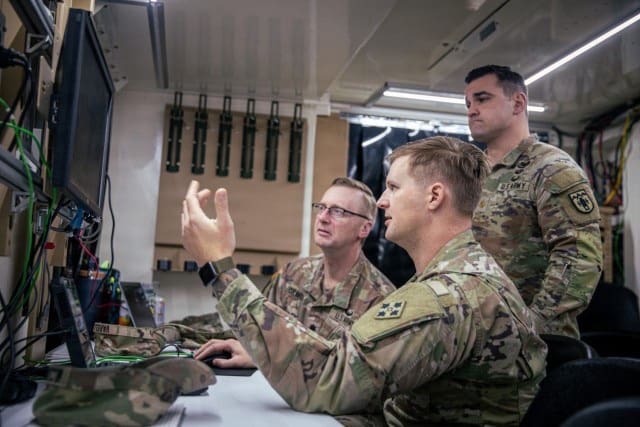
As modern battlefields rapidly evolve, the Army remains at the forefront of capability acceleration and innovation. Through exposure to realistic, emulated threat in the Western corridor, the Army’s All-domain Persistent Experiment (APEX) accelerates technical innovation and enhances Soldier lethality in the most threat-informed, live-sky environment available.

This fall, teams across the Army, Joint Force, industry, allied nations, and academia converged on White Sands Missile Range (WSMR), New Mexico, to assess, develop and reassess technology. The goal: outpace the threat.

“Today’s Warfighters must execute operations across the electromagnetic spectrum in the most contested Degraded, Denied, Intermittent, and Low-bandwidth (DDIL) environment the Army has ever seen,” said Maj. Gen. Patrick Gaydon, commander of the Army Test and Evaluation Command (ATEC). “We must be able to test, experiment, and train to fight in the same environment.”

“Integrating iterative testing, operationally realistic experimentation, Soldier feedback, and emerging technology assessments in support of the Campaign of Learning is vital to ensuring that learning is captured early and often to shape requirements, acquisition strategies, and fielding decisions. We currently have the capability to replicate the DDIL environment at several of our test and training ranges.”

Opening the aperture across a broader swath of the electromagnetic spectrum, APEX provided the DDIL environment needed to test integrated systems that operate in various regions of the spectrum and truly understand their capabilities in a realistic environment. Utilizing the conditions at WSMR, the All-Domain Sensing Cross-Functional Team (ADS CFT) built upon six years of success from the experiment’s previous iterations as the Positioning, Navigation and Timing (PNT) Assessment Experiment (PNTAX).

“This is the most challenging experiment our organization has completed to date,” said Col. Pat Moffett, deputy director of the ADS CFT. “It was an opportunity to learn– bringing together those who are actively championing the Army’s priorities – and putting capability to the test in one of the harshest environments available. Persistent experimentation of this caliber is one way we maintain momentum and lethality.

This pivot generated valuable insights to help Army leaders knit together warfighting systems that support integrating broader future concepts. Together, participants conducted experiments that accelerate investment in the Army’s top priorities, including command and control, integrated fires, and all-arms maneuver.

Integrated, real-time C2

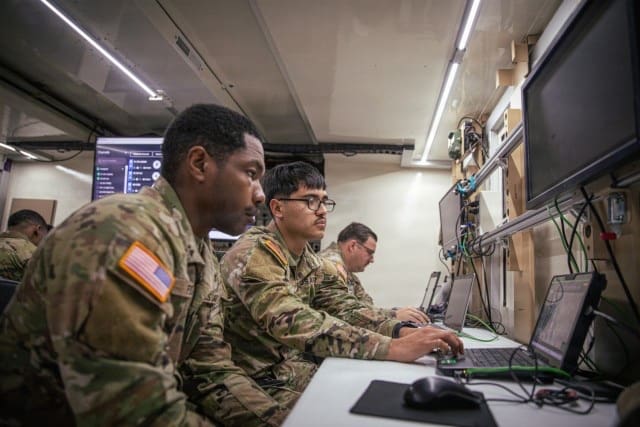
As the Army gains momentum with Next Generation Command and Control (NGC2) prototyping and experimentation, teams at APEX informed Army requirement development for one critical piece of the puzzle: sensor data.

In increasingly convoluted and denied information environments, access to the right data at the right time and the right classification is paramount. The Command, Control, Communications, Computers, Cyber, Intelligence, Surveillance and Reconnaissance (C5ISR) Center Dynamic project, designed to enable automated tipping and cross-cueing for accelerated kill chains, utilized a sensor framework to integrate Army, Joint Service, national, and coalition partner capabilities, enabling accelerated, automated effects.

To validate sensing system interoperability during APEX, the Dynamic project utilized the Joint Interface Control Document – Common Services (JICD CS) framework and Integrated Sensing Architecture (ISA) developed by the Capability Program Executive for Intelligence Electronic Warfare and Sensors’ (CPE IEW&S). These efforts successfully demonstrated the ability to integrate, process and disseminate multi-sensor data to the appropriate decision maker for action, while operating in a DDIL environment.

“The ability for ISA and our interface to JICD to be able to participate in APEX was invaluable,” said Christine Moulton, CPE IEW&S Strategic Integration Director for the Integration Directorate. “The data we collected at the time needed to integrate new sensors using the API provided great insight as we continue to improve the program.”

Live fires across domains

Commanders should not be limited in their effects on the battlefield. At APEX, experimentation efforts blended kinetic and nonkinetic effects, using mature situational awareness capabilities to speed the commander decision process.

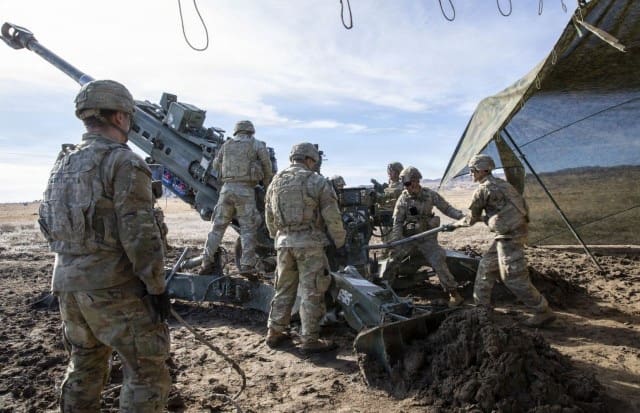
Using Plexus, a system designed to arm commanders with informed decision-making abilities, the C5ISR Center and Joint Program Executive Office for Armaments and Ammunition (JPEO AA) validated situational awareness information, directing the best shooter for the best effect. This integrated, automated approach demonstrated the lethality of cross-domain fires and an enhanced understanding of the environment.

“The Plexus systems-of-systems approach demonstrates cohesive communication across mission command systems and improves the precision and reliability of artillery strikes,” said Kevin O’Hanlon, C5ISR Center PNT Chief.

The right combination of synchronized effects gives friendly forces the tactical advantage, ultimately enabling the commander’s operational plan. The test bed for kinetic and nonkinetic effects formulated by the environment at APEX enhances the effectiveness of cross-domain fires.

All-arms maneuver

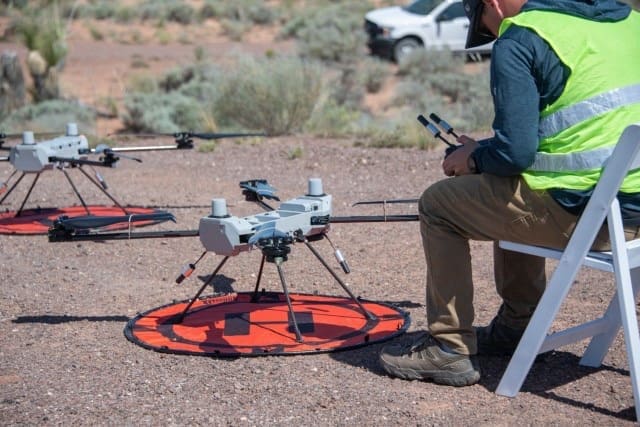
Additionally, APEX boasted multiple scenarios featuring Unmanned Aircraft Systems (UAS) and counter-UAS activities within a DDIL environment. These efforts are critical to validate platform operational relevance.

Given this experiment’s expansion to encompass more than navigation technologies, all-arms maneuver remains a critical part of the modern warfighting strategy. This year, the DDIL environment challenged ground and unmanned air platforms, ensuring the next generation of capabilities can operate through all electromagnetic conditions.

Way ahead

Persistent experimentation is critical to Army transformation, allowing for deliberate learning, training, and warfighting system interoperability. Coupled with Soldier feedback and training in realistic, threat informed operational environments, live-sky experiments are poised to advance broader transformation priorities through nested learning demands.

Experiments in denied, spectrum-degraded environments help the Army close the gap between today’s efforts and tomorrow’s warfare, evaluating capability readiness and adaptability.

The ADS CFT will transition into the Future Capability Directorate (FCD) construct under the Futures and Concepts Command (FCC) as the Transformation and Training Command (T2COM) gains full operational capability.

To maintain experimentation momentum, the next iteration of this experiment is called the DDIL Integrated Environment Supporting Experimentation and Learning, or DIESEL. It will align with the Army’s Concept-Focused Warfighting Experiments and support the command’s goal of turning war-fighting concepts into war-winning capabilities.

By Madeline Winkler

Milipol 25 – Kaptrek Pro Pilot Defense

Friday, November 28th, 2025

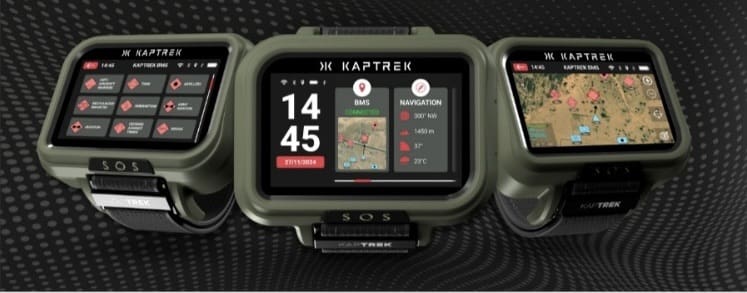
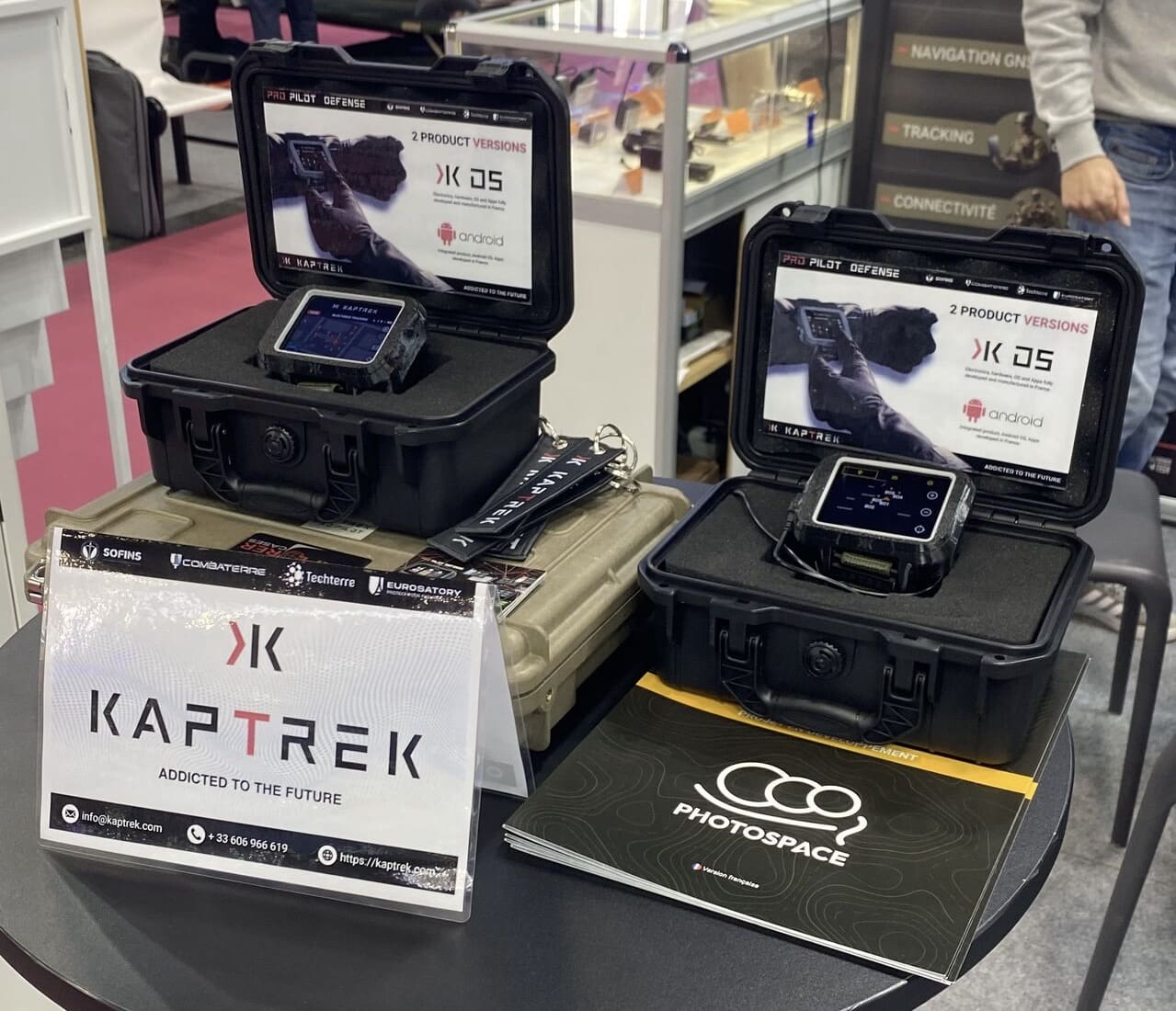
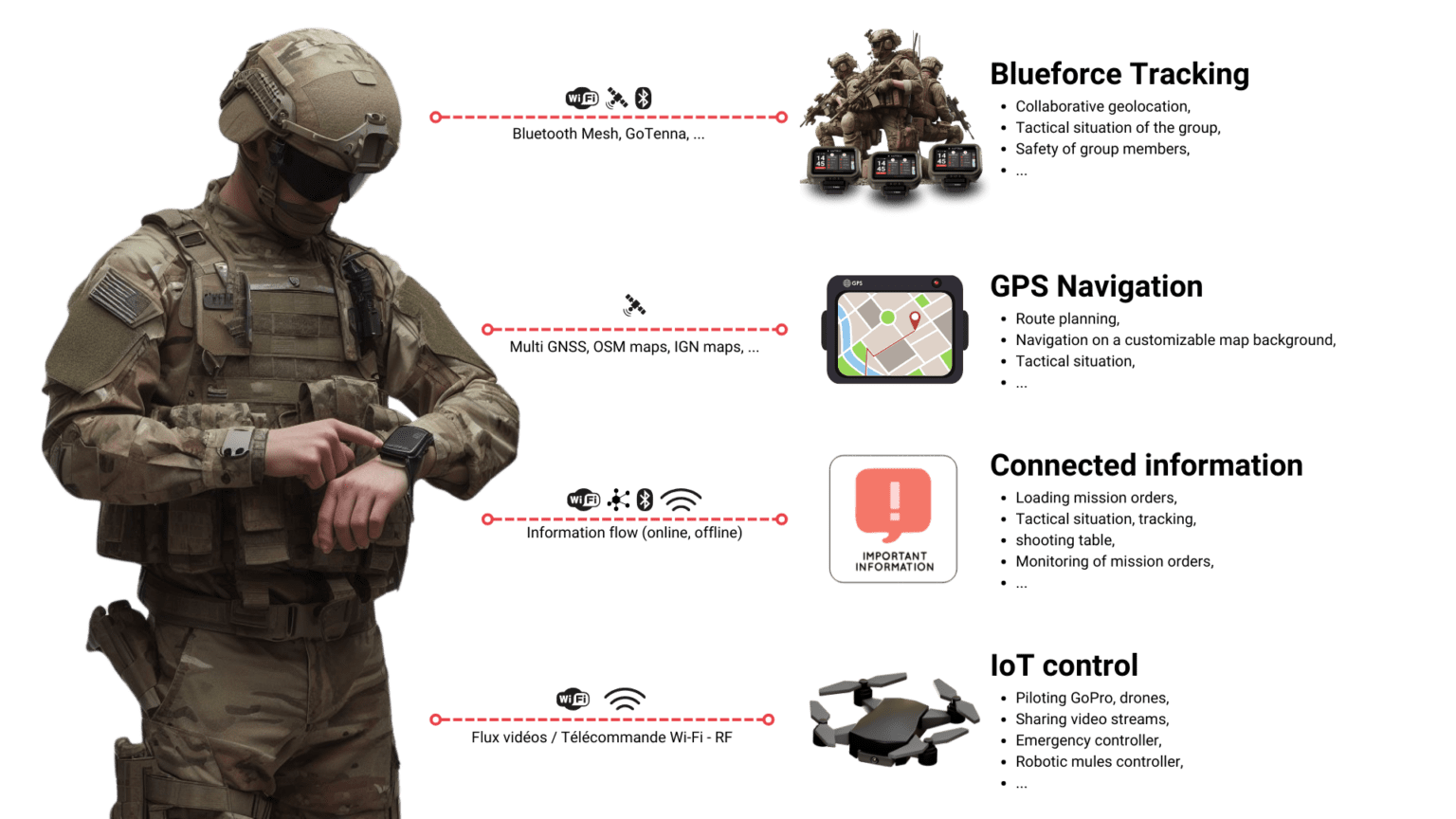
The Kaptrek Pro Pilot was developed as the first French (and European) IOT/connected wrist mounted platform for defense applications.

Capabilities:

  • Advanced Tactical Navigation
  • Real-Time Mission Tracking
  • Secure Communications
  • Health Status Management
  • Connected Device Control
  • Communication Security
  • Emergency Response System
  • Virtual Training
  • Resource Management
  • Interoperability with External Systems

Technical Specs:

  • Screen: 2,4 inches / 52.32 (H) x 31.392 (V) mm
  • Resolution: 800(RGB)*480
  • Battery: 1800 mAh
  • MPU: ARM Cortex-A5 / 32bit / 500MHz
  • Operating System (OS): Proprietary KAPTREK-OS
  • IMU: 3 axis
  • Wi-Fi: Radio 802.11 a/b/g/n 2.4 & 5.0 GHz
  • Bluetooth: BR/EDR/LE 5.1
  • GNSS: GPS / GLONASS / GALILEO / BEIDOU
  • SDRAM: 4 Go
  • eMMC: 8 Go
  • Flash memory: 16 Mb
  • IP Rating: IP67

It is available in two versions:

  • A 100% Made-in-France version,powered by a proprietary, secure Linux-based OS
  • An integrated version built on Android solutions

kaptrek.com/en

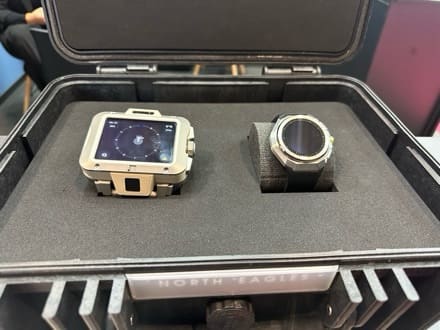
Milipol 25 – North Eagles

Tuesday, November 25th, 2025

North Eagles is a Swiss firm specializing in wrist one situational awareness systems. For instance they manufacture a gas detector for industrial applications.

At Milipol they showed their newest creation, a tactical instrument which offers several functions:

Battlefield Situational Awareness

  • Collect and analyze data generated by the watch sensors or connected sensors
    (GPS, acceleration & pressure sensor, noise)
  • Generate an automatic report of the current field situation (rest or active time, soldier is moving rapidly, fall, explosion, shootings, combat intensity, etc.)
  • Geolocation of troops at Soldier level
  • Target geolocation
  • Distance to target
  • Blue forces geolocation
  • Dead reckoning (GNSS denied environment)

Soldier Health Awareness

  • Collect & analyse data generated by the watch sensors or connected sensors (heart beat, acceleration & pressure sensors, noise)
  • Generate an automatic report of the soldier’s health: stress level, estimated need to recover, medical issue
  • Vital information transmission
  • Proof of life

Communication & Data

  • C2 Support: Enables command and control functions
  • Secure Communication: Provides encrypted data transmission.
  • Multi-Function: Handles location, status, requests & commands
  • Jamming resistance & minimal radio signature
  • Kill Switch

Additionally, this wrist mounted device offers the wearer access to the following data:

  • Local temperature
  • Local pressure
  • Blue and Red tracking
  • Gas detector
  • Ionizing radiation detector
  • Explosives detector
  • Narcotics detector

Although the screen does not depict a map, the system will integrate vector map backgrounds. Additionally, it uses a spread spectrum protocol to connnect to Soldierborne comms systems.

Learn more at northeagles.ch.

Anduril Selected for US Army’s Integrated Battle Command System Maneuver Program

Tuesday, November 11th, 2025

Modern battlefields are defined by speed and saturation. Small unmanned aircraft systems can swarm by the hundreds, overwhelming defenses and striking before human decision loops close. Without effective counter-UAS systems, air defense operators face more targets than they can track or defeat, leaving U.S. forces vulnerable. Current command and control systems weren’t built for this fight — they can’t process data or execute kill-chain decisions at the speed required to stop autonomous, distributed attacks.

To meet this challenge, the Army has selected Anduril Industries for the Integrated Battle Command System Maneuver (IBCS-M) program, establishing Lattice as the Army’s next-generation fire control platform for Counter-UAS missions. IBCS-M provides the command, control, and integration backbone for a vast array of counter-drone systems, enabling a single operator to manage multiple threats simultaneously. It fuses sensor data, automates fire control, and integrates new capabilities, reducing operator load and compressing the time from detection to defeat.

At a recent demonstration at Yuma Proving Grounds, Anduril showcased the power of Lattice — the foundation of IBCS-M. In a seven-day trial, Lattice integrated a previously undisclosed sensor and effector within hours, executed live-fire intercepts that achieved four out of four kills, and demonstrated advanced features like autonomy-enhanced fire control, distributed tracking, and kill-chain optimization.

“We can’t think of counter-UAS as static or in the same vein as counter ballistic missile defense. It has to be maneuverable which means it has to be software-centric and adaptable above all else,” said Alex Miller, CTO of US Army. “We can’t wait a year for a new sensor or effector to be integrated and we can’t tell our deployed soldiers that we have to wait for an FSR to solve the problem. It has to support a platoon leader on the move with many small sensors across many vehicles as much as it has to support a forward operating base or garrison commander using a mix of existing and emerging systems.”

The IBCS-M effort is part of a broader modernization initiative that is reimagining how the Army commands the fight. Legacy systems were built for an era of predictability — today’s world demands an infrastructure that is open, extensible, and capable of evolving at machine speed.

“We’re uniquely positioned to deliver on the Army’s vision because Anduril helped define the new frontier of air defense technology,” said Matt Steckman, President and Chief Business Officer of Anduril Industries. “Our work in autonomous systems and command and control has built the foundation for this moment — it’s a natural extension of the lineage that began when we reimagined how modern defense should operate.”

Anduril and the Army are building a unified command and control ecosystem — one that turns data into decision advantage and ensures U.S. forces can see, decide, and act faster in the era of autonomy.

AUSA 25 – Eagle Eye by Anduril

Thursday, October 23rd, 2025

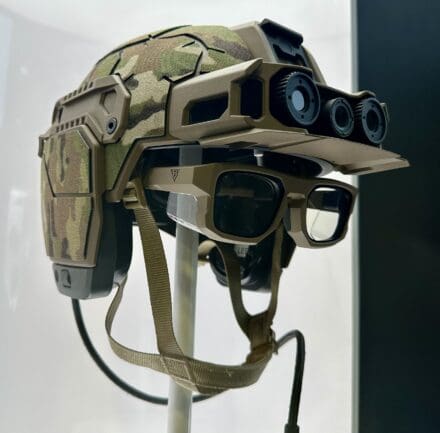
To top off my AUSA coverage I’ve saved the one thing that everyone wants to talk about. Anduril’s Eagle Eye family of warfighter augments is easily the most overhyped defense product release in years. The mainstream press loves it but they don’t know anything about Soldiering or helmet design and manufacture. What’s more, Anduril isn’t offering much in the way of technical specs. Rather, they are relying on a few AI created videos, an impressive list of industry partners, and some static displays as fodder to allow everyone to fill in the blanks with their dreams of what a helmet should be.

When the Army novated the Integrated Visual Augmentation System from Microsoft to Anduril earlier this year I leaped for joy. To be sure, Anduril founder Palmer Luckey knows what he is doing when it comes to Virtual Reality / Augmented Reality. If anybody could get this thing to work, he is our man.

Initially, the Army transformed the IVAS requirement to a Next Gen version but then introduced a completely new opportunity for industry to participate called Soldier Borne Mission Command.

Two companies ended up being selected for SBMC: Anduril who quickly put together a team of industry partners and Rivet which signed on to the Wilcox Industry-led FUSION CLAW consortium.

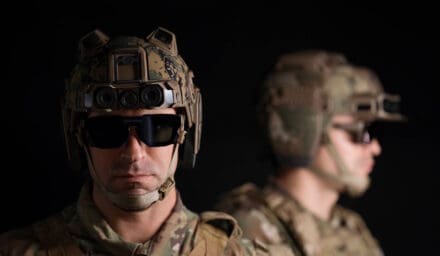
Concurrently, Luckey took his vision of what he believed Soldiers should be wearing on the battlefield and created the aspirational Eagle Eye system which consists of three physical components:

Heads Up Display (the glasses)

Helmet (what everyone is talking about)

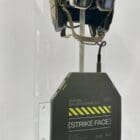
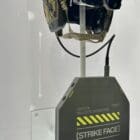
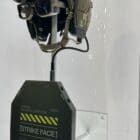
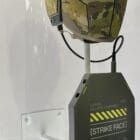
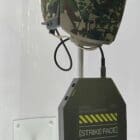
Computer Armor (more on this later)

Underlying everything is Lattice, Anduril’s AI engine which I believe is their greatest asset.

While the concept is very cool, it’s also risky. Not to say that some of the greatest things we use weren’t developed by a guy with vision, but no one has asked for this complete system. Eagle Eye promises a lot, integrating power, cooling, compute and biometrics all into a ballistic shell. Perhaps USSOCOM or the Army will come up with a new requirement but so far, they haven’t. Since Anduril isn’t a name that comes to mind when you think “headborne systems” the customer is accepting some risk as well.

In addition to the HUD and helmet, Anduril went one step further, combining battery and edge processing into a hard armor plate. Some of this has been tried before and hasn’t worked. Quite a bit of it was a materials challenge, but there are also operational reasons why this doesn’t make sense. I’m not going to beat the horse here but if you’ve worn armor for a living you can create your own list. If this thing isn’t stronger, lighter, cheaper, and more efficient than the gear currently used, no one is going to adopt it.

Does Eagle Eye work? According to Palmer Luckey it does but the company hasn’t released any weights, armor aerial density, ballistic performance, or impact mitigation data. Those are the things people who actually wear helmets and armor care about. There’s definitely a cool factor afoot but in the end, if it doesn’t protect as advertised the government isn’t going to buy it and Soldiers aren’t going to wear it.

I for one would like to know more about Eagle Eye aside from some hand built models and even more importantly, I want to see what they’ve done in the SBMC space. The collaborative 3D sand table mission planning capability looks particularly enticing. Likewise, the promise of integrating EW sensors and incorporating a “non-emissive digital laser designator” are huge boons.

I had the opportunity to try an early version of IVAS out years ago. It needed work. Considering Anduril’s Lattice is the Artificial Intelligence backbone that the Army seems to be building its Next Generation Command and Control System around, they’ve got a serious leg up. Remember, the goal of SBMC is to increase situational awareness for the Soldier on the battlefield and provide usable data shared via Android Tactical Awareness Kit within the Soldier’s augmented vision along with data from other sensors, offering a single, clear operational picture.

Show us that and work on the helmet side of things with the industry partners who specialize in the various headborne specialities. For example, the Oakley eyepro is brilliant. Troops love brand names and Oakley is a favorite. If they’re working with Gentex, use more than an Ops-Core suspension and chinstrap. They have been providing helmets to SOCOM for decades now for a reason and Soldiers want what the cool kids got.

Build an innovative helmet, that actually offers improvements over what is currently available and customers will come. The same goes for the compute armor concept.

I can’t wait to see that.

AUSA 25 – RIVET Soldier Borne Mission Command HUD

Tuesday, October 21st, 2025

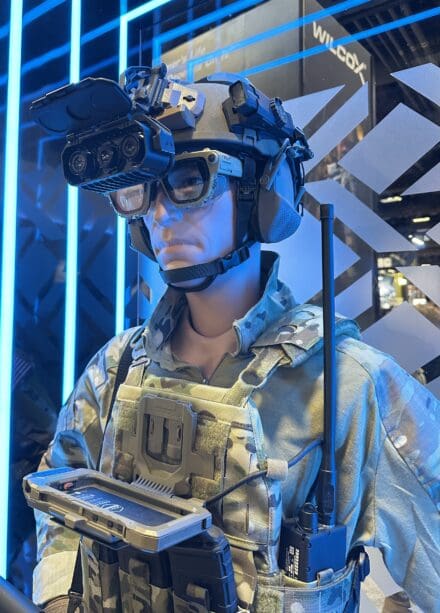
RIVET exhibited their Heads Up Display technology for the US Army’s Soldier Borne Mission Command program in the Wilcox Industries booth.

Through integration with WILCOX’s MANTIS mounting solution, the RIVET HUD becomes part of the FUSION CLAW-compatible system.

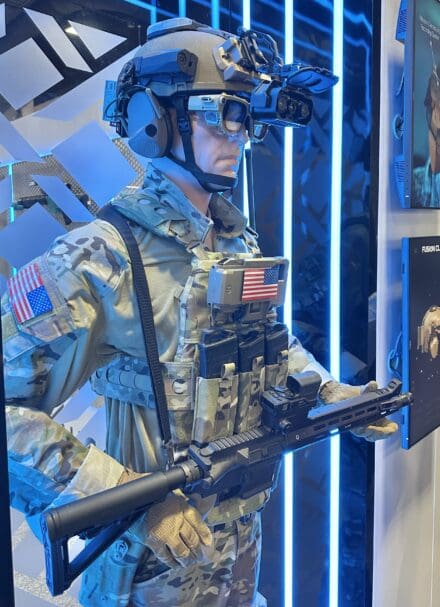
FUSION CLAW is a consortium of partners who have come together to provide the Army with an advanced headborne system to the US Army which is based in the issue IHPS helmet and provides integrated power and data.

Mounted to the front of the helmet is the sensor suite which contains an IR camera in the center and two CMOS low light color cameras on either side to offer binocular vision. It can be worn down in front of the eyes to put the cameras where the eyes are as seen here or up for observation. Either way, the data can be pushed to the eyewear.

What I really like about this option is that the key to viewing the Augmented Reality information is the RIVET Eyewear and those can be used with the Enhanced Night Vision Goggle – Binocular (ENVG-B), which is the current fused NVG/IR system worn by the Infantry and SOF.

Anduril’s EagleEye Puts Mission Command and AI Directly into the Warfighter’s Helmet

Monday, October 13th, 2025

Anduril today unveiled EagleEye, an independently researched and developed, modular, AI-powered family of systems that unifies command and control, digital vision, and survivability within a single, adaptive architecture.

EagleEye is a consequential step toward realizing Anduril’s vision of turning every warrior into a connected node on the battlefield. It consolidates mission planning, perception, and control of unmanned assets into a lightweight system that reduces weight and cognitive load while improving protection.

Anduril is already delivering the Army’s Soldier Borne Mission Command (SBMC) and Soldier Borne Mission Command–Architecture (SBMC-A) programs. Together, SBMC and SBMC-A form a mixed-reality platform that equips U.S. Army Soldiers with integrated situational awareness, mission planning, and training tools to improve decision-making and mobility. EagleEye builds on these advances, pairing mission command software with a heads-up display (HUD) and helmet-native hardware for balance, protection, and battlefield effectiveness.

“We don’t want to give service members a new tool—we’re giving them a new teammate,” said Palmer Luckey, Anduril’s founder. “The idea of an AI partner embedded in your display has been imagined for decades. EagleEye is the first time it’s real.”

Core Capabilities

Mission Planning

EagleEye enables mission command through a high-resolution, collaborative 3D sand table. Operators can rehearse missions, coordinate movements, and integrate live video feeds pinned to terrain. This creates a shared operational picture before and during the mission.

Enhanced Perception

The HUD enhances the operator’s view by overlaying digital information onto the real world, delivering vital contextual insights. EagleEye includes both an optically transparent daytime HUD and a digital night-vision HUD, each purpose-built for its environment. The system’s advanced approach to blue force tracking enables warfighters to know the precise location of teammates in world space, such as their exact position within a building or on a specific floor, rather than simply appearing as a dot on a 2D map. With Anduril’s Lattice network of distributed sensors, the system fuses real-time feeds from across the battlespace, allowing operators to detect and track threats even when terrain or structures block direct line of sight.

Heightened Survivability

EagleEye provides beyond-full-cut ballistic protection and blast wave mitigation in an ultralightweight shell designed for long wear. Rear- and flank-view sensors expand awareness without distraction. Spatial audio and radio frequency (RF) detection add layers of protection, alerting operators to hidden or immediate threats.

Edge Connectivity

EagleEye consolidates soldier networking and command tools into a body-worn system. Operators can task unmanned aerial vehicles (UAS), call for fires, and control robotic teammates while staying mobile. Lattice mesh networking ensures resilient command and control in denied, degraded, intermittent, or limited (DDIL) environments.

Designed with the Warfighter in Mind, for the Warfighter’s Demands

EagleEye is built from the ground up with ergonomic form factors modular add-ons, and a software-first architecture. Configurations include helmet, visor, and glasses variants. The system balances weight, reduces the bulk of traditional night vision goggles (NVGs), and keeps sensors aligned with the warfighter’s center of gravity. The totality of these attributes make EagleEye a standard-setting technology meant to perform to the requirements of military operations.

By partnering with commercial leaders such as Meta, OSI, Qualcomm Technologies, Inc., and Gentex Corporation, who have invested billions in augmented reality, rugged eyewear, compute, sensing, and ballistic helmets, Anduril brings proven technology directly into defense. This approach lowers cost, accelerates development, and ensures a path to continuous upgrade.
EagleEye equips dismounted operators with the ability to plan, fight, and survive while connected to every asset in the battlespace. As part of the Lattice ecosystem, EagleEye ensures persistent connectivity and control in any environment.

Air Force Experiments with AI, Boosts Battle Management Speed, Accuracy

Saturday, October 11th, 2025

LAS VEGAS (AFNS) —  

The Air Force wrapped up the second Decision Advantage Sprint for Human-Machine Teaming, known as DASH 2, a fast-paced experiment exploring how artificial intelligence can help operators make faster, smarter decisions in complex battlespaces.

DASH 2 took place at the Shadow Operations Center-Nellis’ unclassified location in downtown Las Vegas and was led by the Advanced Battle Management System Cross-Functional Team.The effort was conducted in partnership with the Air Force Research Lab’s 711th Human Performance Wing, the Integrated Capabilities Command and the 805th Combat Training Squadron, also known as the ShOC-N. 

“DASH 2 proved human-machine teaming is no longer theoretical,” said Col. Jonathan Zall, ABMS Capability Integration chief. “By fusing operator judgment with AI speed, the Air Force is shaping the future of decision advantage in joint and coalition operations.” 

AI Speeds Decision Advantage 

Initial results showed that machines produced recommendations in less than ten seconds and generated 30 times more options than human-only teams. Two vendors each produced more than 6,000 solutions for roughly 20 problems in just one hour. The software’s accuracy was on par with human performance, despite only two weeks of development. In one case, a single algorithm adjustment would have raised recommendation validity from 70 percent to more than 90 percent. 

“This level of output gives commanders options to execute multiple kill chains simultaneously and we’re excited about our next experiment to generate the courses of action with the machines to help illuminate risk, opportunity gain/loss, material gain/loss, among others,” said Col. John Ohlund, ABMS CFT director. 

Inside DASH 2 

The DASH series is part of the Air Force’s campaign to modernize command and control and gain decision advantage through human-machine teaming. Each sprint refines a specific decision function and informs future Department of the Air Force C2 development. The series also supports the Pentagon’s Combined Joint All-Domain Command and Control initiative. 

“Human-machine teaming is critical to accelerating the speed and quality of decisions across the joint force, and DASH 2 provides the insights we need to make that a reality,” Zall said. 

Human-Machine Teaming in Action

Seven teams participated in DASH 2, including six industry teams and one ShOC-N innovation team. Their challenge was to design AI-enabled microservices capable of assisting operators with the “match effectors” function, which determines the best available weapon system to destroy an identified target. 

Developers observed battle management crews operating without machine assistance, then iteratively designed and tested tools to augment human decision-making. Final demonstrations compared human-only performance against human-machine performance, measuring speed, quantity and quality.

“Being part of DASH 2 showed us how human-machine teaming can enhance performance without losing operator judgment,” said Capt. Steven Mohan III, 726th Air Control Squadron chief of standards and evaluations.

Industry and Air Force Collaboration 

Evaluation focused on whether these tools helped operators make more effective decisions, not just process more data. 

DASH 2 also reaffirmed the value of co-development with both industry and Air Force developers. Companies retained intellectual property rights while the Air Force gained insight into integration and functional requirements for future C2 software. 

“At the ShOC-N, our mission is to put new capabilities into operators’ hands and test them under conditions that resemble real-world battle management,” said Lt. Col. Shawn Finney, 805th CTS/ShOC-N commander. “DASH 2 demonstrated how the battle lab enables rigorous testing while maintaining operational fidelity, bridging the gap between concept and capability.” 

Early Results and Lessons Learned 

The 711th HPW collected data on operator performance, workload and teaming dynamics. Findings confirmed that AI can accelerate decision-making while keeping humans at the center of the process. 

“Collaboration with AFRL, the ABMS program office and industry allowed us to rapidly experiment, refine requirements and accelerate the path from concept to capability delivery,” Ohlund said. 

Shaping the Future of C2 

The DASH series is a key step in modernizing Air Force command and control. By combining human judgment with AI, the service is preparing operators to make faster, more informed decisions in future contested environments. 

“DASH 2 proved human-machine teaming is no longer theoretical,” Zall said. “By fusing operator judgment with AI speed, the Air Force is shaping the future of decision advantage in joint and coalition operations.” 



By Deb Henley, 505th Command and Control Wing Public Affairs

805th Combat Training Squadron, also known as the Shadow Operations Center-Nellis