GORE-TEX WINDSTOPPER

Archive for the ‘Camo’ Category

Agilite Tactical Gear Goes International

Sunday, August 15th, 2010

Agilite, an Israeli-American producer of tactical gear, has launched their new website and formally entered the international. Sales of their products began in Israel in early 2010 and many Israel Defense Forces troopers have already proven Agilite vests in real-world conflict scenarios. Now those same vests are available in American camouflage patterns, including MultiCam pattern from Crye Precision which was recently adopted as the US Army’s OEF Camouflage Pattern.

“The last few years combat in both Iraq and Afghanistan has bred an unprecedented need for tactical gear designed specifically for Middle Eastern combat. Having decades of experience in counter-terrorism ops and tactical design teams inside each of its elite units, Israel has become a world leader in tactical gear design,” says Agilite Founder Elie Isaacson, a former IDF Paratrooper and English-language spokesman for the Israeli Army.

Prior to Agilite’s launch, however, such Israeli-designed vests had never been adapted for a global market nor produced in American patterns. “It’s a great feeling to be able to offer our products internationally. Seeing Israeli vests in US Camo patterns sums up what we are all about” says Steve Hoodjer, Agilite’s co-founder and a former sergeant in the US Army National Guard with two Middle Eastern deployments to his credit. The two founders met in 2005 at Israel’s prestigious Institute for Counter-Terrorism.

Agilite’s product range includes their signature product, The Tactical Hi-Vest, an all-in-one tactical load bearing system that incorporates a detachable modular assault pack. The modular assault pack eliminates the need for soldiers to procure an extra assault pack or butt pack for mission essential items, yet allows for removal when operating from a vehicle or when carrying a rucksack on longer missions. The Tactical Hi-Vest fits “high and tight” on the body allowing for a more comfortable weight distribution than standard issue vests. All products are made in Israel from a combination of American and Israeli materials.

www.AgiliteGear.com

OCP Update

Wednesday, August 11th, 2010

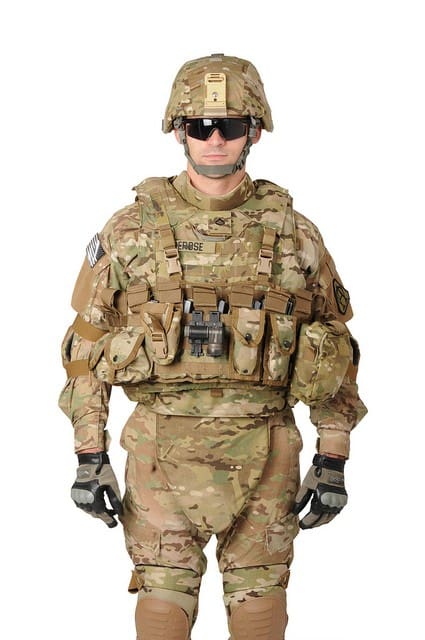
Yesterday, SSD participated in a teleconference with PEO Soldier’s LTC Mike Sloane and CSM Bernard McPherson. Also on hand was SMA Kenneth Preston along with several Subject Matter Experts from PEO Soldier. The press event was in conjunction with the Army’s initial fielding to a Brigade of 19 items in the new OEF Camouflage Pattern (OCP) at Camp Shelby, MS. Up to 3600 Soldiers will be equipped with the new gear over the remainder of the week before shipping off to Afghanistan. From here out, all OEF bound forces Brigades will be fielded Organizational Clothing and Individual Equipment in OCP before deploying from CONUS. Beginning in November, units with more than 120 days left in theater will also receive the kit. PEO Soldier is poised to conduct limited early fielding for deployed Battalion and smaller units who require the enhanced camouflage based on their mission. They are also developing plans to ensure that Individual Augmentees are taken care of. Additionally, Army SOF will be issued gear in the new pattern.

The ambitious fielding schedule would not have been possible without the dedicated work of two communities; the contracting office at Natick and industry. LTC Sloane commented, “The American Industrial Base is leaning forward, flying items in and driving them here.” The other side of this coin is the Army’s contracting strategy. In three months, the contracting office at Natick issued 11 contracts with another six to eight pending. Very impressive.

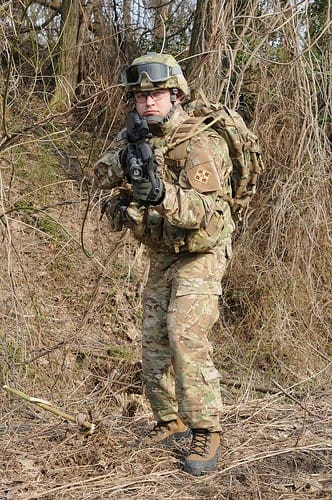
This fielding marks the implementation of phase III of the Army’s Congressionally directed search for enhanced camouflage for troops in Operation Enduring Freedom. Within less than a year, the Army conducted an extensive down select of 57 to five patterns that included an in-theater data collection effort and a comprehensive photo simulation study and wear test. This culminated in the selection of the Crye Precision developed MultiCam pattern as the new OCP.

When asked if he felt that, based on his experience if Soldiers were better protected with the new OCP, SMA Preston commented, “Based on testing…Yes, I believe they are safer.”

So what’s next for OCP? In February 2011, Tier II items including the Aircrew Advanced Combat Uniform, Improved Combat Vehicle Crewman Coverall, Aviation Life Support Equipment, and Fire Resistant Environmental Ensemble items will be introduced in the MultiCam pattern.

Finally, LTC Sloane announced that the Army’s Phase IV of the Global Camouflage effort will not be as short term as initially described. Instead, the TRADOC-led project will not be ready for the Army leadership to make a decision until the end of FY13. This three year effort sounds now to be more of a science project than focused on presenting a near-term warfighting enhancement. On the plus side, the Air Force is participating, and both the Navy and Marine Corps are monitoring the program so there is a slight possibility that the project may deliver a true joint solution. The down side is that for at least the next three years Soldiers must continue to rely on the limited capability of the so-called Universal Camouflage Pattern that caused this whole program in the first place. Perhaps commanders in other theaters will begin to insist that their troops also require enhanced camouflage and we will see increased fielding of MultiCam.

Thanks for Making Our Day Kit Up!

Wednesday, August 11th, 2010

Kit Up! ran with our story on the two developmental variants of the new USN Type II and III NWU. They spoke with a couple of the officials working on the program and the program still doesn’t add up. They were unable to explain the desert camo issue plaguing the program. Additionally, Kit Up! came to a similar conclusion that we have. The Navy will most likely adopt a cut of uniform that NSW won’t want to wear due to the variant 1’s focus on garrison wear. Combine these two issues and you will have a Type II NWU in a restricted camo pattern and the only community that can wear it won’t because it doesn’t meet their functional requirements. Classic…

Be sure to check out the whole story at Kit Up!

More on the Type II and Type III NWU

Monday, August 9th, 2010

The Program Manager for the Naval Working Uniform has set up a fantastic web site to keep the Fleet updated on the roll out of the Type II and III variants of the NWU slated for fielding in Spring 2011. Two variants of the basic layout are currently in conformance testing pitting a traditional BDU cut most Sailors are used to against a more innovative style based on features found on commercially developed combat clothing. In the photo above you can see the Type III which will replace the Camouflaged Utility Uniform in the Woodland pattern. Unfortunately, the Navy plans on retaining two separate desert camo patterns, with Naval Special Warfare adopting the AOR I inspired variant and all others retaining the old 3-color desert pattern which first saw service in Operation Desert Storm.

www.navfac.navy.mil/nwu

Stuff We Didn’t Write About

Saturday, August 7th, 2010

Bushnell Redesigns Popular BackTrack Line

More camo news! US Navy Working Uniform III

This It How It Feels to Be Under a Nuclear Attack

Making Money During A Recession

DARPA’s Inhaled Drugs to Boost Troops at Extreme Altitudes

Fluid defences

Stuff We Didn’t Write About

Sunday, August 1st, 2010

The Invention of the Leatherman: Patent Gallery

New A-TACS Images

New Wound Care Zaps Cuts Closed

DIY Wearable Computer Turns You Into a Cyborg

Are 3D-Printed Fabrics the Future of Sustainable Textiles?

SKD Tactical Updated Their Look

Wednesday, July 28th, 2010

SKD Tactical has updated their look and with it, the entire shopping experience for that matter. As you can see, it is not only more user friendly, but the most popular brands are one click away from the front page. SKD Tactical still offers industry-leading shipping times and great service. Click on the image to check it out.

Army Camo Phase IV

Wednesday, June 30th, 2010

And so it begins…well actually it began awhile ago but Phase IV of the Army’s camo program is gaining steam and Natick in conjunction with PEO-Soldier released a Sources Sought Notice yesterday for camouflage patterns. SSD was also able to speak with PEO Soldier’s COL William Cole and LTC Mike Sloane about the situation.


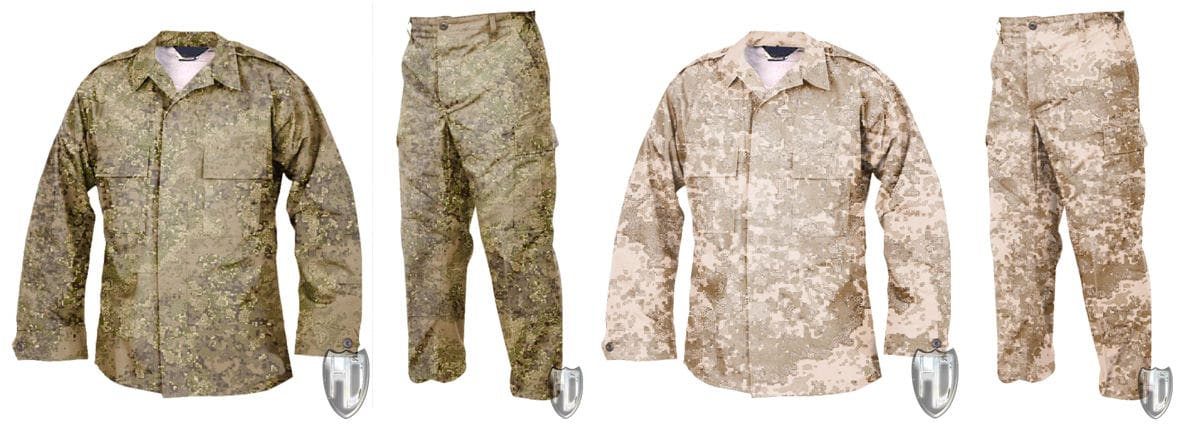
The Army is seeking a family of three different camo patterns including woodland, desert and, transitional (sometime called universal), and one pattern for personal equipment (such as body armor, ammo pouches and rucksacks) which works with all three (3) uniform camouflage patterns. The idea behind the family of patterns is to give Army leaders and Combatant Commanders options. The document goes on to describe a family of patterns as “A family is considered to be of the same or similar geometry with coordinating color palettes to cross the global operating environments. Global operating environments are defined by a geographic classification system that subdivides the global landmasses into areas with similar environmental characteristics.” So ultimately, they are seeking three and possibly four patterns that share basic composition. Sharing basic geometries can be used for identification purposes as well to streamline with supply chain with common printing screens. One option for the family of patterns is that the transitional or universal pattern will be issued in the clothing bag to all Soldiers and the woodland desert patterns would be special issue to those operating in those environments.

The Sources Sought Notice goes on to describe how the patterns will be evaluated. This methodology can be used in both a photosimulation study as well live field tests.

“The woodland pattern may be evaluated in forest, full ground cover, cropland and jungle terrain at distances between 35 and 400 meters.

The desert pattern may be evaluated in low sandy desert and high rocky desert terrain at distances between 35 and 500 meters.

The transitional pattern may be evaluated in both woodland and desert terrain types at the distances cited above.

All evaluations will be made with a subject mannequin and/or human wearing a uniform in the evaluated pattern and a body armor vest with ammo pouches in the family personal equipment pattern.

The primary method for evaluating uniform and personal equipment pattern effectiveness will be determining the distance at which observers have a 50% probability of detecting the camouflaged test subject; the shorter the distance the more effective the camouflage.

The secondary method for evaluating pattern effectiveness, to be used in instances where all patterns are detected at the same range, will be the relative time to detection; the longer the time to detection the more effective the camouflage.

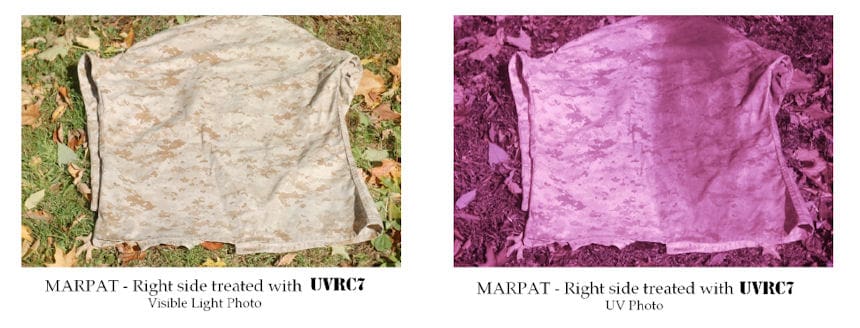
Near IR performance will also be evaluated at distances from 35 and 200 meters. The patterns will be evaluated for Near IR performance in the same terrain types as for daylight performance.”

The big issue here is options. The camouflage team which is comprised not only of PEO-Soldier and Natick but also such stake holders as the Maneuver Center of Excellence, Naval Research Labs, USASOC, and the AWG has to brief the Army leadership on their plan of action in July. This plan not only offers choices but also economizes them through a common pattern geometry for uniforms as well as a common OCIE pattern.

COL Cole said that he expected to see a new family of patterns enter service within two years saying “We want to conduct rigorous testing. This is not a fashion contest.” What is clear is that no one wants to rush into a solution but rather, the Army would like to conduct full testing in all terrain environments and all seasons. Additionally, LTC Sloane added, the Army wants to ensure that they conduct a thorough threat analysis placing the correct emphasis on probable areas of operation.

At this point, the Army is trying to ascertain the state of industry to support this requirement and to give everyone a heads up. Offerors have one month to respond and we are looking forward to seeing what industry comes up with once a full blown solicitation is released.