Anatomy of a Hard Shell pt 1 – brought to you by BFE Labs and UTE
The Book You Won’t Get to Read
The Gear Junkie: Origins of the Swiss Army Knife


Adam Savage was captured wearing a Kitanica MARK I jacket on a recent episode of "Mythbusters" where they are testing whether a Slushie can kill someone when thrown out a car window at highway speeds (It's 2:00 into this clip). Adam's also the proud owner of a Kitanica MARK IV. In fact, overwhelming fan interest in Adam's MARK IV brought Kitanica back into the forefront.
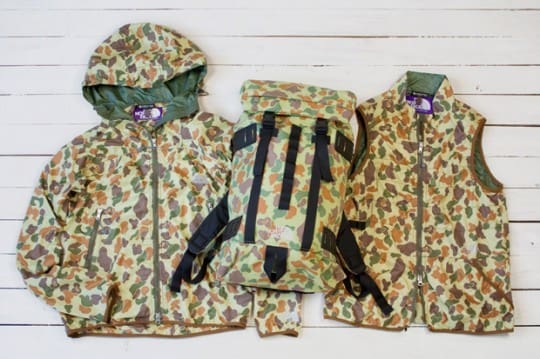
While it’s a fashion statement, TNF has put together some pretty cool kit. Known as the Purple Label line, the Fall lineup is offered in Australian Disruptive Pattern. Here, you see a Gore-tex jacket, Fleece vest, and Day pack. The downside? They are only available in Japan.
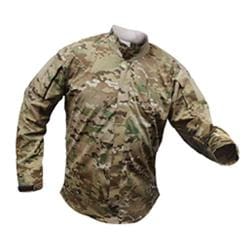 There has been a lot of buzz about Vertx’s new Gunfighter shirt and it is finally available, for pre-order at least.
Available in two weights; a durable nylon cotton ripstop blend and the water-resistant Storm variant, incorporates technical materials and finishes critical for use in harsh weather conditions. Its simple, clean design and articulated shoulders and arm allow for full range of motion. Durable, yet lightweight and breathable, the shirt is ergonomically designed for any situation and does not compromise freedom of movement.
While both versions are currently offered in MultiCam®, Vertx is developing Gunfighter models with solid color shells.
Like all Vertx products, the Gunfighter is designed for the operator who wants the combination of low visual profile and function of a battle garment. It was designed in cooperation with SWAT and military operators interested in a clean, functional approach to high incident tactical wear.
“The Operational Athlete of today has to be highly adaptable, always prepared for a number of situations,†said Vertx President & CEO, Bob Getto. “We work closely with law enforcement and military contacts to understand these unique needs and create wearable performance clothing that can match the versatility required for the job.â€
“Vertx offers a modern take on the battle dress uniform,†said David Walsh, Brand Manager for Vertx. “A low profile, business casual appearance can be maintained without restricting any movement or comfort. This approach enables operators to perform at the highest level needed in an instant without calling direct attention to the individual wearing it.â€
“The gunfighter shirt provides for such a great range of motion without the excess fabric and features associated with other tops that you don’t even know that you are wearing it,†said a SWAT officer wear evaluator. “The Shoulder pocket design is clean, you can slide your arm in and out of jackets or protective equipment and the pocket does not get snagged on the inside of the sleeve.â€
Additional Storm Features
– Stand up collar protects neck from weapon slings and flying hot brass
– Low visual profile zippered bicep pockets provide fluent access to contents
– Loop Velcroâ„¢ patch on both upper arms for Unit patch
– Clean comms wire side seam pass through with Velcro closure
– Intuitive Velcroâ„¢ wrist closures to ensure snag free fit
– Anti-Microbial
– Schoeller Nanosphere® durable water repellant finish
– 100% Made in the USA and Berry Amendment compliant
The Gunfighter Shirt is available now for pre-order with deliveries beginning October 2010 from www.wearvertx.com.
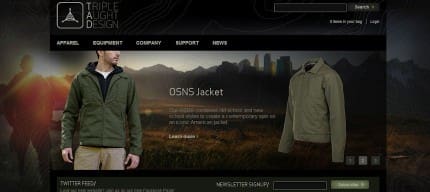
The crew at Triple Aught Designs have been busy remodeling their San Francisco show room. It turns out that wasn’t the only thing they were making over. Their new web site features a whole new look and is visually stunning. Make sure you stop by and check it out.
Our friends at Mil-Spec Monkey have been working on a secret project for some time and they have just unveiled the results.

Starting with a FlexFit cap as a foundation, they have removed the top rivet and applied ample amounts of velcro loop. The loop is color matched so it doesn’t stick out but the shapes are different than what you have seen in the past. This is because MSM specializes in patches and have built the cap to accommodate some of their more exotic designs.
In the photo you will also notice a set of earplugs. Rather than showing up at the range without earplugs, they are stored in a small garage on the sides of the cap. The earplugs are on leashes that are connected to auto-retracters and with a gentle pull go right back into storage mode.
Available in S/M 6 3/4†– 7 1/4†and L/XL 7 1/8†– 7 5/8†in Khaki, Loden (GreenishBrown), and Black. Get them from milspecmonkey.com.
We first published this article back in June of 2008 and it is a reprint of an article from “The Morning News“. The info is just as fresh today as it was in 2002 when it was originally published by them.
The Morning News
Opinions
Men’s Fashion: Part 1, Suits
It’s the one thing every man should own: a suit. THE EDITORS salute the suit’s ability to withstand expiration, bask in its enduring appeal, and offer advice on what to look for when you’re off to buy your own. If only we could be there to say, “Suits you, sir!â€
On Suits
Everyone wants to be Cary Grant. Even I want to be Cary Grant.
—Cary Grant
Without suits, men would have nothing. In the hierarchy of style, a good suit remains a man’s only trump card. Even in this sad age of casual-wear, the suit still carries an air of success, taste, and sophistication. It is designed to make you look better, to break boundaries between social classes, to make a small man tall with pinstripes or a fat man rich with soft wools. The suit looks good in restaurants, trains, dinner parties or Paris; in short, everywhere you want to be. It is, in its best forms, a complete outfit that will never fail you.
And that is exactly what it will do, if you treat it right. Unfortunately the majority of suits you see look awful. This isn’t necessary. Even if you work ten hours with your jacket on, being mindful of your clothing will keep you ready for cocktails after work. Too many men either don’t care or don’t know how to wear a suit, and, suitably, look like shit. This is worth avoiding.
To start us off, a few general rules should be observed when approaching a suit, and most apply to good dressing in general:
The suit, no matter the style, needs to fit your body, closely. This means all pieces should be cut and tailored appropriate to your form. Surprisingly, this doesn’t require a lot of money ($500 can, in fact, get you a good suit) but it does take an eye, and the strength to ignore any saccharine compliments from salesmen.
Trends have six-to-eighteen-month shelf lives. If you plan to retire your suit in this window, feel free to splurge. Otherwise, shop considerately.
Suits are made of wool or cotton, and their variations. Additional fabrics need not apply.
You are an interesting, confident, multi-hued man. Let others learn that from how you behave, not from the label on your jacket.
A suit jacket goes with suit pants, not with jeans or chinos. If you want a casual jacket, buy a sport-coat or a blazer. Stand-up comedians are regularly shot over this rule.
If you’re not comfortable—if you don’t feel the suit’s appropriate for you—the salesman’s looking out for his commission, not your style.
A modestly, well-dressed man has never failed to impress. Yes, never.
Assuming you’re not an investment banker, you don’t need ten suits; you only need four. This means you can be a discerning shopper and spend time accumulating, then keeping your suits in good condition (dry clean once a year, then more for spills; don’t you dare iron it yourself). Think of the process in terms of collecting, spending years searching for that one original-packaged Chewbacca.
The Fab Four
1. The Standard Blue: Great for business, lunches, New York Mayors, summer dinners, or casual parties. Can be worn with black or brown shoes, even white if you’re daring. Reflects well by a pool. Standard blue means navy, with no room for paler shades, even if you went to U.N.C.
2. The Classic Gray: Appropriate for everything and even makes a red-head look dandy. Grays also are the best with patterns, especially anything in the chevron family. Start with plain, move to window-pane. Even such, the gray is never controversial. It’s the Switzerland of suits.
3. The Basic Black: Our favorite and the perennial classic, it’s a fit at the Oscars or your sister’s wedding, the perfect compliment to a good white shirt, beloved by gangsters, designers, and undertakers (those jobs with the highest doses of fashion-conscious aptitudes; respectively, aggression, vanity, and wisdom). If you only own one suit, this is it. You can even be buried in it.
4. Any of the above, with pinstripes.
The Jacket
So. You’ve picked your color and you’re ready for the fit. First comes the jacket. Never was a suit bought for the pants and repeatedly worn afterwards. Pants are easily adjusted by a tailor, jackets can only have minor improvements. Think of true love: it must be close to just-right at first, with a slight thrill when you put it on, the coup de foudre as the French say.
First off: are you a single-breasted man or a double? While both styles can fit most body types, single-breasted jackets tend to flatter the slim while double-breasted jackets make the broad look mighty. This doesn’t imply being “skinny&†or “fat,†it’s simply about your tits; hence the term “breasted.†Choose the jacket style that you can best fill out—from there you’ll always look best. David Letterman, who can rarely be found not wearing a double-breasted jacket, skirts this rule by sitting behind a desk. Notice how uncomfortable he is during the monologue, fussing with his buttons while standing full-view before the camera.
To those opting for the single-breasted jacket, you’ll have to choose how many buttons you want. One? Hmm. Two? Excellent. And returning in popularity. Three? Certainly good, and was much sought-after in the recent past though it’s now reached near total market saturation. But, still classic, and hopefully always available.
Of course, jackets also come in four-, five-, and six-button styles, each with their own fifteen minutes of fame. Four-button jackets have been sported by everyone from The Beatles to Steve Harvey. Can you sport one? Of course! But no, not this season…
Last, the fit. Like we said before, close to the body, but no wrinkles when you button. Vents, double or single, are preferred to the vent-less jacket that, nine times out of ten, looks like a giant condom from behind. Shoulder pads should be avoided—you’re no linebacker—but a tailor will gouge you if you show up post-purchase and ask him to reduce the heft.
Finally, before we move onto trousers, there is one ticklish in-between: the vest. We can put this simply. If you’re ready to buy a vest, you’re either old enough to sport one or dangerously disillusioned. A good rule of thumb: Alfred Hitchcock looked great in vests. Young Jimmy Stewart looked out of his league. Pick your man.
The Trousers
You must now choose a trouser style. There have been, in the history of men’s trousers, a few trends that fucked with a good thing: bell-bottoms, bibs, clam-diggers, “cargo.†Unfortunately, all of these styles eventually found their way into suits.
Men, generally, will take any pants that come with a jacket. Being men, we want some control over how they look—“How they work,†thinks the man—but not too much. Hence, the cuffs-or-no-cuffs debate. Ask a man what he thinks of his pants and he’ll say, “Yeah, I had to go no-cuffs.†We won’t help you here except to say: cuffs are older, no-cuffs are not. Choose according to your image of yourself.
Next comes the pleats question: The only times pleats are wanted is in the single-pleat case, on a pair of wool pants. The case should be that the pants look crisp and well-folded, rather than puckered. How to tell the difference? Think of a pair of pants recently back from the dry cleaner. Remember the line down the middle of the leg. Does your new pleat-to-be look like that? If not, drop the hanger and run.
After cuffs and pleats, you need to worry about waist, swish, drape, belt-loops, ass-hugging, crotch-dangling, and whether or not you need a watch pocket. This is beyond our advice. Suffice to say, your ass is probably less than marble, though it shouldn’t be treated like a towel hook. Pants shouldn’t blow like a scarf in the breeze. The best way to judge a pair of pants is to ask yourself, “Would I wear these pants on a date without the jacket?†If so, they’re fine. If not, move on.
Finally, a salesman will often ask if you’d like to buy two pairs of pants for the suit. The idea is you can alternate pants with the jacket so they wear evenly over time, but since pants can be so easily ruined, you always have a back-up pair. This is similar to electronics store people trying to sell you insurance on an air conditioner; if you have the money, it’s not a bad idea, but it also isn’t necessary.
So now that you’ve picked out your suit, you have to know how to wear it. We’ll assume you know the basics of putting the thing on. (Yes, the jacket part goes on top.) And this brings us to buttoning. It is a historic dilemma, faced by every man. Here, for you, is our easy-to-remember rulebook:
Two-button jacket: Button the top button, only, ever. Button the bottom button and you’ll look like a stooge. That’s really all there is to it.
Three-button jacket: Button either the middle button alone or the top two. Important: the bottom button does not meet its hole. It will plead before a date, just when your stomach’s boiling, “Hey! Friend! Button me once, please. I’m sure we’ll look fine. Come on! Just once!†But you will not give in, you will be strong.
* * *
Now the suit’s on, and you’re ready to go. Comb your hair, have a cocktail, head out for the evening. Travel lightly when you go, meaning don’t bulge your pockets with a Bible-sized wallet. Your outside jacket pockets, in fact, should never be used unless your companion asks; at that moment chuck your pretensions and stuff them full. When you get home, brush down the suit, hang it evenly, and keep it in a bag. Wear it often, with pride, and don’t take shit for looking good. After all, no one can be Cary Grant, but everyone can try.
Oh yeah, another thing: Don’t roll up the jacket sleeves Miami-Vice style. We say this now, but then again, considering the fickle nature of fashion, don’t hold us to it.
—Published April 15, 2002
Copyright 2002, The Morning News