SIG SAUER - Never Settle

Archive for the ‘Contracts’ Category

Mission Ready Announces Winning Submission to Develop US Navy Electrician’s Impact Safety Vest

Friday, April 7th, 2017

VANCOUVER, BC–(Marketwired – April 04, 2017) – Mission Ready Services Inc. (“Mission Ready” or the “Company”) (TSX VENTURE: MRS) is pleased to announce that its wholly-owned subsidiary, Protect The Force Inc. (“Protect The Force” or “PTF”), has been awarded a contract with Natick Soldier Research Development and Engineering Center (“Natick”) for the development of an Electrician’s Impact Safety Vest (“EISV”) to be used by sailors on surface and submarine vessels.

PTF’s successful submission followed a solicitation by Natick for a 3-phase delivery of EISV’s with technology and functionality integrations including excellent mobility and flexibility, arc flash and impact protection — afforded by the selection of specific materials — and physical features to allow for extraction in the event the user becomes injured and incapacitated.

Leveraging a US Government design, PTF will develop the initial prototypes for expert-user field evaluation prior to production, and subsequent delivery, of 75 final prototypes in accordance with the Statement of Work. All costs associated with the development and delivery of the EISV prototypes will be funded by NSRDEC including USD $28,500.00 fee to be paid to Protect The Force for its efforts in bringing the EISV to the commercialization stage. The prototypes will be produced at PTF Manufacturing, the Company’s 22,000 square-foot rapid prototyping facility in Jacksboro, TN which currently manufactures a full range of products dedicated to the tactical and defense industry including tactical outerwear, canine armor products, bomb suits/blankets, riot control protection, carriers, textiles with integrated electronics and ballistic panels.

Francisco Martinez, PTF’s Chief Technology Officer states, “We have had the privilege of pioneering technology with Natick since 2012 — impacting the industry with outstanding innovations — and we are very excited to once again collaborate with Natick and support this critical project with the uncompromising quality and professionalism that has become synonymous with PTF-Natick collaborations.”

Performed by the Innovations team at its Boston, Massachusetts-based lab, Protect The Force has partnered with the US Government on previous emerging product development efforts — including the US Army Ballistic Combat Shirt and US Marines Ballistic Base Layer — and believes its past performance and strategic proximity to Natick has positioned the Company well to respond to government solicitations and will continue to be advantageous going forward.

“This project is a key development for the Company as it further expands our portfolio and scope of expertise into the industrial safety domain,” states Jeff Schwartz, CEO of Mission Ready. “We are proud to be able to certify the prototypes we will be delivering as Berry Compliant — a US Government requirement for textile-based product procurements — with respect to the materials and the manufacturing process; both made and performed in the United States of America.”
www.missionready.com

US Army Issues RFI For Cold Temperature and Arctic Protection System

Thursday, March 30th, 2017

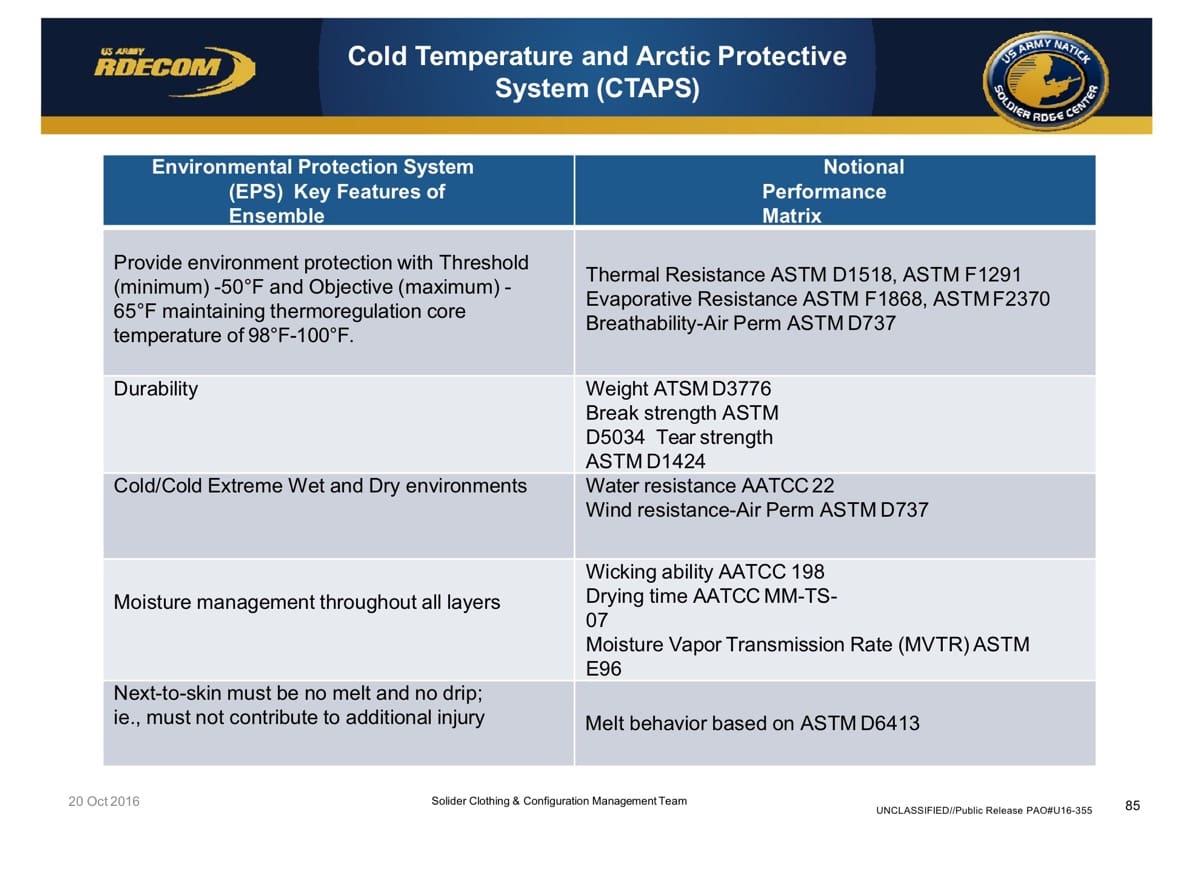
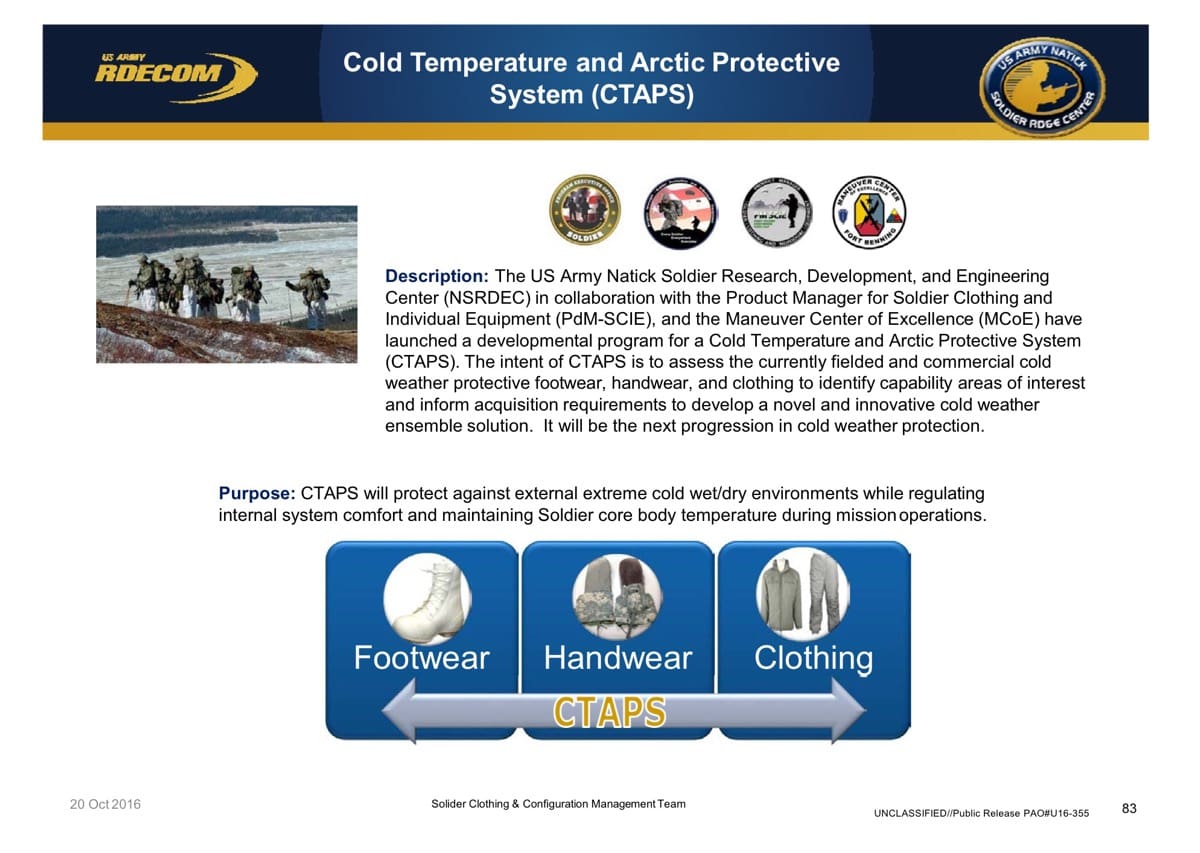
The U.S. Army Natick Soldier Research, Development and Engineering Command (NSRDEC), Natick, MA is conducting a market investigation to identify domestic suppliers and manufacturers of potential sources for materials, individual garment items and complete clothing systems for the development of a Cold Temperature and Arctic Protection System (CTAPS). This RFI will exclude handwear and footwear. The effort will develop a multi-layer system that will provide a minimum of no melt and no drip next-to-skin layers, environmental protection from wind and water, and provide tailorable protection for temperatures spanning a range from 45 Deg F to -65 Deg F in as few garments as possible.  Essentially, it’s a replacement for Extended Cold Weather Clothing System (ECWCS) Generation III which is an adaptation of USSOCOM’s Protective Combat Uniform.

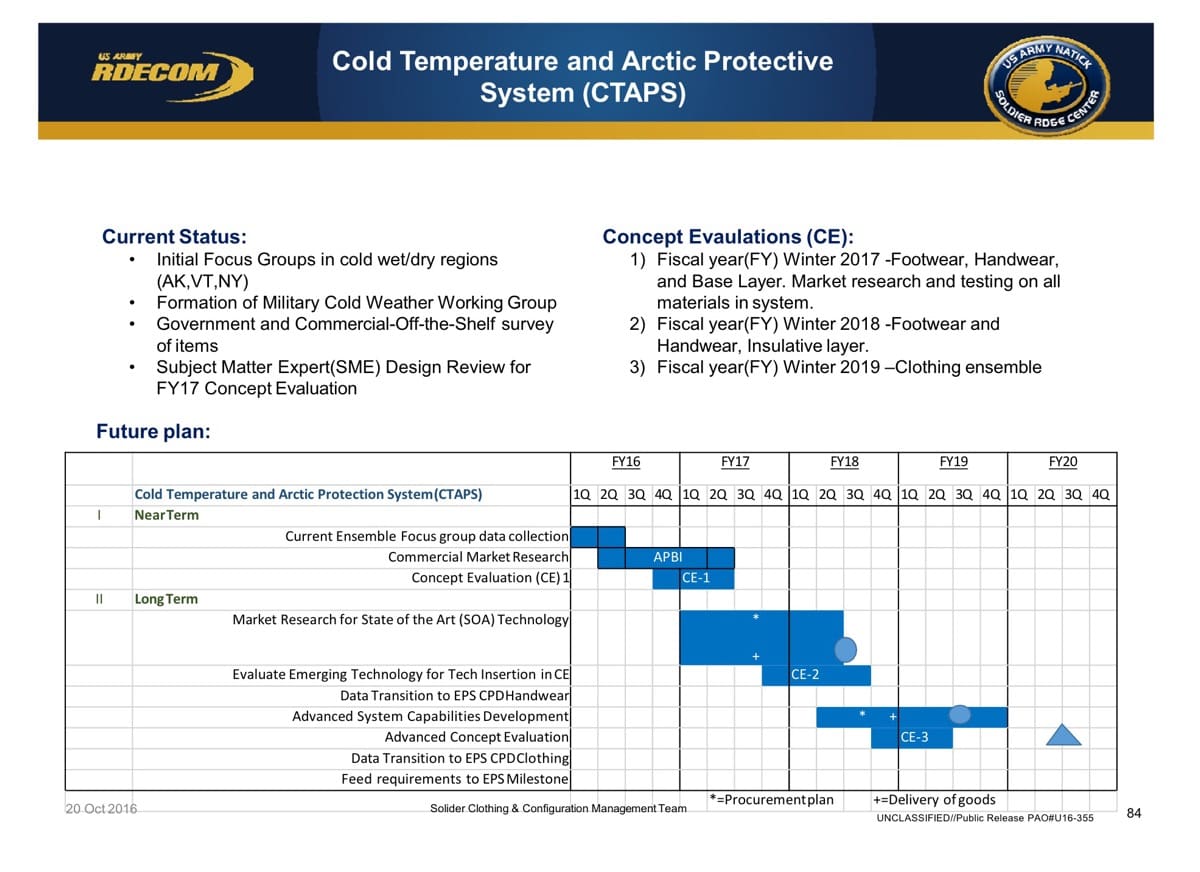
Here are some slides from late last year describing CTAPS. You’ll also notice a reference to “Environmental Protection System,” an overarching program, of which CTAPS is but one component. For example, there will also be a hot/wet aka jungle component of EPS.


According to the RFI, new cold weather materials, end items, and systems should be light weight with better durability, provide high compressibility/good recovery for packing in the ruck, have improved moisture management, and be fast drying while maintaining insulation. The performance of the current seven layer (it’s actually levels not layers, but the RFI refers to them as layers) ECWCS Gen III is the baseline for characteristics and protection upon which materials, individual garments, and complete clothing systems will be compared. The individual garments or layers of the clothing system can be categorized into three areas: base layer (next-to-skin), insulating layer, and outer shell. While flame resistance is not a requirement at this time, materials and items that are flame resistant will be considered. It is also desired to expand no melt/no drip performance beyond the base layers without negatively impacting other performance attributes.

The Government will require 90 days after the 21 April 2017 submission date to make an initial assessment of the proposed technology(s) potential to fulfill CTAPS needs. The Government will integrate selected technologies and designs into test garments for field evaluation in winters 2018 and 2019 to establish operational effectiveness and Soldier acceptance. A test method matrix upon which materials and/or end item garments and systems will be evaluated is attached. Concurrently, NSRDEC will be seeking test methods to better predict operational effectiveness in the field. The Purchase Descriptions of the current ECWCS materials are available upon request. Interested sources may submit any combination of material samples (textiles), end item samples (garments), or complete system samples (ensembles) along with technical information as outlined in item (a) below. The samples will be degraded or destroyed during evaluation and will not be returned to the vendor. If a source chooses to submit samples, no payment will be made by the Government for such samples.

I’m glad to see the government going at the RFI in this fashion. This way they can take a look at best of breed in each category. Unfortunately, when full systems are evaluated against one another, costs are easier to anticipate and control but individual components may be wanting. Natick has been briefing this program since last Summer’s OR and while everyone in industry is excited, there has been some hesitation over the Army’s intent to own the IP for any solution it adopts. This may preclude some of the best solutions from being submitted.

For full details, visit www.fbo.gov.

Revision Awarded US Army Next-Generation ACH Contract

Tuesday, March 21st, 2017

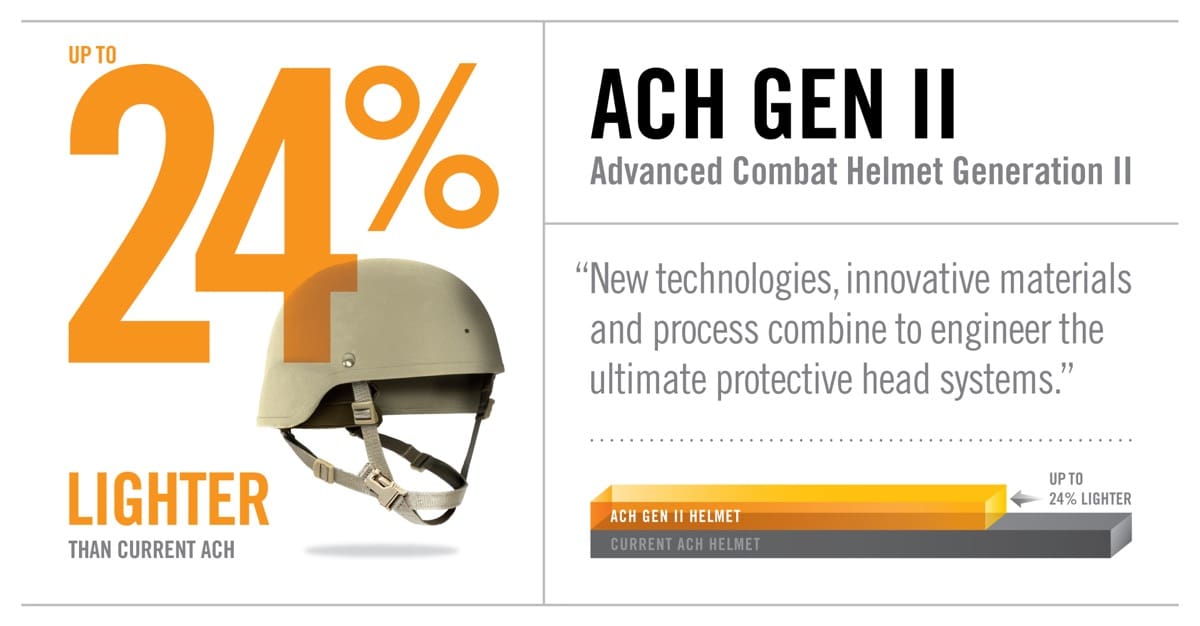
Essex Junction, Vermont (March 21, 2017) – Revision Military, the world leader in integrated head systems, has been awarded the U.S. Army’s Advanced Combat Helmet Generation II (ACH GEN II) helmet contract. This five-year indefinite delivery, indefinite quantity (IDIQ) helmet contract (W91CRB-17-D-0008), awarded on a full and open competition basis to Revision, has a maximum value of $98,111,803 and estimated completion date of March 6, 2022. Revision’s ACH helmet solution is up to 24 percent lighter than the legacy ACH helmet system and this contract represents the first large-scale, significant advancement in ACH technology in 15 years.

Since last contracted by the U.S. Army in 2012—when Revision delivered a total of 180,000 ACH helmets—Revision has invested millions of dollars in new manufacturing equipment and processes, research into the characterization and optimization of advanced ballistic materials, and in the building of a world-class team of scientists and engineers in order to evolve the Company’s capabilities. Additionally, since 2013, Revision’s Newport, Vermont facility—where helmets for this contract will be manufactured—has expanded by 16,000 sq. ft., and the number of employees that work at this facility has more than doubled. As a result of these ongoing investments, and the development of composite materials technological expertise, Revision was able to exceed the weight reduction requirements stipulated in the Army’s solicitation by a sizable margin: The ACH Gen II solicitation required a minimum 15 percent weight reduction compared to the current ACH helmet; Revision’s solution offers up to 24 percent weight reduction over the legacy ACH design, pushing the envelope of attainable weight reduction while maintaining superior ballistic protection.

Revision is dedicated to re-envisioning military head systems with integrated technologies that feature new, cutting edge materials, in a variety of designs and configurations, to exceed all customer requirements. With extensive knowledge of ballistics, electronics, optics, power, and other innovative technologies, Revision is a creative solutions provider, capable of designing and developing custom head protection solutions to meet the changing needs of global militaries.

“With this solicitation, PEO Soldier challenged the helmet industry, raising the technology bar substantially. Revision answered in a big way, dedicating significant resources to set a new standard for lightweight helmet design and performance,” said Jonathan Blanshay, CEO. “Revision has been a proud U.S. Army supplier since 2005, and our investment in this program epitomizes Revision’s unwavering dedication to forward-thinking head systems technology and manufacturing. In the years since Revision was last contracted by the U.S. Army, we’ve become a much stronger company and head systems technology innovator, securing helmet contracts around the world—including for the British Army’s VIRTUS program—and emerging as the vanguard of the U.S. helmet industry. We’re excited to provide this cutting-edge technology to troops in the field who will benefit greatly from the improved performance and significantly lower weight of this next-generation head system. In short, Revision has fully modernized the traditional ACH helmet, bringing this crucial equipment up to speed with the fast pace of modern warfare.”

“This was an intense competition that draws on the reliability and skill of Revision Military’s workforce in Vermont,” said Senator Patrick Leahy (D-Vt.). “The quality of these helmets will protect soldiers from ballistic impacts, while also making them more comfortable with their up to 24% lighter build. Like all Vermonters, I am incredibly proud of the men and women at Revision Military Newport for their hard work and dedication, both of which greatly contributed to Revision being selected for this contract. In past visits to the facility, I have seen firsthand the commitment these employees have to their trade, a commitment depended on by the men and women of our Armed Forces.”


Over Revision’s history, the Company has delivered 1.1 million helmets to the U.S. military, with an additional 300,000 helmets internationally. Across all of these program deliveries, Revision has never received a single warranty claim for product malfunction or defect, has never had to recall a single faulty product, and has never failed a single Lot Acceptance or First Article test. Revision is also the most experienced and most knowledgeable Ultra-High-Molecular-Weight Polyethylene (UHMWPE) manufacturer in the industry. With robust design and development expertise, significant investment in efficient, high-volume manufacturing, and vertical integration, Revision stands ready to meet this U.S. Army’s demand, and will use the revenue generated through this program to continue to build capabilities and advanced innovations to benefit the U.S. military for years to come.

www.revisionmilitary.com

USSOCOM Seeks Personal Defense Weapon

Friday, March 10th, 2017

In a request for information released yesterday to industry, United States Special Operations Command (USSOCOM) seeks to identify potential sources within the national technology and industrial base with the ability to provide a conversion kit for the M4A1 to create a Personal Defense Weapon (PDW) system:

-Complete Kit to include upper receiver and butt stock kit
-Any tools required to complete an operational conversion
-A light and sound reducing suppressor that can be attached to the system when needed

PDW Kit specifics: The kit must be adaptable to the standard M4A1 lower receiver, any modification to the lower receiver must be reversible and nonpermanent. The kit must be in .300 Blackout (BLK) cartridge, total system weight, including the M4A1 lower in not to exceed 5.5lbs. Length with stock extended not to extend 26″ length with stock collapsed or folded shall be 17″ (T), 15″ (O) and a height not to exceed 7.5″. Weapon shall be fully functional when collapsed or folded. Kit should include a 5.56mm barrel that can be changed from .300 BLK to 5.56mm in less than 3 minutes. Accuracy shall be 3.0 MOA (T), 2.0 MOA (O) @100 yds. and 5.0 MOA (T), 3.0 MOA (O) @ 300 yds. both in .300 BLK supersonic.

While there are numerous solutions on the market, based on the mention of a folding stock, it sounds like someone is interested in the SIG SAUER MCX kit.

Interested parties have until 10 April to submit their information. Visit WWW.FBO.GOV for more information.

The IDF’s New “Robocop” Knee Pads

Thursday, March 9th, 2017

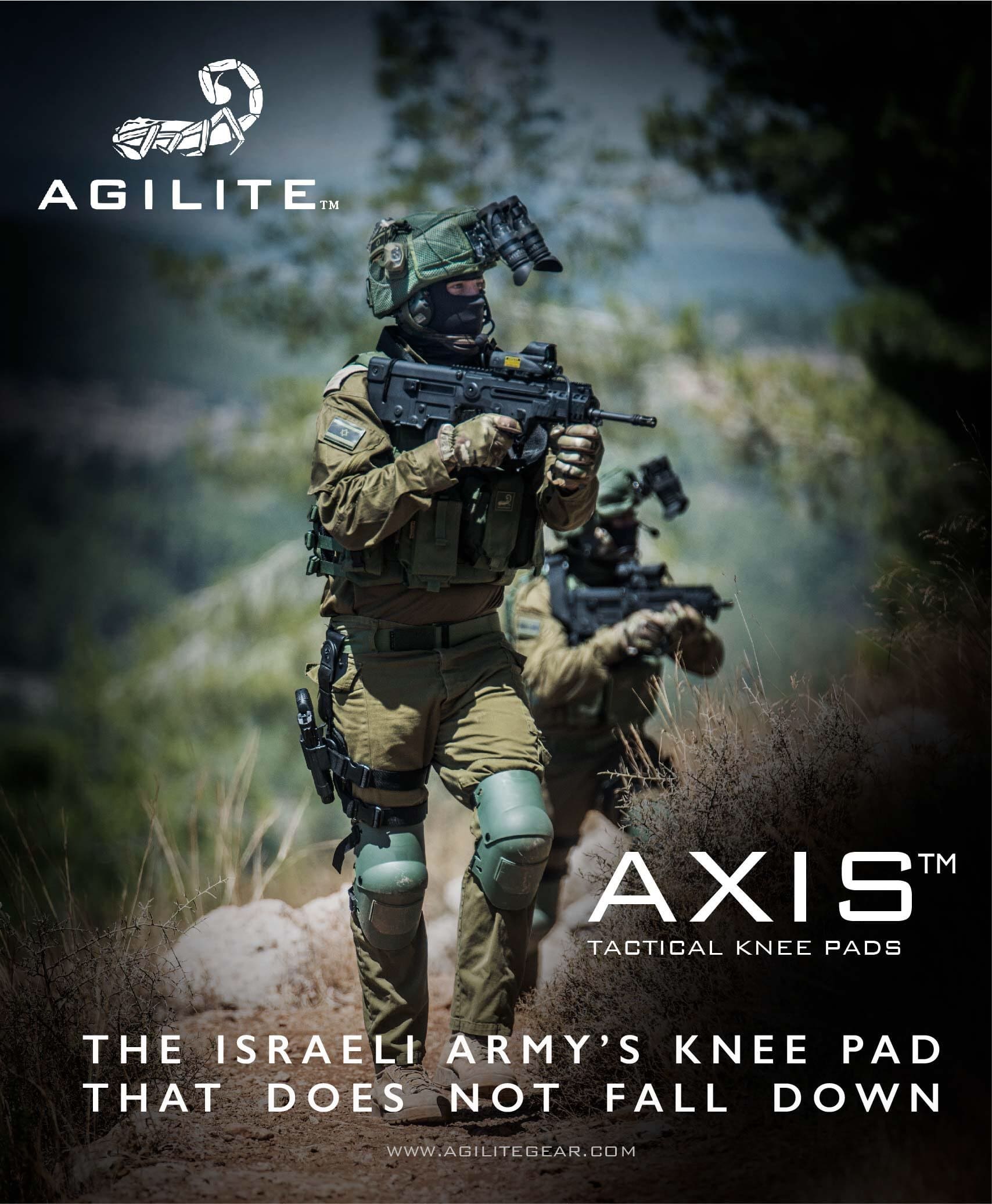
Agilite Axis™ knee pads selected as new standard issue knee pads for all combat troops.

Holon, Israel, 7th March 2017-The Israel Defense Forces (IDF) has announced the selection of Agilite’s Axis™ tactical knee pads for standard issue to all IDF combat troops from March 2017 onwards.

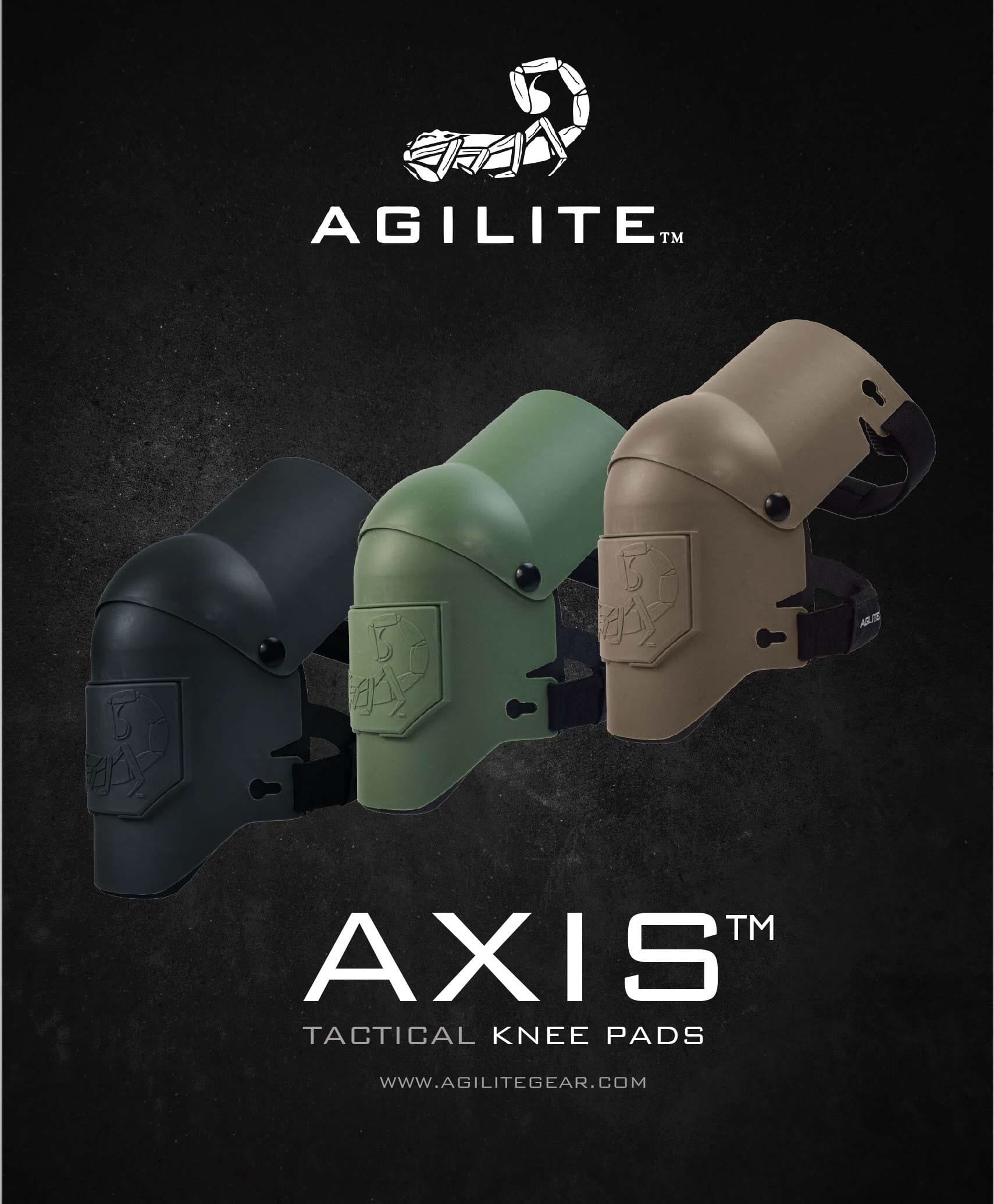
A 2017 adaptation of an old industrial design, Axis’s primary advantage is that unlike regular knee pads, they do not fall down. Whilst rather unusual in appearance (they are nicknamed “Robocop Knee Pads” in Israel), they outperformed every other type of knee pads in extensive IDF trials that spanned several months.

Agilite worked with IDF SF units to perfect the design which provides over 180 degrees of polymer, hard protection as well as internal closed-cell memory foam for comfort even over extended periods. They are also exceptionally light, weighing in at just 9oz (255g).
“Anyone who has spent five minutes in the military knows that with regular knee pads you spend all your time picking them up from your ankles. You put Axis on your knees and forget about them,” said Eric M, a five year veteran of Israel’s Navy SEALS (Shayetet 13) and Head of International sales at Agilite. “The look of them takes some getting used to but they outperform every other tactical knee pad by miles” said Marks. They are also preferential over internal pant knee pads as they provide exponentially more protection, surface coverage and comfort.

The IDF was looking for a new knee pad with increased durability and performance that does not fall down in order to increase combat awareness and the Agilite Axis was selected after an extended period in IDF SOF.

Agilite is now beginning trials of the Axis knee pads in SOF groups across Europe and North America.

Axis are available in Ranger Green, Flat Dark Earth (FDE) and Black from www.agilitegear.com or authorized Agilite dealers and retail at just $32.90.

For more information about Agilite Axis™ or to become and Axis dealer contact:
eric@agilitegear.com or go to www.agilitegear.com.

US Army Awards Revision Military $98M Contract For New Advanced Combat Helmet Generation II 

Tuesday, March 7th, 2017

The Department of Defense just announced a contract award to Revision Military for production of the new Advanced Combat Helmet Generation II. The helmet shares the same shape of the current issue ACH, but boasts a 24% weight reduction thanks to the use of Polyethylene materials.

Revision Military,* Newport, Vermont, was awarded a $98,111,803 firm-fixed-price contract for Advanced Combat Helmet Generation II (ACH GEN II), which includes the procurement of 293,870 production units. Bids were solicited via the Internet with five received. Work locations and funding will be determined with each order, with an estimated completion date of March 6, 2022. U.S. Army Contracting Command, Aberdeen Proving Ground, Maryland, is the contracting activity (W91CRB-17-D-0008).

Congratulations to our Soldiers who will be getting a lighter weight helmet and to Revision, for getting the chance to build them.

Feel The SURG Redux – USSOCOM Again Seeks Suppressor Upper Receiver Group for M4A1 Carbines

Monday, March 6th, 2017

Last year, USSOCOM’s Directorate of Procurement released a solicitation for the Suppressor Upper Receiver Group, however they canceled the program before it was completed. The requirement was a bit too ambitious for the state of the art.

Despite this, SURG isn’t dead. As updates made on the FedBizOpps page from February of this year shows, USSOCOM’s DoP regrouped, rewrote the requirement, and reissued it, with the latest amendment released on March 1st.

As a reminder: “The SURG weapon upgrade of the M4A1 Lower Receiver Group will allow the Warfighter’s weapon to be optimized for continuous suppressed use.” Interestingly, there’s no requirement, at least on the open to the public side, that the upper feature an integral suppressor, just that it is suppressed.

Several companies have licked pieces of the challenge, but not the whole thing as an integrally suppressed upper which can not only handle the M855A1 cartridge but also remain cool enough under use to meet the program’s objectives.

It remains to be seen whether the revitalized requirement will bear an issued product, or will phase out, due to an overly ambitious requirement, like the first time.

Visit www.fbo.gov to view the entire requirement.

GLOCK Protests XM17 Modular Handgun System Award

Monday, February 27th, 2017

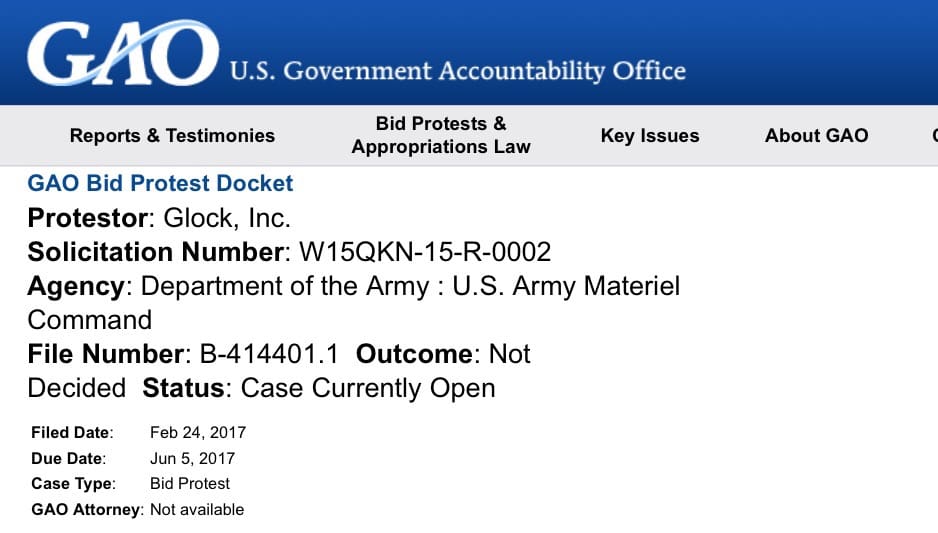
The Government Accounting Office’s protest docket has been updated with GLOCK, Inc’s February 24 protest to SIG SAUER’s January 20th award for the XM17 Modular Handgun System.

img_7810.jpg

The case remains open with a due date of 5 June, 2017. This means work cannot begin on the program until this protest is sorted out.