Colt

Archive for the ‘Drone’ Category

Taking Flight: Pennsylvania Guard Expands Drone Usage

Saturday, November 29th, 2025

FORT INDIANTOWN GAP, Pa. – In a small aircraft hangar on the east end of the post, a makeshift obstacle course has been built primarily from leftover construction material such as wood and PVC pipes.

This isn’t an obstacle course for Soldiers to test their fitness or agility. It’s for operators of unmanned aircraft systems, commonly known as drones.

As seen in Ukraine and elsewhere around the world, drones are becoming more prevalent on the modern battlefield. Where once troops and manned vehicles reigned supreme, unmanned systems now perform numerous missions, including direct attacks, surveillance and target acquisition.

The Pennsylvania National Guard has been using drones for more than a decade, primarily for surveillance and reconnaissance. As tactics have changed in places such as Ukraine, Pennsylvania has strived to keep pace. Chief Warrant Officer 2 Nathan Shea, operations officer with the Unmanned Aircraft Systems facility, said he believes unmanned systems will play an even larger role in future warfare.

“Unmanned systems as a whole – whether that be unmanned aircraft, ground, naval, all of the above – are going to be a massive player in shaping future fights and how we fight,” Shea said. “The more we can remove humans from the front lines and direct combat, I think the more you’re going to see that.”

High-stakes training

The UAS facility at Fort Indiantown Gap dates to 2007 and originally housed the RQ-7 Shadow UAS, which the 28th Infantry Division used until January 2024, when the Army stopped using Shadows.

The Shadow was a fixed-wing UAS with a 20-foot wingspan that was designed for surveillance, reconnaissance and target acquisition, said Shea, who is a member of the 56th Stryker Brigade Combat Team, or SBCT.

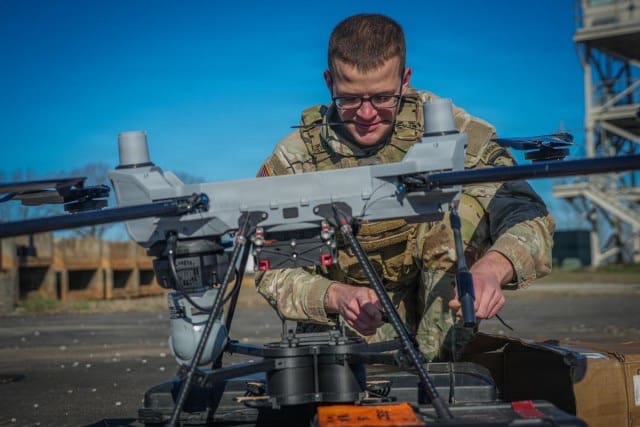
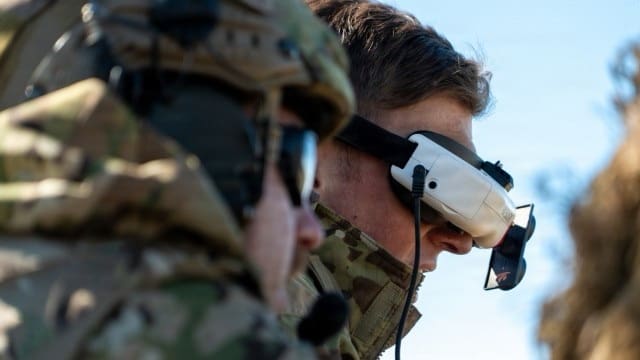
Since the Army has not yet fielded a replacement system for the Shadow, the UAS facility is in a transitional phase. Shea and the other Soldiers who work there are experimenting with different kinds of drones, including first-person-view, or FPV, drones.

The obstacle course, built inside a former Shadow hangar, allows FPV drone operators to practice flying.

“It’s a great indoor, all-weather space that we get to utilize, and it focuses on building out tactics,” Shea said. “Every obstacle, as random as they may seem placed, has a very specific purpose. It’s meant to build accuracy for the pilots.”

Earlier this year, Shea returned from a deployment with the 56th SBCT to Germany, where the brigade assumed responsibility of Joint Multinational Training Group – Ukraine, which trains Ukrainian soldiers. His role was to oversee all UAS operations and the UAS training programs for the Ukrainian Armed Forces.

“We trained these operators from nothing to full-blown drone operators ready to go to war in about 45 days’ time,” Shea said. “It was a very high-stress program. The stakes were very high, and there was very little room for error on either party’s part.”

Shea said he built an obstacle course in Germany similar to the one at the UAS facility to train Ukrainian soldiers, and he plans to build an outdoor training course eventually.

Like other Army units – both active duty and National Guard – Pennsylvania is waiting for funding to build out its UAS capabilities, Shea said. He knows which systems he would like and which are needed to support the different missions.

“There’s no 100 percent answer on a system right now,” Shea said. “What works for the cav [cavalry] is not going to work for the engineers, probably. The advantage is we already tested a lot of these systems, so we know what systems we need, we know what modifications we need to make to those systems to make them fit more warfighting functions.”

‘UAS is the future’

At the 166th Regiment – Regional Training Institute, a U.S. Army schoolhouse on Fort Indiantown Gap that offers numerous courses, instructors are teaching students in several military occupational specialties about drones.

On a recent day, Soldiers from across the Army attending the infantry Advanced Leader Course, or ALC, received a drone familiarization class.

The class was split: half of the Soldiers conducted dismounted infantry operations and infantry tactics, while the other half discussed drone use and what’s happening on the front lines now. While half of the class had those discussions, an instructor used a small quadcopter drone to observe the other half of the class in the nearby woods.

“If we look at the operational environment and the battlefields around the world right now, UAS is the future, and we have to address that fight,” said Sgt. 1st Class Mark Thompson, course manager for the infantry ALC at the 166th Regiment. “These guys are going to be the ones on the front lines, whatever the next major engagement is, so we want them to be able to see drones and experience them for the first time here in a controlled environment, not on the front lines.

“It’s very, very important for them to be able to start encompassing that in the way that they train, the way that they operate,” Thompson added.

Thompson said the 166th Regiment is implementing drones on different fronts. In addition to the familiarization classes, the 1st Battalion also runs the Small Unmanned Aerial System Operator Course, in which students learn drone basics.

The 166th has been using UAS for several years, and the training is constantly evolving as new technologies and new tactics emerge, Thompson said.

“We have a fantastic staff who are all very dedicated to maintaining the most current up-to-date stuff coming off the battlefield right now, whether that be in the European theater or around the world, or down at the border in the United States, how drones are being implemented by friendly and by enemy assets,” Thompson said. “When we get that stuff, we pretty much have a working group as a staff, discuss the positives and negatives, and then we implement it to the students.”

Thompson said UAS familiarization is very important because it gives Soldiers a foundational knowledge base to operate drones efficiently.

“We want them to be able have that foundational knowledge in a training environment so that when they actually go to do it in real world, they are 10 times more proficient because they have that foundational base,” Thompson said.

Drones in the field

Across the Pennsylvania National Guard, Soldiers have increased their use of drones during training throughout the past year.

In August, Soldiers with 1-109th Infantry Regiment, 2nd Infantry Brigade Combat Team – along with Soldiers from 1st Battalion, 107th Field Artillery Regiment and representatives of Carnegie Mellon University’s Software Engineering Institute – used drones and artificial intelligence to make the process of requesting artillery fire less stressful for Soldiers on the battlefield.

The exercise, part of Project Shrike, used a software package developed by Carnegie Mellon University’s Software Engineering Institute in partnership with the U.S. Army Artificial Intelligence Integration Center. This artificial intelligence-enabled system enables artillery units to detect, target and engage threats faster and with greater precision. The project reduces the complex task of calling for fire to mere seconds.

“The system highlights targets and recommends firing solutions for operator decision,” said Chad Hershberger, a software engineer with Carnegie Mellon University’s Software Engineering Institute. “The human is in the decision loop in order to accept or reject the system’s recommendation.”

In a similar exercise in November 2024, instructors from the 166th Regiment’s 1st Battalion used quadcopter drones to gather target information and send it to students taking the artillery Advanced Leader Course under the guidance of instructors from the 2nd Battalion. The students then engaged the targets with howitzers.

They also used drones to observe the fall of the artillery rounds, make required adjustments and conduct battle-damage assessments.

“We’ve been seeing it through open-source intelligence, obviously in the conflict that’s going on in Ukraine, that they’ve been doing a lot of these things, so we’re adjusting with the times, and we’re developing procedures and efficiencies in order to conduct these tasks,” said Sgt. 1st Class Richard Hutnik, quality assurance noncommissioned officer for the 1st Battalion who was piloting a drone during the exercise.

Whether on an obstacle course, in a classroom or in a field training environment, the Pennsylvania National Guard is attempting to stay at the forefront of drone tactics and technology as drone usage continually increases on the battlefield.

By Brad Rhen

Origin Robotics Selected by Belgian Ministry of Defense to Supply BLAZE Drone Interceptors

Wednesday, November 19th, 2025

RIGA, Latvia (18 November 2025)Origin Robotics announced today that the Belgian Ministry of Defense has selected its AI-powered BLAZE interceptor as part of a newly approved 50 million euro national counter-drone package aimed at strengthening Belgium’s ability to detect, track and neutralize hostile unmanned aerial systems. The procurement follows several weeks of escalating drone incursions over airports, military facilities and critical infrastructure.

Belgium’s decision comes amid significant pressure to reinforce its airspace security. The country has struggled to respond to repeated air traffic interruptions due to insufficient counter-drone capacity. In recent weeks Belgium had to call in support from Germany and the United Kingdom to compensate for the shortfall. The new short-term package is intended to restore immediate operational resilience while the Ministry of Defense prepares a longer-term investment plan. In addition, Defence Minister Theo Francken has announced a 500 million euro comprehensive anti-drone program for sustained capability development.

Agris Kipurs, CEO and co-founder of Origin Robotics, said, “This decision reaffirms Origin Robotics as a leading company in the field of advanced autonomous defense systems. In essence, this is a major statement of confidence. Belgium is facing an immediate security problem and has chosen BLAZE as the solution. We are proud to support a NATO ally with a system built for exactly this type of threat environment and we remain committed to delivering reliable, cost-effective and rapidly deployable capabilities.”

Launched in May 2025, BLAZE is an autonomous interceptor designed to neutralize fast-moving aerial threats, including loitering munitions and hostile drones. It combines radar-based detection, AI-powered computer vision and operator-approved autonomy to deliver precise, rapid and scalable defensive capability. The system is man-portable, deployable in minutes and capable of high-intensity operational cycles. BLAZE delivers intercepts through airburst fragmentation and includes robust safety features such as operator-controlled wave-off commands for return or self-neutralization.

The Belgian procurement reinforces the growing adoption of Origin Robotics technologies across Europe. Following the battlefield-proven deployment of Origin’s BEAK system with the Latvian and Ukrainian Armed Forces, as well as recognition through national and EU defense programs, Origin continues to expand its role as a trusted supplier of autonomous aerial defense solutions.

SOFWERX – Low-Cost Thermal EO/IR FPV Cameras Assessment Event

Wednesday, November 19th, 2025

SOFWERX, in collaboration with USSOCOM Program Executive-Special Operation Forces Warrior (PEO-SW), will host an Assessment Event (AE) 27-29 January 2026 to evaluate low-cost First Person View (FPV) Small Unmanned Aircraft System (sUAS) (Group 1) Thermal and EO/IR cameras. Primary focus is fixed mounted cameras with low SWaP and secondary focus is gimballed payload with IR Pointer. 

Current fielded camera systems are high cost or low quality making it uneconomical for consumable FPV drones to operate, or ineffective in training and the battlefield due to lower quality. USSOCOM requires lower cost camera units to bring down the overall cost of the Group 1 UAS program.

Primary objective is to field and deploy low-cost/low-SWaP Thermal and EO/IR cameras that can integrate onto current and future Group 1 sUAS FPV drones. Secondary objective is to find a low-SWaP gimballed Thermal and EO/IR with a Class 3B IR Pointer.

Submit NLT 12 December 2025 11:59 PM ET

Visit events.sofwerx.org/eoirfpv-cameras for more information.

US Air Force Awards Skydio Initial Contracts to Bring Advanced Autonomy to Mission-Critical USAF Specialties

Friday, November 14th, 2025

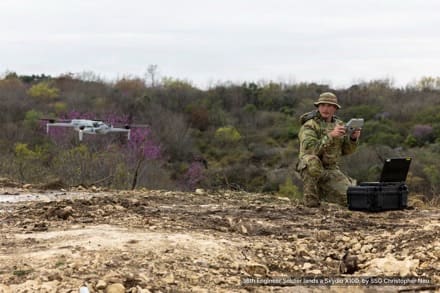
Skydio X10D systems to enhance situational awareness and mission capability for Tactical Air Control Party and Explosive Ordnance Disposal units

Skydio, the leading U.S.-based drone manufacturer and world leader in autonomous flight technology, in partnership with ADS, a leading provider of products, technology, and logistics solutions for the U.S. Military, today announced two initial multi-million dollar contract awards with the U.S. Air Force (USAF) to expand the deployment of Skydio systems across multiple operational units. These efforts extend Skydio’s presence across Air Combat Command (ACC) Tactical Air Control Party (TACP) and Explosive Ordnance Disposal (EOD) units, supporting the Air Force’s broader initiative to integrate uncrewed systems into every Airman’s toolkit.

The Skydio systems will support TACP Airmen in characterizing enemy order of battle, enhancing situational awareness, acting as communications relays, and enabling near-peer engagements through integration with strategic platforms and weaponeering solutions.

In a parallel effort, Skydio has also been selected as the aerial robot of choice for USAF EOD units deploying Skydio systems for both garrison operations and contingency deployments with additional systems planned over the next 18 months.

These contracts align with the Air Force’s broader effort to reimagine the Airman identity—integrating uncrewed systems to extend capability, situational awareness, and mission efficiency at every level. USAF Security Forces use Skydio systems on a daily basis for Base Defense and Installation Security, demonstrating the critical role of autonomous drone technology in protecting U.S. Air Force assets. Beyond security applications, units are also operating Skydio technology, such as aircraft inspection modernization at Travis Air Force Base, where the 60th Maintenance Group pioneered the Air Force’s first drone-based inspection program and reduced C-17 inspection times by more than 90 percent—demonstrating the versatility of Skydio systems across diverse mission requirements.

Skydio X10D delivers operational performance with:

  • A sensor package that is unrivaled in any sUAS this size, including a 48MP telephoto camera
  • A best-in-class Teledyne FLIR Boson+ thermal sensor that can pinpoint temperature differences at each pixel
  • Operational resiliency in environments of contested RF and GPS denial with onboard AI and autonomy
  • Built-in AI for visual navigation – up to 300m altitude – comes standard
  • Advanced obstacle avoidance in every direction
  • A proprietary navigation model for use in zero-GPS environments that utilizes a reference point chosen by the operator, ensuring the X10D can find its way back to the original take off point.
  • Modular, open platform that supports custom third-party attachments and controllers
  • Powerful, full-stack security, starting with the chipset and its firmware
  • IP55 rating for nearly all-weather operation

X10D, part of the Blue UAS Cleared List, also meets the stringent cybersecurity and capability requirements the Department of War demands.

These Air Force awards add to Skydio’s growing partnerships across all branches of the U.S. military, including the U.S. Army’s Short Range Reconnaissance (SRR) Tranche 2 program. The breadth of adoption—from special operations to conventional forces—reflects the operational trust earned by systems designed, assembled, and supported in the United States. Skydio also proudly supports 28 allied nations and 3,500+ public safety agencies, utilities, and enterprise customers worldwide. Skydio’s manufacturing facility in Hayward, CA, is one of the world’s largest drone manufacturing facilities outside of China.

For more information about Skydio for national security, please visit skydio.com/natsec.

US Army Selects Neros Archer FPV and Flatbow Ground Control System for Purpose-Built Attritable Systems (PBAS) Program

Tuesday, November 11th, 2025

LOS ANGELES–Neros is proud to announce its selection as one of the three primary manufacturers of FPV drones for the U.S. Army’s Purpose-Built Attritable Systems (PBAS) program Tranche 1 — an initiative designed to deliver effective, modular, and mission-adaptable FPV drone capabilities to platoon-level units across the force. Through PBAS, Neros will supply the Army with its Archer and Archer Strike drone platforms in both 5-inch and 10-inch variants. These platforms represent the next-generation evolution of the battlefield-tested Archer 8-inch system.

The Army package also includes Flatbow, an upgraded soldier-borne variant of Neros’ Crossbow Ground Control System. This program validates a comprehensive development cycle driven by real-world results in Ukraine and cements Neros’ position as the leading provider of FPV drones to the Department of War.

Archer Strike’s architecture integrates directly with combat-proven anti-armor and anti-personnel Kraken Kinetics Terminus strike payloads to engage targets at ranges exceeding 20 kilometers. The non-Strike variants of Archer deliver major enhancements to ISR capabilities and feature easily modifiable, fully customizable payload configurations — empowering operators to adapt the system to any mission. Flatbow extends these capabilities by providing a rugged, mobile control platform that incorporates advanced technologies to mitigate jamming threats in contested electromagnetic environments.

Together, the Archer + Flatbow PBAS package equips the U.S. Army with a flexible, domestically produced sUAS solution that delivers state-of-the-art, globally competitive FPV capabilities to the warfighter.

“The PBAS program selection caps over two years of rigorous system development and testing with both our Ukrainian and U.S. military partners. An immense amount of engineering effort and team dedication has gone into designing and producing the custom componentry required to meet our performance standards and secure our supply chain,” said Soren Monroe-Anderson, CEO of Neros. “These important procurement programs signal the Army’s and the DoW’s seriousness in addressing critical gaps in our drone capabilities and industrial base. Neros is committed to supporting these efforts and helping our nation meet the rapidly growing demand for sUAS defense solutions.”

Neros is dedicated to ensuring the West maintains an asymmetric advantage over its adversaries by manufacturing advanced FPV systems at scale through resilient allied supply chains.

The Future of Autonomous Fighters Is Coming To Rome

Saturday, November 8th, 2025

GA-ASI Brings Uncrewed Fighter Fleet into Focus at International Fighter Conference 2025

SAN DIEGO – 03 November 2025 – General Atomics Aeronautical Systems, Inc. (GA-ASI), the world leader in uncrewed aircraft systems, is excited to participate in the upcoming 25th anniversary of the International Fighter Conference as the event’s only Four-Star Lead Partner, reflecting the company’s global commitment to the future of autonomous fighter jets.

GA-ASI’s growing production fleet of unmanned combat jets – including the MQ-20Avenger®, XQ-67A Off-Board Sensing Station, and YFQ-42A Collaborative Combat Aircraft – is defining the global future of autonomous and semi-autonomous combat jets, leading the way in autonomy development, manned-unmanned teaming, and affordable, rapid delivery at scale. The company’s vision for its Gambit Series of modular, scalable, uncrewed fighters paves the way for U.S. forces, allies and partners to quickly evolve global air forces for the future fight.

Publicly promising to build and fly a production-representative uncrewed jet fighter for the U.S. Air Force by summer 2025, GA-ASI launched its YFQ-42A CCA in August, pioneering a new era for fighter jets. Flight operations continue today across the growing fleet, cementing GA-ASI’s continued dominance in UAS development and delivery while meeting anticipated timelines and remaining true to its word.

“The YFQ-42A is a revolutionary aircraft, and the fleet is in production and in the air today,” said David R. Alexander, president of GA-ASI. “This isn’t a ‘wait and see’ moment. We’re flying. We’re delivering. And we’re advancing this future of combat aviation, the same way we have for more than three decades.”

Since 1992, GA-ASI has delivered more than 1,300 combat aircraft to U.S. forces and international partners, surpassing more than 9 million total flight hours in 2025. The company’s Predator®, Reaper®, Gray Eagle®, SkyGuardian®and SeaGuardian® aircraft continue to set the standard for medium-altitude, long-endurance UAS performance.

The company’s MQ-20 Avenger, an internally funded uncrewed combat jet that achieved first flight in 2009, continues to serve as a test bed for advanced autonomy integration and demonstration, incorporating and flying the latest cutting-edge software from U.S. government sources, leading industry suppliers and GA-ASI’s own autonomy software development teams, often at company expense.

For International Fighter Conference, Nov. 4-6 in Rome, GA-ASI plans to offer attendees a chance to see the future for themselves, with a full-scale model display of the YFQ-42A CCA co-located inside the show venue and other announcements. For more information on IFC 2025, visit www.defenceiq.com/events-internationalfighter.

Apium Joins Red Cat Futures Initiative to Advance Swarming Autonomy for Tactical Drones

Tuesday, November 4th, 2025

Partnership follows successful U.S. Army testing of Apium’s Swarm Autopilot and Ground Control system integrated into Red Cat’s Teal Drone Operational Capabilities
SAN JUAN, Puerto Rico, Nov. 04, 2025Apium Swarm Robotics, Inc. a developer of distributed autonomy for unmanned systems, has signed a Memorandum of Agreement (MOA) with Red Cat Holdings, Inc. (Nasdaq: RCAT), a U.S. based provider of advanced all-domain drone and robotic solutions for defense and national security.

Through this agreement, Apium joins the Red Cat Futures Initiative, an industry-wide robotics and autonomous systems (RAS) consortium dedicated to putting the most advanced and interoperable uncrewed aircraft systems into the hands of warfighters.

The announcement follows successful integration of Apium’s technology onto Red Cat’s Teal 2 drone enabling the drones to autonomously perform multi-agent missions at the Army’s ACM-UAS Industry Day at Fort Rucker, Alabama. The demonstration showcased the value of decentralized, scalable drone swarming for modern military operations.

“One to Many swarming is the future of autonomous warfare,” said Tyler MacCready, Founder and Chief Scientist at Apium. “However, there needs to be a balance between autonomy and operator accessibility to ensure effectiveness. Our technology allows full swarm capability to be added to existing ‘off the shelf’ multi-domain UxS enabling a single operator to launch, command, and adapt swarms in real time without complex pre-mission planning or centralized control. Partnering with Red Cat and joining the Futures Initiative enables us to deliver that capability at the tactical edge.”

Enabling Tactical Swarms at Scale

Apium’s system scalability is a result of moving the swarm logic from a centralized ground station to the drone itself. This allows each drone to make independent decisions through cooperation with neighboring vehicles without requiring a constant up-link or ground control. This architecture eliminates single points of failure, allowing the swarm to continue to operate even when vehicles fail or ground station communications are lost. The system has also demonstrated resiliency when degraded by jamming or interference.

Operators can engage any of the variety of behaviors found in Apium’s Swarm Library with just a few taps on a touch screen interface. These behaviors range in complexity from orbiting over a target, to fully automated collaborative sorties. Behaviors may be changed or adjusted, at any time, even after the swarm has been launched. Vehicles may join or leave the swarm mid-mission, allowing vehicles to be temporarily reassigned for direct individual control, sensor ops, or kinetic action and later reintegrate with the swarm seamlessly.

“Apium’s system brings distributed drone swarming out of the lab and onto the battlefield,” said Jason Gunter, Director of Special Programs at Red Cat and head of the Futures Initiative. “They’ve proven that you can run adaptive, resilient swarming behaviors with minimal operator burden and without constant connectivity or centralized control. This is a major leap forward for tactical autonomy and the exact capability our warfighters need in complex, contested environments.”

Scaling Autonomy for Complex Operational Environments

The Futures Initiative is a strategic collaboration aimed to fast-track the deployment of autonomous systems across air, land, and sea. It connects Red Cat with industry innovators in AI and computer vision applications, 3D mapping, target acquisition, swarming, and other sUAS decision support features. The program also supports broader national efforts such as the DoD’s priority to rapidly field attritable, autonomous platforms.


By joining the Futures Initiative, Apium will collaborate with Red Cat to integrate its swarm-enabled platform across Red Cat’s entire Family of Systems, led by the Black Widow™. Apium’s technology is also autopilot-agnostic, compatible with PX4, ArduPilot, and other common systems, enabling rapid integration across both current and future unmanned assets.

Auterion Successfully Completes Artemis Program to Deliver Long-Range Deep Strike Drone

Thursday, October 30th, 2025

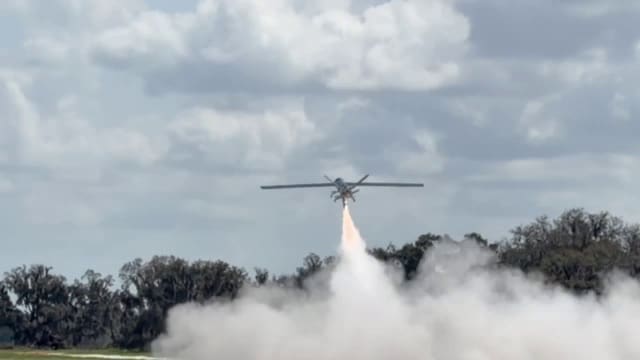
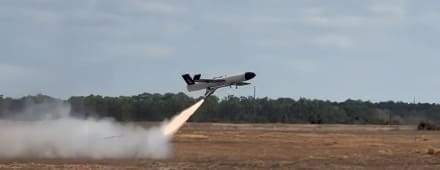
Arlington, VA – Auterion, a global leader in defense drone software and AI-enabled autonomous systems, today announced the successful completion of the Defense Innovation Unit’s Artemis project. The program delivered a deep strike drone proven in Ukraine with up to 1,000 miles range and visual targeting.

The Artemis system is a design similar to a Shahed drone, developed in Ukraine and with manufacturing lines being built in the U.S., Ukraine, and Germany. It offers a 1,000-mile range and can carry warheads of up to 40 kilograms. It relies on Auterion’s Skynode N mission computer and Auterion Visual Navigation system, enabling the drone to navigate and strike targets even when satellite-based navigation is disrupted. The built-in terminal guidance ensures pinpoint accuracy in the final stage of flight.

Auterion is partnered, for the Artemis program, with a Ukrainian hardware manufacturer, whose name is being kept confidential for operational security reasons. Auterion has built partnerships with U.S. and European manufacturers to scale up long range applications. Bringing learnings from the battlefield in Ukraine to U.S. forces and allied partners is a key contribution of Auterion to national security.

Government evaluators have signed off on the program after operational flight tests in Ukraine. The tests included ground launch, GPS and GPS?denied navigation, long-range transit, and terminal engagement. Following these successful evaluations, Auterion now offers the system to the U.S. Department of War and allied nations, with manufacturing capabilities established in both the United States and Europe.

“Software-driven autonomy is changing the nature of deterrence,” said Lorenz Meier, CEO of Auterion. “Our Artemis entrant is designed for mass production and rapid deployment, enabling partner nations to field resilient autonomous strike capabilities at scale. We are ready to build the long-range deterrence force needed to tackle new challenges, especially in the Indo?Pacific.”

The long range drone is part of Auterion’s larger portfolio of short to long-range, one-way attack drones being developed under U.S. defense initiatives. The system leverages Auterion’s open architecture and battle-tested software to ensure rapid adaptability and seamless integration within the broader defense ecosystem. This effort is building on the company’s proven track record of supplying AI?enabled strike kits to Ukraine.


With the Artemis program concluded, Auterion is entering the scale-up phase with the Department of War and allied partners to work towards co?production at mass scale. The company is committed to supporting domestic U.S. production while delivering a common software layer that ensures interoperability and continuous improvement. “This isn’t a black box. It’s a scalable platform that our partners can build and evolve,” Meier added.

auterion.com