Danner Reckoning GTX

Archive for the ‘Drone’ Category

Silvus StreamCaster 4400 Enhanced MANET Radio Receives Department of Defense (DoD) Certification for Secure U.S. Military Drone Operations

Tuesday, December 9th, 2025

DoD’s innovation unit and AUVSI, a leading autonomous innovation industry group, validate expanded portfolio of Silvus NDAA-compliant radios for secure use in unmanned missions

CHICAGO – December 9, 2025 – Silvus Technologies (Silvus), a Motorola Solutions (NYSE: MSI) company and a global leader in advanced wireless networking solutions, today announced that the U.S. Department of Defense (DoD) Defense Innovation Unit (DIU) has added the StreamCaster 4400 Enhanced (SC4400E) mobile ad-hoc network (MANET) radio to its Blue UAS Framework, a rigorous testing and certification program that approves technologies for use in U.S. military unmanned aircraft system (UAS) operations. The Association of Uncrewed Vehicle Systems International (AUVSI) has also added the SC4400E to its Green UAS Cleared Components list, certifying it meets rigorous cybersecurity and supply chain standards for commercial drones and components.

“The Blue UAS Framework and AUVSI Green UAS certification validate that the SC4400E MANET radio meets the rigorous standards for secure, mission-critical connectivity demanded by today’s leading-edge unmanned systems operating in the world’s most challenging and contested environments,” said Neema Daneshvar, vice president of Product, Silvus Technologies. “Its addition to both programs strengthens Silvus’ position as a benchmark for robust, secure and resilient command and control (C2) and mesh networking solutions for UAS and unmanned operations.”

Powered by Silvus’ proprietary Mobile Networked MIMO waveform, SC4400E radios create a scalable connected mesh network that can link hundreds of nodes, from drones to ground radios, to stream high-bandwidth video, voice and sensor data back to command with extreme range. The radio is designed to easily integrate into fixed infrastructure or vehicular, maritime, airborne or unmanned systems, to support missions across air, land and sea. 

The SC4400E provides access to Spectrum Dominance 2.0, an ever-expanding suite of electronic warfare (EW) defense capabilities, including Low Probability of Intercept/Low Probability of Detection (LPI/LPD), Anti-Jamming and Advanced Threat Protection. These capabilities help deliver secure and protected communications in congested and contested spectrum environments without sacrificing performance, even under electromagnetic attack.

The National Defense Authorization Act-compliant SC4400E joins the StreamCaster SC4200EP, StreamCaster LITE SL4200 and SL5200 MANET radios on the Blue UAS Framework and Green UAS Cleared Components list. 

Neros Secures Multi-Million Marine Corps Contract for Archer Strike FPV Drones

Saturday, December 6th, 2025

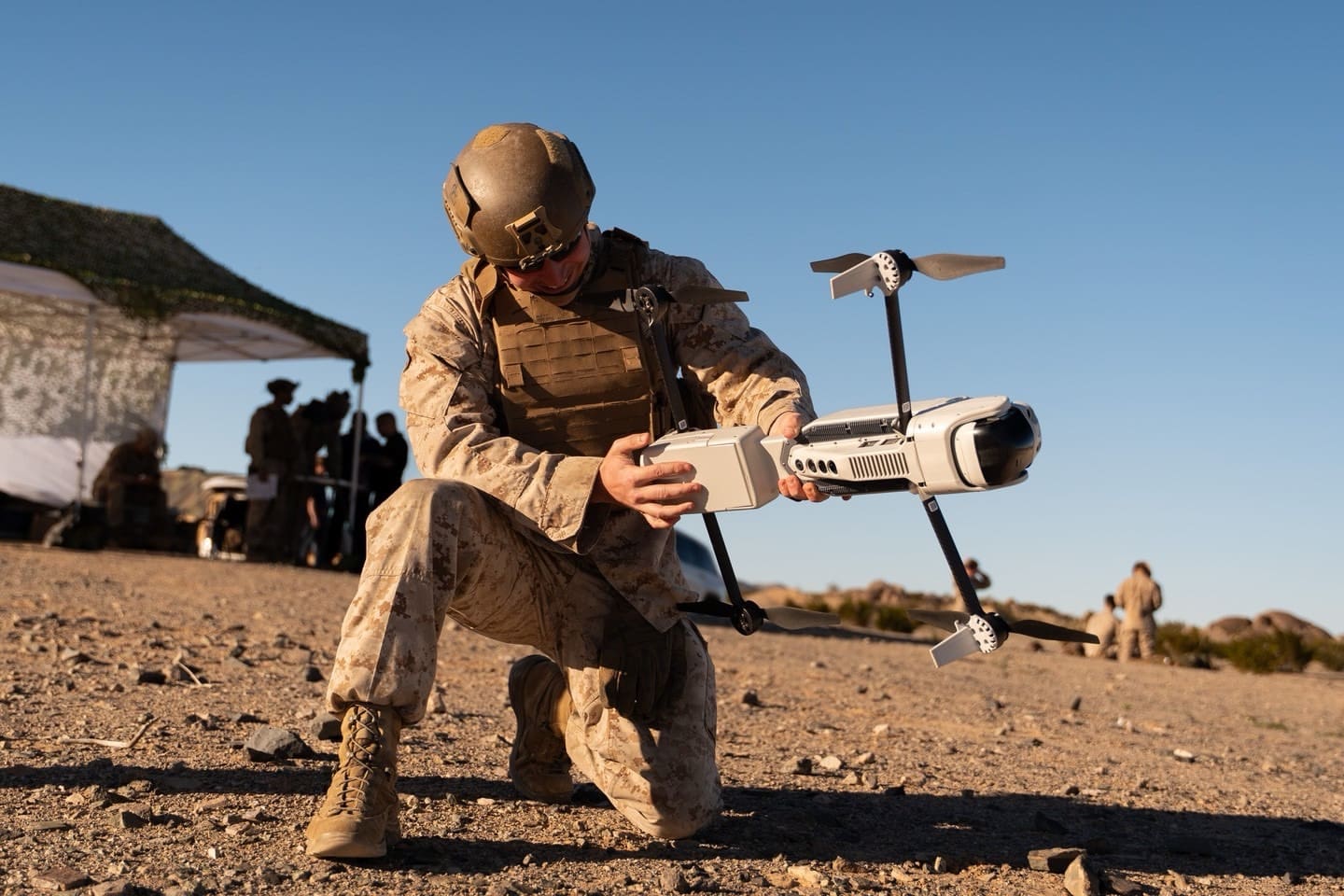
U.S. Marine Corps engaging with the Archer Strike FPV Drone System (Photo by Cpl. Joshua Barker)

El Segundo, CA – Neros Technologies has been awarded a multi-million delivery order contract with the United States Marine Corps to provide advanced small unmanned aerial systems (sUAS) — including kinetic-strike capable FPVs — together with comprehensive operator training and support, across the Fleet Marine Force (FMF).

The award underscores the Marine Corps’ push to rapidly field combat-proven, American-manufactured drone technologies that ensure asymmetric effects capability by expeditionary combat units—at scale. Built without Chinese components and certified under the Department of War’s Blue UAS program, Neros’ Archer FPV drone fleet brings trusted, secure capability directly to Marines operating in contested environments.

The Archer Strike FPV Drone (Photo by Cpl. Joshua Baker)

“This order reflects the lightening pace the Marine Corps is working at to train, develop TTPs, and deploy FPV capabilities. The Marine Corps Attack Drone Team and Marine Corps Warfighting Lab have been instrumental in positioning the Marines as the first-mover in FPV within the service branches.” said Soren Monroe-Anderson, CEO of Neros Technologies “We are proud to work with our partners at Kraken Kinetics, makers of the Terminus modular mission payload system, to deliver these systems and associated training within months, thanks to our scaled production operation and dedicated Mission Success team.”

“We are very grateful for the Marine Corps’ support, and we are committed to putting the best possible asymmetric FPV drone systems in Marines’ hands,” Monroe-Anderson added.

U.S. Marine Corps preparing an Archer Strike FPV Drone (Photo by Cpl. Zachariah Ferraro)

The delivery order includes both system deliveries and hands-on training, ensuring rapid integration of FPV sUAS capabilities into Marine Corps infantry units and Marine Expeditionary Units. By pairing technology with instruction, the Marine Corps gains an immediate kinetic operational FPV capacity that has been proven on the Ukrainian battlefield.

Since the company’s launch in 2023, Neros Archer has become the highest production rate drone built in the United States. The company’s work with the Defense Innovation Unit, early fielding in Ukraine, and accelerating U.S. production base highlight Neros’ ability to move swiftly and deliver trusted systems to the Marines and soldiers who need them.

U.S. Vice President JD Vance engaging with the Archer Strike FPV Drone System (Photo by Cpl. Joshua Barker)

Centcom Launches Attack Drone Task Force in Middle East

Thursday, December 4th, 2025

U.S. Central Command announced today a new task force for the military’s first one-way attack drone squadron based in the Middle East.

Centcom launched Task Force Scorpion Strike four months after Secretary of War Pete Hegseth directed acceleration of the acquisition and fielding of affordable drone technology. The task force is designed to quickly deliver low-cost and effective drone capabilities into the hands of warfighters. 

The new task force has already formed a squadron of low-cost unmanned combat attack system drones. 

These drones, deployed by Centcom, have an extensive range and are designed to operate autonomously. They can be launched with different mechanisms including catapults, rocket-assisted takeoff, and mobile ground and vehicle systems. 

“This new task force sets the conditions for using innovation as a deterrent,” said Navy Adm. Brad Cooper, Centcom commander. “Equipping our skilled warfighters faster with cutting-edge drone capabilities showcases U.S. military innovation and strength, which deters bad actors.” 

In September, Centcom launched the Rapid Employment Joint Task Force led by its chief technology officer to fast-track processes for outfitting deployed forces with emerging capabilities. 

The joint task force is coordinating innovation efforts among service components in three focus areas: capability, software and technological diplomacy. 

Task Force Scorpion Strike’s efforts to build the one-way attack drone squadron are led by personnel from U.S. Special Operations Command Central and align with the joint task force’s capability focus area. 

CENTCOM PAO

World-First Managed Procurement System to Enhance the Success of the Drone Industry

Thursday, December 4th, 2025

[London: 3 December 2025]: Today, leading independent drone advisors, Drone Major, have launched a first-of-its-kind managed procurement services platform for the global drone industry, which will help power Britain’s procurement process and drive innovation across Small and Medium-sized Enterprises (SMEs) in the UK’s drone sector.

The launch of the new managed procurement platform will enable buyers and suppliers in the UK drone industry to efficiently fast-track major projects andunlock new opportunities for SMEs to participate in previously inaccessible large-scale projects.

Drone Major, which secured approval from the UK Civil Aviation Authority (CAA) for the UK’s first beyond visual line of sight (BVLOS) drone flights over the UK’s Critical National Infrastructure in May 2025, has enhanced its existing supplier platform toconnect global suppliers with high-value procurement opportunities in robotics, drones, and unmanned systems.

Robert Garbett, Founder and Chief Executive of Drone Major, commented on the new launch: “The UK has the talent and technologies, many of which reside within our own SME base, but it has lacked the mechanism to bring them to the front line effectively. The launch of our new platform marks a major step forward in empowering British SMEs and startups, giving them a powerful tool to navigate and simplify complex procurement processes in the drone industry.”

“It will help place the UK at the forefront of the global drone industry, while also strengthening the UK’s supply chain independence… and reducing reliance on China.”

The global drone and robotics market is projected to grow from a current size of £55 billion in 2024 to £121 billion in 2030, presenting British SMEs with a major opportunity.[1]

Drone Major’s new platform is centred around a business-to-business marketplace to connect buyers and suppliers globally with vetted, trusted partners in the drone and robotics ecosystem.

It enables the delivery of end-to-end programmes, with Drone Major coordinating the complete supply chain process, ensuring on-time and on-budget project completion.  Drone Major will evaluate supplier bids, select the most capable vendors, and then manage the entire supply-chain execution, in addition to handling compliance, regulatory approval (including harnessing Drone Major’s experience with BVLOS authorisation where needed), project management, logistics, quality control, and final delivery.

Robert Garbett continued: “The new platform showcases the full breadth of our technical capability, enabling us to deliver virtually any solution in the Unmanned Systems domain.

“By opening up access to major opportunities, we’re putting the cards in the hands of the innovators. This platform will help drive a procurement revolution in the UK – cutting costs, saving time, and transforming how enterprise engages with the SME supply chain.”

The new Drone Major platform can be accessed here.

Milipol 25 – Mohoc Optac Drone Camera

Wednesday, December 3rd, 2025

Mohoc is well known for their POV helmet-mounted mission cameras. At Milipol they showed their new OPTAC drone cameras.

Optac is a compact, NDAA-compliant system engineered for uncrewed platforms across air, land, robotic domains. Unlike conventional payloads, Optac uniquely delivers visible, low-light, and IR capability from a single unit.

It is built for attritable UAVs – lightweight, low-cost drones delivering tactical FPV ISR with Digital Image Stabilization (DIS) for clearer, steadier video.

There are three Optac Options:

Optac A1.1

Captures 400-750nm spectrum

Outputs color video

Optac A1.2

Captures 400-950nm spectrum

Outputs black-and-white video

Optac A1.3

Captures 400-750nm + 940nm spectrum

Outputs color video from 400-750nm

Outputs black-and-white video at 940nm

www.mohoc.com

Neros Offers First Blue List First Fiber Optic FPV

Wednesday, December 3rd, 2025

Neros is a company to keep your eyes on in the American made FPV drone game and they’ve just introduced the First Fiber Optic capable FPV to make the USA Defense Innovation Unit Blue List.

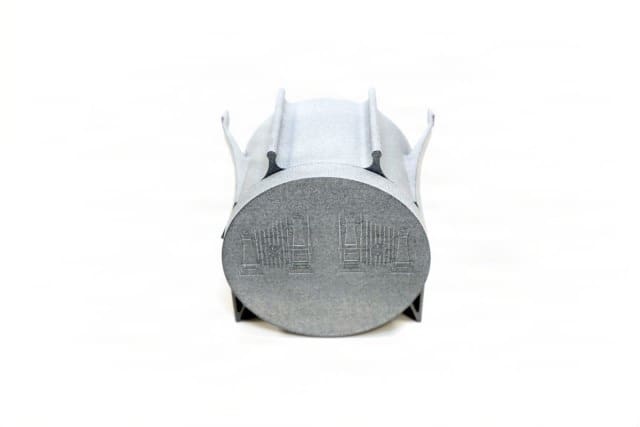
Although EW systems have been effective in countering FPV drones in the Russo-Ukraine conflict, the belligerents have taken the radio control out of the equation by equipping their systems with fiber optic reels which allow control via this extremely lightweight cable system. Now, Neros has introduced a system which meets the DIU Blue UAS framework. The spool is contained in the large canister mounted below the drone.

www.neros.tech

War Department Asks Industry to Make More Than 300K Drones, Quickly, Cheaply

Wednesday, December 3rd, 2025

The War Department requested information earlier this week to gauge industry’s willingness and ability to make some 300,000 drones quickly and inexpensively — a concrete effort by Secretary of War Pete Hegseth to directly meet the “drone dominance” goals laid out by the president.

On June 6, President Donald J. Trump signed the “Unleashing American Drone Dominance” executive order outlining how the United States would up its drone game in both the commercial and military sectors, including how it would deliver massive amounts of inexpensive, American-made, lethal drones to U.S. military units to amplify their combat capabilities. 

Hegseth followed up in July with the “Unleashing U.S. Military Drone Dominance” memorandum, in which he laid out his plan for how the department would meet the president’s intent. 

Part of the secretary’s plan included participating with other parts of government in building up the nascent U.S. drone manufacturing base by approving hundreds of American products for purchase by the department, powering a “technological leapfrog” by arming combat units with the very best of low-cost American-made drones, and finally, training as the department expects to fight. 

“Next year I expect to see [drone] capability integrated into all relevant combat training, including force-on-force drone wars,” the secretary said. 

At that time, Hegseth said, he had already advanced American drone dominance by stripping away regulations that hindered the military’s adoption of small drones and shifting the necessary authorities away from the department’s bureaucracy and into the hands of unit commanders. 

“This was the first step in the urgent effort to boost lethality across the force,” Hegseth said in a video posted today to social media. 

Now the War Department is moving out in a new way on the drone dominance initiative, Hegseth said. 

“The second step is to kickstart U.S. industrial capacity and reduce prices, so our military can adequately budget for unmanned weapons,” the secretary said. 

He noted that, with help from Congress, the department will initially focus on small attack drones. 

“Drone dominance is a billion-dollar program funded by President Trump’s Big Beautiful Bill,” Hegseth said. “It is purpose-built on the pillars of the War Department’s new acquisition philosophy: a stable demand signal to expand the U.S. drone industrial base by leveraging private capital, paired with flexible contracting built for commercial companies, founded by our best engineers and entrepreneurs.” 

A stable demand signal means the War Department will make concrete plans to buy lots of drones, on a regular schedule, over a long period of time. When that happens, American industry will step up to the plate to satisfy the department’s needs, including by investing in and building out its own capacity to produce in the long term. 

The request for information released to industry this week spells out a plan that’ll begin early next year, when the department will, over the course of two years, and within four phases, offer $1 billion to industry to build a large number of small unmanned aerial systems capable of conducting one-way attack missions. 

The first of those four phases, called “gauntlets,” runs from February to July 2026. During that time, 12 vendors will be asked to collectively produce 30,000 drones at a cost of $5,000 per unit, for a total of $150 million in department outlays. 

Over the course of the next three gauntlets, the number of vendors will go down from 12 to five, the number of drones ordered will increase from 30,000 to 150,000, and the price per drone will drop from $5,000 to $2,300. 

“Drone dominance will do two things: drive costs down and capabilities up,” Hegseth said. “We will deliver tens of thousands of small drones to our force in 2026, and hundreds of thousands of them by 2027.” 

Through the drone dominance program, $1 billion from the Big Beautiful Bill will fund the manufacture of approximately 340,000 small UASs for combat units over the course of two years. 

After that, it’s expected that American industry’s interest in building drones as a result of the program will have strengthened supply chains and manufacturing capacity to the point that the military will be able to afford to buy the drones it wants, in the quantity it wants, at a price it wants, through regular budgeting. 

Equipment is only part of the game, the secretary said. Doctrine — how the warfighter fights — is also critical. 

“I will soon be meeting with the military services to discuss transformational changes in warfighting doctrine,” Hegseth said. “We need to outfit our combat units with unmanned systems at scale. We cannot wait. The funding provided by the Big Beautiful Bill is ready to be used to mount an effective sprint to build combat power. At the Department of War, we are adopting new technologies with a ‘fight tonight’ philosophy — so that our warfighters have the cutting-edge tools they need to prevail.” 

Following the end of the Cold War, Hegseth said, U.S. defense spending dropped precipitously, and as a result, there was also a consolidation of defense contractors from hundreds to just dozens. The department, he said, budgeted for quality rather than quantity — and for 30 years got what it needed. 

“However, we now find ourselves in a new era,” he said. “An era of cheap, disposable battlefield drones. We cannot be left behind — we must invest in inexpensive, unmanned platforms that have proved so effective.” 

Drone dominance, he said, is how the U.S. will meet the drone challenge posed by other nations. 

“One of my priorities is rebuilding our military,” Hegseth said. “We can’t do that by doing business the same way we have in the past. We cannot afford to shoot down cheap drones with $2 million missiles. And we ourselves must be able to field large quantities of capable attack drones.”

By C. Todd Lopez, Pentagon News

Milipol 25 – M-TAC Drone Pack

Tuesday, December 2nd, 2025

At Milipol quite a few companies offered drone specific load carriage packs like this example from Ukraine’s M-TAC for 7″ drones with capacity for seven and controller. I expect to see a lot more of this in the near future.