
Vertx is about to drop a major visual upgrade that’ll make your favorite go-to packs even more badass. Stay tuned, this is the upgrade you’ve been waiting for, and it’s coming in hot.


Vertx is about to drop a major visual upgrade that’ll make your favorite go-to packs even more badass. Stay tuned, this is the upgrade you’ve been waiting for, and it’s coming in hot.

ARLINGTON, Va. — The U.S. Army Space and Missile Defense Command’s leader said the command has the lead role in the Army’s Space Vision supporting multidomain operations and defending the United States.
Lt. Gen. Sean A. Gainey, USASMDC commanding general, spoke at a Coffee Series event hosted by the Association of the U.S. Army at AUSA’s headquarters, July 23, 2024, in Arlington.
“Right now, based off of where the Army has moved in some of our demand requirements, we feel we are on path to meet our modernization goals,” Gainey said. “Depending on how we move forward potentially impacts modernization. As of right now, we’re moving on the right path. There are no issues at this time progressing forward with the force structure plan that we have and the growth that we have in place.”
He discussed the command’s initiatives to lead a proof-of-concept demonstration for using C-UAS in the homeland to help U.S. Northern Command determine how to move forward with C-UAS capabilities across the continental United States.
“Warfare is changing drones and all the capabilities that they may need,” Gainey said. “We do our own internal science and technology work so we’re able to do the gap analysis across the space and missile defense portfolio through our (Space and Missile Defense) Center of Excellence. Then our Center of Excellence is able to walk down and document to our technical center from an [science and technology] perspective.
“They can go out and work closely with industry and see what’s out there to help get after some of the challenges that we have moving forward,” he added. “We’re having to leverage more capability for a mission set with our modernization. We’re building based off knowing that there’s a 360-degree threat.”
Gainey said everybody is involved in space and has to be prepared to fight in a degraded denied environment and be able to leverage space.
“We at SMDC developed an Army Space Training Strategy that essentially focuses on how do you get space capability and space awareness, all the way down to the tactical level,” Gainey said. “We leverage that with our space experts inside of formations in our divisions. We are essentially building it inside of the schoolhouse and initial training, always through the training pipeline, and integrating space as part of awareness.”
Gainey talked about the future space operations military occupational specialty and how it will benefit the Army and its future space branch.
“You have an initiative on the space MOS,” Gainey said. “A lot of great work by the leaders in vision that came before me seeing that we can no longer continue to do business as usual in the way we operate right now as we pull Soldiers from air defense.
“We will change those Soldiers to 40 delta MOS to where now they’re space Soldiers and they’re experts,” he added. “So they get basic training all the way up, and then you get a professional noncommissioned officer, which we’re really excited about. We believe this is a stepping stone to a space branch.”
By Jason Cutshaw, USASMDC
The Aquire Read Deploy (ARD) weapon sight, a state-of-the-art device designed and manufactured in the USA to elevate your accuracy and efficiency in the field.
Crafted from durable anodized aluminum, the ARD sight is versatile, mountable on either side or top rails, and built to withstand the rigors of combat. Its standout feature is the digital LCD screen, which displays the range of 40mm projectiles based on the angle of the weapon, the weapon system, and the specific round used. This technology is currently configured for the M203, 320, and PGL6 weapon platforms, accommodating various rounds, including High-Explosive (HE) and non-lethal options.
One of the most impressive aspects of the ARD sight is its adaptability. As new weapon systems and rounds are developed, the sight can be updated with the latest software, ensuring it remains at the cutting edge of military technology. This future-proof design means you’ll always have the most up-to-date targeting information at your fingertips.
What sets the ARD sight apart in the heat of battle is its simplicity. Estimating the range to the target and adjusting your weapon accordingly is intuitive. After the first round impacts, the digital readout allows for rapid adjustments, enabling you to bring your target into sight swiftly and accurately.
For a deeper dive into the ARD weapon sight’s capabilities and real-world applications, check out this informative video:
Whether you’re in training or on the battlefield, the ARD weapon sight is a game-changer, providing the precision and reliability you need to stay ahead of the enemy. Equip yourself with the ARD and experience the future of tactical targeting today.
To schedule a demo or find out more, please email sales@matbock.com or check out www.matbock.com/collections/accessories/products/ard-sight
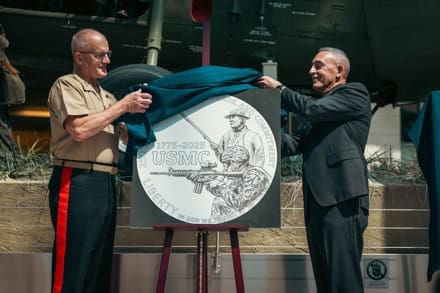
MARINE CORPS BASE QUANTICO, VA —
The Marine Corps Heritage Foundation and the U.S. Mint unveiled a trio of commemorative coin designs honoring the 250 years of Marine Corps service and sacrifice during a minting ceremony July 17, 2024, at the National Museum of the Marine Corps.
The last coin minted in honor of the Marine Corps was for the Corps’ 230th anniversary in 2005, and the generated funds enabled the construction of the NMMC, where the 250th commemorative coins were officially revealed.
“This is a way for everyone in America to recognize the importance of 250 years of what the Marine Corps means to this country,” said retired U.S. Marine Corps Maj. Gen. James W. Lukeman, the president and CEO of the MCHF.
The images on the coins, he said, cover 250 years of “every Marine is a rifleman.” The gold coin depicts the Marine Corps Color Guard while the flag raising of Iwo Jima is on the silver coin, and the clad coin features two Marines: one dons the continental uniform of 1775 with a musket, and the other in modern-day camouflage utilities wielding a M4 service rifle.
“Next year will mark 250 years of the Marine Corps making Marines and winning battles on behalf of our great Nation. These coins represent the cultural significance of our Corps and will directly contribute to the telling of our history and preserving our institution in the hearts of future generations.”
said the Commandant of the Marine Corps Gen. Eric M. Smith.
On July 26, 2023, President Joe Biden signed into law the 250th Marine Corps Anniversary Commemorative Coin Act following its passing through congress, authorizing the minting of over 1 million commemorative coins.
“It’s so special for each of us, because there is so much care that goes into the design of these coins,” said Kristie McNally, the deputy director of U.S. Mint, regarding all the people involved in the design process of the coins. “It’s exciting to actually get to share them with the public.”
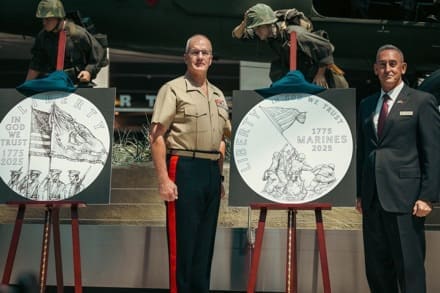
All surcharges generated from coin sales will support the MCHF and the NMMC’s future educational, historical, and cultural programs that preserve, showcase and educate the public on Marine Corps history, traditions and culture.
The commemorative coins become a part of the next year’s national celebration of the Marine Corps’ 250th anniversary, and this set will be the only commemorative coins minted in 2025.
Specifically, the signed legislation authorized the Department of Treasury to mint 50,000 five-dollar coins, 400,000 one-dollar coins, and 750,000 half-dollar coins.
“I am grateful to the Marine Corps Heritage Foundation, congressional leaders, and all those who made this coin possible,” said Smith. “We are honored that they would bestow this symbol of appreciation upon us.
To view the Marine Corps’ 250th Anniversary Commemorative Coins, please visit www.usmint.gov/learn/coin-and-medal-programs/commemorative-coins/us-marine-corps-250th-anniversary.
Sales will be available early 2025, at www.usmint.gov.
Story by Shaemus Sawyer, Marine Corps Base Quantico
Photo by LCpl Joaquin Carlos Dela T
ARLINGTON, Va. (AFNS) —
In an effort to codify the success and significant gains made in line with the Operational Imperatives, Department of the Air Force Secretary Frank Kendall stood up the Integrated Capabilities Office July 19.
Driven by the need to rapidly modernize the DAF to meet emerging challenges in an era of Great Power Competition, the ICO seeks to institutionalize the speed, agility and rapid innovation that the Operational Imperatives have brought to the force.
“The Integrated Capabilities Office will directly support the Department of the Air Force senior leadership team as we develop our integrated modernization plans for the Air Force and Space Force,” Kendall said. “China, our pacing challenge, is modernizing its military with the intent to defeat U.S. power projection capabilities. We will not let that happen.”
The Operational Imperatives were born out of necessity. Upon his arrival in 2021, Kendall ordered a series of studies and analyses that identified key capability gaps within the force. Seven areas of need were determined imperative to meet the pacing challenge: Resilient Space Order of Battle and Architectures, Joint All-Domain Command and Control, Moving Target Engagement at Scale, Next Generation Air Dominance, Resilient Forward Basing, B-21 Long-Range Strike Family of Systems, and Readiness for Wartime Posture.
Initiated under the DAF’s optimization for Great Power Competition, the ICO is a Secretariat-level office that will continue the work of the Operational Imperatives. Prior to initiation of GPC, the Operational Imperative teams operated mostly ad hoc, which allowed for innovation, speed and agility.
The ICO will facilitate agile Integrated Development Campaign Teams led and staffed by operational experts from the newly formed U.S. Space Force Space Futures Command and U.S. Air Force Integrated Capabilities Command, and acquisition professionals from Air Force Materiel Command’s Integrated Development Office and Space Force acquisition organizations.
The campaign teams will work imperative problem sets and provide data-driven solutions and recommendations. The ICO will incorporate these results into prioritized recommendations for modernization and will collaborate with other organizations to integrate these priorities, along with other portfolios, into the budgeting process.
The ICO will remain in a primarily advisory role but will have direct access to the Secretary and senior leadership, with the ability to make highly collaborative and unfiltered, recommendations to ensure emerging capability opportunities get a voice in the enterprise.
Many of the current Operational Imperatives will graduate to existing programs of record and stakeholder teams.
The ICO, in conjunction with the Integrated Capabilities Command and Space Futures Command, will optimize capability development through assessment, development, integration, and fielding of future capabilities that will rapidly modernize the DAF and preserve the advantages U.S. forces have benefited from for decades. The ICO is on schedule to be fully staffed and resourced by the end of 2024.
LANSING, Mich. – Joining the Army is tough; you’re immediately off to basic and individual training, facing drill sergeants, and learning the basics of soldiering. Going straight to Ranger School after that? That’s an entirely new level of challenge and excellence.
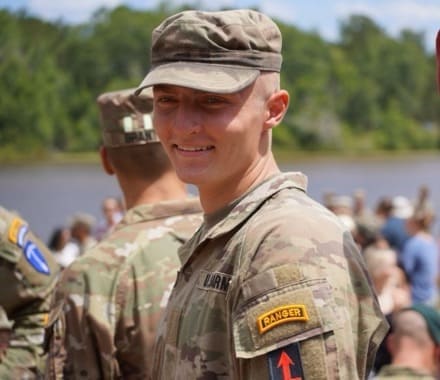
No Michigan Army National Guard Soldier accomplished all three schools through the Ranger Team Leader Initiative program — until now. On June 21st, 19-year-old Pfc. Chase Cammenga achieved this milestone, graduating from all three rigorous training programs.
The RTLI is a specialized training program for enlisted Soldiers in the Army National Guard who aspire to attend Ranger School. This program transitions Soldiers from initial training to the Ranger Training Assessment Course (RTAC) and then directly to Ranger School. The program scouts for top National Guard Soldiers, selecting those with the highest potential to succeed in the challenging Ranger course.
When Cammenga enlisted in the National Guard two years ago in November while still in high school, his ambition to pursue advanced military training was a driving force behind his decision.
“I wanted to challenge myself and be in the best fighting force on the planet,” he said.
Cammenga was initially set on the active-duty route until a friend introduced him to the National Guard. He discovered the Guard offered a balance between military service and pursuing higher education, with educational benefits such as tuition assistance and the GI Bill.
“One of my buddies joined, and I figured this was a good way for me to do both. I could be in the National Guard and still serve while I’m going to college,” he said.
Cammenga embarked on his initial training. The fear of the unknown was daunting, and his One Station Unit Training experience was no exception. OSUT consolidates Basic Combat Training and Advanced Individual Training at one location.
“It was hard because it was the first time I was away from my family for that long. The training was different from anything I’d ever done before,” he recalled.
Cammenga’s determination to excel in training was driven by a desire to be a member of a team. He chose the infantry military occupational specialty of 11B.
“I’ve always wanted to be the best, but more than that, I want to be able to help those around me,” he said. This mindset was particularly evident during Ranger School.
As his time at OSUT ended, he was identified as a standout candidate based on factors such as his PT score of 584 out of 600 points. He earned a spot in the RTLI program.
“I was pretty excited,” he said. “Going to Ranger School wasn’t always a dream, but once I heard more about it, I knew it was what I wanted to do.”
Cammenga’s journey to earning the Ranger tab began with rigorous RTAC training. The 30-day course prepares enlisted Guard members for the Army National Guard “pre-Ranger” course, called the Ranger Training Assessment Course. RTAC lasts 17 days, and all Army National Guard members must complete it before heading to Ranger School.
“In RTAC, the training was incredibly tough. It made us think, ‘If this is hard, just imagine what Ranger School will be like.’ But we always supported each other and lifted each other up,” said Cammenga.
Once RTAC was completed, Cammenga was ready for Ranger School. For more than two months, Ranger students train to exhaustion, pushing the limits of their minds and bodies.
Reflecting on his journey, Cammenga emphasizes the importance of camaraderie and support. “You don’t get your tab; your buddies get it for you. I learned that I had to lean on those around me.”
Recycling during training is a common challenge; for Cammenga, it was no different. Darby, the first phase of Ranger School, was a hyper-structured environment where attention to detail was paramount.
“The instructors were different, with different criteria. It was all about doing everything by the book,” said Cammenga.
Feeling that sinking sensation in his stomach when he realized he had to do Darby again was tough, but he kept telling himself he wasn’t a quitter.
“I felt like I couldn’t go on, but I learned to dig deep and find that inner strength,” he said.
With dedication and hard work, Cammenga passed Darby and moved to the next phase. For Cammenga, the training presented significant challenges, especially the lack of sleep and food for more than 62 days.
“The lack of sleep was the most difficult part for me,” said Cammenga. “There were times I found myself falling asleep while walking. On average, we got about an hour to an hour and a half of sleep a night.” Despite these hardships, he stayed motivated by reminding himself, “At least I’m not in Darby. I can get this done.”
During Ranger School, one mentor, a fellow Soldier in his platoon, had a profound impact on Cammenga.
“He told me that people here will do anything for you; you just have to ask,“ Cammenga said. “His words inspired me to be more patient and to help others wherever I could.“
Cammenga pushed through 12-mile rucks, completed water survival training, navigated difficult terrain, and led battle drills.
“Failure was not an option. I pushed myself harder than I ever thought possible,” he said.
His perseverance paid off when he completed Ranger School and earned the coveted Ranger tab.
“It was one of the proudest moments of my life. All the hard work and sacrifices had finally paid off,” he said.
After Ranger School, he attended airborne school. The training further honed his skills and prepared him for future missions.
“My parents always encouraged me to follow my dreams and never give up,” he said. “During training, they wrote me letters and offered incredible support. Their encouragement was a big part of what kept me going.”
By 2LT Paige Bodine, 126th Theater Public Affairs Support Element
Today Paladin 33 is launching a first production run of their collaboration with Andrew Bawidamann consisting of their American made Outback CCW Sling bags which are great for CCW.

There are many tiger stripes out there, but none are like their exclusive AB Tiger patterns. It is one of the most historically accurate and detailed tiger patterns on the market.

Saigon is their interpretation of the classic ADS tiger stripe from the Vietnam War. The contrast of the olive background and true black tiger stripes is absolutely stunning.
In addition to the classic pattern, they have developed additional spectrums that complement the MultiCam universe. Siberian will work well with MC Alpine and Midnight will work well with MC Black. These stylish additions are not only fashionable but highly effective in various environments.
Lastly, all the bags are built with vertical tiger stripes instead of horizontal stripes. Natural vegetation is orientated vertically and most importantly, a real tiger’s stripes are vertical because the pattern has evolved to perfection over generations.
Siberian dropping today at 1200 PST, Saigon at 1500 PST, Midnight at 1800 PST. Extremely limited quantities.
Units that need unique custom printed and designed soft goods, please feel free to reach out.
Arid and Tropic Tigers coming soon…

• 100% American Made
• 2,000 CU IN
• Extra long carry straps
• 500D Nylon
The FS duffel features a full 500D nylon construction with 3 inch webbing that folds over into the handle for an extremely light weight design that is still incredibly strong and balanced for heavy contents. Extra large zippered opening with premium zipper hardware and FS pull tab. The top has a sewn on webbing carry strap that works great when you need to hang the bag vertically. The inside is completely open with no pockets and around 2,000 cu in.
100% Berry compliant.
Made in the USA with USA Materials.
For more information check out: www.First-Spear.com.