Atrius Development Group

Archive for the ‘Guest Post’ Category

New Army Policy Expands Reimbursement for Spouse Business Costs

Wednesday, June 5th, 2024

WASHINGTON – The U.S. Army is expanding its financial support for military spouses by enhancing the reimbursement program for business costs and relicensing fees. The new directive permits reimbursement of up to $1,000 for business-related expenses, in addition to the already authorized $1,000 for relicensing fees resulting from a relocation.

“Army spouses face unique challenges, especially during a relocation,” said Lt. Gen. Kevin Vereen, Deputy Chief of Staff for G-9. “We owe it to them to provide any opportunity to not just have a job but build a fulfilling career.”

Spouses often face logistical and financial challenges in transferring licenses or businesses to new jurisdictions. This new directive aims to alleviate these barriers, ensure continuity in their careers and enhance the well-being and readiness of Army families.

The new policy, which builds upon previous efforts initiated in 2018, aligns with the Fiscal Year 2023 National Defense Authorization Act Public Law 117-263, which authorized expanded reimbursements, and Fiscal Year 2024 NDAA Public Law 118-31, which adjusted eligibility criteria to include those moving from active duty to the reserve component. It also includes those authorized a final move or placed on the temporary disability retired list.

Qualified relicensing costs cover exam fees, continuing education, certifications, business licenses, permits and registrations. For business owners, reimbursement is available for equipment relocation, new technology purchases, IT services and inspection fees.

Details on qualifying expenses and how to apply for reimbursement are available on the Military OneSource portal at Licensure Reimbursement PCS Moves.

By Army Public Affairs

Tactical Tuesday: The Ultimate Everyday Carry Backpack

Tuesday, June 4th, 2024

The Ready Pack by Vertx® is far from your average backpack – it’s a tactical powerhouse optimized for the modern individual. Crafted with upgraded fabrics and innovative features, this pack is purpose-built to elevate your everyday carry game.

Let’s break down the features:

• The bag offers ample storage without compromising a low-profile look, with additional pockets and an expanded CCW compartment.

• The Rapid Access Pull tab offers fully customizable EDC setup.

• It’s compatible with Premier Body Armor Vertx Ready Pack Level IIIA Insert for maximum protection.

• The enhanced CCW compartment depth ensures ease of draw, while the convertible MOLLE front flap enables gear customization.

• VELCRO Brand loop all throughout the bag for unbeatable custom organization with Tactigami and other hook-and-loop accessories.

• The modular padded laptop sleeve adjusts to fit up to 15″ laptops.

• 3-D molded back panel provides uncompromising comfort and luggage pass-through for travel or shield carry access

• Adjustable padded shoulder straps, a tuckable waist strap, and multiple attachment points for versatile rigging.

• Hydration and comms routing, a light-colored interior, and bonded nylon thread enhance durability and functionality.

• The bag has a 20L capacity, with outside dimensions of 19″H x 11. 5″W x 7. 5″D and a CCW compartment of 16. 5″H x 11″W x 2″D.

Upgrade your EDC game with the ultimate everyday carry backpack, combining functionality, durability, and style. Shop the Vertx Ready Pack at: vertx.com

Soldiers Test Launched Effects Prototypes

Tuesday, June 4th, 2024

REDSTONE ARSENAL, Ala. — “No humans at first contact.” That was the goal of the APEX Lab during the Launched Effects Crew Station Working Group exercise held in April 2024.

The APEX lab — organized under the Systems, Simulation, Software, and Integration Directorate of the U.S. Army Combat Capabilities Development Command Aviation & Missile Center — hosted the exercise with support from mission partners Future Vertical Lift Cross-Functional team, Program Executive Office for Aviation and their program and product offices.

The laboratory welcomed seventeen Soldiers from across the U.S. Army to participate in the exercise. Pilots and crewmembers were selected from operational units to vet potential updates and additions to cockpit and cabin interfaces via government-developed, government-owned software. This enabled AvMC engineers to rapidly prototype some of the Soldiers’ recommendations in real time.

The Soldiers not only test launched effects prototypes in development at the lab, but to also influence — and possibly change — the Army doctrine that will accompany those effects in the future. The event was conducted using the Engineering Analysis Cockpit developed in support of the Utility Helicopter Program Office. Launched effects are drones that can be used in a multi-domain capacity — launching from air, ground, or sea for reconnaissance or target strike far ahead of the accompanying forces.

“All the data that comes from this is going to our PMs,” Jena Salvetti, lead human factors engineer for DEVCOM AvMC’s Aviation Crew Stations Branch, said. “It’s going to help inform requirements and it’s going to help inform a lot of the decisions made.”

As the subject matter experts on hand instructed the Soldiers — they are rewriting the rules.

“We need your help on what it’s going to look like,” FVL’s Chief Warrant Officer 4 Alex Drouin told the Soldiers. “That’s what we’re going to tackle this week. What do you, the users, think works? What doesn’t work? Because I can make a PowerPoint presentation that looks absolutely incredible and a great video, but if it doesn’t work for the users, we are going to fail.”

For Capt. Spencer Hudson, 3rd Battalion, 501st Aviation Regiment, who traveled from Fort Bliss, Texas, to participate, it was an opportunity to influence the equipment Soldiers use daily while also getting a first-hand look at how the engineers develop that technology.

“It is interesting to see the thought process of the developers,” Hudson said. “It builds trust when you have two sides that want to get to the same goal.”

Crew station working groups help ensure that technology is developed right on the first try. Long known as the tip of the spear on the battlefield, what launched effects will do for Army forces, Drouin said, is make that tip autonomous.

“The battlefield is drastically changing from the way we know it,” he said. “This is the future and this is where we are going.”

By Katie Davis Skelley, DEVCOM Aviation & Missile Center Public Affairs

Light Fighter Manifesto Volume III

Monday, June 3rd, 2024

In an age when the lines between conventional and unconventional warfare blur and the convergence of technology and tactics dictate individuals’ survival, the Light Fighter Manifesto emerges as a stark, indispensable source of information. Volume III offers 186 pages of 12 hard-hitting articles that delve into the topics reshaping the modern-day light fighter.

Topics include austere medicine, the art of survival with scavenger tools, the relentless skill of man-tracking, and the unforgiving truths of how terrain reshapes boundaries and war. It covers the grim realities of home defense, the lethal future of kamikaze FPV drones, the critical importance of communication strategies, the silent battles of cyber awareness, and the cold precision of sniping. As governments and regimes crumble and transform, being prepared is no longer a choice but an absolute necessity.

Pre-orders of Volume III can be purchased at lightfightermanifesto.org

MATBOCK Monday: Kibisis 2-Day Pack

Monday, June 3rd, 2024

This bag is so special and versatile we named it the “Kibisis” after the mythical bag that the Greek demi-god Perseus carried Medusa’s head in. Our two-day assault pack, created to answer several requirements across the military branches and law enforcement. Some specific requirements were to hold more gear while remaining lightweight and water-resistant. The ability to hold a fully loaded helmet while remaining easily accessible and finally to have a smaller modular pouch with a shoulder strap that can be zipped on or off depending on the mission. The Kibisis is built to last and reinforced so it can also be jumpable making it one of the most versatile 2-Day assault bags on the market. 100% Made in the USA.

– Contains MATBOCK’s external water seal antenna ports that can be closed when not in use.
– A secondary pack for extra storage can also be unzipped and used separately.
– Side pouches with compression straps are large enough to hold a standard Nalgene bottle.
– Lightweight but durable construction.
– Jumpable pack with enough space to support your operations.

To find out more or to get a quote, email sales@matbock.com or check out www.matbock.com/collections/packs/products/kibisis-2-day-pack

Bioweapons Field Guide for Recovered Munitions to Fill Knowledge Gap

Monday, June 3rd, 2024

Aberdeen Proving Ground, MD — The U.S. Army Combat Capabilities Development Command Chemical Biological Center (DEVCOM CBC) Chemical Biological Applications and Risk Reduction business unit, known as CBARR, provides field response for recovered chemical munitions all over the country and around the world. Sometimes bioweapons munitions turn up, too. Robert Malone, the CBARR Plans and Assessments Branch chief, has a plan for that, he is writing a field reference guide for recovered bioweapons.

“We’ve had a field reference guide for chemical weapons since the mid-1990s,” Malone said. “It’s called the U.S. Chemical Weapons and Related Material Reference Guide. But there’s not one for biological weapons and related material, and that has always surprised me, so I decided to do something about it.”

What brought this need home for Malone is what happened at a field operations site at Holloman Air Force Base in New Mexico. Recovery team members encountered E-61 bomblets. “The CBARR project manager for this field operation, George Noya, came to me because he knew that I had done some extensive research on bioweapons some years back,” Malone said. “That provided me with some good background, but I also got help from a true CBC expert in this area, Chris Whalley, a Center subject matter expert in biological weapons.”

Malone and Noya went to Whalley’s office. Whalley was able to tell them what the item was, its delivery system, its potential agent fills, and he even had an unfilled example of one sitting in his office that they could hold and examine.

“That was enormously helpful to us, but then two things occurred to me,” Malone recalled. “First, why don’t we have this kind of detailed knowledge for the broad range of bioweapons in a form that can be shared? Second, Chris will retire soon, so how can we preserve that knowledge?”

DEVCOM CBC’s mission is to provide innovative chemical, biological, radiological, nuclear, and explosive (CBRNE) defense capabilities to enable the joint warfighters’ dominance on the battlefield and interagency defense of the homeland. It has programs with sources of seed money available to fund good ideas. Through the ‘Quick Empowerment leads to Successful Tomorrows’ program, or QUEST for short, projects of any size from $5,000 to $100,000 tied to the Center’s mission are considered. Applicants get ten minutes to pitch their ideas before the Center’s Innovation Council members, followed by five minutes for questions.

In 2023, Malone submitted his idea, made his pitch and was selected to receive a $22,000 grant to begin work on a concise, easy-to-use field manual. He pulled together a team of CBC colleagues which included Whalley plus Mindy Soethe and Andrew Bailey. Although they were frequently away performing field responses at CBARR’s many project sites, they were able to reach the 40 percent mark over the course of a year.

The manual, thus far, includes biological weapon types, the history of their development and use plus information on their likely prevalence. Compiling this data is a slow, meticulous process, but the team members believe that the usefulness of that data warrants the effort.

Malone and his team submitted a request for funding to finish the field guide and at QUEST 24 Pitch Day in April they gave their pitch to the Innovation Council. They were persuasive, the Innovation Council members gave them a QUEST grant of $25,000, enough to finish the job. As soon as they complete it, they will make it available to CBARR field teams as well as the rest of the Center.

By Brian Feeney

Soldiers Assess New Technologies at Fort Leonard Wood

Sunday, June 2nd, 2024

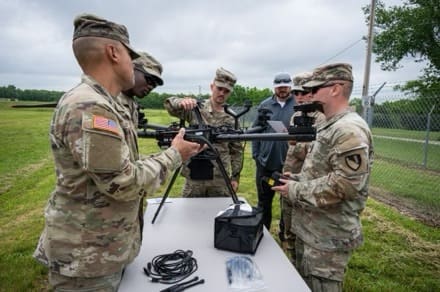
FORT LEONARD WOOD, Mo. — The Army Futures Command Maneuver Support Battle Lab is winding down this year’s Maneuver Support and Protection Integration eXperiments event, commonly referred to as MSPIX, after assessing 16 emerging technologies from May 6 to 23, 2024, at locations across Fort Leonard Wood.

According to Kyle Henry, MSBL Experimentation Branch chief and one of the key organizers of the event, MSPIX puts the latest tools in the hands of Soldiers while also giving capability developers and the science and technology community credible and validated operational experiment venues for their conceptual and materiel development.

Soldiers from Fort Leonard Wood; Fort Bliss, Texas; and Fort Riley, Kansas took part in the assessments.

“Soldier touchpoints early in the capability design process are key to influencing the end product and its ability to support the end user, U.S. Army Soldiers. Key stakeholders are invited to observe the assessment, including the (Maneuver Support Center of Excellence) regiments and members of the (protection warfighting function) community,” Henry said.

Jarret Ellis, an MSBL engineer, said it is crucial to get Soldiers involved in the development of technologies early on to make sure new equipment being issued meets their current needs.

“When these private industry companies come out with technology they think will be helpful, the Soldiers can point them in the right direction,” Ellis said. “A lot of times, the people developing the equipment are not Soldiers in the field — they are from academia, engineers and scientists. MSPIX brings the groups together.”

Soldiers from Army Engineer; Military Police; and Chemical, Biological, Radiological and Nuclear backgrounds participated in this year’s assessments, Henry said.

On May 15, Soldiers from the 16th Brigade Engineer Battalion at Fort Bliss and the 50th Multi-Role Bridge Company, based on Fort Leonard Wood, were at training area 224 to get their hands on a drone programmed to find subsurface explosives in real time by performing aerial surveillance.

The Soldiers were handed instructions on how to setup the Airborne Ground Mines Detection System, calibrate the software and prepare the unmanned aircraft system to sweep a designated area. After the Soldiers performed the steps, the drone took flight over the training area while sending data back to a computer the Soldiers were monitoring.

“Today we are assessing a means to detect explosive hazards. We are working on detecting threats that are buried or partially buried that could kill Soldiers and destroy equipment,” Ellis said. “This is one of the first looks we have had at something that is UAS-borne that could potentially detect hazards without putting Soldiers into the threat.”

Henry said the AGMDS was one of the technologies he was personally most excited to see in action this year. The others were the robotics for engineering operations and chemical, biological, radiological and nuclear sensors in robotic platforms.

“The REO provides standoff and autonomous terrain shaping. The CSIRP is an unmanned and autonomous area reconnaissance that relays information to mission commanders,” Henry explained.

Next year’s MSPIX focus areas will include, according to Henry, wet-gap crossing, situational understanding and protection decision support, obscuration and camouflage and toxic industrial materials site assessment.

By Melissa Buckley, Fort Leonard Wood Public Affairs Office

Emerging Trends in Rifle Scopes and Reflex Sights

Saturday, June 1st, 2024

The world of firearm optics is evolving at a breakneck pace, driven by advancements in technology and innovative engineering. As each new release grows increasingly complex in their features and benefits, it’s important to keep up to date on the latest trends that are pushing the industry forward.

Today, we’re looking at the most significant trends in firearm optics, from digital advancements and thermal fusion systems to the use of exotic materials and compact designs. No matter whether you’re shooting professionally or just an enthusiast,understanding these trends will help you make informed decisions about your equipment and what you can expect to see in the near future.

Digitally Integrated Rifle Scopes

Digitally integrated optics, such as the Vortex NGSW-FC and Magpul/Maztech X4-FCS, are the bleeding edge for rifle scopes.These devices can integrate real-time data display, ballistic calculators, and enhanced user interfaces to enable greater precision downrange. And although these technologies are still new, it’s fair to say that the concepts and technologies behind them are a good representation of what we can expect to become widespread in the future.

Even though traditional rifle scopes optics have improved a lot over the years, there is a limit to the capabilities one can add to an analog optic. New reticles, improved coatings, and wider magnification ranges can make it easier to range and engage targets, but they don’t really change the procedures behind precision marksmanship.

In contrast, digitally integrated optics have the potential to completely streamline the way a marksman approaches long-range shooting. For example, the recently-selected Vortex NGSW-FC (Next Generation Squad Weapon – Fire Control) system incorporates advanced targeting algorithms and environmental sensors to deliver precise ballistic solutionsdirectly in the image. Similarly, the upcoming Magpul/MaztechX4-FCS plans to offer features like shot tracking, hit detection, and augmented overlays, which significantly improve situational awareness and accuracy.

If these optics can achieve their claimed features, there could be a major shift in how we think about precision marksmanship.

Onboard Fusion Systems for Reflex Sights

The integration of thermal and night vision (NV) capabilities into a single optic system is another game-changer in the field. In the past few years, several optics manufacturers have announced fusion-style optics—usually reflex sights with an onboard sensor for night vision or thermal overlay. You may have already seen this sort of technology showcased by Holosun in their Digital Reflex Sight series, specifically the DRS-NV (Digital Reflex Sight-Night Vision) and DRS-TH (Digital Reflex Sight-Thermal).

Once this technology is fully explored, fusion systems could become a popular alternative to basic reflex sights. An optionaloverlay, whether thermal or night vision, could be a compelling option for defensive carbines, where the user isn’t necessarily going to have helmet-mounted NODs available. These sights are also likely to be more affordable than dedicated night vision or thermal units themselves.

Of course, this technology is still relatively new, and today’sprice point is a bit of a deterrent, but it’s likely that future iterations will be cheaper (and smarter too).

Larger Erector Ratios in Rifle Scopes

The evolution of magnification ratios in rifle scopes has seen significant advancements over the years.

Historically, early scopes offered magnification factors in the range of 3x or 4x, which were considered sufficient for most shooting applications at the time. As lens technology improved and the needs of shooters evolved, manufacturers began to introduce scopes with higher magnification ratios, moving up to 6x and eventually 8x. These higher ratios allowed for greater flexibility, enabling shooters to engage targets at both close and long ranges with a single optic .

Recently, the trend has continued with scopes pushing the boundaries to 10x magnification ratios and beyond. With such a wide range, these scopes can provide a very low magnification for close-quarters agility and a high magnification for long-distance precision. On paper, these benefits appear compelling, especially to those in the military and law enforcement sectors, who require optics that can adapt to various mission profiles.

However, the benefits of larger erector ratios come with certain drawbacks. One of the primary challenges is the increased weight and size of these scopes. As the magnification range expands, the internal components of the scope, such as the lenses and erector assembly, become more complex and heavier. This added optic weight can affect the balance and handling of the firearm, making it less agile and harder to maneuver.

But an even larger consideration is the impact on the exit pupil. Exit pupil is the diameter of the beam of light that exits the eyepiece of the scope and enters the shooter’s eye. Exit pupils contribute exponentially to the size of the usable eyebox, so scopes with thinner exit pupil are considerably stricter when it comes to cheekweld and eye placement.

The two factors that contribute to the exit pupil are the diameter of the objective lens and the magnification of the scope itself. As optics manufacturers push higher magnifications into smaller scopes, the maximum magnification gets harder and harder to use. The result is that many users feel that 1-10x and 1-12x scopes are unforgiving when shooting from dynamic or alternative positions.

Overall, the advancements in magnification ratios in modern rifle scopes provide significant benefits, but they also necessitate a balance between versatility, weight, size, and optical performance. It’s likely we won’t see erector ratios go much higher unless manufacturers begin moving to larger objective lenses to accommodate them.

LPVOs with Diffractive or Fiber Wire Reticles

For years, the market has been pushing for brighter and brighter reticles in low-power variable optics (LPVOs), leading to the development of both diffractive and fiber wire technologies.

In first focal plane optics, diffractive reticle technology is the latest and greatest in illumination. Compared to the current standard of ‘etch-and-fill’ illumination, diffractive reticlesgenerate a significantly brighter image by passing collimated light through an amplitude grating. The result is reticle illumination that can nearly match a red dot in overall brightness. Unfortunately, given the complexity and cost of manufacture, diffractive reticles are usually exclusive to high-end rifle scopes, but it’s likely to become more affordable as manufacturers continue to innovate around it.

A similar level of brightness can be achieved in second focal plane optics with a fiber wire reticle. Unlike diffractive reticles, fiber wire reticles can now be found in even affordable rifle scopes, making it a more accessible option for the average enthusiast. In essence, fiber wire reticles use a laminated fiber optic wire on a conventional crosshair. The tip of the wire is positioned at the center of the crosshair, so when it’s illuminated, your aiming point will appear as bright as a red dot sight.

Until diffractive technology becomes more accessible, fiber wire scopes are likely to continue to grow in popularity, potentially becoming the new standard for second focal plane LPVOs.

Advanced Materials & Manufacturing

Changes in materials and manufacturing methods are also revolutionizing the optics industry, offering significant advantages in terms of weight reduction, durability, and performance.

One of the most notable materials making its way into scope design is titanium. Given its high strength-to-weight ratio and excellent corrosion resistance, titanium is an ideal material for producing lightweight optic components. Moreover, the improved durability of materials like titanium ensures that the optics can endure rough handling and adverse conditions, extending the lifespan of the equipment and maintaining reliable performance over time.

It’s also important to consider how new manufacturing technology is changing the way materials are utilized. As 3D printing becomes more precise, manufacturers will be able tocreate complex parts that were previously impossible or too costly to produce using traditional methods. For example, intricate lattice designs can be printed within the scope’s body to provide structural support while minimizing material use, leading to lighter and more rugged optics .

Compact Prism Scopes

Since the advent of the MicroPrism®, the optics market has seen a surge in the popularity of similarly compact prism scopes with low magnification, typically between 1x and 5x.

These scopes have quickly become a favored alternative to traditional red dot sights, namely due to their etched reticles, which, unlike red dots, are not affected by astigmatism. This makes them an excellent choice for shooters with this common vision issue, as the reticle remains clear and sharp regardless of the user’s eye condition .

At the same time, prism scopes come with the added benefit of battery independence. While red dot sights rely on battery powerto project a reticle, prism scope reticles are etched into the glass and only use battery power for illumination. This means that even if the electronics fail or the battery dies, the user can still use the scope effectively under most conditions.

While some will still favor red dots for the ease-of-use and unrestricted eye box, compact prism scopes like the MicroPrism have become an accessible alternative that delivers some considerable benefits.

Conclusion

The world of firearm optics is continuously evolving, bringing forth innovations that enhance performance, versatility, and reliability.

From the integration of digital and thermal technologies in reflex sights to the use of exotic materials like titanium and advancements in 3D printing, these developments are setting new benchmarks in the industry. Larger erector ratios now offer unprecedented versatility, while compact prism scopes provide a robust alternative to traditional red dot sights, addressing common issues like astigmatism and electronic dependency.

Whether you’re a professional marksman or just an interested enthusiast, these new technologies could bring big changes tohow we select and use our optics. Even within the past decade,the average quality and technology in tactical optics has increased tremendously, and these changes are only continuing to accelerate as competing brands fight to deliver the best to their customers.