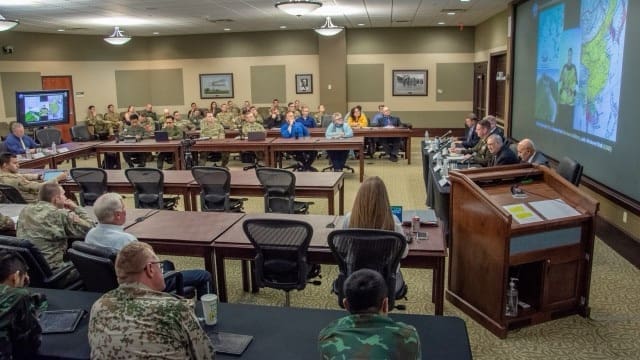
THE ARMY UNIVERSITY, FORT LEAVENWORTH, Kansas – The ongoing Russo-Ukrainian conflict continues to alter the geopolitical situation in Europe and the Indo-Pacific Command region.
The latest Cultural and Area Studies Office panel, recognizing the National Defense Authorization Act’s definition of China as a pacing threat, focused the discussion on the Chinese way of war and the People’s Liberation Army.
Dr. Mahir J. Ibrahimov, CASO Director, set the stage for the session by introducing the topic, and the Brigadier General Mark W Siekman, Deputy Commanding General, U.S. Army Reserve, Combined Arms Center, who provided senior leader opening remarks.
Panelists from various Command and General Staff College and Army University departments, analyzed whether or not a clear Chinese way of war is present within the PLA’s current state of their air, ground force, maritime and even historical background as a pacing threat, or if it is more of a cultural adaptation.
“If you’ve heard GEN Flynn, the current USARPAC commander, he would argue, China is the most consequential threat, in the more consequential theater, and in the most consequential time,” Siekman said.
Chinese recovery from Century of Humiliation
More than a dozen unsuccessful conflicts, spanning more than 100 years, to include the Century of Humiliation, as discussed by Dr. Geoff Babb, Department of Military History, CGSC, can be described as a prologue to the PLA today.
“The Century of Humiliation does not belong to Chinese Communist Party but rather the people of China and is highlighted by the Chinese Communist Party and Xi Jinping,” he said.

Pre-People’s Republic of China, Babb discussed, faced humiliating defeats to Britain, France, and the United States, the later creating the foundational distrust between the U.S. and China that stands today.
The PRC is primarily focused on protecting borders and sovereignty which drives the military and economic decisions of leaderships like Xi Jinping’s, who faced turning a country’s dismal combat track record around.
The introduction of Communist China to the military environment created, what could be argued, a way of war vice a military culture to rejuvenate the nation.
“The Chinese are, in my opinion, strategically defensive and operationally offensive,” Babb said. “When that might change or is that changing is unclear, but they’re certainly building the military forces to be able to do that.”
The PRC’s influence of the PLA is not something to be overlooked, Babb pointed out, highlighting the New Golden Age with the implementation of the Belt and Road Initiative and Treasure Fleet, which combines merchant and military ideals, and the Restored Wall with A2AD.
Each of the three could suggest the PRC’s values and shared understandings, or culture, have created a bridge to the PLA’s way of war.
Three P’s and Two Hows to Understanding PLA’s Ground Force Modernization
Proximity to politics, professionalization, and principles plus how the PLA is seeing itself in modernization and how we make sense of what PLA is trying to do was the framework for understanding the PLA’s modernization efforts presented by Lt. Col. Jason Haub, Advanced Strategic Leadership Studies Program, School of Advanced Military Studies.
The PLA, having seen nearly a dozen major reforms, was brought to its current theater command structure, thanks to Jinping spurring another massive reform in 2016.
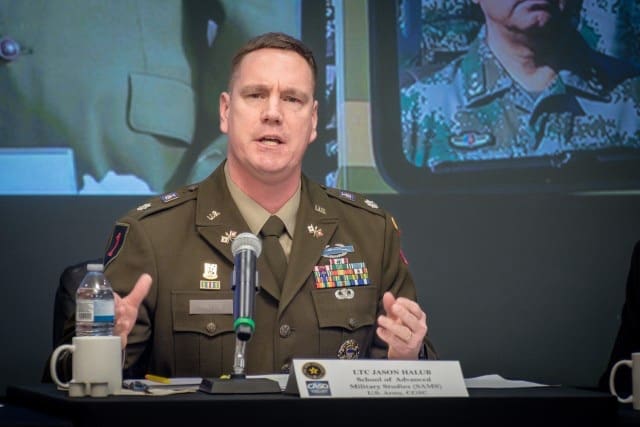
Decisions like this for the PLA are dual tracked through the PRC and PLA, Haulb explained, making it difficult for the PLA ground forces’ modernization to remain a headline priority.
The most recent restructuring jeopardized the PLA ground force’s status within the larger PLA, suggesting a military culture shift, that could create barriers to the PLA’s attempted professionalization.
Further, these PRC driven military adjustments continue to cloud the clarity of what the Chinese way of war is.
“PLA ground forces are not the top priority in terms of modernization effort, and probably have some of the largest hurdles as they grapple with what is this new joint structure, joint theater command structure and how the PLA will fight,” Haub said.
Haub described PLA as a problem solving, learning organization, with a ground force that has a breadth of catching up to do to remain a near threat to the U.S.
“I think it is important to have the framework of a Chinese way of war but to also understand, when we put that aside, how we assess things for what they are and not simply limit ourselves to view things only through an overly sensitive cultural lens,” he said.
Air and space Chinese way of war
China continues struggling with engine manufacturing and modernization, creating disproportionate aircraft improvements, that hold them back from competing equally with the U.S. air modernization effort.
This, however, is not enough to continue the narrative of the exponential U.S. – Chinese air/space gap.
“The capability gap is rapidly shrinking in both the air and space domains. It’s more concerning now in the air domain. Given a bit more time, it is quite plausible that the PLAAF will outstrip the U.S. Air Force in terms of numbers,” Dr. John Modinger, Associate Professor, SAMS, and retired Air Force said.

When it comes to above the ground combat, the Chinese have adopted, what Modinger described, as a “copying and pirating” approach to remaining a competitive threat.
Most air and space craft in the Chinese war portfolio are near identical mimics of American versions.
While not completely aligning with the definition of a Chinese way of war, Modinger offered that the number of crafts and satellites in the U.S. technology constellation is what separates the two nations.
“We see increasing evidence of the Chinese mirroring the United States,” he said. “Not going with their own way of war, but in fact paralleling our developments, if not stealing our technology.”
China goes so far with this technique as to recruit the pilots manning the top-of-the-line U.S. air and space crafts, Modinger explained.
Add to the air and space pot a 550% increase in the number of Chinese launched satellites, the gap above the clouds continues to shrink.
Space and air are competition lanes the U.S. continues to lead not just China, but the world, in terms of technology and use. However, Modinger pointed out that the closing gaps should be noted.
“China will continue to increasingly drop from ‘near’ peer competitor to pacing threat or peer threat,” he said.
Chinese Maritime Triple Threat
The Chinese PLA Ground Force is seemingly shackled from rapid modernization due to the cumbersome collaboration with the PRC, and the PLAFF must resort to looking off the U.S.’s paper to remain competitive in the sky.
On the sea, the Chinese way of war is harder to define due to a simple lack of actual combat tested instances.
Dr. John Kuehn, DMH, CGSC, began his discussion suggesting the Chinese fight at sea is primarily defensive.
“It is built on a doctrine of local area dominance, which is extensive anti-access, area denial systems,” he said.

In the way of war vice military culture lens, Kuehn suggested, overall, the Chinese lean culturally, strategically defensive, and operationally offensive.
The Chinese Navy is the most individualized, meaning not mimicking the U.S. counterpart, of those within the PLA in terms of size and regional location.
The Chinese Navy tonnage exceeds that of the U.S.’s but with a majority being surface ships.
The size and variety of maritime presence is largely a question mark of capability, Kuehn said, due to the Chinese naval history being river based.
Outside the riverbanks, the PLA Navy’s contemporary mission is the defense of the first island chain from Hokkaido in the north down to Singapore.
This fits the Chinese approach to security, to strategy, to warfare, which is using the weaker to undermine the stronger,” Kuehn said. “Use of mines. Use of coastal warfare. Use of non-belligerent tactics. Use deception. For the Chinese this looks like anti-cruise ship missiles, anti-ship ballistic missiles. Missile batteries ashore.”
Additional supplements to the Navy are the Chinese’s enormous Coast Guard and “bully” of maritime security, militia.
“The Coast Guard has some of the biggest cutters in the world,” Kuehn said. “They have at least 50 cutters that are big enough to be used as a second Navy.”
This trio of maritime protection using (illegally) water cannons, shouldering, intel collection and missile use makes the PLA Navy an aspect of Chinese combat power worth understanding.
“This is an area, where on continuum of conflict the Chinese has choices and they are already executing them with their very high handed and sort of bullying approach to maritime security especially in the South China Sea,” Kuehn said.
Whether the four areas of PLA modernization are seen as a clear definition of a Chinese way of war or a rather a semi-contemporary adopted military culture, the challenge Chinese military forces present to U.S. national security is one of importance and need of attention.
This panel is part of a seminar series discussing issues of operational and strategic importance to the U.S., which CASO in coordination with CGSC, universities, think tanks, interagency and other partners conduct every two to three months, which is also live streamed on CGSC’s Facebook page.
The full panel discussion can be viewed on the CGSC Facebook here: www.facebook.com/USACGSC/videos/2468414380022454/.
All past CASO panels are available for viewing on the CGSC YouTube page here: Cultural and Area Studies Office (CASO) – YouTube
By Sarah Hauck, The Army University Public Affairs Office