Freedom comes with a heavy price. Team Winchester understands this and send their thanks in a special message to our service members, their families and Folds of Honor.

See why Folds of Honor and its mission means so much to us.
Freedom comes with a heavy price. Team Winchester understands this and send their thanks in a special message to our service members, their families and Folds of Honor.

See why Folds of Honor and its mission means so much to us.

RAF MILDENHALL, United Kingdom (AFNS) —
Thousands of hours are spent each year removing and installing a boom cover on a KC-135 Stratotanker aircraft – hours that could be used elsewhere. One 100th Maintenance Squadron Airman has invented a new boom cover tool that has the potential to save the U.S. Air Force 40,000 man-hours and approximately $1 million per year.
“I noticed as soon as I got to Mildenhall that removing and installing the boom cover was tedious and time consuming,” said Airman 1st Class Jacob Helzer, 100th MXS hydraulics maintenance journeyman. “Removing the cover the conventional way involves calling the Aerospace Ground Equipment backshop for an aircraft stand and requires two Airmen and a substantial amount of time.”
The current conventional method hinders daily operations, whereas the innovative solution Helzer created is easier, takes less time and lessens the impact on the flow of operations.
“One of the maintenance crew chiefs reached out because he knew I enjoy 3D printing and design and believed I could come up with a solution for the boom cover,” Helzer said. “I then came up with a prototype for a tool that could make the process much smoother.”


Tech Sgt. Steven Jakubowski said Helzer is always looking for ways to innovate and constantly asking questions to gain further knowledge.
“He spent a lot of his free time, outside of work, designing the boom cover tool,” Jakubowski said.
Helzer, using his skill and knowledge with 3D printing, created a prototype called the “Boom Cover Tool.” The tool was manufactured with Helzer’s 3D printer and resembles a butterfly net on the end of a retractable pole with a hoop mechanism that tightens and loosens the net covering on the opposite end.
“Once I created the prototype, I brought it to my section and tested it out,” Helzer said. “A 30-minute job became a one-minute job with the Boom Cover Tool.”
The Boom Cover Tool greatly reduces the number of man-hours needed every time a cover needs to be removed or installed on an aircraft and the cover itself better protects the boom pod during adverse weather conditions.
Each Boom Cover Tool costs roughly $200 to produce.
“The projected savings were calculated by him and I while submitting for Spark Tank by using the 2021 comptroller document for wages,” Jakubowski said.
“I did the math and the projected savings for the Air Force if they utilized the Boom Cover Tool for the entirety of the refueling fleet would be approximately $1 million and potentially 40,000 man-hours annually,” Helzer added.
In order to meet this goal, Helzer has been collaborating with the MXS fabrication flight to produce the test prototypes for each aircraft here.
“Once we have everything streamlined, we can move into the beta testing phase, which is roughly six months, then move on to scaling up for the entire KC-135 Stratotanker aircraft fleet,” Helzer said.
Moving forward, Helzer plans on developing a batch of tools for the local KC-135 fleet to prove the design concept. Helzer would then like to contract the fabrication of a final, more durable prototype and share the Boom Cover Tool throughout the entire fleet and modify the design to be adopted for other variations of refueling aircraft.
“Helzer has been a go-getter from the moment he arrived on station and is always hungry to learn all aspect of his job, and his critical thinking skills are some of the bests I’ve ever seen,” Jakubowski said.
Helzer has always been motivated to improve himself and the way things are done at his job, and one example of this is the Boom Cover Tool.
“This is how change starts, by questioning the way we do things and coming up with a solution that will benefit Airmen at all levels,” Helzer said. “I created the Boom Cover Tool to make the lives of my Wingmen easier and inspire Airmen to devise and implement new ideas to help improve even the simplest tasks.”
By Airman 1st Class Alvaro Villagomez, 100th Air Refueling Wing Public Affairs

EGLIN AIR FORCE BASE, Fla. —
Lt. Col. Mary Clark stepped out to the MH-139A Grey Wolf with confidence.
Confidence gained from taking part in and leading in the developmental efforts of the Air Force’s first acquisitioned helicopter. Those early labors from concept to reality culminated as she climbed into one of the pilot seats for the MH-139A’s first flight under Air Force ownership here Aug. 17.




“This milestone really represents the beginning of Air Force testing for the Grey Wolf,” said Clark, a former requirements officer with the Grey Wolf program, now at the 96th Operations Group. “We can now open up those test points for the military and push the envelope more to ensure we’re delivering that operational capability the units need out of the helicopter.”
The Grey Wolf achieved this milestone after earning its military flight release, Aug. 12. The new status allows Air Force-only aircrew to conduct testing on military capabilities of the MH-139A as the program moves forward. Prior to the military flight release, military and Boeing contractors shared the flight duties since the aircraft’s arrival here in December 2019.


During that two-and-a-half-year period, the military testing fell to the 413th Flight Test Squadron and the AFGSC Detachment 7, in which Clark was a former commander. The 413th FLTS is the Air Force’s only rotary-wing developmental test unit.
“We learned a lot over the last two years,” Clark said. “That experience allowed us to shape our test plans and ultimately save time. We already know some baseline foundational things we don’t have to re-establish in our own program.”
The aircraft’s first flight under its new call sign, Lycan, meaning werewolf, took place above and around Duke Field, an auxiliary field North of Eglin. The goal of that flight was to validate processes, checklists, maintenance, emergency procedures and aircrew communication and coordination.


Tech. Sgt. Alexander Graves, an AFGSC Det. 7 special missions aviator, was part of both MH-139 first flights with Boeing in early 2020 and now the all-Air Force flight. The Airman said he hadn’t reflected on his place in Grey Wolf history as the first enlisted to fly in and instruct on one of the Air Force’s newest aircraft.
“What an honor,” said Graves, a former C-130 loadmaster, who was chosen to be part of the Grey Wolf program. “I never thought in my career I’d be in a position to do something like this. It’s so rewarding to finally test the things we’ve been building up and to see that work we put in over the last two years pay off now.”
The goal for the next 15 months of testing on the four MH-139As here will be to validate the safety of the aircraft and define the limits and maneuvers that can be performed. The developmental testing here will make sure the MH-139A meets AFGSC requirements for operational missions and define baseline operational capabilities upon which to build tactics, techniques, and procedures.
The MH-139A will replace the Air Force fleet of UH-1N aircraft, increasing capabilities in speed, range, endurance, payload, and survivability. The Air Force will acquire up to 80 helicopters, training devices, and associated support equipment. The aircraft will provide vertical airlift and support to four major commands and other operating agencies.
From those humble beginnings in concept to feeling the MH-139A’s wheels leave the pavement, Clark said it was truly a magical moment.
“It’s just extremely satisfying to now own and fly something we worked so hard to get,” she said smiling. “Today the leash was off and we could finally run with the Grey Wolf.”


By Samuel King Jr.

FirstSpear is proud to support HAVA – Honored American Veterans Afield. HAVA is hosting 150 veterans 25-27 August, providing range time, meals and camaraderie.

As the number of injured men and women returning from the battlefields of Iraq and Afghanistan grew, members of the firearms industry initiated a non-profit partnership called HAVA to aid disabled soldiers as they transition to their lives back in the United States. The ultimate goal is to increase their confidence and hope for the future by reconnecting with their love of the outdoors and the American traditions of hunting and firearms.

Visit honoredveterans.org to learn more about how the firearms community is supporting disabled veterans.

Visit FirstSpear to find all the gear and apparel for America’s Warfighter.

When you hear Darley Defense, you should be thinking “premier procurement solutions.” Across the Defense industry and throughout Law Enforcement and First Responder communities, Darley is the go-to for equipment, technology, gear, clothing, and more. It’s not about getting the job done. It’s about getting it done right. Darley Defense is primarily military veterans, so they’ve walked-the-walk and know how to translate complicated procurement jargon into a clear and fast solution. Darley Defense is at NGAUS – booth 1731 – and a key sponsor for the Texas and Georgia National Guard hospitality suites. Visit them at booth 1731, find them at an after-exhibit event or visit DarleyDefense.com to turn your needs into solutions.
HUNTSVILLE, Ala. – The Assured Positioning, Navigation and Timing/Space (APNT/Space) Cross-Functional Team (CFT) has concluded a 64-day stratospheric flight demonstration utilizing Airbus’s Zephyr 8 ultra-long endurance solar-powered unmanned air system (UAS).
Launched from Yuma Proving Ground (YPG) on June 15, the Zephyr 8 UAS ascended to over 60,000 feet into the stratosphere before executing its flight plan over the southern portion of the United States, into the Gulf of Mexico, and over South America. Once returning to airspace over YPG, the team conducted multiple assessments.
On August 18 around 2100 hours PDT, the prototype aircraft’s flight campaign ended when the Zephyr 8 UAS encountered events that led to its unexpected termination over YPG. These events are under investigation. No injuries or risk to personnel or other aircraft resulted from this incident. Further information will be released following the investigation.
“Our team is working hard to gather and analyze important data following the unexpected termination of this flight,” said Michael Monteleone, Director of the APNT/Space CFT. “Despite this event, the Army and its partners have gleaned invaluable data and increased knowledge on the endurance, efficiency, and station keeping abilities of high-altitude UAS platforms. That knowledge will allow us to continue to advance requirements for reliable, modernized stratospheric capabilities to our Soldiers.”
This flight marked a number of firsts for Zephyr 8, including its departure from U.S. airspace, flight over water, flight in international airspace, data collection and direct downlink while outside of U.S. airspace, the longest continuous duration (7 days) utilizing satellite communications, and the demonstration of resilient satellite command and control from three different locations – Huntsville, AL; Yuma, AZ; and Farnborough, UK.
During this flight, Zephyr 8 more than doubled the previous UAS endurance record, just under 26 days, and flew in excess of 30,000 nautical miles – more than one lap around the Earth. The 1,500 flight hours beat all known unmanned aircraft endurance records, marking significant capability and informing future mission requirements.
This experimentation successfully demonstrated Zephyr’s energy storage capacity, flight endurance, station-keeping and agile positioning abilities. Given the amount of data that was generated during the 64-day flight and the time required to analyze it, as well as the need to investigate the events that led to the termination, further flight demonstrations have been postponed until 2023.
This 64-day test flight was performed in conjunction with government and industry partners who support experimentation that continues to inform Army requirements.
-Army Futures Command
KIRTLAND AIR FORCE BASE, N.M. (AFNS) —
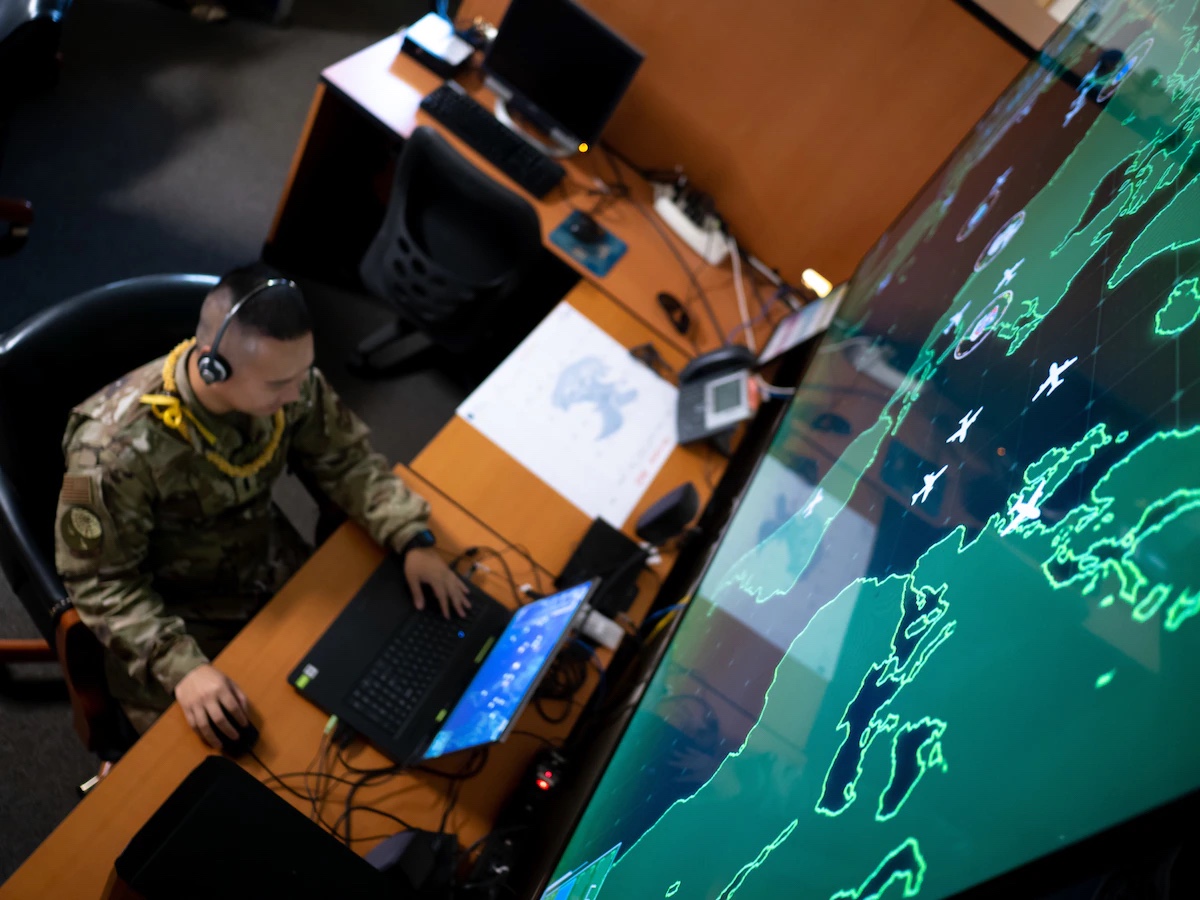
The 705th Combat Training Squadron recently hosted the second virtual Tactical Operations Center-Light experiment iteration in their Distributed Mission Operations Center at Kirtland Air Force Base.
“Twenty-first century large-scale warfare requires our forces to adapt quickly on the move,” said Col. Frank Klimas, 505th Command and Control Wing, Detachment 1 commander, Fort Leavenworth, Kansas.
The TOC-L event was designed to continue U.S. Air Force development of future battle management concepts intended to expedite kill chains and improve distributed control.
Air battle managers and tactical air control party Airmen traveled to Kirtland AFB from across Air Combat Command, Pacific Air Forces, and U.S. Air Forces in Europe to participate in the experiment.
A TOC-L is purposed lightweight, scalable battle management system that enables tactical C2 elements to relocate quickly, establish advanced datalinks, connect to a variety of sensors via a resilient communication structure, and successfully operate in a denied, degraded, or contested operational environment.
“TOC-L aims to adapt our current systems to new tactics needed for the high-end fight, and the DMOC provides a great environment to test those out,” Klimas said.


The event was the second experiment executed at the DMOC and focused on building and capturing tactics, techniques, and procedures, or TTPs, of the USAFE inspired Agile Control Integration Team while concentrating on integrating additional TOC-L mission sets.
“As the Air Force continues to evolve the TOC-L concept, it’s important to have a venue like the DMOC to bring different career fields together and stress test our ideas for different variations of a TOC-L crew,” said Maj. Carl Plonk, 605th Test and Evaluation Squadron, TOC-L experiment director, Hurlburt Field, Florida. “We’ve made a lot of progress in the first two iterations, and we’re looking forward to integrating into Virtual Flag: Battle Management where we can apply added levels of complexity to see how our techniques hold up.”
Plonk continued, “It’s eye-opening to see how these two career fields innovate to overcome mission challenges with limited traditional resources. We’ve asked the team to think creatively with this experiment because quite frankly, this experiment and others like it are changing the way we will conduct battle management in the future.”
The event expanded TACP capabilities based C2 element integration, which included distributed partnering with Air Support Operations Squadrons across the country. Additionally, the experiment saw joint partner involvement with U.S. Marine Corps air controllers from the 3rd Marine Aircraft Wing, providing operational assessment support to bolster concept development.
“Joint inclusion in this experiment further cements the Air Force’s desire to be dialed into theater integration needs from the start,” said Col. Adam Shelton, 505th Test and Training Group commander, Hurlburt Field, Florida. “Efforts like the Advanced Battle Management System are challenging our service paradigms on battle management to decouple personnel from sensors and our Marine Corps teammates with their approach to combined arms warfare are the best suited to inform these efforts.”
The team plans to integrate the concepts and lessons learned from recent experiments into Virtual Flag: Battle Management in August.
“Integrating Airmen from across these two command and control career fields to further develop these concepts is both exciting and necessary,” said Maj. Dustin Nedolast, 505th Command and Control Wing, Detachment 1, TOC-L experiment director, Fort Leavenworth, Kansas. “Collaborative experimentation is key to continually building on the lessons learned throughout these iterations while staying focused on expediting a functional system for the joint force in the future.”
The 705th CTS reports to the 505th Combat Training Group, Nellis AFB, Nevada, and the 505th Command and Control Wing, headquartered at Hurlburt Field, Florida.
By Deb Henley, 505th Command and Control Wing Public Affairs, 505th Command and Control Wing