Salomon Forces Genesis MID GTX

Archive for the ‘Guest Post’ Category

US Army’s Project Inclusion to Cut Board Photos in Holistic Effort to Promote Diversity

Tuesday, June 30th, 2020

WASHINGTON — Starting in August, photos will be eliminated from promotion and selection boards as the Army launches “Project Inclusion” to identify practices that inadvertently discriminate, senior leaders announced Thursday.

The project is a holistic effort to listen to Soldiers, civilians and family members and enact initiatives to promote diversity and equity, according to Secretary of the Army Ryan. D. McCarthy.

“A lot has to be done to address the symbolic challenges that we face that could create divisiveness within our ranks,” McCarthy told reporters.

Before deciding to eliminate photos from officer, enlisted and warrant officer promotion boards, leaders looked at a 2017-2018 study that determined, regardless of race or gender, people looking at photos will have an unconscious bias toward individuals with similar characteristics, G-1 officials said. Further, they said Department of the Army photos provide minimal information compared to the rest of a promotion board file.

During an experiment in the study, researchers ran two identical promotion boards: one that included photos and one without. In the one that did not contain photos, researchers found that the outcomes for women and minorities improved. The results contributed to the decision to remove the photos.

Project Inclusion

Project Inclusion will enact a series of initiatives in the next few months to help build a diverse, adaptive, and cohesive force, said Anselm Beach, the deputy assistant secretary of the Army for equity and inclusion.

“We, as a leadership team, recognize that we need to take a harder look at ourselves and make sure that we’re doing all that we can to have a holistic effort to listen to our Soldiers, our civilians and our families to enact initiatives that promote diversity, equity, and inclusion,” McCarthy said.

In the coming weeks, the Army inspector general and members of the Army Equity and Inclusion Agency will join Army senior leaders as they visit installations, said Under Secretary of the Army James McPherson.

During each visit, leaders will engage in an open and transparent conversation about race, diversity, equity, and inclusion.

“We know that we have to do more,” McCarthy said. “We are going to have very hard and uncomfortable conversations.”

McPherson said that he wants to hear Soldiers’ thoughts about current events and listen to their ideas on inclusivity.

Each “listening session” will look to identify any impact to mission readiness caused by current social issues, Beach said.

“If a Soldier [or civilian] is distracted by an issue, then they are not fully present to accomplish the mission,” Beach said. “Understanding those impacts allow the Army to enhance mission readiness,” which can lead to new policy or adjustments to an operating environment.

Each session would create a “safe place” for Soldiers to express themselves without fear of reprisal. By creating an open dialogue, people will have a chance to understand and support each other, Beach added.

“This is about leadership,” said Gen. Joseph Martin, the vice chief of staff of the Army. “Leaders have to set conditions for these discussions to happen and be productive. They’ve got to create an environment where a Soldier feels safe. And it’s also an environment that’s free of disbelief.”

McCarthy said leaders will also examine racial disparities within the Uniform Code of Military Justice. The Army’s inspector general, Lt. Gen. Leslie Smith, and the Army’s judge advocate general, Lt. Gen. Charles Pede, will then evaluate findings after 60 days and attempt to address the causes of the disparities, McCarthy said.

Changes under Project Inclusion also include the reconstitution of the Army Diversity Council. Led by the secretary of the Army and chief of staff, the council will prioritize diversity programs throughout the Army, all while addressing symbolic and systemic issues, Beach said.

“Part of why we wanted [to host meetings with Soldiers] is to get out and invest exponentially more time engaging with Soldiers at every echelon about these unconscious biases that may exist,” McCarthy said. “We must have a better understanding [of] the challenges every day that ethnic minorities may face. Are there systemic flaws within the promotion system or are there things that may be of a symbolic nature that cause division within our ranks?”

The force is also making changes to the Army People Strategy with the addition of the “Expanding Diverse Talent of the Army Officer Corps Strategic Plan.”

The new plan will focus on diversity and inclusion initiatives to strengthen the Army’s ability to acquire, develop, employ current and future leaders. Similarly, the Army will continue to expand its outreach to Historically Black Colleges and Universities and other minority-serving institutions.

Military justice reform

Tied to the project is an evaluation of the military justice system to determine if any racial disparity or bias exists in the investigation or court-martial processes, McPherson said.

During the assessment, the Army judge advocate general, the Office of the General Counsel, inspector general, and provost marshal will partner and review a range of cases to include absence without leave, urinalysis, and sexual assault or sexual harassment cases.

The review will “compare the severity of punishments by race, and see if there is a disparity… in the result of unconscious bias,” McPherson said.

The Army is also working to determine if the military justice system is more likely to investigate a specific Soldier due to unconscious bias. However, accurately assessing the investigation process could be a challenge, as race and ethnicity information is rarely documented during this stage, he added.

The enduring effort will not only improve equality, but make the force stronger, said Army Chief of Staff Gen. James C. McConville.

“It’s really more about inclusion,” he said. “It’s not just about percentages. It’s not just about numbers. It’s about making people feel that they are a valued member of the team and that you recognize the importance of having different perspectives.”

By Devon L. Suits and Joseph Lacdan, Army News Service

GM Selected to Provide Infantry Squad Vehicles for US Army

Tuesday, June 30th, 2020

In what many would consider an upset, GM Defense was selected to provide over 1,000 Infantry Squad Vehicles to the US Army. They beat out SAIC/Polaris and Osh-Kosh/Flyer both considered incumbents.

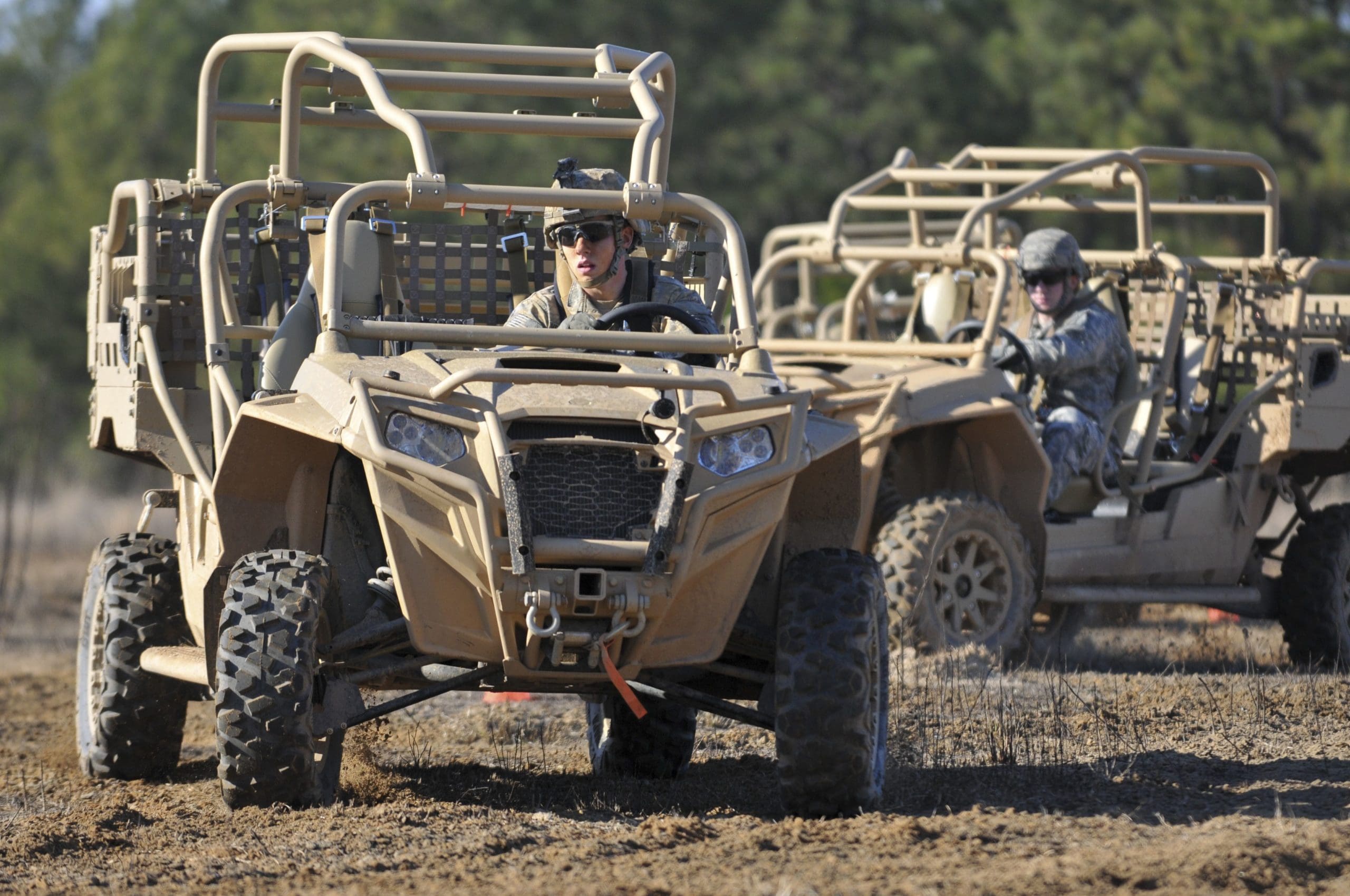
The Polaris DAGOR is in service with the 82nd Abn Div and the Flyer developed GMV 1.1 is in use with USSOCOM and the 173rd Abn Bde.

GM Defense LLC, Detroit, Michigan, was awarded a $214,297,869 firm-fixed-price contract for acquisition of the Infantry Squad Vehicle, installation kits, ancillary hardware and logistical support. Bids were solicited via the internet with three received. Work locations and funding will be determined with each order, with an estimated completion date of June 24, 2028. U.S. Army Contracting Command, Detroit Arsenal, Michigan, is the contracting activity (W56HZV-20-D-0066).

The GM ISV Is powered by a 186-horsepower, 2.8L diesel powerplant and six-speed automatic transmission, the nine man crew is protected by a Roll Over Protection System which serves as a roll bar, but can be stored for air transport.

Based on their successful Chevrolet Colorado midsize truck architecture and its ZR2 and ZR2 Bison variants, this GM truck could make the beginnings of an entire fleet of commercial off-road vehicles to handle the US military’s dat-to-day tasks in a similar fashion to the Commercial Utility Cargo Vehicle programs of the 70s-00s.

Below, is the US Army announcement.
Infantry Squad Vehicle to ‘motorize’ IBCTs

DETROIT ARSENAL, Mich. – The Army today announced it has selected GM Defense, LLC, Detroit, Mich., to produce the Infantry Squad Vehicle, or ISV, to motorize Infantry Brigade Combat Teams. Delivery of this modernized capability is slated to begin with the 1st Brigade, 82nd Airborne Division, as the designated First Unit Equipped next winter. The contract is valued at $214,297,869 and the Army intends to purchase 649 vehicles.

It is based on the Chevrolet Colorado ZR2 architecture, which will derive 90 percent of its parts from commercial-off-the-shelf components.

The ISV program provides IBCTs an additive lightweight vehicle to move Soldiers and their equipment quickly over complex and difficult cross-country terrain. ISVs will provide greater mobility to IBCTs, as they are designed to move across restrictive terrain, allowing Soldiers to close on objectives with less fatigue and greater readiness. The Army can deliver the vehicle to the field by airdrop or helicopter, which increases the flexibility of Soldiers on the move.

This is the second important production contract award for Army light tactical wheeled vehicle modernization programs of record in the last year. The Army announced in June 2019 the production contract of the Joint Light Tactical Vehicle. JLTV is modernizing the Army’s and U.S. Marine Corps’ light tactical wheeled vehicle fleets with a leap-ahead balance of payload, performance and protection.

“The Infantry Squad Vehicle meets the challenges we’ve faced to give our IBCT Soldiers greater mobility and increased survivability,” said Chris Stone, the Maneuver Capabilities Development and Integration Directorate’s deputy Army capability manager – Infantry Brigade Combat Team at Fort Benning, Ga. The CDID is the Army’s proponent for generating and validating the operational need for the Infantry Squad Vehicle.

“As the Army’s newest light tactical vehicle, ISV will allow IBCTs more flexibility and a greater advantage getting to the objective,” he added.

The ISV’s basic operational capabilities include:

Nine-man squad carrying capability

Payload of 3,200 lbs.

External sling load by a UH-60 Black Hawk helicopter

Internal load/external lift by CH-47 Chinook helicopter

Low-velocity air drop by fixed-wing C-130 or C-17 transport aircraft

Exceptional mobility over all terrains

The comprehensive team responsible for bringing the ISV program to production contract award involves not only Army acquisition professionals, but also relevant stakeholders representing the Army’s funding and testing communities, Army Futures Command, and Forces Command. Soldier evaluation via user-acceptance efforts has been a key element of the ISV program from the outset, and has helped compress the time it takes to field a modernized capability that meets infantry Soldiers’ needs.

“The Infantry Squad Vehicle program has focused on meeting the Army’s emphasis on enhancing Infantry Soldier mobility and survivability by rapidly fielding modernized capabilities. Our product management team for Ground Mobility Vehicles undertook a great challenge to develop a strategy using experimentation and technical demonstrations to streamline the ISV acquisition process,” said Timothy G. Goddette, the Army’s program executive officer for Combat Support and Combat Service Support, or PEO CS&CSS, headquartered here.

“Using an innovative acquisition approach through an Other Transaction Authority — a flexible, collaborative tool designed to speed acquisition and modernization — the ISV team awarded the production contract for this capability in 16 months. Using normal acquisition processes, it could have taken as many as 36 months,” Goddette explained.

The ISV acquisition strategy was structured to promote the highest level of competition possible, including affordability. Due to competition, the program office will realize a reduction from the original independent government cost estimate for the program. This provides best value to American taxpayers. What’s more, a senior Army officer who has commanded at all levels in an IBCT was tapped to serve as the ISV program’s Source Selection Authority.

According to Steve Herrick, the Army’s product lead for Ground Mobility Vehicles, PEO CS&CSS, the next steps in the ISV program include GM Defense delivering eight ISVs to Aberdeen Test Center in Maryland within four months. “Following delivery, our program office, along with Army testers, will execute an aggressive and tailored testing plan,” he said.

Herrick went on to explain the Army will conduct tailored production qualification testing to address the vehicles’ ability to meet the performance specifications in areas not previously tested. This will also build confidence in areas already tested, he said. The ISV will also undergo transportability certification, which includes low-velocity air drop and helicopter sling loading. Next summer and fall, the Army will hold an initial operational test and evaluation.

“The program office is marching toward delivering ISVs to the first unit, the 1/82nd at Fort Bragg, approximately eight months after the contract award,” Herrick added. “We are excited about the commercial nature this product brings to the Soldier, and in the future, we could possibly see greater leaps in technology and concepts to include reconnaissance or electric vehicles.”

By Rae Higgins, Program Executive Office for Combat Support & Combat Service Support

TYR Tuesday – IDTOUR VTS |Virtual Trade Show| Shield & Dolly System

Tuesday, June 30th, 2020

Episode Three of Innovate or Die® Tour Virtual Trade Show #IDTOURVTS is here!

Episode Three:

IDTOUR VTS |Virtual Trade Show| Shield & Dolly System

New episode launching every Tuesday.

New CQB Level 3A Shields Launch: Summer 2020

Patent Pending Shield & Dolly System Available Now:

www.tyrtactical.com/products/list/ballistic-shields-and-armor

What is IDTOURVTS?

Our mission has always been about protecting those who run towards the threat.  To that end, we created the Innovate or Die® Tour and Mobile Showroom. Over the past couple years it has allowed us to meet you face-to-face, gather your feedback and answer your questions.

Life has been put on hold for many people around the world, but you have not stopped risking your safety and health against all the threats we face today.

We can’t wait to meet you on the road again.

Thank you to the men and women of the armed forces, first responders and health care professionals who continue to put their lives on the line.  You haven’t stopped working and neither will we.

Episode One:

IDTOUR VTS |Virtual Trade Show| PICO-DS & DSX Plate Carriers

Episode Two:

IDTOUR VTS |Virtual Trade Show| The Ultimate Range Bag

MATBOCK Monday Strap Claw

Monday, June 29th, 2020

Good morning and Happy MATBOCK Monday,

The Strap Claw set attaches to the MOLLE on the front of the plate carrier and holds the backpack straps for the operator without the need for a chest strap.  This allows for removal of the pack without having to undo an extra strap and keeping the motion of removing the pack exactly the same.  The Strap Claws also keep the shoulder area free and clear for proper rifle butt placement as well as alleviates pressure on the brachial artery preventing poor blood flow down the arms.  Each set comes in OD Green with MATBOCK Skins for MultiCam and Black in each package.

Don’t forget to tune in on Monday at 4:30 PM EST as we do a live demo of the Strap Claw and answer your questions!

www.matbock.com/products/strap-claw

Overcoming Adversity: How an Italian Became a Special Tactics Operator

Sunday, June 28th, 2020

Sometimes in order to achieve one’s goal in life, one has to overcome a great deal of adversity and life lessons to do so. No one appreciates this more than Master Sgt. Stefano Guadagnuolo, a Special Tactics operator assigned to the 125th Special Tactics Squadron, Portland Air National Guard Base, Ore. His teammates prefer to call him G for short.

G grew up in the town of Piacenza, Italy in an 80 person condominium, where there was an ‘army of kids’ for playing and snowball fights. Italians are used to being very social, it’s a cultural thing, said G. Every weekend is a celebration and you don’t have to walk far to be with friends and family.

He attended college in Parma and at the age of 18 he was drafted into the Italian Army as a Mountain’s Troop Officer, where he served for two and a half years. After going back to Parma for college, he decided it was time to venture out and try something new. He ended up in Costa Rica to be a diver, and from there travelled to Honduras for a year to become a Dive Master as an underwater tour guide. G met many American friends there vacationing who told him he should come to the states, so he sold all of his scuba gear and flew to Houston.

After arriving in the U.S., he toured the country for a while eventually ending up in San Diego, again as a Dive Master on a boat. He remembered how he always wanted to join the Air Force’s Combat Control career field because he learned about them during his time as an Italian officer, but he couldn’t get a security clearance at the time. Air Force recruiters told him to join the Marines or the Army to get jump and dive certified and then try again. He then joined the U.S. Army Airborne Infantry, and ended up with an Army Ranger contract.

“I had only been in the states for less than a year when I joined the Army, so I had to pick up English very quickly,” said G. “The American culture is very different from Italy, also. Everyone is so spread out and you have to make plans to see each other.”

Once he had gotten used to the culture, the Army realized there was a mix up with his security clearance, and as a result the Army sent G back to Italy where he was assigned to an Infantry Airborne Brigade. He served as a gunner in Vicenza, Italy for four years, but still dreamed of joining the Air Force. He decided to give it another try and called up an Air Force recruiter to apply to become a Special Tactics Combat Controller, but found out he would have to be stateside to apply for Active Duty. Once again G had to veer away from his goal and decided to re-enlist in the Army, as a Deep Sea Diver and was stationed in Virginia for four years. Eight years later, he still had hopes of joining the Air Force, and worked on his citizenship to do so.

“It felt like the target would keep moving past me, and I had to keep asking myself ‘should I do this,’ said G “…but I had already made it this far so I might as well keep going.”

The year he tried to get into the Combat Control pipeline, was also the year the 142nd stood up the 125th Special Tactics Squadron. The squadron saw his resume and concluded he had the qualifications to join, so G moved his family to Portland to take on the extremely difficult two-year pipeline at 35 years of age.

While his 20-year-old teammates were out on the town, he would be at home icing up and letting his body recover after long days of intense training.

Despite some difficulties he was already qualified in many of the required skills and was even named honor graduate at Combat Control School. Thanks to his hard work and determination, G was offered a full-time Active Guard Reserve position at the base. He now currently serves as the Squadron’s Superintendent 13 years later.

“Don’t stay comfortable in what you do,” said G. “Plan on trying new roles and career developments, and take on new challenges. Know your limits and stick to your goals.”

He enjoys what he does, so it made the challenges worth it. He stuck to his goal that he had his heart set on, but had to go through years of experience first to achieve it. Besides the challenges he’s faced in learning English, the cultural differences in the states, and joining the Army to reach his ultimate goal, he has also had to deal with challenges as a Special Tactics operator during conflicts in Bosnia, Iraq, and Afghanistan.

The Air Force has a much better lifestyle than the Army he said. He now has an 18-year-old daughter, Kate Guadagnuolo, who wants to follow in her father’s footsteps and join the U.S. Air Force as well. Kate is scheduled to attend Basic Military Training by the end of the summer after she graduates high school.

“My dad has taught me to take life in strides and that’s how you venture through life and get through it,” said Kate.

G will be retiring in a year, but is proud of his daughter for wanting to follow in his Air Force footsteps and even more glad he stuck to his goal of becoming a Special Tactics Combat Controller by staying resilient, keeping his heart set on his goals, and overcoming the adversity he has faced in his career.

“I know she will be able to handle the military as she is mentally tough,” said G. “You have to be able to stay positive and resilient, but the rewards are worth it.”

She was able to meet his family in Italy and said that they are very intense, but sweet and are very family oriented. Kate enjoys playing in the water, like her dad, through water polo and said that he is goofy and likes to embarrass his kids.

She’s excited to join the Air Force and follow in her dad’s footsteps, but she will be going in to Public Affairs as a Photojournalist. She said G makes fun of her for not being able to run as fast as her old man, so she’ll have to work on that, but has told her that the military can offer her more opportunities for education and travel.

Story by Tech. Sgt. Emily Moon 

142nd Wing Public Affairs

SCUBAPRO Sunday – Operations Red Wings

Sunday, June 28th, 2020

On 28 June 2005, U.S. Special Operations suffered our its biggest loss since WWII.  Please take a moment today and think about the fallen and their families.   Long Live the Brotherhood 

SEAL Delivery Vehicle Team One, Pearl Harbor, Hawaii.


Lt. (SEAL) Michael P. Murphy, 29, of Patchogue, N.Y.

Sonar Technician (Surface) 2nd Class (SEAL) Matthew G. Axelson, 29, of Cupertino, Calif.

Machinist Mate 2nd Class (SEAL) Eric S. Patton, 22, of Boulder City, Nev.

Senior Chief Information Systems Technician (SEAL) Daniel R. Healy, 36, of Exeter, N.H.

Quartermaster 2nd Class (SEAL) James Suh, 28, of Deerfield Beach, Fla.

SEAL Delivery Vehicle Team Two, Virginia Beach, Va.

Gunner’s Mate 2nd Class (SEAL) Danny P. Dietz, 25, of Littleton, Colo.

SEAL Team Ten, Virginia Beach, Va.

Chief Fire Controlman (SEAL) Jacques J. Fontan, 36, of New Orleans, La.

Lt. Cmdr. (SEAL) Erik S. Kristensen, 33, of San Diego, Calif.

Electronics Technician 1st Class (SEAL) Jeffery A. Lucas, 33, of Corbett, Ore.

Lt. (SEAL) Michael M. McGreevy Jr., 30, of Portville, N.Y.

Hospital Corpsman 1st Class (SEAL) Jeffrey S. Taylor, 30, of Midway, W.Va.

Army Night Stalkers


3rd Battalion, 160th Special Operations Aviation Regiment (Airborne), Hunter Army Airfield, Ga.

Staff Sgt. Shamus O. Goare, 29, of Danville, Ohio.

Chief Warrant Officer Corey J. Goodnature, 35, of Clarks Grove, Minn.

Sgt. Kip A. Jacoby, 21, of Pompano Beach, Fla.

Sgt. 1st Class Marcus V. Muralles, 33, of Shelbyville, Ind.

Maj. Stephen C. Reich, 34, of Washington Depot, Conn.

Sgt. 1st Class Michael L. Russell, 31, of Stafford, Va.

Chief Warrant Officer Chris J. Scherkenbach, 40, of Jacksonville, Fla.

HQ Company, 160th Special Operations Aviation Regiment (Airborne), Fort Campbell, Ky.

Master Sgt. James W. Ponder III, 36, of Franklin, Tenn.

Domestic N95 Mask Production Expected to Exceed 1 Billion in 2021

Sunday, June 28th, 2020

WASHINGTON — Thanks to work by the Defense Department’s COVID-19 Joint Acquisition Task Force, U.S. industry is expected to greatly increase the production of N95 masks next year, the task force’s director said.

During a House Armed Services Committee hearing yesterday, Stacy Cummings told lawmakers that nationally, the U.S. was consuming about 50 million N95 masks each year. During the COVID-19 crisis, demand for masks increased substantially to about 140 million during a 90-day peak-use period.

DOD investments to help domestic industry ramp up production of those masks and other equipment will help ensure that in the future the U.S. will better be able to meet demand for personal protective equipment with domestic production, she said.

Based on the investments made by the department, Cummings told the House panel, an increase in production of 450 million masks a year will be attained by October, with a rate of more than 800 million masks per year by January.

“Starting in 2021, we anticipate our total domestic production to be in excess of a billion per year,” Cummings said.

Ellen Lord, the undersecretary of defense for acquisition and sustainment, told lawmakers that increasing domestic production capabilities has been a focus of the department.

“In order to decrease our dependence on foreign suppliers for medical resources, DOD has focused on increasing domestic industrial capacity and capabilities,” she said. “To that end, we executed some $284 million in industrial expansion efforts during the first two weeks of May 2020. Reconstituting domestic production or creating new production that shifted offshore years ago often requires capital expenditure, capital equipment expenditures, retooling and retraining of the workforce.”

Lord also said DOD has been focused on maintaining the health of the defense industrial base during the COVID-19 pandemic. The DIB includes a wide array of businesses that produce weapons, equipment and supplies for the U.S. military.

During the COVID-19 pandemic, businesses that make up the DIB suffered as other U.S. businesses did, Lord said. Should some of those businesses fail as a result of COVID-19-related disruptions, it might result in the department not being able to procure important defense-related supplies, equipment or weapons, she added.

Lord said the department is using $688 million of CARES Act funding to address impacts to the DIB by directly offsetting financial distress and providing investments to regions most severely affected.

She also said that increased communication between the department and the DIB were key in allowing defense officials to better understand where the industry was hurting most, and where the need existed most. When first she stepped into the A&S leadership role in 2017, she said, she set up quarterly meetings with DIB representatives to better assess their needs. The COVID-19 pandemic accelerated that communication.

“When the pandemic hit and we saw how catastrophic it could be to our defense industrial base, what we did was just really amped up those engagements,” she said. “So starting on March 17, we had our first [teleconference] with industry, and we broadened beyond just the three industry associations that we worked with, to really start including nontraditionals and others.”

The number of industry representatives involved in those meetings also increased, Lord said, “For multiple weeks, we had calls three times a week. One of those calls per week was focused on small business, and we listened to what the problems were,” she said. “As a result of that, … a lot of the leadership of A&S listened to what the issues were, and we tried to start taking the first small steps.”

Lord said as a result of that communication, the department worked to simplify how to do business with the military, including raising the threshold for micropurchases and increasing the progress payment rate from 80% to 90% for large businesses, and from 90% to 95% for small businesses.

“This change will infuse an estimated $3 billion in cash to all levels of the DIB,” Lord said. “Further, the department has partnered with the major primes to ensure this increase in cash makes its way throughout the supply chain.”

By C. Todd Lopez, Defense.gov

New research advances Army’s quest for quantum networking

Saturday, June 27th, 2020

RESEARCH TRIANGLE PARK, N.C. — Two U.S. Army research projects advance quantum networking, which will likely play a key role in future battlefield operations.

Quantum networks will potentially deliver multiple novel capabilities not achievable with classical networks, one of which is secure quantum communication. In quantum communication protocols, information is typically sent through entangled photon particles. It is nearly impossible to eavesdrop on quantum communication, and those who try leave evidence of their tampering; however, sending quantum information via photons over traditional channels, such as fiber-optic lines, is difficult – the photons carrying the information are often corrupted or lost, making the signals weak or incoherent.

In the first project, the University of Chicago research team, funded and managed by the U.S. Army’s Combat Capability Development’s Army Research Laboratory’s Center for Distributed Quantum Information, demonstrated a new quantum communication technique that bypasses those traditional channels. The research linked two communication nodes with a channel and sent information quantum-mechanically between the nodes—without ever occupying the linking channel.

“This result is particularly exciting not only because of the high transfer efficiency the team achieved, but also because the system they developed will enable further exploration of quantum protocols in the presence of variable signal loss,” said Dr. Sara Gamble, program manager at the lab’s Army Research Office and co-manager of the Center for Distributed Quantum Information. “Overcoming loss is a key obstacle in realizing robust quantum communication and quantum networks.”

The research, published in the journal Physical Review Letters, developed a system that entangled two communication nodes using microwave photons—the same photons used in cell phones—through a microwave cable. For this experiment, they used a microwave cable about a meter in length. By turning the system on and off in a controlled manner, they were able to quantum-entangle the two nodes and send information between them—without ever having to send photons through the cable.

“We transferred information over a one-meter cable without sending any photons to do this, a pretty unusual achievement,” said Dr. Andrew Cleland, the John A. MacLean Sr. Professor of Molecular Engineering at Pritzker Molecular Engineering at University of Chicago and a senior scientist at Argonne National Laboratory. “In principle, this would also work over a much longer distance. It would be much faster and more efficient than systems that send photons through fiber-optic channels.”


Though the system has limitations, it must be kept very cold, at temperatures a few degrees above absolute zero, the researchers said it could also potentially work at room temperature with atoms instead of photons.

The team is now conducting experiments that would entangle several photons together in a more complicated state, which could ultimately enable enhanced quantum communication protocols and capabilities.

Entangled particles aren’t just limited to photons or atoms, however. In a second paper published June 12 in the peer-reviewed journal Physical Review X, the same Chicago team entangled two phonons—the quantum particle of sound—for the first time.

Using a system built to communicate with phonons, similar to the photon quantum communication system, the team entangled two microwave phonons, which have roughly a million times higher pitch than can be heard with the human ear.

Once the phonons were entangled, the team used one of the phonons as a herald, which was used to affect how their quantum system used the other phonon. The herald allowed the team to perform a so-called quantum eraser experiment, in which information is erased from a measurement, even after the measurement has been completed.

“Phonons give you a much bigger time window to do things and relieve some of the challenges in doing a quantum eraser experiment,” Cleland said.

Though phonons have a lot of disadvantages over photons—for example, they tend to be shorter-lived—they interact strongly with a number of solid-state quantum systems that may not interact strongly with photons. As a result, phonons could provide a better way to couple to these systems.

This coupling is a critical capability for many quantum networking applications, and may also benefit other quantum information science applications such as quantum computing. Additionally, the wavelengths of phonons are shorter than those of photons for the same frequency, potentially enabling smaller quantum circuits.

“Together, these experiments provide multiple avenues for future research into how we construct quantum networks that function in non-ideal environments, and reliably transfer quantum information between systems,” said Dr. Fredrik Fatemi, researcher at the laboratory and co-manager of the Center for Distributed Quantum Information. “Both are critically important for developing future quantum technologies.”

By U.S. Army CCDC Army Research Laboratory Public Affairs