GORE-TEX Professional

Archive for the ‘Guest Post’ Category

Max Talk 24: Squad Hasty Attack II: Maneuver by Bounding Overwatch

Monday, June 3rd, 2019

This is the twenty fourth installment of ‘Max Talk Monday’ which shares select episodes from a series of instructional videos. Max Velocity Tactical (MVT) has established a reputation on the leading edge of tactical live fire and force on force training. MVT is dedicated to developing and training tactical excellence at the individual and team level.

This is a follow up to the ‘Squad in the Attack: Hasty Attack‘ video from last Monday. It explores the use of ‘bounding overwatch’ as an added security measure as the squad advances, and covers additional aspects of squad maneuver under fire. Utilizing a sand table model with army men, as a method of introduction to explain these essential small unit tactics drills.

Detailed explanations can be found in the MVT Tactical Manual: Small Unit Tactics.

Max is a tactical trainer and author, a lifelong professional soldier with extensive military experience. He served with British Special Operations Forces, both enlisted and as a commissioned officer; a graduate of the Royal Military Academy Sandhurst. Max served on numerous operational deployments, and also served as a recruit instructor. Max spent five years serving as a paramilitary contractor in both Iraq and Afghanistan; the latter two years working for the British Government in Helmand Province, Afghanistan.

Website: Max Velocity Tactical

YouTube: Max Velocity Tactical

Excellence in Tactical Training.

SCUBAPRO Sunday – D-Day Navy Combat Demolition Units, The Frogmen of D-Day

Sunday, June 2nd, 2019

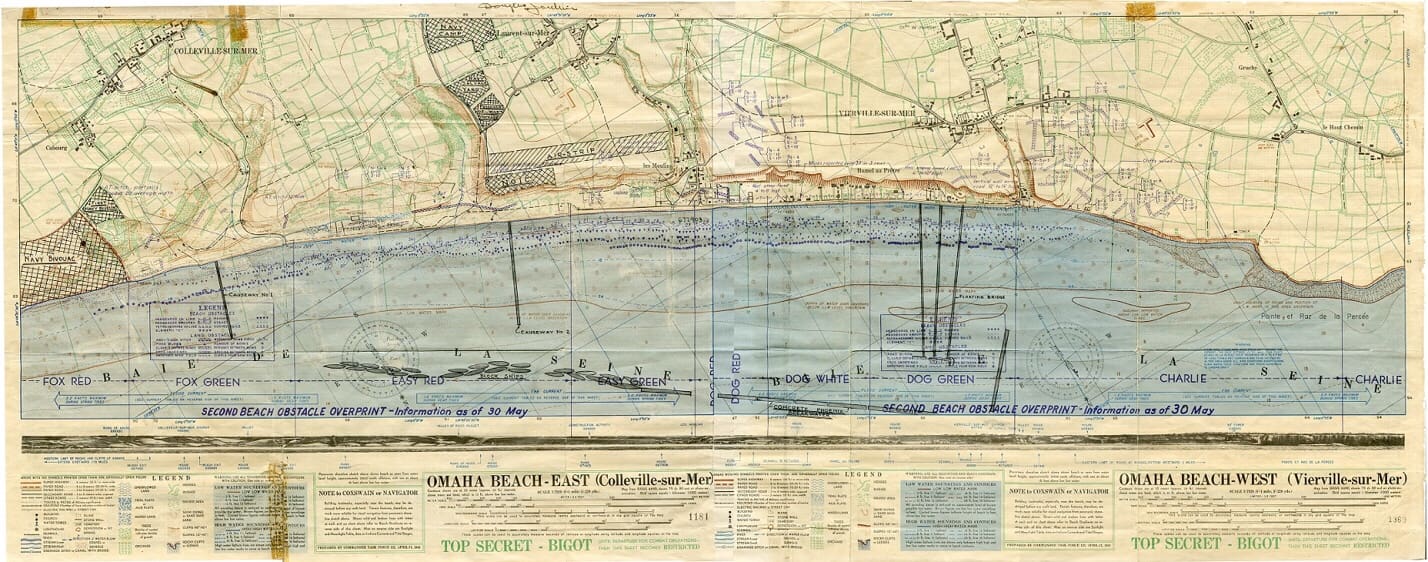
When the U.S. entered WWII, the Navy knew it would need men that would have to go in to reconnoiter the landing sites, locate and destroy obstacles and defenses. The Army and Navy established the Amphibious Scout and Raider School at Fort Pierce, Florida in 1943 to train men in the specialty of amphibious raids and tactics. Most of these men used their skills throughout North Africa, the Pacific, and the Normandy landings. In 1943, the Navy created a large dedicated force for this task called the Naval Combat Demolition Unit, or NCDU, that were also trained at Fort Pierce, Florida.

The Navy had a significant role in the June 6, 1944, D-Day invasion. However, long before that day, the Naval Combat Demolition Units (NCDUs) had to perform pre-invasion recons of the beaches and shore placements, even going as far as to bring buckets of sand back to make sure the beach could support the specialized amphibious tanks that would go ashore to provide close-in gun support. The Navy’s role in D-day was to provide shore bombardment, the follow-up gunfire support, plus transporting and landing many of the Army troops who stormed ashore.

The Naval Beach Battalions were naval elements of the Army Engineer Special Brigades for the invasion of Normandy. NCDUs were formed up about one year before D-Day. They were made up of 1 officer and 5 enlisted men. They trained alongside the Scouts and Raiders at Fort Pierce. They were organized by Lt. Cdr. Draper Kaufman, an explosives expert, with the specific goal of clearing beach obstacles.

In Late 1943, 10 NCDUs had arrived in England from Fort Pierce, FL, to meet and train with their British counterparts for future missions. In early 44, the units split and joined with the 2nd, 6th, and 7th USN Beach Battalions, the organizations, set up to coordinate and facilitate the Army landings. At this time, eight additional six-man units arrived from the U.S. to be split among the Beach Battalions.

The NCDU men were not the Frogman you would see in the movies of the same name. They were more like the man you would see in the movie Carlson’s Raiders. They mainly operated from rubber rafts and were not expected to spend long periods in the water. They wore fatigues, combat boots, and steel helmets. The men were in excellent physical condition but operated mainly in shallow water.

The more recons that were done on Hitler’s “Atlantic Wall” showed it becoming more formidable by the months. So as new personal from Ft Peirce arrived and the subsequent arrival of some Army Combat Engineers enabled each of the NCDUs to double in size. In April, of 44 the officers leading the Navy units and their Army counterparts were briefed about a hypothetical long, wide gradual sloping sand beach with a 25-foot tide change.

On that beach, and extending into the surf, they could expect minefields and a variety of devilishly designed obstacles placed to block and cripple landing craft. To clear the beach, the invasion planners envisioned an aerial and naval bombardment sweeping the coastline. Then the initial wave of infantry, supported by specially designed amphibious tanks, would land during low tide after dawn and rush to secure the beaches. Following in their wake, the NCDUs would land with a mission to blow a 50-yard gap in the German obstacles and place markers so landing craft coming in later that morning at high tide would have a straight, unobstructed path leading to the beach.

The Americans were assigned beaches “Utah” and “Omaha.” At 0630, H-Hour, on the morning of June 6, 1944, 11 NCDUs came in with 8th Infantry Regiment at Utah. With the Army securing the beach, the Navy demolition men went to work and quickly blew eight 50-yard gaps and had enough time to expand one gap to 700 yards. This allowed successive waves of troops, ashore and quickly secured a substantial beachhead by midday.

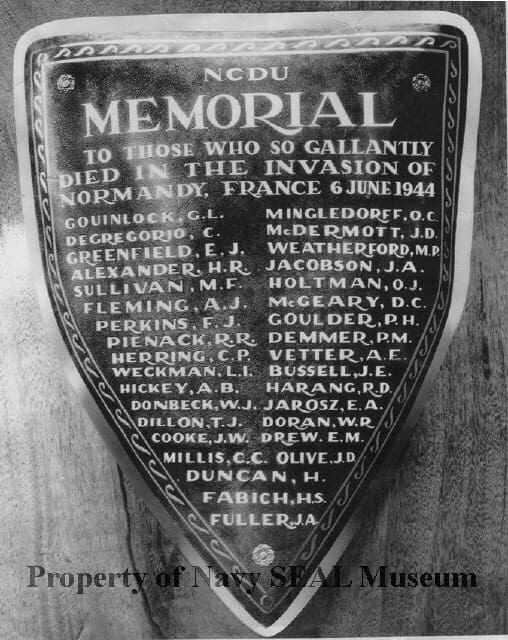
Four sailors were killed on Utah, and 11 others were wounded. Because of their efficient work, the units on Utah beach received a Navy Unit Commendation.

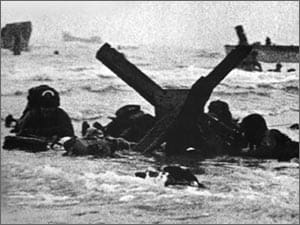
At Omaha, the Germans were better entrenched and had built a more robust network of obstacles. Sixteen teams, each with 7 Navy and 5 Army engineers tasked with clearing fifty-foot-wide corridors through the beach obstacles. One of the first teams ashore was wiped out as it landed, and another lost all but one man as it prepared to set off its lengths of twenty-pound explosive charges. Casualties were appalling: of the 175 NCDU men at Omaha, thirty-one were killed and sixty wounded—a 53 percent loss rate. It also didn’t help that the pre-invasion air and sea bombardments mostly missed their marks. As a result, the invaders were savaged by heavy artillery, mortar and machine-gun fire that ripped into the NCDU landing craft. Also, choppy seas swamped many of the amphibious tanks, depriving the invaders of needed of close-in firepower. However, the survivors succeeded in clearing five main channels through the obstacles and three partial channels before the rising tide forced them to withdraw. By the end of the day, about one-third of the obstacles had been destroyed or removed.

Through the gaps poured the reinforcements needed to hold off any counter attacks and to take the fight inland. Seven sailors earned the Navy Cross for their work that day. For their heroic actions, the Omaha NCDUs received a Presidential Unit Citation.

On Gold, Juno, and Sword the British beaches the NCDUs relied heavily on Royal Marine commandos specially trained for the task. Their mission and equipment were similar to their American counterparts but owing to less effective defenses; the Marines sustained fewer casualties, then the Americans did.

www.wwiifoundation.org/2014/09/10/ernie-corvese-us-navy-ncdu-d-day

Top 10 Takeaways from US Army’s Mad Scientist Initiative Meeting

Tuesday, May 28th, 2019

Over the weekend we mentioned the US Army’s meeting of futurists. Here are the top 10 takeaway from that meeting.

“Top Ten” Takeaways from the Disruption and the Operational Environment Conference

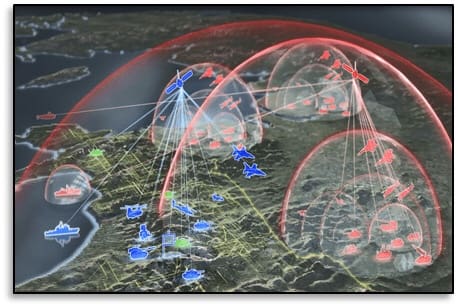
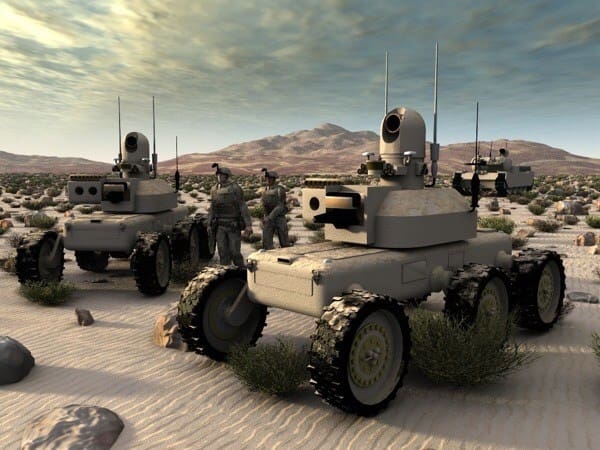
1) The Army is having an “Own the Night” moment. It has the opportunity to gain a competitive advantage over adversaries who have spent large amounts of capital and effort on gaining overmatch in niche areas like Anti Access/Area Denial (A2/AD) and anti-tank capabilities. The Army can “Own Unmanned and Autonomous Warfare.” There is a sweet spot in man-machine teaming that can limit vulnerabilities and strengthen cognition, awareness, and proficiency in dense urban environments.

2) Setting norms in AI/autonomy may accelerate development as researchers and programmers have defined left and right boundaries. Currently, uncertainty and lack of clarity are causing delays and trepidation in their development. If the DoD establishes the absolute boundaries of its AI and autonomy policies, it can streamline R&D, S&T, and acquisition / modernization. However, setting firm left and right boundaries does present some risk — with reduced development and asymmetry in adversarial AI development and implementation.

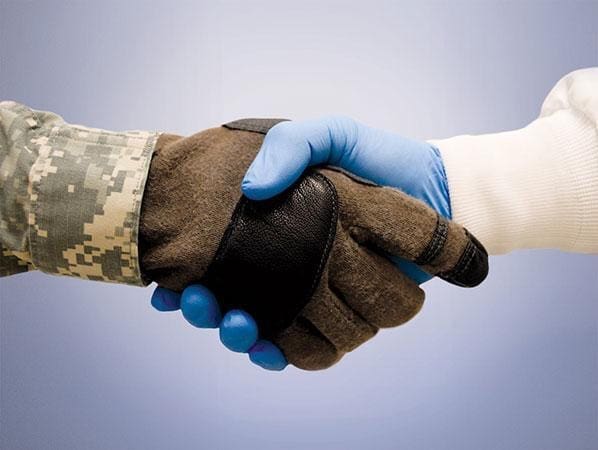
3) Artificial Intelligence and Trust. Successfully incorporating AI into Army formations to gain and maintain competitive advantage over adversaries in an increasingly contested OE will require bridging the gap between AI and humans by establishing trust. A true man-machine relationship plays a critical component in this process. Professional Military Education should improve tech literacy in the areas of AI, robotics, and autonomy, and introduce critical thinking earlier, producing an officer corps that can interact with AI decision-making tools and understand its limitations and vulnerabilities.

4) The Increased Crowding of Space will Create Operational Challenges for the US Army: A maneuver Brigade Combat Team has over 2,500 pieces of equipment dependent on space-based assets for Positioning, Navigation, and Timing (PNT) and Low Earth Space is cluttered with satellites, debris, and thousands of pieces of refuse. This is worsened by a growing space community with over 90 spacefaring countries and companies such as Amazon, Google, and Alibaba racing to capitalize on a potential space boom in the 2020s. The U.S. military will need to determine how to operate in space amongst increasing traffic and potentially non-attributable nefarious space tampering and attack where total space visibility and situational awareness is not possible.

5) Technology forecasting helps us understand what is probable, but with proper planning based on this insight, we can begin to determine what is necessary and influence development and investment. This must be partnered with an agile procurement process that can rapidly adjust to changing technological circumstances, rather than continue to spend money on near-obsolete multi-year exquisite platforms.

6) Scaling up technology in the military may necessitate a change to the ways in which they are developed. The rapidity of technological advancement may force development of whole systems – counter to current acquisition processes – rather than individual technology segments.

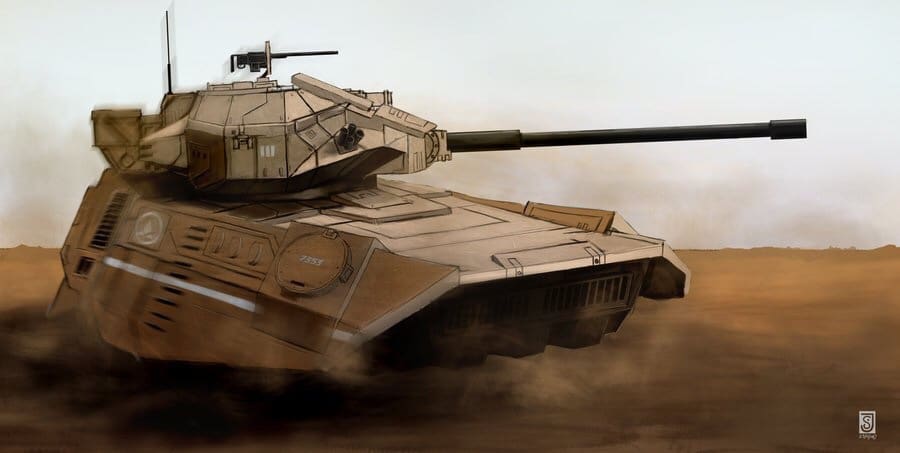
7) Disposable versus Exquisite: Current thinking espouses technologically advanced and expensive weapons platforms over disposable ones, which brings with it an aversion to employ these exquisite platforms in contested domains and an inability to rapidly reconstitute them. In large-scale ground combat operations with a peer competitor, the ability to reconstitute will be imperative. The Army (and larger DoD) may need to shift away from large and expensive systems to cheap, scalable, and potentially even disposable unmanned systems.

8) Leveraging Allies in Fielding Future Technology:  International Joint projects with our allies have benefits in cost-sharing, interoperability, and fostering cultural diversity in the development of crucial, complex technologies. Just as NASA collaborated with a variety of international partners for its Europa Clipper mission, so to could the U.S. Army when it comes to AI and autonomous warfare, as well as quantum information sciences, hypersonics, and directed energy weapons.

9) The Army should expand its learning beyond past combat actions and open
the aperture to lessons learned from organizations outside DoD.
The current Army Learning Enterprise captures important information from exercises and combat operations, but doesn’t include research from civilian organizations. NASA’s experience with degraded communications during the Mars Rover mission and robotic disaster relief during the Fukushima cleanup and Hurricane Harvey are incredible resources for Army capability developers, organization designers, and Leaders developing techniques and procedures for technology integration to mine and apply to force modernization efforts. The Army should aggressively pursue and incorporate lessons learned from non-DoD agencies and industry regarding disruptive technologies that have direct military implications.

10) The Changing Nature of Information Warfare: The prevalent and growing presence of fake news, data, and information, coupled with deep fakes, hyperconnectivity, and global economic intertwining changes the nature of conventional information warfare. This new era of information warfare will require increasingly potent algorithms to recognize and defend against false and transfigured information while leveraging the strength of human-tech partnerships in all domains to portray an accurate and trusted common operational picture.

If you would like to learn more about this conference, the agenda and biographies of each of the presenters are here on the Mad Scientist APAN site, while videos of each of the conference presentations can be viewed here on the TRADOC G-2 OE Enterprise YouTube Channel…

Article from Headquarters, U.S. Army Training and Doctrine Command (TRADOC) which co-sponsored the Mad Scientist Disruption and the Operational Environment Conference with the Cockrell School of Engineering at The University of Texas at Austin and the U.S. Army Futures Command (AFC) on 24-25 April 2019 in Austin, Texas. World-class presenters addressed robotics, artificial intelligence (AI) and autonomy, the future of space, planetary habitability, and the legal and ethical dilemmas surrounding how these disruptive technologies will impact the future of warfare, specifically in the land and space domains.  The following post captures the Mad Scientist Initiative’s “top ten” takeaways from this conference.

USPA Approves Specified Round Canopy Jumping

Monday, May 27th, 2019

On May 23, the USPA Board of Directors’ Executive Committee voted to allow USPA members to jump with the U.S. round parachute groups that are recognized by the Federal Aviation Administration. USPA members may perform static-line jumps with these groups using the groups’ equipment at their own airport locations, at FAA-approved airshows and demonstrations, and at events in foreign countries governed by those countries’ aviation authorities. USPA specifies that these static-line jumps must be at a minimum altitude of 1,500 feet above ground level.

USPA members who have been qualified by these groups to act as instructors and jumpmasters may serve as instructors and jumpmasters to anyone who is a member of a round canopy group prior to May 25, 2019.

This action removes any uncertainty about USPA member participation with the upcoming jumps by the round canopy groups in Europe in commemoration of the 75th anniversary of the D-Day invasion of Normandy on June 6, 1944.

The approved Executive Committee motion reads, “Effective immediately, USPA members who are members of a civilian parachute group listed with the FAA’s National Aviation Events Program may jump with that group using the following equipment and altitude:

• Minimum altitude 1,500 feet AGL

• Static-line deployed

• Round main

• Chest-mounted reserve

• Reserve static line not required

• Automatic activation device not required

• Altimeter not required

USPA members who are members of such groups may act as an instructor or jumpmaster, if so qualified by their group, using the above altitude and equipment, for those members of the group who have made a jump with that group, using the above altitude and equipment, prior to May 25, 2019, and may act as an instructor or jumpmaster for any member of the group who is a graduate of a military jump school as verified by DD214 or other military records.

These allowances do not extend to jumps at Group Member DZs, but only to the groups’ own locations, and at airshows and demonstrations allowed by the FAA or another country’s aviation authorities.”

Those with questions about what activities fall under this motion can email safety@uspa.org.

Via The Parachutist

Max Talk 23: The Squad in the Attack: Hasty Attack

Monday, May 27th, 2019

This is the twenty third installment of ‘Max Talk Monday’ which shares select episodes from a series of instructional videos. Max Velocity Tactical (MVT) has established a reputation on the leading edge of tactical live fire and force on force training. MVT is dedicated to developing and training tactical excellence at the individual and team level.

23 is a discussion and explanation of the Squad Hasty Attack Battle Drill, using training footage and a new addition of a sand table model with army men, as a method of introduction to explain this essential small unit tactics squad drill.

Detailed explanations can be found in the MVT Tactical Manual: Small Unit Tactics.

Max is a tactical trainer and author, a lifelong professional soldier with extensive military experience. He served with British Special Operations Forces, both enlisted and as a commissioned officer; a graduate of the Royal Military Academy Sandhurst. Max served on numerous operational deployments, and also served as a recruit instructor. Max spent five years serving as a paramilitary contractor in both Iraq and Afghanistan; the latter two years working for the British Government in Helmand Province, Afghanistan.

Website: Max Velocity Tactical

YouTube: Max Velocity Tactical

Excellence in Tactical Training.

SCUBAPRO Sunday – Memorial Day

Sunday, May 26th, 2019

Shortly after the Civil War, Memorial Day began as Decoration Day. The reason for that is because it was a day on which Americans, North and in the South, would decorate the graves of soldiers who died in the Civil War.  


Maj. Gen. John A. Logan, who lead a group for Northen Civil War veterans, declared in 1868 that Decoration Day would be observed on May 30. The date was chosen only for the reason that it didn’t coincide with any battles fought. It was a day for the North and South to honor their fallen and decorate their graves. After World War I the holiday was broadened to include service members who died in all of the country’s wars, not just the Civil War. 


Multiple cities claim to be the birthplace of the holiday, but President Lyndon Johnson formally gave the honor to Waterloo, N.Y., in 1966. Up until 1971, Memorial Day was observed on May 30, the date Logan had selected for the first Decoration Day. In 1968 Congress passed the Uniform Monday Holiday Act, which established Memorial Day as the last Monday in May to create a three-day weekend for federal employees. The same law also declared Memorial Day as a federal holiday. It did not go into effect until 1971. 


Most people look at the Memorial Day weekend as the unofficial start of summer, mattress, and furniture sales or a day for cooking out. I know most of the people that read SSD will understand what the real meaning is. This is a day to remember the fallen man and woman of the military that has gone before us. Like most holidays in the U.S., it has been turned into just a weekend for sales and people to try and make money. But please take the time to think about the fallen, and their families that have as President Lincoln said: “Laid so costly a sacrifice upon the altar of Freedom.”  


There are a couple small things you can do. One is if you fly an America flag lower it to half staff until noon. Then at noon raise it all the way up until sunset. Second, in the year 2000, the National Moment of Remembrance was passed in Congress this says at 3pm local time take a moment in your own way to remember the fallen. Lastly, Memorial day is not Veterans Day.  I heard someone say, “oh this weekend, we should really thank a veteran.”  This isn’t for us.

I hope you all have a good day with family and friends.

Long live the Brotherhood


Mad Scientist Initiative Helps Illustrate ‘Realm of the Possible’

Saturday, May 25th, 2019

FORT MEADE, Md. — In the distant future, teams of Soldiers equipped with high-powered exoskeletons disembark a series of autonomous personnel carriers outside the enemy’s position. Overhead, a small fleet of drones scans the engagement area, giving each Soldier a real-time view of the battlefield through their heads-up display.
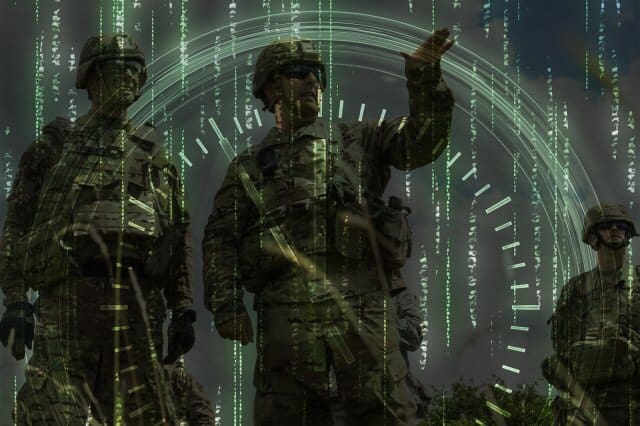
As each team moves into position, they hear a series of explosions on the other side of the enemy base. From over 2,000 meters away, the Army’s high-energy precision fires systems have just disabled the enemy’s anti-access and area-denial capabilities.

At the same time, teams of Soldiers use their exoskeleton suits to leap over the perimeter wall to engage the enemy and secure the compound.

This is one scenario of a future operating environment. In reality, it is nearly impossible to predict how the Army will operate and fight in a distant future, said Matt Santaspirt, an Army Futures Command intelligence representative.
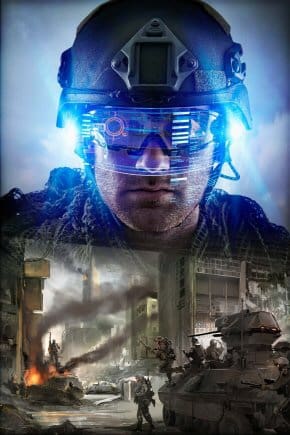
To guide the Army in the right direction, the U.S. Army Training and Doctrine Command’s Mad Scientist team functions like a scout on the battlefield, always looking ahead and evaluating ideas to help build the force, he said.

Nested within both Army Futures and Training and Doctrine Commands, the MadSci initiative was created to address opportunities and challenges in the Army’s near-, mid-, and far-term future, said Allison Winer, the team’s deputy director of engagement.

The goal is to maximize the Army’s limited resources and help Soldiers fight and win in a futuristic operational environment, she added.

“The Army only knows what it knows; and [the Army] always talks to itself,” Santaspirt said. “We want to break out of that echo chamber.”

“We are harnessing the intellect of the nation to describe the art of the possible,” he added. “We know that you can’t predict the future, but we’re trying to say, ‘Here is a range of possibilities.’ [The goal] is to be less wrong than our adversary.”

To accomplish this goal, the MadSci team compiles information from a wide range of sources, in support of Army senior leaders’ priorities, Santaspirt said.

These sources include traditional mediums: academia, industry, think tanks, labs, reports, and white papers; to the more nontraditional platforms: crowdsourcing, social media, science fiction, and cinema, to name a few.

Beyond the collection of materials, the MadSci team often organizes themed conferences, bringing communities together to address key Army topics. For example, the team recently conducted the Mad Scientist Disruption and the Future Operational Environment Conference in Austin, Texas.

During the conference, presenters addressed robotics, artificial intelligence and autonomy, the future of space, planetary habitability, and the legal and ethical dilemmas surrounding how these disruptive technologies will impact the future of warfare, specifically in the land and space domains, according to MadSci officials.

“We had somebody come in and talk about robotics and how we can use them in an austere environment,” Santaspirt said, adding there were specific examples of robotics used in Fukushima, Japan.

“The approach is to bring together experts … so we can refine those key ideas, and disrupt [the Army’s] assumptions,” he said.

A week after the event, the team posted some key takeaways from the conference on the Mad Scientist Blog. The MadSci blog and other social media platforms are often used as a crowdsourcing tool to help poll an audience or generate conversation about key Army topics, Winer said.

Some of the conference findings included: a need to set left and right boundaries for artificial intelligence and autonomy, increased crowding of assets in space will cause operational challenges, and fake news coupled with hyper-connectivity is changing the nature of information warfare.

Additionally, the MadSci team organizes science fiction writing competitions to help determine possible futures for crucial Army programs, Winer said. For years, science fiction has depicted worlds that are both logically possible, but functionally different than current society.

“Science fiction is used as a kind of forecasting to see what possible futures might look like,” she said. “Aside from being just plain-on cool, it gives the Army a way to use storytelling, historical analysis, and outsourcing to write about the realm of the possible. And it is an effective tool for a lot of businesses and other leaders in industry to try.”

Through their research and continual online engagements, the MadSci team creates a range of possibilities, then later presents their findings to Army senior leaders and key decision makers, Santaspirt said.

“It is a different way of thinking,” Santaspirt said. “If [the Army] can get that out there and start meeting the right people, make certain decisions or investments, or get people thinking in a different way … you might see what we’ve discovered — as it comes to light down the road.”

Mad Scientist Initiative Website

Mad Scientist Initiative videos

By Devon L. Suits, Army News Service

Photos by Peggy Frierson & Mad Science Initiative

FirstSpear Friday Focus – Donate to SOWF this Memorial Day

Friday, May 24th, 2019

The Special Operations Warrior Foundation provides financial aid to the children and families of fallen Special Operations service-members and ensure their children can go to college. Through the Memorial Day Weekend, FirstSpear will match any donations made through the website to SOWF.

To donate: go to www.first-spear.com, go to your shopping cart and click the “Donation” tab in the upper-right hand corner of your screen underneath the “Proceed To Checkout” button.