FirstSpear TV

Archive for the ‘Guest Post’ Category

Kit Badger Asks, “What’s the Best Length?”

Saturday, November 30th, 2024

In this video by my friend Ivan, he looks at carbine barrels from 13.7″ to 16″ to determine the best barrel length. Specifically, he examines what is gained or lost by deviating from the non-NFA 16″ barrel length.

Learn more at kitbadger.com/13-7-to-16-the-best-barrel-length.

10th Mountain Division Hosts Summit Strike 2024 – Offering a Glimpse into Future of Multi-Domain Operations

Saturday, November 30th, 2024

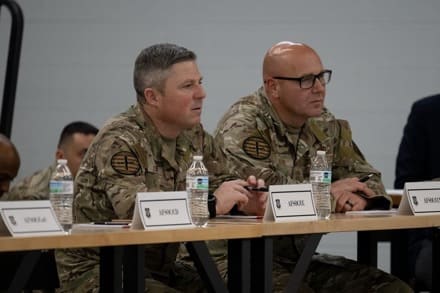
The 10th Mountain Division (LI) hosted Summit Strike 2024, Nov. 19-21, with the intent to seamlessly integrate fires; intelligence, surveillance, reconnaissance (ISR); and multi-domain operations (MDO) assets by partnering with other countries, military branches, and multiple industry partners to defeat adversaries, while showcasing Fort Drum as the premier training and force development hub in the Northeast.

“It is our sacred obligation to fight and win our nation’s wars,” said Maj. Gen. Scott Naumann, the 10th Mountain Division (LI) and Fort Drum commander. “Summit Strike provides the 10th Mountain Division the opportunity to hone the skills our warfighters need to accomplish this. Through this multi-domain training exercise, we are able to learn, refine requirements, and develop innovative solutions to fight a near-peer enemy with successive iterations of live, multi-domain training.”

“This type of training, partnered with facility improvements, deepening institutional knowledge from our deployments, and ever-strengthening partnerships in the region, positions the division to continue leading transformation initiatives to build warfighting readiness,” he added.

The exercise involved live-fire training, with emitters simulating enemy artillery and weapon systems placed throughout the Fort Drum training area. The Joint Air Ground Integration Center (JAGIC), then coordinated attacks on these targets using various weapon systems, including High Mobility Artillery Rocket Systems (HIMARS), AH-64 Apache helicopters, A-10 Warthogs, and Mobile-Low, Slow, Small-Unmanned Aircraft Integrated Defeat Systems (M-LIDS).

Summit Strike ’24 validated the division’s ability to integrate surface-to-surface, rotary-wing, and fixed-wing weapon systems, enhancing its lethality. The exercise also incorporated emerging military electronic systems technology to build resilient kill webs.

“Here, in these types of exercises, replicating real-world, large-scale combat operations, we are coordinating, synchronizing, and employing effects both lethal and non-lethal,” said Maj. Mark Smerka, 10th Mountain Division Artillery operations officer.

Owners of an 80-year-old legacy, born in the battle of Riva Ridge in Italy, the 10th Mountain Division remains at the forefront of modern warfare. The division is dedicated to adapting to the ever-evolving battlefield, embracing innovation, and staying ahead of potential threats, in line with the unit’s history as they face the future of warfighting.

“The future fight that we’re looking at in a near-peer environment is going to be bigger, faster, require more assets and more technology than we’ve been using in the past,” said Maj. Sean Thomas, 10th Mountain Division JAGIC chief. “We’re embracing a lot of that in this exercise, testing it out and getting comfortable using it.”

The exercise involved more than 400 service members from Fort Drum, with additional support from both U.S. and international military members. By fostering these partnerships within the Army and Department of Defense, Summit Strike ’24 provided MDO training on Fort Drum and allowed for the development of shared systems to enhance warfighting capabilities.

“We won’t fight alone in any future operation, whether that’s multi-branch or multi-nation,” said Capt. Maddie Crimmins, commander of C Battery, 3rd Battalion, 27th Field Artillery Regiment, 18th Field Artillery Brigade, located at Fort Liberty, N.C. “Here we are executing multi-platform as well as multi-domain.”

Summit Strike ’24 provided a demonstration of the division’s ability to coordinate and execute an MDO live-fire exercise. The exercise highlighted the unique training opportunities offered by Fort Drum in a low-threat environment for Soldiers to train for MDO threats in a contested environment.

“Summit Strike is really the first of its kind where you have a division creating an MDO environment at home station to make sure we are trained proficiently so that we can win the Army’s future wars,” said Capt. Sean Thorpe, 10th Mountain Division cyberspace and electromagnetic activities officer in charge.

Summit Strike ’24 solidified Fort Drum’s position as the premier training and force development hub in the Northeast, showcasing its ability to integrate emerging technology and systems into range operations. The exercise also highlighted the division’s commitment to partnering with industry to enhance MDO training capabilities at Fort Drum.

“We learned that the 10th Mountain Division is able to conduct multi-domain operations, especially here at home station,” said Maj. Michael Spickard 10th Mountain Division assistant chief of fires, and lead planner for Summit Strike ’24. “We are more prepared in the future to make this exercise grow for Summit Strike ’25.”

By PFC Alyssa Norton, 27th Public Affairs Detachment

FS Friday Focus: Gear Up for the Holidays with FirstSpear

Friday, November 29th, 2024

Gear Up for the Holidays with FirstSpear

This Christmas season, we’re delivering tactical-grade specials daily, starting December 5th. From the field to everyday life, these sought-after designs and innovations are crafted for those who rely on uncompromising performance and precision in everything they do.

Stay in Comms:

Daily Drops: New, products are available daily through the holiday.

First Access: Be among the first to discover each drop as it’srevealed, then stay on for the latest new gear throughout 2025.

Built for the Elite: Trusted by the best, FirstSpear gear isn’t just another purchase—it’s a commitment to quality.

Don’t miss your shot. Whether you’re still in the fight, transitioning to civilian life, or just someone who values gear that holds up, this is your season to secure what you need.

Sign Up.

Stay Alert.

The countdown is on.

Subscribe to the FirstSpear newsletter today and get ready for a steady stream of serious deals this Christmas. Act fast—time and inventory wait for no one.

Soldier, Astronaut, Receives Rare Honor

Friday, November 29th, 2024

WASHINGTON — Huddled inside the International Space Station a million feet above the earth’s surface, Kate Rubins decided she wanted to go back.

In 2021, while on her second space mission, the astronaut chose to return to her roots in the medical science field and apply for a commission in the Army Reserve while continuing her career at NASA.

“I thought when I got back to the planet, this was one thing that I really wanted to do,” Rubins said.

She had worked alongside Army aviators and astronauts, including retired Army Col. Jeff Williams, who spent 28 years in NASA’s space program and served as commander of her first space flight in 2016. Retired Army Col. Pat Forrester, then the chief of the astronaut office at Johnson Space Center in Houston, Texas, mentored Rubins during her first years in the space program.

Before NASA, Rubins researched the effects and treatment of infectious diseases as a microbiologist with Army researchers from the U.S. Army Medical Research Institute of Infectious Diseases at Fort Detrick, Maryland, and the Centers for Disease Control in Atlanta, Georgia, to develop the first model of smallpox infection, research that would eventually jumpstart her career as a molecular microbiologist, studying and treating infectious illnesses in the U.S. and Africa.

That successful stint studying virology eventually led to her selection into NASA’s 20th astronaut class in July 2009. As an astronaut, Rubins would go on to log the fourth most hours in space by a female astronaut with two space flights under her belt. Rubins also became the first to sequence DNA in space during an expedition 2016.

For her achievements, the Army honored now-Major Rubins with the U.S. Army Basic Aviation Badge with the Astronaut Device and the Basic Space Badge, becoming the first Army reservist and fourth Soldier to receive the combined honor. The service presented the awards in a pinning ceremony at the Pentagon’s Hall of Heroes on November 21.

To qualify for the award, an astronaut must be a member of the U.S. Army and have flown on a space mission.

“This award is a really great opportunity to recognize both NASA and the U.S. Army, particularly the Army Reserve,” said Rubins a native of Napa, California. “People are excited about this award, but it’s not about me. This is really about the fact that it’s incredible that I get to serve my country in my civilian role as an astronaut and then in my Army Reservist role. So I think it’s pretty neat to see those two worlds come together.”

During Rubins’ years with NASA, she said she never forgot the call to duty that she felt working with Army astronauts and Army researchers. Rubins recalled seeing her own stepfather spend a decade as an Army chaplain.

Rubins reflected on her mentor, Forrester, an Army master aviator who completed Ranger School. He served as an advisor for astronauts during his 31 years in NASA.

“He’s an incredible mentor,” Rubins said. “I think every astronaut will say that Colonel Forrester left an indelible mark on the astronaut office.”

Williams, also an Army pilot and experienced astronaut, took the role of commander on NASA expedition 48, Rubins’ first space flight.

“He taught me everything I know about spacewalking,” she said. “It was incredible to serve with him. He was a very experienced astronaut at that point.”

Rubins went on her second NASA mission in 2020 to 2021 for Expeditions 63 and 64, joining a seven-person crew. On this six-month expedition at the International Space Station, Rubins once again felt the call to battle against a spreading disease. She had served as NASA’s deputy director for human health and performance after her first spaceflight and trained for her second spaceflight during the COVID-19 pandemic.

Rubins began filling out necessary paperwork for her direct commission aboard the ISS.

“It all came together like a lightbulb moment,” Rubins said. “I really wanted to serve my country when I get back. I can’t do it full time, but maybe I could sign up to be a reservist.”

Rubins wanted to use her skills in her previous career to help save lives as a Soldier. She said she realized that civilians with established careers can add value to the Army and Army Reserve.

“You’re bringing all those skills from the civilian world to bear… I think that’s great,” she said.

Rubins joined the Army Reserve as a medical service corps officer and microbiologist. In this role, Rubins explores using innovation and technology as a member of the Army Reserve’s 75th Innovation Command based in Houston, supporting Army Futures Command. Her work in continuous experimentation helps advance the Army’s modernization efforts, she said.

Rubins took a direct commission course at Fort Sill, Oklahoma, joining the Army Reserve as an 0-4. She then completed the Basic Officer Leadership Course at Fort Sam Houston, Texas, where she trained to be an medical service corps officer, attending courses alongside doctors, nurses, social workers and psychiatrists. She said she learned how to care for Soldiers in deployed environments and how to set up field hospitals

From the lab to the last frontier

Rubins first dreamed of flying into space while visiting a California state park as a 5-year-old. Her parents brought her to stargazing parties as a child where she said she remembers peering into telescopes and gazing at celestial bodies.

During Rubins’ years at Vintage High School in California’s Napa Valley, HIV cases and the AIDS epidemic plagued much of the nation. By 1994, AIDS became the leading cause of death among adults ages 25-44, according to the American Psychological Association. She worked on a program to combat HIV transmission as a high school student.

She said the opportunity to contribute to the fight against HIV inspired her to make that the focus of her undergraduate studies at the University of California-San Diego where she earned a bachelor’s degree in molecular biology.

During her time as a fellow and principal investigator position at the Whitehead Institute for Biomedical Research [MIT/Cambridge, Massachusetts]between 2007-2009, Rubins led a team of 14 researchers studying poxviruses, MPOX and smallpox, and filoviruses, Ebola and Marburg viruses Rubins and some members of her lab participated in missions to the Democratic Republic of the Congo in Central Africa. There Rubins worked with Army research teams to prevent and treat MPOX infection.

Following her work for MIT, she never lost sight of her dream. A friend encouraged her to apply to be an astronaut when she saw a job posting on USAjobs.gov. Rubins said she thought she faced slim odds. NASA typically recruits engineers, military test pilots and physicists.

To Rubins’ surprise, NASA called back.

“It didn’t seem like biology was very big part of NASA’s mission,” Rubins said. “What I didn’t know is, it actually is. It’s a big part, and it’s become a bigger part in recent years with the research on the International Space Station.”

Still Rubins had to pass multiple medical tests and make it through several rounds of interviews before getting accepted into the space program.

“When I got the final call, I think I was just more surprised than anything,” she said. “I never had expected that. Of course, I was incredibly thrilled and excited, but it was a pretty big life change.”

Rubins had to undergo rigorous training that included field survival skills and learning to fly the T-6 Texan with the Navy. She also had to spend hours in a simulator at the Johnson Space Center. She underwent training submerged in water to simulate weightlessness in zero gravity conditions.

Rubins said she faced the most daunting portion of the astronauts’ two-year training while learning to spacewalk. Rubins said being able to navigate weightlessness amid the vastness of space humbles even the most experienced military pilots. Forrester assigned her to evaluate and monitor spacewalks for crewmembers following her first spacewalk.



“Spacewalking is just one of these things that’s on the limits of human existence,” Rubins said. “It’s like the limit of what humans can do. So we’re absolutely pushing our performance to the max, and nobody finds it easy.”

On July 7, 2016, from the Baikonur Cosmodrome in southern Kazakhstan, Rubins would achieve something she once thought unreachable.

Rubins, as part of a three-person crew, launched into space. As the spacecraft torpedoed farther and farther from the Earth’s surface, Rubins focused on performing system checks, measuring oxygen levels and assessing the atmosphere.

Then her expedition commander told Rubins and another first-time astronaut to look out the window.??She said she gasped in awe at the vastness of the expanse and seeing the earth in orbit for the first time.

“I was speechless. I couldn’t talk for a full two minutes,” Rubins said. “It was so amazing to see the Earth and be orbiting the Earth. And my initial impressions were just that it was so bright and blue. It really looks like it’s glowing from space.”

“So you kind of just see this… blue ball suspended in the blackness of space. It was …. just a truly incredible sight,” she said.

On Rubins’ first two spacewalks she helped install a docking adapter to allow new vehicles to dock to the ISS. Rubins and Williams used a robotic arm to install the ring-shaped device. On the second spacewalk Rubins collapsed a radiator no longer used by the ISS and installed new high-definition cameras.


On her second spaceflight, Rubins led on a seven-hour spacewalk on Feb. 28, 2021, with fellow astronaut Navy Capt. Victor Glover and embarked on a six-hour, 56-minute walk with Japanese astronaut Soichi Noguchi.

Rubins actively supports NASA’s future goals to return to the moon through the agency’s Artemis campaign. The goal of Artemis: to return to the moon to explore the unexplored polar regions on the lunar surface for technology discovery, scientific advancement, and prepare for deep space and Mars missions, with the expedition scheduled for September 2026, according to NASA.

Soldier in Space

Rubins said many of the skills she learned in the Army are transferrable to her work as an astronaut. She said skills she learned as a Soldier, including land navigation during Basic Officer Leadership Course, will be useful during missions to the moon to chart paths on the lunar surface.

“We don’t have satellite navigation around the moon,” Rubins said. “We don’t have magnetic fields or a compass, so we are going to be using maps and terrain association and land navigation. Some of the other similarities are that these are professional people in both areas, and they’re doing a challenging and a difficult task, but they’re relying on a team.”

“And so I find the work that I do with the U.S. Army Reserve, working in small teams, depending on each other, working together, those skills are very helpful in the job of being an astronaut,” she said.

By Joe Lacdan, Army News Service

WRAIR Advances Neurostimulation Research in New Partnership with NATO Committee

Thursday, November 28th, 2024

On October 16, 2024, the NATO Neurostimulation Committee visited the Walter Reed Army Institute of Research’s (WRAIR) Sleep Research Center (SRC). Hosted by Dr. Tracy Jill Doty, Chief of the SRC, the visit focused on learning about ongoing fatigue mitigation research using neurostimulation.

The NATO Neurostimulation Committee is a working group of leading researchers in neuroscience, cognition, and brain function. Established in July 2024, the committee addresses common limitations in neurostimulation research by conducting large-scale, multi-laboratory experiments across multiple countries. Its mission is to advance the understanding of cognitive performance enhancement through robust and thorough investigations. The committee’s work centers on neurostimulation, a field that encompasses various technologies and techniques for targeting specific brain regions. Dr. Doty, an expert in sleep and fatigue, provides valuable insights to these efforts.

“The committee didn’t previously have an expert in sleep and fatigue, but it’s a critical area where neurostimulation technology could make a substantial impact,” Dr. Doty explained. “Applying neurostimulation to maintain brain health under fatigue conditions is a growing field, and this partnership between the committee and the SRC is a natural fit.”

The SRC contributes to the committee’s international research efforts by developing brain stimulation methods to enhance slow-wave sleep and help service members maintain alertness during extended operations. These capabilities, including pioneering advancements in slow-wave sleep enhancement, have been a hallmark of the SRC’s work.

Service members often face challenges such as insufficient sleep or limited rest periods, which significantly impair cognitive performance and mission readiness. Studies show that a single night of sleep deprivation can impair alertness and cognition to levels comparable to a 0.08% blood alcohol concentration.

“The Sleep Research Center is at the forefront of neurostimulation technology,” said Dr. Doty. “We’re eager to explore new opportunities to advance this technology for military applications.”

Although still in its early stages, this collaboration between the SRC and the NATO Neurostimulation Committee holds significant promise for improving service members’ cognitive resilience and overall brain health.

Story by Zeke Gonzalez 

Walter Reed Army Institute of Research

First of the First: 11th Air Task Force Conducts First Field Exercise

Wednesday, November 27th, 2024

McGREGOR RANGE, N.M. —

The 11th Air Task Force conducted its first field training exercise at McGregor Range, New Mexico, Nov. 4-19, 2024.

As the Air Force shifts toward a more agile, team-oriented force structure, the exercise united Airmen from Davis-Monthan and Holloman Air Force Base to test and refine new concepts for combat readiness.

“This is the future of the Air Force,” said  U.S. Air Force Lt. Col. Daniel Jamerson, 11th Combat Air Base Squadron commander. “We’re here to prepare our Airmen for the next fight, whether in new terrain, against new adversaries, or in different operational conditions than what we’ve faced in the past.”

The exercise focused on protection-based core task training, ensuring Airmen from diverse career fields are ready to operate as a cohesive unit in combat scenarios. This approach contrasts with past models where Airmen were individually deployed and often worked with unfamiliar teams upon arrival. The shift toward integrated team training reflects the Air Force’s vision for agile combat employment, a proactive and reactive operational scheme of maneuver to enable U.S. forces to increase survivability while generating combat power.

Airmen learned and demonstrated base defense drills, weapons tactics, visual signals, guardian angel and chemical, biological, radiological and nuclear preparedness. Airmen also gained experience using counter-unmanned aerial systems, M4 carbines, M18 pistols and heavy weapons. 

The training culminated in a base defense scenario, led by U.S. Army 2-363rd Training Support Battalion Task Force Black Scorpion out of Fort Bliss, Texas, where Airmen implemented everything they learned and demonstrated their ability to defend a contingency location while under simulated attack.

“This training instills mission ready airmen and agile combat employment techniques to ensure that we are prepared for that next fight,” said Jamerson. “It’s great to be proficient in your primary Air Force Specialty Code, but you need to be prepared at any given day to be whatever we need to be for a combat air base squadron. It all comes down to that mission focused piece.”

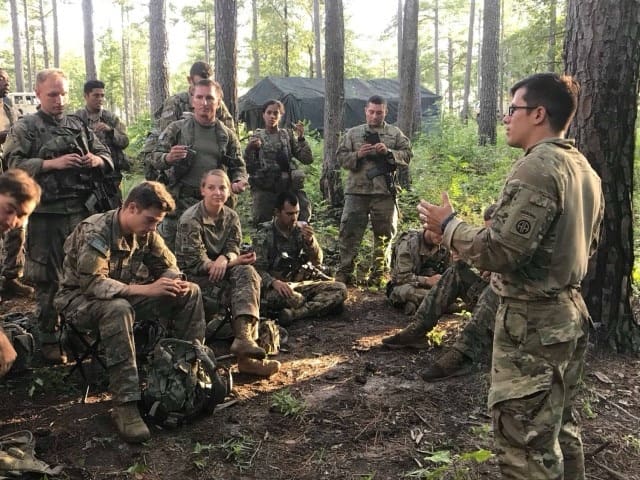
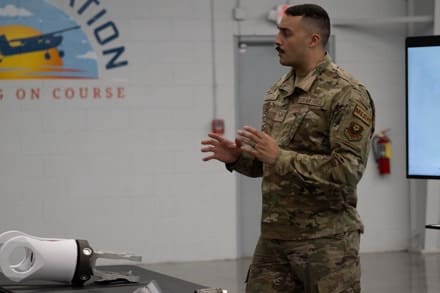
Security forces Airmen led focused training for fellow 11th ATF members.

This training is setting us up to be the best technical experts in our AFSCs while training our peers who are deploying with us, said Airman 1st Class Caleb Roy, 355th Security Forces Squadron response force member. Roy explained the team was preparing one another for aircraft protection, access control, vehicle searches, weapons tactics, and day-to-day proficiencies so each Airman is interchangeable down range.

The 11th ATF’s efforts are part of a broader initiative to align Air Force force presentation models with those of sister services. The goal is to provide the Department of Defense with clearer insights into Air Force capabilities and readiness levels. The exercise also served as the first opportunity for the Airmen of the 11th Air Task Force, split between Davis-Monthan and Holloman, to train together.

“This is our first opportunity to [come together] to learn our strengths and weaknesses,” said Chief Master Sgt. Jerome Clark, 11th CABS senior enlisted leader. “It’s much better to work with the team all the way through a cycle. All of that ties into us training together, and then deploying together and having a successful mission.”

The exercise prepared Airmen for the way the Air Force will be operating going forward and familiarizes them with the Air Force Force Generation Cycle. It allows a more predictable deployment cycle and the ability to better plan operations without the disruptions of last-minute assignments. This structured approach not only enhances operational readiness but also builds confidence among the team.

“We’re deliberate, motivated, and excited,” said Clark. “This process is setting the foundation for a stronger, more agile Air Force.”

Jamerson echoes Clark’s feelings.

“The future is here,” said Jamerson. “The combat air base squadron is not just a concept, it’s the reality of how we’re going to fight and win the next conflict. We’re building something transformational, and this is just the beginning.”

By Airman 1st Class Jasmyne Bridgers-Matos, 355th Wing

Team O’Neil’s Tactical Driving Tuesday – Close Proximity

Tuesday, November 26th, 2024

In this week’s tip, Instructor Wyatt discusses close proximity driving and suggests drills you can use to imporve your skills.

If you’re in need of in-person training like this, sign up for the Team O’Neill Tactical Driving Course at their facility in the White Mountains of New Hampshire. This five-day course includes driving under NODS and is available to military and other government agencies as well as civilians.

The Ultimate Black Friday Sale at vertx.com Starts Now!

Tuesday, November 26th, 2024

The Ultimate Black Friday Sale at vertx.com Starts Now!

Get 30% off sitewide using code BF30, giving you the chance to snag top-tier tactical gear that never compromises on quality. But that’s not all—score up to 80% off on select items, no code needed.

Exclusions apply on new releases and sale items, but with deals like these, it’s a tactical treasure hunt you don’t want to miss. Shop the Vertx Black Friday Sale now!