As I said in the comments in the Fighting Load Continuum (FLC), Part II, if I accomplish nothing else, I am hoping these articles will re-energize leaders’ emphasis on soldiers’ loads similar to what some of us experienced in the late 80s “Lightfighter” era. That focus in turn will presumably empower young leaders to make smarter decisions about what to carry and what not to carry. Carrying ONLY the mission essentials may or may not result in appreciably lighter individual loads, but I am making the argument that inculcating strict load discipline habits will assuredly enhance the unit’s chances for mission success. Bottom line up front, combat loads are both an enabling and debilitating mission factor that deserves much more active leadership attention then it is now receiving.
As we have already noted, the Army has a long-standing aspirational combat weight goal that it freely admits cannot realistically be achieved. Accept that fact but do not be afraid to attack the problem anyway. Be aggressive and do what can be done to lighten your unit’s load because it makes tactical sense. New technologies do tend to add weight – but also provide critical new or better capabilities. We talked about body armor specifically last time; good leaders prefer to bring people home alive – if not perfectly intact – so we accept the capability and the tradeoffs that body armor represents. Remember, human nature being what it is, unless ruthlessly controlled by leaders, units and individuals will ALWAYS carry as much as they can get on their backs “just in case” when going into combat.
A risk is a chance you take; if it fails, you can recover. A gamble is a chance taken; if it fails, recovery is impossible.
Erwin Rommel
Leaders cannot realistically avoid taking risks with soldiers’ lives in combat; however, leaders must do everything possible not to gamble with those lives. In terms of load management, the risk incurred is directly proportional to a unit’s ability to recover if a planning assumption proves to be mistaken. For instance, food and water are important to sustain combat power, but a temporary shortfall of those commodities is not likely to cost lives or have an immediately catastrophic impact on a mission. That is even true if the mission is unexpectedly and unavoidably extended or changed.
I will use a scenario based on a number of real world incidents to illustrate. Let us say a patrol (mounted or dismounted) went out in the morning for a short pre-scheduled meeting with a Host Nation counterpart. The meeting goes as planned, but on the way back a vehicle rolls over into the river – or perhaps just one soldier falls in and is swept under. Like it or not, the emergent recovery mission is now of indefinite duration. Still, if the patrol brought limited water or chow with them, it is of no great concern because remedial action is relatively easy. The patrol can make do until additional supplies can be delivered to them by vehicle, air or on foot if necessary. Sure, some stomachs may growl or mouths get dry before resupply gets there, but the situation remains low risk throughout. Indeed, our logistical system is optimized to rapidly deliver bulk consumables like water, food, and ammo.
On the other hand, if the patrol left behind Night Observation Devices (NODs) because they expected to complete the mission well before dark, that situation would be much more potentially dangerous. Recovery from that decision would be a lot more difficult and a low risk mission can quickly become high risk or even a gamble. We issue NODs individually and do not have many replacements on hand; therefore, they cannot be stockpiled and readily available like water, food, and ammo. Imagine the remaining soldiers of the parent unit trying to search individual bags and tuff boxes to collect NODs left in the rear and deliver them to the patrol before nightfall. A herculean task that – while not impossible – is best avoided. That is why I often use NODs to explain the “Gilligan’s Island Rule” mentioned in Part I. In short, it is rarely prudent to leave NODs behind even if the original mission is supposed to be a routine, daylight, “three hour tour.”
I also mentioned last time that I always cringe a little when I hear combat loads being compared / equated to civilian backpacking – even extreme forms of backpacking. While both involve packs, they are apples and oranges. An ultra-light enthusiast or even someone trying to summit Everest may be pitting himself against unforgiving nature. However, he is not also simultaneously moving to engage and destroy armed opponents that are intent on killing him first. Likewise, a civilian backpacker generally carries only his own gear and supplies. Conversely, soldiers always hump two categories of gear into combat, stuff carried to support him or herself, and – usually considerably more – stuff carried that is intended to support other members of the team. To that end, a combat soldier must always pack items in a manner that effectively supports the unit mission and his teammates – rather than for his own comfort and convenience. Beyond that, a soldier’s mission is not just to get somewhere and back. A soldier strives to get there, win the close fight with his team, and get back alive. That alone is the ultimate goal of combat. If a lighter load facilitates mission success, great. If a heavier load is needed to get the job done, so be it.
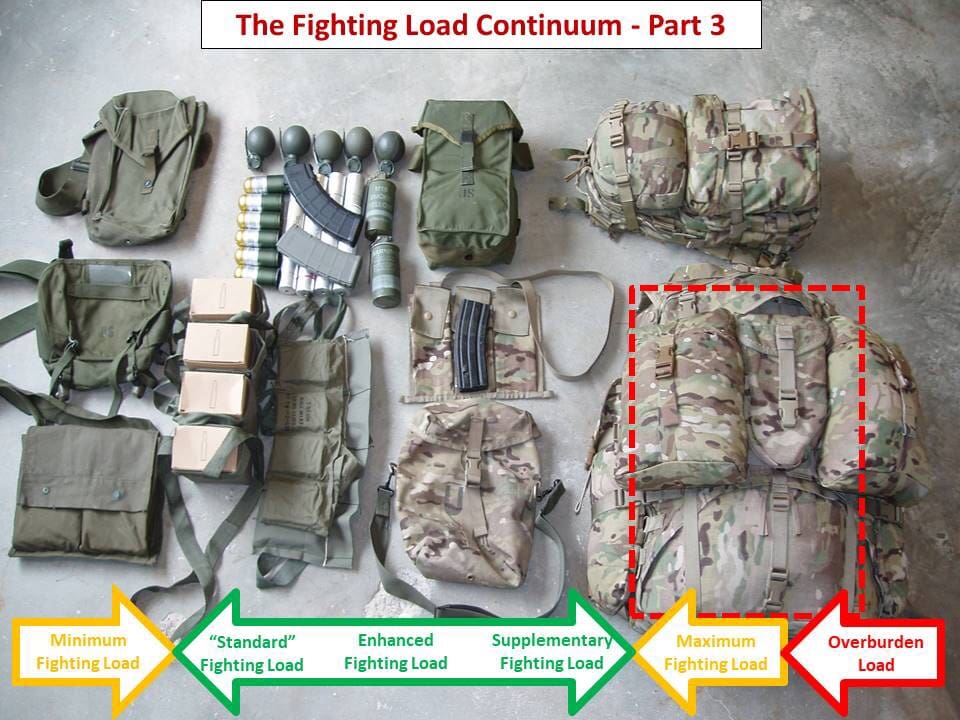
Appropriate packaging and packing of team materiel facilitates transferability and helps speed up mission transitions. The packaging of combat loads starts with distributing essential capabilities between the individual’s “fighting load” carrier, rucksack and assault pack. An additional challenge of effective load management – at the high end of the FLC especially – is not just about limiting the weight but also the bulk of a combat load. There are sound tactical reasons to keep the “cube” of any rucksack within the limits I have outlined in red on the large Molle rucksack in the attached picture. It is desirable that the pack dimensions not extend more than a couple of inches above the shoulders, much lower than the end of the tailbone, and no wider than the shoulders. Why is that? Easy, so the soldier can always fit readily through a fixed wing aircraft’s jump doors, down a ship’s passageways and – even more common in combat – thread through residential doorways, hallways or stairwells and still fight effective with a rucksack on if necessary. Note, I have purposely “inflated” this sample rucksack beyond the desirable size range – fully recognizing that overloading is more common than not.
Assault Packs and the Army issue Medium Rucksack provide smaller options that may be suitable in limited cases. Assault Packs like the one displayed (top right) in the attached picture are sized to carry an ASIP Radio (not shown) and accessories and can be used to carry other signaling devices like flares, smoke grenades, and visual or thermal panels critical during actions on the objective. Of course, additional ammunition for machineguns, some breaching tools, or demolitions might also be carried in these relatively small packs if needed. Similarly, some additional water and perhaps a singular piece of snivel gear might be loaded. Generally, there would not be room for substantial food or sleeping gear in this echelon of the FLC. Therefore, the “Assault Pack Load” alone is not going to be adequate for missions planned to extend beyond 24 hours. I would submit that despite falling into the so-called “3-Day Pack” category, the Medium Rucksack alone would probably be inadequate for a mission beyond 48 hours. Realistically, even filled to capacity including sustainment pouches, the large Molle and the FILBE rucksacks will still not get a unit much beyond 72 hours without at least a resupply of water and batteries.
As many of us have experienced in the past, when new “lightweight” gear has potentially reduced combat weight, the almost instinctive tendency is to use that “savings” to now carry more of something else. I suggest rejecting that understandable but counterproductive reaction. If a leader did not consider “something else” mission essential before, why is it mission essential now? It still sounds suspiciously like “nice to have” to me. For a time in the 82nd Airborne Division, I was a mortar platoon leader in a rifle company. We had both 60mm and 81mm mortars – 3 tubes each. The 60s (and their ammunition) were obviously the lighter option. If my platoon was tasked with harassing and interdiction (H&I) fires the 60s would do. However, if the company was going to be attacking a dug in enemy, the 81s were clearly the better choice. In short, because they were much more effective, the company humped the 81s more often than the 60s – despite the considerable extra weight. I say “the company” because, while the Mortar Platoon could haul the tubes and associated items, one or more of the Rifle Platoons had to carry most of the ammo. The reality of that considerable shared burden helped squash any inclination to seriously consider carrying any superfluous “nice to have” items.
Let us focus now on enhancing the packaging and transferability (P&T) of some common items in a combat load. At the bottom left of the attached picture is a claymore mine. It is the perfect embodiment of P&T. Everything needed to make the mine go boom is consolidated in the provided pouch. It is packed in the factory that way. It even has instructions with pictures on an inside flap just in case. This pouch can be readily carried internally or externally on any size rucksack. The claymore is not likely to be employed in an assault, but rather in the defense, after an objective is secured, or to deter pursuit in a break contact situation. When needed, the owner can disconnect it from the ruck, use the integral strap to carry it independently and / or pass it to someone else to employ – quick and easy. Unfortunately, not every item the military issues is so inherently P&T friendly. It behooves units to reconfigure those items into logical packets similar to the claymore example prior to launching on a combat mission.
Some of this is probably a no brainer for people who have been doing it for a while. However, it is not something units do consistently well unless the leadership is paying attention. For instance, a radio should always be packaged with antenna, handmike or headset, and batteries even if it is only a contingency backup to the primary. If the radio is passed to someone else to use or just to carry, everything should stay together and the system constantly remains fully mission capable. As a side note, when talking about electronics or weapon systems especially, it is obviously preferable that whoever is carrying the item have enough training to put the item into operation and use it effectively in an emergency. In other words, it was necessary for the 11B (infantry) paratroopers I referenced above to hump additional mortar ammunition but it would make no sense to task them to carry the actual mortar tubes into battle.
In the picture, I have displayed some of the old school P&T items and the current ones that a unit can still acquire. For many years, I carried the canvas “Bag, Carrying, Ammunition, M1,” a.k.a. the General Purpose (GP) Bag (top left) and the associated GP Strap. They date back to just before WWII. I bought this one, dated 1951, at a surplus store in Tacoma, Washington in 1979 and carried it for most of the rest of my career. I also jumped it many times. Usually, under the top flap of my Alice but also exposed for airfield seizures without a ruck. Inside would be star clusters, smoke grenades, binoculars, and in the late 80s a unit purchased sabre radio. Much like the claymore pouch, I could quickly separate this bag when I dumped my ruck and retain only the critical items I needed immediately. Additionally, since my troopers knew this was where I kept my most mission essential leadership stuff, if I went down they could readily grab the bag and continue the mission without me.
Those canvas GP Bags – and the equally rare nylon versions from the late 70s (top center) – as the name suggests, are great for general ammunition haulage. Numerous fragmentation or smoke grenades, 40mm rounds, loaded magazines of any caliber, bandoliers, machinegun belts, and so on, fit neatly inside the bag and can be dropped off and recovered easily and as often as necessary. Unfortunately, the GP Bags were no longer standard issue or readily available in the late 70s and 80s. Therefore, we used the ubiquitous buttpack (left center) with GP Strap in exactly the same fashion instead. As I recall, it was common practice for machinegun teams to leave a 50 round “starter belt” on the gun and backfeed ~250 rounds into buttpacks. The gun crew would carry what they reasonably could and – depending on how much ammunition needed to be carried – additional buttpack loads would be distributed to other members of the platoon. Indeed, buttpacks worked well for all the smaller munitions, but were not deep enough for parachute flares and star clusters. That is why I always personally preferred the GP Bag.
For some reason, simple pre-mission P&T preparation seems not to get the emphasis today that it did in years past. The GP Bags and the buttpacks are gone. There are only two standard issue items that I know of currently available to potentially address this recurring challenge. One would be sustainment pouches with GP Strap as shown (center bottom). While not reinforced the way the GP Bag was, the Molle and FILBE sustainment pouches have the volume to perform the same function. But, the FILBE pouch has no strap attachment points. And, unfortunately, the Molle pouch design is seriously flawed. The D-Rings on the side that the straps attach to are much too low. To be effective, the rings would have to be moved up at least 2 inches. The Army and Marines do issue a 6-magazine bandolier (center). I liked to use these to hang extra magazines in a vehicle; however, I do not care for them as a general purpose P&T tool since they are useless for anything other than M4 magazines. In combat, constantly feeding the crew served weapons is usually much more of a priority than replenishing individual riflemen.
Can approaching the combat load challenge from a different angle, such as I am suggesting with the FLC concept, really facilitate junior leaders making appreciably better tactical load management decisions? I certainly believe it is a sounder place to start. It is surely worth an honest try. How we choose to frame a problem trends to limit or expand our suitable solution set choices. In the case of combat, winning the fight with the fewest possible casualties must be a leader’s priority and objective. As I have said before, he or she must think first in terms of minimum mission essential capabilities and avoid obsessing simplistically on load weights. In Part IV, I will be discussing leader tools already available like SOPs, inspections, and rehearsals that can be either enablers or obstacles to effective combat load management – depending on how they are used or misused.
LTC Terry Baldwin, US Army (Ret) served on active duty from 1975-2011 in various Infantry and Special Forces assignments. SSD is blessed to have him as both reader and contributor.