USSOCOM has released an RFI for candidate technologies for the upcoming Technical Experimentation Night Vision/Electro Optics and Advanced Sniper Rifle (ASR) Military Utility Assessment (MUA) which will take place 14-18 November at Camp Blanding, Florida.
In particular, they are interested in technology readiness levels 3-6 and the intent of this event is to highlight technologies that support night vision/electro optics systems and advanced sniper rifle systems.
Technology areas to explore during the event include the following:
1. True Color Night Vision. Presentation of visible spectrum light (approximately
400nm to 750nm – flexible) that aids in target discrimination, mobility, combat identification, identify friend or foe, or situational awareness via a natural appearing manner. The need is from clear sky no moon (approximately 0.001 lux) to daylight conditions. Day only solutions will not be considered. A capability that allows true color at higher illumination and switch or transition to black and white at the lowest illumination (.001 lux) is of interest. Factors of consideration include resolution, sensitivity, latency, size, weight, power, dynamic range, and bits of color at low light. Both analog and digital solutions are of interest.
1.1. True Color Night Vision for man portable applications. This includes night vision goggles, rifle scopes, and binoculars. Retrofits to existing kit are considered as well as original full up solutions. For man portable applications; size, weight, and power have a priority. For head borne applications latency is of particular concern – though not so much a concern for rifle scopes or binoculars.
1.2. True Color Night Vision solutions for ground mobility visual augmentation systems that are compatible with integration into electro-optic / infrared turrets. The technology should also be applicable to fixed wing / rotary wing / maritime applications which would also use the electro-optic / infrared turret. For the platform based solutions size, weight, and power needs are not as stringent though integration is inherently important.
2. Undetectable day/night aiming for either assaulters, snipers: beyond iron sight or etched reticle.
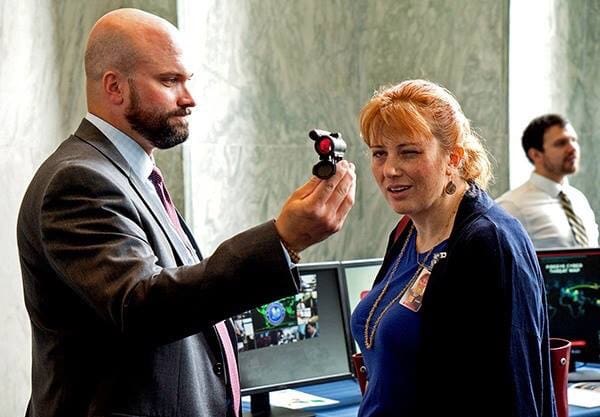
2.1. Passive aiming methods that provide a cursor for point of aim / point of impact of the assaulter rifle shots (typically 5.56mm or 7.62mm) is sought. The cursor should ideally be viewable by other team members. Ranges include close quarters combat up to 500 meters.
2.2. Ability to actively call in and direct close air support through visual cue, illuminate, mark, and/or aim for assaulters, snipers, or JTACS without detection by opposing force.
3. Group I, II, III, Unmanned Aerial System Intelligence Surveillance Reconnaissance (ISR)
3.1. Team based situational awareness. Technologies that can provide small teams or maneuver elements with real-time Visible National Imagery Interpretability Rating Scale (VNIIRS) 9 or better streaming video, Ground Moving Target Indicator and Radio Frequency (RF) environment characterization capabilities. The technology should be audibly and visually undetectable to the greatest extent possible.
3.2. Force protection for any maneuver element. Technologies that can automatically follow (digital tether) a maneuver element. The solution should provide real-time streaming video to multiple concurrent users. Solution should provide VNIIRS 9 or better video quality in real time. The ability to detect and display Identify Friend or Foe markers would be beneficial.
3.3. Overhead persistent surveillance. Technologies that can be programmed to orbit or perch and stare at an area or object of interest. Technology should be visually and acoustically undetectable by persons or systems resident at an observed area or object of interest, while providing users VNIIRS 9 or better video quality in real time.
4. Tactical Surveillance Equipment (TSE).
4.1 TSE internet protocol (IP) compatible prototypes that can demonstrate or
explore session announcement protocol for broadcasting multicast session information. 4.4.2. TSE prototypes or software that can execute compression of imagery and
video with loss that does not result in undue noise or artifacts. This is for low-bandwidth applications, e.g. situations where frame rate times resolution times bit depth bit depth is 2 megabytes or less. Ultimately a lossless imagery appearance while with loss compression is utilized.
4.3. Technology advancements in detection, recognition, and identification (DRI) for TSE that significantly exceeds current state of the art.
4.4. Modular turbulence mitigation software/hardware for TSE that can either be used to retrofit existing equipment or be a new solution.
4.5. Software application or an “app” that can calculate necessary information for performing TSE tasks such as facial recognition, DRI, personal identification, ground sample distance, ground resolution distance, pixels between eyes of a person.
5. Cursor on Target (CoT) Integrated Heads Up Display (HUD). Systems producing CoT data are becoming more widely employed to provide battlespace situational awareness (SA) data. Joint Terminal Attack Controllers view this SA data to aid in accomplishing their mission. CoT integrated HUD systems which display friendly and enemy positions as well as aircraft positions, call signs, and altitudes as icons on the HUD are sought.
Submissions should consider a CoT HUD that:
– Integrates into current eye protection equipment or Ballistic Clear Glasses with Fusion/Panoramic night vision goggles (NVG).
– Integrates with current PLI data sources (i.e. Android and/or CoT Radios).
– Incorporates an intuitive user friendly interface.
– Displays compass direction, distance, and current grid.
– Rapidly enables/disables HUD overlay in case of close quarters combat situations.
– Can be powered off of other equipment with minimal cabling.
– Has wired information assurance or is wireless with information assurance.
6. Target Engagement
6.1. Positive identification of a person of interest (POI) as subject / not subject
at and beyond maximum effective range of sniper rifle calibers such as .338 Lapua Magnum, or .50. Size, weight, power, probability of false alarm and probability of false rejection are of specific concern.
6.2. Multispectral optics and fusion of various bands in an intuitive and value added manner. Information overload is a concern while information loss can be a concern – a balance is sought. Fusion of all optics bands is ideal, fusion of both reflective and emissive bands is a minimum. Algorithm are sought that would allow for operation on both man portable systems as well as UAS or manned platforms.
7. Advanced Sniper Rifle (ASR) Military Utility Assessment (MUA). This MUA will serve as a market survey for crafting requirements of the future ASR program. Technologies of interest include.
7.1. Commercial Off the Shelf (COTS) bolt action rifle with switch caliber capability (3 calibers). Able to fire 7.62mm NATO, .300, and .338 caliber ammunition.
7.2. Candidate weapons systems must include suppressor technology that can be used for all 3 calibers, whether integrated or detachable.
For full details on how to nominate a texhnology, visit https://www.fbo.gov/index?s=opportunity&mode=form&id=7580f2c57048e540f9f4ea42fadec8f1&tab=core&_cview=0