Phantom Lights

Archive for the ‘Press Release’ Category

Marine Corps Explores Deploying 3D Mobile Fab Labs

Wednesday, August 16th, 2017

CAMP LEJEUNE, N.C. —
The Marine Corps is looking to make additive manufacturing as expeditionary as the operating forces using it.

The X-FAB—which stands for expeditionary fabrication—facility is a self-contained, transportable additive manufacturing lab that can deploy with battalion-level Marine maintenance units. The 20-by-20-foot shelter is collapsible for easier transport, and houses four 3-D printers, a scanner and computer-aided design software system that make quick work of replacement and repair part fabrication.

IMG_0295

Marine Corps Systems Command and Marine Corps Installations and Logistics teamed up with machinists from the 2nd Maintenance Battalion at Camp Lejeune, North Carolina, in July to conduct a field user evaluation, or FUE, of a prototype X-FAB. The evaluation will continue through Sept. 1, enabling Marines to test the technology and provide feedback on its capabilities to officials in the requirements and acquisition communities.

“Additive manufacturing is perfectly suited for the machinist community’s mission,” said Ed Howell, program manager for Supply and Maintenance Systems at MCSC. “We don’t know where the technology will take us, but this is a great opportunity to find out what Marines think about it and explore the viability of additive manufacturing for the C7912 Shop Equipment, Machine Shop.”

Shop Equipment, Machine Shop—also known as SEMS—is a deployable shelter equipped with a milling machine, lathe and other tools to quickly repair damaged vehicle parts, weapons and other equipment. The concept is to field X-FAB as a complementary capability for Corps’ intermediate-level maintenance shops that already use SEMS.

In addition to providing an expeditionary additive manufacturing capability, X-FAB can potentially reduce the maintenance battalion’s logistics footprint by eliminating the need to transport large amounts of spare parts, said Master Sgt. Carlos Lemus, staff noncommissioned officer in charge of the Additive Manufacturing and Innovation Cell with 2nd Maintenance Battalion.

“X-FAB will also enable us to better support Marines by getting platforms back in the fight faster,” said Lemus, who took part in the FUE. “We are looking to exploit this capability, because it has the potential to cut out the time it takes to order and receive parts; instead of waiting weeks or a month for a part, our machinists can get the part out by the end of the day.”

X-FAB gives Marines a way to innovate, and make and create their own solutions and ideas—a unique capability that is not available to forward-deployed Marines now, said Lt. Col. Howie Marotto, Additive Manufacturing lead at Marine Corps Installations and Logistics.

“In a contested environment where ships cannot easily land, or airplanes cannot necessarily fly in and deliver goods, Marines need a way to support themselves—at least temporarily,” Marotto said. “The deployable X-FAB would give them another outlet to supply themselves until the regular logistics or supply chain can support them. In some cases, they can even create a capability they didn’t have before, like 3-D-printed drones.”

The X-FAB shelter runs on generator or shore power, and takes a team of four Marines two to three hours to set up. It weighs about 10,500 pounds fully equipped, and for now can be transported via a commercial flatbed truck. Future testing will explore transportability options with Marine Corps vehicles, said Ted Roach, a program analyst in MCSC’s Supply and Maintenance Systems.

Today, X-FAB is purely experimental and exploratory, funded by Department of Defense research and development dollars, Roach said. Throughout the course of the FUE, MCSC will solicit feedback from Marines on everything from the size and layout of the shelter, and capability of the printers and software, to the quality of the printing materials and finished products. That feedback will be used to improve the equipment for future evaluations and inform the acquisition strategy for X-FAB.

Future efforts for X-FAB experimentation will include incorporating it into joint exercises and deploying it aboard ship to explore options for shipboard integration, Roach said.

“We plan to integrate X-FAB into various environments and see what’s within the realm of possibilities,” he said. “With additive manufacturing, you’re only limited by the size of your printer and your imagination.”

By Monique Randolph, MCSC Office of Public Affairs and Communication | Marine Corps Systems Command
Savage Arms Introduces Model 10 GRS in 6mm Creedmoor

Tuesday, August 15th, 2017

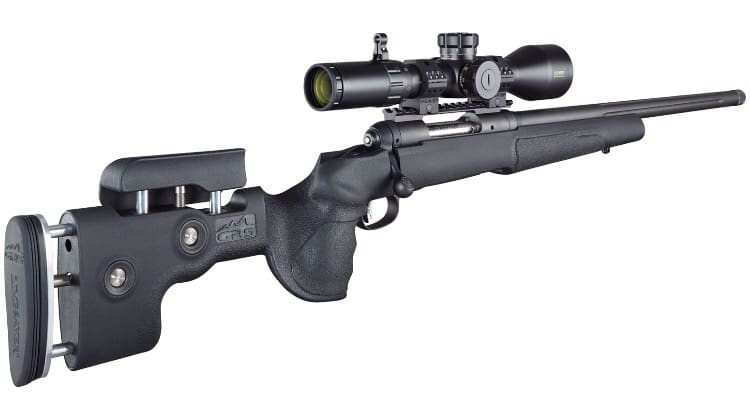
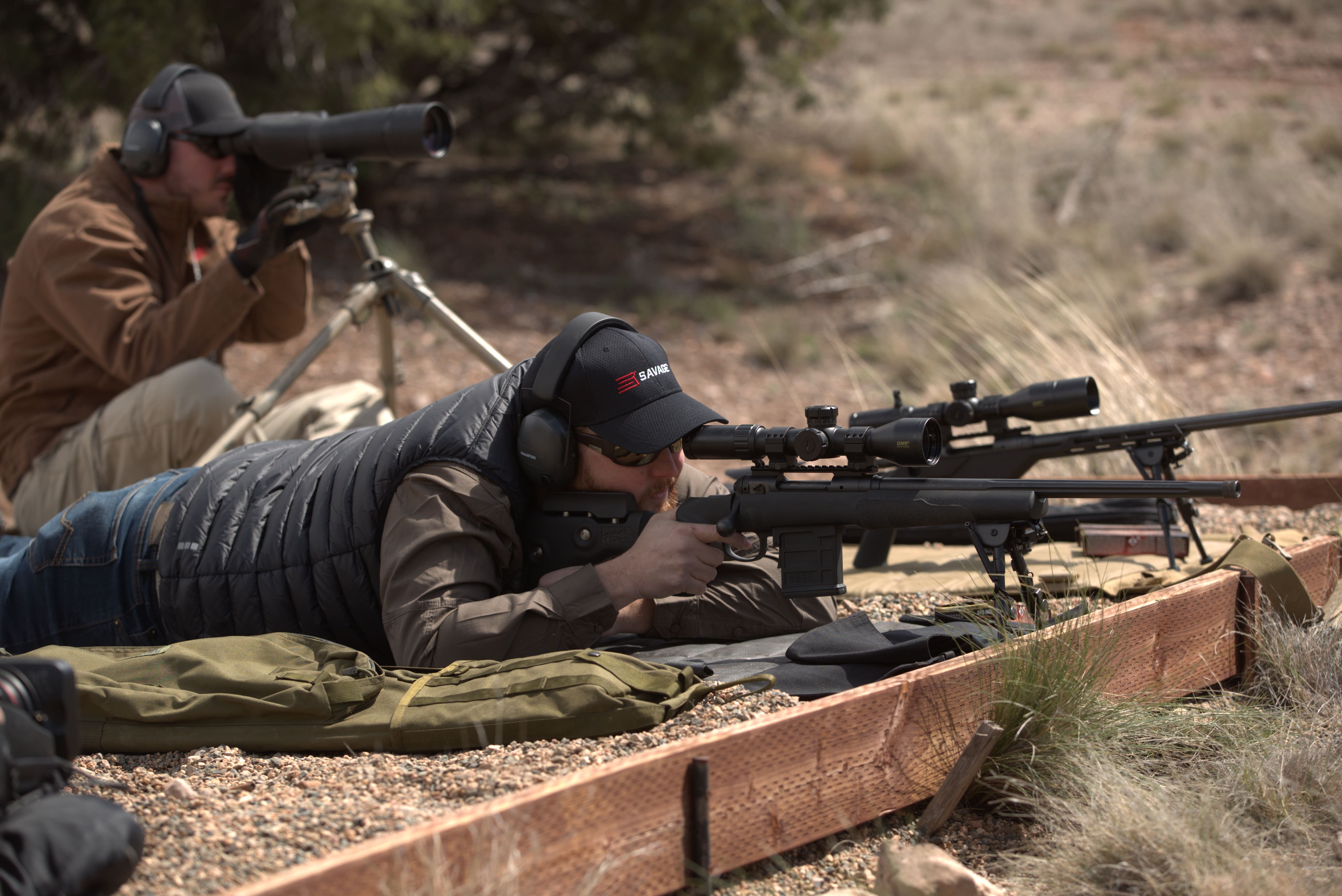
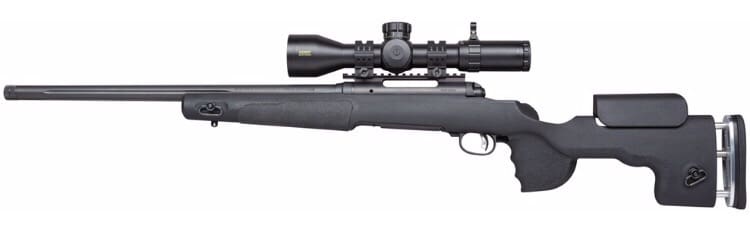
SUFFIELD, Connecticut – August 14, 2017 – Savage Arms is pleased to offer serious long-range shooters a new secret weapon with the Savage Model 10 GRS in 6mm Creedmoor. The rifle delivers exceptional accuracy and performance whether you’re engaged in top-level competition or simply trying to beat your personal best. Shipments of these firearms are currently being delivered to dealers.

Based on necking the 6.5 Creedmoor down for 6mm bullets, the 6mm Creedmoor cartridge is capable of accurate 1,000-yard shots that had moderate recoil and is predicted to be the next hot cartridge for long-range precision shooting competitions.

Savage’s Model 10 GRS houses the full suite of accuracy-enhancing features firmly within a GRS stock made of 15 percent fiberglass-reinforced Durethan, with 65 percent glass bedding material.

The rock-stable stock’s slimmed down dimensions and textured surfaces provide a better grip in wet conditions, while its length-of-pull can be adjusted to fit any shooter. Plus, its Savage action, precise button rifling, fluted heavy barrel and user-adjustable AccuTrigger deliver the accuracy of custom rifles at a fraction of the price.

www.savagearms.com

GERBER Partners with Boneyard Brewing

Tuesday, August 15th, 2017

GERBER ANNOUNCES NEW SHARKBELLY IPA
IN PARTNERSHIP W/ BONEYARD BEER

PORTLAND, OREGON (August 10th, 2017) – GERBER boasts a long history in the Pacific Northwest, designing quality knives and tools that are purpose built for hard working individuals and outdoor enthusiasts. The products may vary in application and user, but one appreciation runs true throughout the greater PNW: that of a good craft beer. When GERBER learned that the folks at Boneyard Beer in Bend, Oregon carry GERBER knives as their everyday tool of choice, the mission was clear: check out the operation and get the new Sharkbelly knife into their hands. What began as a brewery tour and product photoshoot, quickly turned into a badass partnership that taste buds all over the region can benefit from.

Introducing the GERBER Sharkbelly IPA: a special-edition brew by Boneyard Beer.

“After working with the GERBER team and using their gear for so many years, we aimed for a brew that matched the bold and uncompromising attitude that GERBER represents. Our company cultures, branding, and attitudes blend so well, this project has been exciting from the get-go. The Sharkbelly is an everyday carry knife with no frills that is easy to use; likewise, the Sharkbelly IPA is a straightforward, clean, crisp IPA that cuts to the chase and leaves you wanting more.” – Nick Murray, Director of Sales & Marketing, Boneyard Beer

The announcement comes ahead of a limited-run distribution in the Portland, Oregon metro area, aiming to give GERBER fans a chance to experience the hometown brand in a new way. Bend locals can also find it on tap at Boneyard’s tasting room, and if demand calls for it the Sharkbelly IPA may find a place in the permanent rotation for the brewery.

The Sharkbelly is an update to the classic everyday carry pocket knife with lightweight utility and standout features. Designed and built in GERBER’s Portland, Oregon manufacturing facility, this American made knife is available in partially serrated and full fine edge blade variations. The 420HC modern sheepsfoot-style blade is easily deployed with a sizable thumb hole, revealing flat top serrations that are easy to sharpen on a flat stone and practical for daily abuse. The tactile SharkSkin Grip™ succeeds in function and aesthetics with unidirectional scales that provide additional traction when in hand – smooth in one direction and grippy in the other.



Look for the distinctive tap handle featuring the GERBER logo and a hammerhead shark swathed in an American flag, an ode to two unapologetically badass brands that serve as the masters of their respective crafts.
Get it while it’s tapped at these locations:

B2 Taphouse – Salem, OR
Flyboy Brewing – Tigard, OR
Big Al’s – Beaverton, OR
The Growlerie – Beaverton, OR
Loyal Legion – Portland, OR
Bailey’s Tap Room – Portland, OR

Learn more about Boneyard Beer here.
Check out more from GERBER here.

B.E. Meyers & Co. Inc. Exhibiting at Strike Challenge Domestic Capabilities and Specialized Response Equipment Demonstration

Tuesday, August 15th, 2017

August 14th, 2017 (Redmond, WA) –

Strike Challenge

B.E. Meyers & Co. will be exhibiting at the Defense Systems Information Analysis Center (DSIAC) “Strike Challenge 2017” this week. The event will be held at the Camp Rilea Armed Forces Training Center in Warrenton, Oregon, August 15-17.

Strike Challenge will feature product demonstrations of several B.E. Meyers & Co. products including a demonstration of the MAWL-DA at the Camp Rilea MOUT site.

To connect with the B.E. Meyers & Co. team for a personal demonstration, please contact us at sales@bemeyers.com.

Strike Challenge affords U.S. industry the opportunity to present current and evolving domestic operations (DOMOPS) capabilities and specialized response equipment/systems. The event encompasses tactile interactive demonstration of equipment specifically designed for emergency response, survivability, security, search and rescue and special operations mission sets.

For more information about Strike Challenge, please visit: www.dsiac.org/events/2017-strike-challenge

Royal Air Force JTACs Integrate with US Counterparts

Monday, August 14th, 2017

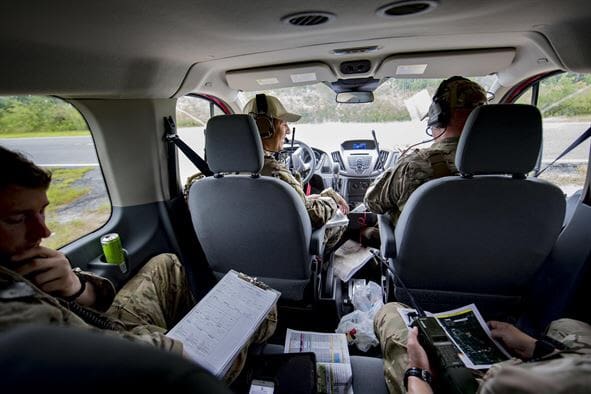
MOODY AIR FORCE BASE, Ga. – Members of England’s Royal Air Force recently spent time immersed with the 93rd Air Ground Operations Wing at Moody Air Force Base, Georgia.


An A-10C Thunderbolt II conducts a show of force maneuver during training, July 26, 2017, at Grand Bay Bombing and Gunnery Range, Ga. The range features a moving target system, which is on a 1,000 foot long track that is remotely controlled by the control tower and can move back and forth to assist in training. (U.S. Air Force photo/Andrea Jenkins)

The NATO allies visiting were Joint Terminal Attack Controllers tasked with building stronger ties with the 93rd AGOW in hopes of future integration opportunities.

“All the missions overseas aren’t integrating just the U.S. Armed Forces, but also our NATO forces,” said Master Sgt. Francisco Corona, the 93rd AGOW NCO in-charge of weapons and tactics. “So all the NATO forces are trying to train with us. I’d rather integrate in (training) where we can make mistakes and learn from them instead of making mistakes in a deployed location.”

Since 2001, U.S. and foreign JTACs have been in high demand as liaisons between Army ground commanders and Air Force assets.



U.S. Air Force and Royal Air Force joint terminal attack controllers communicate with 23rd Fighter Group A-10C Thunderbolt IIs during a close air support training exercise, July 26, 2017, in Lakeland, Ga. Two Royal Air Force members recently spent time with the 93rd Air Ground Operations Wing to compare and contrast how each entity conducts business and to plan future coalition training events. (U.S. Air Force photo/Airman 1st Class Daniel Snider)


“As air-to-ground experts, we advise, assist and control for the ground commander to meet his intent, whether its kinetic effects, like bombs on targets, or getting smarter at cyberspace,” said Corona.

Both groups of JTACs said they’re no stranger to operating in coalition settings while deployed.

“While I was a JTAC in Afghanistan, the vast majority of our aircraft were U.S. aircraft,” said Squadron Leader Neil Beeston, the officer commanding Air Land Integration Cell. “It was great working with the U.S. Armed Forces, especially with the A-10s; it’s a fantastic aircraft. The troops on the ground know that when you’ve got a pair of them above you, you’re in pretty safe hands.”

While the JTACs and U.S. aircraft are skilled professionals, sometimes communication barriers exists between countries. Beeston’s colleague stressed the importance of hashing out common issues.

“The whole worldwide JTAC community has the same struggles,” said Flight Sergeant Simon Ballard, the chief instructor from the ALIC. “Since we’re going to be working together, we need to practice together before we go do that in the real world.”

Not having the allied JTAC community in sync and on par with each other could potentially lead to less-than-optimal situations, which in turn risks lives.

“We don’t want to learn how to work together in a war area of operations,” said Corona. “We’re flexible though, whether it’s [English] JTACs or whatever joint force JTACs, we make things happen and we’ll make it work.”


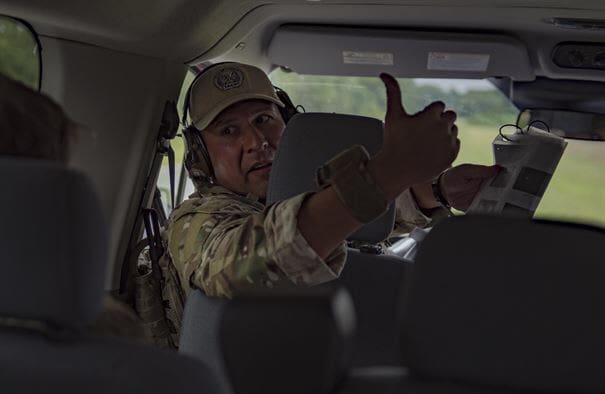
MSgt Francisco Corona, the 93rd Air Ground Operations Wing NCO in charge of weapons and tactics, communicates with a fellow Joint Terminal Attack Controller during a close air support training exercise, July 26, 2017, in Lakeland, Ga. Two Royal Air Force members recently spent time immersing with the 93rd Air Ground Operations Wing to compare and contrast how each entity conducts business and plan future coalition training events. (U.S. Air Force photo/Airman 1st Class Daniel Snider)

After the gathering, troops returned to their leadership with proposals and plans to further integrate training scenarios, whether it be academic courses or mixing into each country’s exercises to further synchronization.

“The bonus for them is they’d be integrating with different Army divisions because the 93rd AGOW is spread over at least six Army divisions,” said Corona. “They’d get that opportunity, where there’s not many divisions they work with over in [England].”

While Corona is confident in U.S. JTACs, he said it’s all about continuing to get better, to maintain leading from the front.

“We’re figuring out how we go to the next level to continue to be the best JTACs in the world,” said Corona. “We’re going forward with a proficiency mindset, of ‘how do we get better,’ because at the end of the day, the better trained individuals are going to be the winners.”

By Airman 1st Class Daniel Snider, 23rd Wing Public Affairs

Aurora And MIT Celebrate Nine Years Of Student Robotics Program Success

Monday, August 14th, 2017

Zero Robotics MS Finals Summer 2017

Zero Robotics engages students in science, technology, engineering and math (STEM)
through computer programming and space research

Cambridge, MA, August 11, 2017 – Middle school students across the country today participated in a live interactive broadcast of NASA astronaut Jack Fischer operating satellites developed by Aurora and MIT aboard the International Space Station (ISS). The basketball-sized, battery operated satellites were controlled using computer code written by the students as part of the Zero Robotics summer learning program.

Founded by MIT’s Space Systems Laboratory and run in partnership with Aurora and the Innovation Learning Center, Zero Robotics is a robotic programming competition for middle and high school students. Students learn to write software to autonomously control the SPHERES satellites aboard the ISS. Each year, the Zero Robotics competition challenges students to address a real spaceflight operational scenario.

“Aurora is proud to partner with MIT on this innovative and engaging STEM-education program,” said John Langford, Aurora Chairman and CEO. “Zero Robotics has introduced thousands of students over the years to the wonders of spaceflight and robotics. With this next generation of scientists and engineers at the helm, the future of NASA’s space program looks exceptionally bright.”

Aurora built the SPHERES satellites and has partnered with MIT on the Zero Robotics program since its inception in 2008. Over the years, Aurora’s involvement has evolved to encompass competition coordination support, student mentoring, instructor education, and curriculum development.

This year’s middle school finals comprised of 13 teams hailing from 12 U.S. states and Russia. Zero Robotics is also open to high school students, with a tournament held each year between September to December for students grades 9-12. The Middle school competition is sponsored by the Center for the Advancement of Science in Space (CASIS), the Northrop Grumman Foundation, and NASA. To learn more about the Zero Robotics program, and to view results from today’s competition, visit www.zerorobotics.mit.edu. To learn more about Aurora’s SPHERES program, visit www.aurora.aero/SPHERES.

Craig Morgan, Spirit of Blue Foundation Present Safety Equipment Grant to Dickson County Sheriff’s Office.

Saturday, August 12th, 2017

NASHVILLE, TENNESSEE – August 10, 2017 – Yesterday, the Spirit of Blue Foundation partnered with country music star Craig Morgan to present a safety equipment grant to the Dickson County Sheriff’s Office. The grant includes 70 tourniquets along with tactical belt holders that will be issued to all patrol division and reserve deputies that serve the county. Craig formerly served as a Deputy with the Sheriff’s Office in Dickson County before embarking on his country music career and was on hand to present this grant to the Sheriff’s office in his hometown. The grant, with a combined value of $4,238, is the first of Spirit of Blue’s 2017 Tourniquet Project campaign and was funded by a generous donation from Law Enforcement United (LEU). LEU is an organization of over 1,000 active and retired police officers who honor fallen officers and raise funds to assist charitable organizations that serve the law enforcement community.

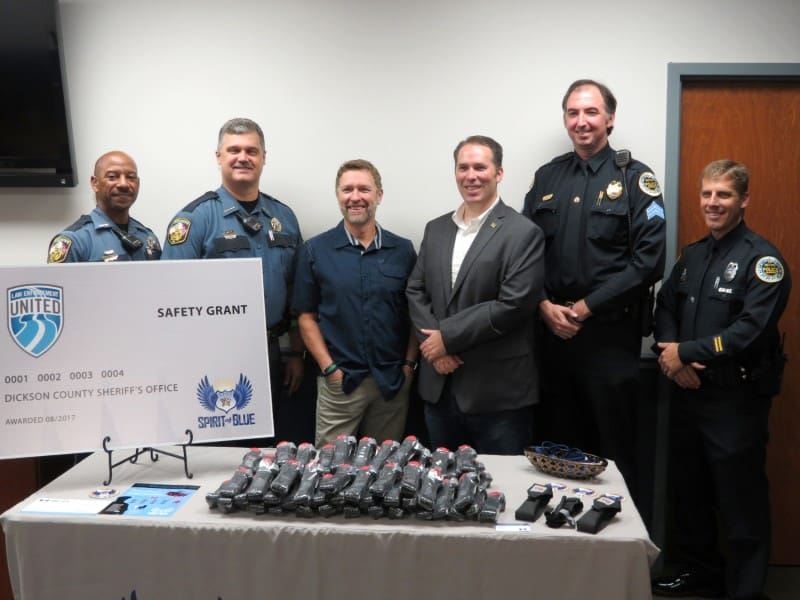
The Dickson County Sheriff’s Office received a grant for 70 tourniquets and duty belt holders from Spirit of Blue. Receiving the grant (left to right) were Chief Deputy Jerone Holt and Sheriff Jeffrey Bledsoe. Presenting the grant (center) was country music star Craig Morgan and Spirit of Blue Executive Director Ryan T. Smith. Representing the grant sponsor, Law Enforcement United, (right to left) were Metropolitan Nashville Police Department Officer Joshua Black and Sergeant Anthony Brooks.

The Dickson County Sheriff’s Office received a grant for 70 tourniquets and duty belt holders from Spirit of Blue. Receiving the grant (left to right) were Chief Deputy Jerone Holt and Sheriff Jeffrey Bledsoe. Presenting the grant (center) was country music star Craig Morgan and Spirit of Blue Executive Director Ryan T. Smith. Representing the grant sponsor, Law Enforcement United, (right to left) were Metropolitan Nashville Police Department Officer Joshua Black and Sergeant Anthony Brooks.

“Having served as a Deputy with the Sheriff’s Office, I know firsthand how critical it is to have this kind of lifesaving equipment available for all of our men and women on the force,” said Craig Morgan, following the event. “I’m glad for the opportunity to take part in this donation to Dickson County and proud to help kick off Spirit of Blue’s Tourniquet Project Campaign.”

Tourniquets are vital pieces of medical equipment that officers and deputies require on the road in the event of a traumatic injury to an extremity. When only precious minutes exist to treat such an injury, tourniquets are able to be applied individually or on a co-worker to prevent excessive blood loss until that individual can be placed into medical care. As a secondary benefit, officers and deputies who carry a tourniquet are also able to use them to rescue a member of the community who may have experienced a similar type injury as happened with the Monroe County (NY) Sheriff’s Office in July of this year with tourniquets that Spirit of Blue granted to them in October of 2015.

“Being the recipients of this grant from Spirit of Blue means a tremendous amount to a sheriff’s office of our size. We operate on a limited budget and being able to supply all of our deputies with a new piece of equipment isn’t always feasible,” commented Sheriff Jeffrey Bledsoe of the Dickson County Sheriff’s Office. “The tourniquets and duty belt holders we are receiving will be an asset to each of our deputies. Dickson County has a lot of areas that are rural and remote. These tourniquets could mean the difference between life and death for any one of our deputies who are out there putting their service to Dickson County ahead of themselves on a daily basis. We are very appreciative of what Craig Morgan and the Spirit of Blue are doing for us here.”

CAT Tourniquet

The C-A-T Tourniquet, manufactured by North American Rescue, has proven to be 100% effective in occluding blood flow in both upper & lower extremities by the U.S. Army’s Institute of Surgical Research and has been the official tourniquet of the U.S. Army since 2005. The duty belt holder, manufactured by Blue Force Gear, is constructed with their proprietary, lightweight ULTRAcomp material and was specially designed for Spirit of Blue’s Tourniquet Project Campaign to hold the C-A-T Tourniquet. Spirit of Blue has granted 463 C-A-T Tourniquets since its first tourniquet grant in 2014. In 2017, Spirit of Blue has a goal of granting another 1,000 tourniquets to officers who need them across the country. To learn more, or participate in the campaign, visit: www.spiritfoblue.org/TQ

ASA Statement Regarding Potential ATF Determination On Modular Suppressors

Friday, August 11th, 2017

ATLANTA, GA – Over the past week, multiple claims have stated that the BATFE’s Firearms and Ammunition Technology Division (FATD) is in the process of issuing an industry wide determination on the legality of modular suppressors. After speaking at length to several of our contacts within ATF, ASA has concluded that these assertions stem from misinterpreted comments made by ATF officials at a recent industry conference. According to our contacts at ATF, these are the facts related to three separate areas of discussion:

Modular Suppressor Design – FATD is in the process of reviewing a request from an independent industry representative regarding a single, specific modular suppressor design. The representative is seeking a determination regarding their specific product, not a blanket determination that would apply to other existing modular designs. The issue in question is whether or not the suppressor being reviewed has the ability to assemble more than one functional suppressor out of the component parts that are supplied as a single suppressor to the end-user.

ATF 29P – On May 4, 2016, ATF published an Advance Notice of Proposed Rulemaking (ANPRM) in response to an eight year old request by the National Firearms Act Trade & Collectors Association (NFATCA) made in 2008. In the ANPRM, ATF sought to specify that manufacturers must mark the outer tube of suppressors, not just any externally visible part. The ASA, along with many members of the industry, submitted comments to the ATF opposing ATF 29P. We have been told by ATF that 29P is no longer being worked on by the Bureau, as many current suppressor designs without an outer tube have made the proposed rules within 29P obsolete.

NFA Handbook – The NFA Division and Firearms & Explosives Industry Division are working on a long overdue update to the NFA Handbook. Within the updated handbook, new language will be included that addresses the repair or replacement of modular suppressor components. This language will be consistent with previously published guidance, which states that the serialized component of a suppressor cannot be replaced without the filing of a new Form 2 by the manufacturer, and a new Form 4 by the consumer, including the payment of applicable transfer taxes. Unmarked components of a modular suppressor may be replaced by a licensed manufacturer on a one-for-one basis, just as previously allowed in the silencer FAQ published by ATF on April 17, 2008.

In summation, there are currently no widespread determinations set to be issued by ATF with regards to modular suppressors.

americansuppressorassociation.com