GORE-TEX Professional

Archive for the ‘Press Release’ Category

Textron Systems’ Damocles Loitering Munition Selected For US Army Low Altitude Stalking & Strike Ordnance (LASSO) Contract

Friday, February 27th, 2026

Wilmington, Mass., Feb. 25, 2026 – Textron Systems Corporation, a Textron Inc. (NYSE: TXT) company, announced today it was awarded a prototype agreement from the U.S. Army for the Low Altitude Stalking & Strike Ordnance (LASSO) program. Under the prototype agreement, Textron Systems will deliver a DamoclesTM loitering munition system and demonstrate it to the U.S. Army.

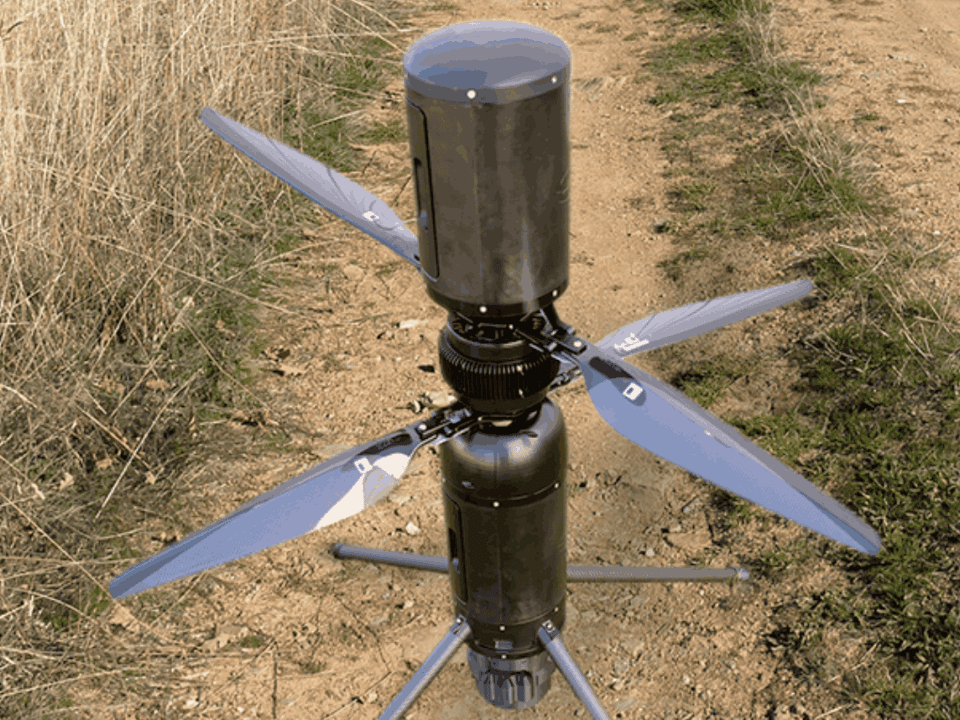
The DamoclesTM loitering munition, equipped with Textron Systems’ advanced GEN2 Explosively Formed Penetrator (EFP), is a cutting-edge system designed to deliver decisive lethality in peer warfare environments. For the LASSO program, the Damocles system is integrated with a vertical take-off and landing (VTOL) uncrewed aircraft system (UAS) to deliver top-attack capability. In the VTOL configuration, no launch or recovery equipment is required.

The Damocles system is built with a modular open systems approach (MOSA), allowing other payloads to be integrated into the system to support various concepts of operation (CONOPS), such as electronic warfare effects. For operational safety, the system includes features to prevent unexploded ordnance (UXO), reducing the risk of hazardous remnants on the battlefield.

“Loitering munitions technology will be key in protecting the warfighter on the battlefield – they allow warfighters to send systems like Damocles beyond-line-of-sight (BLOS) to engage a target from a safer standoff distance,” said Henry Finneral, Senior Vice President, Weapon Systems. “Textron Systems is proud to support this mission and leverage our industry-leading EFP technology to provide next-generation capability at speed and at scale.”

Epirus, Digital Force Technologies Partner to Develop Non-Kinetic Counter UAS Kill Chain

Friday, February 27th, 2026

Los Angeles & San Diego, Calif—February 23, 2026Epirus and Digital Force Technologies (DFT) have partnered to deliver a fully integrated counter-UAS kill chain unifying the companies’ respective technologies for detection, tracking, identification, localization and non-kinetic, low collateral defeat of unmanned aerial systems (UAS) threats.

Under the agreement, Epirus will lead systems integration of DFT’s Seraphim command-and control and multi-modal sensor fusion software with Epirus’ Leonidas high-power microwave (HPM) platform for critical point defense.

Epirus’ Leonidas high-power microwave is a proven non-kinetic counter-UAS solution that  leverages electromagnetic interference to defeat swarming, AI-controlled and fiber-optic guided UAS that can evade legacy electronic warfare tactics. The Leonidas platform emits precise  electromagnetic interference to disable the critical electronics onboard a drone, neutralizing the  threat. Using software-based, operator-defined safe zones, Leonidas provides a scalable, high precision and low-collateral counter-UAS capability. The platform defeated a 49-drone swarm simultaneously with a targeted burst of electromagnetic interference at a 2025 live-fire demonstration.

DFT’s Seraphim software platform and counter-UAS Family of Systems deliver autonomous  tracking and identification of UAS threats in complex operational environments. Trusted to support  critical missions worldwide, Seraphim is built on a modular, scalable architecture that remains  sensor- and effector-agnostic, enabling rapid integration of best-in-class capabilities. Seraphim  combines sensing, decision support and effects coordination through a unified operational  interface. By fusing data in real-time and autonomously prioritizing threats, the platform enables  operators to move from detection to response with speed and precision.

“Leonidas was designed to maximize interoperability with partner technologies,” said Andy Lowery, Epirus CEO. “This collaboration marries our systems integration and swarm defeat  expertise with DFT’s edge processing and automation knowhow to deliver exactly what our  customers are asking for: a flexible, adaptable and fully integrated counter-UAS kill chain for critical point defense missions.”

“Integrating Seraphim with Epirus’ Leonidas high-power microwave platform extends AI-enabled  decision making through the defeat layer of the counter-UAS kill chain, delivering a turnkey detect to-defeat capability,” said Justin MacLaurin, Digital Force Technologies CEO. “This partnership  reflects a shared commitment to scalable, interoperable systems that give operators faster, more  effective solutions to defeat evolving drone threats.”

The companies will partner on U.S. government demonstration activities and are expected to  present their full counter-UAS kill chain solution later this year.

ISI Introduces KNIGHT– A Very High-Resolution Satellite with Advanced SWIR and Video Capabilities

Thursday, February 26th, 2026

Knight combines 35 cm true?color imaging, Full Motion Video and 1.5 m SWIR sensing to extend space?based intelligence into night and low?visibility conditions

February 25, 2026, Israel – ImageSat International (TASE: ISI), a global leader in space-based intelligence solutions, reports that the KNIGHT development program is progressing according to schedule and has entered its final stages. The satellite is designed to strengthen ISI’s operational portfolio by delivering persistent, high-clarity observation of critical targets across day, night, and degraded visibility environments, enabling effective collection in low-visibility conditions such as haze, smoke, fog, and during dawn and dusk.

For defense and security users, KNIGHT provides reliable monitoring in conditions where conventional electro-optical systems face limitations. Its integrated SWIR channel enhances detection, recognition, and tracking capabilities, while onboard AI processes imagery directly in orbit – prioritizing mission-critical data and accelerating response timelines.

Building on the intelligence-centric architecture pioneered by ISI’s RUNNER satellite, KNIGHT incorporates proven in-orbit analytics, real-time movement tracking, and efficient narrow-band intelligence dissemination via embedded AI. It extends this foundation into the very high-resolution domain and into night and limited-visibility operations, combining 35 cm true-color imaging with a dedicated SWIR channel and integrated video capabilities to deliver a richer and more dynamic intelligence picture.

Advanced onboard computing enables real-time image and video assessment, autonomous memory management, and optimized downlink usage. The satellite can filter low-quality data, re-task areas of interest autonomously, and deliver actionable intelligence directly to operational networks. Its flexible processing architecture also allows software and algorithm updates throughout its lifetime, ensuring continuous performance enhancement and evolving analytical capabilities in orbit.

“Completing recent development milestones demonstrates the maturity of the Knight program and our continued execution towards a launch planned for 2027,” said Noam Segal, CEO of ImageSat International. “KNIGHT is being developed to provide defense and security users with clearer and more continuous intelligence, both static and dynamic, regardless of time of day or visibility conditions. By integrating very high-resolution imaging, SWIR sensing, video, and onboard AI-driven processing, it enhances operational flexibility and decision-making confidence in complex environments.”

www.imagesatintl.com

DSTG and DroneShield Sign Bilateral Collaborative Research Agreement to Advance Counter-Drone Technology

Thursday, February 26th, 2026

Sydney, Australia – 26 February 2026 – DroneShield (ASX:DRO), a global leader in counter-drone technology, today announced the signing of a Bilateral Collaborative Research Agreement (CRA) with the Australian Department of Defence (Defence), through the Defence Science and Technology Group (DSTG), to strengthen Australia’s capability in counter-drone technology.

The agreement establishes a framework for sharing data on emerging drone technologies and access to either parties test articles, ranges and facilities. This collaboration will leverage DSTG’s scientific expertise and DroneShield’s industry-leading counter-drone technology to ensure both organisations continue to deliver world-class solutions to emerging threats posed by new drones.

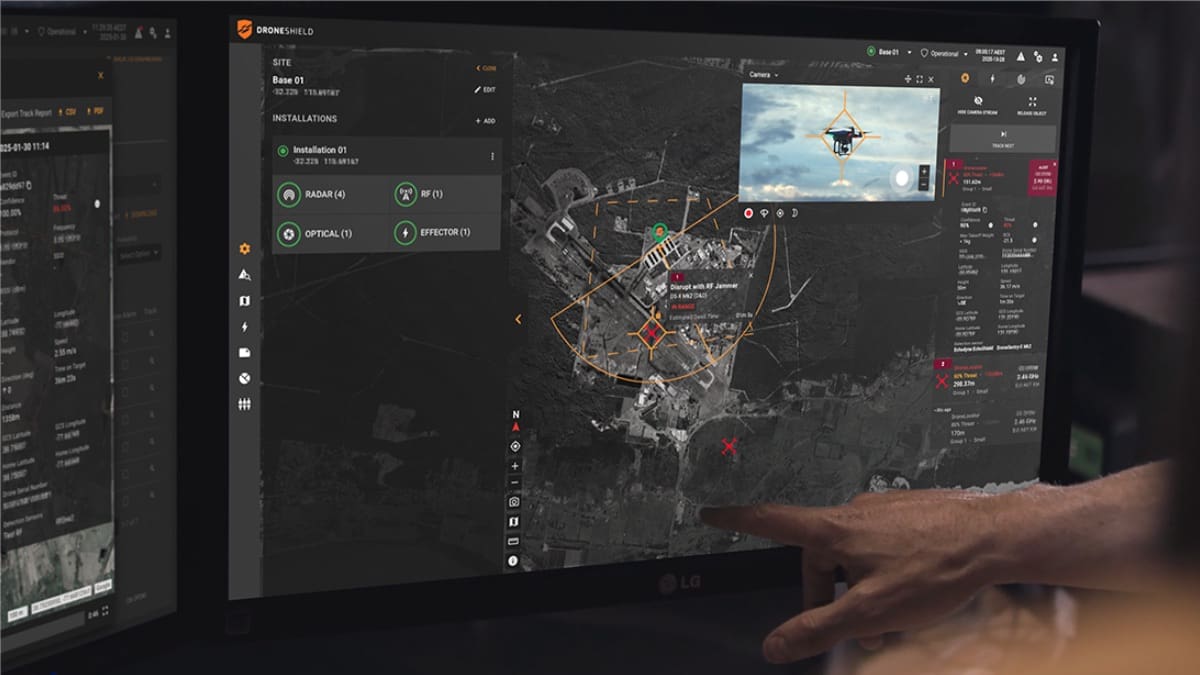
DroneShield has also announced the establishment of a $13 million R&D Hub in Adelaide for counter-drone technology, strategically located to enable closer collaboration with Defence and DSTG. This investment complements DroneShield’s previous R&D collaborations, such as with the DSTG-supported Defence Innovation Network that helped develop DroneOptID, DroneShield’s optical system for detection, identification and tracking of fast-moving drones.


Image: A new partnership between DroneShield and DSTG will establish a framework for sharing data on emerging drone technologies

Angus Bean, Chief Product Officer of DroneShield said, “This agreement represents an important step in advancing counter-drone technology not only for Defence but for DroneShield’s end-users globally. Working closely with DSTG allows us to combine our practical experience with their research expertise to deliver innovative solutions that meet the evolving needs of the Australian Defence Force.”

The collaboration will focus on emerging drone technologies through sharing data, test articles and conducting collaborative test programs to drive innovation areas that enhance detection, tracking, and neutralisation of unauthorised drones, supporting Defence and industry efforts to safeguard Australia’s security in an increasingly complex operational environment.

DSTG’s media release including quotes attributable to Chief Defence Scientist Prof Tanya Monro may be viewed at: defence.gov.au/news-events/releases/2026-02-25/australia-accelerate-counter-drone-research-droneshield

Insect Shield LLC and Co-Founder’s Estate Agree to Pay $1.4M to Settle False Claims Act Allegations

Thursday, February 26th, 2026

Insect Shield LLC, located in North Carolina, and the Estate of Richard Lane, a co-founder and co-owner of Insect Shield, have agreed to pay a combined $1.4 million to resolve allegations that Insect Shield and Lane caused the submission of false claims to the Department of Defense (DoD) under contracts to provide Army Combat Uniforms. Lane served as the president and chief operating officer of Insect Shield until his death in December 2022.

The United States filed its complaint-in-intervention in December 2023 alleging that Insect Shield, a subcontractor to multiple defense contractors who manufacture Army uniforms, violated the False Claims Act by falsifying test results regarding the application of permethrin, an insect repellant, to Army uniforms.  The United States alleged that between 2015 and 2021 Insect Shield and Lane failed to follow the permethrin testing requirements by inappropriately combining results from different rounds of testing, re-labeling test samples to hide the true origin of the samples, performing re-tests of uniforms in excess of what the contract permitted, and concealing failing test results.

“Government contractors and subcontractors must comply with contractual commitments and share truthful information with the government,” said Assistant Attorney General Brett A. Shumate of the Justice Department’s Civil Division. “The Justice Department will aggressively pursue those who defraud the American taxpayers by failing to properly perform required testing on goods supplied to our soldiers.”   

“The Defense Criminal Investigative Service (DCIS), is fully committed to safeguarding the integrity of the DoD procurement process,” said Special Agent in Charge Christopher Dillard of DCIS Mid-Atlantic Field Office. “Manipulating and failing to perform contractually required testing is not only fraudulent, but compromises military readiness. DCIS will continue to collaborate with our law enforcement partners and the Department of Justice to investigate and hold accountable those who submit false claims.”

“Our Soldiers rely on government contractors to provide equipment that they can depend on while serving their country,” said Special Agent in Charge Keith Kelly, Department of the Army Criminal Investigation Division, Fraud Field Office. “The result of this investigation shows that our Army CID and our partner law enforcement agencies are relentless in their pursuit of anyone who may attempt to defraud the U.S. Government by falsely reporting compliance with contractually obligated requirements for equipment used by our Soldiers

The civil settlement resolves a lawsuit brought under the qui tam or whistleblower provisions of the False Claims Act, which permit private parties to sue on behalf of the United States when a defendant has submitted or caused to be submitted false claims for government funds and receive a portion of any recovery.  Ms. Downs will receive $315,000 as her share of the settlement.  The qui tam case, which was filed in the United States District Court for the Middle District of North Carolina, is captioned U.S. ex rel. Downs v. Insect Shield, LLC et al., No. 1:19-cv-1026 (M.D.N.C.).

The resolution obtained in this matter was the result of a coordinated effort between the Justice Department’s Civil Division, Commercial Litigation Branch, Fraud Section, and the U.S. Attorney’s Office for the Middle District of North Carolina with assistance from the DoD Office of Inspector General, Army Criminal Investigation Division, Defense Contract Management Agency, and Defense Contract Audit Agency.

The matter was handled by Fraud Section Attorneys Jonathan Hoerner, Jikky Thankachan, and Jeffrey McSorley and Assistant U.S. Attorneys for the Middle District of North Carolina.

The claims resolved by the settlement are allegations only and there has been no determination of liability.

Note: Read the Insect Shield Agreement here; and the Estate of Richard Lane Agreement here.

Department of Justice Office of Public Affairs

Accrete Expands Classified Data Support to Meet Growing Customer Demand and Mission Needs

Wednesday, February 25th, 2026

NEW YORK, Feb. 23, 2026 — Accrete, Inc., a dual-use AI company founded in 2017, whose Knowledge Engine platform encodes institutional knowledge, judgment, and expertise into AI agents for decision superiority, announced that it has successfully deployed its Argus platform into the Joint Worldwide Intelligence Communications System (JWICS) through Second Front’s 2F Game Warden®.

This is an important step in Accrete’s ongoing effort to meet surging demand by delivering expanded capabilities for teams operating in Top Secret data environments. This achievement reinforces Accrete’s dedication to current and future defense stakeholders while bringing more value to organizations, reducing friction between workflows, and accelerating the delivery of insights that inform time-sensitive decisions.

“Customer need for Accrete’s platform is growing because mission teams need trusted, actionable answers from complex data,” said Prashant Bhuyan, Founder, CEO, and Chairman of Accrete, Inc. “JWICS deployment means that Accrete’s Expert AI Agents can interact with open source and government data to drive faster, better-informed outcomes, delivering decision advantage in mission-critical environments.”

Accrete’s Knowledge Engine is the foundational cognitive infrastructure for encoding institutional knowledge into persistent organizational intelligence. Knowledge Engines become even more powerful when they can operate across classified and unclassified data, connecting siloed systems into shared context while preserving the why behind past decisions. Accrete’s platform enables trusted AI agents to surface critical insights and emerging risks that humans would never think to search for as information complexity grows.

“This milestone reflects Accrete’s broader focus on scaling alongside customer needs. The company has been operational at DoW Impact Level 4 (IL4) and is now expanding secure support for classified data, accelerating capability delivery, and ensuring defense customers can apply Accrete’s AI platform across the full range of mission operations,” said Bill Wall, CEO of Accrete AI Government.

GA-ASI Develops Long-Range Weapons Capabilities for MQ-9B

Wednesday, February 25th, 2026

Industry Leading UAS Expands Mission Roles To Include Naval Strike

SAN DIEGO – 23 February 2026 – General Atomics Aeronautical Systems, Inc. (GA-ASI) is developing the addition of long-range standoff weapons to its top-of-the-line MQ-9B SkyGuardian® and SeaGuardian®.

Demand continues from naval and air warfighters for platforms that can hold targets at risk from great ranges, especially over the expanses of air and water in the Western Pacific. That’s why GA-ASI engineers have begun the work of adapting MQ-9B’s payload, stability, range and other features to accommodate the new generation of extended-range precision weapons.

“MQ-9B continues to impress in the field and we keep adding to our global customer list,” said GA-ASI President David R. Alexander. “We want to continue to build value in the aircraft by expanding into more missions. MQ-9B features extraordinary payload capacity, so it only makes sense to add to our mission sets with the ability to carry long-range weapons.”

So far, GA-ASI has performed all the performance analytics and is confident in MQ-9B’s ability to carry long-range weapons over long distances, while providing a measure of persistence and endurance. Company engineers and others continue to refine the technical aspects of this integration and potential concepts of operation, eyeing weapons such as the Lockheed Martin Joint Air-to-Surface Standoff Missile and Long-Range Anti-Ship Missile, as well as the Kongsberg/Raytheon Joint Strike Missile.

GA-ASI plans to fly at least one of these new weapons as early as 2026.

Hypothetically, a mission profile might look like this: MQ-9Bs could launch from a number of friendly bases in the Western or Southern Pacific, fly to a hold point and loiter there outside a hostile power’s weapons engagement zone. If the order came to release the weapons, the aircraft could launch them in coordination with other U.S. or allied operations.

In addition to the SkyGuardian and SeaGuardian models, MQ-9B also includes the Protector RG Mk1 that is currently being delivered to the United Kingdom’s Royal Air Force (RAF). GA-ASI also has MQ-9B procurement contracts with Belgium, Canada, Denmark, Germany, India, Japan, Poland, Taiwan and the U.S. Air Force in support of the Special Operations Command. MQ-9B has also been featured in various U.S. Navy exercises, including Northern EdgeIntegrated Battle ProblemRIMPAC, and Group Sail.

Bundeswehr’s Luchs 2 Reconnaissance Vehicle: Rheinmetall Receives Orders for CT-025 Medium-Calibre Turret, Oerlikon KBA 25 Automatic Cannon and Modern Simulators

Wednesday, February 25th, 2026

Rheinmetall will contribute to the reconnaissance capabilities, combat effectiveness and training of the German Army’s Intelligence and Reconnaissance Corps. General Dynamics European Land Systems (GDELS) is the prime contractor for the next generation ‘Luchs 2’ reconnaissance vehicle of the Bundeswehr, which is due to be delivered from 2029 onwards. GDELS has commissioned Rheinmetall to supply the turret, main armament and corresponding simulators. The contract was signed in Kaiserslautern at the beginning of February 2026. The total order value is in the mid three-digit million-euro range.

“We are grateful for the trust that GDELS and the Bundeswehr have placed in our products and capabilities”, said Timo Haas, Head of the Digital Systems Division. “The Luchs 2 contract package is a significant success for our Bremen site and our colleagues in Rome. At the same time, it sends a strong signal in favour of European defence cooperation”.

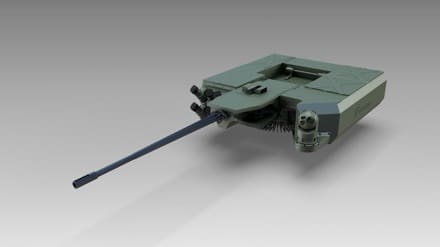
The largest share of the Luchs 2 contract package will be fulfilled by Rheinmetall Electronics GmbH in Bremen. At first, 274 CT-025 turrets are to be delivered by 2031, marking the first major order of this newly developed, modular, unmanned turret system. The Luchs 2 will receive a modified version of the CT-025, complying with the specific requirements of the Bundeswehr. The newly developed Rheinmetall turret will serve as a technological base platform for different mission profiles, and combines high operational capabilities with maximum adaptability to operational and logistical requirements. 

State-of-the-art sensor technology and digital networking give the turret particular strengths: a stabilised vision system enables precise counter-attacks against ground and air targets, including drones (UAVs). The fully digitalised fire control system with inertial weapon stabilisation, a ballistic computer and GVA/NGVA-compatible interfaces, ensures maximum accuracy, even when the vehicle is in movement. 

Furthermore, the Bundeswehr version of the CT-025 features a turret hatch supplemented by ballistic protection, allowing an open protected position while commanding the vehicle in motion. To comply with the maximum weight requirement, the ammunition supply has been adapted according with the mission. Additionally, the height profile has been optimised to ensure compatibility with other platforms. 

The CT-025’s open, modular framework enables full integration into the Rheinmetall Battlesuite, the Group’s digital ‘capability store’. This allows functions such as AI-supported target tracking or mission-specific software upgrades to be quickly and flexibly integrated without hardware modifications.


The German Army’s mechanized reconnaissance forces will soon be fighting with the tried-and-tested Oerlikon KBA 25 mm automatic cannon. Manufactured by Rheinmetall Italia S.p.A. in Rome, it is Rheinmetall’s most widely produced weapon in the NATO standard calibre of 25 mm x 137. Manufactured over 6,000 times, it combines a battle-proven design with outstanding reliability. With three firing modes (single shot, rapid single fire /175 rounds per minute and burst fire /600 rounds per minute), dual belt feed and a range of up to 2,500 metres, the CT-025 offers versatile firepower. The Oerlikon KBA 25 mm is a cost-effective, scalable solution offering high effectiveness against a wide range of targets due to the variety of 25 mm x 137 ammunition types available. It can penetrate the armour of most modern armoured personnel carriers. 

With a firing rate of 600 rounds per minute – the highest in its category – and thanks to the new 25 mm x 137 proximity fuse ammunition technology, it also provides an effective protection against drones. The dual belt feeder allows two different types of ammunition to be loaded as well as a fast interchange between the two. This turns the KBA 25 mm into a thorough, multi-purpose weapon. Its low recoil enables it to be installed on various platforms, ranging from heavy tracked vehicles to light armoured 4×4 reconnaissance vehicles. It is suitable for both manned and unmanned turrets, as well as anti-aircraft mounts and naval applications. This paves the way for a cross-sectional main weapon for the Bundeswehr, enabling synergies in training, maintenance and logistics.

Modern simulation technology, also supplied by Rheinmetall Electronics, will soon be used to provide comprehensive, mission-oriented, modern training for reconnaissance soldiers. GDELS has commissioned the development and delivery of six combat simulation training devices for vehicle-based reconnaissance troops (AGFS). The reference system is scheduled for delivery in mid-2028 and will later be upgraded to the same standard as the other five devices in the series.

The AGFS is a highly realistic simulator, recreating the battlefield. Its precise replication of key elements, such as vehicle logic, sensor technology and ballistics, enables highly realistic training in line with the ‘train as you fight’ concept. The AGFS is designed to enable networking with other AGFS simulators or other compatible systems. Rheinmetall is developing the AGFS on the same technological basis as the firing and combat simulators already under contract for the Puma infantry fighting vehicle, the heavy weapon carrier and the Schakal wheeled infantry fighting vehicle.

Rheinmetall has also been commissioned in the field of live simulation. The established training device, the AGDUS combat simulator, will be fully integrated into the coming vehicle fleet. The laser-based training tool will enable army reconnaissance troops to train in realistic conditions – from firing exercises to large-scale exercises in the combat training centre in all types of operations. Rheinmetall is thus relying on the installation already proven in the Puma and Lynx programmes, which enables laser-based combat using original display and control elements.