FirstSpear

Archive for the ‘Profession of Arms’ Category

Ivy Soldiers Test Knowledge, Strength and Determination During E3B qualification

Saturday, December 23rd, 2023

FORT CARSON, Colo. — For an entire month, Ivy Soldiers prepare, practice and perfect more than 40 tasks in order to successfully execute a five-day evaluation. Upon sufficing the tasks, Soldiers are able to earn one of three Army-sponsored badges: the Expert Infantryman Badge, the Expert Soldier Badge and the Expert Field Medical Badge.

1st Stryker Brigade Combat Team, 4th Infantry Division, recently hosted the three badge evaluations, known as E3B, at Fort Carson from December 4-8, 2023.

“This is a great opportunity for Soldiers to hone and sharpen all of their skills,” said Sgt. 1st Class Julian Pacheco, E3B lane noncommissioned officer in charge assigned to 1st SBCT, 4th Inf. Div. “Whether you get it or not, there is a positive outcome out of this. Soldiers get an opportunity to come out here and train.”

Each testing lane evaluated is a skill level 10, or entry level, task. Pacheco says the badge helps a Soldier’s career progression regardless of their occupational specialty, however, it is no easy feat.

“There is a very high rate of attrition because it’s very methodical and procedural,” said Pacheco. “It asks a lot of the Soldiers throughout the week in order to get their GOs.”

To put the attrition into perspective, 1,100 hundred Soldiers submitted a packet for E3B. By day 3 of the testing, 252 remained in the running for one of the three badges.

Pfc. Angelina Shabelina, a cavalry scout assigned to 2nd battalion, 23rd Infantry Regiment, 1st SBCT, 4th Inf. Div., felt added pressure to her participation as she aspired to gain her ESB.

“I am nervous about earning my ESB because I am the only female from the battalion who is testing for the ESB,” Shabelina said. “It’s a lot of pressure and work.”

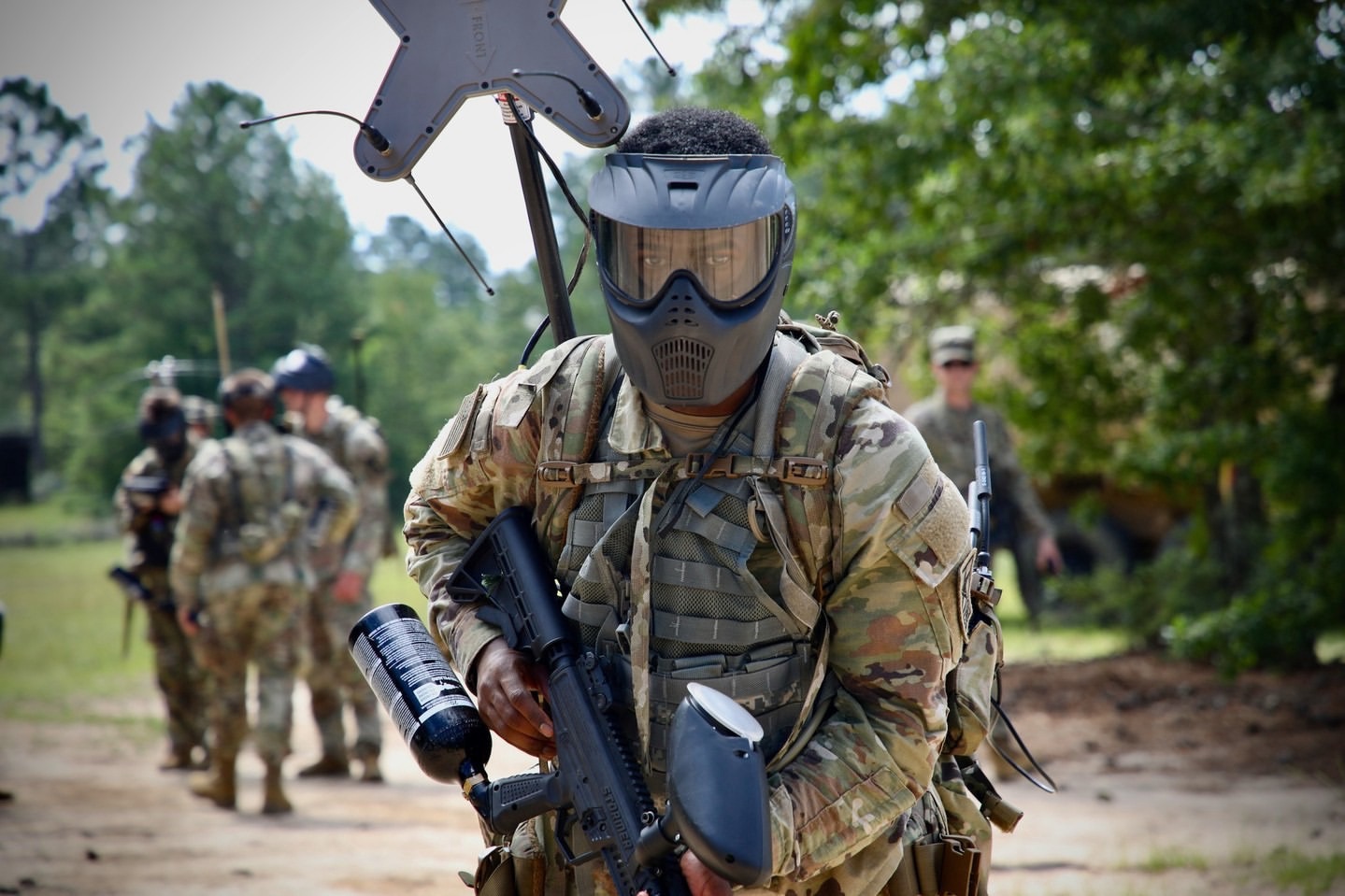
Shabelina says there is a lot of preparation behind E3B testing, which consists of events ranging from land navigation to weapon familiarity. The first event started with the expert physical fitness assessment and then moved onto land navigation.

However, the testing doesn’t end there. Throughout the week, Soldiers must pass 10 different stations that tested their knowledge of tactical combat casualty care, weapons functions checks and basic knowledge of different weapon systems, patrolling and tasks associated specifically to the badge they were testing for.

For example, the EFMB conducts three testing lanes with a varying number of evaluated skills. These lanes test the practical ability and keen eyes of candidates while performing evacuation and warrior skills tasks.

“EFMB is a test of a candidate’s attention to detail,” said Sgt. 1st Class Jonathan Bland, flight paramedic, 2nd Battalion, 4th General Support Aviation Battalion, 4th Combat Aviation Brigade, 4th Inf. Div. “All of the grade sheets and standards are published and that is really where the rubber meets the road.”

Soldiers are graded on each task to a strict standard. Participants are eliminated if they receive two no-go’s on a task. Soldiers who complete all the tasks perfectly are recognized as earning their “True Blue” for EIB, “Perfect Edge” for ESB and “No Blood” for those who earned their EFMBs with perfect scores.

Despite a plethora of rigor during the first few days of competition, the remaining Soldiers enter the final event, a 12-mile road march completed within three-hours. After crossing the finish line, Soldiers must disassemble and reassemble their weapon within five minutes.

“If you feel like you are losing yourself when you’re training up, you get everything right, you are in line to test out, and your mind goes completely blank, try to remember the Soldiers who are motivating you,” Shabelina said. “For me it’s my first sergeant and my team leader.”

In the end, 172 out of 924 Soldiers earned one of the E3B awards. Ivy Division alumni were able to pin the respective badges onto the recipients during the award ceremony at the conclusion of the final event.

Story by SPC Jason Klaer

Photos by PVT Cecilia Ochoa and SPC Mark Bowman

First USAF Officer Training School-Victory Graduates Take Flight

Tuesday, December 19th, 2023

MAXWELL AIR FORCE BASE, Ala. (AFNS) —  

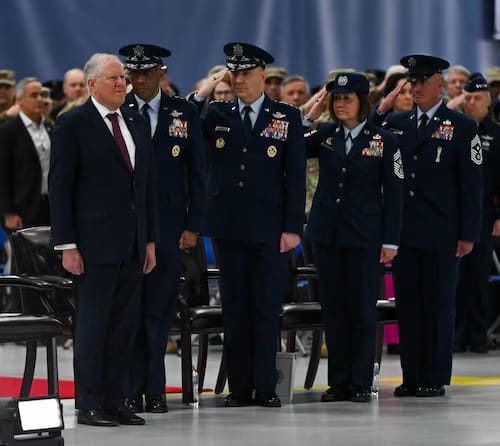
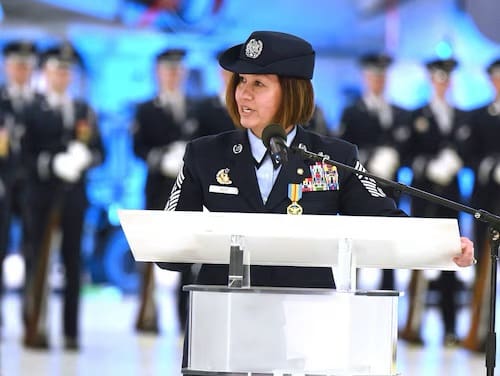
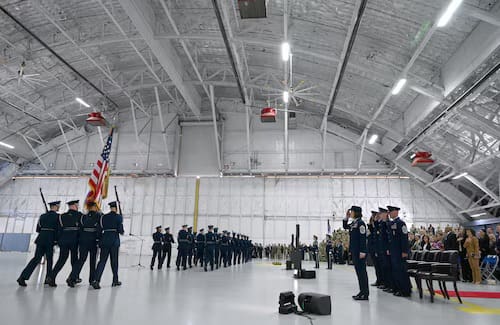
The first Officer Training School-Victory class graduated at Maxwell Air Force Base Dec. 8.

The graduation ceremony marked the historic transformation of the Department of the Air Force’s Officer Training School, setting an elevated standard for the next generation of Air and Space Force leaders. OTS-V provides a competency-based course designed to develop warrior-minded leaders of character committed to the Air Force oath, values and creed.

The new course promotes transformative change through leadership reps and sets in the affective, cognitive and behavioral learning domains. This experiential learning includes 60 hours across 28 days of challenging mission command experiences, as officer trainees lead their teams in multiple demanding environments to achieve the commander’s intent. OTS MCEs are conducted in three primary environments: a new tactical level Multi-Domain Warfighting Lab, an innovative Combined Joint Task Force Wargame and a deployed field exercise to prepare graduates to serve and lead Airmen and Guardians through volatile, uncertain, complex and ambiguous challenges to accomplish difficult missions.

“All of it has changed to produce a better warfighter,” said Col. Derrick J. Iwanenko, deputy OTS commandant. “For the first time, we’re a competency-based course, executing mission command experiences. Within our condensed timeline, nobody is executing the level of reps and sets we’re able to induce for the trainees through mission command.”

OTS-V incorporates a physically, intellectually and emotionally rigorous five-module approach across 60 training days. OTS will conduct, on average, 20 classes per year with a new class starting every two weeks. The additional class start dates promote flexibility for stakeholders, reduce candidates’ wait time to attend training, and allow for increased trainee throughput. At any point, OTS will have up to five classes in session in various phases of training. The new training construct allows OTS to easily surge production to meet mission requirements in both steady state and a contingency mobilization posture.

“I’m extremely grateful and honored to have had the privilege to serve and to be a part of our OTS transformation,” said Col. Keolani Bailey, OTS commandant. “I’m sincerely appreciative of the entire OTS team for their innovation, passion, and commitment to the mission, each other and our trainees. Our OTS professionals are the best in the leader development business! I am also thankful for the officer trainees who invest their best to develop themselves, their peers, and our staff as we continually improve to become the premier leader development institution within the profession of arms. As warrior-minded leaders of character, our graduates emerge committed to living with honor, lifting others and elevating the performance of their teams to deter, fight and win our nation’s wars.”

By Airman 1st Class Tyrique Barquet, Air University Public Affairs

FORSCOM Commander’s Forum Outlines the Future of Army Formations

Tuesday, December 5th, 2023

FORT LIBERTY, N.C. — Commanders and command sergeants major from across the U.S. Army Forces Command footprint gathered at Fort Liberty for the FORSCOM Commander’s Forum, Nov. 29-30, 2023. The conference brings together senior leaders from all Forces Command corps and divisions as well as the Army National Guard and Army Reserve for focused training and conversations on leading warfighters on the battlefield.

Gen. Andrew Poppas, FORSCOM commanding general, welcomed the group and explained there was much to cover over the two-days. He continued by explaining his “4-Wins:” Win Trust and Empower Leaders; Win the First Fight; Win the Future Fight; and Win as a Balanced Total Army.

“The framework we’ve laid out is the 4-Wins,” said Poppas. “This is the framework in which we move forward. And I will tell you that at every touchpoint within each one of these domains, I feel we’ve made great success. In the way we are building the team, in the way we’ve embraced it … strengthening the relationships we have and engaged leadership.”

He continued by expressing his vision of a warfighting force and professional warriors. Warriors need the mindset of always moving forward; the warrior spirit to hone yourself to be physically and mentally fit; and training methodology focused on building formations to their greatest capability, he said.

“The strength of that formation is that they rely on each other,” Poppas said. “It’s the person to your left that’s carrying the shield that protects you. It’s the strength of the formation that moves forward.”

Poppas explained the number one priority for the Army chief of staff is warfighting and FORSCOM owns warfighting. As he looked around the room, he acknowledged that the leaders sitting there were in the positions they are in due to their strong backgrounds as leaders, warfighters, and Soldiers.

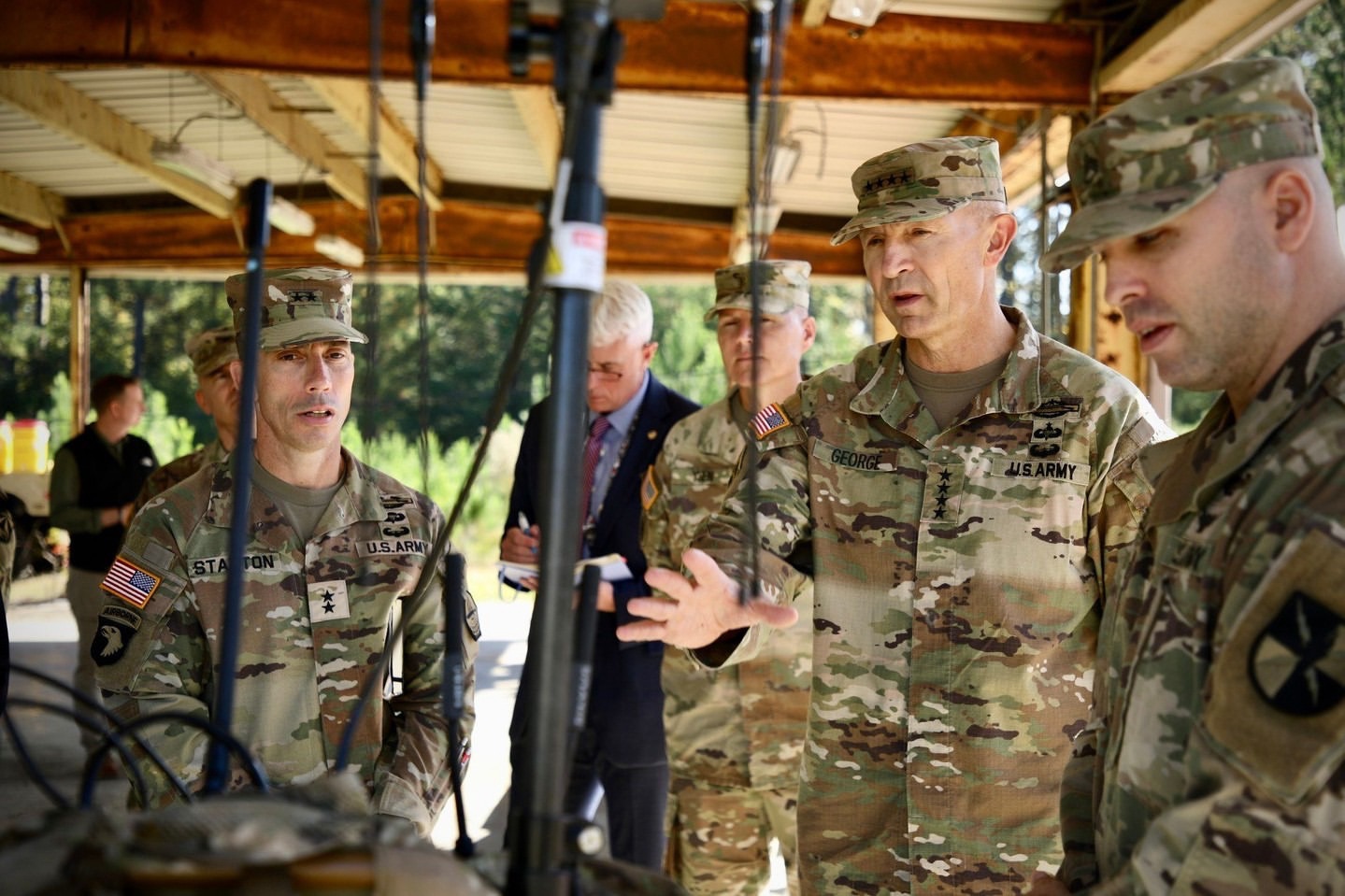
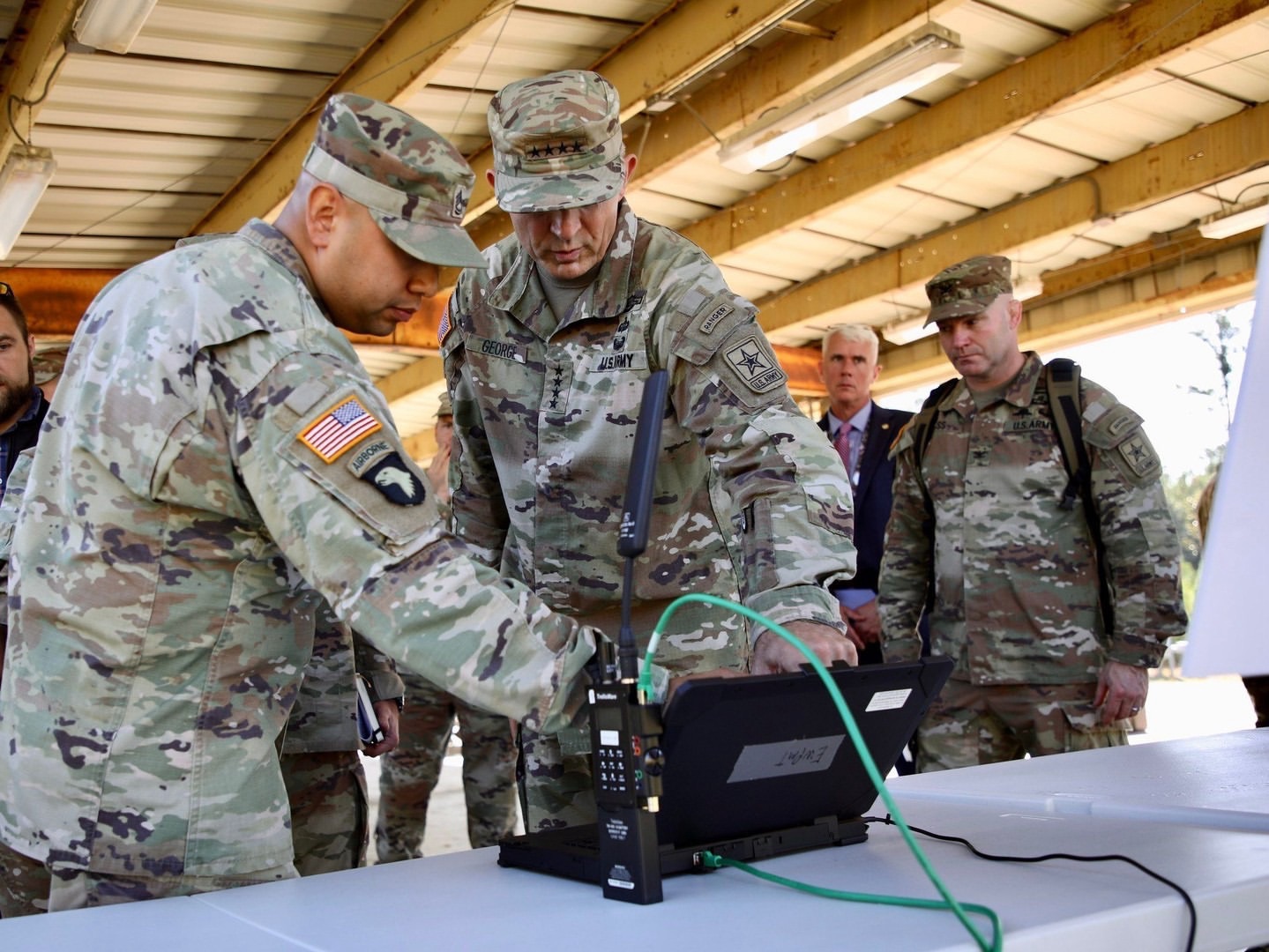
This year, the 41st Chief of Staff of the Army, Gen. Randy George, was the guest speaker for the forum. George has served as the Chief of Staff of the Army since Sept. 21, 2023. He began his discussion by acknowledging that world today is a very complex place. The Middle East, Ukraine, Taiwan and Africa were cited as just a few of today’s global hot spots the U.S. Army has interests. In addition to these topics, George recognized challenges with recruiting efforts, equipment and parts delay and budget stability.

As he continued, George shared with the group the questions he asked to his staff at the Pentagon: what can we stop doing or change; how do we adjust our processes; how can we push down authority and funding; and are we making the right trade-offs?

“I generally don’t talk about 2030 because I don’t think we have that much time,” said George. “2030 is too far down the road. We are going to be a lot different before that, I can guarantee you. We are going to be a lot different in the next four years.”

The Army chief of staff continued the conversations, outlining his some of his priorities — such as warfighting, delivering ready combat formations, adjusting the approach to military construction projects, and production of a new mobile app to help inform Soldiers and families of quality of life programs available to them.

Focusing on continuous transformation, George explained that transformation is more than just purchasing new equipment. Transformation also includes changes to processes, training and how Army formations look.

“I want our leaders to decide what our formations will look like, not a bunch of us sitting inside the [Pentagon],” explained George. “I can certainly do that, I definitely have my own opinions on a lot this, but I want everybody involved in what we’re doing.”

The topic of strengthening the profession was saved until last to emphasize the point. George shared an example from his time as a division commander. Underlining how he and other division commanders would share advice and lessons learned with each other to help increase lethality and warfighting capabilities.

“I remember when I was a captain and pulling the drawer open and Armor Magazine and Infantry Magazine were there, and they were very helpful,” said George. “I’m asking for your help in making sure people are writing about our profession. We should be talking about our profession.”

By Adam Luther

Army Publishes First Doctrinal Manual Dedicated to Information

Monday, December 4th, 2023

FORT LEAVENWORTH, Kan. — The Army has released its first doctrinal publication dedicated to the topic of information and its role in multidomain operations on the Army Publishing Directorate website, Nov. 27, 2023.

Army Doctrine Publication 3-13, Information, codifies the Army’s approach to the military uses of data and information, and recognizes all activities generate informational effects that can contribute to, or hamper, achieving objectives.

“Information is central to everything we do. It is the basis of intelligence, a fundamental component of command and control, and the foundation for communicating thoughts, opinions and ideas,” said Lt. Gen. Milford Beagle, Jr., commanding general, Combined Arms Center and Fort Leavenworth. “As a dynamic of combat power, Army forces fight for, defend, and fight with information to create and exploit information advantages — the use, protection, and exploitation of information to achieve objectives more effectively than enemies and adversaries.”

Authors from CAC’s Combined Arms Doctrine Directorate, the organization charged with writing the new manual, acknowledge that changes in the security environment necessitated an update to doctrine. Adversaries are already using informational power to try to gain regional influence and control well ahead of potential armed conflict. These actions make the competition for information and ideas continuous and persistent.

Key to achieving objectives in a contested environment like this means gaining an information advantage, a new term now defined in doctrine. An information advantage is “a condition when a force holds the initiative in terms of situational understanding, decision making, and relevant actor behavior.”

“Our new doctrine makes it clear that everyone plays some role in achieving information advantage,” said retired Army colonel and CADD Director Richard Creed. “And similarly, commanders need to consider information from a combined arms perspective because all Army capabilities create effects in the information dimension of our operational environment. We can’t make it the sole purview of a single staff section or certain specialties and expect success during operations. Operations now require leaders to consider how information enables operations, how to protect friendly information, how to employ information against an enemy or adversary, and how to attack the enemy’s ability to use information effectively.”

To facilitate that process, ADP 3-13 gives leaders a framework for developing information advantages during operations and at home station. It also spells out how commanders can leverage aspects of information that enable command and control; protect data, information, and networks; inform audiences; influence threats and foreign relevant actors; and attack the threat’s ability to use information.

The publication of ADP 3-13 is just the start of a sustained education campaign from CAC. As with the release of FM 3-0, CADD is developing a series of products to help Soldiers understand the new doctrine. Articles, videos and podcasts devoted to ADP 3-13 are in the works and will be announced via CADD’s social media channels. The team will also work closely with the Centers of Excellence, Army University and the combat training centers to ensure this information is incorporated into professional military education and training. In addition, mobile training teams will visit select installations and organizations to further integrate the ideas outlined in the manual.

“ADP 3-13 provides the intellectual underpinnings that describe how Army forces will gain, protect, and exploit information advantages; however, doctrine is only the beginning. The hard work starts when we begin to internalize these ideas into leader development, education, and training,” said Beagle.

To learn more about ADP 3-13 and other doctrine, visit the Combined Arms Doctrine Directorate website.

By Randi Stenson, MCCoE Public Affairs

Air Force Reserve Component Launches Direct Commission Program; Constructive Service Credit for Cyberspace Warfare Operations Career Field

Wednesday, November 22nd, 2023

By Secretary of the Air Force Public Affairs

ARLINGTON, Va. (AFNS) —  

The Department of the Air Force has announced that the Air Reserve component has initiated a direct commission and constructive service credit program memo for people interested in serving in the cyber security and cyberspace warfare operations career fields.

Brig. Gen. Terrence Adams, deputy principal cyber advisor to the Secretary of Defense and senior military advisor for Cyber Policy, made the announcement on behalf of the Air Force at the Aspen Institute Cyber Summit in New York.

“As our nation faces tough challenges in the cyberspace warfighting domain, the Air Force Reserve needs the best talent America has to offer,” Adams said. “The Cyber Direct Commission program is designed to attract highly skilled cyber professionals from industry and enlisted career fields who want to serve their nation in a part time capacity.”

Enlisted personnel and civilians qualified to serve as Air Force Warfighter Communications Operators (17D) and Cyberspace Effects Operators (17S) can earn a direct commission as an Air Force officer. Also eligible are personnel who are qualified to earn a cyberspace engineer/agile software developer – Cyberspace Engineering “Z” prefix as outlined in the Air Force Officer Classification Directory.

“This program will allow the service to access cutting edge talent and leverage private sector skills to make us more competitive in the changing world environment,” said Alex Wagner, assistance secretary of the Air Force for Manpower and Reserve Affairs.

A review board will determine if candidates are eligible for constructive service credit for prior commissioned service, advanced education, and special training or experience.

Constructive service credit is used to determine initial grade, rank and service for promotion eligibility and is usually granted in year-long increments.

Applicants must meet the following criteria:

·?? Be eligible for a commission in the Air Force, including physical standards for entrance

·?? Possess or be eligible for a top secret/sensitive compartmented information security clearance

·?? Have a quantifiable record of leadership, management or supervisory experience in academia, civilian and/or military organizations (preferred)

·?? Have qualifying advanced education, specialized training and/or experience in cyber-related fields as outlined in the memo

Candidates will incur an initial four-year Selective Reserve obligation from the date of appointment or commission and an additional four-year Inactive Ready Reserve obligation. They will also be required to complete the U.S. Air Force Officer Training School program. Their monthly reserve obligation will depend on the needs of their units, training requirements and mission requirements.

This program follows a regular Air Force pilot program for direct commissioning into cyber career fields and constructive service credit launched in 2020.

This is the first time the reserve component has opened direct commissions to career fields other than lawyers, chaplains and medical personnel. The service may consider expanding the direct commission program to other reserve and Guard career fields in the future.

Career fields that may be considered are operations analyst, intelligence, security forces, chemist, nuclear chemist, physicists, nuclear physicists, developmental engineer and acquisition manager.

US Army Soldiers and NATO partners earn highly coveted expert badges

Monday, November 20th, 2023

By SPC Jet Cortez

VILSECK, Germany — U.S. Soldiers and NATO partners participated in an event known as ‘E3B’ Nov. 6 to 10.

The 2nd Cavalry Regiment hosted and provided the opportunity, training, and evaluations necessary for candidates to receive the Expert Infantry Badge, Expert Soldier Badge, and Expert Field Medical Badge.

“Being in your own head can be one of the biggest challenges,” said U.S. Army Pfc. Simon Jack, an Infantryman assigned to Apache Troop, 1st Squadron, 2nd Cavalry Regiment. “Just remember to relax, you’ve done it before, and just go through the steps like you did in training.”

Prior to the start of testing for E3B, the candidates went through a training phase for two weeks, sharpening their technical and tactical knowledge to be successful in the numerous tasks ahead.

During evaluation week, Soldiers were required to pass the Expert Physical Fitness Assessment, land navigation, three evaluation lanes with 10 tasks each: the patrol lane, weapons lane, medical lane, and then a 12-mile ruck march.

The amount of candidates narrowed down gradually. Each lane had graders evaluating every candidate, testing their ability to complete tasks correctly with various “go” and “no-go” scenarios.

“You’ve got to put in the hours and the work to make sure that you learn all 30 of these tasks and are able to complete them in a proficient manner, because if you’re not, then this is one of those badges that is going to be very difficult for you to get,” said U.S. Army Capt. Ben Do, a field artillery officer assigned to 3rd Battalion, 27th Field Artillery Regiment.

“It’s definitely one of those things that you have to be fully dedicated to,” said Do.

Regardless of the outcome, Soldiers gained experience that they can use to teach others and become more reliable and capable leaders for their units.

“At the end of the day, we are getting a whole bunch of training that we can bring back to our troops and increase lethality,” said U.S. Army Sgt. Dylan Mecca, a horizontal construction engineer assigned to the 15th Engineer Battalion.

Out of the 1,700 candidates who participated in the E3B event, there were 548 candidates who earned their respective badges at the graduation ceremony.

Specific titles were given to candidates who earned their respective badges without receiving a single no-go in their particular lane, acknowledging the candidates’ efforts to execute every task of each event. These titles include “True Blue” for EIB, “No Blood” for EFMB, and “Perfect Edge” for ESB.

“Once you wear the badge, it doesn’t mean that you can just brain dump it,” said Do. “People are gonna look to you to be the subject matter expert on any of the 30 tasks that you completed.”

With the conclusion of E3B 2023, U.S. Soldiers and NATO partners successfully engaged in the given opportunity to develop lethality, interoperability, and test their skills, which are vital assets for maximizing mission success in real-world environments to deter enemy forces.

To view more photos and videos of this event visit this website.

SECAF Authorizes Space Force Good Conduct Medal

Sunday, October 29th, 2023

U.S. Space Force Guardians are now eligible to receive the Space Force Good Conduct Medal (SFGCM) if eligibility criteria are met, effective immediately.

This medal recognizes “exemplary behavior, efficiency, and fidelity of enlisted members of the United States Space Force,” according to a memo signed by Secretary of the Air Force Frank Kendall Aug. 30, 2023.

The memo also outlined award eligibility for the SFGCM will be retroactive to the date the U.S. Space Force was established by law, Dec. 20, 2019.

Eligibility for the award includes members demonstrating the Space Force core values of Character, Connection, Commitment, and Courage; members will receive the SFGCM after serving in the Space Force for three years.

Award of the SFGCM is automatic unless denied by the unit commander.

This new medal comes after Executive Order 8809, Good Conduct Medal, was amended by Executive Order 14085, Expanding Eligibility for Certain Military Decorations and Awards, dated Oct 3. 2022, and will be reflected in the next revision to DAFMAN 36-2806, Military Awards: Criteria and Procedures, Attachment 14.

By Secretary of the Air Force Public Affairs

GAFPB: A Powerful Symbol and More Than a Badge

Monday, October 23rd, 2023

Soldiers endure discomfort and pain for many reasons. They may do so as part of their wartime duties, or in training. Everyone reaches a point where they choose to quit or drive on. Military awards – particularly badges – are earned, not given. Each course or task demands some level of sacrifice.

Many servicemembers particularly value the chance to earn a foreign award. No badge is worn by as many U.S. servicemembers though as the German Armed Forces Proficiency Badge – GAFPB.

My introduction to the badge came as a 19-year-old draftee serving in the German Air Force, Luftwaffe, after graduating from Berlin’s John F. Kennedy School. This opportunity presented itself to me courtesy of my German mother. My American father served as a U.S. Army JAG officer attached to the U.S. embassy to Germany at the time. I recall that the sewed on GAFPBs adorning my basic training instructor’s uniforms served as a symbol of their competence and professionalism. Everyone in my unit wanted a chance to prove themselves and receive the badge.

My understanding of this particular award would evolve over time. I would earn, and then encounter, this badge throughout my career.

The badge in German is formally called the, “Abzeichen für besondere Leistungen im Truppendienst.” This term more accurately translates as, “award for special performance in military service.” In U.S. military service, we refer to it as the German Armed Forces Proficiency Badge, but it is officially the German Armed Forces Efficiency Badge.

Army Regulation 600-8-22, Military Awards, stipulates that foreign decorations will only be presented by a designated representative from the awarding nation. As such we work with our German partners as part of each event, and they generate and sign award certificates. Army Regulation 600-8-22 also includes the German Armed Forces Efficiency Badge as a specifically named foreign badge specifically authorized for acceptance and wear by both enlisted personnel and officers.

A U.S. Army commander may also approve the wear of the foreign badge. Many units publish memorandums that authorize acceptance, retention and wear of the badge or use the DA Form 4187.

Events required to receive the GAFPB include completing various sport exercises including a shuttle run, flexed arm hang, and a one-kilometer run. Servicemembers must also pass a first aid exam and demonstrate proficiency in their chemical, biological, radiological, and nuclear protective equipment. Pistol marksmanship is also key, with shooters required to engage three targets using five rounds. Most events conclude with the required ruck march, or the challenging 100-meter swim and uniform doff.

German servicemembers wear the badge on the left breast pocket of their utility and service uniforms, while U.S. Soldiers may only wear it on their Army Service Uniform coat and shirt and Army Green Service Uniform coat. Soldiers may only wear one foreign badge on their uniforms, centered, or aligned with the right edge of unit awards or nameplate, above the right pocket and unit awards.

The West German Bundeswehr established the award in 1971 and servicemembers of all branches may earn the badge. It is an award of the Federal Republic of Germany’s Bundeswehr and available in three steps, or levels. Gold, silver and bronze. Interestingly, the German military places more value on gold than we do in the U.S. military. U.S. O-1 rank is gold across all services and branches, while O-2 is silver. German officer rank is silver, while all general officer ranks are gold. As such the gold GAFPB is more difficult to earn than the silver or bronze.

The badge prominently features the Bundesadler – the federal eagle – surrounded by a wreath. It’s interesting and relevant that Germany and the United States of America share an affinity for the same bird and use it as national symbols.

After I left the German military, I attended university in the U.S., enlisted in the Army Reserve, and then later commissioned as a Regular Army officer. During the Basic Officer Leaders Course, German liaison officers detailed to the Maneuver Support Center of Excellence offered another opportunity to earn the GAFPB. I witnessed hundreds of young U.S. Army military police 2nd Lt.’s earn their badges.

Some years later I was assigned as provost marshal to 2d Cavalry Regiment based in Vilseck, Germany. I again saw our formations regularly host German partners during various GAFPB events. Units and individual soldiers drew close to German units and servicemembers.

Last summer I served as officer in charge during a large GAFPB event held at Camp Shelby, Miss. We worked closely with German servicemembers assigned to the German Armed Forces Command in Reston, Va. and the defense attaché staff detailed to the Federal Republic of Germany’s embassy to the United States. We hosted over 300 servicemembers during the event.

Most recently I attended the 3d U.S. Infantry Regiment (The Old Guard) GAFPB event. Historic Joint Base Myer-Henderson Hall served as a backdrop for the competition. Abutting Arlington Cemetery and a stone’s throw from the Pentagon, the installation is also very close to the German embassy located in Washington D.C.’s Foxhall Village neighborhood close to Georgetown. The defense attaché staff again took time to run over 250 servicemembers through each event. This time I covered the event as a public affairs officer.

Supporting GAFPB events is both time consuming and expensive for German servicemembers and their commands. Each GAFPB event may take two or three days – not including travel. This takes leaders away from their missions and staffs out of their offices. We must acknowledge the sacrifices they make as well.

So why do we go through all this effort to earn a badge? Its great training. Each event builds teams and camaraderie. Individuals reach their limits – and push past them. The badge is a visible symbol of an enduring partnership.

Over the years I watched men and women fight through pain, fatigue and doubt. This year a young soldier marched the soles off his feet, his boots red with blood and skin sloughing off. He made it past the ruck march. I’ve watched well prepared swimmers cramp up in the pool, sink to the bottom, yet manage to remove their uniform blouse and trousers to complete the swim. I’ve seen senior leaders compete alongside their young soldiers, earning a badge – and respect – after over 25 years of service.

What I enjoyed seeing most though were the conversations and insights shared between allied servicemembers before, during and after a GAFPB event. The briefest conversations between the Germans and our troops sparked interests that led to much greater understanding.

German Navy Rear Adm. Axel Ristau, the German embassy’s defense attaché, emphasized both moral and physical fitness after the latest GAFPB. He also highlighted the alliance between the two countries. “It’s a visual sign of our outstanding bilateral cooperation, and we both, the Americans and German soldiers who earn this badge, can be very proud.”

Ristau earned his badge in 1987. He marveled at how this award binds two nations together – “It’s a sign of a transatlantic link. I wear, and my comrade here, wears the same badge on a military uniform.” He told me this as 213 U.S. servicemembers, their friends and families celebrated their achievement in Fort Myer’s Conmy Hall, its massive display screen showing enmeshed German and American flags braced by the gold, silver and bronze GAFPBs.

While not as far removed from earning my badge as Ristau, I also appreciate its importance and feel much the same way. What at first to me was a badge worn by my respected instructors and superiors in the German military, has now as a U.S. Army officer become that symbol of proficiency, and of true German-American partnership.

By MAJ Joshua Frye

MAJ Joshua Frye is the public affairs officer for the Military Intelligence Readiness Command, U.S. Army Reserve.