Your reading assignment for tonight:
STRATEGIC LATENCY UNLEASHED: THE ROLE OF TECHNOLOGY IN A REVISIONIST GLOBAL ORDER AND THE IMPLICATIONS FOR SPECIAL OPERATIONS FORCES

Get your copy here.
Your reading assignment for tonight:
STRATEGIC LATENCY UNLEASHED: THE ROLE OF TECHNOLOGY IN A REVISIONIST GLOBAL ORDER AND THE IMPLICATIONS FOR SPECIAL OPERATIONS FORCES

Get your copy here.
This will come in handy for those of you working in a joint environment. Late last week, US Space Force issued a memorandum outlining the rank structure for their Guardians with an effective date of 1 February 2021.
E1 Spc1 Specialist 1
E2 Spc2 Specialist 2
E3 Spc3 Specialist 3
E4 Spc4 Specialist 4
E5 Sgt Sergeant
E6 TSgt Technical Sergeant
E7 MSgt Master Sergeant
E8 SMSgt Senior Master Sergeant
E9 CMSgt Chief Master Sergeant
E9 CMSSF Chief Master Sergeant of the Space Force
You may address the junior enlisted specialist ranks as “Specialist.” Alternatively, you may use “Spec” or “Specialist” and the grade, as in “Spec4” like they used to do in the Army.
Sergeants are of course addressed as “Sergeant,” which can be used for TSgt and MSgt as well. TSgt may be also addressed as “Tech Sergeant” or “Technical Sergeant” although a MSgt may be only alternatively addressed as “Master Sergeant.” Interestingly, a SMSgt may be called “Senior” and a CMSgt “Chief.”
This convention is an interesting break in logic for Senior NCOs. Of course, in the late ’50s the Air Force was so enamored with the so-called “super grades” of E8 and E9 that they traded their Warrant Officers in for more of them. In fact, until 1995, Air Force enlisted rank insignia kept the MSgt and below visually distinct by only putting SMSgt and CMSgt stripes above the star. I guess in the mid-90s something finally made them give in and acknowledge MSgts as Senior NCOs. But I digress. I almost let you off by tiptoeing earlier around the fact that you can call a CMSgt just “Chief,” but you can’t call a MSgt just “Master.” Marinate in that one for awhile.
Having said all of that, there’s still no word on what USSF enlisted rank insignia will actually look like aside from this temporary CMSSF insignia.

Although Officer ranks were also mentioned in the memorandum, there is no difference from the Air Force, Army or Marines. Alas, USSF seems to have taken the Air Force’s lead and chosen to forego Warrants.

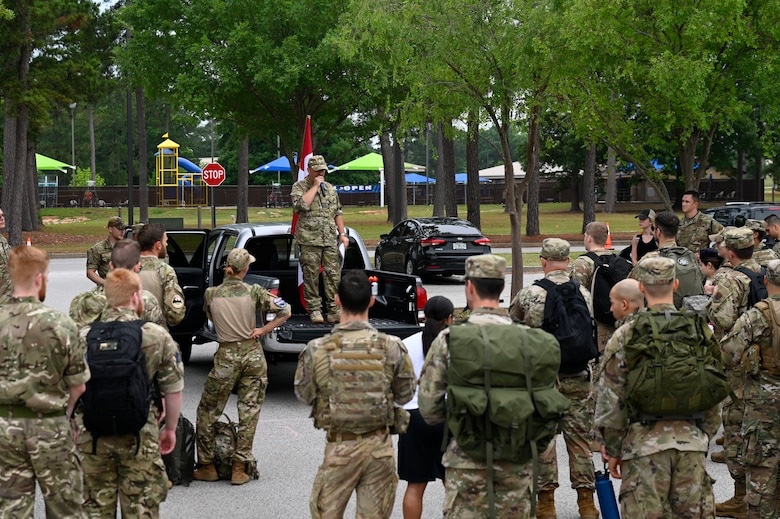
JOINT BASE LEWIS MCCHORD, Wash. – Advisors from 5th Security Force Assistance Brigade took part in an intensive test of their physical fitness and tactical expertise in the inaugural Tactical Advisor Readiness Program assessment at Joint Base Lewis McChord, Washington, Jan. 21, 2021.
“We trust teams, filled with great Non-Commissioned Officers, to build and sustain mastery of the fundamentals of combined arms warfare in garrison, so that these teams can operate alone as our ambassadors in foreign countries,” 5th SFAB Commanding General, Brig. Gen. Curtis Taylor said.

SFAB teams are designed to be highly-modular and independently deployable in configurations ranging from 4-12 personnel depending on the advisory function of the team such as logistics, communications, maneuver, medical, engineering or field artillery.
“The TARP is where we bring our teams together to compete against one another so that we can reward our very best and validate our training,” Taylor said.
The TARP event began at 6:30 a.m. on a dark and rain-soaked Vanguard Field where 5th SFAB NCOs like C Company, 2nd Battalion, 5th SFAB’s 1st Sgt. Anthony Fuentes, took on a challenging physical training event designed to test the stamina and strength of his team.

“I started an all-volunteer 5 a.m. team train up event the day we received the concept of operations for the TARP event,” Fuentes said. “We used the TARP CONOP as an objective and built our team mission statement with key tasks each team member had to hit for us to be successful.”
The day continued with a timed ruck march which led to an obstacle course; followed by multiple stations which included an SFAB Advisor knowledge test followed by lanes testing weapon assembly and disassembly, treating a casualty, operating tactical communications equipment, call for fire, and a lay out of all required equipment.

It was Fuentes team, Battalion Advisor Team 520, that outlasted the other teams from across the brigade at the end of the day.
“It’s hard to build a team when isolated in a hotel room during COVID-19 restrictions or during large scale exercises,” Fuentes said. “We just needed to focus on bettering each other, and this event allowed us to do that.”
The 5th SFAB will send its first teams into the U.S. Indo-Pacific Command’s Area of Operation in the coming weeks. This monthly TARP event becomes increasingly critical in preparing Advisors for a challenging operational environment.
“Across the formation today, I saw young sergeants leading their team in hard PT, shouldering the load when the litter got too heavy and serving as subject matter experts for their team on the communication lane.” Taylor said. “I have great confidence that these superb NCOs will represent our Army and our Nation with pride across the Indo-Pacific.”
One of these young sergeants was Sgt. April Mullins, a maintenance advisor and wheeled vehicle mechanic from 3rd Squadron, 5th SFAB.
“During the TARP event, I realized that while we are great as a team, we also need to know how to do things on our own when our teammates are absent,” Mullins said. “This really showed us that we need to train to know each other’s job as well as we know our own.”

This was part of the Commanding General’s intent during the development of this first TARP event, as Taylor emphasized that SFABs are built on a foundation of autonomy and accountability.
The task of putting this together, fell to 3rd Squadron, 5th SFAB Operations Sgt. Maj. Thomas Wrinkle.
“We modeled the event after an Expert Infantry Badge/Expert Soldier Badge/Spur Ride competition and included all of the units within 5th SFAB to execute,” Wrinkle said. “We chose events that would allow the teams to operate as a team and also test them as individuals.”
The winning team received recognition from Brig. Gen. Taylor and the 5th SFAB’s senior enlisted advisor, Command Sgt. Maj. Robert Craven at a ceremony later that day. The monthly winning team will also have their team’s achievement enshrined in unit folklore with their team number engraved on a unit trophy.
Until then, NCOs will continue to train their teams beginning with 90 minutes of hard PT every morning preparing for next month’s TARP event and any mission that lies ahead.
By MAJ William Leasure, 5th Security Force Assistance Brigade Public Affairs

WASHINGTON — New changes to grooming and appearance standards are slated to take effect next month, as part of the Army’s commitment to improve the wellbeing of all Soldiers.
Army senior leaders approved several upcoming grooming and appearance modifications, said Sgt. Maj. Brian Sanders, senior enlisted leader of Army G-1’s uniform policy branch.
The announcement will be followed by an all-Army activities message that will take effect late February and will supersede the standards outlined in the grooming and appearance chapter of Army Regulation 670-1 until the next scheduled revision.
“This is one of the many facets of putting our people first and recognizing who they are as human beings,” he said. “Their identity and diverse backgrounds are what makes the Army an ultimate fighting force.”
The changes originated from a panel of 17 Soldiers — 15 women and two men — who assessed a list of proposed grooming and appearance modifications connected to the professional appearance, health and wellness, diversity, and inclusion of Soldiers.
The panel included Soldiers from all components, representing a cross-section of ranks, units, ages, cultural backgrounds, career fields and races. The process also included two Army dermatologists, an Army psychologist, and an Army equal opportunity advisor as subject-matter experts, who provided medical or EO knowledge to back the panel’s findings.
The push to change the Army’s grooming standards proves that the force is evolving and making a concerted effort to make everyone feel included, said Master Sgt. Quintana Mitchell, the uniform policy NCO for G-1.
“I use the analogy, ‘If you look good, you feel good — and if you feel good, you perform [well],” Sanders said. “If I am in the Army long enough, it would be nice to see how these changes have improved productivity … and make Soldiers perform better.”

Minimum hair length
One of the updates will authorize no minimum hair length for all personnel, to include making it an optional style for female Soldiers. Under the current policy, a Soldier’s hair length can be no shorter than 1/4 inch from the scalp unless otherwise exempt due to a medical condition or injury.
Panel findings determined that females attending Ranger, Special Forces, or Sapper training were often encouraged to cut their hair to abide by health and hygiene recommendations while training in an austere environment, Sanders said.
If the Soldier were to washout or graduate from training, their hair was often below the 1/4 inch minimum length requirement and outside Army regulations.

Multiple hairstyles
Soldiers will also be authorized to wear multiple hairstyles as long as it maintains a neat and professional appearance, and if the hairstyle doesn’t impede the use of headgear or other equipment, Sanders said.
Under the current standard, Soldiers are allowed to braid, twist, lock, or cornrow their hair if they are uniform and no greater than 1/2 inch in width. Individuals must also have appropriate size and spacing between each braid, cornrow, twist, or lock, and are authorized one distinct type of hairstyle at one time. The updated standard removes the constraints of dimension requirements.
By eliminating some of the restrictions, Soldiers will now have more flexibility, all while keeping it within the confines of professionalism, Mitchell said. Further, having a choice to wear multiple hairstyles will allow female Soldiers more ways to secure their hair so that it can fit appropriately under their headgear.


Ponytails
Female Soldiers with medium-length hair will have the option to wear a ponytail if the individual’s hair length or texture prevents them from securing it into a tight bun, Sanders said. A medium-length hairstyle must extend more than 1 inch from the scalp and cannot exceed the lower edge of the collar in all uniforms.
Under the new policy, medium-length ponytails are only authorized for wear on the back of the scalp and cannot exceed the head’s width or interfere with the proper wear of a Soldier’s headgear.
The updated standard will also allow females with long hair the option to wear a ponytail while wearing an Army Combat Uniform during physical training, or while wearing tactical headgear during tactical training or combat operations. The Army defines long hair as a length that extends beyond the collar. Army standards require this hairstyle to be neatly and inconspicuously fastened above the collar’s lower edge.
“We can’t tell a Soldier to cut their hair so their helmet can fit,” Sanders said. “We can still allow a female Soldier with longer hair to put into a long ponytail and tuck it in their ACU top so they can still conduct their mission.”
Dermatologists involved in the review process provided critical input tied to the updated ponytail policy, Sanders said. The authorized wear of a medium-length ponytail could lower an individual’s risk of hair loss, reduce scarring, or decrease the likelihood of migraine headaches caused by repeatedly pulling hair into a tight bun.
The lack of hairstyle options as a result of a Soldier’s hair length or texture can often stress an individual as they try various techniques and devices to secure their hair to maintain a neat appearance, Mitchell said.
Hair highlights, root growth
The Army plans to authorize the wear of highlights if it presents a natural appearance and is not a prohibited color, Sanders said. Further, if a Soldier decides to color or highlight their hair, root growth of a different color should not exceed 1.5 inches of the original color.
“Some Soldiers develop natural highlights,” Sanders said. “We cannot assume that a Soldier’s hair should be a specific color” based on their complexion.
Under the current regulation, Soldiers are only authorized to dye, tint, or bleach their hair. The color of their hair must also be uniform and not detract from their professional appearance. Unauthorized pigments include, but are not limited to, purple, blue, pink, green, orange, bright red, and fluorescent or neon colors.
“The emphasis is on natural hair colors,” Mitchell said. “It doesn’t necessarily have to be a color that is typically seen on a certain ethnic group. It just has to be a natural hair color” that presents a neat and professional image.

Optional wear of earrings with ACU
Female Soldiers will soon be authorized to wear earrings with their ACU. Earrings can either be screw-on, clip-on, or post-type earrings in gold, silver, or diamond and must be unadorned and spherical without exceeding 6 mm or 1/4 inch in diameter.
Pearl earrings are not authorized with the ACU, Sanders said. Females are currently authorized to wear earrings when wearing their service, dress, mess, and evening mess uniforms.
Individuals will not be allowed to wear earrings in a field environment or during a combat-related deployment, or in locations where access to regular hygiene is limited.
“Our identity is important,” Sanders said. “If we care about people first and the Soldier as a whole, we have to care about the many aspects to who they are as well. This is a small, but significant change that positively impacts a considerable size of our force.”
Additional colors of lipstick, nail polish
Along with supporting a Soldier’s identity, the Army approved the use of additional colors of lipstick and nail polish, including the wear of clear nail polish by male Soldiers. Females also have the option to wear an American manicure, a two-tone nail style that maintains a natural appearance.
“Some male Soldiers in certain occupation specialties rely on their hands, which are under constant bombardment while working with tools or harsh chemicals,” Sanders said. “A male Soldier would take this opportunity to keep their nails protected.”
According to the updated policy, extreme colors and nail shapes, such as a coffin, ballerina, and stiletto nails, are prohibited while in uniform or on duty in civilian clothes. Unauthorized pigments include, but are not limited to, purple, blue, pink, green, orange, bright red, and fluorescent or neon colors.
Offensive wording change, updated imagery
Another update will remove and replace potentially offensive and weaponized words and phrases, such as “Mohawk, Fu Manchu, dreadlock, eccentric, and faddish,” Sanders said.
Army officials are currently replacing phrases of concern with alternative verbiage to provide increased clarity and guidance about a Soldier’s professional appearance based on safety, good order, and military bearing — instead of relying on the phrase at the discretion of the commander.
“This is how we shift the culture and embrace forward thinking,” Sanders added. “It is time to dig deeper and use our lexicon and vocabulary to describe what is authorized and what does not conform to a professional military appearance, good order and discipline.”
The updated standard will also include a link to imagery and videos to provide Soldiers with specific examples of proper grooming and appearance standards, Sanders said. Current images are too vague, outdated, and leave too much room for interpretation without adequate guidance.
“Pictures speak 1,000 words,” he said. “We won’t be able to capture every grooming and appearance standard, but we will be able to categorize them to equip Soldiers at all levels” with the information needed to ensure regulatory standards are being realized in a fair and inclusive way that is easily understood across the force.
By Devon Suits, Army News Service
Revised Army regulation and grooming standards support diversity, equity and inclusion and people first priority
WASHINGTON — The U.S. Army has announced major revisions to Army Regulation 670-1, Wear and Appearance of Army Uniforms and Insignia, which will include guidance on wearing the new Army Green Service Uniform and several other key changes. In addition, the Army is also revising its grooming standards to support its People First priority and diversity and inclusion efforts.
“The Army must continue to put people first by fostering a culture of trust that accepts the experiences and backgrounds of every Soldier and civilian,” said Lt. Gen. Gary Brito, Deputy Chief of Staff for Personnel. “Our diverse workforce is a competitive advantage, and the Army must continue to offer fair treatment, access and opportunity across the force.”
The new version of AR 670-1 will go into effect Feb. 24. Major changes include implementation of the AGSU, clarified policy on breastfeeding or pumping in uniform, authorization for breastfeeding/pumping Soldiers to wear an optional undershirt, implementation of the Improved Hot Weather Combat Uniform, and full transition to the Operational Camouflage Pattern — removing references to the Universal Camouflage Pattern.
“The Army has maintained a longstanding tradition of Soldiers presenting a clean and professional appearance,” said Sgt. Maj. Mark Anthony Clark from the Army’s Office of the Deputy Chief of Staff for Personnel (G-1). “A professional appearance is an outward manifestation of the pride they have in themselves and in service to our country.”
New grooming standards, which will be reflected in a forthcoming memo (ALARACT), will also go into effect in February. Approved revisions include optional wear of earrings, lipstick and nail colors for women and clear nail polish for men. Earrings will remain unauthorized in field environments, combat-related deployments or locations where access to normal hygiene is not available.
Approved hairstyle changes include no minimum hair length for female Soldiers, allowing multiple hairstyles at once (i.e. braiding, twists or locs). Soldiers will be able to wear ponytails if unable to form a bun, and may wear long ponytails while conducting physical training, in the combat uniform or when female Soldiers wear equipment such as, but not limited to, combat helmets.
“In an effort to stop hair damage and loss stemming from hairstyles like the bun, the Army approved healthier hairstyle options that are more inclusive of various natural styles,” said Clark.
Soldiers will also be allowed to have a uniform hair color blend (also known as highlights) as long as it presents a natural appearance. However, purple, blue, pink, green, orange, bright red, fluorescent or neon colors, and some others will be prohibited.
In addition, the revised regulation will not contain potentially offensive language used to describe several hairstyles – for example, “Mohawk, eccentric, faddish, Fu Manchu, dreadlock” – which will be replaced with alternative verbiage.
“We are continuously assessing our policies to identify areas for improvement, then implementing policies that demonstrate our commitment to ensuring all Soldiers feel as though they are valued members of the Army team,” said Brito. “We know that actions speak louder than words when it comes to inclusivity and equity within our ranks, and we believe that the changes we announced today are one example of policies that put our people first.”
By U.S. Army Public Affairs

Editor’s note: Here is the link to the updated DA PAM 670-1
The Army published the updated TC 3-20.0 Integrated Weapons Training Strategy (IWTS) on the 18th of June, 2019 based on training lessons learned accumulated over the preceding 18 years of continuous combat operations in Iraq and Afghanistan. While for the civilian sector 18 months is plenty of time for implementation of new policies and procedures, the Army generally takes three to five years for full implementation and socialization (there are still NCOs who don’t know the changes to the 2016 revision of TC 3-22.9 Rifle and Carbine regarding the shot process, but I digress.) This article is purely to serve as a means to help boost awareness of the changes to the Integrated Weapons Training Strategy so that leaders at all levels can best adapt existing policies to fall in line with new Army doctrine.




The major change to the IWTS regarding Live Fire Exercise (LFX) progression is the addition of Table V Fire Control Exercise (FCX) to Squad/PLT/Co tables which serve to replace the traditional blank iteration that would occur prior to a “live” iteration. Instead, blank rounds are last used during Table IV Field Training Exercise (FTX). While this change initially seems to increase risk during training, it actually reduces risk as the progression of tables, if followed properly, will improve proficiency in individuals and small teams through increased repetition of tasks. Additionally, the 75th Ranger Regiment learned, “the blind hit live fire is safer than live fire on rehearsed terrain.”1 This finding supports the IWTS’s implementation of Table V FCX instead of a blank iteration on the maneuver range itself.
Speaking with members of the MCOE’s Weapons and Gunnery Branch at Building 4 on Fort Benning, GA, the implementation of Table V (FCX) serves to reduce logistical complication of multiple ammunition DODICs, provide an additional repetition using live ammunition, and reduce bad habits that are often seen during blank runs. The IWTS describes the FCX as, “a course of fire using training ammunition on an authorized live-fire facility. This table trains basic skills at a reduced tempo to enable proper leader and Soldier execution of the skills… This table includes the execution of critical skills in a live environment under live-fire conditions. Table V is commonly the first training event where the element employs its weapons with full caliber training ammunition, within a combat-realistic scenario and targetry to a required performance measure and standard…” While Table V could (in theory) serve as the “blank run” for those who are more resistant to change, to do so would be getting away from the original intent of the change itself.
The 75th Ranger Regiment’s lessons learned identified having the blank run be on an offsite objective of similar scale and target array/training objectives but different terrain greatly improved the training value of their Live Fire. The Regiment noted that, “Although the concept and scheme of maneuver remained constant, each progressive iteration demanded effective communication. Rangers moderated the pace of movement and target engagement to match their reduced situational awareness. Likewise, leaders matched their decision tempo to their reduced level of understanding. A “sight unseen” scenario completely strips the typically choreographed maneuver sequence and communication, and leadership are stressed to a whole new degree. Clean and concise communication governs the tempo and lethality of the assault.” With this in mind, the change to Table IV (FTX) is justified as it provides the offsite blank iteration prior to Tables V and VI.
Understandably, this is a significant change that will require the redirection of the Army’s bureaucratic momentum to overcome existing institutional inbreeding when it comes to live fire training. Unfortunately, many of the leadership positions that need to support these changes in order to allow the Army to properly implement it are rarely at the levels where these LFX progressions commonly occur. It is the Colonel to General Officer population and their staffs at both Brigade and echelons above brigade that need to embrace and fully support this new doctrine if any meaningful changes are to occur in a timely manner.
Below is an example of a squad level progression as well as provided the descriptions of each table as listed in the training circular.
Squad LFX Progression Example:2

(1) Crawl:
a. Table I (SOP), “is a pre-live-fire, hands on performance, and written evaluation of weaponry tasks, characteristics, capabilities, and function in a live environment. It verifies the Soldier’s abilities to perform critical tasks, understand how the unit operates tactically as the mission requires, and employ the weapons and systems safety during training and tactical operations as part of the element… Soldiers must demonstrate proficiency on individual tasks, skills, and knowledge through testable (written) and performance (hands-on) evaluation. Table I is a pre-requisite to any live-fire training with the element.” 3
b. Table II (STX-V), “is a simulations based demonstration of performance of employing the element to its primary capabilities. It is the culminating evaluation of the small team or squad after completing the element’s appropriate simulations training strategy. Table II is a replication (simulation) of the element’s supporting collective tasks (small teams and squads), or their live-fire qualification course (crew platforms and mortars). It provides a measured demonstration of performance before any live-fire event for the element.”4
(2) Walk:
a. Table III (STX), “is a live environment, hands-on training event utilizing training aids and devices, and may include the use of blank ammunition, pyrotechnics, and battle effects simulators. This event trains and evaluates the element’s ability to execute critical tasks using their organic weapons, systems, and equipment, during day and limited visibility conditions, and while operating in a CBRN environment.”5
(3) Run:
a. Table IV (FTX), “is a live environment where dismounted small teams and squads conduct an externally evaluated FTX using TADSS and training and evaluation outlines for all supporting collective tasks. It includes the use of blank ammunition, pyrotechnics, and battle effects simulators, as well as an appropriately trained and equipped opposing force… Table IV is the squad’s [Collective Task Proficiency (CTP)] evaluation that is used to determine the company’s overall CTP metric. This table includes the execution of critical skills in a live environment… prepares the element to employ their weapons and systems against the most common threat scenarios using prescribed targetry or opposing forces to a required standard.”6
b. Table V (FCX), “is a course of fire using training ammunition on an authorized live-fire facility. This table trains basic skills at a reduced tempo to enable proper leader and Soldier executions of the skills… This table includes the execution of critical skills in a live environment under live-fire conditions. Table V is commonly the first training event where the element employs its weapons with full caliber training ammunition, within a combat-realistic scenario and targetry to a required performance measure and standard…”7
c. Table VI (LFX), “uses full caliber training ammunition on an authorized life-fire facility or safety certified training area that assesses a squad’s tactical employment and lethality proficiency…”8
While the changes to some of the tables seems drastic, their successive building upon previous tables will both increase proficiency at both individual and collective levels, and reduce risk associated with conducting what amounts to a blind live iteration during the FCX. Additionally, there is nothing saying that leaders cannot still conduct TEWTs and “dry” safety walks of the lanes with subordinate echelons prior to.
These changes will simultaneously increase the training value of all training events in a LFX progression and increase safety during tables utilizing live ammunition. By adapting to the new training doctrine the Army can remain the premier land warfare organization within the Department of Defense and best prepare its Soldiers, NCOs, and Officers for the next war.
CPT Daniel Vazquez is a 2013 graduate of Norwich University’s Corps of Cadets and has a B.A. in history. Commissioned as an Infantryman in 2013, he has served in both Infantry and Stryker Brigade Combat Team formations. He is currently serving as a Rifle Company Commander in an IBCT Infantry Battalion.
Footnotes:
1 Live Fire Training as a Building Block to Readiness and Leader Development document can be found on the 75th Ranger Regiment’s Lessons Learned MilSuite page. (CAC Enabled) https://www.milsuite.mil/book/groups/75th- ranger-regiment-lessons-learned
2 TC 3-20.0 Integrated Weapons Training Strategy, Chapter 8-2, Table 8-2.
3 TC 3-20.0 Integrated Weapons Training Strategy, Chapter 8-2, Para 8-7 & 8-8.
4 TC 3-20.0 Integrated Weapons Training Strategy, Chapter 8-3, Para 8-9.
5 TC 3-20.0 Integrated Weapons Training Strategy, Chapter 8-4, Para 8-11.
6 TC 3-20.0 Integrated Weapons Training Strategy, Chapter 8-5, Para 8-13 & 8-14. 7 TC 3-20.0 Integrated Weapons Training Strategy, Chapter 8-6, Para 8-15 & 8-16 8 TC 3-20.0 Integrated Weapons Training Strategy, Chapter 8-7, Para 8-17
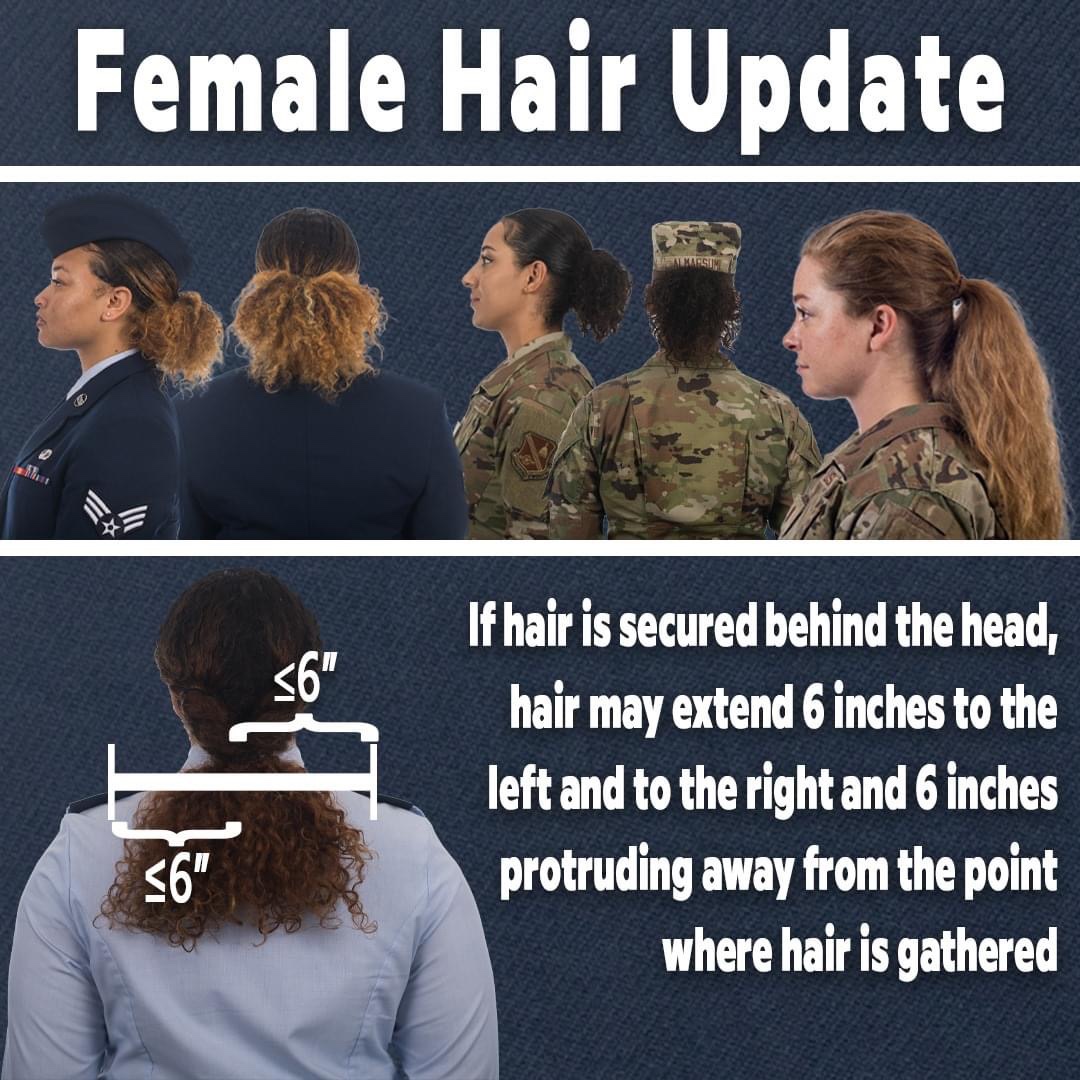
As an outcome of the 101st Air Force uniform board, Air Force women will be able to wear their hair in up to two braids or a single ponytail with bulk not exceeding the width of the head and length not extending below a horizontal line running between the top of each sleeve inseam at the under arm through the shoulder blades. In addition, women’s bangs may now touch their eyebrows, but not cover their eyes.

These new changes will be effective upon publication of the new standards in Air Force Instruction 36-2903 in February.
“As I outlined in Action Order A: Airmen, this decision is a commitment to supporting the Airmen We Need and sustaining the culture and environment of excellence that will continue to make the Air Force an attractive career choice for Airmen and families,” said Air Force Chief of Staff Gen. Charles Q. Brown, Jr. “I’m thankful for the feedback and research conducted from a number of women leaders, the Women’s Initiative Team, the Air Force uniform board, and our joint teammates.”
The Air Force uniform board convened virtually in November 2020 to discuss ideas sourced from Airmen across the Air Force who participated in a dress and appearance crowdsourcing campaign. Participants on the board included 19 diverse Airmen of various ranks from across the major commands and headquarters directorates.
The board reviewed all ideas including a recommendation from the Air Force’s Women’s Initiative Team. Thousands of women across the Air Force provided feedback to the Women’s Initiative Team, stating constraints to hair grooming standards resulted in damage to hair, migraines and in some cases, hair loss. The detailed work done by the Women’s Initiative Team to research and support the recommendation was greatly appreciated by the uniform board.
“In addition to the health concerns we have for our Airmen, not all women have the same hair type, and our hair standards should reflect our diverse force,” said Chief Master Sergeant of the Air Force JoAnne S. Bass. “I am pleased we could make this important change for our women service members.”
In addition to addressing issues associated with personal health and hair loss, adjusting female hair standards supports ongoing efforts to address diversity and inclusion in the ranks. Earlier this year and in her role leading the Defense Department’s Diversity Board, then-Secretary of the Air Force Barbara M. Barrett played a prominent role in supporting these types of adjustments to ensure a more inclusive culture in the services.
The Air Force chief of staff approved the policy after considering feedback from the force, the uniform board recommendation, and the professional image and standards of the Air Force and U.S. military.
“We remain committed to removing barriers to service,” said Lt. Gen. Brian Kelly, Air Force deputy chief of staff for manpower, personnel and services. “In an all-volunteer force, we want fully qualified volunteers who are representative of the nation to see us as a great opportunity to maximize their talent and serve.”
Members must adhere to current occupational safety, fire and health guidance, and mishap prevention procedures emphasizing when and how to mitigate the potential for injury from hair of varying lengths around machinery, equipment, power transmission apparatus or moving parts. Airmen are encouraged to reach out to their safety office for assistance in analyzing any potential hazards, as applicable.
Another idea considered by the board related to beard wear for men. Unlike with women’s hair standards, there are no known health or hair loss issues associated with current male grooming standard compliance. As such, the Air Force plans to continue under the current male grooming standards without adjustments. Beards are currently permitted in conjunction with medical exceptions such as shaving waivers or for approved religious accommodations.
At this time, Guardians will adhere to the female grooming standards of the Air Force. Eventually, the U.S. Space Force will develop its own policy.
Numerous other ideas from the board are still under consideration for implementation and will be released in the future. For more information, consult AFI 36-2903 Dress and Appearance.
Secretary of the Air Force Public Affairs