Leaders practice leadership constantly, but rarely – if ever – come close to mastering it. Practicing good leadership is always hard. To be successful, leaders have to strive to be harder…and smarter. I have not always been good, and I certainly have not always been smart, but I always tried to do it right. The most challenging leadership position I ever had was as Commander of F Company, 1st Battalion, 1st Special Warfare Training Group at Camp Mackall, North Carolina, 2000-2001. I have spoken about that assignment several times before. To be sure, the actual job of managing two phases of the Special Forces Qualification Course (SFQC) was both personally and professionally rewarding. It was the single most satisfying assignment of my career.
On the other hand, the leadership and command climate of the 1st Training Battalion at the time left much to be desired and made some aspects of my job harder than it needed to be. I make no secret of my bias here. I consider myself the good guy in this story, and my Battalion Commander (BC) the bad guy. Performing my unit’s training mission was a joy; dealing with my boss was a constant frustration. I am sure he saw it differently then and likely still does to this day. He is free to tell his version. However, if his story is substantially different from what I am about to share, he will be a damn liar.
As I have mentioned before, by 2000, Special Forces were in a statistical death spiral. In better times, we had become a Branch, stood up the 1st SFG, and started reactivating the 3rd SFG by 1990. Then, the Army went through a significant drawdown after Desert Storm. So, by 1993-94, our in-service recruiting pool was reduced almost by half. I saw the effects while I was commanding C/1/5th SFG, 1994-95. With few exceptions, the Group had ODAs with only 7-8 personnel assigned and even fewer on hand on a daily basis. The problem was getting worse as time went on. We were simply losing more people to ETS and retirement then we were graduating from the SFQC.
When I got to the Special Warfare Center and School (SWCS) in April 2000, the situation looked bleak. Some good initiatives did come out of this difficult period. The 18X-Ray Enlistment Option for example that let us dip into another pool of potential candidates. However, while that initiative was approved during my time at SWCS, it was almost two years later – well after my time – before any of those folks got through the pipeline. Other ideas were frankly harebrained. One Group Commander opined that the Army could be convinced by SF leadership to “levy” soldiers to attend our Selection Course (SFAS). Whether they wanted to go or not. He believed that at least some of those pressganged into attending would pass. I have no idea why he imagined that tactical units would voluntarily cull out their best and brightest – rather than take the opportunity to get rid of their shitbirds – to meet our needs rather than their own. Fortunately, that experiment was never attempted.
One of the unfortunate consequences of wrestling with this seemingly insurmountable problem was that the people actually in charge began to look around for someone else to blame. Much of that blame fell – unjustly – on the Cadre of the Training Companies. Since my company had two big pieces of the SFQC, we got our share of the blame and then some. In fact, when the new BC met my Cadre for the first time, his initial comment was “if you people were better NCOs we would have more people graduating from the course.” Fortunately, SF NCOs are not shy. One of my NCOs jumped up immediately and replied, “Sir, you don’t know what the F#@* you are talking about!”
I had only been there a couple of months myself but I had already seen my NCOs busting their rear ends trying to get salvageable borderline students across the finish line. After the BC had thrown his rhetorical grenade in the classroom, the situation only deteriorated. He got defensive, and the Cadre continued to push back – hard but professionally – on the additional points he tried to make. It was the most counter-production encounter I have even witnessed between a commander and troops. After only 3-4 minutes, the BC beat a hasty retreat. My SGM and I immediately buttonholed him and his CSM outside the building and unloaded on him as well. He left Camp Mackall and went back to the Battalion HQ at Fort Bragg. Believe you me, he left pissed at all of us – especially me – and he never got over it. As for myself, I could not have been more proud of my soldiers.
Do not get me wrong, the Cadre at the SFQC are not perfect. Some occasionally get into what we call the “protect the Tab” mode and add their own personal hoops for the candidates to jump through or invent their own standards. However, despite the pressure, most do an outstanding job class after class. In Ranger School – at least when I went through – the RIs rotated out every 24 hours or so. I would say that methodology is appropriate for that particular school. Of course, because of that constant change over, I do not remember any of the RIs except those I had served with in other units. Conversely, individual SFQC Cadre stay with the same student team throughout a phase. More akin to the way Drill Sergeants continuously instruct as well as model the behavior expected of their assigned charges. Similarly, just as soldiers remember their Drill Sergeants, an SFQC candidate will likely also remember his Cadre Team Sergeant’s example of quiet professionalism – good, bad, or otherwise.
The majority of the Cadre in my company routinely carried that heavy burden with pride, skill, and style. Moreover, they did it day after day without complaint. However, they were not inclined to be unfairly critiqued by anyone not shouldering that same rucksack. I had overlapped with the BC in 3rd Group. He commanded A/3/3 and, toward the end of my tour, became XO of 1/3 while I was commanding A/1/3; but I had not had enough personal contact to form a professional opinion of him. Still, the BC’s intensely negative attitude towards the Cadre was hard to understand. He had been an NCO in the Air Force as a SERE instructor; shifted to the Army and been an 18C (SF Engineer), in 7th Group; then a Signal Officer, also in 7th Group; before going through the 18A (SF Officer) course. I have to assume that in one or both of his SFQC experiences the Cadre at the time had inflicted damage to his sensibilities in some fashion.
He definitely held a grudge. Whenever he met with students – mine or those of the other companies in the battalion – he always asked first if they had any complaints about their cadre or had they witnessed any cadre misconduct. He made it abundantly clear that he did not trust us and, in turn, we knew not to trust him. Since he was some 35 miles away from me at Bragg, I had to deal with him far less than some of the other company commanders based across the street from him. When he did come out to see me or the other two companies (SFAS and SERE) at Mackall, he always came out unannounced – specifically, as he self-righteously told me to my face more than once – to catch us doing “something wrong.”
Normally, given that he was only one-year group ahead of me and we had served together as Majors, one would expect our professional – if not personal – relationship to be cordial and near-peer. Indeed, I was the senior Major in the Training Group at the time. However, he took every opportunity to emphasize that he was a Lieutenant Colonel (LTC) and the boss and I was just a Major and his subordinate. True enough, but irrelevant to my mission, so I mostly tried to ignore him. One of the idiosyncrasies of working at a schoolhouse is that you do not have a unit produced Training Schedule that is subject to change at a moment’s notice. Instead, Cadre execute a Program of Instruction (POI) that has to be followed with little deviation. It also meant that resources like money, aircraft, and other transportation assets were pre-allocated two years out. Therefore, I had no requirement or need to ask battalion or Training Group for anything additional.
The BC seemed to have trouble understanding that reality. For example, he slipped onto the Camp one afternoon and started shutting down training. We were in the middle of teaching the Military Decision Making Process (MDMP) in the student team rooms. In those days, the students lived and did most academic training and planning is some pre-fabricated sheds. Those sheds had been used and abused when I went through in 1990-91. By 2000, they were in bad shape. In fact, SWCS had cut off funding for anything but emergency maintenance and the buildings were already scheduled for demolition and replacement within a couple of years. He went into one of the rooms, was dissatisfied with the neatness of the student team’s gear and ordered a GI Party. He was in the process of doing the same in all the other team rooms when I caught up with him.
He started to chew my ass about how the team rooms were pigsties and it was my fault. He then demanded that I put one hour of barracks maintenance every day on the schedule. He added that he expected me to personally inspect each barracks daily to ensure a high standard of cleanliness. I told him no. I explained that the buildings were at the very end of their lifecycle. I also said I cannot change the POI, and neither can you. Every hour of the day and night is allocated to specific tasks. Right now, we are doing MDMP. For many of the NCOs and even some of the officers, it is the first time they have seen anything above a Patrol Order. They are graded on this task. If we fail, they will be recycled or dropped. Nowhere in the POI does it require me to run an NCO Academy or conduct white glove inspections. If you can get the Proponency – ultimately the CG – at SWCS to add barracks inspections I will start doing them. I also mentioned that it would take about two years before any such change would take effect.
I am not sure how much of what I said got through. He just looked at me and said, “So you are refusing my order?” I replied with more composure than I felt, “Sir, I have explained to you why I cannot follow that order.” He stormed off. I then when around all the team rooms, stopped the GI Party and got the students and Cadre refocused on their actual mission. The next day, the BC came back and gave me a Letter of Reprimand for “disobeying” his order. I took it and moved on. The funny thing is, I do not think he cared about the barracks issue. He certainly never checked again. I knew he was not going to pursue the asinine idea of scheduling barracks maintenance with the CG. I eventually came to think that he just wanted to pull my chain – just to remind me that he could.
It became a regular thing. About a month later, during Robin Sage, he came out to see a student team. The team we chose to show him was having some problems. We made a point of trying to build student teams that were balanced in terms of skill sets and prior experience. We intentionally avoided creating teams of just studs or duds. However, despite our best effort, every cycle saw one or two teams that just did not “gel” the way we would hope. One of the ways we would “reset” a team like that would be to have the OPFOR force them out of their G-Base and require them to move to another. It was a wakeup call and usually helped the students regain their footing and refocus on the mission. I explained all of that to the BC before we got there.
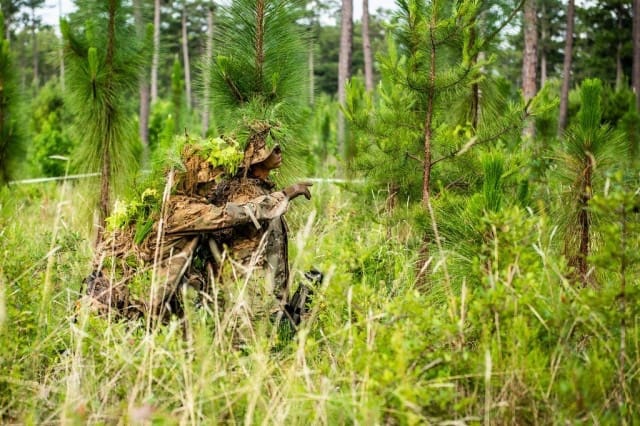
Robin Sage is not like most Army training. It requires the students to respond to the dilemmas they encounter in fictitious Pineland. Many of those challenges are entirely unscripted and others are of the students’ own making based on how they respond or fail to respond. It is, of course, an artificial environment but great effort is made to help the students suspend their disbelief and react as if the situations are real and deadly serious. To do that, we always kept visitors to a bare minimum. When visitors did come out, we asked them to come in civilian clothes rather than uniforms. The BC insisted that he and his CSM would be in BDUs. I asked him to at least take off his top and put on a cadre shirt and ballcap. The BC would have none of that. I noted, that he took some glee in saying no – I surmised because the suggestion had come from me.
It was mid-morning when we got to the new G-Base. The student team and their role-playing guerrillas had literally just gotten there less than an hour earlier. They had been on the run for about 40 hours and were still establishing their security. The BC eschewed going around the perimeter to meet the soldiers individually as they busied themselves with their priorities of work – as they had been taught. Instead, he yelled out for them to stop what they were doing and gather around him. He introduced himself as the BC and asked them how they were being treated by the Cadre – pointing to me and my NCOs. He did not ask any questions about their training. I had to stifle a chuckle. Given that the students knew that we were unsatisfied with their performance as a team up to that point, I was sure they thought the BC’s visit was just another Pineland dilemma for them to solve. They stood silently until the BC was done; and as he turned to leave, they went back to work. As a side note, that team did much better during the rest of Robin Sage and most graduated.
I thought that was it. I told myself that the damage was minor and I should be grateful for that. However, when we left the woodline the BC started to chew my ass. He was especially angry that the students were unshaven. I reminded him that they had been moving, sometimes under OPFOR pressure, for two days. He said that was no excuse. He declared that since I knew that my BC was coming out to “inspect” training that I should have had the students “go admin” to shave, clean themselves up, and be standing in formation – ready for inspection – when he got there. It was very bizarre. Afterward, he gave me another Letter of Reprimand for “students not clean-shaven.” I put it with the first one.
That became the pattern. About once a class, he would come out and bitch about something. From time to time, he would find some similarly absurd reason to reprimand me. It was a running joke in the company that I was going to need a bigger file cabinet for all those letters. Toward the end of the year, my company was awarded an Army Superior Unit Award. There was no award ceremony and the BC never mentioned it. As I said earlier, most of the time I forgot all about him. Our classes at Mackall were back to back to back. There was not much time to dwell on nonsense. After a while, when he realized I was not giving him much satisfaction he stopped coming out much at all. The companies at Bragg were not so lucky and I felt sorry for them but relieved nonetheless.
In early 2000, my fist LTC Board was coming up. I had about seven months with the BC at that point and might normally get a Complete the Record Officer Evaluation Report (OER) for the Board. Of course, that was only truly helpful if one was going to get a “top block” rating on that evaluation. Since I had no doubt that the BC did not consider me top block material I knew that was not going to happen. After all, I already had six formal Reprimands from the guy; not to mention countless ass chewing for various lesser “unprofessional” offenses in his eyes. In early March, I got a message to meet him at the Training Group Commander’s office. I had not seen the BC in a couple of weeks and rarely had reason to see the Group Commander (GC). I assumed that the BC had decided to take his animosity toward me to the next level and that this was going to be unpleasant.
I was wrong. When I got there the GC was friendly, calling me by my first name and inviting me in. I went into the office and saw the BC was already sitting there. The GC sat at his desk and informed me that the BC had recommended me for a top block OER. I was stunned and remained mostly silent – as did the BC. Once the GC, BC, and I signed the OER, his secretary took it for submission. The write-ups in the OER were exceptionally flattering. Apparently, everyone in my chain of command agreed, I walked on water and was the best of the best. I knew almost instantly it was a trap – or more precisely a bribe. The BC had decided that if I could not be intimidated, perhaps I could be bought.
What I did not understand immediately is why the BC went to the trouble. However, he wasted little time in letting me know that I “owed him one.” He had something specific in mind that he wanted from me in payback. The manning challenges that I mentioned the Groups were having also directly affected the Training Group. I never had more than two-thirds of the Cadre I was supposed to have. For some events like Robin Sage, we got some “guest cadre” from the Groups. The Groups wanted that tasker to go away but did not want to lose any more people to a full SWCS tour either. Someone, I do not who, came up with the idea of expanding the guest cadre program significantly in order to sharply reduce the number of assigned instructors. The trouble with that idea is that just because someone graduated from SFQC it does not follow that they can teach the course to standard without additional preparation. Graduating college does not make one a professor, getting jump wings does not make one qualified to be a Black Hat at Airborne School.
To get newly assigned Cadre ready to solo a class we used what was called the Shadow Program. It was a fairly informal process. A new guy would be partnered up with an old hand and stick with him through one class cycle. To refresh some technical skills, like land navigation, we would take them out to the STAR course and run them through separate from the students. Likewise a myriad of Small unit tactics, Unconventional Warfare techniques, etc. needed to be reintroduced. Depending on the Group they had come from and where and how often they had deployed, invariably some of those skills would have atrophied. Except for the guys shadowing, we seldom had more than one Cadre NCO for each student team. They had to be ready to teach and then evaluate the students’ performance in all those tasks by themselves. Shadowing also allowed us to evaluate that new NCO. Again, not everyone who graduates the SFQC is suited to teach at the school.
Sometimes we would get a guy on a second SWCS tour and we could shorten the timeline but that did not happen often. This idea of handing students to guest cadre with little or no preparation had been rattling around SWCS for a couple of months. I was dead set against it for all the reasons I just mentioned. I had reminded people that four Ranger students had died in 1995 in part because some of the RIs that night were not well versed in the School’s safety protocols. Therefore, I also saw it as a safety issue. Moreover, by this time I knew that my most experienced NCOs were also the guys most capable of getting student stragglers over that finish line. Inexperienced, temporary cadre would not have those skills. I thought the idea had been shelved as unworkable but my BC had decided to resurrect it. More accurately, he was tasking me to make it work.
I believe, and have often argued, that soldiers are obliged to execute legal orders – no matter how much they might personally disagree with those orders. Certainly, there can be exceptions; however, I am convinced it is a sound principle to follow barring extraordinary circumstances. So, I now had my marching orders – and they were not illegal. I gathered my Cadre, told them of my concerns but asked that we all withhold judgment until we had done legitimate mission analysis. I put the two committees to work separately and we broke down the tasks involved, the time required, mitigation strategies, and potential areas to accept risk. It was good sound work and the two teams came up with a tailored range of options. It became clear that if we had the guest cadre for enough time – the length of a class plus 3 weeks prior prep time (~10 weeks total) – we could get the job done. However, to work it also required consolidating the majority of classroom training and the result was a far more centralized process then had ever been used in the SFQC before. Bottom line: all of the Courses of Action we developed were clearly sub-optimum compared to the status quo – but not impossible. I admit I had hoped my teams would find a more obvious fatal flaw to kill the idea forever.
Nevertheless, I still expected that when I briefed the plan to the SWCS leadership and told them that the juice was not even close to being worth the squeeze they would agree to abandon the idea. I took our analysis to the BC and he went ballistic. He demanded that we redo the briefings to only highlight how we would make it work and emphasize that we saw no significant downsides. Moreover, he declared that the guess cadre would only arrive the week prior to a class starting. My company would produce and provide those guests with “cheat sheets” or a “smart booklet” that they could self-study and familiarize themselves with over a weekend! I told him he was out of his mind, that would be a lie, and I was not going to brief any such thing. I reminded him that he had a staff and he could do his own mission analysis and if he believed that bullshit he could brief it himself. He said, “no, you are going to brief it just the way I told you. Come back to me in two days with a new briefing.”
He had actually done me a favor and I am sure he did not even realize it at the time. He had just ordered me to lie to SWCS leadership – and that was an illegal order that I had no intention of following. I spent the next day visiting the SWCS Staff Judge Advocate (SJA) and Inspector General (IG). They shrugged off my illegal order premise and basically said it is not illegal or against regulations for your commander to be an asshole. I was not going to get any help from the system. That evening I went to see the SWCS CG. I had not had much contact with him but found out quickly that he was no fan of mine. Apparently, the BC had told him I was against any and all change in the SFQC and that he had reprimanded me more than once and had taken me under his wing in hopes I would become more of a team player. I tried to steer the conversation in a more fact-based direction but it was no use. He shook my hand on the way out. No help there.
The next day my SGM and I drove together to Bragg. He had been a great partner throughout all of the nonsense and I always counted on his honest feedback. He said, “Sir, it looks like you are just going to have to give them what they want. The guys will understand.” And there it was. He had just given me an opening to wiggle out of full responsibility with a relatively clean conscience by claiming, “Their fault not mine.” It was a rare moment of perfect clarity for me. I had seen it coming and knew what I had to do. I had no choice. We met the BC in his conference room with his staff present. I pushed the same briefings toward him that he had already seen. I told him that this is all we can do and this is what I intend to brief – including all the downsides. He threw the briefings in my face and started to storm out. In order not to drag this on, I will just say there were raised voices, chair banging, and red faces involved and I gave as good as I got.
When it was over I had been relieved. The BC also ordered me not to go back to Camp Mackall. He was afraid that I would foment some kind of insurgency. I probably could have. Instead, my two Cadre teams met me separately that day outside of the camp. I told all of them how sorry I was to have failed them. I cried more than once that day. I teared up writing it down just now. There is an upside to being publicly cashiered. I got to see who my real friends were. I was highly radioactive for some time. Men I had known for years would not return my calls. Thankfully, others still did. My BC had been a little too clever when he arranged that top block OER. It was clearly suspicious to write me up as a stud in March and then claim that I had “engaged in a [unspecified] pattern of misconduct” among other things a few weeks later.
SWCS unintentionally helped me as well. I requested an investigation in writing and they denied my request. If you have been in the Army you know they open an investigation if there is toilet paper missing from the latrine. That certainly looked like they were hiding something. Someone – the BC I presume – started a rumor that I had a nervous breakdown from the pressure of the job. The SWCS SJA came to me and counseled that I was “lucky” because they could have charged me under the UCMJ. I told him he was full of shit. They had used an administrative process to remove me from command precisely because that puts all the onus on me to prove my innocence. If they charged me with a crime that meant a court-marshal, they would have to provide enough proof to convict me, and I would have a defense lawyer and the opportunity to provide evidence and witnesses of my own. SWCS did not want that. They wanted me to go quietly. That is also why SWCS did not attempt to pull my SF Tab or my TS Clearance despite my alleged heinous crimes against good order and discipline.
Later, I provided evidence of what actually happened to the Training Group Commander and he ended up writing a letter in my support. I consider him one of the good guys and a friend. Up front, I framed this as a story of good guys and bad guys with me in the lead good guy role. But, I am not the hero of this story. The heroes are those SFQC Cadre NCOs who did all the work successfully training, assessing, teaching, coaching, and mentoring, every emergent SF Candidate seeking to earn their Green Berets. Since then, I have asked myself many times if there was not a better way to work through the situation I found myself in. Perhaps a series of different decisions that might have led to a more positive outcome? Yes, I believe there probably was a better way. I still have not figured out what that might have been; but I am certain that a smarter leader, with more talent than I, would have done it differently. No doubt.
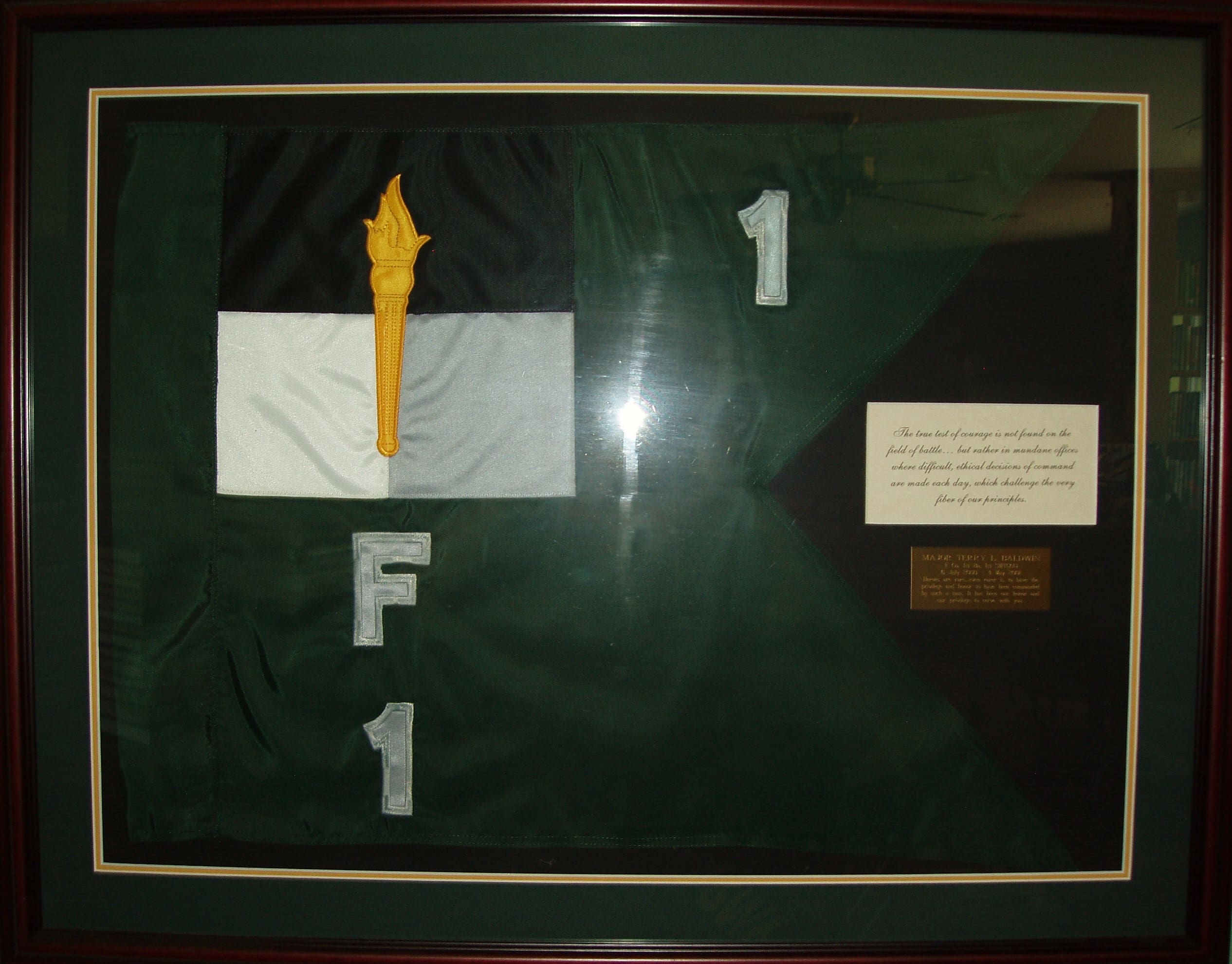
I said I believe in following legal orders. That does not mean a leader has any obligation to underwrite someone else’s bad choices. Instead, be honest with your soldiers. Tell them it is not your cockamamie idea but if anyone can make chicken salad out of this chicken shit we can. Do not let anyone barter your reputation, credibility, and integrity, as cover for his or her bad decisions. Make whoever actually made the decision own it. Good leaders will always do that anyway. Bad leaders do not deserve your loyalty, your soldiers do. Finally, I draw your attention to the attached picture. It is a framed guidon from F Company. Typically, a commander who is relieved would not receive a guidon. I did. It was presented at a clandestine ceremony the Cadre invited me to at Camp Mackall about three weeks after I was fired and forbidden to return. I consider it living proof that I must have been doing something right. It is my most prized memento and the highest award for service I ever received. De Oppress Liber.
LTC Terry Baldwin, US Army (Ret) served on active duty from 1975-2011 in various Infantry and Special Forces assignments. SSD is blessed to have him as both reader and contributor.