SIG SAUER - Never Settle

Archive for the ‘Robotics’ Category

SOFWERX – Semi-autonomous Precision Robotic Application Industry Demonstration Day

Tuesday, February 8th, 2022

SOFWERX, in collaboration with USSOCOM J5 (Strategy, Plans, and Policy), the joint Accelerator for Innovative Minds (AIM), and US Army Combat Capabilities Development Command (DEVCOM) Chemical Biological Center (CBC), will host an Industry Demonstration Day 29-30 March 2022 to explore Commercial Off-The-Shelf (COTS) and Independent Research and Development (IR&D) technology applications with the potential to inform the concept of a semi-autonomous robotic spraying capability.

This effort will also include a discussion of related attributes and known limitations. Features to be demonstrated include the ability to spray a layer of paint from predesignated point to point, to map the area to be painted, painting of elevated surfaces, painting equal to or faster than humans, with a user friendly remote work station, and the capability to store mission information. Topics to be discussed include future challenges and human factors engineering.

RSVP NLT 01 March 2022 11:59 PM ET to participate.

Get full details at events.sofwerx.org/spra.

Robot Dogs Take Another Step Towards Deployment at the Border

Tuesday, February 8th, 2022

The American Southwest is a region that blends a harsh landscape, temperature extremes and various other non-environmental threats that can create dangerous obstacles for those who patrol the border. The territory is vast and monitoring it is critical to our nation’s security. That’s why the Science and Technology Directorate (S&T) is offering U.S. Customs and Border Protection (CBP) a helping hand (or “paw”) with new technology that can assist with enhancing the capabilities of CBP personnel, while simultaneously increasing their safety downrange.

S&T has a deep understanding of CBP’s technology needs in the field. In its role as the research and development arm of the Department of Homeland Security (DHS), S&T is always identifying solutions to support the complex CBP mission. For instance, S&T is currently supplementing CBP’s bipedal human personnel with quadruped mechanical reinforcements to help the agency better allocate resources. In this case, Man’s best friend comes with a very futuristic twist.

“The southern border can be an inhospitable place for man and beast, and that is exactly why a machine may excel there,” said S&T program manager, Brenda Long. “This S&T-led initiative focuses on Automated Ground Surveillance Vehicles, or what we call ‘AGSVs.’ Essentially, the AGSV program is all about…robot dogs.” 


A robot dog showing off capabilities during testing in Lorton, Virginia.

The goal of the program is to leverage technology to force-multiply the CBP presence, as well as reduce human exposure to life-threatening hazards.

Early on, CBP voiced interest in a four-legged ground drone solution, and Long was more than happy to get to work on it. S&T’s AGSV Program collaborated with Ghost Robotics, an industry partner that develops advanced AGSV systems, to achieve the objective. When Ghost Robotics was brought into the fold, they saw an opportunity to re-engineer a version of their pre-existing robot dog for the multifaceted CBP mission.  

According to Gavin Kenneally, the chief product officer at Ghost Robotics, their 100-pound robot dog was bred for exactly the type of work that CBP needs done, “It is a rugged, quadruped robot. It traverses all types of natural terrain including sand, rocks, and hills, as well as human-built environments, like stairs. That’s why you want legs, and not tracks.”

Downrange, the Danger to CBP Agents and Officers Is Very Real

Due to the demands of the region, adding quadruped mechanical reinforcements is a smart use of resources. Despite the dangers, and maybe even using them as cover, there are many types of illegal activity that happen in the harsh border zones.

“Just like anywhere else, you have your standard criminal behavior, but along the border you can also have human smuggling, drug smuggling, as well as smuggling of other contraband—including firearms or even potentially, WMD,” explained Agent Brett Becker of the CBP Innovation Team (INVNT). “These activities can be conducted by anyone from just a lone individual, all the way up to transnational criminal organizations, terrorists or hostile governments—and everything in between.”


A robot dog operating alongside ATVs in the southwest U.S. Photo: Courtesy Ghost Robotics.

Becker elaborated on the perils by adding, “Operating out in the desert or mountains, agents and officers have to contend with the rugged terrain, high heat and humidity, and then, of course, they can come across those who wish to do harm. But there are plenty of risks closer to home, too. For instance, when missions take Border Patrol Tactical Operators into towns, cities, or ports, they can encounter hazardous environmental conditions, volatile individuals, or hostile threats. These situations can all be inherently dangerous.”

The challenges that CBP faces are not lost on Long, “A big part of our job here at S&T is to understand the current operational needs of our DHS components and find innovative technologies to support them. We are keenly aware that the CBP mission is broad and the risks to personnel are many, and that’s why S&T’s work to fill capability gaps is so critical. And that’s specifically why we think that the robot dog solution is such a great fit.”

S&T Knows That Teamwork Makes the Machine Work

S&T has been working with CBP, Ghost Robotics, and the team for about two and a half years on specifications, development, and capability testing. This collaboration has yielded important CBP mission-focused advancements to the AGSV platform.

For S&T, building and managing partnerships (both interagency and public/private) is an integral part of executing its mission. S&T also understands that good communication is essential in any relationship, and that’s especially true when it comes to its valued partners.

“After talking with our partners at CBP INVNT, we built a team, and together, we identified the capability gaps, defined the challenges, and developed criteria and testing simulations called ‘use-case exercises.’ Then, having set the bar of expectation for the technology, we communicated all of that to our performer,” said Long.


A video camera or sensor package (known as a “payload”) can be attached to a robot dog. Photo: Courtesy Ghost Robotics.

Before moving into the use-case exercise phase, the robot dogs first went to a facility in Lorton, Virginia, for the “initial payload integration” phase. The so-called “payloads” are video and other sensor packages that, after being mounted onto the robot dog, can transmit real-time video and other data back to the human operating or monitoring the AGSV. The team assessed the ease and integration of loading different payload cameras, sensors, and radios onto the AGSVs, and then tested their ability to be controlled from a laptop or a handheld remote. Movement on asphalt, grass, and hills was also evaluated.


A robot dog practices climbing up and down grassy hills.

Having successfully passed the milestones in Lorton, things moved to El Paso, Texas, for advanced testing and evaluation.

S&T Capability Assessments Determine if the Programmable Pooches Are Up to the Task

A robot dog on maneuvers, traversing a rugged landscape in the desert southwest.
Along the border, the challenges ramped up as the use-case exercises began. This phase assessed the capabilities of the robot dogs in realistic scenarios.

Long’s team worked with the U.S. Army’s Night Vision and Electronic Sensors Directorate (NVESD) and Ghost Robotics to ensure the robot dogs were prepared to engage in a diverse set of evaluation tasks. The El Paso use-case exercises would require the ability to maneuver in harsh environments, operate in tight spaces and be unphased by high heat, as well as low oxygen conditions—situations that are especially dangerous for CBP agents and officers.

“In a nutshell, the robot dogs would need to (figuratively) jump through a lot of hoops and show a significant amount of mission adaptability,” noted Long.

In an example of the platform’s desired flexibility, Ghost Robotics designed their payload capabilities as an open system. The benefit there is that it makes it easier to integrate different types of cameras (360-degree, thermal, night vision, zoom, etc.) and sensors (chemical, biological, radiological, nuclear, etc.) onto the robots. Once mounted, the payload is plugged into the high-performance CPU that runs the AGSV. During use, the AGSV maintains a connection to the operator via standard frequencies, such as radio, Wi-Fi, GPS, or other means. 

To ensure that the AGSVs could deliver as promised, they were tested by walking up hills, down ravines, and over rocks, all while carrying 20-pounds worth of payload.

A robot dog scans a desert landscape with its camera and sensor while on sentry duty.
Then, the testing transitioned to an indoor training facility that was built to replicate a residential building. There, the robot dogs would encounter a scenario that simulated being met by potentially hostile individuals. Set to the operator driven mode and using the wireless connection, the operator would maneuver the AGSVs to enter the structure, move through hallways, and peer around corners, as well as navigate stairs.

Later, in a desert area, the dogs were programed to go on simulated sentry duty. Under this autonomous mode setting, the AGSVs headed out and made turns when they reached pre-determined GPS waypoints. After completing their circuit, they returned to base. This was done in the daylight, as well as at night.

Additional testing included putting the dogs through the paces of simulated inspections outside, inside, and under train cars at railyards.

Endurance testing was also an important part of the overall exercises. Data was collected on battery life and impact of terrain on that endurance.  Fortunately, when the Ghost Robotics team was working on its robot dog for CBP, the team focused a lot of energy on motor efficiency. Their objective was to ensure the battery-powered pooch could complete longer missions with the maximum payload onboard. They also designed their AGSV to be extremely nimble.

A robot dog inspects a railyard at night.
Kenneally says that their robot dog’s legs are so advanced and sensitive that, “It has the ability to feel through its motors and can estimate friction forces and automatically correct for uneven or slippery ground.” This self-correcting ability makes it an ideal platform for off-road operations across multiple environments.

Some of the other mechanisms the team evaluated were basic field maintenance and repair, such as the ease of swapping out worn “paw” treads.

Valuable information was compiled from each of the exercises. Long explained the process, “When industry develops a prototype, we (along with our partners in the field) evaluate the new technology and give feedback to the developer. That way, the next iteration of the tech accomplishes what we need it to do—and thus fills the capability gap we are targeting.” The benefit to industry is that the performers can potentially position themselves to be even more useful to CBP in the future, when the prototypes become commercial products available for procurement.

S&T Is Committed to Addressing Capability Gaps

Overseeing programs to develop and test robot dogs in real-world scenarios is a great example of how S&T is dedicated to bringing the most innovative advancements to its DHS components.

Long demystified the AGSV program by saying “Technology such as semi-autonomous drones (air, ground, and even water) are used effectively as force multipliers elsewhere—and robot dogs are no different.”


Robot dogs could fill important capability gaps and assist in the DHS mission. Photo: Courtesy Ghost Robotics.

In the future, could metallic beasts of burden shoulder some of the physically taxing and dangerous operational work to become a CBP agent or officer’s best friend?

After the successful completion of the use-case scenarios (that confirmed real-world capabilities) the robot dog work will continue with S&T leading the way. So, don’t be surprised if in the future we see robot “Fido” out in the field, walking side-by-side with CBP personnel.


Potentially a new best friend for CBP personnel in the field.

Milrem Robotics Awarded Contract to Support the Development of the Italian Army’s Robotics Program

Sunday, January 16th, 2022

The NATO Support and Procurement Agency (NSPA) awarded the European leading robotics and autonomous systems (RAS) developer and system integrator Milrem Robotics a contract to provide RAS Concept Development and Experimentation (CD&E) Services to the Italian Army.

The scope of the multi-year campaign is to explore RAS technology in order to update the Italian army’s RAS strategy and outline an implementation roadmap for the introduction of unmanned systems and related technology into service.

Milrem Robotics will support the Italian army in developing a clear path to how RAS technology, systems and architectures can generate operational advantages and ground armed forces benefits when operating in urbanized environments.

“Milrem is proud to be selected as the partner for supporting the Italian Armed Forces in one of the most advanced and challenging RAS CD&E initiatives in the world. This program is well in line with our core competencies as a system integrator for autonomous and robotic technologies,” said Kuldar Väärsi, CEO of Milrem Robotics.

The Italian CD&E level of ambition is to exploit prototyping skills and technological capabilities to demonstrate future operational benefits and finally, to identify short to mid-term (5-15 years) transformational initiatives for the development of operational RAS capabilities.

The scope of the cooperation is to capture, analyse and deliver decision support data from all stages of the experimentation process, stemming from field activities, war-gaming, modelling and simulation, innovative technologies, etc., that will respond to the challenges set forth by the problem statement.

The deliverables of the contract include a Command and Control (C2) System, an autonomy engine, systems integration of 3rd party capabilities, several unmanned ground and air vehicles and a variety of sensors and effectors.

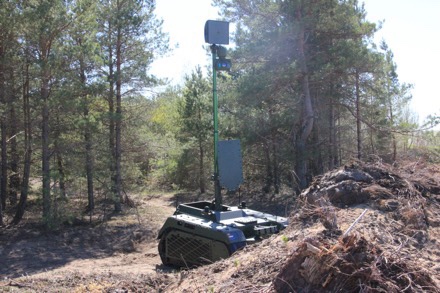
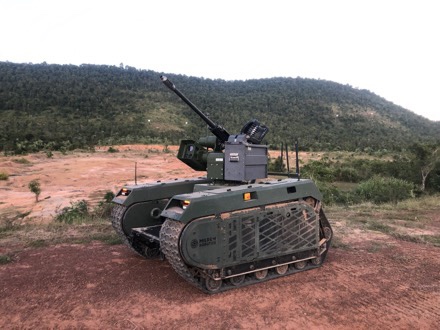
Milrem Robotics is the leading European robotics and autonomous systems developer and systems integrator. The company is known for its THeMIS and Multiscope Unmanned Ground Vehicles and the Type-X Robotic Combat Vehicle. The THeMIS supports dismounted troops while the Multiscope is intended for civilian use such as forestry and firefighting.  The Type-X Robotic Combat Vehicle is a wingman for mechanized units.

Milrem Robotics is the leader of a consortium that was recently awarded 30.6M (EUR) from the European Commission’s European Defence Industrial Development Programme (EDIDP) to develop a European standardized unmanned ground system (UGS).

During the project, titled iMUGS, modular and scalable architecture for hybrid manned-unmanned systems will be developed to standardize a European wide ecosystem.

Milrem Robotics Led iMUGS Consortium Demonstrates Deployment of Unmanned Systems

Friday, December 3rd, 2021

The iMUGS Consortium, in charge of a 32,6 MEUR project developing the European standard unmanned ground system (UGS), demonstrated how defence forces can use tactical 4G/5G communications networks and UGS’ equipped with ISR and signal intelligence payloads, jammers, acoustic sensors, and various other technology to conduct missions.

The demonstration that was performed in September in Latvia, was led by LMT, a member of the integrated Modular Unmanned Ground System (iMUGS) consortium, with the support of the project coordinator Milrem Robotics and featured an ensemble of different technology.

Latvian National Armed Forces used two Milrem Robotics’ THeMIS Unmanned Ground Vehicles (UGV) during two scenarios to display the benefits of teaming up manned units with unmanned systems.

One THeMIS UGV was equipped with an Intelligence, surveillance, and reconnaissance (ISR) payload, Signal Intelligence antenna (SIGINT) provided by The Electronic Communications Office of Latvia, Rheinmetall’s Rapid Obscuring System (ROSY) Smoke Grenade Launcher, Bittium’s Vehicular Software Defined Radios (Tough SDR Vehicular), and FN Herstal’s deFNder Light Remote Weapon Station (RWS). The RWS integration was part of the demonstration, but not of the iMUGS project itself.

The second THeMIS, used as a mule for transporting the squad’s equipment, was equipped with Rantelon’s Improvised Explosive Device (IED) Jammer and Bittium’s Tough SDR Vehicular.

The units and UGVs used Bittium’s tactical communication network TAC WIN combined with LMT’s commercial 4G and a tactical 5G-SA bubble provided by Bittium and Cumucore.

In addition, Krauss-Maffei Wegmann’s (KMW) Dingo infantry mobility vehicle was used as the command centre from where UGVs were operated in Line of Sight (LOS) and Beyond the Line of Sight (BLOS) mode using Bittium’s SDR radios and to where the ISR and Signal Intelligence sensor feed was relayed and incorporated into LMT’s Battle Management System Viedsargs.

“The displayed scenarios showed that unmanned systems, enhanced with innovative communication systems and various defence technology, can be used for collecting and sharing tactical information, improve situational awareness, decrease troops physical load, and increase force protection,” explained Kuldar Väärsi, CEO of Milrem Robotics.

”For the first time ever, in a special network, a tactical network was connected with a stand-alone 5G network. This allowed communication between units and robots, as well as collecting information from sensors and placing this information into LMT’s Battle Management System “Viedsargs”,” said Ingmars Pukis, Vice President and Member of the Management Board of LMT.

Additional equipment used in the demonstration included: SRC Brasa’s NATRIX UGV used for CASEVAC, high-speed First-Person View drone, Vertical Take-off, and Landing UAV STAR, and a gunshot detection and source recognition audio sensor by Riga Technical University (RTU).

The iMUGS project was launched in 2020 to develop a modular, cyber secure and scalable architecture for hybrid manned-unmanned systems. Its goal is to standardize a Europe-wide ecosystem for ground platforms, command, control and communication equipment, sensors, payloads, and algorithms. Addressed operational challenges include enhanced interoperability, increased situational awareness and faster decision-making.

The system will use an existing UGV – Milrem Robotics’ THeMIS – and a specific list of payloads.

The project’s progress is displayed during six demonstrations. „So far Milrem Robotics and LMT Innovations have set the bar very high. Which means we have some great things to wait for as the main results of the iMUGS projects are yet to be seen,“ said Martin Jõesaar from the Estonian Center for Defence Investments, the representative of the participating Member States in the iMUGS Project. The next demonstration will take place in Q1 of 2022 in Finland.

iMUGS is a cooperation between 13 parties: Milrem Robotics (project coordinator), Bittium, Diehl Defence, dotOcean, GMV Aerospace and Defence, Insta Advance, Krauss-Maffei Wegmann, Latvijas Mobilais Telefons (LMT), NEXTER Systems, Royal Military Academy of Belgium, Safran Electronics & Defense, Sol.One and Talgen Cybersecurity.

Watch the Demo 2 Scenarios here:

Milrem Robotics Opens Its Central European Office And Introduces Upgraded THeMIS UGV

Thursday, November 18th, 2021

The European leading robotics and autonomous systems provider Milrem Robotics opened its office in the Netherlands today making the first step towards creating a Central European Robotics Center. Simultaneously the company introduced its upgraded THeMIS unmanned ground vehicle (UGV).

One of the reasons the city of Best near Eindhoven was chosen as the location for Milrem Robotics’ Dutch office is to be closer to one of the company’s key customers – the Royal Dutch Army – and other relevant markets.

“The main reason, however, is our goal to establish a Central European Robotics Center where R&D, simulations, training, system integration and technical support are under one roof and where end-users can visit, but more importantly come to acquire knowledge for their own Robotics and Autonomous Systems development,” explained Kuldar Väärsi, CEO of Milrem Robotics.

“Our office is situated in the middle of the Brainport Eindhoven technology region and is well connected by a large European Airport, and by a broad road network to access the rest of Europe. This allows us to efficiently provide training and coaching to officers and NCOs in tactical basic operations with unmanned systems,” said Julien den Ouden, Managing Director of Milrem Robotics Netherlands. “We will offer the “Milrem experience” in a comprehensive package where the UGV is integrated with various other third-party systems,” den Ouden added.

At the opening ceremony, Milrem Robotics also introduced their upgraded THeMIS UGV that was specifically designed to accommodate all hardware, software and the flawless operation of MIFIK – Milrem’ Intelligent Functions Integration Kit. MIFIK features wired and wireless follow-me, waypoint navigation and obstacle detection and avoidance. Considerable upgrades were also done to THeMIS’ camera system and overall user experience.

Milrem Robotics Netherlands is the company’s fifth office in Europe. The company has two offices in Estonia, one in Sweden and one in Finland.

Milrem Robotics is the leading European robotics and autonomous systems developer and systems integrator. The company is known for its THeMIS and Multiscope Unmanned Ground Vehicles and the Type-X Robotic Combat Vehicle. The THeMIS supports dismounted troops while the Multiscope is intended for civilian use such as forestry and firefighting.  The Type-X Robotic Combat Vehicle is a wingman for mechanized units.

Milrem Robotics is the leader of a consortium that was awarded 30.6 MEUR from the European Commission’s European Defence Industrial Development Programme (EDIDP) to develop a European standardized unmanned ground system (UGS).

During the project, titled iMUGS, modular and scalable architecture for hybrid manned-unmanned systems will be developed to standardize a European wide ecosystem.

Project Origin Robotic Vehicles Join JRTC Rotation in Historic First

Monday, November 1st, 2021

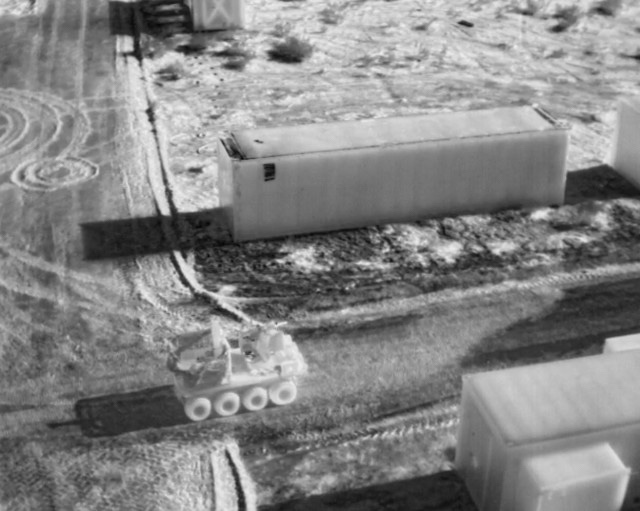
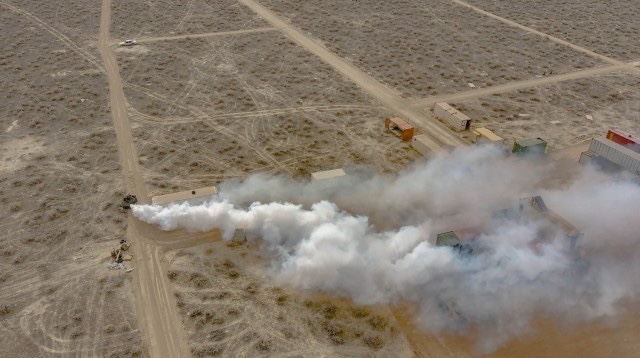
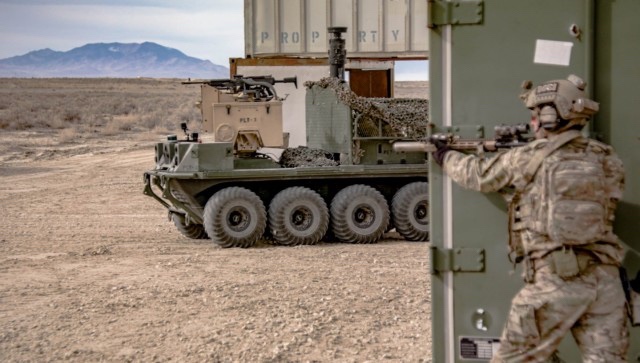
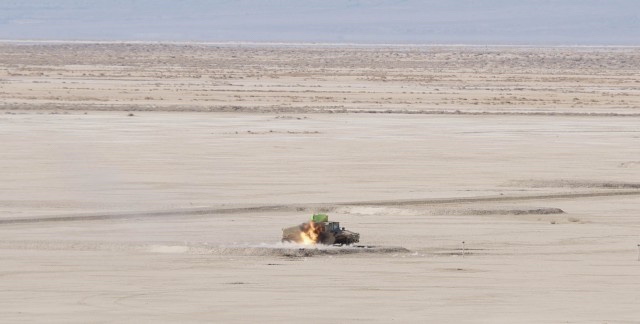
DETROIT — In an historic first, U.S. Army Soldiers integrated a Robotic Combat Vehicle (RCV) surrogate into the opposing force during a recent rotation at the Joint Readiness Training Center at Fort Polk, Louisiana, in September. This event enabled the Army to gain valuable insight in how best to utilize robotic vehicles in combat and furthered its ongoing Campaign of Learning around RCV development.

During the exercise, Soldiers from the 1st Battalion (Airborne), 509th Infantry — known as Geronimo — used two Project Origin vehicles (RCV surrogates) in a simulated battle with the 3/101st (Air Assault). The Origin vehicles are an Army Development Command (DEVCOM) Ground Vehicle Systems Center (GVSC) prototyping effort and provides the Army with the ability to conduct rapid technology and autonomous behavior integration that Soldiers assess during multiple touchpoints each year.

While on-site engineers and technicians collected technical data, the Soldiers in the field further validated the combat benefits of adding robots to a manned-unmanned teamed formation and identified new capabilities desired for the next Project Origin Soldier operational experiment.

“With these units, the human survivability rate increases significantly,” explained Sergeant First Class Eugene Lackey (Pathfinder Company). “This system allowed us to close with and destroy the enemy safely from a distance. It [also enabled] us to the find the enemy before he could find us. It is a great tool and I wish we could have it for little bit longer to really see how we can change the way wars are fought.”

The feedback from Geronimo Soldiers adds to the Army’s growing library of information on the use of robots.

“Project Origin’s key competency is its ability to collect Soldier feedback and technical data, use this information to rapidly iterate both its software and physical payloads, and evaluate the changes in relevant tactical environments,” said Todd Willert, Project Origin project manager at GVSC. “The lessons learned during Project Origin experiments directly support the development of the Robotic Combat Vehicle and the Army’s forthcoming Ground Autonomy Software, user interfaces (Warrior Machine Interface), and modular architectures.”

GVSC and the Army’s Next Generation Combat Vehicles Cross Functional team, both based at the Detroit Arsenal in Michigan, and the Army Capability Manager-Infantry Brigade Combat Team (ACM-I), based in Georgia, worked together to integrate the Project Origin platforms into the JRTC rotation.

“JRTC stressed the systems to their breaking points, allowing us to identify problems that would undoubtedly arise in the future,” said MAJ Cory Wallace, RCV lead for NGCV CFT.

During the exercise, the Soldiers and the robots also endured a tropical storm, further adding to its complexity.

Among the highlights of the exercise, the Geronimo force used the Project Origin platform to block a key intersection for 36 hours, an effort that benefitted from Origin’s low heat signature while conducting long hours of battery-powered “silent watch.” In addition, Geronimo used the project Origin vehicles to deny helicopter landing zones and conduct route reconnaissance. Using the robots to conduct these operations – the two platforms were controlled by four operators and an NCO – allowed the Soldiers who would have been assigned those tasks to be assigned different missions.

“This validated the notion that if we assign the dumb, dirty, dangerous missions to the robots, we can re-assign our Soldiers to the high-priority complex missions and tasks,” Wallace said.

The Army has additional Soldier Touchpoints, with Project Origin and other RCV platforms, scheduled throughout 2022 as it prepares to make future decisions on the potential acquisition of RCVs.

By Dan Heaton

Air Force Installation Contracting Center Acquisitions Bolster EOD Readiness for FY21, Beyond

Tuesday, October 26th, 2021

TYNDALL AIR FORCE BASE, Fla. (AFNS) —


EOD robot upgrade The Air Force Installation and Mission Support Center is acquiring new base support robots for Explosive Ordnance Disposal flights Department of the Air Force-wide. The new T7 Robotic system replaces the 20-year-old Andros F6A. (U.S. Air Force graphic by Greg Hand)

The success of implementing new explosive ordnance disposal technology in fiscal year 2021 has the Air Force Civil Engineer Center looking forward to FY22.

“Our Airmen conduct high-risk operations in support of the mission, and we ensure they have the tools and resources they need to perform their jobs safely, efficiently and effectively,” said Col. John Tryon, AFCEC Detachment 1 commander. “It’s our duty to identify civil engineering needs and advance Air Force capabilities through research, development, test and evaluation, and we take that very seriously.”

AFCEC’s Readiness Directorate partnered with the Air Force Installation Contracting Center to use more than $41 million for new EOD equipment, such as a new base support robot to clear unexploded ordnance from airfields, during the past year.

In July, the AFICC awarded an $85 million, 10-year, indefinite-delivery, indefinite-quantity contract for the T7 Robot System to replace the Andros F6A robot, which has been used by the Air Force for two decades. The T7 offers a suite of new and enhanced capabilities, including a more modular design that allows users to repair it by swapping subassemblies rather than individual parts — an issue that plagued the previous robot.

“This system will move robotics forward 20 years,” said Dennis Carson, EOD robot product manager. “It enhances warfighter readiness with its ability to resolve hazardous threats and missions remotely, allowing Airmen freedom of movement at any location.”

AFCEC will begin distributing the first of the T7s in May 2022 — 56 of the 170 inventory objective of T7s were funded at contract award. The remaining requirement will be purchased this fiscal year.

The T7 is the second of two new robotic systems AFCEC is upgrading for the EOD career field. A year ago, the directorate delivered the first of the Man Transportable Robot System Increment II to the 325th Civil Engineer and the 823rd Rapid Engineer Deployable Heavy Operational Repair Squadrons.

To date, the readiness directorate has distributed 129 MTRS IIs and provided system training to 49 EOD flights. The directorate expects to distribute the remaining 202 systems by January 2023.

The second wave of new technology deliveries took place in July when the AFCEC team debuted the Vidisco Guardian 12 Digital Radiographic X-ray system, a $27 million procurement package, at Eglin AFB, Florida, and Hill AFB, Utah.

“This new system is essentially everything old wrapped into a new package with the addition of digital technology enhancements,” said Dave Hodgson, EOD logistics lead for AFCEC. “Compared to the previous analog models, this new system gives Airmen clear and concise images, which reduces the amount of time they have to spend analyzing the images.” 

To date, the AFCEC team has distributed 36 X-ray systems, with the remaining 15 base support systems to be distributed in 2022 and mobility configurations through 2026.

Just as FY21 came to a close, AFICC awarded a $24 million contract for the Large Clearance Blade Assembly, or L-CBA. Attached to armored front-end loaders, the equipment is used for rapid clearance of unexploded ordnance from airfield surfaces after an attack.

Because it’s mounted to an armored front-end loader, the paired capability will dramatically reduce clearance times, Hodgson said.

AFCEC plans to begin blade deliveries to bases in the European and Pacific theaters and some training sites in mid-October. Full fielding will run through 2026. The contract enables the Air Force to obtain more than 70 large blades needed to support the Rapid Mass Mechanical Clearance program over the next several years.

The directorate also executed a Life Cycle Sustainment order for bomb suits. The suits are designed to protect EOD personnel responding to scenarios with potential explosives. The $2.2 million annual acquisition provides 76 suits to replace one-seventh of the current inventory.

“When EOD technicians have to make that long walk down range to manually perform procedures, this suit — the EOD 10E — provides the best possible protection if an explosion occurs,” Hodgson said.

Rounding out FY21 EOD funding executions, AFCEC’s EOD modernization program is seeing its work pay off as the Air Force prepares to take the next steps in bringing the Recovery of Airbases Denied By Ordnance, or RADBO, system to the Air Force EOD suite of tools.


EOD robot upgrade The Air Force Installation and Mission Support Center recently contracted for the delivery of new explosive ordnance disposal base support robots for the Department of the Air Force enterprise. This chart shows a comparison of the 20-year-old Andros F6A to the new T7 Robot System. (U.S. Air Force graphic by Greg Hand)

AFCEC funded a $3.9 million effort in FY21 to convert the state-of-the-art ground-based laser prototypes to the final production configuration. The system will be delivered to Nellis AFB, Nevada, in December to support career field training as well as tactics, techniques and procedures incorporating the RADBO system, L-CBA, the prototype design completion on the Small Clearance Blade Assembly and an unmanned system application for Rapid Explosive Hazard Mitigation and Rapid Airfield Damage Repair vehicles.

By David Ford, Air Force Installation and Mission Support Center Public Affairs

SOFWERX – USSOCOM Autonomous Interoperability Standards Development Event

Saturday, October 23rd, 2021

SOFWERX, in collaboration with USSOCOM’s Directorate of Science and Technology (S&T) and Naval Special Warfare (NSW), will host the Autonomous Interoperability Standards Development Event, 07-09 December, 2021. In the Human Machine Teaming Aspects of Mission command, the objective is to bring together Special Operations Forces (SOF) representatives and Subject Matter Experts (SMEs) to assist USSOCOM in discerning the future of Autonomous Interoperability for Unmanned Air, Ground, Surface, and Underwater Systems (UxS). Focus areas will include but are not limited to sensors, communications, and platforms.

NSW has developed a vision for the future whose key elements include next generation UxS and autonomy solutions, and interoperable maritime and air assets. To do this effectively, NSW needs interoperability standards for the heterogeneous UxS platforms that they will use now and in the future. USSOCOM thus needs to develop and implement a set of interoperability standards that are not cumbersome, that are flexible, and that will support new technologies. They will also need to provide enough freedom for companies to use their creative approaches but with well-defined interfaces, messaging, communications, navigation, and control systems. Further, the backing of NSW and USSOCOM should provide an incentive for commercial players to rally around the new standards. This effort will support agility, wider government and commercial participation and ensure cost-effective development.

This event is restricted to U.S Citizens Only.

Submit NLT 29 October 11:59 PM ET, details at events.sofwerx.org/interoperability.