FirstSpear

Archive for the ‘Robotics’ Category

Army, Academia Collaborate on Exoskeleton to Reduce Soldier Injuries

Thursday, September 1st, 2022

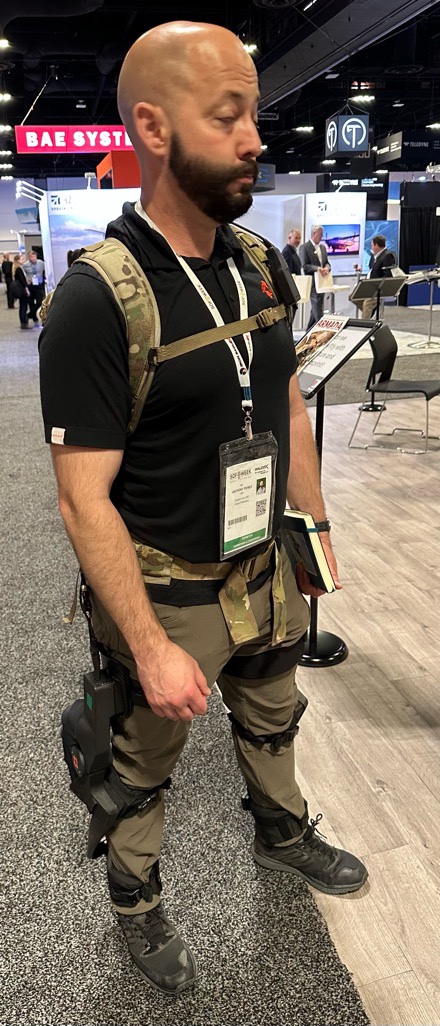
ABERDEEN PROVING GROUND, Md. — An unpowered exosuit designed to reduce the physical demands placed on Soldiers is one step closer to adoption after prototypes earned passing grades from more than 100 Soldiers at three Army posts.

According to the U.S. Army Public Health Center, low back injuries result in more than one million lost or limited duty days for Soldiers each year.

The Army’s Pathfinder program — led by a collaborative team of Soldiers from the 101st Airborne Division at Fort Campbell, Kentucky, and engineers at Vanderbilt University — brought about the design and testing of unique, exoskeleton prototypes to augment lifting capabilities and reduce back strain for sustainment and logistics operations.

The research and development of the soft, lightweight, unpowered exoskeleton, called the Soldier Assistive Bionic Exosuit for Resupply, or SABER, has moved from the Pathfinder team to the U.S. Army Combat Capabilities Development Command Soldier Center, or DEVCOM SC. The DEVCOM SC team is preparing the suit for manufacturing and robust field trial use by the Army.

The Pathfinder program is a congressional initiative to advance the Army Futures Command’s modernization goals and support the innovation of Soldier-inspired, research-based technologies like SABER. DEVCOM officials said they leverage the program to connect Soldiers with its global science and technology network, which ranges from fundamental research to advanced technology upgrades to already fielded equipment.

“By engaging Soldiers earlier in the research and development process, we are able to make them aware of emerging research and technologies that academia can provide to help meet their needs,” said Dr. Arwen DeCostanza, Pathfinder program manager. “Collaborative projects like this one, yield discoveries and future outcomes by capitalizing on the creativity of Soldiers, faculty, students, industry partners and the Army science and technology community.”

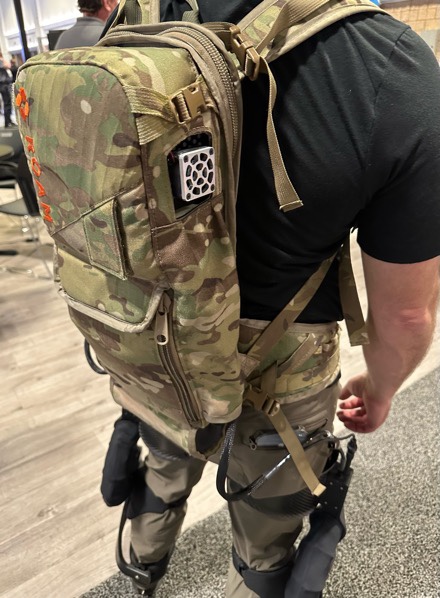
Working with Soldiers in the 101st Airborne Division, researchers at Vanderbilt designed SABER as a wearable device that is soft, lightweight and form fitting. This unmotorized device can be selectively engaged by the Soldier to assist lifting capabilities.

The exosuit design addresses needs identified by the Soldiers, such as aiding strenuous lifting tasks like ammunition resupply and reducing injury and fatigue, critical to readiness over sustained periods.

“We spent the first few months focused on interviewing, observing and spending time with Soldiers,” said Dr. Karl Zelik, associate professor of mechanical engineering, Vanderbilt University. “We didn’t try to create Iron Man — a complex, full-body, rigid, unrealistic suit. Instead, we started by deeply understanding Soldier needs to develop a lightweight, low-profile, non-powered wearable tool that helps provide much-needed assistance without slowing Soldiers down or interfering with other operational tasks.”

To develop the idea for this project, Vanderbilt engineers engaged Soldiers in frequent interviews, design sprints and field tests to identify critical problems hindering their daily duties in the field. Physical overexertion stood out as a problem in need of a rapid solution.

To address strength and endurance limitations associated with material handling and field artillery, Vanderbilt researchers, engineers, technology translation experts and other military partners — working alongside Soldiers — took an exoskeleton technology Vanderbilt had previously designed for commercial use and spent a year of iterative development and testing to transform it into the SABER system.

In designing the system, the team focused on extended use of the suit during critical tasks to address Soldier load and movement issues.

More than 100 Soldiers participated in testing of the exosuit at three different bases, reporting less back strain and greater endurance while wearing SABER prototypes.

“Over the course of the day, lifting 60-pound rounds you get worn out, especially after hours. It takes a toll on your body,” said Pfc. Dale Paulson, 101st Airborne Division. “Wearing the suit really helped a lot, especially with getting the rounds out of the back of the truck. It felt like it gave me an extra boost. I didn’t have to work as hard. I feel like it helped me move quicker.”

Biomechanical evaluations revealed that the three-pound suit reduced stress on Soldiers’ backs by more than 100 pounds while lifting. Additionally, most Soldiers increased their endurance by over 60 percent while wearing SABER.

An overwhelming 90 percent of Soldiers surveyed after operational field testing in May 2022 believed the exosuit increased their ability to perform job tasks, and all of them reported that they would be likely to wear it for their job if it were developed into a product and made available to them.

DEVCOM Army Research Laboratory, in cooperation with DEVCOM SC, is providing funding to HeroWear, a Nashville-based industrial exosuit manufacturer and to Vanderbilt University to iteratively design and fabricate dozens of pre-production units in late 2022, with the goal to ramp up to hundreds of units in 2023.

DEVCOM SC will also conduct field demonstrations for critical stakeholders, getting the technology in the hands of the 101st Soldiers and other units, while simultaneously working a broader transition path.

“We were extremely proud to be recognized by our fellow DEVCOM and AFC leads as partners of choice in understanding the technology, and how to introduce this game-changing capability to Soldiers,” said Dave Audet, chief, systems division, DEVCOM SC. “Our on-going DEVCOM Soldier Center exoskeleton program and collaboration with Vanderbilt made it possible to accelerate technology modification and a successful transition from [the Army Research Laboratory] to Soldier Center.”

The DEVCOM Army Research Laboratory manages the Pathfinder program in close partnership with the DEVCOM Armaments Center. Civil-Military Innovation Institute executes the Pathfinder program on site at each military location and facilitates the interactions between military and universities.

Universities in North Carolina, Tennessee, West Virginia and Montana are working with the 82nd and 101st Airborne Divisions — both under XVIII Airborne Corps — several Special Operations Groups and West Virginia and Montana National Guard units, to identify and rapidly solve Soldier challenges and accelerate the transition of those solutions into the Army.

By DEVCOM Public Affairs Office

Cavalry Troopers Explore Future of Robotics at Fort Hood

Tuesday, August 23rd, 2022

FORT HOOD, Texas – Robotic Combat Vehicles, or RCVs, will become the future for combat operations.

This is another reason why troopers with the 1st Battalion, 7th Cavalry Regiment “Garryowen,”, 1st Armored Brigade Combat Team, 1st Cavalry Division, are working with the Next Generation Combat Vehicle Cross Functional Team members to test different versions of the RCV platforms here until late summer 2022.

The testing started in late July with Soldiers training on the vehicles, followed by tactical scenarios and situational training exercises. Army engineers and technicians collected the Soldiers’ feedback, and will use that to further develop the robotic vehicle’s capabilities with the end-user in mind.

“Soldier feedback is the foundation for every single requirement we’re writing,” said Maj. Cory Wallace, RCV lead for the Next Generation Combat Vehicles Cross-Functional Team, during a training session, July 25. “If you have people (engineers) who are not connected with the Soldiers, every step of the process, we build stuff that is not useful, doesn’t work or seems way too expensive and it never leaves the motor pool.”

Garryowen troopers will have a chance to employ a tethered Unmanned Aerial System, a counter-UAS jammer, modular smoke obscuration module, a Commonly Remote Operated Weapon System (equipped with both crew-served weapons, up to 50-caliber, and a Javelin), as well as an autonomous drive function.

The RCV platforms have non-standard battery-powered systems. Soldiers are testing the limits of the vehicles in the Fort Hood training areas terrain, driving them on various terrain conditions commonly encountered on the battlefield. The Soldiers are also testing the vehicles’ ability to identify and avoid obstacles and their capacity to fire weapons while on the move.

“If you think about it, you know, in any … combat formation, 90 percent of it is a movement moving on unimproved surfaces from point A to point B. We can then off-load that onto a robot and have that robot do that, so the crews can perform more important tasks.” Wallace said.

Soldiers in the field have further validated the combat benefits of adding robots to a manned-unmanned teamed formation. On-site technicians have collected technical data, and the Soldiers have identified new capabilities desired for the operational experiment with the RCVs.

The Soldiers believe that the robots will be beneficial in several ways. First, they will provide increased situational awareness, more efficient use of resources, and greater flexibility in planning and execution. In addition, Wallace added, the Soldiers believe that the robots will reduce the risk to Soldiers’ lives by providing a safe way to gather information and conduct operations in dangerous environments. The on-site technicians will continue to collect data, and the Soldiers will continue to validate the benefits of adding robots to the formation.

“We are essentially planning and writing for the future. What we want to do is make sure we’re well prepared, and we have trained individuals so we can win the nation wars,” said Staff Sgt. Miguel Albertson, 1-7 Cav.

The Army is preparing to make future decisions on the potential acquisition and use of unmanned systems in combat by conducting additional Soldier training and evaluation sessions with RCV platforms over the next 36 months.

Soldiers will have the opportunity to provide input on how they believe unmanned systems could be employed in combat operations, as well as identify any challenges or limitations that should be considered. This feedback will inform future decision-making on the Army’s acquisition of the systems.

By Eric Franklin, Fort Hood Public Affairs

Testing of the Army’s First Autonomous Vehicle Speeds Ahead

Tuesday, August 16th, 2022

REDSTONE ARSENAL, Ala. — Imagine the possibilities of a self-driving vehicle on the battlefield.

Engineers at the U.S. Army Combat Capabilities Development Command Aviation & Missile Center, or AvMC, don’t have to imagine it, they are building it. The Autonomous Multi-Domain Launcher takes a High Mobility Artillery Rocket System — or HIMARS — and modifies it with hardware and software to be controlled remotely and driven autonomously.

“[The Autonomous Multi-Domain Launcher] represents a significant and exciting modernization improvement for the Army,” said Christi Dolbeer, director of DEVCOM Aviation & Missile Center’s Technology Development Directorate. “Adding autonomy to drive mobile launchers and increasing the firing power of those launchers represents a powerful combination. I am very proud of the DEVCOM AvMC and DEVCOM Ground Vehicle Systems Center teams working together to give Soldiers even greater capabilities.”

While it resembles the self-driving cars in the news, the Autonomous Multi-Domain Launcher — or AML — will have capabilities that those vehicles will never possess — but also challenges. Regular autonomous autos operate on established roadways, they aren’t navigating a sometimes treacherous terrain. They also aren’t being fired upon by enemy combatants. Then there is the matter of size.

“We are talking about putting a 36,000-pound vehicle in an area where there will be humans running around,” said Lucas Hunter, AML project manager for AvMC. “Tesla and other companies are working on vehicles that can sense cars in front of them and behind them; they have these nice stripes on the road that tell it, ‘I am getting out of my lane.’ Well, we are driving through open country, we don’t have stripes — we have holes, we have cliffs.”

AML in its current incarnation will look notably different than the final system as the existing cab will eventually be eliminated from the vehicle. Later iterations will also boast a new launcher and increased firing power.

AML was conceptualized as a tool to increase mass fires and “thicken the force,” but what exactly does that translate to in theater?

“AML applies a wingman concept to the Soldiers we already have on the battlefield,” Hunter said. “That spreads out capabilities. So more targets have to be addressed by the enemy. At the same time, it increases the number of rounds that our Soldiers have available which keeps them in the fight longer. With HIMARS, once they fire their six rounds, they have to reload. If you add 12 more, now they are able to support frontline troops three times as long.”

How this new capability will be utilized is currently being explored by the Fires Center of Excellence and the Strategic and Operational Rockets and Missiles Office. Concept testing was conducted in 2021 at Fort Sill, Oklahoma, to demonstrate how the wingman concept might look, emulating a mission with the Precision Strike Missile — the missile being part of the Army’s Long-Range Precision Fire cross-functional initiative and also in the AvMC portfolio.

For Hunter, AML marks not just a landmark paradigm shift for Army battlefield technology, but for the world of robotics itself. With the strides already made in breaking the manual chain and developing the robotic applique kit, it is easy to forget that AML has only been in existence since February 2020.

“There are all kinds of situational awareness challenges that the robotics industry is just now starting to look at,” Hunter said. “AML, which will be called HIMARS Increment 2, has to be able to travel wherever it is told to travel. It has to be able to tell, ‘Hey, there is a cliff right here.’ It has to be able to recognize whatever terrain it is on.

“This is a career field in robotics — how to enhance that situation awareness and do so in passive manners. We need sensors that collect situational awareness data without emitting detectable energy like light or sound. Because you don’t want this to light up like a Christmas tree when the enemy is looking.”

By Katie Davis Skelley, DEVCOM Aviation & Missile Center Public Affairs

Close Combat Lethality Task Force Hosts Artificial Intelligence for Small Unit Maneuver Working Group

Saturday, August 13th, 2022

FORT BENNING, Ga. — The Department of Defense Close Combat Lethality Task Force hosted the Artificial Intelligence for Small-Unit Maneuver working group July 27 – 28 at Fort Benning.

The purpose of the working group was to establish a joint artificial intelligence community of interest to identify capability gaps, review existing AI initiatives and synchronize AI focus areas to improve lethality across DOD, and specifically, U.S. Army, U.S. Marine Corps and special operations close combat small-unit formations.

Participants included academic experts, representatives from the Office of the Under Secretary of Defense for Research and Engineering, Chief Digital and Artificial Intelligence Office and operational end-users from the U.S. Army, U.S. Marine Corps and U.S. Special Operations Command communities, each possessing a unique skill set on how to leverage AI for their specific missions.

“We are transforming the joint force by integrating next-generation technologies and war-fighting concepts,” said U.S. Army Col. Shannon Nielsen, director of the Close Combat Lethality Task Force. “[This] enhances our ability to compete globally, deter adversaries, and win on all-domain battlefields at the small-unit level.”

During the working group, participants discussed current and future AI initiatives and opportunities to synchronize Artificial Intelligence for Small-Unit Maneuver efforts to gain technological and resourcing efficiencies.

The Artificial Intelligence for Small-Unit Maneuver working group will continue to meet monthly with members of the joint AI community of interest to identify, prioritize, and advocate AI programs and DOD investment strategies to improve close-combat lethality.

By Alexander Gago

Milrem Robotics Delivers the First THeMIS Unmanned Ground Vehicle to the Spanish Army

Thursday, August 11th, 2022

The European leading robotics and autonomous systems developer Milrem Robotics has delivered the first THeMIS Unmanned Ground Vehicle to the Spanish Ministry of Defence.

The Ministry, through the Directorate of Armament and Material, awarded the contract for one THeMIS UGV to A.Paukner, S.A., Milrem Robotics’ representative in Spain.

The THeMIS was acquired in the framework of the Scorpion program that was launched in early 2021 to evaluate the capabilities of existing unmanned ground vehicles. During the first phase of the program a list of missions will be defined that can benefit from the usage of unmanned ground systems.

“The THeMIS has already proven itself to 12 countries, seven of which are members of NATO, as a capable, robust and versatile system. We are glad that Spain has joined as the 13th user of THEMIS and chosen Milrem Robotics as a partner to build their robotic and autonomous systems capabilities,” said Kuldar Väärsi, CEO of Milrem Robotics.

“A.Paukner, S.A is proud to become the first supplier of a UGV platform to the Spanish MoD within the framework of the ambitious “Escorpion program” devoted to testing and evaluating these unmanned ground systems,” said G. Ingo Paukner, CEO of A.Paukner, S.A.

“The THeMIS UGV is a very powerful, flexible, and easy to deploy multirole platform (also quickly configurable for disaster relief and firefighting missions, if needed) to be incorporated with leading edge Spanish Industry solutions. The combination of technologies provides a solid product and new capabilities to the Spanish Army which could potentially also generate joint business opportunities with other allied Armed Forces. The support and commitment of Milrem Robotics for this project have been outstanding. We are grateful for this support as well for the MoD’s trust in our company and its unmanned systems portfolio,” G. Ingo Paukner added.

“THeMIS provides a robust robotic platform ready to be equipped with several payloads in order to boost experimentation and other R&D activities with a reliable and well-known solution,” said a representative of the Spanish MoD’s program.

The THeMIS UGV is a multi-mission capable system intended to support dismounted troops that can serve as a mule for transporting a squad’s gear or be rapidly converted into a weaponized remotely operated unit to offer force protection.

It is the first system in its size class deployed to a conflict area during the anti-insurgency operation Barkhane in Mali. During the deployment, the THeMIS traversed 1200 km in one of the world’s harshest terrains of lava rock soil and climates climbing to 50 degrees Celsius in the shade. The UGV was operational for over 330 hours.

Milrem Robotics is the leading European robotics and autonomous systems developer and system integrator. The company is known for its THeMIS and Multiscope Unmanned Ground Vehicles and the Type-X Robotic Combat Vehicle. The THeMIS supports dismounted troops while the Multiscope is intended for civilian use such as forestry and firefighting.  The Type-X Robotic Combat Vehicle is a wingman for mechanized units.

Milrem Robotics is the leader of a consortium awarded 30.6M (EUR) from the European Commission’s European Defence Industrial Development Program (EDIDP) to develop a European standardized unmanned ground system (UGS). During the project, titled iMUGS, modular and scalable architecture for hybrid manned-unmanned systems will be developed to standardize a European wide ecosystem.

Persistent Systems Delivering Thousands of Networking Radios to QinetiQ US in Support of US Army’s Robot Program

Tuesday, August 2nd, 2022

July 27, 2022

Persistent Systems, QinetiQ US collaborate on ongoing Common Robotic System – Individual, or CRS(I), program

Persistent Systems, QinetiQ US also renew Wave Relay® Ecosystem industry partnership for another five years

NEW YORK, N.Y. — Persistent Systems, LLC (“Persistent”) a leader in mobile ad hoc networking (MANET), announced that it has received additional orders from QinetiQ US to provide thousands of Wave Relay networking devices in support of the U.S. Army’s Common Robotic System – Individual, or CRS (I), program.

CRS (I) is the Army’s continuing effort to provide dismounted troops with a lightweight, highly mobile unmanned ground vehicle (UGV) to conduct reconnaissance, surveillance, and target acquisition. In 2019, QinetiQ was selected to provide its SPUR platform for CRS(I). Persistent Systems, in turn, supplies the communications and command-and-control element of the UGV.

“The MPU5’s robust, low-latency networking capability allows the operator of the SPUR platform to send commands to the UGV as well as receive video and other sensor data back, which can also be shared with everyone else on the network,” said Nick Naioti, VP for Business Development for Persistent. “To date, Persistent Systems has supplied hundreds of radios for CRS(I) and we are just entering full-rate production for the program.”

The company’s new, state-of-the-art production facilities will meet the increased demand as well as those of other programs, he added.

QinetiQ US renews partnership with Persistent Systems

In addition to the CRS(I) orders, QinetiQ US is renewing for another five years its partnership in the Wave Relay® Ecosystem, an industry alliance of sensor, UGV, and unmanned aircraft contractors all using Persistent’s MANET as their default network. Ecosystem partners enjoy such benefits as competitive pricing, on-site expert training, product integration support, and access to the Persistent technology roadmap.

During last the five years, Persistent Systems collaborated closely with QinetiQ US. Besides supporting QinetiQ US in its early CRS(I) deliveries, Persistent has helped its Ecosystem partner on the Tactical Adaptable Light Ordnance Neutralization (TALON) family of robotic systems for the U.S. Army, providing an upgraded communications package for the UGVs.

The two companies have, as Ecosystem collaborators, won some $500 million worth of business. “We are excited to extend our partnership with QinetiQ US,” Naioti said, “and look forward to backing the company on future initiatives.”

US Army Tests Ground Robotics in Multinational Exercise

Saturday, July 9th, 2022

HOHENFELS, Germany — The U.S. Army’s most recent Soldier Operational Experiment, or SOE, confirmed the value position of Robotics and Autonomous Systems, also known as RAS, in a coalition environment. This is a position that provides their human counterpart with the following benefits: enhanced lethality, improved options, and a degraded threat.

Project Origin, a technology demonstrator that supports the Robotic Combat Vehicle, or RCV, development effort and other RAS programs, enabled the OPFOR at the Joint Multinational Readiness Center to expose the rotational unit to capabilities that our adversaries are developing while at the same time evaluating emerging technology in a relevant tactical environment. This SOE provided the Army with Soldier feedback and technical data required to inform the RCV’s requirements and develop use cases that will enable future formations to dominate the dynamic, lethal, and contested battlefields of 2030 and beyond.

During the SOE, U.S. Army DEVCOM Ground Vehicle Systems Center and its industry partners from General Dynamics Land Systems integrated the latest robotic technology into both OPFOR and the rotational unit’s formations. While the rotational unit consisted of a diverse number of NATO countries partnering with U.S. forces primarily from the 3d Infantry Division, the OPFOR comprised of Soldiers assigned to 1st Battalion, 4th Infantry Regiment.

The OPFOR employed Project Origin in various missions ranging from breaching obstacles to raiding Forward Arming and Refueling Points, also known as FARPs, during Operation Combined Resolve XVII. Similar to last year’s SOE at the Joint Readiness Training Center, the Project Origin team concluded that the grueling operational tempo and dynamic environments associated with combat training centers enable them to learn more in two weeks than they do during an entire year of smaller-scale experiments. In addition to integrating Project Origin into the rotation, the Ground Vehicle Systems Center — or GVSC — also fielded the Army’s Autonomous Transport Vehicle, or ATV, to evaluate the Army’s autonomous logistic resupply capability in this challenging multinational environment.

Regarding Project Origin, the OPFOR employed the platforms to support human maneuver by leveraging payloads such as the Common Remotely Operated Weapon Station Javelin, smoke generator, tethered unmanned aerial system, and electronic warfare components. Meanwhile, GVSC enabled the rotational unit with un-crewed logistic resupply missions through the use of the ATV robotic Palletized Load System vehicles. These robotic resupply vehicles reduced the number of Soldiers required to transport the equipment and materiel necessary to support both U.S. forces and Soldiers from 12 additional NATO countries during the rotation.

Both Project Origin and ATV exposed 5,600 Soldiers from the 3rd Infantry Division and NATO allies to the capabilities and benefits of RAS. In Project Origin’s case, the rotational unit learned that U.S. adversaries’ RAS can achieve lethal effects and degrade their combat power before they make contact with actual humans. Further, the rotational unit learned that RAS enables a formation to employ enabling combat effects such as obscuration and aerial surveillance instantaneously.

Project Origin’s modular mission payloads provided the OPFOR with these capabilities at the point of need without having to wait for their higher headquarters to processes and prioritize similar requests with available assets. The OPFOR’s FARP raid was one such example. During this mission, the OPFOR raided a FARP to prevent the rotational unit’s AH-64 helicopters from interdicting an on-going OPFOR air assault. Project Origin’s operators identified an opportunity to employ the obscuration payload and “smoked out” the entire FARP. As a result, the AH-64s could not take off until the smoke cleared and thus prevented them from interdicting the OPFOR air assault.

An added benefit of a combat training center rotation like this one is that the Project Origin team identifies scenarios or instances during which Origin achieved significant success, then “red teams” those moments to develop “Counter RAS” concepts.

“Our adversaries are developing these systems, so the Army must learn how to defeat them in training environments prior to meeting them in combat,” said Maj. Cory Wallace, Robotic Requirements Lead with the Next Generation Combat Vehicle Cross Functional Team. “Further, the Origin team identifies the capability or use case that contributed to Origin’s success and then leverages them to shape and inform the RCV program of record,” he said.

The JMRC SOE highlights the importance of considering how RAS operates in a coalition environment and where operational and technical interoperability are paramount.

“The United States Army European Command asked GVSC to bring Project Origin robots to this JMRC rotation in order to find out if the Army is on the right path for developing technology and behaviors for use in the European theater of operation, as well as allowing our Coalition forces to fight against unmanned ground systems,” said Todd Willert, GVSC’s Project Origin Program Lead.

“Technology is not slowing down, so we have to make sure we’re on the cutting edge and rapidly developing new capabilities that align with our operational units spread across the world.

“Project Origin, through Soldier Touchpoints, is defining the future of these revolutionary systems through informing required capabilities and transitioning technology and behaviors to the Army’s robotic programs,” Willert said.

Willert defined the most memorable engagement of the rotation as one during which “we heard a Soldier from the rotational unit yell, ‘I am attacking it, but it’s not human,’ while engaging one of the Origin platforms.”

The criticality of the software driving the RCV’s development effort cannot be overlooked. Project Origin and the ATV program enable the Army to collect Soldier feedback and technical data to direct its software development efforts so that they align with user requirements.

During Combined Resolve XVII, GVSC allowed Soldiers to evaluate the effectiveness of the Modular Open Systems Approach (MOSA) based autonomy, Robotics Technology Kernel (RTK), and a common user interface known as Warfighter Machine Interface (WMI). GVSC collected feedback from the OPFOR employing the Origin platforms as well as the rotational unit who conducted logistic resupply missions using ATVs.

“Building a MOSA-based, common approach to ground autonomy software lets the Army collaborate with a wide range of industry-leading partners while controlling current and future costs,” said Bernard Theisen, GVSC’s Division Chief for Ground Vehicle Robotics. “RTK, the Army’s library of modular software package, can be tailored to meet the needs of autonomous ground platforms. Autonomy—at various levels—offers great opportunity for different platforms to perform different tasks that improve Soldier safety and reduce cognitive burdens.”

“Advances in ground robotics and autonomy will provide Army formations new capabilities that will help achieve its goals for Multi-Domain Operations,” Theisen said. “GVSC’s autonomy projects such as Project Origin and ATV have shown Army leaders so much about what autonomy can do, which allows them to make informed decisions about what the force needs in this space going forward.”



Finally, Combined Resolve XVII highlights the benefits of the partnership between industry and the Army’s research centers.

“This partnership is imperative to achieving the collective goals associated with the Army’s modernization efforts. Having our industry partners integrated in the process enables them to identify issues, develop potential solutions and deliver better reliability during future experiments,” Wallace said.

The Army has learned from previous modernization efforts that industry must integrate into the process from the development of draft requirements to the delivery of the final product. Project Origin’s success is a testament to this methodology.

Combined Resolve XVII is but a single event in the Army’s collective campaign of learning that leverages multiple SOEs in both CONUS and OCONUS environments to collect Soldier and commander feedback as well as technical data to develop the capabilities that future formations require to dominate multiple domains on tomorrow’s battlefields.

“This aggressive experimentation approach speaks to the fundamental approach of the Army’s modernization effort which places the user as the focal point of the development process,” Wallace said. “The Army then continues to iterate until the user is satisfied in order to ensure that future formations have the equipment necessary to achieve tactical relevance in any operating environment.

“Speaking plainly, equipment that is not useful or reliable rarely leaves the motor pool and wastes money and time during its development. Prototypes and theoretical use cases are interesting, but they are meaningless until we give them to Soldiers to use in the mud and rain in the most brutal operating environments we can find. We cannot conclude that we built something right if it does not work in the worst conditions. We must test in relevant multinational environments to build towards operational and technical interoperability. Opportunities such as JMRC provide the Army with these opportunities and will allow us to win tomorrow’s fight by building today’s equipment right,” Wallace said.

By Jerome Aliotta

Soldiers Get Hands-On Experience With New Tech During Combined Resolve

Friday, June 17th, 2022

GRAFENWOEHR, Germany — Combined Resolve 17 put an Army brigade and multinational units to the test on more than just their combat readiness and interoperability — the exercise brought future capabilities into the current fight.

Combined Resolve is a U.S. Army exercise consisting of 5,600 service members, Allies and partners from more than 10 countries, and is designed to assess units’ abilities to conduct combat operations effectively in a multi-domain battlespace. Combined Resolve 17 is scheduled to take place from May 20 to June 19, 2022.

The 1st Battalion, 4th Infantry Regiment — serving as the opposing force in Combined Resolve — pitted robotic combat vehicles, or RCVs, against the 1st Armored Brigade Combat Team, 3rd Infantry Division and their partner nations in simulated combat.

The RCVs are part of Project Origin, an initiative in development as part of the Army’s modernization efforts from the Ground Vehicle Systems Center, or GVSC, under the Army Combat Capabilities Development Command. The program tests and experiments with autonomous ground vehicles to support Army maneuvers and provide a variety of load packages, depending on the situation.

This training provided Project Origin engineers with real-time feedback on the capability, utility, and combat effectiveness of the latest generation of RCVs. The vehicles are remote or autonomously controlled and designed to assist with a wide range of operations including long-range reconnaissance, concealment, electronic warfare, and autonomous resupply operations.

“Anytime we can get technology in [Soldiers’] hands and find out, right away, what they like, what they don’t like, helps us to not expend resources in the wrong areas,” said Todd Willert, an engineer with GVSC. “Being out here with the [Soldiers] is the most productive thing for the Army’s Robotic Combat Vehicle Program.”

Soldiers with the 1st Battalion, 4th Infantry Regiment have been working with Project Origin since the beginning of Combined Resolve 17, however the current iteration of RCVs they are training with have already been through two weeks of hands-on experimentation with the 1st Special Forces Group at Dugway Proving Ground, Utah.

“This is something I didn’t think we would be seeing in the [Infantry] as soon as we are,” said Sgt. Andrew Carmichael, Sniper section leader with 1st Battalion, 4th Infantry Regiment. “It’s definitely here to stay, so the quicker we can expose our allies and our own forces to this technology and how to implement and defend against it, is crucial in the next fight.”

Soldier feedback within multinational exercises inform Army modernization on requirements operating in the coalition environment, promoting interoperability and communicates strength of a combined U.S., Allied and partner force to shape the security environment. At the conclusion of Combined Resolve the RCVs will be taken to Grafenwoehr Training Area in order further test their capabilities and conduct live fire training.

For more information on visit the Combined Resolve DVIDS page.

By Spc Garrison Waites