GORE-TEX Professional

Archive for the ‘Robotics’ Category

ONYX Remotely Actuated Weapon

Monday, October 24th, 2022

One of the most promising pieces of equipment meant I saw at AUSA is the Remotely Actuated Weapon by ONYX.

RAW is a Platform-Agnostic Modular Lower Receiver allowing the user to Bring Your Own Upper Receiver.

Currently at Technology Readiness Level 6 (TRL6) signifying it has a fully functional prototype or representational model. The RAW itself is less than 4 lbs and can be mounted to static fixtures or air, ground, or maritime platforms including robotic systems.

It can also be used in conjunction with the Onyx X360 gimbal, which provides 360-degree azimuth and 40-degree elevation integrated with intelligent slew-to-cue automation.

Additionally, ONYX is working on image characterization in order to alert the user to what the system is looking at.

SIG MG 338 x AimLock Remote Weapon Station

Wednesday, October 19th, 2022

The AimLock Remote Weapon Station has arrived on the scene as a lower cost alternative to more comprehensive RWS on the market.

During the recent AUSA expo in Washington, DC, SIG SAUER showcased the AimLock R-M1 paired with the MG 338 machine gun in .338 Norma Mag. The R-M1 can be mounted on a variety of platforms including tripods, buildings, ATVs, UTVs, ground vehicles, boats, and helicopters.

In addition to being remotely operated, the R-M1 integrates AimLock’s auto-targeting technology.

Land Forces 22 – Ghost Robotics

Thursday, October 6th, 2022

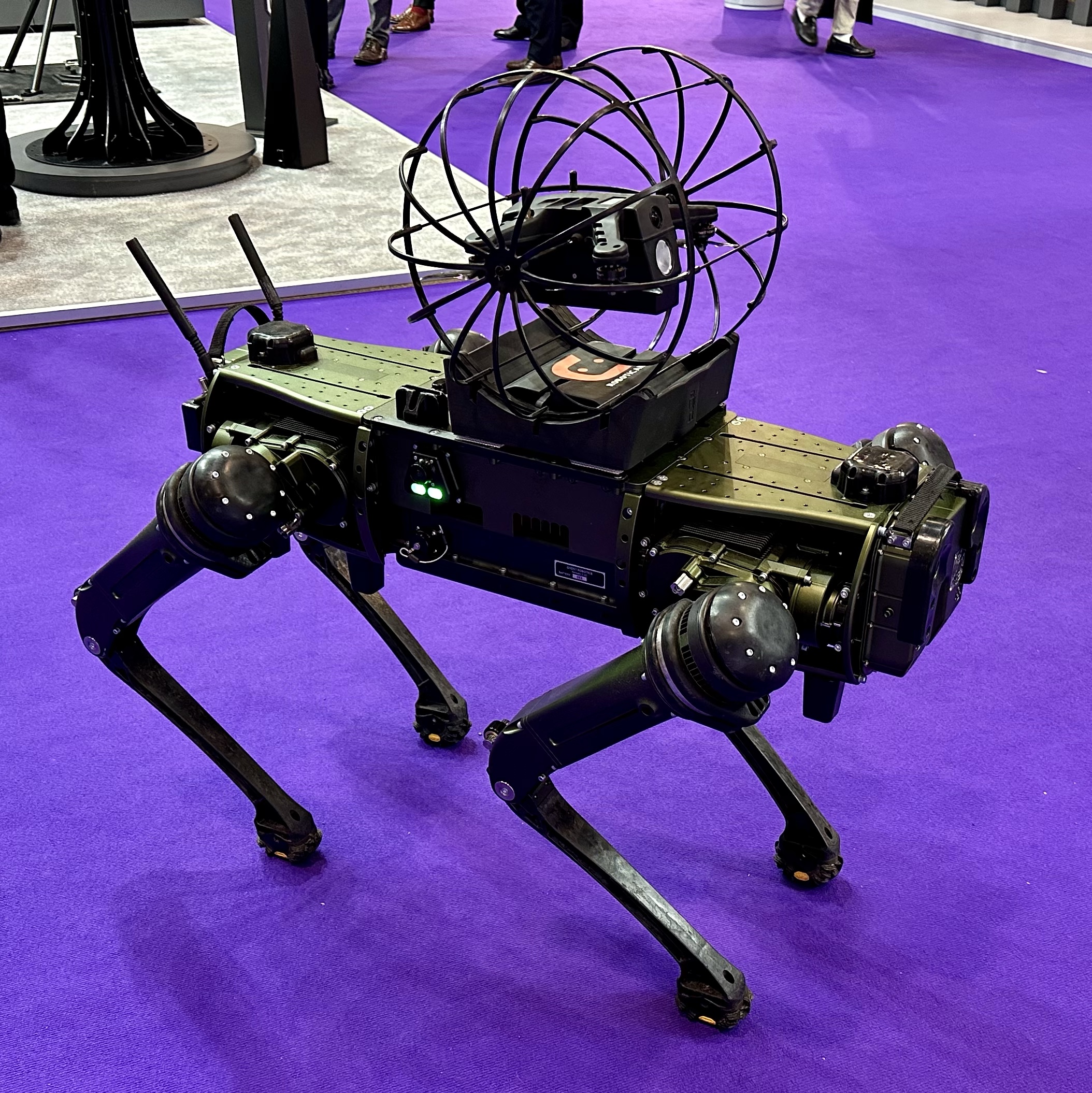
Ghost Robotics‘ Quadruped Unmanned Ground Vehicles are making a great showing in the Australian Defence Force stand, conducting demos of their capabilities. Available in Australia from Omega Dev Group, ADF currently has two dogs they are using to shape their ground robotics requirements under the Robotic & Autonomous Systems Implementation & Coordination Office (RICO).

Land Forces 22 – DefendTex Banshee

Tuesday, October 4th, 2022

Billed as an Land Autonomous Munition Platform, the Banshee from Australia’s DefendTex boasts a top speed of 100 km/hr and a range of 70 km.

This thermal seeking system is designed to look for tanks, drive under them and destroy the tank or anything else it’s set after.

It can also be used to deliver their line of unmanned aerial systems like the D40 via their multibarrel
launch system.

www.defendtex.com

Army to Test Robotic Vehicles on Land and Sea During PC 22

Thursday, September 29th, 2022

WASHINGTON — Industry partners working with the Army and Defense Advanced Research Projects Agency engineers will fly a pilotless UH-60 Black Hawk helicopter carrying up to 3,000 pounds on supply runs as part of its annual Project Convergence experiments this fall. In addition, the range of the tests will expand significantly across the Pacific.

Lt. Gen. Scott McKean, director of Army Futures Command’s Futures and Concepts Center, said that autonomous vehicles will cover great distances on land and sea during the joint experiments of PC 22, which the Army designed to augment joint, all-domain command and control, or JADC2.

The Army will work to reduce the number of Soldiers necessary to operate the autonomous vehicles, eventually having a single Soldier controlling multiple vehicles, McKean said.

The experiments will be held at locations in the Pacific and at Yuma Proving Ground, Arizona, in October and November. JADC2 is the Defense Department’s concept for joint warfighting.

“Autonomous capability is at the forefront of what we believe our next operating concept will be based on,” McKean said during the Defense One State of the Army conference on Sept. 7. “Why do you need a Black Hawk? Think of the capacity that a Black Hawk provides in the sense of carry capabilities. It really will help us provide commanders options.”

As part of the Army’s broader modernization efforts, PC 22 will help validate the Army 2030 multi-domain operations goals. The Army plans to publish its new, Army 2030 multi-domain operations doctrine this fall.

In addition to the autonomous Black Hawk, the service will deploy air and ground robotic vehicles from the U.S., United Kingdom and Australia during tests at Yuma, Camp Pendleton, California, and the National Training Center in San Bernardino County.

“This is convergence,” McKean said. “How do we pass the data from those robotic vehicles back to the command post so commanders can make sense and act on what those systems are providing? This is going to be a great learning opportunity to see just where we are.”

In addition, the Army will test its ability to “swarm” using a group of drones controlled by a Soldier.

This year the experiments will include participation from all six military branches including the Space Force as well as the British and Australian militaries. Carrier strike groups and the U.S. Navy’s Third Fleet elements will be stationed in the Pacific and sensors will be placed in areas from Japan to Australia.

McKean said that Project Convergence 2021 set the foundation for this fall’s iteration, allowing the Army to build greater levels of integration with other military branches.

This year the series of experiments will divided into two phases.

First the services will operate in a Pacific environment; engaging under maritime conditions and long distances. Then, the experiments will move to land-dominant scenarios. There will also be an additional combat simulation at Yuma, where the Army is working with industry solutions to develop battlefield dynamics with feedback from military representatives.

“It is not an Army experiment. This is not how the Army is approaching JADC2,” McKean said. “This is truly a joint, and combined experiment venue to inform JADC2 as well as other capabilities that we’re trying to develop out as part of our modernization process.”

McKean said the scenarios revolve around three objectives. First the militaries will establish an integrated air and missile defense through the development of protective and defensive fires. Second, participants will be employing joint, offensive fires and the ability to hit targets and great distances.

Finally the Army will examine which authorities and policies hinders its ability to fight as a joint combat force. The military branches will also focus on establishing proper communications between each service’s command post.


“We’re looking at both mass and precision,” he said. “That was part of the objective to scale this experiment establishing a mission partner network. We understand that we’re not going to be able to fight without our allies and partners.”

By Joe Lacdan, Army News Service

Tomahawk Robotics Awarded $6.5M Contract with United States Marine Corps

Tuesday, September 20th, 2022

MELBOURNE, Fla., Sept. 15, 2022 — Tomahawk Robotics is thrilled to announce the award of the Autonomy and Robotics Enhanced Multi-Domain Infantry Squad (ARTEMIS) program through the Marine Corps Warfighting Laboratory (MCWL). The $6.5M award spans activities and deliveries scheduled from 2022 through 2024.

The ARTEMIS program builds on capabilities delivered under Tomahawk Robotics’ existing Radio Agile Integrated Device (RAID) contract with MCWL. With the ARTEMIS contract, Tomahawk Robotics will integrate six additional unmanned systems and several ground radios used by the US Marine Corps into the Kinesis Ecosystem.  These unmanned systems include both ground and airborne platforms in use by US Marine Corps Infantry Units.    

Brad Truesdell, Tomahawk Robotics’ CEO said “This is another major step forward in our work to deliver AI-enabled universal robotic command and control for our men and women in uniform. Through this program, we will deliver products providing for the safe, efficient, and intuitive control of robotic systems by the US Marine Corps.”

The ARTEMIS program leverages previous DoD investments to provide a fully integrated common control and communications solution for both air and ground unmanned systems. It will enable universal robotic control of legacy Program of Record (PoR) systems as well as next-generation unmanned systems, sensors, and payloads for dismounted Marine Corps units. Universal robotic control technologies provide infantry units with significant improvements in situational awareness, mission success, and lethality to meet the challenges of tomorrow’s battlefield.

Tomahawk Robotics is proud to support the Marine Corps and the US DoD through this work.

AeroVironment’s Unmanned Ground Vehicles to Use Persistent Systems Mobile ad hoc Network as Preferred Network for Platforms

Monday, September 19th, 2022

Persistent Systems, LLC (“Persistent”), a leader in mobile ad hoc networking (MANET), announced today that AeroVironment’s unmanned ground vehicles (UGV) business has joined Persistent’s Wave Relay® Ecosystem.

The Ecosystem is a growing industry alliance of unmanned aircraft systems (UAS), UGVs, and sensor companies all utilizing Persistent’s Wave Relay® MANET as their preferred network for command-and-control and communications functions.

“We are very excited to have AeroVironment’s UGVs join the Ecosystem,” said Nick Naioti, Senior VP for Business Development for Persistent Systems. “In building the networked battlefield, we are providing the warfighter with increased situational awareness while also reducing size, weight, and power.”

At the core of the Ecosystem, the Wave Relay® MANET enables tactical teams to receive critical information from unmanned systems and their sensors which facilitates improved decision making, increasing both soldier safety and effectiveness.

According to the agreement between the two companies, the following UGVs will incorporate Persistent’s MANET hardware:

• telemax™ EVO PRO;
• telemax™ EVO HYBRID;
• telemax™ EVO PLUS;
• tEODor™ EVO; and
• EVO Upgrade Kit.

These ruggedized, all-terrain UGVs perform a variety of dangerous missions, including explosive ordnance disposal (EOD), hazardous materials handling (HAZMAT) and chemical, biological, radiological, and nuclear (CBRN) threat assessment.

“Persistent has established itself in the market as a network provider that delivers extended range, high throughput and robustness against radio interference, all of which are critically important to our customers’ life-saving missions,” said Brian Young, AeroVironment vice president and product line general manager for UGVs.

In addition, Wave Relay® MANET gives companies the opportunity to move beyond simple point-to-point solutions and build whole constellations of connected air and ground assets, Naioti said.

Milrem Robotics Delivers the THeMIS UGV to Ukraine

Tuesday, September 6th, 2022

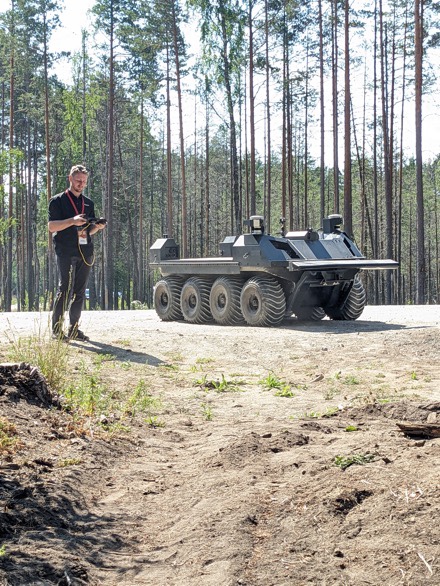
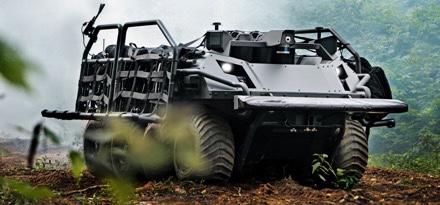
The European leading robotics and autonomous system developer Milrem Robotics delivered the THeMIS unmanned ground vehicle (UGV) suited for casualty evacuation (CASEVAC) and transportation of supplies to Ukraine.

The THeMIS equipped with stretchers for rapid CASEVAC was delivered to a Ukrainian charitable organization. Onsite training was provided upon delivery for the quick deployment of the system.

“Casualty evacuation is one of the most crucial and labour-intensive activities in conflicts. Traditionally, it takes several people to carry a stretcher and required medical equipment. However, it would require only one to operate a UGV, which can accommodate several wounded and a lot of equipment. This means that more personnel are available to help more people,” explained Captain (res) Jüri Pajuste, Defence R&D Director at Milrem Robotics.

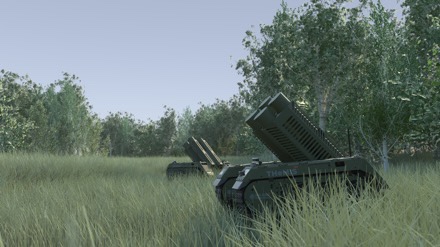
The THeMIS UGV is a multi-mission vehicle with an open architecture that enables it to be rapidly configured from having a transport function to being weaponized, performing ordnance disposal, or supporting intelligence operations according to the nature of the mission.

THeMIS UGVs have been acquired by 16 countries, 8 of which are members of NATO, including Estonia, Germany, France, the Netherlands, Norway, Spain, the UK, and the US.