XC3 Weaponlight

Archive for the ‘Robotics’ Category

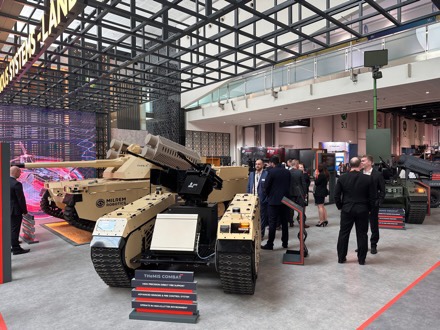
Milrem Robotics and FN Herstal Demonstrate Intelligent Combat UGV at Eurosatory

Wednesday, June 15th, 2022

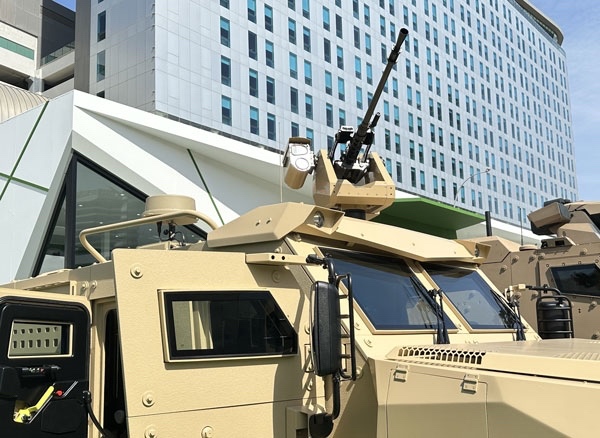
The European leading robotics and autonomous systems developer Milrem Robotics and the leading firearms manufacturer FN Herstal demonstrate the THeMIS Combat unmanned ground vehicle (UGV) equipped with the deFNder® Medium Remote Weapon Station (RWS) and intelligent functions at Eurosatory 2022.

The THeMIS Combat UGV provides direct fire support for manoeuvre forces and acts as a force multiplier. With the deFNder® Medium remote weapon station, it offers high precision over wide areas, day and night and increases stand-off distance, force protection and survivability for dismounted soldiers.

The THeMIS UGV is equipped with Milrem’s Intelligent Functions Kit (MIFIK) that allows autonomous mobility such as follow me, return home, point-to-point navigation and obstacle detection and avoidance. Autonomous functions are strictly limited to mobility only. The weapon system is controlled only by a human operator.

“Being part of many combat UGV assessment programs around the globe we have seen that these systems considerably increase the capability of units, especially small units,” said Cpt (res) Jüri Pajuste, Defence Research and Development Director at Milrem Robotics. “Their benefit comes from higher firepower and mobility and most of all through changing tactics. UGV’s are not just technology gadgets, but useful tools to win conflicts,” Pajuste added.

“We are proud to demonstrate the capabilities of our deFNder® Medium on Milrem Robotics’ THeMIS this year again”, said Igor Klapka, VP Systems for FN Herstal. “The number of applications addressed to with our RWS is growing to successfully include unmanned ground or aerial vehicles, and radio-frequency control, whilst the armament remains operated by the human operator. The deFNder® Medium is a stabilized RWS capable of automatically tracking and classifying potential targets, in particular to overcome the latency constraint of any wireless communication of UGVs.”

The THeMIS Combat will be demonstrated twice a day at the demonstration area during Eurosatory 2022.

Milrem Robotics Launches Command and Control for Robotic Systems at Eurosatory

Saturday, June 11th, 2022

The European leading robotics and autonomous systems developer Milrem Robotics will launch their command and control (C2) system for intelligent unmanned systems at Eurosatory 2022.

Milrem Robotics’ solution integrates multiple different unmanned aerial and ground assets (UxV) into a composite command and control system and merges sensor and effector data from multiple payloads. It allows the constant monitoring and controlling of the UxV systems’ most important variables, such as energy status, fault conditions, operating parameters, built-in diagnostic tests, initialization, and configurations.

The system is developed in cooperation with Fleetonomy.ai, Rait88, MIL Sistemika and other partners.

“Integrating different unmanned systems and traditional manned assets through a command-and-control system enables the efficient deployment of autonomous vehicles on the battlefield,” explained Kuldar Väärsi, CEO of Milrem Robotics. “Integrated autonomous ground systems enable a significant increase of firepower and capabilities using fewer human resources and at the same time increasing the safety of our troops, which has always been the goal of Milrem Robotics.”

The C2’s autonomy engine is capable of remotely navigating and controlling the position and motion vectors of the UxV’s and/or other integrated RAS components.

It supports user-defined autonomous missions and behaviour sets, delivers an ALFUS Contextual Autonomy Capability level of 4+ for behaviours related to autonomous navigation such as route planning, object avoidance and geo-mapping. It also provides many autonomous functions like flight control, target detection and automatic optimized routing.

The autonomy engine autonomously creates routes against pre-determined mission sets such as search, intercept, shadow etc, considering the selected vehicles’ mobility & intelligence characteristics.

CANSEC 22 – Mawashi

Tuesday, June 7th, 2022

Mawashi designs and builds human augmentation exoskeletons. Their latest creation is this upper body chassis which is so new, they don’t even have a name for it yet.

It is meant to weighing about five pounds, the design allows the wearer to carry up to 45 pounds with no additional fatigue. The burden is borne by the spine system and transferred to the hips rather than at the shoulders.

As you can see, this exoskeleton mimics the skeletal system, but is external to your body. These systems have no external power. The original Uprise (Ultralight Passive Ruggedized Integrated Soldier Exoskeleton) transfers the weight all the way to the ground. This upper body exoskeleton is a more simple and lower cost option for those who wear armor and have basic load carriage requirements like guards or vehicle mounted troops while the Uprise full body exoskeleton is more appropriate for those who most move overland by foot and carry additional equipment.

Above you can see the UPRISE and new UPLIFT flanking the upper body system. The Ultralight Passive Load-bearing Innovative Frame Technology was created for industrial applications but is already under evaluation of logistics use in several militaries. UPLIFT assists the wearer during lift, move, and carry tasks through three mechanical passive systems at the shoulders, back, and knees. Since current battery lifetimes are too short for an eight-hour workday, UPLIFT uses a mechanical clutch with springs.

OpEx 22 – Recon Robotics

Thursday, June 2nd, 2022

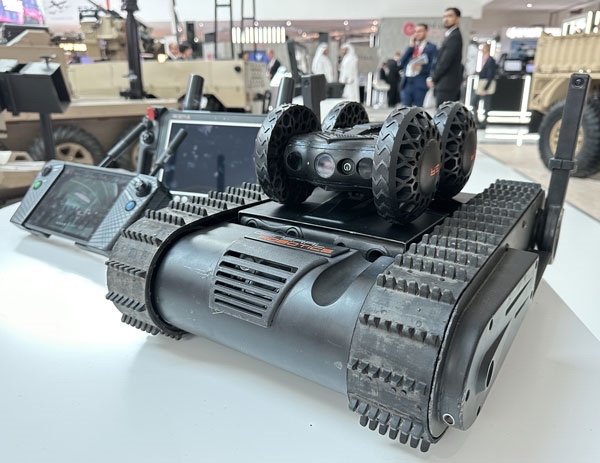
Recon Robotics is introducing a new controller which features a larger view screen and has integrated antennas for a more streamlined design. Additionally, you can record video right on the controller. It is also compatible with future upgrades.

Milrem Robotics Launches an Autonomous ISR UGV, the THeMIS Observe

Sunday, May 29th, 2022

The European leading robotics and autonomous systems developer Milrem Robotics will launch a newly developed autonomous Intelligence, Surveillance and Reconnaissance (ISR) unmanned ground system THeMIS Observe that will be showcased during the fourth iMUGS project demonstration in Belgium.

“A UGV based ISR system significantly increases a tactical unit’s reaction speed on targets as well as the stand-off distance from enemy units,” explained Cpt (res) Jüri Pajuste, Defence Research Director at Milrem Robotics. “Thanks to that the capability and survivability of tactical reconnaissance units will increase considerably,” Pajuste said, adding that this type of capability is usually not available on one platform for light infantry units.

The THeMIS Observe is based on Milrem Robotics’ THeMIS UGV and integrated with ISR equipment from various leaders in their fields. The system includes the Z:Sparrowhawk camera from HENSOLDT, the Squire radar by Thales, Metravib Defence Pearl acoustic shot detection and the ROSY (Rapid Obscuring System) by Rheinmetall. The system can also be equipped with a light remote weapon station.

“The combination of those systems allows units to do multi-sensor identification on one platform and react faster on emerging targets,” Pajuste added.

Additionally, the THeMIS Observe is equipped with Milrem’s Intelligent Functions Kit that enables autonomous functions such as follow-me, waypoint navigation with obstacle detection and avoidance.

The THeMIS Observe will be demonstrated during the European Commission’s European Defence Industrial Development Programme (EDIDP) funded iMUGS project’s fourth demonstration in Belgium in June. The iMUGS project aims to develop a European standardized unmanned ground system (EUGS). During the project, modular and scalable architecture for hybrid manned-unmanned systems will be developed to standardize a European wide ecosystem.

The system will also be on display at Eurosatory on Milrem Robotics’ stand in Hall 6 K 253.

Sky-Hero, AARDVARK, and PROJECT7 Expand Groundbreaking Tactical Robotics Suite with the SIGYN Mk1 Throwable Robot, Using the Same Controller as the Loki MK2 sUAS

Wednesday, April 13th, 2022

The tactical robotics suite from Sky-Hero, Aardvark Tactical, and PROJECT7 ARMOR is undergoing a huge expansion in 2022, providing tactical operators with access to an easy-to-use, intelligent recon ecosystem that revolutionizes mission safety. While the highly successful LOKI Mk2 Tactical sUAS changed operator tactics in the air, the new SIGYN Mk1 Recon System provides superior scouting on the ground in the form of a compact, throwable robot.

SIGYN Mk1 is an operator friendly robot that provides teams with superior scouting through two ultra-sensitive Day-Night cameras. While 150-degree views allow for an impressive scope, dimmable IR LEDs on the front, back, and top of the vehicle provide video clarity and NVG lighting. SIGYN Mk1 is purpose built with aviation-grade carbon fiber and reinforced with polycarbonate frames for a rugged but lightweight build, allowing the operator to deploy the bot with a single-handed throw.

SIGYN Mk1 is seamlessly integrated into the Sky-Hero Tactical Robotics Suite and is operated via the Odyssy GCS, the same handheld GCS controller that operates the LOKI Mk2. The small but rugged Odyssy GCS controller employs the superior Odyssy platform, an ultra-secure interface that doesn’t require the use of GPS, WiFi, or cell service. Its strong AES 256 encryption and diversified analog audio-video receptors prohibit signal interception and secure all vehicle, payload, and intelligence data. The GCS can operate up to four devices simultaneously. This allows a single operator to control any combination of up to four LOKI sUAS and/or SIGYN UGVs simultaneously from a single GCS controller. It also allows other team members to choose between and watch any of the four device feeds from the new Tactical Wrist Viewer, regardless of which device is currently being controlled. The new suite of payloads, from diversionary devices to sensors, will expand to support the SIGYN and be interchangeable between Loki and SIGYN in Q3 2022. All products are designed and constructed in Europe and the United States by NATO allies and supported in the United States by Aardvark Tactical.

Also new in 2022 is an expanded partnership between Sky-Hero and PROJECT7. Designed to create an entire line of deployment accessories for LOKI and SIGYN, the partnership ensures that they remain the most tactically deployable robots in the world. The new PROJECT7 accessories include the PROJECT7 ILB-FLEX backpack system, purpose-built for Sky-Hero robotics. The system is mission configurable with removable pouches and panels, allowing the end user to select and carry only the items required for the current mission. PROJECT7 is also releasing a new leg carrying system for SIGYN, a revised version of the LOKI Vest Integration System (LVIS), and a new P7 Gauntlet to house the new remote viewer.  

Driven by innovative technology, the Sky-Hero Tactical Robotics Suite allows operators to eliminate the risk of the unknown in close-quartered indoor operations. Learn more about how the SIGYN Mk1 and the complete Sky-Hero Tactical Robotics Suite can revolutionize the way your team approaches an operation at loki.aardvarktactical.com or by contacting Aardvark Tactical, the exclusive North American distributor.

About SKY-HERO: Founded in 2013 and located in Brussels, Sky-Hero is a dynamic, flexible, fast-growing company that specializes in drones and robotics. With a target market in civil security, their clients range from Police Special Forces to International Security companies, mountain rescue teams, and firefighters.

About AARDVARK: Founded in 1987, Aardvark Tactical is a leading distributor and system integrator specializing in the protection of tactical operators from Local, State, Federal, and Military Units. AARDVARK is headquartered in La Verne, CA.

About PROJECT7 ARMOR: PROJECT7 is the culmination of years of research and development geared toward producing the ultimate integrated tactical armor systems. PROJECT7 is sold exclusively to sworn Military, Law Enforcement, and Federal Agents through our sole source distribution partner, AARDVARK, in La Verne, CA.

Raul Rikk to Join Milrem Robotics as Science and Development Director

Tuesday, April 12th, 2022

Estonia’s National Cyber Security Director Raul Rikk will join Europe’s leading developer of robotics and autonomous systems Milrem Robotics as the Science and Development Director.

Raul Rikk is the founder and developer of several international and domestic organizations, including NATO’s Cooperative Cyber Defence Centre of Excellence (CCDCOE) and the National Cyber Security Department at the Estonian Ministry of Economic Affairs and Communications.

He has extensive experience in leadership, management, coordination and teamwork at various levels of management and in various projects. Raul also has extensive international work experience in many different countries and international projects.

“Milrem Robotics is currently involved in the evaluation and concept development of robotics and autonomous systems (RAS) in 14 countries. The next step of these evaluations is the implementation of RAS on a larger scale and a crucial factor in this is cyber security. Especially for military applications. Raul’s role will be improving the usability of robotics enabling them to be applied on a larger scale and thus increasing the defence capabilities of our client countries,” said Kuldar Väärsi, CEO of Milrem Robotics.

“Raul’s long-term background in the field of cyber defence, combined with his international experience and Defence Forces background, makes him a very strong addition to Milrem’s team in tackling these challenges,” he added.

“I am delighted to join Milrem Robotics, the defence industry’s flagship of innovation and robotics. The current security situation has made strengthening national defences even more important than before, and in this context the development of defence technologies is a key element,” Rikk said.

“In the coming years, I would like to focus on perfecting Milrem Robotics’ products and services to a level expected by NATO and partner countries,” he added.

Milrem Robotics’ current S&D Director prof. Mart Noorma will depart the company end of May 2022.

“For the last five years Mart has been focused on building our strategic development competences. Thanks to him we now have one of the world’s leading teams engaged in offroad autonomy and for that he has my gratitude,” said Kuldar Väärsi.


Raul Rikk will join Milrem Robotics’ team in June 2022.

Army Special Operations Forces Use Project Origin Systems in Latest Soldier Experiment

Friday, March 11th, 2022

DUGWAY, Utah — Army Green Berets from the 1st Special Forces Group conducted two weeks of hands-on experimentation with Project Origin Unmanned Systems at Dugway Proving Ground. Engineers from the U.S. Army DEVCOM Ground Vehicle Systems Center were on site to collect data on how these elite Soldiers utilized the systems and what technology and behaviors are desired.

Project Origin vehicles are the evolution of multiple Soldier Operational Experiments. This GVSC-led rapid prototyping effort allows the Army to conduct technology and autonomous behavior integration for follow-on assessments with Soldiers in order to better understand what Soldiers need from unmanned systems.


For the two-week experiment, Soldiers with the 1st Special Forces Group attended familiarization and new equipment training in order to develop Standard Operating Procedures for Robotic Combat Vehicles. The unit utilized these SOPs to conduct numerous mission-oriented exercises including multiple live-fire missions during the day and night.

The live-fire operations employed the M240 and M2 machine guns and the MK19 automatic grenade launcher.

“These live fire operations were critical to determining the military utility of the Robotic Combat Vehicle unmanned technology,” said Todd Willert, GVSC’s project manager for Project Origin. “The unit was successful with integrating the systems into their formation for both offensive and defensive operations.”

The Green Berets incorporated numerous Origin modular mission payloads to assist with long-range reconnaissance, concealment, electronic warfare and autonomous resupply operations.

A senior medical sergeant with the 1st Special Forces Group said the modularity of payloads provides flexibility for use in a variety of mission sets: “The upscaling of capabilities for a direct heavy-weapon system gives us the advantage we’ve never had before in typical dismounted roles.”

Willert stated the inclusion of Special Operations Forces into technology assessments provides more depth in understanding what is needed to mature unmanned systems for the Army’s Operating Force.

In addition, this experiment supports the continual development of the Army’s Robotic Technology Kernel — the Modular Open System Architecture-based library of software that can be used for ground autonomy — along with the Warfighter Machine Interface, the Army’s library of modular software used by Soldiers to control robotic vehicles. This open systems architecture approach will enable common unmanned maneuver capabilities across the ground vehicle fleet.

“We are in the process of tailoring software packages to meet the needs of end users,” Willert said. “Autonomy — at various levels — offers great opportunities for different mission sets that improve Soldier safety and reduce cognitive burden. The professional and thoughtful comments from these Soldiers will greatly assist us with developing behaviors for future unmanned systems.”

1st Special Forces Group Detachment Commander added, “The robots are best employed to maximize the standoff between Soldiers and enemy threats.” He went on to say, “The Project Origin system, for any type of dismounted operations we conduct, would provide us increased capabilities to recognize and identify individuals on target from a much greater standoff while decreasing the risk to the force as our Soldiers accomplish their mission.”

Maj. Cory Wallace, the RCV Requirements Lead with the Next Generation Combat Vehicle Cross Functional Team, said: “Working with an Operational Detachment Alpha enabled us to understand new use cases and consider new approaches to integrating robotic and autonomous systems into future experiments.”

“The feedback from the operators gave us a completely new perspective as to how we need to shape our future development efforts in order to provide the most effective unmanned systems possible to Army formations, Wallace said.

A senior weapons sergeant summed up the event by saying, “The Project Origin system allows us an ability to operate the system outside of enemy fire. This allows an ability to focus on advanced tasks such as terrain analysis, developing enemy courses of action, and thinking ahead of the now, rather than seeking cover and returning fire.”

By Jerome Aliotta