TYR Tactical

Archive for the ‘SOF Week’ Category

SOF Week 25 – Transcend Robotics

Wednesday, May 14th, 2025

Transcend Robotics exhibited their Vantage Mil and Vantage Mini systems in the ADS Inc booth.

The Mini is a great throw-bot option, offering 8-inch automatic obstacle climbing, 2-hour runtime with swappable batteries, and up to 250ft communications NLOS.

Vantage MIL, an under 40 pound multi-mission ISR UGV is deployable in under one minute. Based on patented mobility technology, no operator intervention is required to overcome cluttered areas, barriers up to 16 inches, and international stairs.

These systems are IP-based allowing you to use Silvus, Persistent Systems, or other approved radios as required, that can also serve as comms relays (currently comes standard with Silvus). The robots come with tracks as well as wheels, allowing you to select which drive setup best suits your mission, and you can easily swap between them in the field. You can integrate with ATAK directly, or by utilizing Tomahawk’s Kinesis Ecosystem and S20 Grip controller.

SOF Week 25 – Crossfire Packs

Wednesday, May 14th, 2025

Australia’s Crossfire Packs has gained quite a following in the US. Recently, they introduced a couple of new PALS compatible pouches for use with their DZ rig, a classic belt kit.

The Juice Box is intended to be attached to the yoke as a hydration carrier (2L reservoir). It will also work with their packs, or the kit you already own. It includes matching removable Ciabatta slice which will accept a broken down MRE.

The Butter Bar is a commander’s pouch with three removable dividers so you can keep everything organized from notebooks to headlamps to magazines.

These are currently available in MultiCam, Ranger Green, and Woodland. My DZ Rig is Tigerstripe so maybe I can talk them into making one of each for me and my friend @Prepared_Pathfinder.

Gear ships from their warehouse in Charlotte, NC.

SOF Select 25 – Strategic Sciences

Wednesday, May 14th, 2025

This photo, taken in the Strategic Sciences booth, combines two things that readers find fascinating: the Knight’s Armament Co Light Assault Machine Gun in 5.56mm and Strategic Science’s Multi Function Muzzle Device, a new suppressor technology developed in conjunction with the Irregular Warfare Technology Support Directorate.

The Canadian arm of the company, Millbrook Strategic Sciences Inc, has signed a deal with CANSOFCOM for the devices and here in the US they’ve been trying them out on every NATO weapon (including those under development) they can get their hands on. Available in multiple calibers from 5.56 up to 50 BMG, expect to see a lot of these floating around soon.

SOF Week 25 – GoTAK Trackers

Wednesday, May 14th, 2025

GoTAK exhibited their GoTAK Trackers. Offered in three variants, these low-cost tracking devices are designed to operate globally and integrate directly with Tactical Awareness Kit servers. They feature low power requirements and a compact form factor.

Personnel Tracker

Track your personnel with a key-fob sized device with a 24 hour battery life with 3 second interval updates. Charge easily with the included USB C dock.

Vehicle Tracker

Track your vehicles with the GoTAK Tracker ODB2 that powers and connects to vehicles over the diagnostic port (ODB2). Simply plug it in and the vehicle charges the internal battery for constant operation even with the vehicle is stationary or parked.

Asset Tracker

Track your assets or personnel with the GoTAK Tracker V1 or the XL with the optional magnetic base that fits in the palm of your hand with up to 7 years on a single charge with daily interval updates. Charge easily with the included USB C dock.

getgotak.com

SFC Energy AG and Polaris Government and Defense Collaborate to Equip NATO and NATO-aligned Defense Organisations with Advanced Fuel-Cell Powered Vehicle

Wednesday, May 14th, 2025

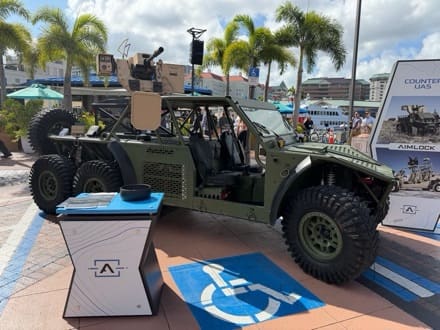
Brunnthal/Munich, Germany, 13 May 2025 – SFC Energy AG (“SFC”, F3C:DE, ISIN: DE0007568578), a leading provider of fuel cells for stationary, portable and mobile hybrid power solutions, has announced a key collaboration with Polaris Government and Defense (“Polaris”) at Special Operations Forces Week (“SOF Week”) in Tampa, Florida, USA. Polaris showcased a high-mobility tactical vehicle with the EMILY 3000 as an optional integrated power supply. This capability is specifically being offered to NATO and NATO-aligned defense organisations.

Installing SFC Energy’s EMILY 3000 in the Polaris’ MRZR vehicle platform provides a highly reliable power solution available for mission-critical applications. The methanol fuel cell-based system can power radios, surveillance systems, drone equipment, sensors, and other electronic devices – all without the need to run the vehicle’s engine. This enables extended operations while preserving camouflage and reducing both thermal and acoustic signatures.

The EMILY 3000 delivers a dependable and autonomous power supply for a variety of electronic and communication systems. Weighing only 12 kilograms (approximately 26.5 pounds), it increases power output on lightweight tactical vehicles without compromising mobility. Its high energy density enables for extended runtimes and minimises the need for refuelling during prolonged operations. One of its key advantages is its virtually silent performance, producing minimal acoustic and thermal signatures – making it exceptionally well-suited for covert operations.

The system supports the simultaneous charging and use of various battery types, including lithium-ion, lithium-polymer, and conventional lead-acid batteries. In contrast to traditional setups, it eliminates the need to run the vehicle engine or rely on noisy generators. This reduces fuel consumption, acoustic exposure, and the risk of early detection. Fully automatic in operation, the EMILY 3000 contributes to longer battery life and reduced vehicle wear by cutting down on engine use and maintenance.

Its flexibility also enables the system to function either as an onboard charger or as a portable, field-based power supply. Additionally, the EMILY 3000 and its fuel cartridges are military-certified, carry a NATO supply number, and are approved for air transport in accordance with UN3473 regulations – making them fully deployable in international operations.

By integrating the EMILY 3000, Polaris light tactical vehicles gain enhanced operational endurance and power autonomy – especially critical in scenarios where silence, reliability, and energy independence are key tactical requirements.

Dr. Peter Podesser, CEO of SFC Energy AG: “By offering the EMILY 3000 as an accessory option in Polaris vehicles, we are delivering a mission-ready, low-signature power solution tailored to the needs of modern armed forces. The Polaris MRZR is widely deployed by the United States and other NATO and allied forces worldwide for its exceptional off-road mobility and versatility. By including our innovative and field-proven fuel cell technology on this trusted platform, military forces can significantly enhance their operational range, energy autonomy, and tactical utility in real-world missions.”

Further information on SFC Energy’s Clean Energy and Clean Power Management solutions can be found at www.sfc.com.

SOF Week 25 – Edgevolt Battery System from 3ME Technology

Tuesday, May 13th, 2025

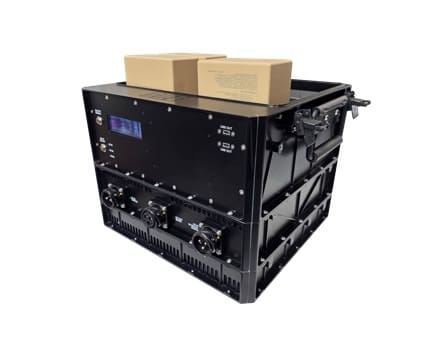
3ME Technology is an Australian company which has been working on battery systems for the ADF for the past few years.

Recently, they created a new form factor which mimics the size and weight (22 kg) of a 5 gallon Jerry Can, providing 24V 2.4 kWh. This means single person lift.

Weatherproof, they can be used alone or connected in serial (up to 10) for higher power requirements. What’s more, they are hot swappable while in serial.

SOF Week 25 – EdgeTak by EDT

Tuesday, May 13th, 2025

Integrating WIFI / Bluetooth and GPS as well as 2 X USB-TYPE C ports and a RJ45 jack, this TAK server is meant for deployment at the edge. It relies on an NVIDIA ORIN NX Carrier with 8TB of storage.

Key features include:

Superior Modularity: Easily integrate tactical and Al/ML applications with versatile connectivity

Optimal Kit Fit: Designed to fit flexibly on-body including existing radio and magazine pouches

Open Platform: No proprietary software or licenses; the platform is open for customizing the application stack, giving operator full control and mission flexibility

This sounds promising. They are introducing EDGETAK RF this summer which will incorporate a fully integrated spectrum awareness and collection capability from 30MHz- 8GHz.

– 2 x RX/TX channels of up to 80MHz IBW

edt.com

Senior Official Outlines Future Priorities for Special Ops

Tuesday, May 13th, 2025

Colby Jenkins, performing the duties of the assistant secretary of defense for special operations and low-intensity conflict, outlined his priorities for the future of the special warfare community while delivering remarks today during Special Operations Forces Week 2025 in Tampa, Florida.

Jenkins cautioned the audience that America’s adversaries are converging across regions and “the thresholds between peace and conflict.”

“We do not need another threat briefing; we need action — focused and unrelenting,” Jenkins said.

He added that such action recently came in the form of guidance from Defense Secretary Pete Hegseth, who kicked off SOF Week 2025 with keynote remarks, May 6. Hegseth said his focus is on defending the homeland, deterring Chinese aggression while maintaining a free and open Indo-Pacific region and shifting burdens to partners and allies.

“SOF delivers persistent presence, asymmetric advantage and strategic effects across all three priorities every day, everywhere,” Jenkins said, adding that SOF is also the only force in the Defense Department that delivers across all three lines of effort.

He then listed five priorities aimed at meeting Hegseth’s guidance:

  • Designing the future force to prevail in future conflicts;
  • Maximizing the performance and resilience of SOF personnel;
  • Ensuring training and readiness meet future needs;
  • Aligning capability development to strategic priorities; and
  • Strengthening resource oversight and the institutionalization of accountability.

Regarding the first priority concerning force design, Jenkins said there needs to be a shift from static formations optimized for crisis response and counterterrorism to “adaptable, tailorable, multidomain SOF formations” meant to prevail in high-end conflict.

“The future of SOF is relentless: smaller teams, faster decisions, smarter systems [and] harder targets,” Jenkins said.

As for performance and resilience maximization when it comes to SOF personnel, Jenkins said future operators will need to be agile, resilient, physically and mentally capable, and able to thrive in isolated, high-pressure environments.

“We cannot afford to simply maintain the old standards,” he said. “We must sharpen them, modernize them and expand them without losing the warrior ethos that define[s] our special operations.”

He also said the goal will be to build and preserve a force where human performance, and not just that of technology, will prove to be a critical advantage over adversaries.

“Because in the end, it is not the weapon, the drone, or the system that wins the contest. It is the person who knows when and how to use all of that technology and who refuses to quit; that person secures victory for us,” Jenkins said.

On the topic of ensuring training and readiness meet future needs, Jenkins said the battlefield of the future will be more complex, contested and ambiguous than anything SOF has faced before.

Because of that, he said, future SOF will have to operate in challenging environments while integrating cyberspace and electronic warfare. They will also need to conduct irregular warfare alongside allies, partners and indigenous forces across all phases of competition and conflict.

“Traditional training models and infrastructure focused primarily on physical skills and kinetic action will not be enough,” Jenkins said, adding that it will be necessary to rethink training for the future threat environment.

Regarding aligning capability development to strategic priorities, Jenkins said “innovation for innovation’s sake” isn’t enough.

“We must drive innovation with purpose, laser-focused on building the capabilities that allow our forces to impose costs, create dilemmas and deny advantages to our adversaries,” he said.

Jenkins added that SOF must harness artificial intelligence to accelerate decisive advantage.

On the final priority, Jenkins said strengthening resource oversight and institutionalizing accountability are necessary in an era of increasing operational demands and constrained budgets.

“Resources are not just dollars on a spreadsheet; they are the fuel for readiness, resilience and victory,” he said, adding that every dollar spent must sharpen readiness, enhance capability or increase strategic leverage.

“We have an incredible opportunity right now to make sure that our enterprise has the resources that it needs and can divest of operations or resources or platforms that we no longer need. So, let’s take advantage of that,” Jenkins said, adding that no funds should be “wasted on bureaucracy that does not deliver warfighting advantage.”After highlighting future priorities, Jenkins appealed to the SOF community for their own ideas regarding shaping the future.

“Whether you are in industry … government or the SOF community itself, you are part of this effort,” he said. “Help us develop the capabilities that give our operators the advantage they need at the speed they need.”

Jenkins said that winning future fights will not come from doing more of the same but from thinking differently, acting decisively and working together.

“This is our moment to forge the future of special operations,” he said. “A future where small teams create strategic impacts; a future where resilience, adaptability and speed win the day, [and] a future where American strength and American values prevail. Now let’s get to work.”

By Matthew Olay, DOD News