Infinadeck is a omnidirectional treadmill for use with Virtual Reality training systems.
Units and agencies can procure Infinadeck by contacting Atlantic Diving Supply.

Infinadeck is a omnidirectional treadmill for use with Virtual Reality training systems.
Units and agencies can procure Infinadeck by contacting Atlantic Diving Supply.

Trango Systems offers a wide variety of modular range infrastructure including the barricade seen above which has a swappable top. The barricade’s lightweight construction allows it to be moved easily between training areas or to adjust for different training scenarios.
The barricade supports different rifle placement, directional fire, and target acquiring patterns applications.
Panels are manufactured from Panelo-O-foam, a ricochet free and highly durable material.
Units and agencies can procure Trango Systems products by contacting Atlantic Diving Supply.
SUN PRAIRIE, WI – Fire Facilities Inc. (FFI), has introduced new forcible door accessories for fire training towers. The dependable entry doors are offered to enhance training experiences for fire departments, public safety training facilities and military use.
Manufactured by Breaching Technologies Inc. (BTI), the field-proven breach products are now available from Fire Facilities to provide more realistic and flexible training options in their training towers for forcible entry exercises. Fire Facilities now offers the Explosive, Pry and Ram-Pry breaching door products.
“Forcible entry doors truly make training experiences more realistic,” says Aaron Adams, president of Fire Facilities Inc. “These doors are engineered and built to withstand the rigors of lifelike, real world training. The good news is the doors can be added to our existing training facilities or requested when placing a new order.”
Lifelike Training
The Explosive Breaching Door is offered to fit especially with tactical towers. The inward swinging door can simulate up to a four-lock set using the locking system built into the door along with the expendable preaching pins. The explosive breaching pins are designed to simulate resistance to a maximum 400-grain breaching charge. The door itself is skinned with high-density polyethylene to reduce the risk of fragmentation and corrosion from explosive exposure.

The Pry Breaching Door is mainly for the use fire training towers. It opens outward and can simulate up to a three-lock set using the built-in locking system and patented BTI breaching pins. The pins are made to simulate breaching wood, metal and reinforced frames. In addition to breaching pins, the pry door uses a low-cost wood insert to accept the use of a Halligan tool or similar type of prying tool.

Finally, the Ram-Pry Breaching Door works well for towers that require both tactical and fire training within the same structure. The versatile inward and outward opening door includes expendable breaching pins along with wood inserts. It offers realistic ram and pry breach training and uses a low-cost wood insert to accept the use of a Halligan tool or other similar prying tools.

This specific Ram-Pry Breaching Door was recently installed on a custom Fire Chief training model from Fire Facilities requested by the Nebraska Army National Guard for their training site in Hastings, Nebraska. It’s expected the Ram-Pry Door will be incorporated into the unit’s live-fire training, search and rescue, rappelling and helicopter rescue scenarios.
Fire Facilities Inc. (FFI) manufactures a full line of steel fire training structures engineered to withstand real-life firefighting conditions. From mobile units to burn rooms to high-rise towers, FFI training models are available in a multitude of configurations. Our parent company, Trachte Building Systems, is one of the largest and oldest manufacturers of steel self-storage systems in the industry. For more information, visit www.firefacilities.com or call 800-929-3726.
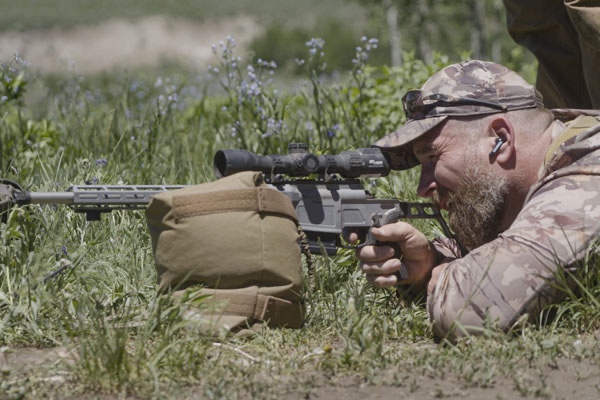
SureFire Field Notes is an informational video series with tips and techniques from subject matter experts of all backgrounds. In this episode, Matt Pranka discusses the importance of competitive shooting and relevance to tactical shooters.
Matt Pranka is the owner of Xray Alpha, has 26 years of military experience in Special Operations and is a USPSA Grand Master in production Division.
Xray Alpha instructors has spent decades being sent to all of the hot-beds of action, hunting the enemies of the United States. We actively put our training to the test on a regular cycle. We continue to work in this capacity and will consistently be putting ourselves into the fray. Xray Alpha training is driven from the passion of its founder to relay timely and effective training and tactics to the individuals that use them to save others, protect their family, and protect this nation. This isn’t something we want to do for fun or a quick buck, we are driven to give back as something we must do.

Special thanks to Route 66 Shooting Sports Park and the Norco Running Gun IPSC Club.
www.xrayalpha.com
www.surefire.com

HOUSTON, July 22, 2021 — Not so long ago, a strong password felt mighty enough to keep you safe and your computer data private. But we now live amid heightened risks in malware, phishing, spearphishing and denial-of-service attacks. Even scarier, it is possible for computer terrorists to wreak global havoc by commandeering your personal computer – yes, your own computer – without you suspecting danger until it’s way too late.
Sound frightening? It can be. But in this game, the good guys have critical skills, too.
The fall 2021 CyberCops program – funded by $250,000 grant from the U.S. Navy’s Office of Naval Research and sponsored by the University of Houston with cooperation of the University of Houston-Downtown and Texas Southern University – will introduce the critical field of cybersecurity to students recruited from the three participating universities’ ROTC (Reserve Officer Training Corps) programs.

In recent headlines, accusations of cyber aggression by unfriendly foreign powers reveal how high the stakes are.

Rakesh Verma, computer science professor at the UH College of Natural Sciences and Mathematics, leads the new CyberCops training program.
“The Department of Defense is interested in artificial intelligence and machine learning, and how those fields intersect with the needs of defense. They want students who plan on taking up careers in defense to have that kind of training and background,” said Rakesh Verma, computer science professor at the UH College of Natural Sciences and Mathematics. “Because these are ROTC students, the expectation is they will enter into a D.O.D. agency. But there are a lot of opportunities in the private sector, too, for people coming out with cybersecurity backgrounds.”

In the CyberCops program, students will study how to protect data, networks and computers as they also learn another critical lesson: Always stay a step ahead.
“The students will gain expertise in the intersection of a number of fields, including data science, machine learning and cybersecurity. They will have a semester of classroom training then spend about 10 weeks in my lab on the University of Houston main campus. There, they will study models on statistics, machine learning, natural language processing and data mining,” Verma said.
The term natural language processing refers to programming that “teaches” computers to understand not only the digital language of computers but also written and spoken words in various languages – English, Chinese, Russian and others.
Just how bad are the hackers, terrorists and just plain thieves who troll the internet? Don’t underestimate them, Verma warns.
As an individual, you may be at risk of:
• Ransom demands – Your data is locked. “Your computer’s been hacked, and all the data encrypted. Then you might receive a demand to pay a certain number of bitcoins to get it back,” Verma said.
• Thieves – Your identity is stolen. “These are criminals whose goal is to make a lot of money quickly,” Verma said. With special software, they enter the dark web where each set set of stolen credit card information sells for about $5, a Social Security number for around $10.
• Zombies – And we’re totally serious here. In cybersecurity circles, a zombie is a computer that’s under the control of an attacker. If a cyber terrorist commandeers your computer, all you can do is watch your screen helplessly while someone – on the other side of the world or maybe next door – swiftly moves through the internet with your identity, perhaps with the aim of infiltrating a commercial or government network, or conducting a denial-of-service attack

Risks are greater for government agencies and businesses. In early July, Microsoft announced discovery of the PrintNightmare hack and urged all Windows users to immediately install an update. The U.S. government and its allies later said the hackers were hired by China’s government or its representatives.

Two months earlier, the Colonial Pipeline ransomware attack resulted in a five-day shutdown, fuel shortages in the Eastern U.S. and a ransom of $4.4 million. Eventually all but $2.1 million of the ransom was recovered.
Several companies have faced spearphishing, which targets one individual inside an organization. For example, by weaving in facts easily found on a company’s website, attackers can craft an “urgent” email convincing enough for a trusted employee to move money.
Knowing how to fight the threat is not always easy, especially with deceptions, fake news and social engineering specifically designed to avoid detection. “You have to put yourself in the shoes of the attacker. Think like an attacker and find the weaknesses.” Verma said.
For the six gifted students recruited for the new program, an exciting future may start with CyberCops training on the UH campus. And for your own data, security may someday depend on the critical lessons they learn there.

Defoor Proformance Shooting 2022 open enrollment classes will be live for purchase Tuesday, July 20 at noon Eastern. Full sellouts are expected.
The offerings include multiple pistol, carbine and scoped rifle classes going up and a few new locations.
Remember, every class for the past five years has sold out within a couple hours of posting.
defoor-proformance-shooting.myshopify.com
JOINT BASE SAN ANTONIO-CHAPMAN TRAINING ANNEX, Texas—The Special Warfare Human Performance Squadron, SWHPS, recently marked its second anniversary.

The SWHPS is the first squadron of its kind in the Department of Defense, and its sole purpose is to provide Special Warfare Airmen and cadre embedded/holistic Human Performance, HP support.

“We reached our two-year milestone as a squadron and I cannot tell you how immensely proud I am of the team,” said Lt. Col. Shawnee A. Williams, SWHPS, commander. “With all of the hard work done to stand up the SWHPS, I am excited to see this capability propel forward every day!”

The SWHPS mission statement is to optimize the performance, durability, and sustainability of the Special Warfare human weapon system by taking an interdisciplinary approach toward the advancement of science and technology throughout the SW operator’s lifespan.

The organizational structure is made up of five geographically separated units, GSU, across the United States coast-to-coast. Within this construct are nine human performance flights supporting 80 Special Warfare cadre, 500 support staff, and 1,100 Special Warfare students annually.

“Our team sets the foundation for building physically superior, mentally sharper, and spiritually stronger warriors who will go into harm’s way to tackle our nation’s most dangerous and difficult tasks,” said Col. George Buse, Special Warfare Human Performance Support Group, commander. “To this end, SWHPS focuses on being brilliant at instilling HP principles in SW Airmen. We also leverage technological advances, research capabilities, and a holistic approach for the sake of further integrating and professionalizing the SW training enterprise,” said Buse.

Some key accomplishments of the SWHPS include standing up the first SW Human Performance purpose-built facility and hence named the Airman 1st Class Baker Combat Conditioning Center at the Panama City Dive School, Panama City, Florida. This facility occupies 13K square feet, $1.3 million in performance equipment, and serves a joint population of cadre and students with over 700K annual course hours.

At GSU location Yuma, Arizona, the first-ever embedded physical therapist for Army and Air Force personnel position has been established to increase access to care for evaluation, diagnosis, treatment, and injury prevention services for trainees and support staff members at Military Free Fall Courses.

Educationally, SWHPS has established a location at the U.S. Air Force Academy and took on their USAF Physical Therapy Fellowship Program for the Air Force Medical Service, and propelled it forward (was not under the old Battle Field Airmen Model). The Fellowship program has since graduated eight fellows with three more due to graduate in 2021 and has secured national accreditation.

Additionally, SWHPS has established a human performance footprint, across the training pipeline that employs integrated wearable technology, along with HP technician support. This footprint enables SWHPS to track parasympathetic/sympathetic system output, sleep, musculoskeletal health, velocity-based training, and water-based event metrics to include heart rate and physiological data points.

“Another first of its kind is the HP portfolio integration with the Learning Management System/database. The integration will soon provide continuity between training and operational units,” Williams said. “This allows for a human performance portfolio to travel with each member throughout their Special Warfare career.”

The Squadron’s Nutrition SMEs created the first stand-alone performance dining facility and now oversee all menus in support of the Special Warfare Preparatory Program. “It provides a much-needed ‘learning lab for trainees when they first enter Special Warfare,” said Maj. Miriam Seville, the lead dietitian for the Special Warfare Training Wing. “The trainees get to practice the sports nutrition principles that they learn in class and experiment with a wide variety of healthful foods and beverages that fuel and sustain optimal performance.
“This dining facility introduces trainees to what fueling the Human Weapon System can and should look like, and enables them to build habits here that will support them throughout their training and into operational status,” she said.
In November of 2020, the SWHPS graduated the first Air Force Institute of Technology Performance Nutrition Fellow, who now brings world-class nutrition capability, guidance, and knowledge to Special Warfare programming.
Williams added a final thought on the accomplishments of the program, “Over the past two years, SWHPS has set the foundation for an integrated approach to building and maintaining a human weapon system. We have taken a purposeful and tailored approach to embedded HP and coupled it with real-time physiological feedback to the trainees and are also expanding care to the cadre,” she said.
“The future of this organization will be to shape not only Air Force, but DOD policy to enable a lifecycle platform for the SW operator. The SW Airmen will not just experience high-level/holistic HP support in the training pipeline, but rather, they will see it woven into their career field education and training plans, and expanded services offered in their operational units,” she said. “This then lends itself to the creation or standup of a human weapon system program office just like we have for our hardware.
“We are truly on the cusp of a cohesive training environment where physiological, cognitive, and resiliency elements are assessed weekly, if not daily, to propel the individual to their highest potential versus a binary reactive environment,” Williams concluded.
Members of the Special Warfare Training Wing provide initial training for all U.S. Air Force Special Warfare training AFSCs, to include, Combat Controllers, Pararescue, Special Reconnaissance, and Tactical Air Control Party Airmen.
To learn more about SR Airmen or other U.S. Air Force Special Warfare career opportunities, go to: www.airforce.com/careers/in-demand-careers/special-warfare.
By Andrew C. Patterson, Special Warfare Training Wing/ Public Affairs