BOSS-Xe from Wilcox Industries

Archive for the ‘UAS’ Category

DroneShield Releases US DoD Compliant DroneSentry-C2

Thursday, December 17th, 2020

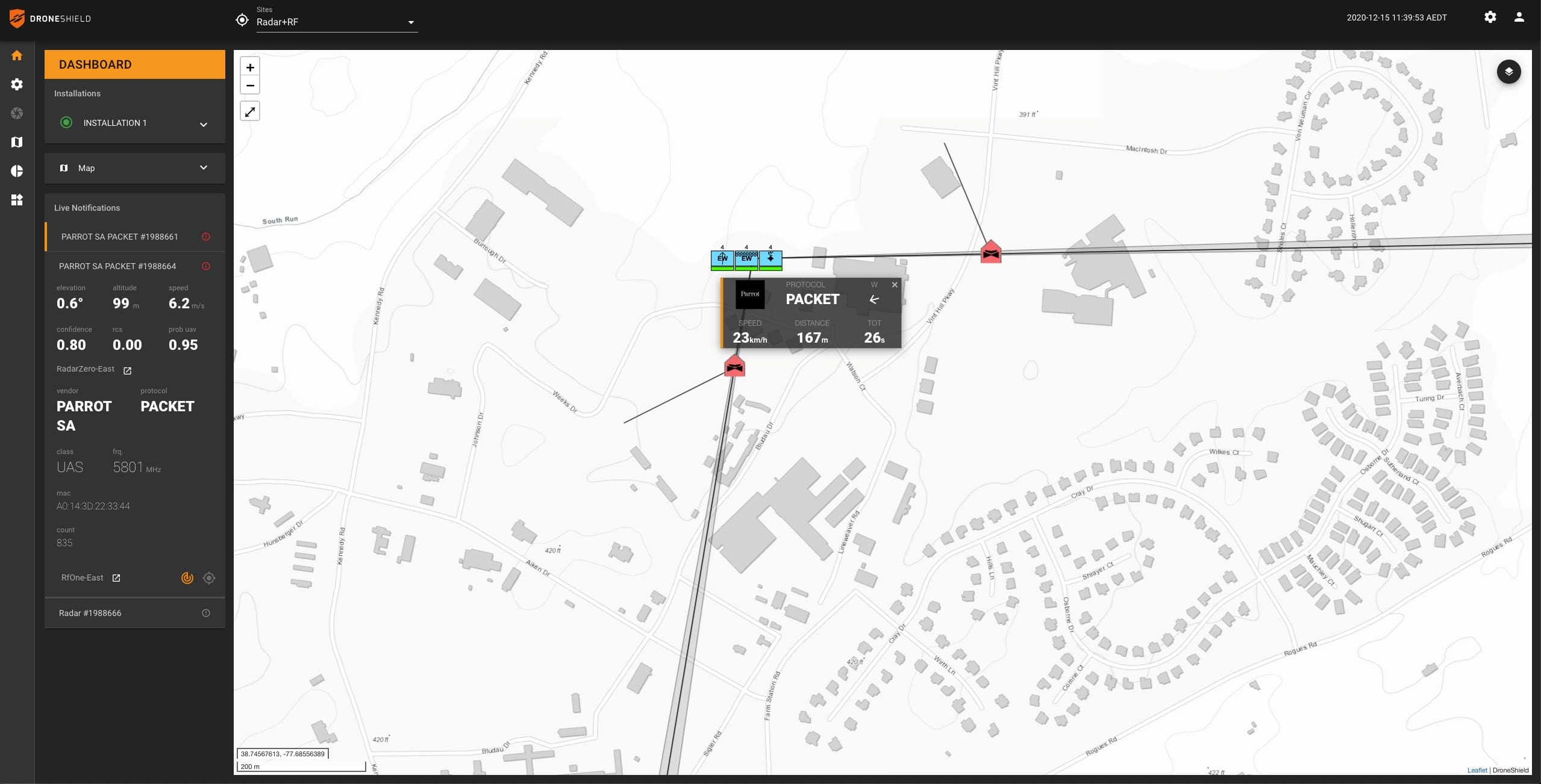
DroneShield Ltd (ASX:DRO) (“DroneShield”, or “Company”), is pleased to release a US DoD MIL-STD-2525 compliant version of its DroneSentry-C2TM command-and-control system, as part of its continued work with the US Department of Defense.

MIL-STD-2525 refers to a standard structured set of symbology for the display of information in command and control systems and applications, by use by the US Department of Defense, and non-DOD entities such as other Federal agencies and NATO partners. DroneSentry-C2 TM now provides users with industry leading enterprise features and MIL-STD-2525 compliance.

DroneSentry-C2 TM is a common operating picture for the Counter-UxS mission. DroneSentry-C2 TM enables its users to visualize their operational space, integrate with existing perimeter security and C2 systems, and leverage multi-sensor fusion capabilities unique to DroneSentry-C2TM. As a sensor agnostic, open architecture platform, DroneSentry-C2 TM brings advanced interoperability and flexibility to users.

Oleg Vornik, DroneShield’s CEO, commented, “DroneShield has continued to rapidly scale our US efforts. In support of that, we work closely with our customers and partners to incorporate real-world feedback into the continuous development of our solutions.  The specific shaping and standardizing of our offerings to meet the requirements of the US Department of Defense and MIL-STD-2525 is an important part of this work and a testament of our commitment to our customer and their mission.”

For enquiries, please contact info@droneshield.com.

DroneShield and Squarehead Partner in the C-UAS Space

Friday, December 11th, 2020

DroneShield Ltd’s (ASX:DRO or DRO.AU) (“DroneShield”), a pioneer and global leader in the C-UAS sector, and Squarehead, a Norwegian-based acoustic array technology company, have entered into a partnership in the C-UAS space.


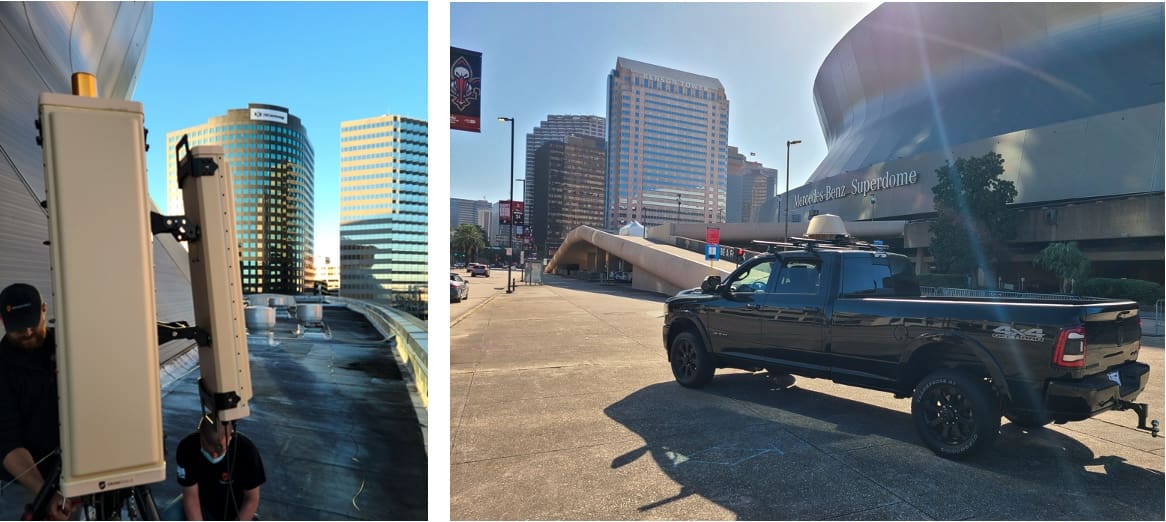
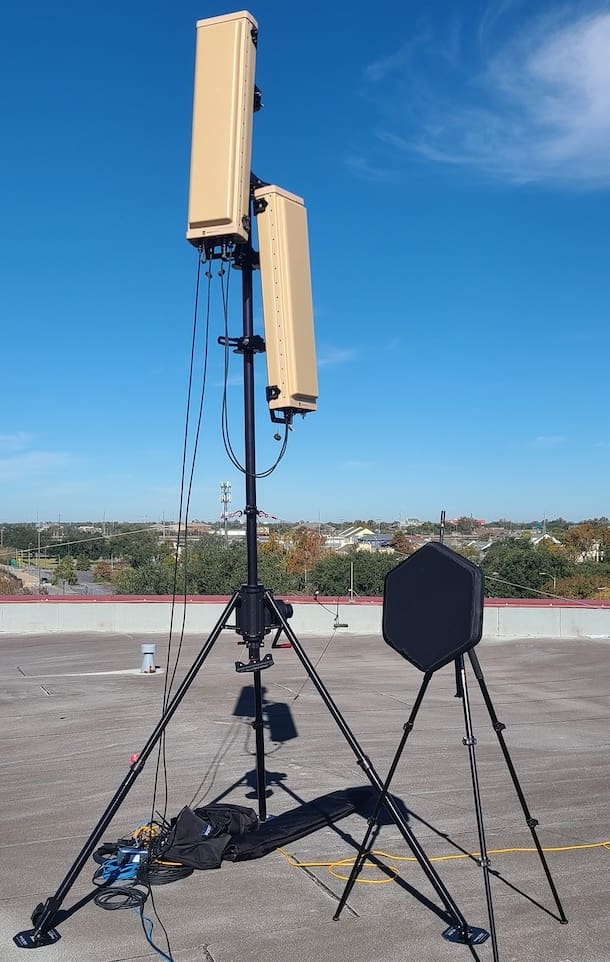
DroneShield’s DroneSentryTM multi-sensor C-UAS system with integrated Squarehead Discovair G2TM acoustic direction finding sensors

Going forward, DroneShield will be offering an integrated system for C-UAS detection and mitigation, with DroneShield’s radiofrequency, radar and camera-based UAS detection and electronic warfare UAS defeat products integrated with Squarehead’s Discovair G2TM direction-finding acoustic system, within DroneSentry-C2TM airspace awareness, command-and-control and reporting software. This product integration of the two companies’ offerings has been completed, and the combined solution is available to customers at present. The combined system is presently undergoing test evaluation schedule with the U.S. Department of Defense.

Squarehead CEO Stig Nyvold said: “We are pleased to enter into the partnership with DroneShield in the rapidly emerging C-UAS space. C-UAS security and airspace awareness is becoming an increasing problem for  wide range of military and civilian customers, and we expect our capability to detect any drone in the near field to provide a great added layer in DroneShield’s solution.”

Oleg Vornik, DroneShield’s CEO, added: “This partnership combines DroneShield best-in-class C-UAS sensors and effectors with Squarehead’s expertise in the acoustic domain. The combined system is already being evaluated by the US military, and we look forward to rolling this out globally, with an extensive schedule in front of us over next several months, including Europe and the US.”

Navy Announces Aerial Vehicle Operator Warrant Officer Specialty

Friday, December 11th, 2020

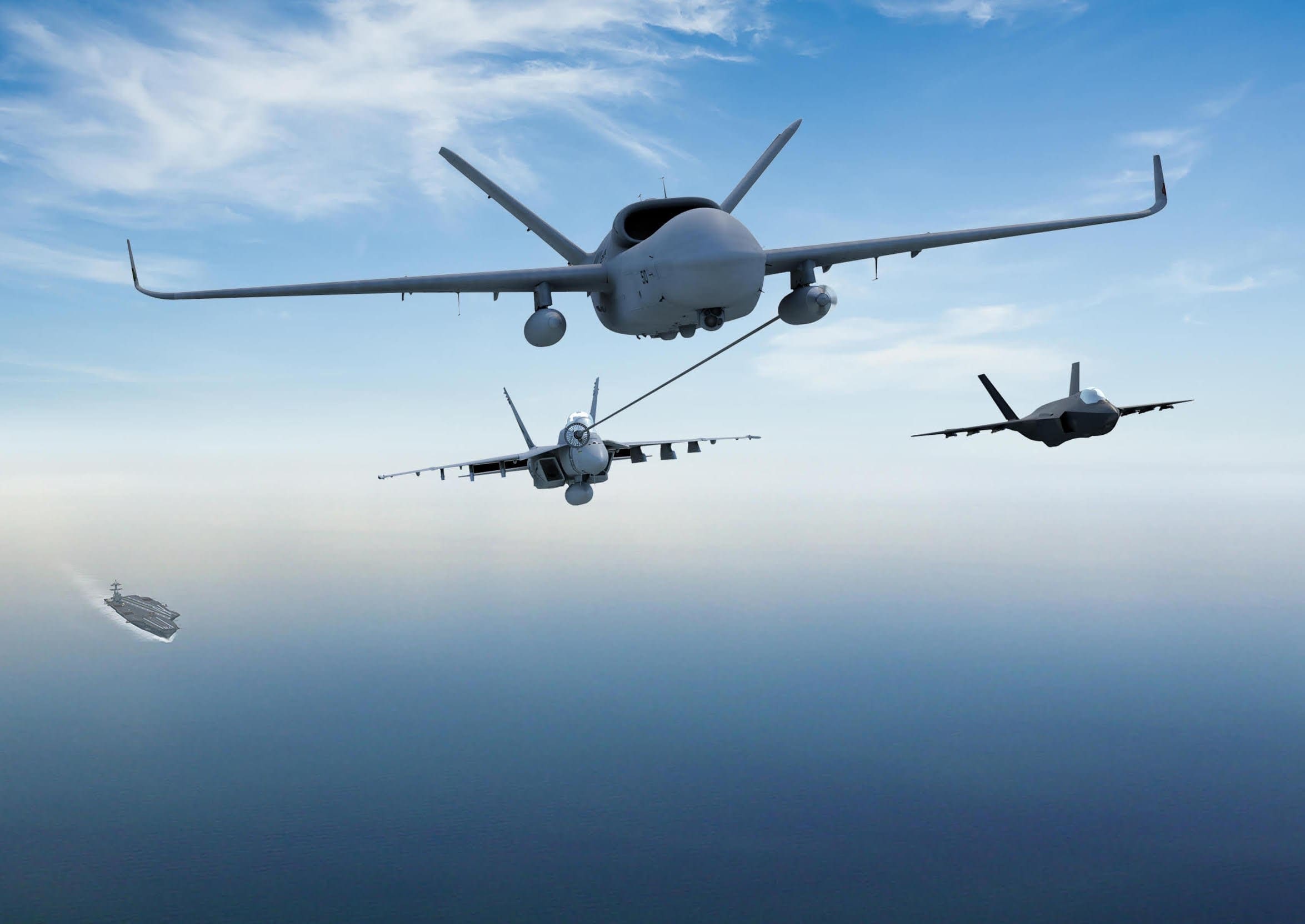
The Navy announced a new warrant officer specialty designator whose job will be to operate carrier-based MQ-25 Stingray unmanned aerial vehicles, which are expected to start appearing in fleet carrier air wings sometime in 2024.

The Navy announced a new warrant officer specialty designator whose job will be to operate carrier-based MQ-25 Stingray unmanned aerial vehicles, which are expected to start appearing in fleet carrier air wings sometime in 2024.

The establishment of the Aerial Vehicle Operator (AVO) warrant officer specialty became a reality Dec. 9 with Secretary of the Navy Kenneth J. Braithwaite’s approval of the new designator, which was announced in NAVADMIN 315/20.

Over the next 6-10 years, the Navy will recruit, train and send to the fleet, a community of roughly 450 warrants in grades W-1 through W-5.

Those selected for the program will first complete Officer Candidate School in Newport, R.I. Upon graduation, they will be designated as Warrant Officer One and must complete basic flight training as well as advanced training on the MQ-25 aerial vehicle. Once complete with basic flight training, these officers will earn their own distinctive Navy “wings of gold” warfare device and be assigned the 737X designator.

“AVO’s will start out operating the MQ-25 Stingray, the Navy’s first carrier based unmanned aerial vehicle, which is expected to join the fleet with an initial operating capability in 2024,” said Capt. Christopher Wood, aviation officer community manager at the Bureau of Naval Personnel in Millington, Tenn.  

The use of warrant officers as the primary operators of unmanned aerial vehicles came about because the expected career path they’ll have as they move up the ranks will be as technical specialists who complete repetitive tours, which fits the Navy’s model on how warrant grades are utilized.

“Unlike traditional Navy Chief Warrant Officer’s, the majority of these officers will be accessed much younger and trained along the lines of current Naval Aviators and Naval Flight Officers in the unrestricted designators,” Wood said.

“However, Naval Aviators and Naval Flight Officers require assignments that progress in tactical and leadership scope to be competitive for promotion, while warrant officer AVO’s will be technical specialists and spend their careers as operators.”

Navy Recruiting Command will begin accepting applications for initial AVO accessions in fiscal year 2022. In addition to street-to-fleet warrants, enlisted Sailors will also be able to apply for the program, and potentially earn the 737X warrant officer designator.

“Currently, the plan is to grow the community from the ground up with Warrant Officer AVOs,” Wood said.  “However, Naval Aviation will continue to evaluate the requirements of the program as it matures.”

Commanding and executive officers, as well as department heads of MQ-25 squadrons, will be filled by aviators and flight officers administratively screened for those commands.

“During the first 4-5 years of the program, some MQ-25 AVOs will come from other Type/Model/Series as we build up the knowledge base, with the first 3-4 deployments having a mix of existing unrestricted line and new warrants making up the ready room.”

And though right now the community will be focused on the MQ-25, in the future, warrant officer AVOs may also operate the MQ-4C Triton while on shore duty following their initial MQ-25 sea tour.  As the Navy’s footprint in unmanned aerial vehicles increases, so could the scope of the AVO community.  

AeroVironment Introduces Extended Range Antenna, Expanding UAS Command and Control up to 40 Kilometers in a Lightweight, Portable Form Factor

Thursday, December 10th, 2020

• Cost-effective optional antenna array kit designed to integrate seamlessly with AeroVironment’s standard RF head antenna  

• Provides operators 100 percent greater controllable range over standard RF head antenna with minimal logistical footprint

• Add-on kit narrows antenna beam width, extending command and control range up to 40 km


AeroVironment’s new Extended Range Antenna (Photo: AeroVironment)

SIMI VALLEY, Calif., Dec. 10, 2020 – AeroVironment, Inc. (NASDAQ: AVAV), a global leader in unmanned aircraft systems (UAS), today announced the introduction of its Extended Range Antenna (ERA), the latest addition to AeroVironment’s growing line of network connectivity solutions. The ERA is a lightweight, portable antenna array kit designed to integrate seamlessly with AeroVironment’s standard RF head antenna to support a diverse range of missions.

The ERA add-on kit narrows the antenna beam width, extending the command and control range up to 40 kilometers (24.9 miles) with minimal impact to its size, weight and power (SWAP) footprint. Similar to the standard RF head antenna, the ERA is manually positioned. The included RF Unit switch allows users to toggle between omnidirectional mode, for short-range operations, and extended range mode, for longer-range operations. The ERA supports both M1/2/5 and M3/4/6 Digital Data Link (DDL) operating bands.

By adding the ERA kit to their existing AeroVironment RF antenna, UAS flight operators can immediately expand their operational capabilities, gaining actionable battlefield intelligence at greater stand-off range to maximize their stealth and safety. When used in combination with other AeroVironment network connectivity options, the ERA provides an enhanced level of operational flexibility. This enables teams to coordinate command and control transfer of UAS, such as Puma LE, easily over greater distances, maximizing the aircraft’s multi-mission capabilities, in day or night operations, across dynamically changing environments.   

“AeroVironment continues to incorporate direct customer and user feedback into our product development investments to address increasingly complex and dynamic mission requirements,” said Rick Pedigo, AeroVironment vice president of sales and business development. “Not only do operators benefit from available options in terms of UAS capabilities, but they can also benefit from a selection of antenna options that are portable, easy to operate and provide extended range and multi-mission capabilities.”

Further expanding its connectivity solutions, AeroVironment recently announced updates to its Long Range Tracking Antenna (LRTA), which it now offers in two versions to support M1/2/5 and M3/4/6 DDL frequency bands. AeroVironment’s network connectivity product line includes the pocketable, short-range pDDL (5 km), standard RF antenna (20 km), ERA (40 km) and LRTA (60 km) capabilities in both M1/2/5 and M3/4/6 bands.

For more information on AeroVironment’s network connectivity solutions, visit www.avinc.com/tuas/network-connectivity.

DroneShield Releases Next Edition of C-UAS Factbook

Thursday, December 3rd, 2020

DroneShield’s C-UAS Factbook is now in its 5th edition, providing an overview of available C-UAS technologies, and merits of each approach.

The C-UAS Factbook can be downloaded here.

Drone Pilot Academy Ready for Action as Drone Surveying Distributor for Microdrones

Monday, November 23rd, 2020

Rome, NY –Drone Pilot Academy, based in the United Kingdom, a Civil Aviation Authority (CAA) accredited training provider since 2015 and commercial drone retailer since 2017, has partnered with Microdrones as an authorized distributor of drone surveying equipment throughout the United Kingdom and Ireland.

As a Microdrones distributor, Drone Pilot Academy will offer Microdrones Integrated Systems that come with everything a commercial user needs to get started using drones for surveying and mapping – the UAV, the sensors, and the software and hardware. In addition, the Microdrones as a Service (mdaaS) sales model will allow Drone Pilot Academy to broaden the drone surveying market with convenient hardware and software packages at affordable monthly payment and rental options.

Drone Pilot Academy Managing Director, James Ixer, first took notice of Microdrones during a CAA training course for one of their customers. “We experienced the seamless Microdrones workflow, from the ease of mission planning with mdCockpit to reliable flight performance, and the end results of possessing and visualizing the data,” said Ixer. “At the end of the day, the data, combined with the mdaaS sales model, is what really sold us. Previously, drone LiDAR solutions were prohibitively expensive for most mainstream operators due to the large capital outlay required. We were drawn to Microdrones when we saw the mdaaS Rent-It option that allows customers to maximize their cash flow with manageable monthly payment options.

As their name implies, Drone Pilot Academy offers a variety of pilot, surveying, and mapping training courses to help their customers make the most of their drone surveying equipment. Ben Evans, the Business Development Manager, is ready to conduct demonstrations and show customers how easy it can be to get started with drone surveying. “Having a training academy,” Evans said, “means not only can we supply the drone but we can get them the appropriate qualifications and exemptions to integrate and operate the microdrones fleet into their business model. We’re ready, willing and able to conduct demos throughout the UK at a location of convenience for prospective clients.”


David Pendrill, the Microdrones regional sales manager for Northern Europe, looks forward to the new partnership with Drone Pilot Academy. “These guys are going to be able to offer the best of both worlds,” Pendrill explains. “With their vast experience training drone pilots combined with the ability to offer advanced drone surveying equipment from Microdrones they’ll be able to demonstrate to customers how easy it is to adopt the Microdrones workflow and create new business opportunities.”


The Drone Pilot Academy Limited (DPA) is a commercial drone retailer and a CAA authorized training provider for those who wish to use drones for both commercial or recreational use. They provide courses in PfCO CAA Drone training, surveying, thermal detection, safety, video editing, a drone cinematic masterclass and customized training courses.

Their instructors have an extremely credible background and are all ex-military aviators with a wealth of experience in training and instruction to help guide customers through the commercial course or the practical flight training.

For more information about Drone Pilot Academy visit www.dronepilotacademy.co.uk

Elistair Unveils Long-Endurance Orion 2 Tethered Drone for Military, Security, and Industrial Use

Friday, November 6th, 2020

LYON, France — Elistair, a leader in tethered drone solutions, announced today the development of its new Orion 2 tethered unmanned system for military, government, and industry users. Unlike other multi-rotor drones, the Orion 2 hexacopter delivers round-the-clock surveillance for up to 24 hours at a time, making it a true persistent surveillance platform.

“For example, we made it IP54; we optimized the lifespan of the components, including the motors; and we added a safety battery that could recharge in the air.”

“Small, unmanned multi-rotor systems are great if you want a hover-and-stare capability, but they’re also notoriously short on battery life,” said Timothée Penet, CTO and co-founder of Elistair. “Powered tethering stations, like our Safe 2 and Ligh-T 4, offer a solution by increasing a platform’s time in the air—and that’s great for many missions. But what if you need to be on station for a whole day?”

That is where Elistair’s own Orion 2 comes into the picture.

A lightweight yet extremely durable hexacopter, the Orion 2 is designed as a quick-deploy system (automated push-button takeoff and landing) that can stay in the air for 24 hours—something that, previously, could only be done by a helium-filled tactical aerostat, which was a much larger platform and came with a very complicated logistical train.

“We developed redundancies at every level to ensure that the Orion 2 could stay up that long,” said Pierre-Moana Levesque, R&D Director at Elistair. “For example, we made it IP54; we optimized the lifespan of the components, including the motors; and we added a safety battery that could recharge in the air.”

The new Orion 2 is an improvement over the original Orion drone, which has already proven itself with international customers. The Orion helped secure the Ryder Cup in September 2018, flying over crowds of 300,000 attendees for 8 to 11 hours a day, and has been employed by the French police, British military, and Singaporean government.

With its micro-tether of 330 feet (100 meters), the Orion 2 flies higher than its predecessor and surveils more ground. It can also carry up to 2kg (4.5 pounds) of payload, so it can serve simultaneously as an ISR and telecom platform. The Orion 2 can also stream georeferenced electro-optical and infrared imagery at the same time, and it can deploy 4G/5G communications nodes thanks to a new fiber optics cable option.

“The Orion 2 tethered drone is a clear advance over the very capable Orion in terms of persistence, logistical footprint, and data control. We are thrilled by this product launch,” said Guilhem de Marliave, CEO and co-founder of Elistair.

Brigantes Presents – One Bravo Quadcopter Drones

Wednesday, October 21st, 2020

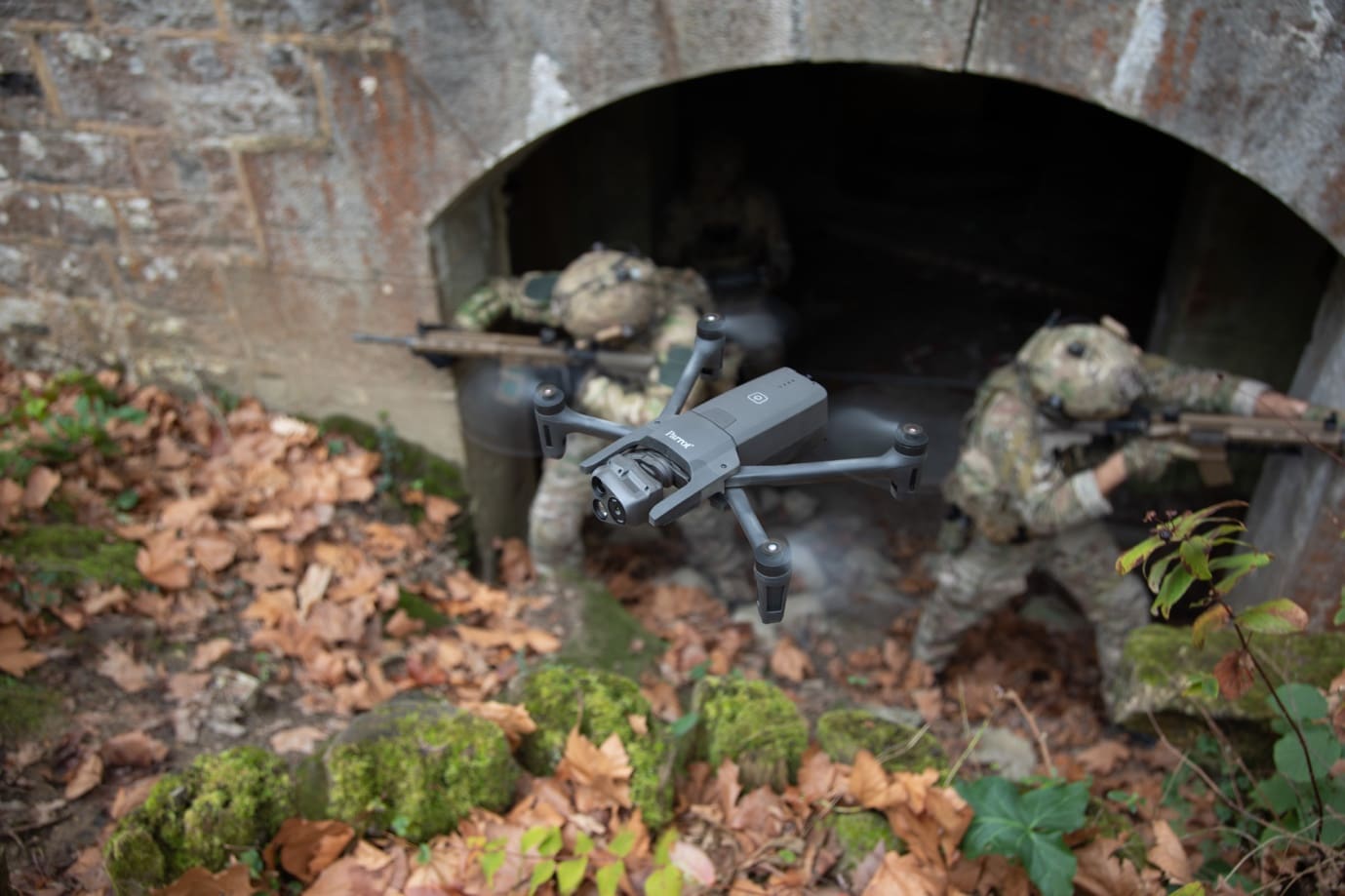
Parrot have long been the European leader in professional consumer drones and the features of these drones are able to translate very successfully within a military environment.

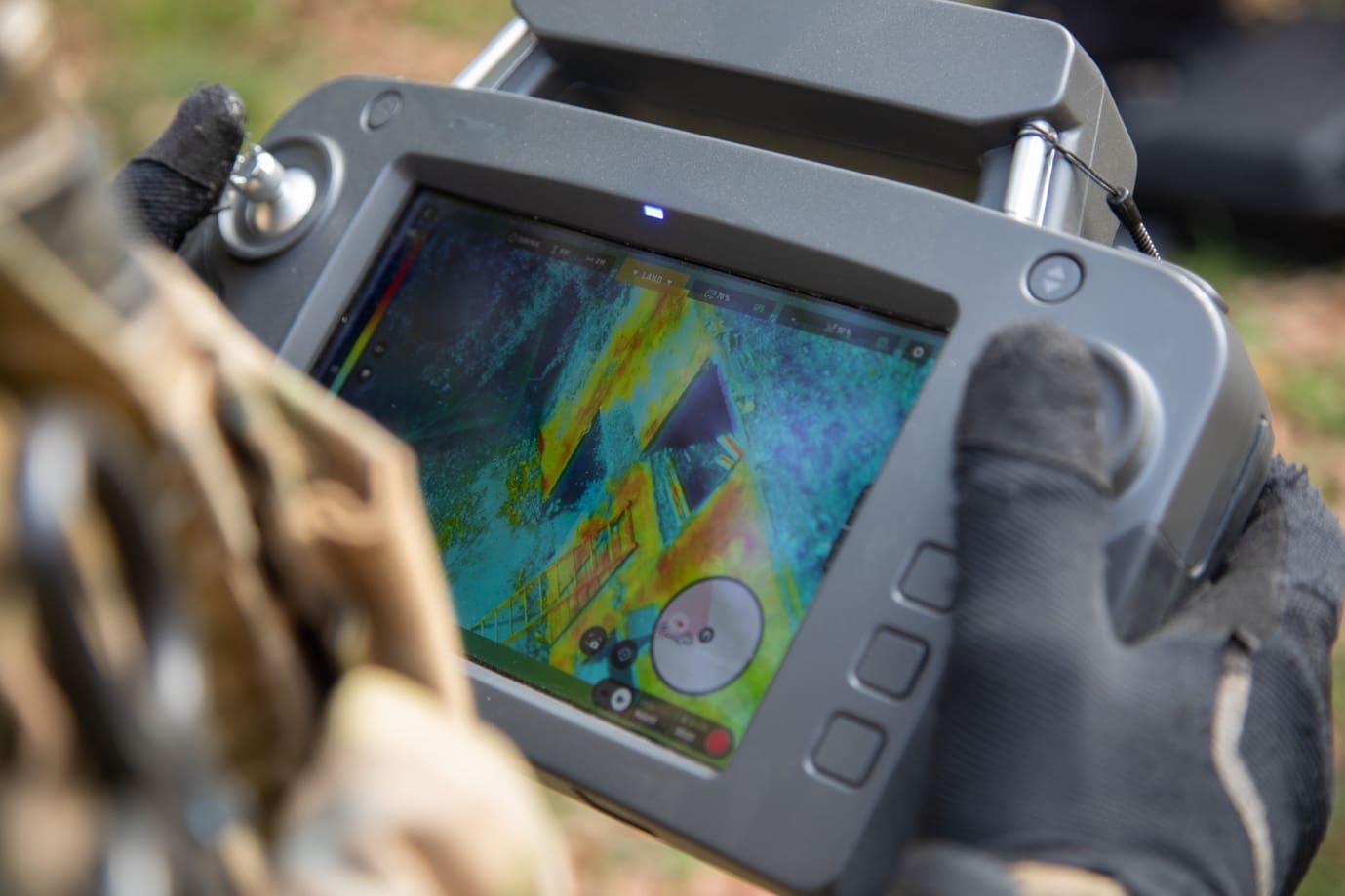
The ANAFI Thermal SE is a French, discreet, micro drone equipped with EO/IR cameras for Scouting & Intelligence, Combat Support & Mobility Support. Ultra compact and lightweight, with 11x zoom, it delivers real-time video and high resolution shooting capabilities from up to 4km away. With 26 minutes of flight time, ANAFI Thermal SE flies at an altitude ensuring total discretion beyond enemy lines and contributes to the conduct of close operations. Close operation requires speed and mobility. Thanks to the small form factor and its compact design, ANAFI Thermal SE can be easily integrated in the soldier’s tactical equipment pack. The camera module provides high quality and precise thermal imaging for urban environment detection and identification of threats and its secure wireless link (AES) transmits images and commands in real time with no data being disseminated.

The Anafi USA was originally designed for the US Army and is manufactured in Massachusetts. It is considered a big jump up in capability from the Thermal. The USA has similar features to the Thermal SE with additional features. It is IP rated to IP53, so it is ideal for poorer weather conditions and desert environments. It has a much larger thermal sensor, so the quality is increased, and it has a stabilised 32x zoom, which is a feature usually reserved for much larger, expensive drones in this industry.  

Brigantes have worked with Parrot to provide advise and feedback to make these drones even more suitable to the end user. The additional changes, such as allowing the software to recognise grid referencing in MGRS and measuring angles in mls, make data mapping and surveillance in many deployments much easier to accomplish.

These drones are powerful, lightweight and can pack away easily in a Burgan whilst on exercise or deployments.

For more information:

UK – tribe@brigantes.com

International – international@brigantes.com

For visit our website Brigantes.com to set up an account. Procurement accounts are available.